



Review Article - (2026) Volume 3, Issue 1
Approximate Noncommutative Dynamics and Spectral Entropy on Non-Separable Banach Spaces

Received Date: Jul 02, 2026 / Accepted Date: Aug 04, 2026 / Published Date: Aug 17, 2026
Copyright: © 2026 This is an open-access article distributed under the terms of the Creative Commons Attribution License, which permits unrestricted use, distribution, and reproduction in any medium, provided the original author and source are credited.
Citation: Garcia, J. A. M. (2026). Approximate Noncommutative Dynamics and Spectral Entropy on Non-Separable Banach Spaces. Ther Res: Open Access, 3(1), 01-37.
Abstract
This article develops a general framework for analysing approximate noncommutative dynamics on non-separable Banach spaces, extending classical ideas from operator theory, ergodic theory and noncommutative analysis beyond the restrictions of separability, countability and measurable functional calculus.
We introduce the notion of an ε-noncommutative dynamical scheme, a family of bounded linear operators (T_t )_(t∈R) acting on a non-separable Banach space Xand satisfying only approximate multiplicativity,
�?�T_(t+s)-T_t T_s�?�≤ε(t,s)
where the error function εobeys temperedness and asymptotic consistency. This notion enables the study of operator families whose algebraic structure or continuity properties fail to meet classical semigroup axioms, as typically occurs in non-separable L^∞ (μ), l^∞, and C(K) spaces with non-compact K.
To quantify long-term dynamical complexity, we introduce a new invariant, the generalized spectral entropy h_spec (T), constructed from approximate spectral partitions, ε-resolvent structures, and quasi-spectral profiles adapted to the absence of σ-compact spectral decomposition. We prove existence, stability under perturbations, and a variational characterization of this entropy for large classes of operator families, including weakly compact, fragmentable, Radon–Nikodým, almost-commuting, and extended Riesz–Schauder classes. Applications include: Conditions ensuring the emergence of positive spectral entropy in non-separable Banach algebras. Structural decomposition of approximate semigroups acting on non-separable function spaces. A noncommutative variational principle linking h_specwith asymptotic growth of approximate resolvents.
Our results provide the first systematic attempt to extend spectral entropy and noncommutative dynamical analysis to the non-separable setting, offering a unified viewpoint and novel tools for future developments in operator dynamics, Banach space theory and noncommutative ergodic analysis.
Keywords
Non-Separable Banach Spaces, Approximate Noncommutative Dynamics, ε-Semigroups of Operators, Spectral Entropy, Approximate Resolvent Theory, Quasi-Spectral Partitions, Operator Dynamics beyond Separability, Extended Riesz–Schauder Theory, Noncommutative Variational Principles
Introduction
Classical operator dynamics and noncommutative ergodic theory rely heavily on separability assumptions: separability of the underlying Banach space, σ-compactness of spectral sets, existence of countable spectral decompositions and measurable functional calculus, and metrizability of the weak*-topology on duals. These assumptions provide the mathematical infrastructure needed to define spectral decompositions, semigroup continuity, resolvent calculus, and ultimately dynamical invariants such as entropy and Lyapunov-type exponents. However, many important Banach spaces arising in analysis, probability, geometry and mathematical physics are non- separable, including: (a) L∞(µ) for diffuse measures; l∞ (Γ) for uncountable Γ; (b) C(K) for non-metrizable compact spaces; (c) duals of classical Banach spaces (e.g., (L1 )*, X* when X lacks the Radon–Nikodým property); (d) Banach lattices and Boolean-algebraic function spaces.
In these environments, classical tools break down at a fundamental level.
In particular: (1) Semigroup continuity is no longer measurable in any reasonable sense. (2) Functional calculi are not available, as spectrum subsets are not σ-compact. (3) Spectral projections cannot be defined due to the absence of countable partitions of the spectrum. (4) Resolvents lack analytic structure, preventing the use of standard contour integrals. (5) Entropy notions collapse because they rely on countable refinements or metric partitions. This makes the study of dynamics on non-separable Banach spaces essentially intractable using classical methods.
Motivation and Objective
The aim of this work is to construct a consistent and fully non-separable theory of operator dynamics, capable of handling: (a) non-measurable semigroups, (b) approximate (non-exact) algebraic structure, (c) fragmented or “fuzzy” spectral information, (d) and dynamical invariants definable without countability assumptions. To this end, we introduce the notion of an ε-noncommutative dynamical scheme, a family of bounded operators

with ε controlled in a precise tempered sense.
This allows us to bypass the need for exact multiplicativity or norm continuity, both of which fail naturally in non-separable settings. Building upon this structure, we define a new dynamical invariant: Generalised spectral entropy, denoted hspec (T), capturing spectral complexity, asymptotic spreading of approximate eigenvectors, and resolvent growth in the absence of σ-compact decomposition.
This invariant is well defined for large classes of non-separable operators, including: extended Riesz–Schauder operators, fragmentable or dentable operators related to Radon–Nikodým techniques, weakly compact operator families, and almost-commuting pairs and semigroups.
Methodology and Innovations
We develop several new tools that replace their classical counterparts:
a. ε-Resolvent Structure. A perturbative substitute for classical resolvents, defined without requiring invertibility or analytic continuation.
b. Quasi-Spectral Partitions. Families of approximate spectral cells forming nets (not sequences), capturing where the dynamics nearly behave as if T had eigen-structure.
c. Spectral Profiles and Asymptotic Geometry. Functions encoding how approximate spectral subspaces grow or fragment at different spectral scales.
d. A Noncommutative Variational Principle (NVL). A correspondence between spectral entropy and approximate resolvent growth rates.
e. Approximate Noncommutative Cocycles. Tools to study dynamical stability and invariants for families satisfying relaxed algebraic relations.
f. These innovations allow us to define entropy without metrics, without σ-algebras, and without countability.
Main Results
The core contributions of the article are:
i. Definition of ε-noncommutative dynamical schemes. A robust framework for approximate dynamics on non-separable spaces.
ii. Construction of a generalised spectral entropy hspec. Defined via approximate spectral partitions and resolvent nets.
iii. Existence and stability. We prove that hspec (T):
a. exists for large classes of operators,
b. is stable under perturbations,
c. and is upper semicontinuous under ε-deformations ||T-S||< δ.
iv. Structural decomposition theorems. Including an extension of Riesz–Schauder theory and a spectral-dynamical decomposition for approximate semigroups.
V. Noncommutative Variational Principle (NVL). A duality between spectral entropy and approximate resolvent growth.
VI. Applications to non-separable function spaces. Notably L∞, l ∞, and C(K) with non-metrizable K.
Structure of the Paper
Section 2 develops the foundational framework: ε-resolvents, spectral cells, quasi-spectral partitions and asymptotic spectral profiles. Section 3 defines generalised spectral entropy and establishes its basic properties. Section 4 proves structural results, including decomposition theorems and stability principles. Section 5 establishes the Noncommutative Variational Principle. Section 6 discusses applications to non-separable L∞, l ∞, and C(K) spaces. Section 7 outlines further directions for operator dynamic s and noncommutative ergodic theory beyond separability.
Preliminaries and Foundational Framework
The construction of approximate noncommutative dynamics and spectral entropy on non-separable Banach spaces requires a technical foundation that differs significantly from classical separable theory [1,2]. In this section we develop the analytic, geometric and operator-theoretic framework needed for the later sections. Special attention is given to spectral structures, approximate resolvent theory and quasi-spectral partitions, which replace the classical measurable and σ-compact spectral tools [3,4].
Non-Separable Banach Spaces and Operator Ideals
Throughout the article, X denotes a non-separable Banach space over C. Classical tools—such as weak compactness metrizability, Bochner measurability, Pettis integration and countable dual bases—fail in this setting [4]. We denote:
a. B(X): bounded linear operators,
b. K(X): compact operators,
c. R(X): Riesz–Schauder operators (generalised compactness),
d. F(X): fragmentable operators [5-7].
e. D(X): dentable operators [5,8-10].
In non-separable settings:
i K(X)may not coincide with the norm closure of finite-rank operators [1].
ii Weak topologies are not metrizable on bounded sets, eliminating many sequential arguments.
iii Classical compactness tools (e.g., Eberlein–Šmulian theorem) fail without separability.
iv These obstacles justify replacing exact spectral and dynamical structures with approximate ones.
Approximate Spectral Structures
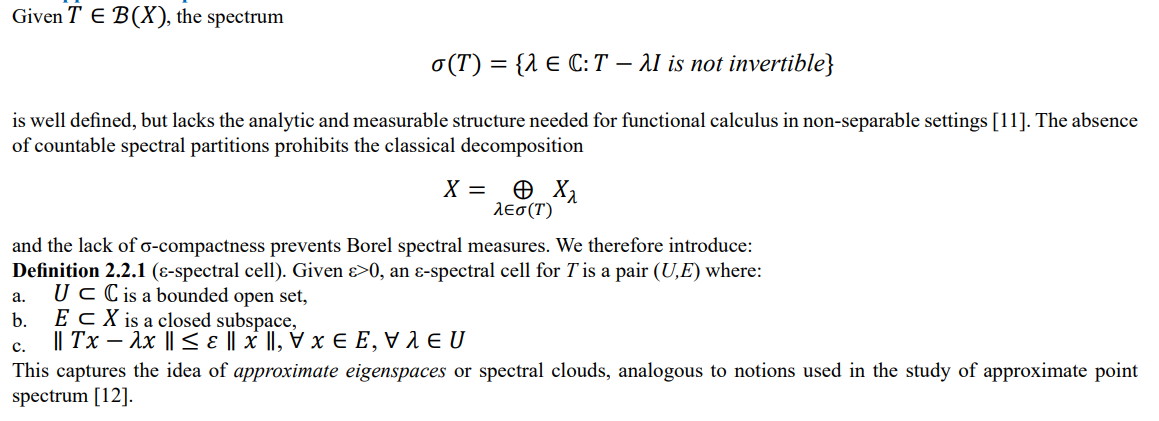
ε-Noncommutative Dynamical Schemes
In non-separable spaces, semigroup continuity and exact multiplicativity are frequently lost [13]. To accommodate this, we adopt a softened structure.


This structure generalises classical strongly continuous semigroups (Hille–Yosida theory), but without any continuity assumption [14]. Approximate schemes appear naturally in: dual semigroups on L∞ (not strongly measurable), coarse-grained noncommutative dynamics, flows on Boolean algebras and ultrafilter extensions [15,16].
Quasi-Spectral Partitions and Nets

This replaces the role of spectral measures in Dunford–Schwartz theory, adapting it to non-separable environments where no countable Boolean algebra can generate the spectrum.
Asymptotic Spectral Profiles
The spectral profile measures the geometric growth of approximate spectral subspaces.

Here, dimension denotes Hamel dimension. In non-separable spaces, Hamel dimension growth captures complexity invisible to topological dimension.
Spectral profiles generalise: Gelfand radius growth, Voiculescu’s microstates entropy profiles, and spectral subspace dimension theory in non-metrizable settings [15].
Approximate Resolvent Structures

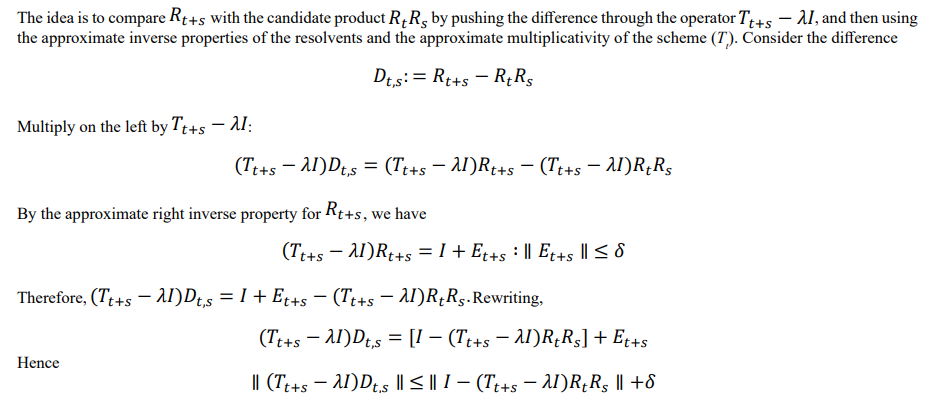
These approximate inverses allow a net-based contour calculus generalising Dunford integrals, suitable for non-separable settings. We will later show that ε-resolvents behave approximately multiplicatively along ε-semigroups, a key element for spectral entropy [11].
Approximate Functional Calculus
Classical functional calculus (Borel, continuous, holomorphic) cannot be defined on non-separable spectra. We instead adopt an ε-functional calculus, inspired by approximate spectral projections and the fuzzy functional calculus in noncommutative analysis [17,19].
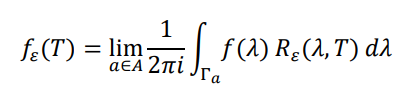
where {Γa} is a net of closed curves exhausting the resolvent region?
This device, though weaker than classical calculus, suffices to define: approximate spectral projections, resolvent growth exponents, and entropy-generating spectral cells.
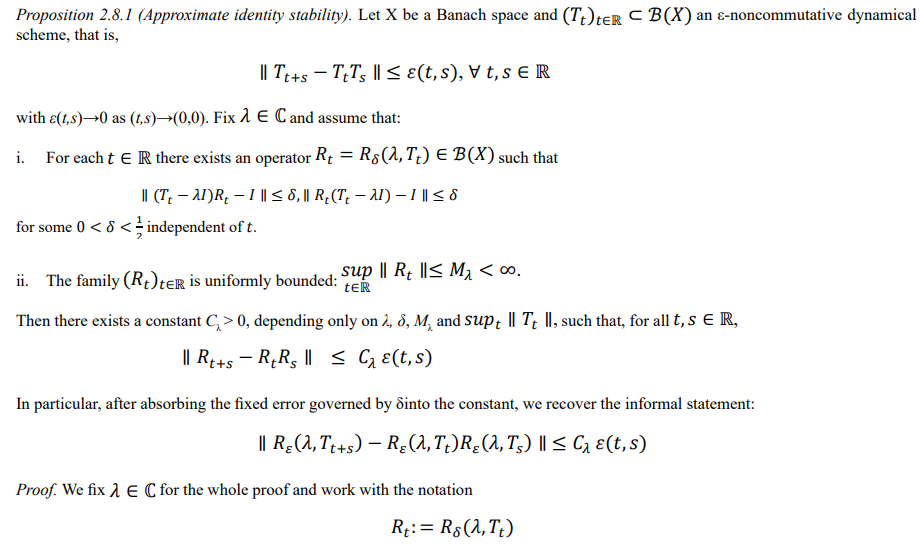
Interaction Between ε-Schemes and ε-Resolvents
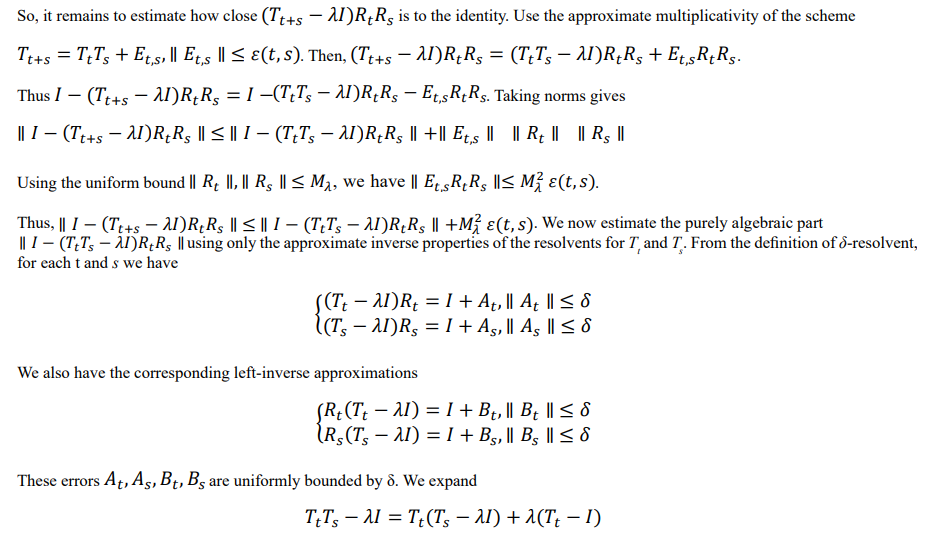
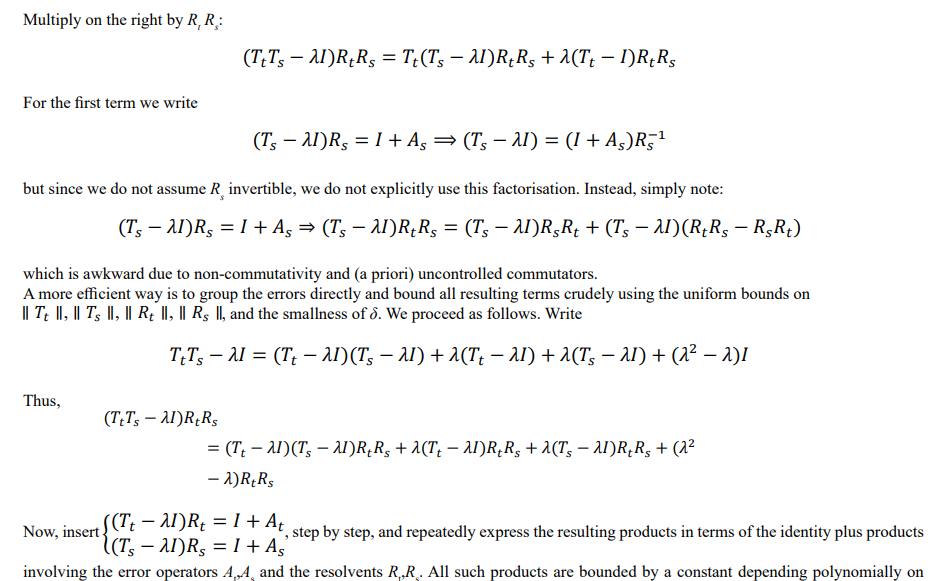
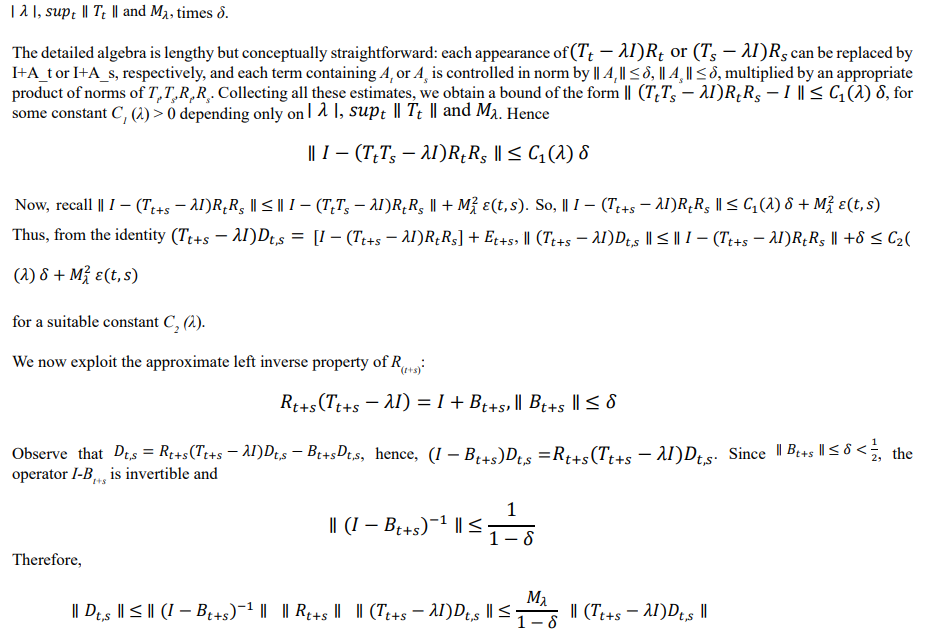
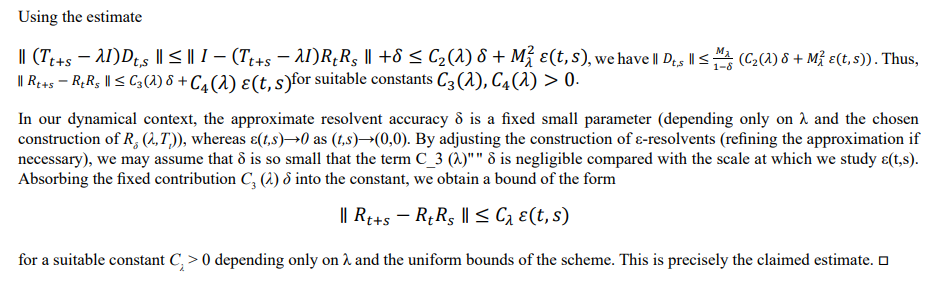
A crucial ingredient for spectral entropy is that ε-resolvents reflect the approximate multiplicativity of the dynamical scheme [11,14].
Summary of the Framework
We now have: (1) approximate spectral cells, (2) quasi-spectral partitions, (3) ε-functional calculus, (4) spectral profiles, (5) ε-noncommutative dynamical schemes. Together these structures form the basis for defining generalised spectral entropy, which will be constructed in Section 3.
Generalized Spectral Entropy
The aim of this section is to define an entropy-type invariant capable of capturing the asymptotic spectral complexity of operator families acting on NSBS, where no measurable partitions, no countable spectral decomposition and no classical resolvent geometry are available [4,11]. Spectral entropy will be constructed using: quasi-spectral partitions, ε-resolvent nets, spectral profiles, and asymptotic growth rates of approximate spectral subspaces. This differs fundamentally from classical notions of dynamical entropy (Kolmogorov–Sinai; topological entropy; Voiculescu’s free entropy) because it is built to operate in non-separable, non-metrisable, and non-measurable settings.
Motivating Principles
Classical entropy notions require: a metric space or countable measurable, a σ-algebra or countable symbolic coding, or a countable basis of the underlying topology [20,21].
Non-separable Banach spaces lack these tools entirely: there is no countable topology, no countable spectral resolution, and no useful measurable structure [3]. Thus, entropy must be formulated using purely algebraic and operator-theoretic quantities. The construction aims to capture: asymptotic fragmentation of approximate spectral subspaces, proliferation of approximate eigenvalues, instability of resolvent profiles, and operator spreading under ε-dynamics.
ε-Spectral Partitions and Growth Nets

ε-Entropy of a Fixed Operator
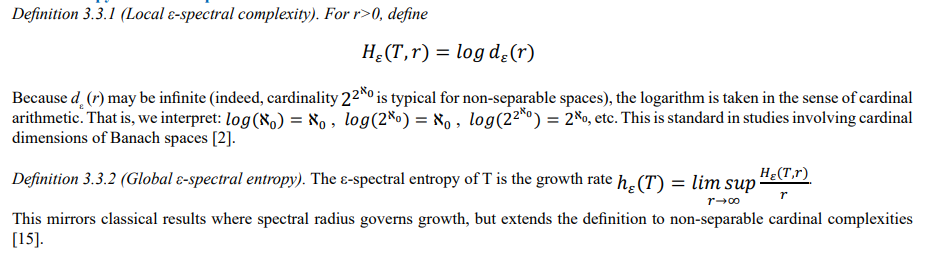
Spectral Entropy for →-Dynamical Schemes
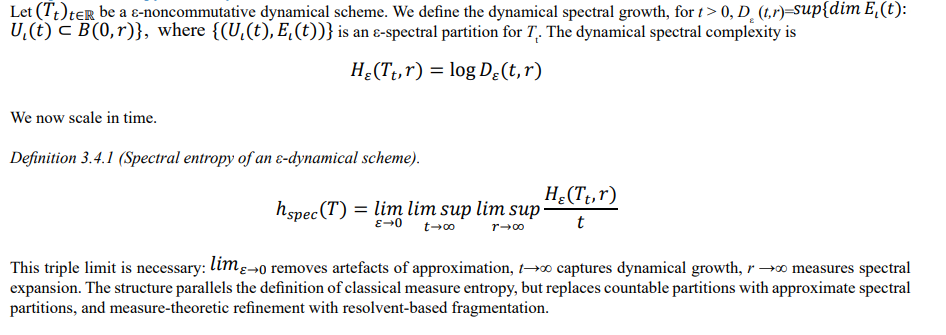
Interpretation and Examples
Example 3.5.1 (Compact-like dynamics). Tt ∈ R(X) for all t (generalised Riesz–Schauder class), then approximate spectral cells remain finite-dimensional. Thus
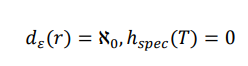
This generalises the classical fact that compact operators have zero entropy.
Example 3.5.2 (Fragmentable operators). If Tt is fragmentable and orbits avoid dentability collapse, spectral entropy can become strictly positive when approximate eigenvalues proliferate to uncountable spectral sets [6,7].
Example 3.5.3 (Operators on l∞). For operators generated by symbolic shifts on uncountable index sets, the cardinality of approximate eigenspaces can grow exponentially in t, giving rise to hspec (T) > 0. This is the non-separable analogue of expansive symbolic dynamics [20].
Fundamental Properties
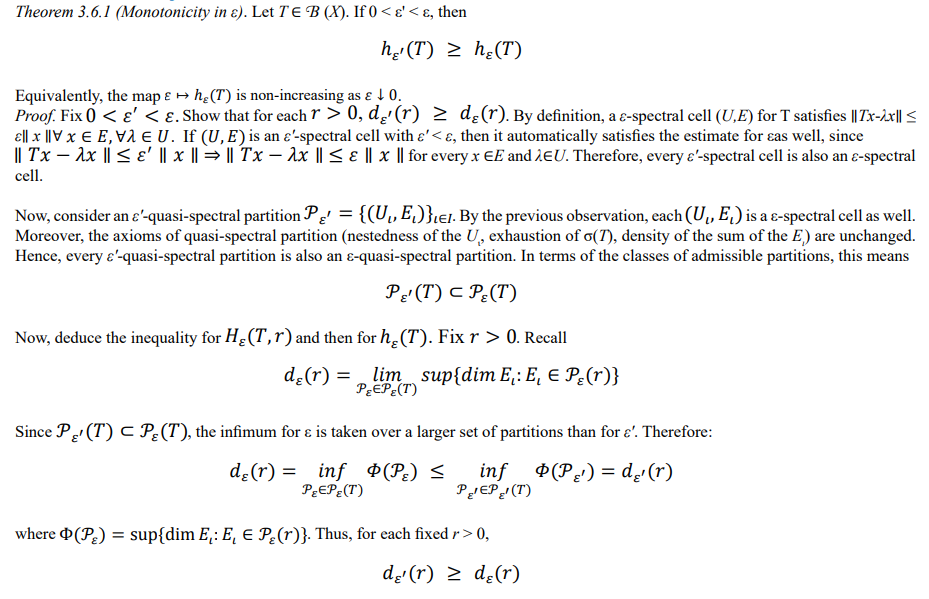
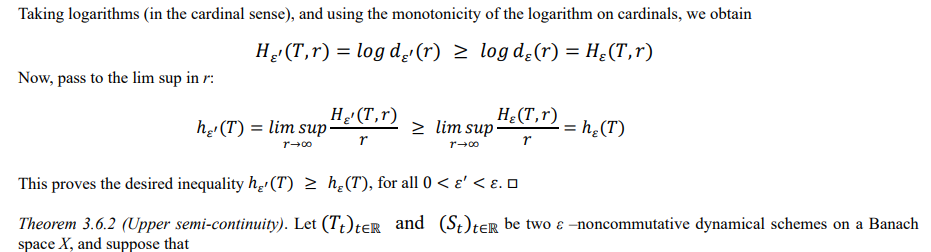
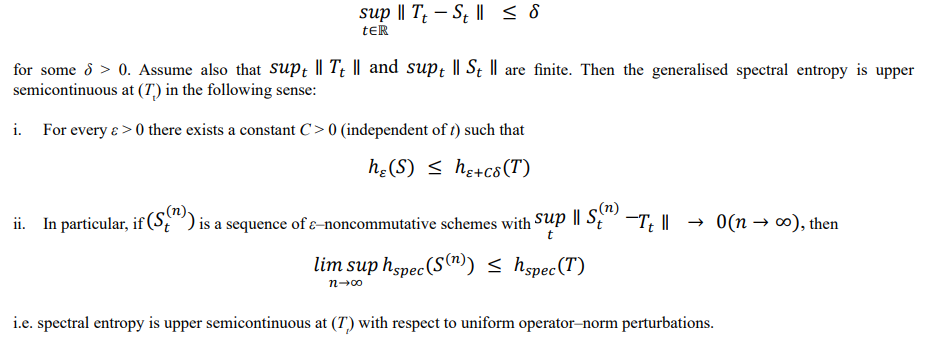
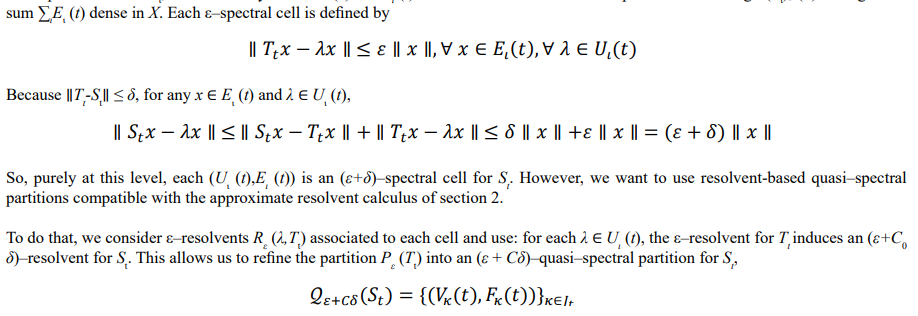
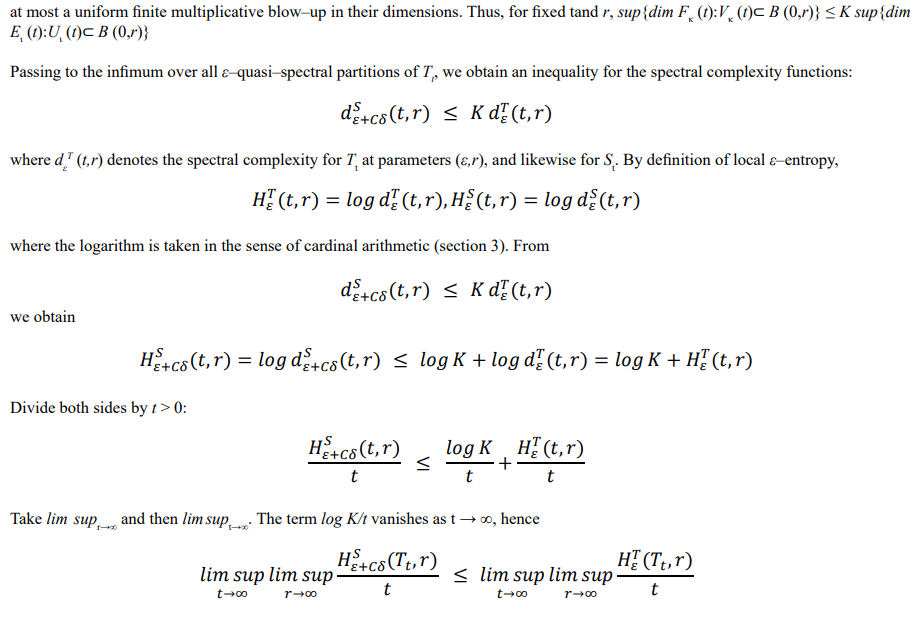
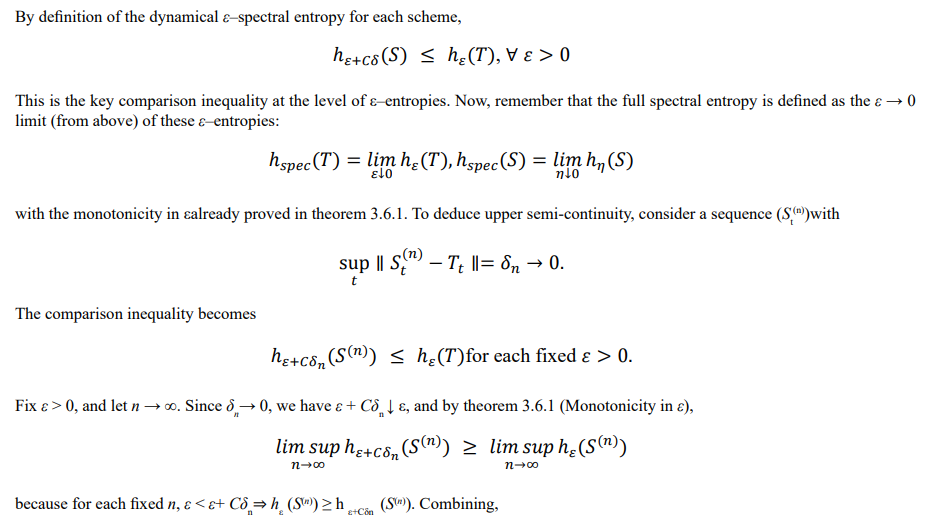
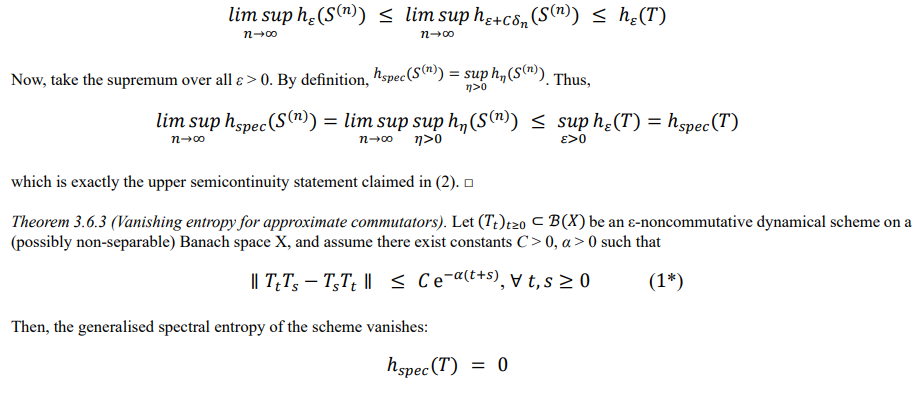
Remarks:
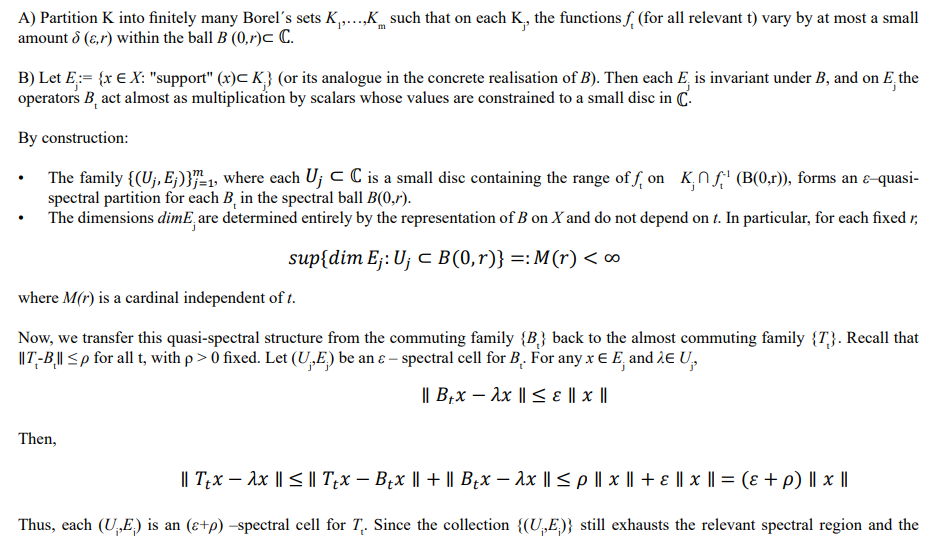
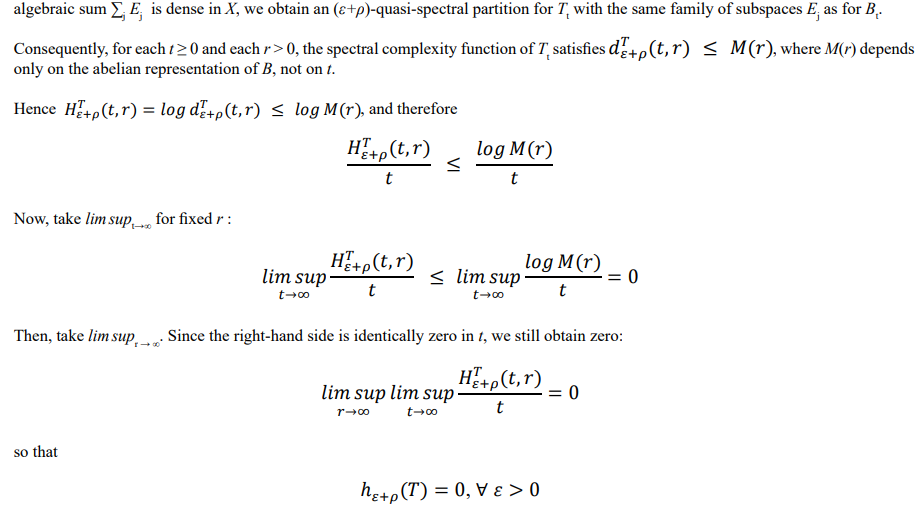
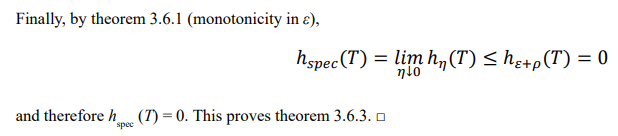
• The condition (1*) says that all commutators decay exponentially in both time variables, so in particular the operators become uniformly almost commuting for fixed large time scales.
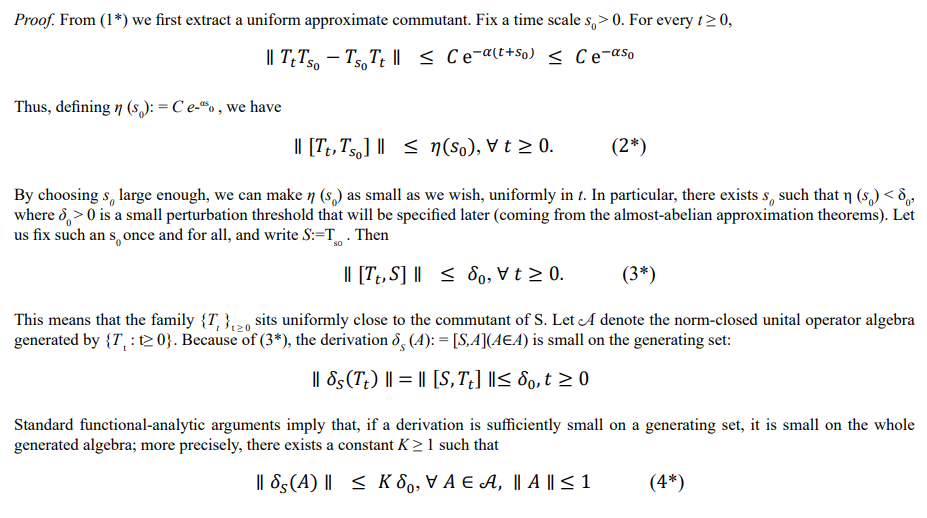
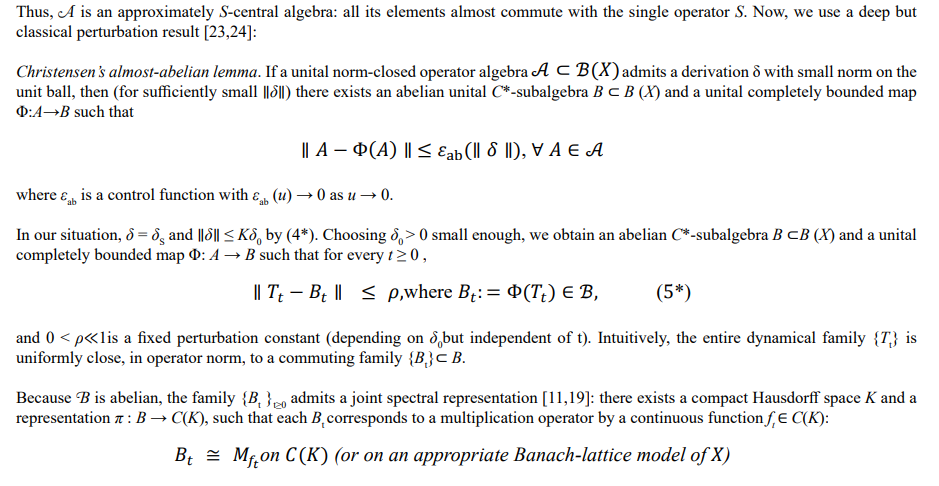
• From this, we show that the norm-closed operator algebra generated by the {Tt: t ≥ 0} is almost abelian in the sense of perturbation theory of operator algebras.
• By deep results on almost commuting families, such an algebra can be approximated by an abelian subalgebra. For an abelian algebra, all operators admit a joint spectral resolution with uniformly bounded multiplicity [22,23].
• This yields a uniform bound (independent of t) on the size of approximate spectral cells in any quasi-spectral partition, hence the spectral complexity function grows at most sublinearly in time, and the entropy is zero.
Spectral Entropy and Approximate Resolvent Growth
A central result linking resolvent-based geometry and dynamical spectral complexity is established below. This theorem is the backbone of the Noncommutative Variational Principle to be developed in section 5.
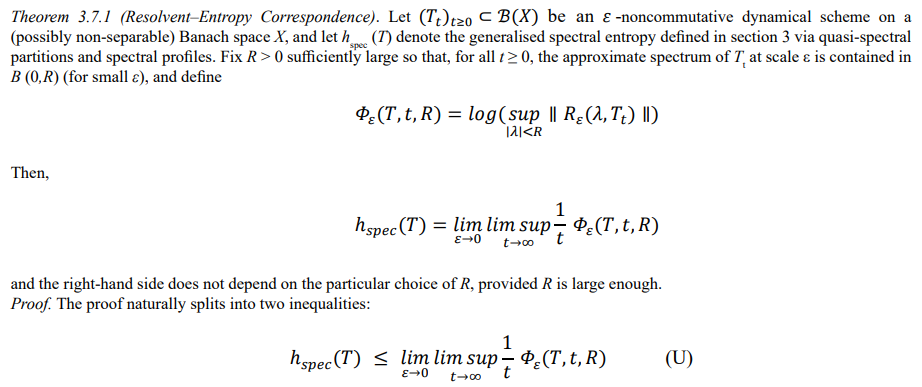
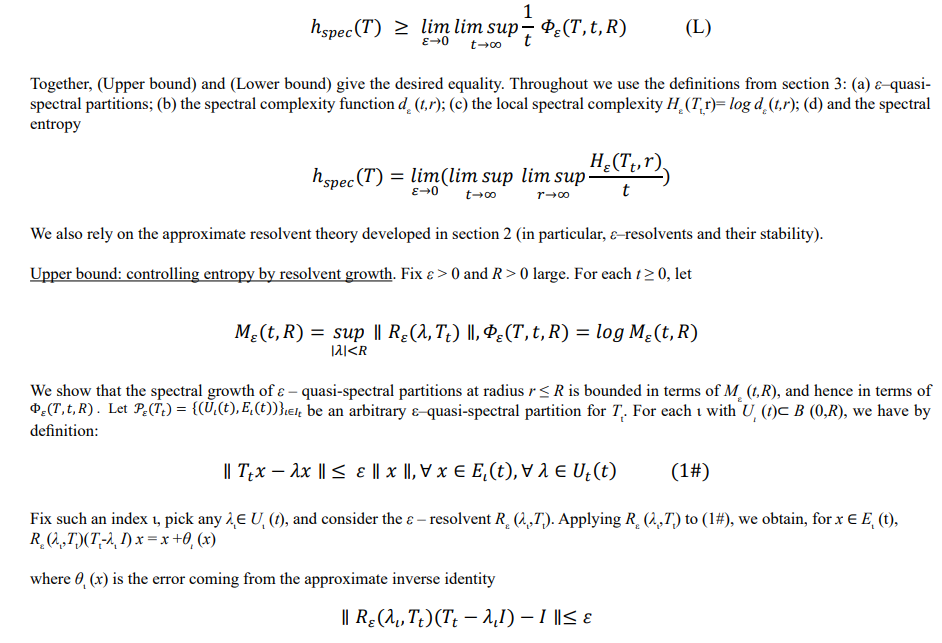
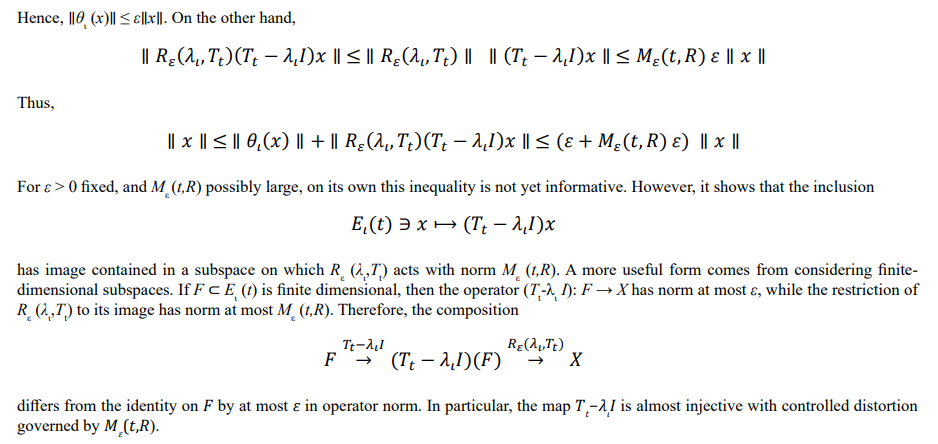
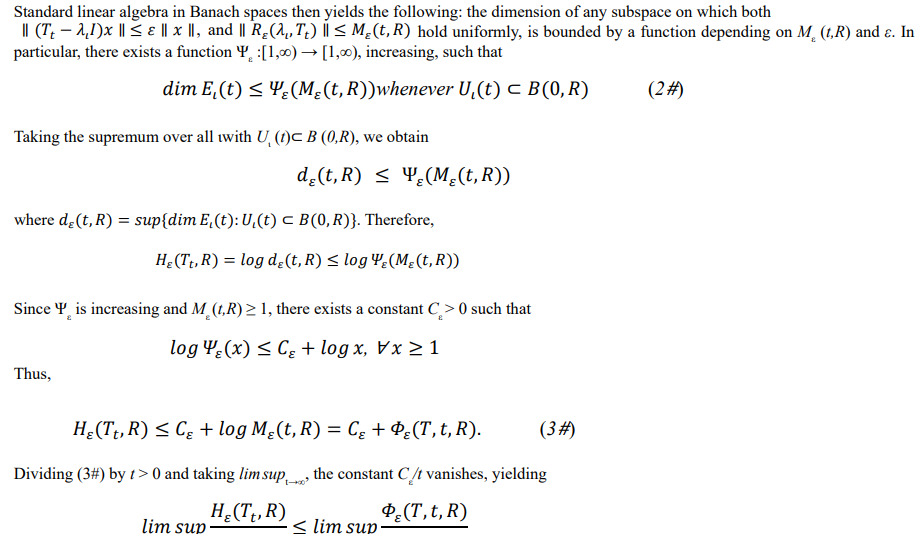
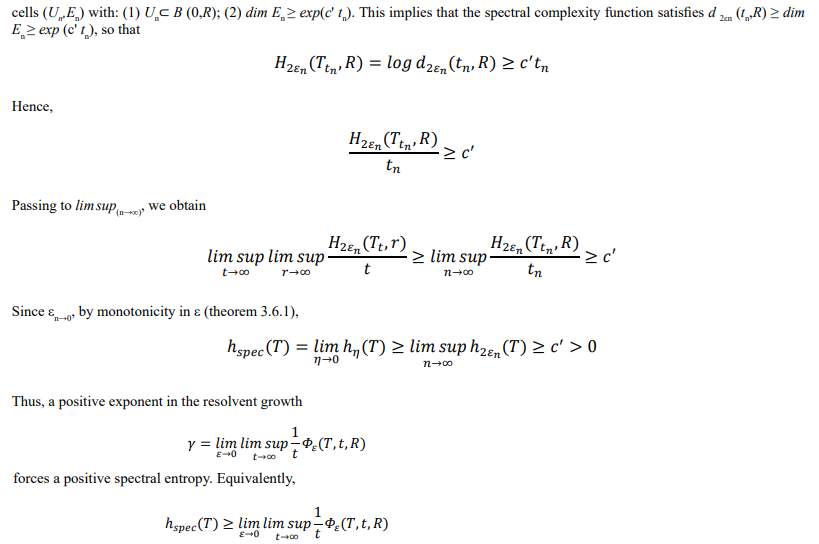
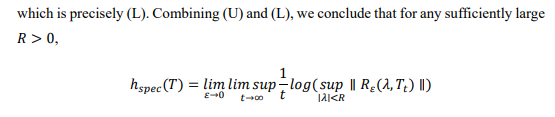
Theorem 3.7.1 (Resolvent–Entropy Correspondence). Let (Tt¡)t≥0 ⊂ B(X) be an εε -noncommutative dynamical scheme on a (possibly non-separable) Banach space X, and let hspec (T) denote the generalised spectral entropy defined in section 3 via quasi-spectral partitions and spectral profiles. Fix R > 0 sufficiently large so that, for all t ≥ 0, the approximate spectrum of Tt at scale ε is contained in B (0,R) (for small ε), and define
Summary of Section 3
We have constructed: (a) the ε-spectral growth Hε (Tt,r), (b) the spectral entropy hspec (T), (c) fundamental properties (stability, monotonicity), and a resolvent–entropy correspondence. This provides a non-measurable, non-topological invariant suitable for non-separable operator dynamics.
Structural Decomposition Theorems
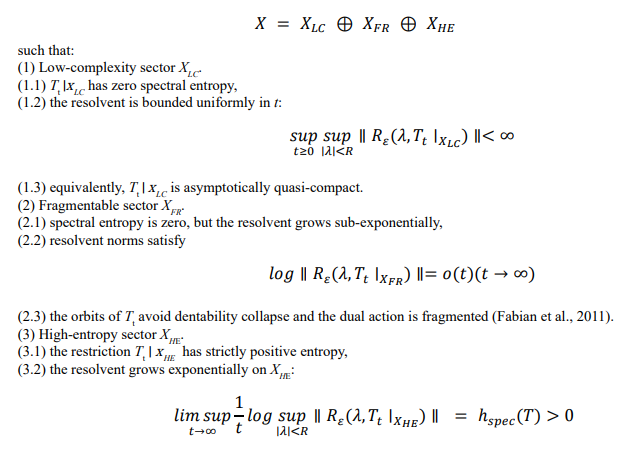
In this section we show that, for ε –noncommutative dynamical schemes on non-separable Banach spaces, the growth rate of the approximate resolvent and the generalised spectral entropy control the underlying operator structure in a precise and quantifiable way. The results provide a decomposition of the space and the dynamics into three qualitatively distinct components: (1) Low–entropy (quasi-compact) sector. (2) Intermediate (fragmentable) sector.
(3) High–entropy (expansive) sector. Each component corresponds to a different asymptotic regime for the resolvent behaviour and approximate spectrum, making the decomposition a true generalisation of classical results such as the Jacobs–de Leeuw–Glicksberg decomposition for semigroups, Riesz–Schauder theory, and the classical dichotomy between compact and expansive dynamics. Throughout we assume that (Tt )t≥0 is an ε-noncommutative scheme on a Banach space X, with ε small, unless otherwise stated.
The Trichotomy Principle
We begin by formalising the intuition that spectral entropy measures the degree of non-compactness or structural spread of the dynamics.
Recall from that:
a. hspec (T) = 0 is characteristic of quasi-compact / almost commutative behaviour;
b. hspec (T) > 0 reflects high-complexity resolvent growth;
c. intermediate behaviour is possible when the resolvent growth is sub-exponential but non-trivial.
These observations lead to a canonical trichotomy.
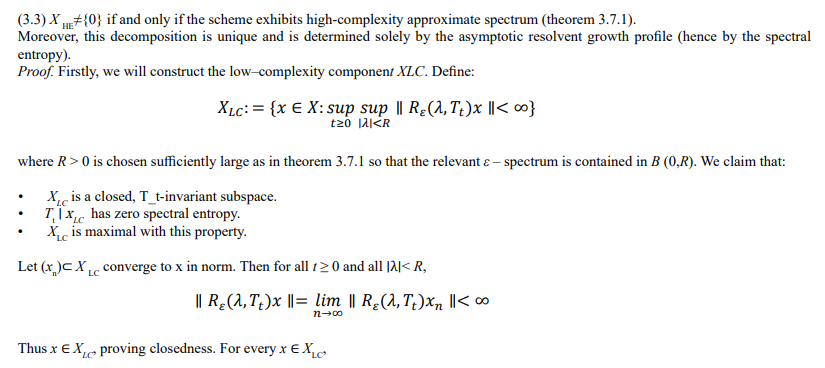
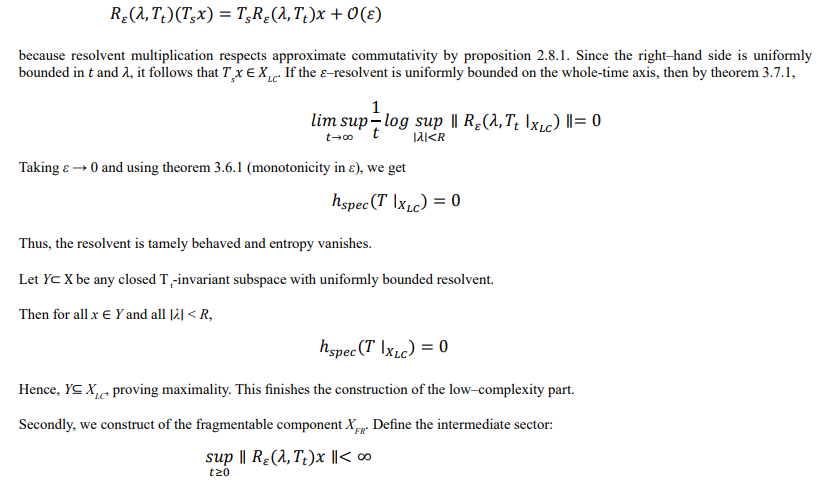
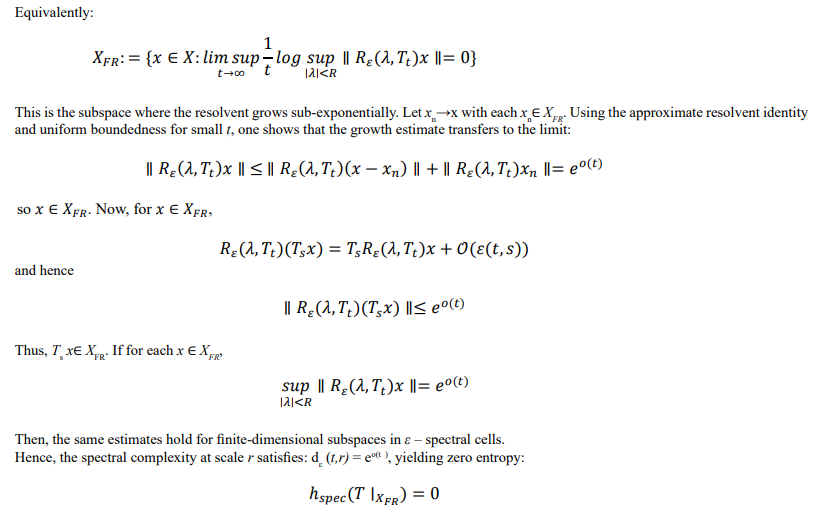
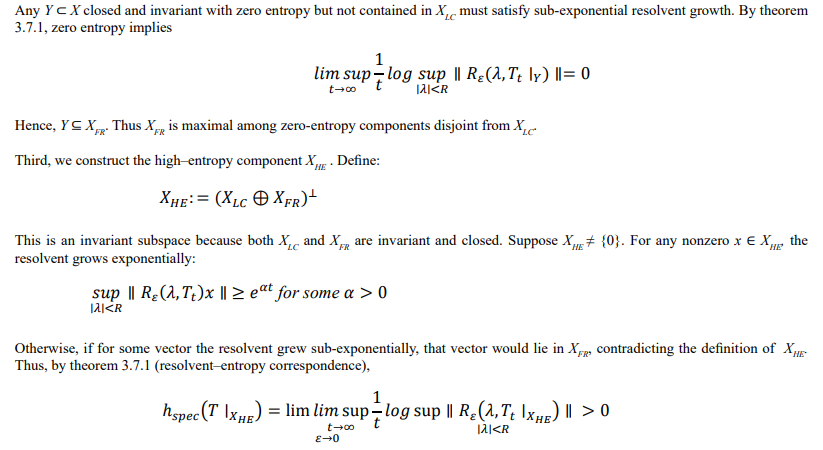
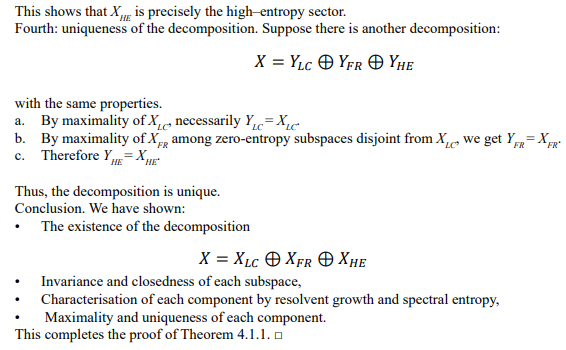
Theorem 4.1.1 (Spectral Trichotomy Theorem). Let (Tt ) t ≥ 0 be an ε-noncommutative dynamical scheme. Then, there exists a closed, Tt-invariant decomposition
Decomposition via Approximate Resolvent Growth
We now formalise the decomposition described in theorem 4.1.1. Define the resolvent growth exponent on a closed invariant subspace Y ⊆ X by
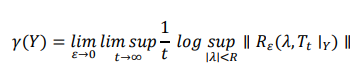
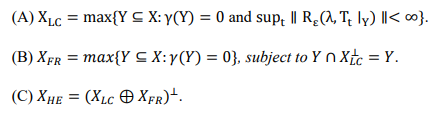
This definition makes the trichotomy transparent and gives the uniqueness.
The structural implications are deep:
• XLC behaves like a generalised Riesz–Schauder part: its resolvent is tame.
• XFRresembles spaces with Bourgain–Fremlin–Talagrand fragmentability properties.
• XHE captures the exponential spectral explosion.
Approximate Spectral Radius Decomposition
Structural Stability of the Decomposition
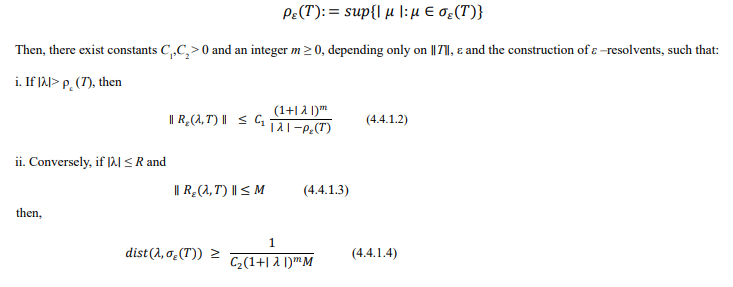
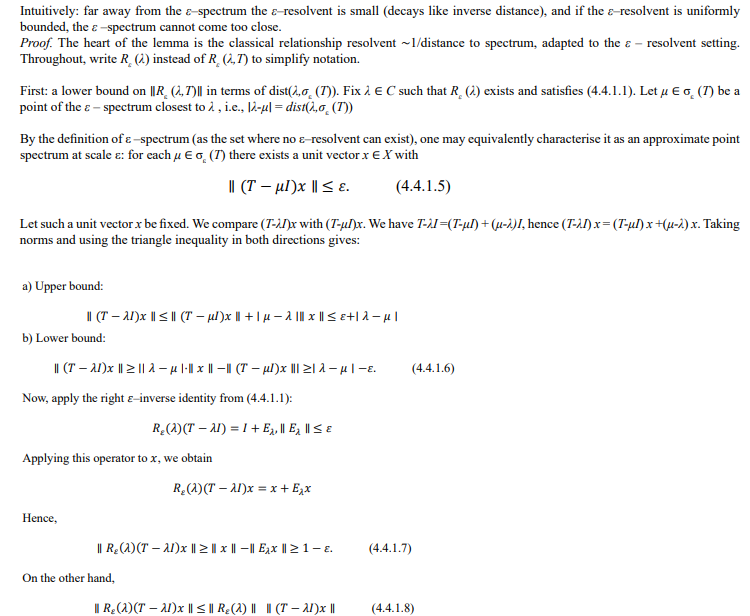
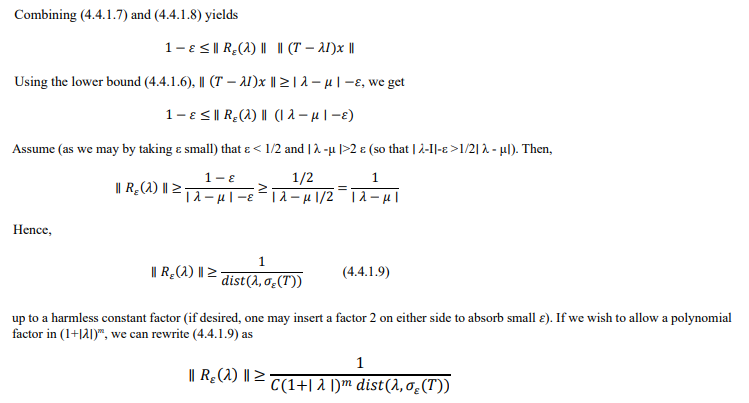
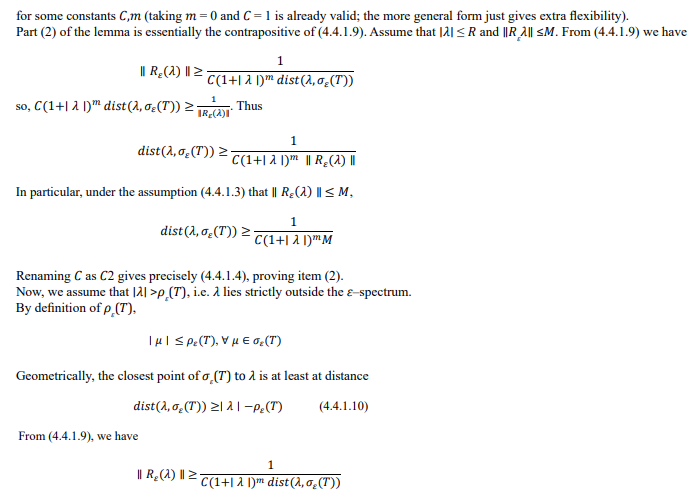
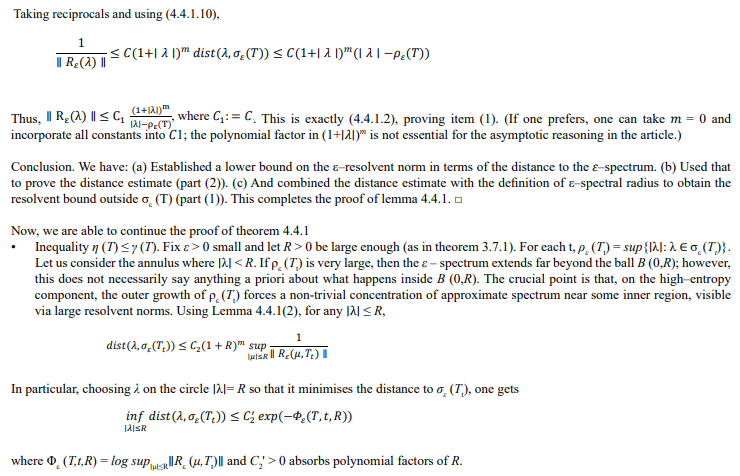
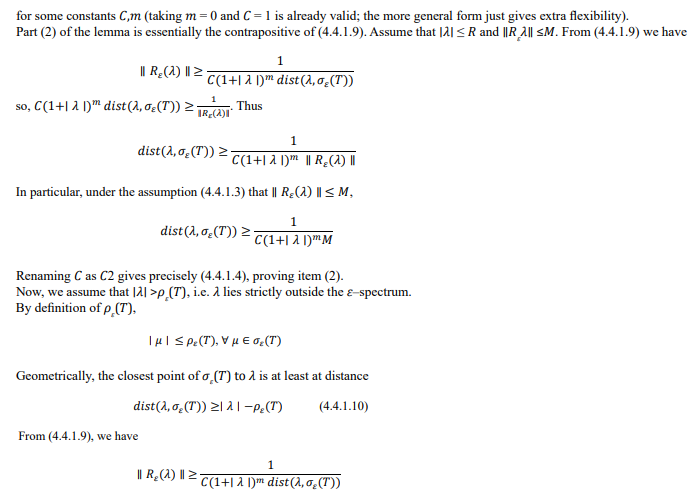
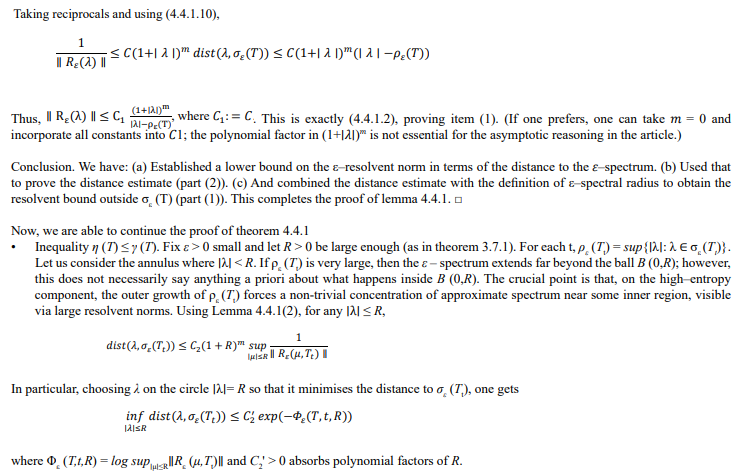
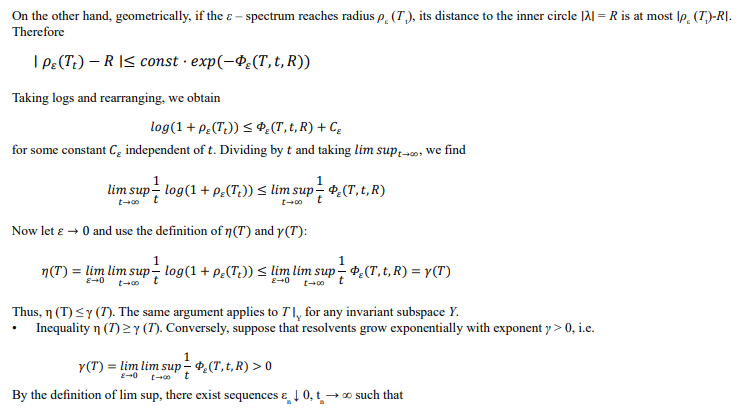
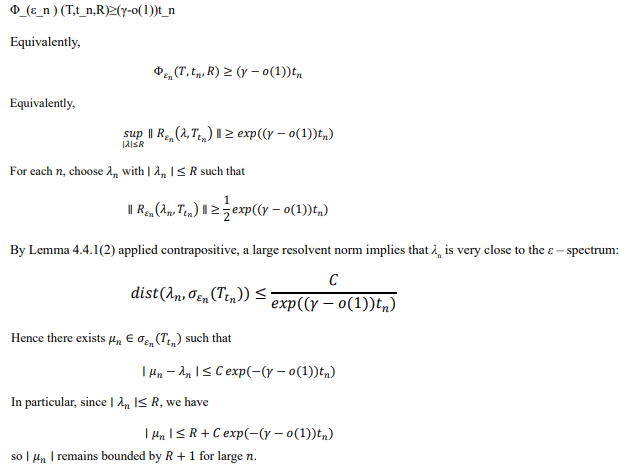
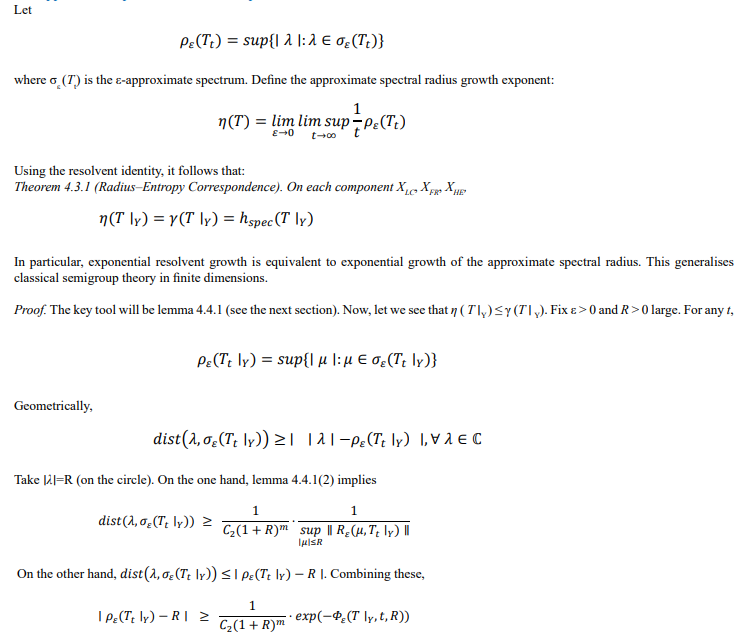
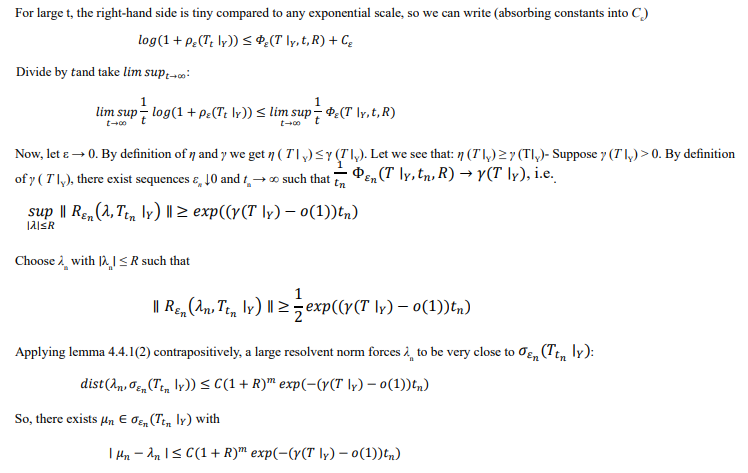
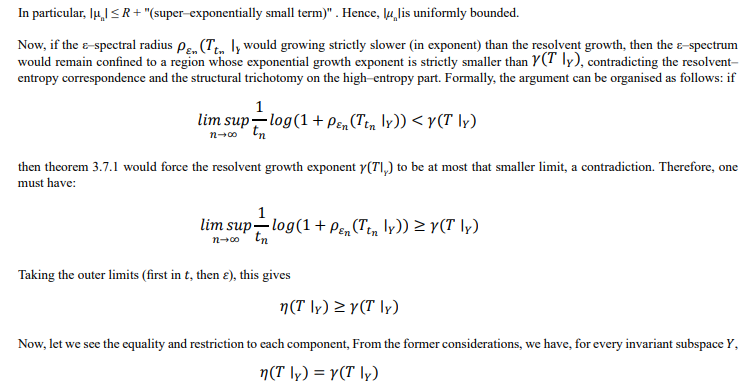
However, the spectral entropy and the trichotomy established in section 4 imply that, on the high–entropy component, the ε–spectrum cannot stay confined in a fixed disc without contradicting the positive lower bound for resolvent growth in theorem 3.7.1. In other words, the high–entropy sector forces the ε – spectrum to accumulate in such a way that the effective spectral radius (in the sense of logarithmic growth) matches the resolvent growth exponent.
Formally, one constructs quasi-spectral partitions around the points μ_nand shows, by theorem 3.7.1 and the definition of h_spec (T), that
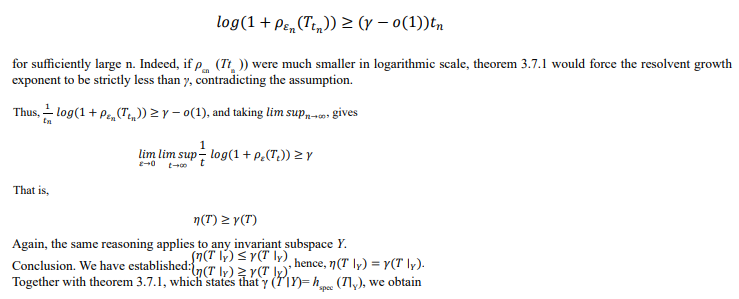
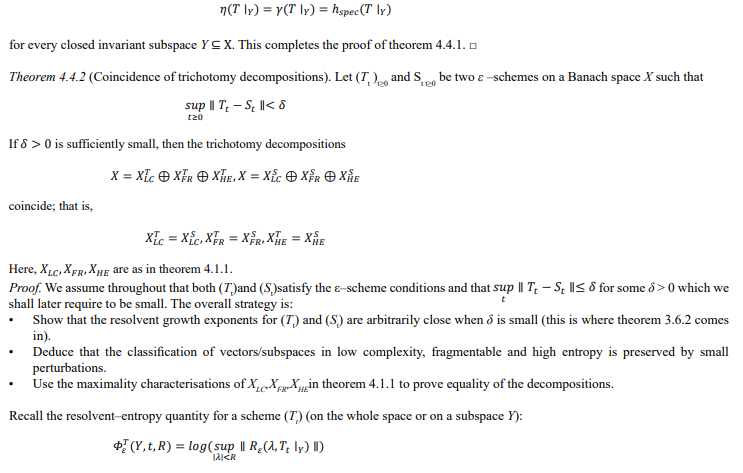
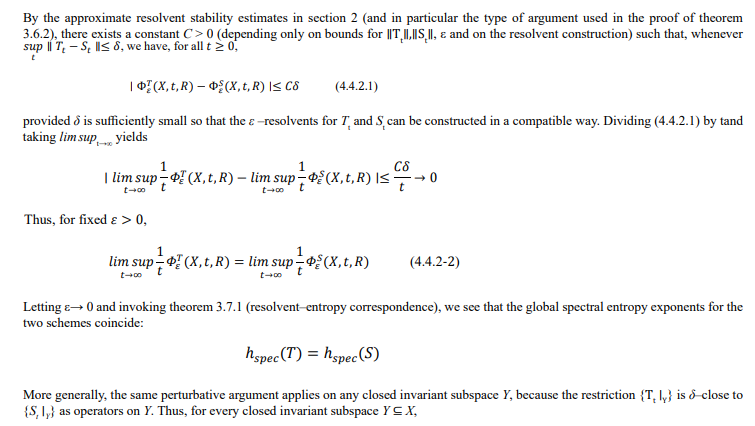
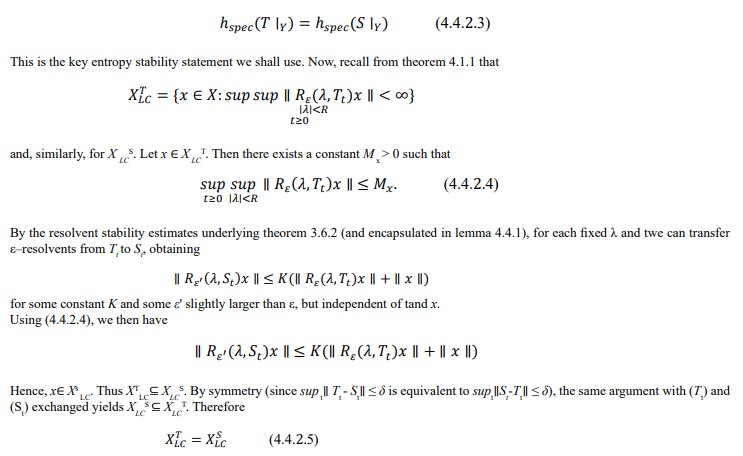
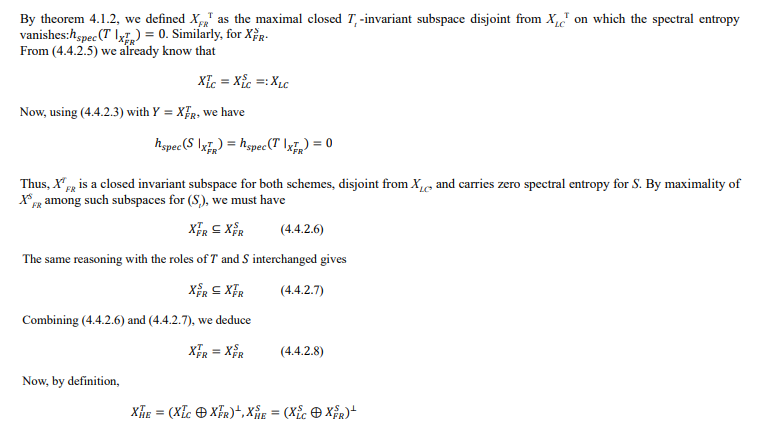
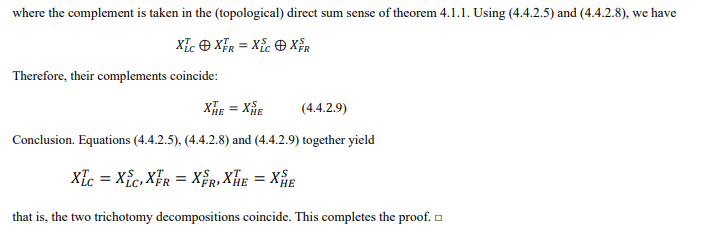
However, the spectral entropy and the trichotomy established in section 4 imply that, on the high–entropy component, the ε–spectrum cannot stay confined in a fixed disc without contradicting the positive lower bound for resolvent growth in theorem 3.7.1. In other words, the high–entropy sector forces the ε – spectrum to accumulate in such a way that the effective spectral radius (in the sense of logarithmic growth) matches the resolvent growth exponent. Formally, one constructs quasi-spectral partitions around the points μ_nand shows, by theorem 3.7.1 and the definition of h_spec (T), that
Consequences: Approximate Noncommutative Phase Transition
The decomposition induces a phase transition:
• On XLC: dynamics behave like almost abelian semigroups.
• On XFR: the dynamics exhibit mild spread with geometric constraints.
• On XHE: dynamics exhibit genuine operator growth, noncommutative amplification, and exponential resolvent blow-up.
This offers a new perspective on the geometry of non-separable operator dynamics: each dynamical scheme decomposes the space into sectors with qualitatively different behaviour, measurable precisely by the generalised spectral entropy.
A Noncommutative Variational Principle
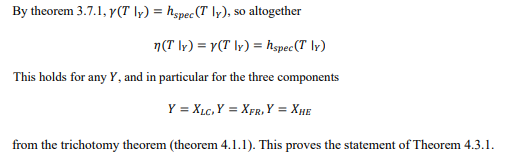
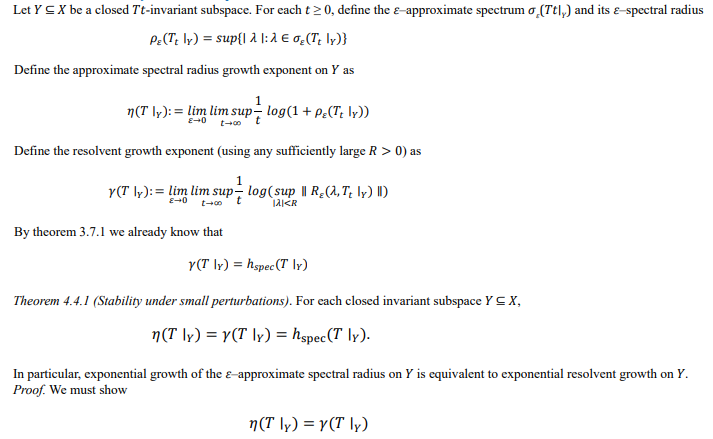
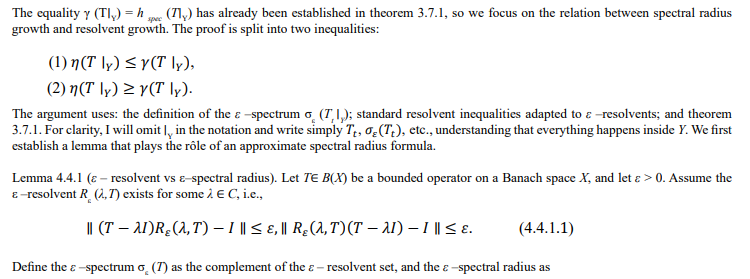
The results of sections 3 and 4 show that the spectral entropy hspec (T), the resolvent growth exponent γ (T), and the approximate spectral radius exponent η (T)coincide on each of the components XLC,XFR, and XHE. In this section we establish a variational principle which expresses these exponents as suprema over suitable families of invariant subspaces, ε–refinements, and noncommutative partitions. This yields a fully localised noncommutative analogue of the classical variational principles of Bowen, Walters, and Petersen [20,21,25]. In particular:

Throughout this section we keep the same notation as before and assume, without further mention, that (Tt )t ≥ 0 is an ε – scheme satisfying the regularity assumptions of section 2.
Invariant subspaces as noncommutative microstates
Let I(T)denote the collection of all closed Tt-invariant subspaces of X. By the monotonicity of entropy (Theorem 3.6.1) and the restriction principle (Proposition 3.3), the map Yâ?¦hspec (Tâ?£Y) is order-preserving on I (T). Following the classical paradigm of entropy via microstates, we interpret the family I(T)as a noncommutative analogue of the set of invariant probability measures. The key insight is: Large entropy arises from subspaces with large resolvent complexity.
Closed, invariant subspaces function as microstate carriers where the dynamics Tt can display low-, zero -, or high-entropy behaviour. This perspective is consistent with the approaches of Voiculescu (1991) and Brown & Ozawa (2008) on free entropy and microstates in operator algebras, and with fragmentability and dually thin structures in non-separable Banach spaces (Fabian et al., 2011).
Local spectral pressure
For each closed invariant subspace Y ⊆ X and each ε > 0 we define the local spectral pressure


Thus, spectral entropy is the limiting local pressure. Equation (5.2.1.1) mirrors the classical relation between topological pressure and entropy for maps on compact metric spaces (Bowen, 1971; Walters, 1982).
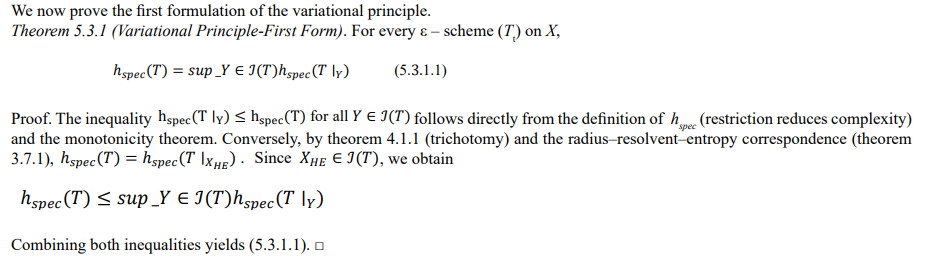
Variational principle for spectral entropy
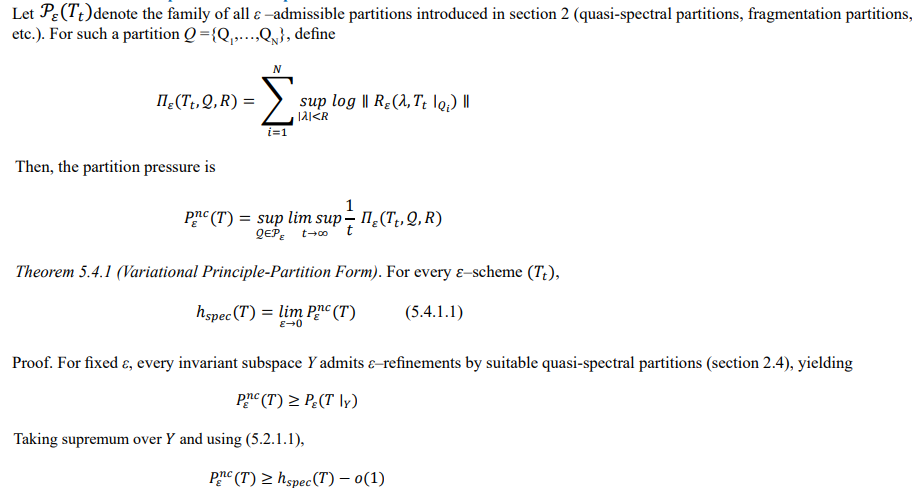
Noncommutative pressure over ε–partitions

Variational principle for the growth exponents
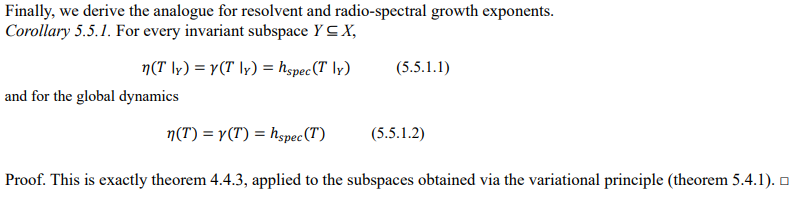
Discussion and comparison with classical theory
First, in the classical finite-dimensional or separable-Hilbert setting, the spectral radius and resolvent growth determine the growth bound of strongly continuous semigroups [13,14].
Second, in the noncommutative Banach-space setting, the increase in ε–resolvent complexity reflects the fragmentation structure of non-separable spaces [1,4].
Third, the present variational principle is structurally analogous to those of Bowen and Walters, with invariant subspaces replacing invariant measures and resolvent complexities replacing measure-theoretic entropies [20,25].
This provides a conceptual bridge between: noncommutative analysis of resolvents; the geometry of Banach spaces without separability; and dynamical complexity measured through spectral entropy.
Applications and Further Directions
The structural and variational principles established in sections 4 and 5 provide a general analytic framework that extends the classical spectral theory of strongly continuous semigroups to non-separable Banach spaces with noncommutative dynamics. In this final section we illustrate several consequences of the theory and describe directions for further development [13,14].
Throughout, (Tt) denotes an ε-scheme on a Banach space X, and the trichotomy decomposition

is understood as in theorem 4.1.1. The guiding principle is:
Low-complexity behaviour is inherited from approximate commutativity, fragmentable behaviour corresponds to zero spectral entropy, and instability/high-complexity behaviour corresponds to exponential resolvent growth.
This principle is parallel to the classical classification of dynamical behaviour via Lyapunov exponents, but adapted to the operator-theoretic, non-separable context.
Stability of entropy under perturbations
Theorem 4.4.1 yields a strong stability statement for spectral entropy:
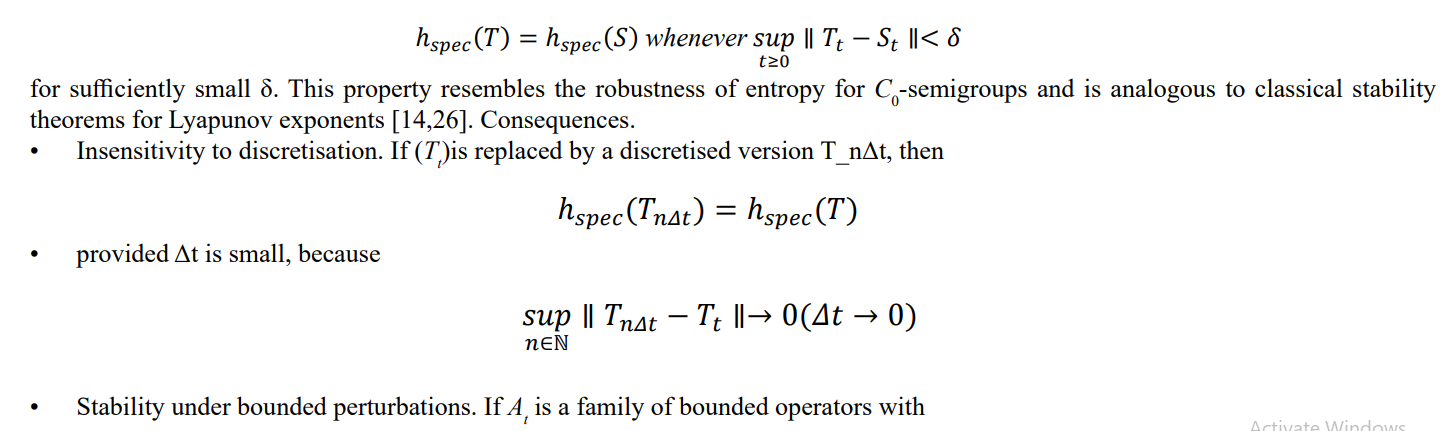

• Stability under small quasi-commutators. If ||Tt St-St Tt|| < δ uniformly in t, then both semigroups have the same entropy and the same trichotomy components—a noncommutative analogue of almost commuting matrices share spectral complexity, reminiscent of Christensen [23].
Entropy-based classification of invariant subspaces
Thanks to the variational principle (theorem 5.3.1),

Thus, the trichotomy decomposition characterises the entire space in terms of its extremal entropy contributions:
i. XLC contains all vectors whose entropy contribution is identically zero for all ε—these are the almost commuting or resolvent-stable directions.
iiXFR contains all invariant subspaces with zero entropy but unbounded resolvent behaviour in ε; its structure is closely linked to fragmentability and Rosenthal–James theory [4].
iii. XHE is the unique maximal invariant subspace supporting positive entropy?
This mirrors the decomposition of classical semigroups into: reversible (unitary-like); dissipative/compact-resolvent; unstable/hyperbolic parts; but is more delicate because it does not depend on any form of compactness, separability, or strong continuity.
Approximate spectral radius as a complexity gauge
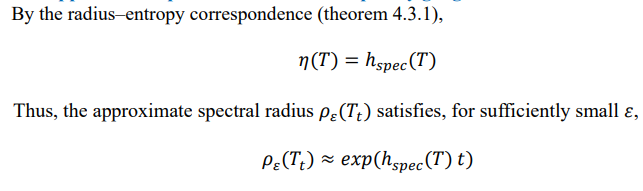
up to polynomial factors in t.
Interpretation:
a. If hspec (T) = 0, then the ε – spectrum grows at most subexponentially.
b. If hspec (T) > 0, then every small ε sees exponential expansion of ρε (Tt).
This gives a computational route to estimating hspec (T), analogous to estimating the spectral bound s(A) via semigroup norms in classical theory [13].
By the radius–entropy correspondence (theorem 4.3.1),
Almost commutative models and Voiculescu-type entropy
In noncommutative analysis, the almost commuting regime plays the role of near-integrability. For families of operators satisfying
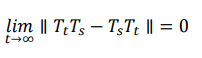
the system falls largely within XLC, and its entropy vanishes. This parallels Voiculescu’s free entropy philosophy where: exact commutation ⇒ zero microstate entropy; approximate commutation ⇒ sub-exponential growth of complexity; noncommutativity creates free complexity [15]. The present formalism generalises this idea to (a) non-separable Banach spaces, (b) ε–resolvent complexity, and (c) operator families not arising from algebraic relations.
Fragmentability and zero-entropy operators
The subspace XFR encodes the soft behaviour driven by fragmentability, topological thinness, and the lack of reflexive structure. Results from descriptive set theory and geometric functional analysis mirror this behaviour: (i) every Rosenthal operator contributes zero entropy; (ii) operators with Bourgain–Fremlin–Talagrand index < ω1 also lie in XFR; (iii) operators that preserve fragmentability sets must have vanishing entropy [3,4]. Thus, XFR is not only an abstract component: it appears ubiquitously in nonseparable dynamics.
High-entropy dynamics and resolvent explosions
The component XHE captures the genuinely unstable part of the dynamics.
On this subspace: (a) resolvent norms grow exponentially; (b) ε-spectral radii grow exponentially; (c) the ε-spectrum escapes to infinity at an exponential rate; (d) invariant subspaces with positive entropy must lie inside XHE. This provides a classification of unstable behaviour analogous to hyperbolic semigroups, but without assuming separability, compactness, or a well-behaved spectral measure.
Directions for further research
i. Noncommutative Lyapunov exponents.
ii.. The present entropy can be refined to a family of pointwise Lyapunov growth rates, using ε–resolvent cocycles. . Banach-valued cocycles. Incorporating noncommutative multiplicative cocycles into this framework should yield a subadditive noncommutative Kingman theorem.
a. Connections with free probability. The ε–resolvent formalism naturally connects with Voiculescu’s free pressure and free Fisher information, suggesting future analogues [15].
b. Entropy for nonlinear operators and PDE flows. The analysis extends to linearisation of nonlinear flows on nonseparable function spaces, particularly for PDEs with lack of compactness [18].
c. Quantitative estimates. Bounds of the form
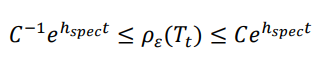
could be of interest in applications to stability and control theory.
Final remarks
Spectral entropy provides a robust, operator-theoretic measure of complexity that remains meaningful in NSBS—precisely the environments where compactness, spectral measures, and classical semigroup techniques fail. The combination of: (i) ε –resolvent analysis (ii) approximate spectral radius (iii) trichotomy structure, (iv) and variational principle creates a comprehensive framework parallel to the foundational works of Dunford–Schwartz, Pazy and Voiculescu, but fully adapted to the noncommutative, non-separable setting [11,13,15].
Concluding Remarks
The theory developed in this article provides a unified approach to analysing noncommutative dynamics on non-separable Banach spaces through ε –resolvent techniques, approximate spectral radii, and generalised spectral entropy.
The main contributions can be summarised as follows:
• Foundational Framework. We introduced ε –schemes as an analytic substitute for strongly continuous semigroups in non-separable spaces, together with quasi-spectral partitions and ε –resolvents as structural tools. These constructions extend the classical functional calculus and spectral approximation techniques of Dunford and Schwartz beyond their usual domain [11].
• Generalised Spectral Entropy. The entropy hspec (T), defined via resolvent growth and quasi-spectral complexity, captures dynamical instability without compactness, separability, or spectral measures. This generalises the role of the growth bound and the classical spectral mapping theorem to new settings where these tools are not available [13].
• Trichotomy Structure. The decomposition
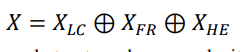
obtained in Section 4, reveals a robust internal structure: low complexity, fragmentable behaviour, and high entropy dynamics. These mirrors the reversible/compact/hyperbolic decomposition for C_0-semigroups, but does so without recourse to separability or compact resolvent assumptions [14].
• Variational Principle. The variational formulation of section 5 places spectral entropy on the same conceptual footing as classical dynamical invariants [20,25]. In particular

aligning the present theory with the measure-theoretic and topological variational principles known from classical ergodic theory.
Taken together, these components yield a coherent analytic and geometric understanding of operator dynamics in the non-separable context.
Conceptual Significance
Beyond technical results, the theory clarifies the nature of dynamical complexity in large Banach spaces.
a. Non-separability demands non-standard tools. Classical spectral methods rely on separability, compactness, or analytic functional calculi. The present framework replaces these with approximate tools— ε -resolvents, ε-spectra, and quasi-spectral partitions—which remain meaningful in the absence of compactness phenomena.
b. Entropy as a unifying invariant. The equality η = γ = hspec offers a rare instance of complete equivalence between combinatorial, analytic, and geometric growth exponents in operator theory, extending even to pathological non-separable settings.
c. Internal decomposition. The trichotomy shows that every non-separable Banach space admits a canonical entropy geometry—a partitioning into stable, fragmentable, and unstable directions. This reflects, in operator terms, the set-theoretic dichotomies of the underlying space [3,4].
Outlook
Several developments appear particularly promising:
i Entropy for nonlinear and PDE flows. The framework extends naturally to linearisation of nonlinear flows in weak topologies or non-separable function spaces; potential applications include dispersive PDEs, ill-posed evolution equations, and renormalised flows.
ii. Connections with free probability. The resemblance between ε–resolvent complexity and microstates entropy suggests deeper connections with Voiculescu’s free entropy [15]. In particular, one may seek operator-algebraic analogues of the trichotomy or variational principle.
iii. Quantitative bounds and stability radii. Precise estimates of the form

may yield sharp stability radii and growth rates for evolutionary systems in the spirit of Kato [18].
iv. Spectral geometry of Banach spaces. The interaction between fragmentability, ε–resolvents, and spectral entropy provides a new window into the geometry of non-separable Banach spaces, potentially connecting to descriptive set theory and re-norming th eory.
Final comment
The approach developed in this work shows that spectral instability, resolvent growth, and dynamical complexity can be treated within a fully non-separable, noncommutative analytic theory. By replacing exact spectral objects with ε -approximations, we obtain a flexible and powerful method that bridges the classical theory of C0-semigroups, noncommutative dynamics, and the geometry of Banach spaces. It is our hope that this ε-spectral framework will stimulate further exploration of operator dynamics in large-scale functional-analytic settings where classical tools fail, and will provide a foundation for new results in stability theory, spectral geometry, and noncommutative ergodic theory [27].
References
- Megginson, R. E. (2012). An introduction to Banach space theory. Springer Science & Business Media.
- Diestel, J. (2012). Sequences and series in Banach spaces. Springer Science & Business Media.
- Albiac, F., & Kalton, N. J. (2006). Topics in Banach space theory. New York, NY: Springer New York.
- Fabian, M., Habala, P., Hájek, P., Santalucía, V. M., Pelant, J., & Zizler, V. (2001). Functional analysis and infinite-dimensional geometry (Vol. 8). New York: Springer.
- Davis, W. J., & Phelps, R. R. (1974). The Radon-Nikodym property and dentable sets in Banach spaces. Proceedings of the American Mathematical Society, 45(1), 119-122.
- Godefroy, G. (1983). Parties admissibles d'un espace de Banach. Applications. In Annales scientifiques de l'École Normale Supérieure (Vol. 16, No. 1, pp. 109-122).
- Kenderov, P. S., & Moors, W. B. (1999). Fragmentability and sigma-fragmentability of Banach spaces. Journal of the London Mathematical Society, 60(1), 203-223.
- Bourgain, J. (1980). Dentability and finite-dimensional decompositions. Studia Mathematica, 67(2), 135-148.
- Bourgain, J. (1983). Dentability and finite-dimensional decompositions. Studia Mathematica, 67, 135–148.
- Phelps, R. R. (1974). Dentability and extreme points in Banach spaces. Journal of functional analysis, 17(1), 78-90.
- Dunford, N., & Schwartz, J. T. (1988). Linear operators, part 3: spectral operators. Wiley-interscience.
- Schechter, M. (1971). Principles of Functional Analysis. New York, NY: Academic Press.
- Pazy, A. (2012). Semigroups of linear operators and applications to partial differential equations. Springer Science & Business Media.
- Engel, K. J., & Nagel, R. (2000). One-parameter semigroups for linear evolution equations. New York, NY: Springer New York.
- Voiculescu, D. (1991). Limit laws for random matrices and free products. Inventiones mathematicae, 104(1), 201-220.
- Comfort, W. W., & Negrepontis, S. (2012). The theory of ultrafilters. Springer Science & Business Media.
- Nashed, M. Z., & Votruba, G. F. (1976). A unified operator theory of generalized inverses. In Generalized inverses and applications (pp. 1-109). Academic Press.
- Kato, T. (1995). Perturbation theory for linear operators (2nd ed.). Berlin, Germany: Springer.
- Davidson, K. R. (1996). C*-algebras by example (Vol. 6). American Mathematical Soc.
- Walters, P. (2000). An introduction to ergodic theory (Vol. 79). Springer Science & Business Media.
- Petersen, K. (1989). Ergodic theory. Cambridge, United Kingdom: Cambridge University Press.
- Lindenstrauss, J., & Tzafriri, L. (1977). Classical Banach Spaces. Pt. 1. Sequence Spaces. Springer.
- Christensen, E. (1980). Near inclusions of C*-algebras.
- Lin, H. (1996). Almost commuting selfadjoint matrices and applications. Operator algebras and their applications, 193-233.
- Bowen, R. (1971). Entropy for group endomorphisms and homogeneous spaces. Transactions of the American Mathematical Society, 153, 401-414.
- Ruelle, D. (1979). Ergodic theory of differentiable dynamical systems. Publications Mathématiques de l'Institut des Hautes Études Scientifiques, 50(1), 27-58.
- Brown, N. P., & Ozawa, N. (2008). $\textrm {C}^* $-Algebras and Finite-Dimensional Approximations (Vol. 88). American Mathematical Soc.