




Review Article - (2018) Volume 3, Issue 1
Adipose Triglyceride Lipase Single Nucleotide Polymorphism is Associated with Heart Failure Development after Acute Myocardial Infarction in Patients with Dyslipidemia
2Department of Human Genetics and Disease Diversity, Tokyo Medical and Dental University, Graduate School of Medical and Dental Sciences, Tokyo, Japan
3Department of Cardiovascular Medicine, Tohoku University Graduate School of Medicine, Sendai, Japan
Received Date: Apr 25, 2018 / Accepted Date: Jun 05, 2018 / Published Date: Jun 10, 2018
Copyright: ©Yasuhiko Sakata, et al. This is an open-access article distributed under the terms of the Creative Commons Attribution License, which permits unrestricted use, distribution, and reproduction in any medium, provided the original author and source are credited.
Abstract
Introduction: There is limited information on the incidence of diabetes despite INDIA being the Global capital for Diabetes. Though much of data is available in patients already diagnosed with diabetes but data regarding the new onset diabetes in the subset of Acute coronary syndrome (ACS) is very limited.
Materials and methods: This was a Cohort study in which 200 consecutive ACS patients were included. Lab data about their FBS; PPBS; Lipid profile & Hba1c, BMI , BP and their clinical status was collected at the time of admission, after discharge at 2 weeks, 6 weeks & 3,6 & 12 months post ACS.
Results: In study 85% were males. Mean age was 56 years. Prevalence of various atherosclerotic risk factors in study population matched the regional prevalence of them. 20% (n=40) developed New onset diabetes (NOD), 2.5% (n=5) developed Impaired fasting Glucose, 6% (n=12) developed Impaired glucose tolerance in and 1.5% (n=3) developed both Impaired fasting glucose and Impaired Glucose tolerance over a follow up period of 1 year. MACE rates & Revascularisation rates were significantly higher in NOD population. NOD patients had significantly higher BMI, waist circumference, BP, TG, LDL and Low HDL. NOD patients were on Higher dosage of statins, diuretics and Beta blockers.
Conclusion: The study highlights two important things, first incidence of new onset diabetes in acute coronary syndrome patients is High, Second new onset diabetes has a significant impact on the clinical outcome of ACS patients
Keywords
Acute Coronary Syndrome, New Onset Diabetes, Incidence
Introduction
Several studies suggested that cardiac steatosis may lead to diastolic cardiac dysfunction in patients with type 2 diabetes mellites [1-2]. Adipose triglyceride lipase (ATGL), also known as patatin-like phospholipase domain containing 2 (PNPLA2), is a crucial enzyme in the lipolysis cascade which catalyzes the rate-limiting step of lipolysis, i.e. the breakdown of triacylglycerol to diacylglycerol [3- 5]. We have recently reported cases of ATGL genetic deficiency with a massive triglyceride deposit in cardiovascular systems, causing in cardio-myovasculopathy and severe heart failure [6-8]. These lines of evidence suggest that functional variants in the ATGL gene may cause lipid accumulation in cardiomyocytes and cardiac dysfunction. In this study, we thus evaluated the impact of ATGL single nucleotide polymorphism (SNP) genetic variant on heart failure hospitalization in patients after acute myocardial infarction (AMI).
Rs7925131 is one of the SNPs in the ATGL gene, which was associated with plasma triglyceride levels in European ancestry individuals [9]. We thus genotyped rs7925131 polymorphism in 4056 patients with acute myocardial infarction (AMI) who were registered to Osaka Acute Coronary Insufficiency Study (OACIS) between 1998 to 2010 and gave a written informed consent to the genotyping study. The OACIS is a multicenter, prospective, observational registry for AMI in Japan and is registered to the University Hospital Medical Information Network Clinical Trials Registry (UMIN-CTR) in Japan (ID: UMIN000004575) [10-13]. The primary end-point was set as 5-year heart failure hospitalization rate after survival discharge of AMI. Event rates were estimated using Kaplan-Meier analysis and compared using log-rank test. The impact of rs7825131 homozygous carriers (TT) on primary end-point was evaluated as hazard ratio (HR) and its 95% confidence interval (CI) using multivariable Cox regression analysis adjusted with patient demographics and medications at discharge. Statistical significance was set as p<0.05. All statistical analyses were performed using R software packages version 3.1.0 (R Development Core Team).
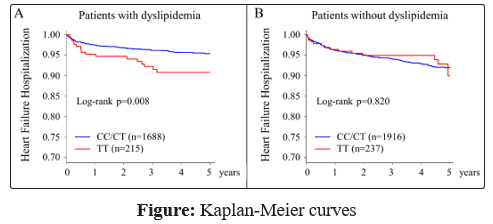
Among the patients enrolled in the present study, median age was 65 (quartile 57-73) years old, 77.4% were male, 46.9% had a history of dyslipidemia and 90.7 % underwent percutaneous coronary intervention for AMI. The proportions of CC, CT and TT carriers were 43.1%, 45.7%, and 11.2%, respectively. Kaplan-Meier analysis revealed that patients with rs7825131 TT had higher incidence of heart failure hospitalization in patients with dyslipidemia after survival discharge of AMI, while not in those without dyslipidemia (p for interaction=0.045) (Figure). Multivariable Cox regression analysis demonstrated that rs7825131 TT genotype was associated with higher incidence of heart failure hospitalization after AMI in patients with dyslipidemia after adjustment for patient demographics and medications at discharge (HR 2.51, 95% CI 1.38-4.55, p=0.003), but was not in those without dyslipidemia.
In this study, we demonstrated that ATGL rs7825131 homozygous carriers with dyslipidemia had higher incidence of heart failure hospitalization after discharge of AMI. Although this ATGL variant was reported to be associated with impaired lipid metabolism, this is the first report that functional variant of the ATGL gene was associated with cardiovascular phenotype in relation with dyslipidemia [9]. Accumulation of triglycerides or other lipids in myocardium is a possible explanation for this observation, since it has been reported that intrinsic abnormalities of cardio-myocyte lipid metabolism can lead to cardiac dysfunction, despite a lack of clear evidence identifying association between ATGL rs7825131 genetic variant and intrinsic cardio-myocyte lipid metabolism in the present study. Along with the industrialization and civilization of the society, it has been reported that the number of patients with ischemic HF is increasing worldwide [1-2,7-9,14-18]. Thus, primary and secondary prevention of ischemic HF is now an emerging agenda in the contemporary clinical settings. However, the mechanism of HF progression after AMI has not been fully understood so far [13-16]. Thus, we hope our findings may give physicians a new insight to prevent ischemic HF, since the present results clearly demonstrated an association between ATGL genetic variant and HF development in the secondary prevention of AMI. Therefore, it should be urgently addressed whether management of serum and/or cellular lipid metabolism could prevent HF development in rs7925131 homozygous carriers after AMI.
References
- McGavock JM, Lingvay I, Zib I, Tillery T, Salas N, et al. (2007) Cardiac steatosis in diabetes mellitus: a 1H-magnetic resonance spectroscopy study. Circulation 116: 1170-1175.
- Rijzewijk LJ, van der Meer RW, Smit JW, Diamant M, Bax JJ, et al. (2008) Myocardial steatosis is an independent predictor of diastolic dysfunction in type 2 diabetes mellitus. J Am CollCardiol 52: 1793-1799.
- Zimmermann R, Strauss JG, Haemmerle G, Schoiswohl G, Birner-Gruenberger R, et al. (2004) Fat mobilization in adipose tissue is promoted by adipose triglyceride lipase. Science 306: 1383-1386.
- Jenkins CM, Mancuso DJ, Yan W, Sims HF, Gibson B, et al. (2004) Identification, cloning, expression, and purification of three novel human calcium-independent phospholipase A2 family members possessing triacylglycerol lipase and acylglycerol transacylase activities. J Biol Chem 279: 48968- 48975.
- Villena JA, Roy S, Sarkadi-Nagy E, Kim KH, Sul HS (2004) Desnutrin, an adipocyte gene encoding a novel patatin domain- containing protein, is induced by fasting and glucocorticoids: ectopic expression of desnutrin increases triglyceride hydrolysis. J Biol Chem 279: 47066-47075.
- Hirano K, Ikeda Y, Zaima N, Sakata Y, Matsumiya G (2008) Triglyceride deposit cardiomyovasculopathy. N Engl J Med 359: 2396-2398.
- Kaneko K, Kuroda H, Izumi R, Tateyama M, Kato M, et al. (2014) A novel mutation in PNPLA2 causes neutral lipid storage disease with myopathy and triglyceride deposit cardiomyovasculopathy: a case report and literature review. Neuromuscul Disord 24: 634-641.
- Hirano K, Tanaka T, Ikeda Y, Yamaguchi S, Zaima N, et al. (2014) Genetic mutations in adipose triglyceride lipase and myocardial up-regulation of peroxisome proliferated activated receptor-γ in patients with triglyceride deposit cardiomyovasculopathy. Biochem Biophys Res Commun 443: 574-579.
- Schoenborn V, Heid IM, Vollmert C, Lingenhel A, Adams TD, et al. (2006) The ATGL gene is associated with free fatty acids, triglycerides, and type 2 diabetes. Diabetes 55: 1270-1275.
- Ozaki K, Ohnishi Y, Iida A, Sekine A, Yamada R, et al. (2002) Functional SNPs in the lymphotoxin-alpha gene that are associated with susceptibility to myocardial infarction. Nat Genet 32: 650-654.
- Hara M, Sakata Y, Nakatani D, Suna S, Usami M, et al. (2014) OACIS Investigators. Reduced risk of recurrent myocardial infarction in homozygous carriers of the chromosome 9p21 rs1333049 C risk allele in the contemporary percutaneous coronary intervention era: a prospective observational study. BMJ Open 4: e005438.
- Hara M, Sakata Y, Nakatani D, Suna S, Usami M, et al. (2014) OACIS Investigators. Renin-angiotensin-aldosterone system polymorphisms and 5-year mortality in survivors of acute myocardial infarction: a report from the Osaka Acute Coronary Insufficiency Study. Int Heart J 55: 190-196.
- Matsumoto S, Sakata Y, Suna S, Nakatani D, Usami M, et al. Circulating p53-responsive microRNAs are predictive indicators of heart failure after acute myocardial infarction. Circ Res 113: 322-326.
- Shimokawa H, Miura M, Nochioka K, Sakata Y (2015) Heart failure as a general pandemic in Asia. Eur J Heart Fail 17: 884-892.
- Ezekowitz JA, Kaul P, Bakal JA, Armstrong PW, Welsh RC, et al. (2009) Declining in-hospital mortality and increasing heart failure incidence in elderly patients with first myocardial infarction. J Am Coll Cardiol 53: 13-20.
- Velagaleti RS, Pencina MJ, Murabito JM, Wang TJ, Parikh NI, et al. (2008) Long-term trends in the incidence of heart failure after myocardial infarction. Circulation 118: 2057-2062.
- Shiba N, Nochioka K, Miura M, Kohno H, Shimokawa H (2011) CHART-2 Investigators. Trend of westernization of etiology and clinical characteristics of heart failure patients in Japan -First report from the CHART-2 Study. Circ J 75: 823-833.
- Ushigome R, Sakata Y, Nochioka K, Miyata S, Miura M, etal. (2015) CHART-2 Investigators. Temporal trends in clinical characteristics, management and prognosis of patients with symptomatic heart failure in Japan -- report from the CHART Studies. Circ J 79: 2396-2407.