



Mini Review Article - (2021) Volume 6, Issue 2
A Survey of Kocho Processing Practice and Challenges to Scientific Developments
Received Date: Nov 18, 2021 / Accepted Date: Nov 26, 2021 / Published Date: Dec 02, 2021
Copyright: ©Melaku Tafese Awulachew. This is an open-access article distributed under the terms of the Creative Commons Attribution License, which permits unrestricted use, distribution, and reproduction in any medium, provided the original author and source are credited.
Citation: Melaku Tafese Awulachew. (2021). A Survey of Kocho Processing Practice and Challenges to Scientific Developments. Adv Nutr Food Sci, 6(2), 65-71.
Abstract
Kocho is a food product made from the decortication and fermentation of enset parts. A quarter of Ethiopia’s population lived in the south and south-western parts of the country, where staples or co-staples were used as a food source. Kocho preparation consists of several steps, all of which are still carried out using indigenous knowledge and traditional practices. Despite its benefits, enset plant processing for food preparation is time consuming, unsanitary, requires a long fermentation period, is low in protein, and has a strong odor. The unusual sensory characteristics are the result of microbial spoilage caused by Kocho’s high moisture content. High moisture content encourages the growth of spoilage microorganisms, which produce unpleasant organic compounds. Kocho’s nutritional and organoleptic properties may thus be process-related. Nutrient loss and time-consuming fermentation processes are common and vary by location. Furthermore, accurate understanding and introduction of these processes in both enset growing and nongrowing regions can help to improve, standardize, and increase the process’s utilization in order to contribute to the country’s food security. However, there has been little research on the preservation of kocho by chemical ingredients and natural species, as well as microbes involved in fermentation and spoilage. Furthermore, very few studies on the effect of biochemical and the role of fermentation on the degradation of anti-nutritional factors have been reported. It can be stored for years and, like other fermented foods, can inhibit the growth of pathogenic bacteria, extending product shelf-life while ensuring consumer safety. Above all, this review is being conducted with the goal of reviewing the kocho processing practices and challenges to Scientific developments. Similarly, the document attempts to provide a brief description of its common characteristics in terms of microbial, biochemical, and fermentation conditions.
Keywords
Kocho, Enset, Microbes, Biochemical, Fermentation Conditions.
Introduction
Fermented kocho product is kocho food that has been subjected to the action of microorganisms or enzymes so that desirable bio-chemical changes cause significant modification to the food or fermented as a type of energy-yielding microbial metabolism in which an organic substrate, usually a carbohydrate, is incompletely oxidized and an organic carbohydrate acts as the electron acceptor. Kocho is an Ethiopian traditional fermented food product made by fermenting parts of the ‘false banana’ (Ensete ven-tricosum). It is made from the scraped pseudostem and corm, which are fermented in solid state fermentation (National Research Council, 2006).
Enset is a multipurpose crop and provides food for more than 13 million people in Ethiopia. It’s one of the fourth agricultur-al systems in Ethiopia. Its cultivation and fermentation tradition are unique and important food sources for Ethiopia. The quarter of Ethiopian population those were inhabited in south and south western part were used as staples or co-staples food source.
Annual production of enset plant in Ethiopia is 6543 kg/ha and 4.5 million tons of kocho are available as standing stock. Relative to other crops its highly productive, drought tolerate and obtained throughout the years and stored without the need of refrigerator, where it makes a major contribution to food security of the coun¬try. Regions where enset is used as staple food are usually less affected by the recurrent drought periods that occur in Ethiopia. The overall objective of this paper is to review the characteristics of indigenous kocho processing practice and research drawing op¬portunity mechanisms and pathways intersection in correlation to microbial, biochemical and fermentation conditions.
Review
Challenges and kocho processing practice
Today, Kocho is processed from Enset with major concerns such as food safety and security issues, Microbial dynamics of Enset fermentation, microbial spoilage and accompanying changes and biochemical changes during fermentation, effect of altitude on mi¬crobial successions, chemical composition and degradability, min¬eral content and mineral absorption inhibitory factors to improve indigenous Kocho processing.
The fermentation method and duration differ from area to area, sometimes even from household to household (supplementary fig¬ures 1-4).


(a) (b
Figure 1: (a). sheets Fermented kocho storage in plastic bags; (b). Preservation of fermented kocho with dried leaf
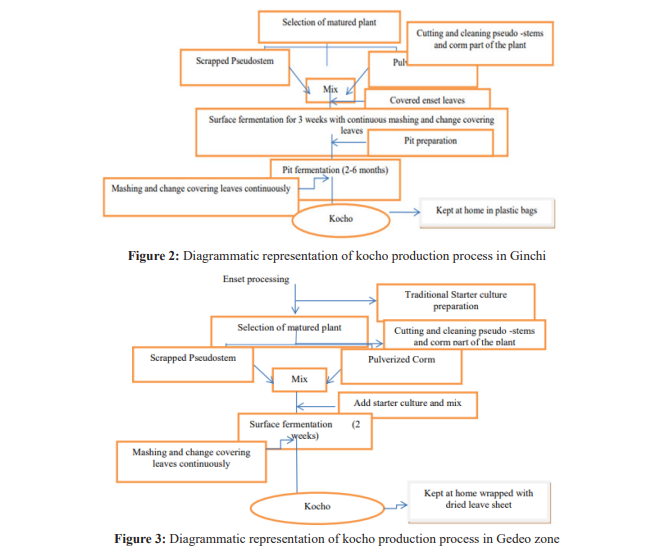
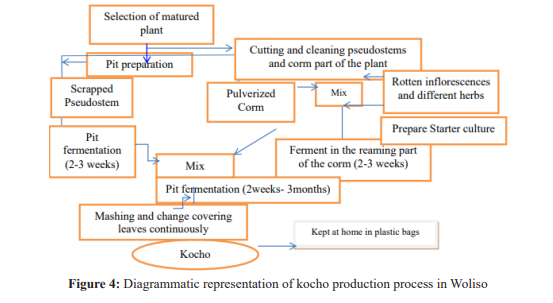
According to in high altitude regions, fermentation is carried out in a pit after supplementation of a traditional starter for about 2–5 months, whereas in low altitude regions, traditional surface fer-mentation is followed by pit fermentation as a two-step process for about 2–4 months. In the Gedio zone, traditional surface fer-mentation for 2–4 weeks with the addition of a traditional starter is common. Enset processing is mostly done from October to early December, with a few exceptions from May to mid-June. Enset is typically harvested just before flowering; the best time to harvest is when the plant flowers. The length of time it takes to flower is determined by climatic conditions, clone type, and management. As a result, the flowering time ranges from 3 to 15 years, but is best around 6 or 7 years.
General understanding and Effect of Fermentation
Fermentation
Microbes have played an important role in human food production through fermentation since ancient times, originally for food pres¬ervation purposes. The technique of fermentation has been used globally to improve nutritional, safety, and organoleptic properties of food using different raw materials. Also, in Africa the technique has been used as an inexpensive method to effectively preserve and improve sensory and safety of food. The production of fer¬mented products is based on the microbial activity that transforms a raw material into a product with increased sensory and nutrition¬al value, leading to several known general nutritional attributes, including the following: 1) Enhanced nutritional value through the breakdown of certain constituents and anti-nutritional factors, in¬creased availability of micronutrients such as iron, zinc and calci¬um, and the synthesis of B vitamins. 2) Enhanced digestibility due to the breakdown of indigestible oligosaccharides such as lactose and complex polysaccharides. 3) Enhanced food safety by protec-tion from proliferation of pathogenic microbes by the low pH and antimicrobial compounds, which also gives the products a pro¬longed shelf life. 4) Elimination of toxic substances such as myco¬toxins. 5) The fermenting bacteria serve as probiotics, contributing to a healthy ecology of intestinal bacteria which promotes general health.
Benefits and Pitfalls of Fermentation
Table 1. Benefits and pitfalls of fermentation.
|
Benefits/Pitfalls |
Description |
|
BENEFITS |
|
|
General advantages |
−mild conditions (pH and temperature) − development of unique flavors and textures of food − low consumption of energy − low capital and operating costs −relatively simple technologies |
|
Pathogenic bacteria and spoilage organisms are inhibited |
The most food is fermented by lactic acid fermentation, during which pH is lowered to ca. 4. Also, bacteriocins, hydrogen peroxide, ethanol, diacetyl are produced. This inhibits the growth of unwanted microorganisms and prevents spoilage of food |
|
Detoxification and softening |
Lactic acid fermentation also may reduce the content of natural toxins in plant food: e.g. cyano-genic glycosides in cassava (major staple food in Africa) and soften plant tissues. |
|
Enhanced digestibility – degradation of oligosaccharides and dietary fiber |
Complimentary food for children containing amylase-rich flour and lactic acid bacteria. Also, fermentation of plant foods favors transformation of phytate by phytase. This increases several fold bioavailability of iron. The consequence of lactic acid fermentation is decreased tannin content in cereals, which increases minerals absorption and protein digestibility of grains. |
|
Beneficial health effects |
Fermentation improves food safety and quality through the presence of probiotics that protect from E. coli and other pathogens and have hypocholesterolemic and anticarcinogenic effects, which is of particular significance in lactose intolerance and gastrointestinal disorders |
|
PITFALLS |
|
|
Fermentation technologies are complex and sensitive and require careful control of: |
-Quality and safety of raw materials – initial level of contamination − environmental hygiene and sanitation − safety of metabolites − processing conditions and degree of acidity achieved |
|
Risk of contamination |
If the fermentation was not properly conducted, spoilage may appear which causes annoying odor, bad taste (butyric acid, hydrogen sulfide, aromatic amines). Also, there is a danger of contamination by pathogenic bacteria |
|
Risk of intoxication |
There were reported cases of dangers associated with the consumption of fermented food. In Alaska, fish, seafood and birds were traditionally fermented in grass-lined hole. In 1980’s the fermentation began to be carried out in plastic containers. This resulted in the development of botulinum bacteria which thrive under anaerobic conditions and caused several botulism cases |
Effect on Foods
Fermentation of foods is the controlled action of microorganisms to alter the texture of food, to preserve (by the production of acids and alcohols) and to produce characteristic flavors and aromas. Changes produced by fermentation in food are discussed in Table 2.
Table 2. Change produced by fermentation in food.
|
Change |
Description |
|
Texture |
food is softened as the result of complex changes in proteins and carbohydrates |
|
Nutritional value |
microorganisms improve digestibility by hydrolysis of polymeric compounds, mainly polysaccharides and proteins; secrete e.g. vitamins |
|
Enrichment with |
protein, essential amino acids, essential fatty acid |
|
Flavor |
Sugars are fermented to acids, which reduce sweetness and increase acidity, in some cases bitterness is reduced by enzymatic activity |
|
Aroma |
the production of volatile compounds: amine, fatty acid, aldehydes, ester and ketones |
|
Color |
Proteolytic activity, degradation of chlorophyll and enzymatic browning may produce brown pigment |
Fermentation Feedstocks /Microorganisms/
Microorganisms that are used in industrial fermentations include:
Bacteria: Acetobacter, Streptococcus, Lactococcus, Leuconostoc, Pediococcus, Lactobacillus, Propionibacterium, Brevibacterium, Bacillus, Micrococcus, Staphylococcus.
Yeast: Saccharomyces, Candida, Torulopsis, Hansenula.
Mold: Aspergillus, Penicillium, Rhizopus, Mucor, Monascus, Ac-tinomucor.
Lactic acid bacteria (LAB) are naturally present in milk, fruit juice, plant products, intestine and mucosa. In fermentation prod¬ucts, antimicrobial effect of their acids is used. Lactic acid bacte¬ria are divided into three groups: homolactic (Streptococcus spp., Pediococcus spp.), heterolactic (Leuconostoc spp.) and facultative (Lactobacillus spp.). Generally, Lactobacilli are stronger acid pro¬ducers than Streptococci.
Most LAB produce bacteriocins, which reduce the use of chemical preservatives, e.g. Lactococcus lactis produces nisin which inhib-its growth of Cl. botulinum and Listeria monocytogenes). Some LAB have stabilizing and viscosity forming properties. This en-ables us to avoid using synthetic stabilizers and emulsifiers. Yeasts are frequently minority companions of LAB and are also used to produce CO2 (in beer and breadmaking) and ethanol (alcoholic beverages). Molds are used in the production of enzymes which degrade polymeric components: cell wall polysaccharides, pro-teins, lipids, which is significant for texture, flavor and nutritional value of mold fermented foods.
Discussion
Kocho Human Gut Microbiota
The human gut is host to millions of bacteria and it is known that its composition is specific for every individual. However, most can be categorized as belonging to one of three groups, based on the predominance of either of the genera Bacteroides, Privately, or Ruminococcin (Arumugam M et al., 2011). Gut microbiota com-position of humans is affected by changes in lifestyle and diet. The intestinal microbiota has been recognized as a vital asset for health and neuro-development and is established in the first three years of life so that its modification during this period has the potential to affect host health and development has been shown that shifts in microbiota composition towards more favorable taxa and combi¬nations of taxa leads to better health, for instance by a better func¬tioning immune system and protection against invasion of patho¬genic bacteria via the intestine (Inconnu MA, Bird AR, 2014). this way, a healthy gut microbiota with good nutrition helps to prevent disease. Since traditional fermented foods contain a mixed com¬munity of a variety of species, they are likely to include strains with probiotic effects that thus can have an impact to better health of their consumers.
Microbial Activities in Enset Fermentation Processes
The corms of mature enset plants were used as main raw material for the preparation of starter culture. Studies reveals during fer¬mentation of kocho, the value of pH was gradually decreased. In line with this, the number of microorganisms during fermentation of kocho was seen gradual increment. Lactic acid bacteria, En¬terobacteriaceae, spore forming bacteria and yeast are reported as responsible microbes for acid production during kocho fermenta¬tion. At the initial fermentation Enterobacteriaceae increased and thereafter counts of Enterobacteriaceae reached below detectable level. According to on the day zero, Kocho has high moisture content, low titrateble acidity, near neutral pH and high soluble reducing sugar concentration when compared to the final fermen¬tation days of Kocho. During the initial period, Kocho contained a diverse group of microorganisms such as aerobic and anaerobic spore formers, Gram negative bacteria including members belong¬ing to the Enterobacteriaceae, lactic acid bacteria and yeasts. In indigenous fermented foods, the microorganisms responsible for the fermentation are usually the microbial flora naturally present on the raw substrate. It has also been indicated that Leuconos¬toc mesenteroides is responsible for initiating the fermentation of Enset during initiation period. As it was described in the previous study, because of the activities of this species and to some extent, of Streptococcus faecalis, the pH of the fermenting Kocho was reduced from 6.5 to 5.6. These organisms may be then succeeded by some of the homo-fermentative Lactobacillus species. Through the activities of the Lactobacillus species, the pH can be further re¬duced to 4.2. The microorganisms are also temperature dependent. For instance, if Pediococcus cerevisiae present in Kocho, it can’t achieve prominence in relatively low fermentation temperature be¬tween 14°-18°C. Spore-formers may be present in fairly high num¬bers during the first 15 days of fermentation. The butyrous odor usually detected during the first two weeks in fermenting Kocho is due to the activities of certain clostridial species, and yeasts can be also present in fairly high numbers.
Biochemical condition of Microorganisms
Microbes, in general, require an appropriate biochemical and bio¬physical environment to grow and express normal metabolic ac¬tivities. Biophysical environmental factors including temperature, pH, water activity, redox potential, and the presence of inhibitory compounds produce a wide range of variations among microbes’ strains. The biochemical environment conditions are made avail-able through nutrients in the culture media. In addition to carbo-hydrates (carbon source), culture media, bacteria produce lactic acid which conserves food. i.e., Lactic Acid Bacteria (LAB) are usually supplemented with various free amino acids, peptides, nu¬cleic acid derivatives, fatty acids esters, minerals, vitamins, and buffering agents. The fastidious characteristics of LAB, the abili¬ty of LAB strains to produce acid and antimicrobial compounds, and the variations in nutritional requirements among LAB strains have added additional limitations and challenges with regard to developing general growth media. In addition, metabolites that are produced by some LAB strains may inhibit the growth of other strains or even the same strain such that the case of bacteriocin production. On the other hand, low nutrient concentrations may cause fast depletion in the essential nutrient which may negative¬ly affect growth whereas high nutrient concentration such as salts could also negatively affect growth or could be insoluble in water [1-42].
Conclusion
The enset plant is one of Ethiopia’s fourth agricultural systems. Its cultivation and fermentation traditions are one-of-a-kind and vital food sources for Ethiopia. Fermentation was traditionally a meth¬od of preserving food that has been used for centuries and contin¬ues to be used today. However, since other preservation techniques are available, the main purpose of food fermentation is now to pro¬duce a wide range of fermentation products with distinct taste, fla¬vor, aroma, and texture. Using various microbial strains, fermen¬tation conditions (microorganisms, substrates, temperature, time of fermentation, etc.), and chemical engineering achievements, we can produce hundreds of different types of foods and food acids. Surprisingly, in such a diverse range of products, flavors, and tex¬tures, only two types of fermentations are used in the majority of cases: lactic acid and ethanolic fermentation. Concerns of enset-related research may include gaining familiar-ity with a phenomenon or gaining new insights into it and accu-rately portraying its characteristics, which may lead to minimiz-ing post-harvest loss in terms of value addition, identifying its optimum preservative effects, or searching for an alternative to processing, packaging, and related Techniques. Furthermore, the function of both is to alter conditions so that undesirable spoiling or pathogenic microorganisms do not grow and alter the food. Nat-ural ecosystems, on the other hand, have limited nutrient supply, long generation times, mixed populations, and continuous fluxes of components into and out of the system. The main reasons for Kocho’s limited cultivation and consumption could be related to its unusual inherent sensory characteristics for non-consumers, nutrition loss, long fermentation period, lack of awareness, and its short shelf-life. Nutrient loss and time-consuming fermentation processes are common and vary by location.
Competing Interests
The authors declare that they have no competing interests.
References
- Abebe, Y., Bogale, A., Hambidge, K. M., Stoecker, B. J., Bai-ley, K., and Gibson, R. S. (2007). Phytate, zinc, iron, and calcium content of selected raw and prepared foods consumed in rural Sidama, Southern Ethiopia, and implications for bioavailability. J. Food Compos. Anal. 20:161-168.
- Anukam KC, Reid G: African traditional fermented foods andprobiotics. Journal of medicinal food 2009, 12(6):1177-1184.
- Arumugam M, Raes J, Pelletier E, Le Paslier D, Yamada T, Mende DR, Fernandes GR, Tap J, Bruls T, Batto JM et al: Enterotypes of the human gut microbiome. Nature 2011, 473(7346):174-180.
- Ashenafi, M. (2006). A review on the microbiology of indigenous fermented foods and beverages of Ethiopia’, Ethiopopi-an Journal of Biological Sciences, Vol. 5, pp189-245.
- Atlabachew, M., and Chandravanshi, B. S. (2008). Levels of major, minor and trace elements in commercially available enset (Ensete ventricosum (Welw.), Cheesman) food products (Kochoand Bulla) in Ethiopia. Journal of Food Composition and Analysis, 21(7): 545-552.
- Batty J.C. and Folkman S.L. (1983). Food Engineering Fundamentals. New York: John Wiley and Sons. [This presents various process aspects of food production].
- Bekers M., Laukevics J., Vedernikovs N., Ruklisha M. and Savenkova L. (1997). A Closed Biotechnological System for the Manufacture of Nonfood Products from Cereals (Ch. 21), In: Campbell G.M., Webb C. and McKee S.L., Cereals: Novel Uses and Processes, New York: Springer-Verlag. [This discusses various non-food fermentation products from cereals]
- Belay, A., Hunduma, T., Fekadu, E., Negisho, K., and Ali,A. (2008). Gender based analysis of production system in Ambo. In: Chiche, Y. and Kelemu, K. (eds.), Proceedings of the workshop on gender analysis in agricultural research (pp. 27-29) Addis Ababa, Ethiopia.
- Brandt, A.S., Anita, S., Clifton, H., J, M.T., Endale, T., Mu-lugeta, D., Gizachew, W.-M., Gebre, Y., Masayoshi, S., Shif-eraw,T., 1997. The “Tree Against Hunger” Enset-Based Agricultural Systems in Ethiopia. American Association for the Advancement of Science, Washington, DC.
- Beumer R.R., (2001). Microbiological Hazards and Their Control: Bacteria, In: Adams M.R. and Nout M.J.R., Fermentation and Food Safety, Gaithesburg: Aspen Publishers. [This discusses safety aspects of fermentation products.
- Battcock M, Azam-Ali S: Fermented fruits and vegetables. A global perspective. Rome: FAO; 1998.
- Birmeta, G., Nybom, H., Bekele, E., 2004. Distinction between wild and cultivated enset ( Ensete v entricosum ) gene pools in Ethiopia using RAPD markers 148, 139–148.
- Conlon MA, Bird AR: The impact of diet and lifestyle on gut microbiota and human health. Nutrients 2014, 7(1):17-44.
- Derrien M, Veiga P: Rethinking Diet to Aid Human-Microbe Symbiosis. Trends in microbiology 2017, 25(2):100-112.
- Egounlety M, Aworh OC, Akingbala JO, Houben JH, Nago MC: Nutritional and sensory evaluation of tempe-fortified maize-based weaning foods. International journal of food sciences and nutrition 2002, 53(1):15-27.
- Fellows P.J. (2000). Food Processing Technology – Principles and Practice. Fermentation and Enzyme Technology (Ch. 7). London: Woodhead Publishing. [This provides a comprehensive information on food fermented products].
- Gashe, B. A. (1987a). Kocho fermentation. Journal of Applied Bacteriology, 62(6): 473-477.
- Gashe, B. A. (1987b). Spoilage organisms of Kocho. MIRCEN Journal of Applied Microbiology and Biotechnology, 3(1): 67-73.
- Hotz C, Gibson RS: Traditional food-processing and preparation practices to enhance the
- bioavailability of micronutrients in plant-based diets. Journalof Nutrition 2007, 137:1097-1100.
- Hunduma, T., and Ashenafi, M. (2011). Effect of altitude on microbial succession during traditional Enset (Ensete ventricosum) fermentation. International Journal of Food, Nutrition and Public Health, 4(1): 39-53.
- John, R. P., Nampoothiri, K. M. and Pandey, A. (2007). “Fer-mentative Production of Lactic Acid from Biomass: An Overview on Process Developmentsand Future Perspectives,” Applied Microbiology and Biotechnology.
- Karssa, T. H., Ali, K. A., and Gobena, E. N. (2014). The microbiology of Kocho: An Ethiopian traditionally fermented food from Enset (Ensete ventricosum). International Journal of Life Sciences, 8(1): 7-13.
- Kanshie, K. T. (2002). Five thousand years of sustainability? A case study on Gedeo land use (southern Ethiopia). Treemail Publishers, Heelsum, the Netherlands: 16-100.
- Kort R, Sybesma W: Probiotics for every body. Trends in Biotechnology 2012, 30(12):613-615.
- Lechiancole, T., Ricciardi, A. and Parente, E. (2002). “Op-timization of Media and Fermentation Conditions for the Growth of Lactobacillus sakei,” Annals of Microbiology.
- Mirbach M.J. and El Ali B. (2005). Industrial Fermentation (Ch. 9), In: Ali M.F., El Ali B.M. and Speight J.G., Handbook of Industrial Chemistry. Organic Chemicals. New York: Mc-Graw-Hill. [This discusses various apsects of industrial fermentations].
- Mokoena MP, Chelule PK, Gqaleni N: Reduction of Fumoni-sin B1 and Zearalenone by Lactic Acid Bacteria in Fermented Maize Meal. Journal of Food Protection 2005, 68(10):2095-2099.
- Motarjemi Y., Asante A., Adams M.R. and Nout M.J.R. (2001). Practical Applications: Prospects and Pitfalls, In: Adams M.R. and Nout M.J.R., Fermentation and Food Safety, Gaithesburg: Aspen Publishers. [This discusses advantages and disadvantages of fermentation processes].
- National Research Council, 2006. Lost Crops of Africa: Vegetables, II. The National Academies Press, Washington, D.C.
- Nout MJR: Rich nutrition from the poorest – Cereal fermenta-tions in Africa and Asia. Food Microbiology 2009, 26(7):685-692. Nout MJR, De Vos WM, Zwietering MH: Food Fermentation: Wageningen Academic Publishers; 2005.
- Nout MJR, Darkar PK, Beuchat LR: Indigenous fermented foods. In: Food Microbiology: Fundamentals and Frontiers Third Edition. Edited by Doyle MP, Beuchat LR. Washingon DC: ASM Press; 2007: 817-835.
- Nurfeta, A., Eik, L. O., Tolera, A., and Sundstøl, F. (2008). Chemical composition and in sacco dry matter degradability of different morphological fractions of 10 Enset (Ensete ventricosum) varieties. Animal Feed Science and Technology, 146(1): 55-73.
- Rodríguez JM, Murphy K, Stanton C, Ross RP, Kober OI, Juge N, Avershina E, Rudi K, Narbad A, Jenmalm MC et al: The composition of the gut microbiota throughout life, with an emphasis on early life. 2015 2015, 26.
- Sahle, M., Yeshitela, K., Saito, O., 2018. Mapping the supply and demand of Enset crop to improve food security in Southern Ethiopia. Agron. Sustain. Dev. 38, 1–9.
- Shank, R. and Ertiro, C. (2008). A Linear Model for Predicting Enset Plant Yield and Assessment of Kocho Production in Ethiopia, Addis Ababa.
- Shephard GS: Impact of mycotoxins on human health in developing countries. Food Additives & Contaminants: Part A 2008, 25(2):146-151.
- Tsegaye, Z., Gizaw, B., 2015. Community indigenous knowledge on traditional fermented
- enset product preparation and utilization practice in Gedeo zone. J. Biodivers. Ecol. Sci. 5, 214–232.
- Wroe C. (1997). Bioethanol from Cereal Crops in Europe, (Ch. 23), In: Campbell G.M., Webb C. and McKee S.L., Cereals: Novel Uses and Processes, New York: Springer-Verlag.
- Tiruha H, Kebede A, Edessa N (2014). The microbiology of Kocho: An Ethiopian Traditionally Fermented Food from Enset (Ensete ventricosum). Int. J. Sci. 8(1):7-13
- Yirmaga, M. T. (2013). Improving the indigenous processing of kocho, an Ethiopian traditional fermented food. Journal of Nutrition and Food Science, 3(182): 1-6.
- Zimmermann MB, Chassard C, Rohner F, N’Goran EK, Nind-jin C, Dostal A, Utzinger J, Ghattas H, Lacroix C, Hurrell RF: The effects of iron fortification on the gut microbiota in African children: a randomized controlled trial in Côte d’Ivoire. The American Journal of Clinical Nutrition 2010, 92(6):1406-1415.