

Journal of Investment, Banking and Finance(JIBF)
ISSN: 2997-2256 | DOI: 10.33140/JIBF
Impact Factor: 0.92

Review Article - (2026) Volume 4, Issue 1
A Study on Work-Life Balance of Working Women in the Surat City of Gujarat State
2M.Com., M.Phil., Ph.D, Shri J.D.Gabani Commerce & S.A.S. College of Management, India
Received Date: Dec 17, 2025 / Accepted Date: Jan 12, 2026 / Published Date: Jan 27, 2026
Copyright: ©2026 Dhwani Vishwanath Sharma, et al. This is an open-access article distributed under the terms of the Creative Commons Attribution License, which permits unrestricted use, distribution, and reproduction in any medium, provided the original author and source are credited.
Citation: Sharma, D. V., Sheth, K. I. (2026). A Study on Work-Life Balance of Working Women in the Surat City of Gujarat State. J Invest Bank Finance, 4(1), 01-05.
Abstract
Work–life balance (WLB) has emerged as a critical area of research as more women enter the workforce globally. In India, changing socio-economic structures and increasing participation of women in the professional domain call for an in-depth examination of how working women manage their professional responsibilities alongside personal and family commitments. This study investigates the level of work–life balance among working women in Surat City, Gujarat State. A structured questionnaire was administered to 150 working women across various sectors including corporate, education, healthcare, and service industries. Data were analyzed using descriptive statistics, chi-square tests, and correlation techniques to examine relationships between work, personal life, demographic variables, job satisfaction, and perceived support mechanisms. Findings indicate that while a majority of respondents experience moderate work– life balance, significant challenges persist in time management, role conflict, stress levels, and support systems. The study concludes with recommendations for organizational policies, individual strategies, and future research avenues to enhance the work–life equilibrium of working women in urban Indian settings.
Keywords
Work–Life Balance, Working Women, Job Satisfaction, Role Conflict, Support Mechanisms, Professional Commitment and Personal Responsibilities
Introduction
The concept of work–life balance (WLB) has gained prominence with the rapid entry of women into the workforce and the increasing complexity of professional commitments. Work–life balance refers to the degree to which an individual is able to concurrently manage work responsibilities and personal life demands in a way that minimizes conflict and maximizes overall well-being. Maintaining a healthy work–life balance is not only essential for psychological health and job satisfaction but also influences organizational productivity, employee retention, and social well-being. In India, the transformation from a traditional society to a more industrialized and service-oriented economy has resulted in expanded career opportunities for women. Surat, an industrial hub known for diamonds and textiles has seen a noticeable rise in working women across sectors like manufacturing, retail, education, healthcare, information technology, and banking. However, women often face dual expectations: maintaining professional success and fulfilling domestic roles. While work gives financial independence and self-fulfillment, domestic responsibilities such as childcare, elderly care, and household management continue to prevail, leading to stress and role conflict. This research aims to evaluate the work–life balance of working women in Surat City, examining the factors that facilitate or hinder balance, their coping mechanisms, and perceptions of organizational support. The study contributes empirical insights that can guide policy formulation for employers, HR practitioners, and social planners.
Review of Literature
Greenhaus & Beutell (1985) posited that work–life balance arises from minimizing role conflict between work and family domains and that conflict occurs when pressures from one role impede the fulfilment of the other. Work–family conflict manifests as time- based, strain-based, or behaviour-based interference.
Haar et al. (2014) expanded the concept to include well-being outcomes such as stress, life satisfaction, and psychological health, finding that lack of balance correlates with burnout and reduced job satisfaction.
In the Indian context, Singh & Gupta (2015) investigated professional women in metropolitan cities and highlighted cultural expectations as key determinants of work–life imbalance, especially in traditional households where women bear the bulk of domestic responsibilities irrespective of employment status.
Patel & Vyas (2019) studied working women in Gujarat, reporting that supportive organizational policies such as flexible work hours, childcare facilities, and leave benefits significantly enhance work–life balance. They also found that time management skills among women positively influenced perceived balance.
Sharma & Sharma (2020) examined the relationship between job stress and family satisfaction, showing that women with higher autonomy and supportive supervisor attitudes reported better work–life balance and overall well-being.
Despite extensive research, there is an identified gap in localized studies focused on mid-sized urban centers like Surat City, where industrial work culture, commuting challenges, and traditional family structures intersect uniquely with women’s professional roles. This study attempts to fill this gap.
Methodology
Research Design
This study adopted a descriptive and analytical research design to investigate work–life balance among working women in Surat City. 3.2. Sampling Method A non-probability purposive sampling method was used to select 150 working women across different professional sectors including corporate, education, healthcare, government services, and small businesses.
Data Collection Tool
A structured questionnaire was developed containing both closed and Likert-scale questions. The questionnaire was divided into sections:
1. Demographic Information (age, marital status, education, work sector, work experience)
2. Work–Life Balance Indicators (time management, role conflict, stress levels)
3. Organizational Support (availability of flexible hours, leave provisions, supervisor support)
4. Personal Coping Strategies (self-care, delegation of household work)
5. Overall Satisfaction with work–life integration.
A pilot test was conducted with 20 respondents to ensure reliability and clarity. Cronbach’s alpha for the work–life balance index was 0.82 indicating high internal consistency.
Data Collection Procedure
Data were collected through online platforms (Google Forms) and face-to-face distribution. Consent was obtained from all participants, and confidentiality was assured.
Data Analysis Tools
Data were analyzed using SPSS version 23. Descriptive statistics (mean, standard deviation, percentages) were used to understand variable distributions. Cross-tabulation and chi-square tests examined relationships between demographic variables and work–life balance levels. A correlation analysis assessed associations between organizational support and perceived balance. Graphs and tables were used for visual representation.
Analysis and Discussion
|
Variable |
Category |
Frequency (150) |
Percentage |
|
Age (Years) |
20–30 years |
45 |
30% |
|
31–40 years |
75 |
50% |
|
|
41–50 years |
25 |
16.70% |
|
|
Above 50 years |
5 |
3.30% |
|
|
Marital Status |
Married |
95 |
63.30% |
|
Unmarried |
50 |
33.30% |
|
|
Divorced/Widowed |
5 |
3.30% |
|
|
Work Sector |
Corporate |
55 |
36.70% |
|
Education |
30 |
20% |
|
|
Healthcare |
25 |
16.70% |
|
|
Government |
20 |
13.30% |
|
|
Others |
20 |
13.30% |
|
|
Work Experience |
Below 5 yrs |
30 |
20% |
|
5–10 yrs |
70 |
46.70% |
|
|
Above 10 yrs |
50 |
33.30% |
|
|
Source: Research Result |
|||
Table 1: Profile of Women Employees
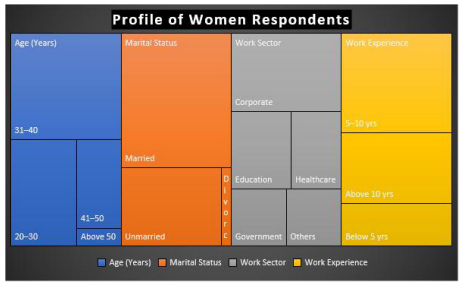
(Source: Research Result)
Figure 1: Profile of Women Employees
The majority of respondents belonged to the age group of 31–40 years (50%), indicating prime professional engagement. Most were married (63.3%), highlighting possible dual role pressures. Corporate sector respondents were the largest group.
|
Work–Life Balance Level |
Score Range |
Frequency |
Percentage |
|
Low |
Up to 30 |
30 |
20% |
|
Moderate |
31–44 |
80 |
53.30% |
|
High |
Above 44 |
40 |
26.70% |
|
Source: Research Result |
|||
Table 2: Women’s Work-Life Balance Score from Surat City
Over half (53.3%) reported moderate work–life balance, while 20% experienced low balance, and 26.7% had high balance. This indicates a majority struggling to fully harmonize work and personal life but not at extreme imbalance.
|
Support Mechanism |
Available (%) |
|
Flexible Work Hours |
70 (46.7%) |
|
Work from Home Options |
35 (23.3%) |
|
Childcare Leave |
50 (33.3%) |
|
Medical/Family Leave |
95 (63.3%) |
|
Supervisor Support |
90 (60%) |
|
Source: Research Result |
|
Table 2: Matrix of Organization Support and Work – Life balance
The Pearson correlation analysis reveals a statistically significant and positive association between organizational support mechanisms and perceived work–life balance among working women. Flexible work hours show a moderate positive correlation with work–life balance (r = 0.45, p < 0.01), indicating that greater flexibility in work schedules helps women better manage their professional and personal responsibilities. Supervisor support demonstrates the strongest positive relationship (r = 0.52, p < 0.01), highlighting the crucial role of empathetic leadership, guidance, and understanding in enhancing employees’ work–life balance. Additionally, work-from-home options exhibit a positive and significant correlation with work–life balance (r = 0.38, p < 0.05), suggesting that remote working opportunities contribute to reducing work–family conflict.
|
Marital Status |
Low |
Moderate |
High |
Chi-Square |
P Value |
|
Married |
25 |
50 |
20 |
12.34 |
0.02 |
|
Unmarried |
5 |
25 |
20 |
|
|
|
Source: Research Result |
|||||
Table 3: Relationship between marital status and work–life balance
Married women were more likely to report moderate or low balance, indicating that household responsibilities add to work conflict. Time management is pivotal for women with better scheduling, delegation, and boundary setting reported improved balance. Unmarried women reported higher balance. A majority (53.3%) reported moderate balance. This aligns with prior studies (Patel & Vyas, 2019) showing that urban working women experience fluctuating levels of harmony between work and personal lives. Role conflict remains pervasive, particularly among married women, reflecting sustained expectations of domestic responsibilities. Organizational policies, especially flexible hours and supervisor support emerged as significant determinants of better work–life balance. Human resource practices targeted at flexibility, family leave, and supportive leadership can alleviate pressures and enhance employee well-being. High stress levels signify an ongoing struggle to meet competing demands. Personal coping strategies such as effective time management, delegation of household tasks, use of support networks (family help, childcare), and stress-relief activities were beneficial. However, structural limitations limit how much individuals can adapt without external support.
Findings & Conclusion
The findings reveal that a significant proportion of working women experience only a moderate level of work–life balance, indicating ongoing challenges in effectively managing professional and personal responsibilities. Organizational support mechanisms, such as flexible working hours, leave provisions, and supportive workplace policies, play a crucial role in enhancing work–life balance. Moreover, effective time management skills and strong supervisor support emerge as key determinants of positive work–life integration, helping women cope with role demands more efficiently. The study also highlights that marital status and traditional societal role expectations significantly influence work–life balance levels, with married women facing comparatively greater pressures due to additional family responsibilities. Persistent stress, work overload, and limited personal and leisure time further underscore the challenges encountered by working women. Collectively, these findings suggest that achieving sustainable work–life balance requires not only organizational interventions but also broader societal changes aimed at redistributing domestic responsibilities and fostering a more supportive environment for working women.
Future Scope of Study
Based on the study that have been conducted, the researcher has found the below mentioned future scope of study.
• Comparative Studies: Future research can compare work–life balance across different urban centers or rural regions to discern contextual variances.
• Longitudinal Studies: Tracking changes over time will help understand evolving dynamics of work–life balance as workplaces adopt hybrid and flexible paradigms.
• Sector-Specific Analysis: Investigate unique challenges in sectors such as IT, manufacturing, education, healthcare, and government.
• Gender Comparative Research: Including male employees to compare gender-based differences in work–life balance perceptions.
• Intervention Studies: Implement and evaluate the effectiveness of specific organizational policies (flexi-time, remote work, childcare facilities).
• Qualitative Expansion: In-depth interviews and focus group discussions can provide richer insights beyond quantitative measures.
References
- Udaykumar, M. T. K. (2023). A STUDY OF WORK–LIFE BALANCE OF EMPLOYEES WORKING IN BANKING SECTOR IN GUJARAT STATE (Doctoral dissertation, GUJARAT TECHNOLOGICAL UNIVERSITY AHMEDABAD).
- MANDAVIYA, M. (2013). A STUDY ON PERCEPTION OF QUALITY OF WORK LIFE AMONG TEXTILE INDUSTRY WORKERS IN GUJARAT. CLEAR International Journal of Research in Commerce & Management, 4(8).
- Raval, N. (2023). The Labour Market Behaviour of Working-Age Women in Surat City. In Conference Proceedings of the International Conference on Women (Vol. 1, No. 1, pp. 42- 51).
- Patel, P., Rana, R. D., & Com, M.Academic andAdministrative Responsibilities as Determinants of Faculty Job Satisfaction: A Comparative Study of Self-Financed Commerce Colleges Affiliated to Veer Narmad South Gujarat University, Surat’.
- Batukbhai, R. N. (2014). AN APPROACH FOR POPULATION PROJECTION OF AN URBAN AREA: A CASE STUDY OF SURAT CITY (Doctoral dissertation, Gujarat Technological University).
- Kantor, P., Rani, U., & Unni, J. (2006). Decent work deficits in informal economy: Case of Surat. Economic and Political Weekly, 2089-2097.
- Chowdhury, S. R. (2021). Migration and city competitiveness: a comparative analysis with Surat as a special case. Vision, 25(4), 460-470.
- Desai, A. R., Desai, A. R., & D'Costa, W. (1994). State and Repressive Culture: A Case Study of Gujarat. Popular Prakashan.
- Singh, H., & Hanspal, M. G. (2023). GENDERED PERSPECTIVES OF MIGRATION TO GUJARAT: BEHIND THE NUMBERS. “The Deccan Geographer” Journal, 61(3),150-159.
- Agrawal, W. C. V. (2017). Work life Balance Strategies: Progress & Problems in Indian Organizations-Specific to Raising a Child (Doctoral dissertation, Doctoral dissertation, Gujarat Technical University).
- Agrawal, W. C. V. (2017). Work life Balance Strategies: Progress & Problems in Indian Organizations-Specific to Raising a Child (Doctoral dissertation, Doctoral dissertation,Gujarat Technical University).
- Nikam, K. (2019). Work-Life Balance and Organizational Citizenship Behavior as Concomitant of Organizational Ethics and Values: A Study of Information Technology Sector Employees (Doctoral dissertation, Maharaja Sayajirao University of Baroda (India)).
- Syed, S. M. (2021). Work Life Balance Issues and Strategies among Tourand Travel Agency Employees: An Empirical Study. Design Engineering, 7111-7131.
- Patel, C. J. J., & Raval, R. V. (2023). A STUDY ON VARIOUS REASONS OF EMPLOYEES’TURNOVER FROM STARTUPS.
- MALAYSIA, U. U. A. (2017). THE INFLUENCE 01''WORK RELATED FACTORS ON WORK LIFE BALANCE AMONG EMPLOYEE AT PERBADANAN PUTRAJAYA.
- Jayaram, N., & Varma, D. (2020). Examining the ‘labour’in labour migration: Migrant workers’ informal work arrangements and access to labour rights in urban sectors. The Indian Journal of Labour Economics, 63(4), 999-1019.
- Patel, V. (2017). Parents, permission, and possibility: Young women, college, and imagined futures in Gujarat, India. Geoforum, 80, 39-48.
- Shukla, N., Das, A., & Mazumder, T. N. (2025). Complexities of urban resilience in the global south: key insights from Surat city, India. Mitigation and Adaptation Strategies for Global Change, 30(6), 43.
- Das, B., & Sahu, G. B. (2019). Coping with cities and connecting with villages: Migrant workers in Surat city. The Indian Journal of Labour Economics, 62(1), 89-112.