



Research Article - (2025) Volume 10, Issue 2
A Qualitative Analysis of Anemia Management Among Adolescent Girls of Telangana Social Welfare Schools
2Telangana Social welfare residential schools, India
3Synergy India Foundation, India
4Department of Nutrition, St.Ann’s College for women, India
Received Date: Aug 21, 2025 / Accepted Date: Sep 18, 2025 / Published Date: Sep 23, 2025
Copyright: ©©2025 Sandhya NVS Dittakavi, et al. This is an open-access article distributed under the terms of the Creative Commons Attribution License, which permits unrestricted use, distribution, and reproduction in any medium, provided the original author and source are credited.
Citation: Dittakavi, S. N., Savitha, R. S., Prashanthi, R., Kumar, S. K., Kumari, P. (2025). A Qualitative Analysis of Anemia Management Among Adolescent Girls of Telangana Social Welfare Schools. Adv Nutr Food Sci, 10(2),1-09.
Abstract
Introduction: Anemia, a major public health issue in India, significantly affects adolescent girls, impacting their health, academic performance, and future reproductive health. Despite various government initiatives, the prevalence of anemia remains high. To understand the prevalence of anaemia in adolescent girls and to provide better solutions for managing anaemia at a very early stage a gap analysis study was conducted in the selected schools of Telangana social welfare residential schools.
Methodology: This study employs a qualitative approach, where Focus group discussions (FGDs) and in-depth interviews (IDIs) were conducted with key stakeholders, including state-level policymakers, health officers, regional health officers, and educational staff from selected districts. The selection was based on anemia performance indicators from NFHS-5 data, ensuring diverse socio-economic and geographical perspectives. COREQ checklist method was used to report the qualitative data.
Results: The study reveals critical gaps in the implementation of anemia control programs. Key issues include a lack of awareness about anemia's long-term health impacts, inadequate training for stakeholders, and poor monitoring and evaluation mechanisms. These gaps hinder the effectiveness of existing programs, resulting in persistently high anemia rates.
Conclusion: To address these gaps, the study recommends standardized protocols for managing anaemia, comprehensive training programs for stakeholders, enhanced awareness campaigns, and robust monitoring mechanisms. Improved implementation of anemia control measures such as standardized protocols, regular screening programs and creating awareness among stake holders, students and parents is crucial for better health outcomes.
Keywords
Anaemia, Adolescent Girls, School Health Programs, Nutritional Deficiency, Anaemia Management, Stakeholder Capacity Building
Abbreviations
WIFS: Weekly Iron and Folic Acid Supplementation
SABLA: Rajiv Gandhi Scheme for Empowerment of Adolescent Girls
TSWREIS: Telangana Social Welfare Residential Educational Institutions Society
ASHA: Accredited Social Health Activist
ICDS: Integrated Child Development Services
NRHM: National Rural Health Mission
Introduction
Koshkakaryan et al. 2015 suggests that micronutrient deficiency is common, usually aggravated by hunger and poverty among the populations, coupled with ignorance on proper nutritional habits, anaemia being one of the serious public health concerns. According to World Health Organization (WHO), anaemia is a condition with haemoglobin below typical levels for the given age, gender, and physiological conditions due to the deficiency of one or more basic nutrients - iron, folic acid, zinc, vitamin B12 and proteins. Roche et al. 2018 reviewed that iron deficiency anaemia is estimated to be the single most significant cause globally of morbidity and mortality in adolescent girls [1,2]. Physiological conditions like menstruation recurrent pregnancies due to childbirth with minimal time for the body to recuperate lead to reduced academic potential; decreased wellbeing and productivity at home or in the community and increased maternal and infant morbidity and mortality for adolescents who become pregnant. Anemia is estimated to contribute to 20% of maternal deaths. Children born to iron- deficient mothers are more likely to have low iron stores, to suffer from impaired physical and cognitive development, and to have suboptimal immune systems. Early-life iron status substantially influences human potential at the individual and country-level [3]. Despite having had an anaemia control program for 50 years, India has the highest burden of the disease. The lack of anaemia reduction in the country is surprising, considering India's rapid economic growth during the last 20 years. Anaemia rates are expected to decline approximately a quarter as fast as income increases [4]. According to NFHS-5, West Bengal and Gujarat had the highest prevalence of anaemia among adolescent girls. Almost 97% of the adolescent women in Ladakh in the 15 to 19 age group were anaemic, an increase from 81.6% during NFHS-4 (National Family health Survey). Among large states, the prevalence was the highest in West Bengal with 70.8%, up from 62.2% during NFHS- 4, followed by Gujarat with 69%. According to NFHS 5, anaemia in adolescent girls of Telangana is around 64.7%. It would be surprising to understand that anaemia in adolescent girls is as high as 79% in some parts of Telangana.
<img src=" https://www.opastpublishers.com/scholarly-images/9683-6925685c4502f-a-qualitative-analysis-of-anemia-management-among-adolescent.png" width="500" height="300">
From the statistics, it is very clear that Anaemia is most prevalent and Government of India, in association with many National nutritional institutes have designed various programs to alleviate anaemia. The National Nutritional Anemia Prophylaxis Program (NNAPP) was launched in 1972 during the 4th five-year plan in India with the aim to curb the prevalence of anemia. Weekly administration of iron and folic acid (WIFS) has been proved to be effective in several developed and developing countries (including those in the Southeast Asia Region) for prevention and management of IDA, among adolescents. Adolescents who are in school may be easier to reach through the school system while those not in schools could be reached through an adolescent-to- adolescent approach i.e., a school going adolescent reaches an out- of-school adolescent in the community [5]. Other schemes of the Ministry of Women and Child Development, like “Rajiv Gandhi Scheme for Empowerment of Adolescent Girls” (SABLA), in which supplementary nutrition is provided to adolescent girls in the form of take-home rations or hot cooked meals. Under SABLA, each adolescent girl will be given at least 600 calories and 18–20 grams of protein and the recommended daily intake of micronutrients, at Rs 5 per day per beneficiary, for 300 days in a year. The Ministry of Health and Family Welfare took a policy decision to develop the National Iron+ Initiative in which there will be a Weekly supplementation for adolescent girls (10–19 years).
Even though supplementation of diet with iron and folic acid (IFA) has been a part of Government of India programming for over three decades, the levels of IFA remain low according to the NFHS data. Hence, to understand the challenges and lacuna a situational analysis is essential. Situation Analysis is a preliminary assessment of a particular situation that is inter-connected with a project to be implemented in a particular geographic area. In other words, it is a scoping and analyzing process that helps the project team develop a shared understanding of their project’s context, which includes two factors to look at and analyze critically: internal factor/program and external factor/environment [6]. Adolescent health has not received attention as a priority public health issue in many countries, and existing interventions are often dispersed and fragmented. One of the main challenges faced is the scarcity of information about adolescent health issues and their determinants regarding related behaviours, risk factors, laws, legislation, policies, and programmatic responses. Scarcity of information and lack of data collection and analysis tools are the main challenges for the work of adolescent health programs as per WHO.
JL Beard (2000) revealed in his studies that the problem of anaemia is related to a wider population than the traditionally considered groups of pregnant and lactating females and children [7]. With the onset of menstruation and associated blood loss, there is a further rise in prevalence and severity of anaemia in adolescent girls. Brabin and Brabin (1992) revealed in their studies that Adolescent girls require continuous replacement of iron during menstruation [8]. There is the ‘vicious cycle of anaemia’ for women in India since girls are married and enter motherhood with poor iron status at very young ages. Barr et al, 1998, conducted a study on Reducing iron deficiency anaemia due to heavy menstrual blood loss in Nigerian rural adolescents and revealed that heavy menstrual bleeding, present in 12.1%, to be one of the most important contributing factors to iron deficiency anaemia [9]. Leenstra et al. 2004 conducted a cross-sectional study on prevalence of anaemia and iron deficiency revealed that malaria and schistosomiasis were the main risk factors for anemia in young adolescent girls [10].
In a study done by Andrea, 2016, the stakeholders’ roles were considered to be direct or indirect (i.e., subject matter experts and regulatory oversight), which would influence any program [11]. A stakeholder analysis was selected as an approach as it is a well- established method for identifying growth areas, gaps and critical persons who can influence policy. Effective training of these stakeholders can be beneficial as per WHO (Medium Strategic Plan, 2007) [12]. We can see a change in the work performance and efficiency, increased impact and a healthy community. It is the foundation for development of human resources. Poor training is a waste of resources. Evaluation depends upon the effect of training in terms of change in behavior in the workplace leading to improved performance of the organization.
Hence, the study is planned in such a way that the stakeholders responsible for the wellness of the anaemic girl child will be thoroughly interviewed, one on one or in groups to understand the lacuna and gaps in the execution of the program. Their knowledge attitude and practices would be analyzed in order to understand their skills in managing anaemic girl students in the social welfare hostels of Telangana state.

Figure 1: Need for Correcting Anaemia At Adolescent Age
Methodology
Study Population
Stratified random sampling method was used to select the study population group. Based on the Anaemia performance indicators, obtained from the Health Command centre and the NFHS 5 data, the districts were graded as good, moderate and poor, out of which 20% was selected from each category for the study. The selection criteria of the participants were in such a way that it includes all the social, geographical and economic insights of the current situation. A convenience sampling method was used to select the participants from the stratified groups. Various stakeholders include (the study population)
- i. State Level Policy Makers: Deputy Secretary, Health care officers, Training, and monitoring officers (of both sexes).
ii. Health Command Centre Staff: Project head, Doctors, Health care assistants and field staff (of both sexes).
iii. Regional Health Officers: Regional health and sanitation officers of 13 regions (of both sexes).
iv. Principals: One Principal from one revenue division of the selected districts.
v. Teachers: One teacher from one revenue division of the selected districts.
vi. Health Supervisors: One Health supervisor from one revenue division of the selected districts.
vii. Assistant Care Takers: One Assistant caretaker from one revenue division of the selected districts.
The tools and informed consent were prepared in English and the same was translated to local language (Telugu) to obtain the consent from eligible subjects, contains the complete details of the study procedure. The tools were validated by piloting them with the stakeholders directly who were not part of the study. Study subjects who are included in the study were informed on record of the Zoom session during the FGDs and IDIs. The details of the interviewer (Author1) were introduced to the participants in detail including their background information and the purpose of the interview.
Subject Eligibility Criteria
a. Inclusion Criteria: All stakeholders dealing with girls’ schools were included in the study (exception for state level officers, command centre staff and regional health officers). The age group of the girls studying in the Telangana Social welfare residential schools is 10yrs to 18 yrs.
b. Exclusion Criteria: All stakeholders dealing with boys’ schools were excluded from the study (exception for state level officers, command centre staff and regional health officers)
Methods
An extensive literature review helped in finalizing the protocol for the identifying the lacuna in the service provided by the stakeholders who are responsible for the wellness of the students at Telangana Social welfare residential schools. Various publications were reviewed, and it was understood that stakeholders play a major role in upgrading the process of implementation of any project in the public health systems. For example, a study in Iran, involved focus group discussion, semi-deep interviews with the participation of the target community of students, parents of students, school principals and school health instructors, general manager of the Office of Community Nutrition (Department of Education) including manager, deputy and school health officer, which conferred that, the Iron Supplementation Program requires intervention at individual, interpersonal, inter-organizational, and intra-organizational levels to provide comprehensive support for the program and, ultimately, increase program productivity [13]. Another study concluded the importance of policy making in implementation of Iron supplementation programs to increase the outreach and effectiveness of the program [14]. It is clearly understood that short term implementation programs without rigorous awareness, management and follow up programs end aggravating the situation. Maternal anaemia is still being followed up very closely since, the time period to improve Hb% is limited in such cases.
Since ethical approval was obtained, the details of the project were produced to the Secretary, Telangana Social welfare residential schools in March 2022. Various stakeholders from the state level were selected and in-depth interviews were conducted for the selected stakeholders. Additional in charge for School health program, trainings and Programs were interviewed separately to identify the gaps in implementation of Anaemia programs. The doctors and the Health Assistants working for School Health Program have been interviewed individually. Based on the performance indicators of NFHS, School Health program, socio economic and cultural backgrounds of the districts, 7 of total 33 districts were selected under the category of Good, Moderate and poor performing districts. From each district around 2 – 3 stakeholders of each category (Principals, Teachers, Health Supervisors and Assistant Care Takers) have been selected for conducting Focus group discussions (April 2022). The flow of the study is thus followed as:
Process Followed to Conduct the Gap Analysis
1. Selection of the districts with the help of anaemia indicators from the data provided by Health Command centre of the schools and latest NFHS.
2. Preparation of discussion prompts, focus group questionnaires, and consent form for FGD, develop sampling strategy and in- depth interview guide.
3. Conducted In-depth interviews with the State level officers who were involved in policy making.
4. Conducted In-depth interviews with the Doctors and Health assistants of the Health Command centre.
5. Conducted Focus group discussions with the regional health officers, principals, teachers, health supervisors and assistant care takers from the selected districts.
Ethical Approval
Protocol was presented, discussed and reviewed by the Institutional Ethical Committee of JSS College of Pharmacy, Mysore at its meeting held on 25.03.2022 and the same has been cleared and approved on 26.03.2022 at Seminar Hall, Department of Paediatrics, JSS Hospital, Mysuru.
Data Analysis
COREQ (Consolidated criteria for reporting qualitative research) checklist was used for the analysis of the collected data [15]. The collected data was transcribed, translated and coded for detailed analysis. The thematic codes were derived from the prepared tools and were used for analysis.
Results and Discussion
Understanding the prevailing situation in managing the adolescent Anaemic children in the residential schools and creating protocols to identify, treat and follow up will be helpful in alleviating as well as stopping the reversal of anaemia. Anaemia is clearly a national burden as per many researchers and a strong policy making with simplified protocols is the need of the hour. The graph illustrates the total number of recorded anaemia cases across schools. It shows that there was an increase in the number of cases in 2020- 21 compared to 2019-20. However, it is noteworthy that there was a significant decrease in the number of moderate cases in 2019-20 compared to 2018-19.

Figure 2: Total number of Anaemia cases recorded in SIF note in three years
The increasing number of identified anaemia cases and irregular patterns of identification over the years suggests the need for understanding the gaps and creating standardized procedures for monitoring anaemia across the schools.
Qualitative Analysis
Sample districts were selected based on their performance indicators. Taking various anaemia indicators into consideration from sources like NFHS the selection of the study districts were made. Also considering their geographical parameters to represent the diversity of the state, the selection of the districts for the study was made. The selection criteria is explained in the below Table 1.
|
|
All women age 15-19 years who are anaemic (%) |
Children age 6-59 months who are anaemic (<11.0 g/dl) |
All women age 15-49 years who are anaemic |
Points given for All women age 15-19 years who are anaemic (%) |
Points given for Children age 6-59 months who are anaemic (<11.0 g/dl) |
Points given for All women age 15-49 years who are anaemic |
Total Score |
|
|
Komaram bheem asifabad |
74.5 |
70.7 |
67.3 |
1 |
1 |
1 |
3 |
Poor |
|
Jogulamba Gadwal |
66.9 |
82.4 |
64.6 |
1 |
1 |
2 |
4 |
Poor |
|
Vikarabad |
62 |
70 |
61 |
2 |
1 |
2 |
5 |
Moderate |
|
Nizamabad |
65.2 |
65.3 |
57 |
1 |
2 |
3 |
6 |
Moderate |
|
Khammam |
61.7 |
60.5 |
62.4 |
2 |
3 |
2 |
7 |
Better |
|
Siddipet |
76.6 |
63.5 |
56.7 |
1 |
3 |
3 |
7 |
Better |
|
Warangal Urban |
54.9 |
67 |
57.9 |
3 |
2 |
3 |
8 |
Better |
|
Adilabad |
68 |
76.3 |
61.1 |
1 |
1 |
2 |
4 |
Poor |
|
Badradri Kothagudem |
79.3 |
69.3 |
68.7 |
1 |
2 |
1 |
4 |
Poor |
|
Karimnagar |
73.2 |
70.8 |
61.1 |
1 |
1 |
2 |
4 |
Poor |
|
Mahabubabad |
70.3 |
81.1 |
62.8 |
1 |
1 |
2 |
4 |
Poor |
|
Peddapalli |
78.3 |
69.6 |
64.6 |
1 |
2 |
2 |
5 |
Moderate |
|
Jayshankar bhupalapally |
64.9 |
67.9 |
65.9 |
2 |
2 |
1 |
5 |
Moderate |
|
Kamareddy |
65.5 |
71.6 |
58.9 |
1 |
1 |
3 |
5 |
Moderate |
|
Wanaparthy |
65.2 |
75.3 |
58.7 |
1 |
1 |
3 |
5 |
Moderate |
|
Mahabubnagar |
61.2 |
82.6 |
54.7 |
2 |
1 |
3 |
6 |
Moderate |
|
Nagarkurnool |
62.1 |
75.1 |
54 |
2 |
1 |
3 |
6 |
Moderate |
|
Nalgonda |
60.6 |
74.5 |
54.3 |
2 |
1 |
3 |
6 |
Moderate |
|
Suryapet |
64.5 |
76.6 |
57.5 |
2 |
1 |
3 |
6 |
Moderate |
|
Warangal rural |
64.3 |
71.5 |
59.3 |
2 |
1 |
3 |
6 |
Moderate |
|
Jagithial |
66.2 |
59.9 |
56.3 |
1 |
3 |
3 |
7 |
Better |
|
Medak |
57.7 |
70 |
54.4 |
3 |
1 |
3 |
7 |
Better |
|
Hyderabad |
70.6 |
63.6 |
52.7 |
1 |
3 |
3 |
7 |
Better |
|
Medchal malkajgiri |
56.1 |
73.8 |
56.8 |
3 |
1 |
3 |
7 |
Better |
|
Rajanna Sircilla |
61.4 |
65.7 |
56 |
2 |
2 |
3 |
7 |
Better |
|
Ranga Reddy |
58 |
75.8 |
53.2 |
3 |
1 |
3 |
7 |
Better |
|
Yadadri Bhuvanagir |
60.1 |
65.3 |
53.8 |
2 |
2 |
3 |
7 |
Better |
|
Jangoan |
58.8 |
69.5 |
57.5 |
3 |
2 |
3 |
8 |
Better |
|
Nirmal |
57.3 |
65.3 |
57.7 |
3 |
2 |
3 |
8 |
Better |
|
Mancherial |
62.3 |
58.7 |
56.7 |
2 |
3 |
3 |
8 |
Better |
|
Sangareddy |
59.5 |
67 |
48.3 |
3 |
2 |
3 |
8 |
Better |
|
|
|
|
|
Scores: upto 60% = 3 = Good ; upto 65% = 2 = Moderate; Above 65% = 1 = Poor |
|
|||
Table 1: Selection of The Sample Districts Based on Their Performance (NFHS 5 Data)
Focus Group Discussions (FGDs) and In-Depth Interviews (IDIs) were conducted with various stakeholders responsible for the healthcare of children in schools. The IDIs were conducted one- on-one, while the FGDs were held via the online platform ZOOM. Each IDI lasted approximately 30 minutes, and each FGD took around 60 minutes. The one-on-one IDIs were audio recorded using mobile phones, and the online FGDs were recorded on the platform, simultaneously notes were taken for the same by Author1. The list of the interviewed stake holders is given below:
- 8 IDIs were conducted with State level offices (4) and Doctors (4) working at the Health Care Centre, Panacea.
- 16 FGDs were conducted with a total of 54 stakeholders
1. 3 batches of 11 RHSOs (Regional Health and Sanitation Officers), (Across Telangana)
2. 3 batches of 10 Teachers (from 7 districts – Kumarambheem Asifabad, Jogulamba Gadwal, Nizamabad, Siddipet, Vikarabad, Khammam, Warangal)
3. 3batchesof9Principals(from7districtsKumarambheemAsifabad, Jogulamba Gadwal, Nizamabad, Siddipet, Vikarabad, Khammam, Warangal)
4. 3 batches of 10 Health Supervisors (from 7 districts Kumarambheem Asifabad, Jogulamba Gadwal, Nizamabad, Siddipet, Vikarabad, Khammam, Warangal)
5. 1. batch of 4 Health Assistants
6. 3 batches of 10 Assistant Care Takers (from 7 districts Kumarambheem Asifabad, Jogulamba Gadwal, Nizamabad, Siddipet, Vikarabad, Khammam, Warangal)
All the interviews were recorded. Transcriptions and codes were made for the completed FGDs and IDIs using the COREQ checklist. From the selected districts various stakeholders were identified for IDIs and FGDs. All the selected participants were approached over phone and have given their consent for the participation in the study. There were no dropouts, or no participant refused to participate in the study. Thematic codes were derived initially from the prepared tools related to the strengths, timely identification, management of anaemia, novel initiatives, challenges were used to analyse the data.
SWOT Analysis of The Qualitative Data
Strengths - Initiatives:
From the interviews conducted it has been understood that there have been many initiatives in the TSWREIS schools which are made very efficiently to monitor the health of students on regular basis. These initiatives will be very helpful in implementation of various studies, programs or awareness campaigns. Some of these initiatives are listed below.
• Sif Note: Sif note initiated by Synergy India foundation in association with Govt of Telangana, is an app which can be downloaded in the smart phones of the Health supervisors present in each school. Sif note also has user IDs for the doctors and the officials. So, when a student gets sick, the Health supervisor uploads the condition into the Sif note and a notification is reached to the Doctor present in the Health command centre. The doctor either replies back in the app and/or calls the Health supervisor and guides her/him on the appropriate treatment procedures. This initiative has been in place for more than 8 years now and has been a lifesaving program in many emergency and chronic situations.
• Health Leaders: This is a school level initiative where, the school selects few students to be health leaders who are responsible for checking the health and sanitation of the students in their residential school. They daily check on hand washing areas, report sick students to the health centre and ensure proper sanitation around the school and dormitory.
• Lifesaving Group Meets: The health leaders and some selected teachers make a Lifesaving group and meet weekly twice or thrice and discuss about the healthy habits of the students, management and identification of the sick students, continuous care being provided to students with chronic disorders etc,. This initiative is helpful in following up of students suffering from various health problems and maintaining the health and sanitation of the students studying at the school.
• Healthy Tuesday: Every Tuesday is followed as Healthy Tuesday in the schools and various health, nutrition and sanitation related topics are discussed in the assembly to create awareness in the students. Anaemia has been discussed very often in these Healthy Tuesday sessions.
• Special Diet: When a student is identified as anaemic, be it mild, moderate or severe, schools are providing some extra diet to such students. The diet is not uniform across the state but the schools do provide special diet to the children with such chronic disorders.
• Buddy Pair: All the students in the class are made into pairs called Buddy pairs. These buddies track and trace each other, in their education, health, sanitation and safety. They are supposed to know whereabouts and how-a-bouts of their buddy so that it becomes easier for the class teachers and staff to know the well-being of the students in th residential school
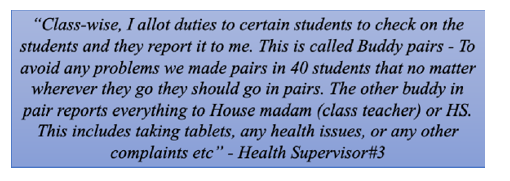
• Yoga and Exercise Daily: As per the scheduled timetable of the students in the hostels, they have a specific time for yoga and exercise every day and all the students are supposed to attend the daily yoga and exercise.
Weakness – Challenges
• Delay in Identification: Identification has been an issue in many schools majorly due to lack of regular screenings and skills in identification. All the stakeholders stated that they do ask the children to get their Hb tested before coming to the school from their nearest PHC. Some children get it done and some do not. Also, very few health supervisors know about the Rashtriya Bal Swasthya Karyakram (RBSK) program, where the RBSK team screens all the students in the school. This is done once or maximum twice a year. But many school staff including the principals are not aware of this scheme.
• Quality of Food: Quality of the food is not uniform and is varied in various districts and schools. Menu and the quantity of the food provided is more or less the same in the schools, but when it comes to quality it needs to be uniform and of high standard, which is currently a challenge.
• Lack of Uniform Procedures: Non-uniform methods of identification, management and treatment of Anaemic stu- dents is one of the major problems. Most of the teachers and principals are not aware of the physical signs and symptoms of Anaemia. Even health supervisors who have a background of basic medical knowledge have different opinions about identification, treatment and management of Anaemia.
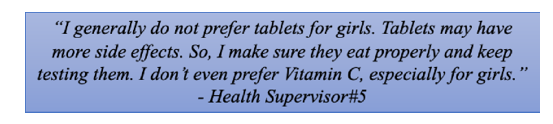
• Poor Eating by the Students: It has been a common com- plaint from all the cadres of the health care staff that most of the girls do not eat properly. When asked about the reason, it was understood that the reasons could be taste of the food, lack of appetite, quality of the food etc. Most health staff think this could be a major reason for many students suffering from anaemia.
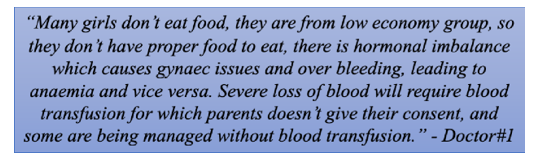
• Not Identifying Girls with Heavy Bleeding: Girls with heavy bleeding either do not report to the health supervisors about it or it is not being noted or treated properly. This is one more challenge which is basically leading to increase in num- ber of anaemia cases in the girl students.
Opportunities - Probable Solutions
• Regular Screening for All the Students: There are many resources which can be used in performing regular screenings for the students including RBSK, SIF, PHC, Digital Hemoglo- binometer (being used by HS in some schools) etc.
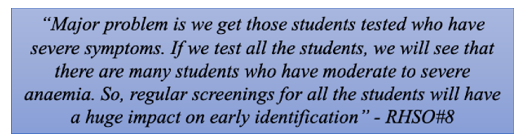
• Maintaining Quality of The Food: Fortification of food with superfoods will increase the amount of micronutrients present in the food. Superfoods which are available naturally like Mo- ringa, sesame, peanut, spirulina etc can be added to the daily food to maximize the amount of micronutrients prent in the food given to the students. Also, sourcing food from a single place uniformly across the schools can help in maintaining the quality of the food and also can be helpful in sourcing the food materials at a cheaper price.
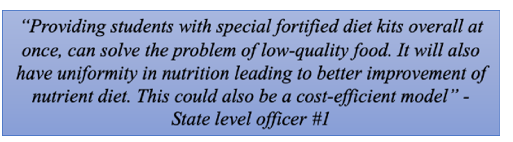
• Protocol Designing and training: Special training programs for the healthcare staff with protocols designed to have uni- form methods of identification, treatment and management across the schools will help in alleviating anaemia and having standard management systems for the future.
• Awareness for students: Importance of having good Hb lev- els needs to be addressed to the students in order for them to realize that this will not just solve their health but concentra- tion and focus problems. Awareness camps for the students to make them understand the side effects and future implications of Anaemia is recommended.
Threats - Possible barriers
• Lack of uniformity in the treatment and food provided can have a greater influence on the outcomes in reducing anaemia.
• Lack of very strict follow up will lead to long term anaemia ending up as maternal Anaemia. This has some fatal side ef- fects during maternity and hence adolescence is the correct age to resolve the issue. (80% of maternal deaths due to Anae- mia in Southeast Asia).
• Misconceptions about blood transfusion during emergency.
• Severe anaemia leading to academic loss of the students.
Conclusion
Despite the existence of national initiatives like the Weekly Iron and Folic Acid Supplementation (WIFS) and the SABLA pro- gram, the prevalence of anaemia remains high due to factors such as inadequate awareness, insufficient training for stakeholders, and poor monitoring and evaluation mechanisms.
The results of the study emphasize the necessity for standardized protocols to manage anaemia, comprehensive training programs for stakeholders, enhanced awareness campaigns, and robust monitoring systems. The results also underscore the importance of regular screening and follow-up programs to ensure early detection and treatment of anaemia, which is crucial for improving the health outcomes of adolescent girls. By addressing these gaps and implementing the recommended measures, it is possible to significantly reduce the prevalence of anaemia and improve the overall health and academic performance of the affected population.
In conclusion, the results provide valuable insights into the chal- lenges and solutions for managing anaemia among adolescent girls, calling for a coordinated effort to implement effective and sustainable anaemia control measures. Research on the role of diet diversification and food fortification in conjunction with supple- mentation programs may also provide comprehensive strategies for anaemia reduction. Ultimately, future studies should aim to develop a holistic and sustainable model for anaemia management that can be scaled and adapted across different contexts.
Acknowledgements
The author would like to thank Shri Ronald Rose, IAS, Ex-Sec- retary, TSWREIS for providing us a platform to work upon. We thank Mr. Saamerla Kiran, Project Head, Panacea, Dr. Meena Pa- tangay, HOD, St. Ann’s College, and Dr. Swathi, Panacea, who have been supportive with their comments and suggestions.
Conflict of interest
The authors declare they have no conflicts of interest.
References
- Koshkakaryan, M. (2015). Assessment of current surveillance system of anemia among children 9-12-months old in Arme- nia (Doctoral dissertation).
- Roche, M. L., Bury, L., Yusadiredja, I. N., Asri, E. K., Pur-wanti, T. S., Kusyuniati, S., ... & Izwardy, D. (2018). Adoles- cent girls’ nutrition and prevention of anaemia: a school based multisectoral collaboration in Indonesia. bmj, 363.
- Bailey, R. L., West Jr, K. P., & Black, R. E. (2015). The epide- miology of global micronutrient deficiencies. Annals of nutri- tion and metabolism, 66(Suppl. 2), 22-33.
- Nguyen, P. H., Scott, S., Avula, R., Tran, L. M., & Menon,P. (2018). Trends and drivers of change in the prevalence of anaemia among 1 million women and children in India, 2006 to 2016. BMJ global health, 3(5), e001010.
- Dittakavi, S. N., Savitha, R. S., Kumar, S. K., & Kumari, P. Assessing the Knowledge, Attitudes, and Practices of KeyStakeholders in Anaemia Management among Adolescent Girls in Social Welfare Schools.
- Saxena, D., Yasobant, S., & Golechha, M. (2017). Situational analysis of sickle cell disease in Gujarat, India. Indian Journal of Community Medicine, 42(4), 218-221.
- Beard, J. L. (2000). Iron requirements in adolescent females.The Journal of nutrition, 130(2), 440S-442S.
- Brabin, L., & Brabin, B. J. (1992). The cost of successful ado- lescent growth and development in girls in relation to iron and vitamin A status. The American journal of clinical nutrition, 55(5), 955-958.
- Barr, F., Brabin, L., Agbaje, S., Buseri, F., Ikimalo, J., & Briggs, N. (1998). Reducing iron deficiency anaemia due to heavy menstrual blood loss in Nigerian rural adolescents. Pub- lic Health Nutrition, 1(4), 249-257.
- Leenstra, T., Kariuki, S. K., Kurtis, J. D., Oloo, A. J., Kager, P. A., & ter Kuile, F. O. (2004). Prevalence and severity of ane- mia and iron deficiency: cross-sectional studies in adolescent schoolgirls in western Kenya. European journal of clinical nutrition, 58(4), 681-691.
- Ramírez, A., Velasco, S., Bernal, O., Vera-Chamorro, J. F., & Olagnero, G. (2016). Situational analysis and expert evalua- tion of the 1000 days: Nutritional and health status in 4 coun- tries in Latin America. Health, 8(5), 444-455.
 . 2011). WHO Medium-Term StrategicPlan 2008-2013 and Proposed Programme Budget 2012-2013.
- Alami, A., Zarei, F., Tehrani, H., Hosseini, Z., & Jafari, A. (2019). Perceived challenges of the Schools Iron Aid National Plan from stakeholder perspectives.
- Ferreira, H. S., Vieira, R. C. S., Livramento, A. R. S., Doura- do, B. L. L., Silva, G. F., & Calheiros, M. S. C. (2021). Prev- alence of anaemia in Brazilian children in different epidemi- ological scenarios: an updated meta-analysis. Public health nutrition, 24(8), 2171-2184.
- Tong A, Sainsbury P, Craig J. Consolidated criteria for report- ing qualitative research (COREQ): a 32-item checklist for in- terviews and focus groups. International Journal for Quality in Health Care. 2007. Volume 19, Number 6: pp. 349 – 357