

Archivos de Ciencia e Investigación(ADCI)
ISSN: 3068-014X | DOI: 10.33140/ADCI


Research Article - (2026) Volume 2, Issue 1
A Purely Analog Electronics Circuit for Computing Derivatives and Integrals with Respect to Any Variable
Received Date: Dec 03, 2025 / Accepted Date: Jan 28, 2026 / Published Date: Jan 30, 2026
Copyright: ©2026 Aris Skliros, et al. This is an open-access article distributed under the terms of the Creative Commons Attribution License, which permits unrestricted use, distribution, and reproduction in any medium, provided the original author and source are credited.
Citation: Skliros, A. (2026). A Purely Analog Electronics Circuit for Computing Derivatives and Integrals with Respect to Any Variable. Arch Cienc Investig, 2(1), 01-05.
Abstract
This paper introduces an innovative Analog electronics circuit designed to compute derivatives and integrals of a function with respect to any variable, extending beyond the conventional limitation to time-based operations. Unlike traditional Analog computers, which rely on time-dependent differential equations, this design utilizes operational amplifiers, diodes, and other Analog components to perform precise computations without requiring digital differential analyzers. By integrating a time derivative circuit, a multiplier, an integrator, and a function inverter, the proposed circuit addresses a broader class of dif- ferential problems. This work provides theoretical analysis, detailed circuit schematics, and component specifications to substantiate the approach, marking a significant advancement in Analog computing by broadening its scope to non-temporal systems.
Keywords
Analog Computing, Operational Amplifiers, Derivatives, Integrals, Circuit Design
Introduction
Analog electronic computing has traditionally been confined to solving differential equations with respect to time, employing integrators and differentiators optimized for temporal variables. This limitation has often forced reliance on digital differential analyzers for computations involving other variables, undermining the elegance of pure Analog solutions. This paper proposes a novel circuit that computes derivatives and integrals with respect to any variable using exclusively Analog components, including operational amplifiers, diodes, resistors, capacitors, and inductors By eliminating digital approximations, this design delivers precise, purely Analog results. The proposed circuit bridges a critical gap in Analog computing, enabling direct solutions across diverse domains. This paper outlines the methodology, presents schematics and explores the thereotical foundation offering a resource for researchers and engineers in Analog electronics
Related work
Previous efforts in Analog computing, as detailed by Ulmann, have predominantly focused on time-based operations. Conventional Analog systems compute integrals like f (t) dt and derivatives such as df(t) , restricting their utility to temporal dynamics [1-3]. For non- time variables, hybrid systems incorporating digital differential analyzers were typically employed, introducing complexity and discretization errors. This work builds on foundational Analog circuits (e.g., adders, multipliers) while introducing a novel configuration that generalizes differentiation and integration without digital assistance.Methodology
Circuit Overview
The proposed circuit leverages time-based Analog operations and function inversion to compute integrals and derivatives with

Integral Computation
To compute:
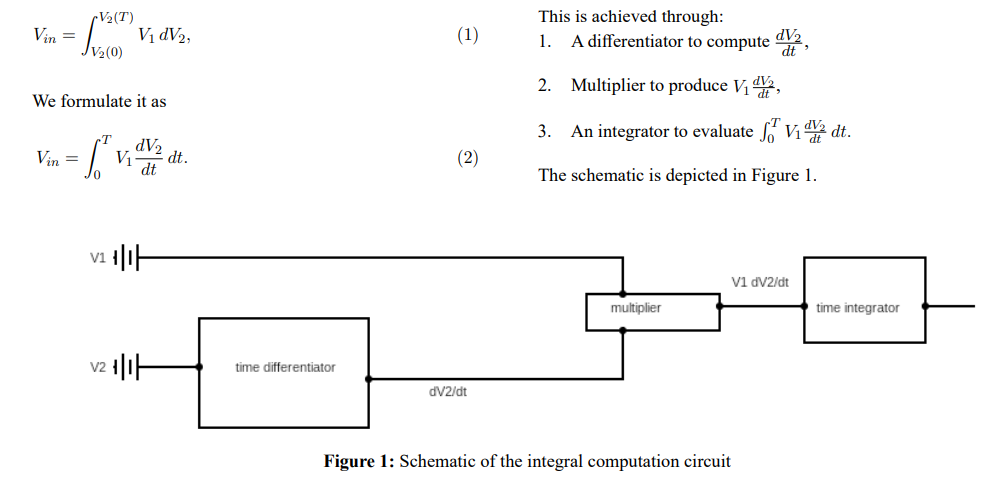
Legend: Diagram illustrating the basic layout and key components of the electronic circuit designed for integral computation. (File: SchematicOfIntegral.png)
A detailed view of the circuit, including all electronic components, is provided in Figure 2.
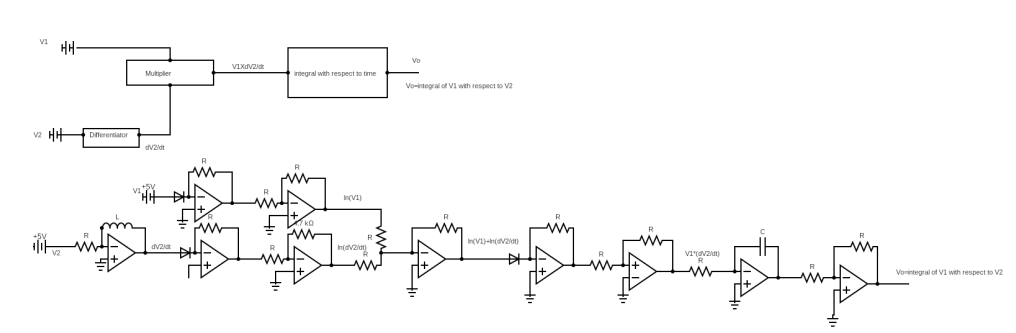
Figure 2: Detailed schematic of the integral computation circuit
Legend: Expanded view of the integral computation circuit, showing all electronic components and their connections in detail. (File: Integral with respect to variable.png)
Theoretical Foundation
Corollary 0.1. Let f be continuous and V (t) differentiable. Then:


Derivative Computation
The derivative computation builds on the integral circuit from Section 3.2 and incorporates an inverse function mechanism. The inverse circuit operates as follows (Figure 3):
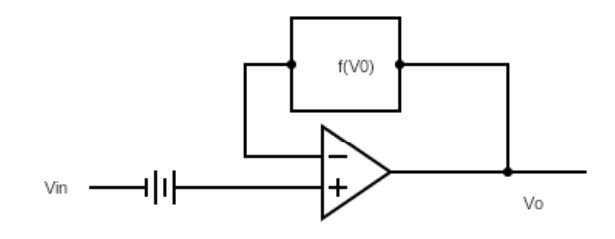
Figure 3: Inverse function circuit diagram
Legend: Schematic representation of the electronic circuit designed to compute the inverse function, highlighting its core structure.
(File: finverse.png)
Using Kirchhoff’s Voltage Law:
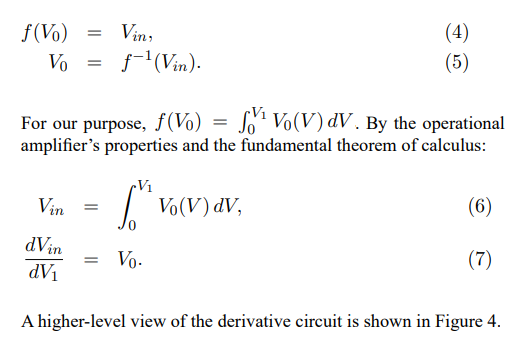
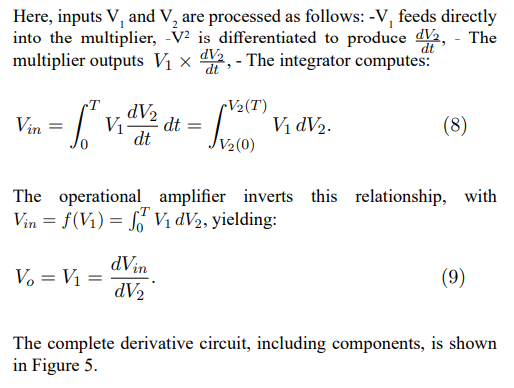
Component Requirements
Derivative Circuit: 3 voltage sources, 12 op-amps, 3 diodes, 1 capacitor, 1 inductor, 17 resistors. Integral Circuit: Same as above, minus 2 op-amps, 2 resistors, and 1 battery.
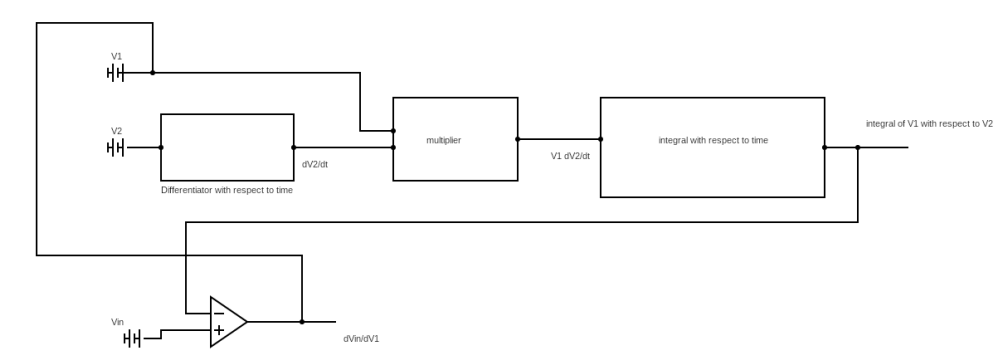
Figure 4: Summary of the derivative computation circuit
Legend: Overview diagram of the electronic circuit used for derivative computation, summarizing its primary components and layout. (File: summaryderivativecircuit.png)

Figure 5: Detailed schematic of the derivative computation circuit
Legend: Comprehensive view of the derivative computation circuit, including all electronic components and their interconnections. (File: DerivativeWithRespectToVariable.png)
Results and Discussion
The proposed circuit accurately computes integrals and derivatives with respect to any variable, as verified by theoretical analysis and schematic design. Unlike traditional methods, it avoids finite difference approximations, delivering exact analog solutions. Potential inaccuracies in logarithmic/antilog stages, as noted in [1], can be minimized using high-precision components.
Conclusion
This paper introduces a purely analog circuit that extends
Circuit Components
A.1. Multiplier Circuit
The multiplier employs logarithmic and antilog circuits (Figure 6).
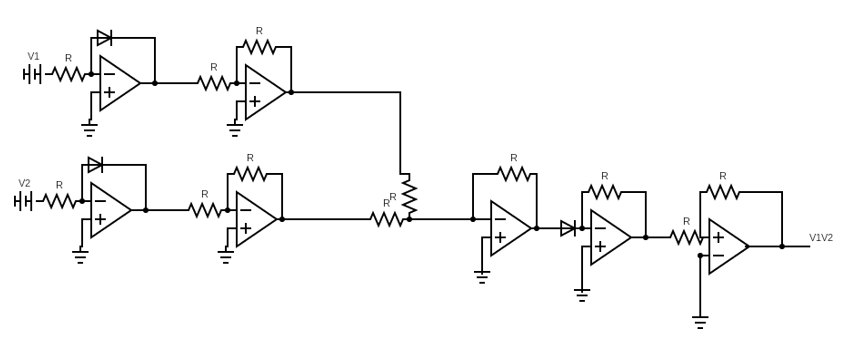
Figure 6: Multiplier circuit diagram
derivative and integral computations beyond time-based systems, advancing the field of analog computing. Future research could focus on practical implementations and performance comparisons with hybrid systems.
References
- Ulmann, B., Analog Computing, Oldenbourg Verlag, ISBN 978-3-486-72897-2.
- Ulmann, B., Analog Computer Programming, ISBN 9781978201934.
- Ulmann, B., Analog and Hybrid Computer Programming, De Gruyter, ISBN 978-3-11- 066207-8.