

Journal of Oil and Gas Research Reviews(JOGRR)
ISSN: 2993-3617 | DOI: 10.33140/JOGRR
Impact Factor: 0.7

Research Article - (2026) Volume 6, Issue 1
A New Approach of Crude Oil Demulsification
 and Anvar Movsumzada
 Received Date: Apr 06, 2026 / Accepted Date: May 08, 2026 / Published Date: May 19, 2026
Copyright: ©2026 Orkhan Nabizada, et al. This is an open-access article distributed under the terms of the Creative Commons Attribution License, which permits unrestricted use, distribution, and reproduction in any medium, provided the original author and source are credited.
Citation: Nabizada, O., Movsumzada, A. (2026). A New Approach of Crude Oil Demulsification. J Oil Gas Res Rev, 6(1), 01-06.
Abstract
This study investigates and proposes a novel approach for crude oil demulsification by employing a laboratory-scale reservoir model designed to simulate real reservoir conditions. Two distinct injection scenarios were examined to evaluate the effectiveness of chemical-assisted demulsification. In the first case, conventional produced water was utilized as the injected fluid to serve as a baseline for comparison. In the second scenario, the produced water was blended with varying concentrations of a selected chemical demulsifier and then injected into the reservoir model. This comparative approach enabled the evaluation of how demulsifier concentration influences both emulsion stability and oil recovery performance. Experimental results clearly demonstrated that the introduction of chemical demulsifiers into the produced water significantly improved in-situ emulsion destabilization. This enhancement resulted in a noticeable increase in oil recovery efficiency and a reduction in the free water content of the recovered product within the same operational period. Furthermore, the study identified optimal demulsifier concentrations that achieved maximum demulsification efficiency while minimizing overall chemical consumption. The findings indicate that incorporating chemical demulsifiers into the water injection process not only enhances subsurface separation but also enables the direct reinjection of produced water into the reservoir. This practice can minimize the need to transport large volumes of crude oil emulsions to onshore processing facilities, thereby reducing operational expenditures (OPEX) and improving overall field profitability.
Keywords
Demulsification, In Situ Demulsification, Petroleum Emulsions, Reservoir Model
Abbreviations
O/W Oil in Water Emulsion
W/O Water in Oil Emulsion
PR Polyoxyethylene Polyoxypropylene Quaternized Polyoxyolefins
ND-12 Specific Demulsifier for Oily Rocks of Azrbaijan Republic
Introduction
It is well known that oil industry suffers from the existence of crude oil emulsion from the beginning of petroleum extraction in the world. While it did not attract a lot of attention in the first exposures, it became a major challenge for the next steps of oil refining activities by making visible problems like corrosion, increased resident time in separators, handling large amount of water content and so on [1]. A considerable body of literature has demonstrated that various reservoir parameters contribute to the formation and stability of crude oil emulsions. Among these, the chemical composition of crude oil particularly the presence of aromatic compounds, naturally occurring surface-active agents, and other related components has been well established as a determining factor [2-5]. However, despite extensive research in this area, most studies have primarily focused on identifying the optimal chemical composition of demulsifiers required for breaking crude oil emulsions. In contrast, there is a noticeable scarcity of studies addressing the selection of the appropriate location for demulsifier application within the production system. The limited available literature mainly considers factors such as mixing intensity and turbulence, typically beginning from the bottomhole region [6,7]. Consequently, the application of demulsifiers has conventionally been carried out at three main points: the bottomhole, the wellhead, and the separator. In our proposed approach, however, and in line with observations made by several researchers, the potential pre-existence of emulsions within the reservoir itself has been taken into account [8]. From an economic and operational standpoint, we suggest based on experimental evidence that adding demulsifiers directly to the injection water used for reservoir pressure maintenance may represent a more effective and efficient strategy.
It should be noted that, in the petroleum industry and particularly in the context of crude oil production in the Republic of Azerbaijan, the predominant type of emulsion encountered is the water-in-oil type [9]. Consequently, the present research has primarily focused on this emulsion type, and the crude oil emulsions used in the experimental studies were also of the water-in-oil type. Although a number of scientific studies exist in the oil industry practice regarding the selection of the injection point of the demulsifier, the final injection point is generally known to be the bottom¬hole zone. This new approach was previously proposed by Mr. Abbas Firoozabadi, but there are several differences between his approach and ours. The main difference between them is both the comparative analysis and the introduction of a new factor — the demulsifying factor.
Materials and Methods
The experiments were conducted under laboratory conditions at room temperature. The model reservoir was prepared in a cylindrical glass tube, which mimicked the experimental medium. The glass tube had a length of 70 cm and an internal diameter of 5 cm. Initially, reservoir sand was packed into a cylindrical glass cell according to the dimensions corresponding to the similitude (auto-model) region characterizing the reservoir model [10]. Then, the model was saturated with various crude oil samples in emulsion form. Subsequently, formation water with different demulsifier concentrations was injected into the model, and the displacement process was carried out. For the experiment, one test was performed for each crude oil sample taken mainly from Azerbaijan’s Caspian Sea oil fields named the Chiraq, Azeri, and Guneshli oil fields. To determine the optimal demulsifier concentration for each crude oil sample, five experiments were conducted, resulting in a total of fifteen experiments. The reservoir sand, crude oil, and formation water used in the tests were all obtained from wells belonging to the respective oil formations. At the end of the experiments, the ASTM D95 method was used to determine the water content percentage of the produced fluids. The demulsifier composition used for these experiments are ND-12 special for Azerbaijan oil fields. Based on a comperative study, it was selected out of two demulsifier samples [11].

Figure 1: Displacement of Water by Oil in a Water Wet Layer
The oil samples are injected into the glass filled and packed with formation sandstones shown in figure 1. When the oil started to drop down from the outlet of glass, it was assumed the model is fully saturated with oil and ready for sweeping operation.
Figure 2 shows how the demulsifier solution is injected into model. It is elevated high to make a hydraulic pressure to let the water enter the reservoir model.
Before starting the experiment, both the emulsified oil and demulsifier solution is mixed around 5 minutes to make sure that they are homogenous enough. That was done by a magnetic mixer shown in figure 3.

Figure 2: Demulsifier in Injected Water
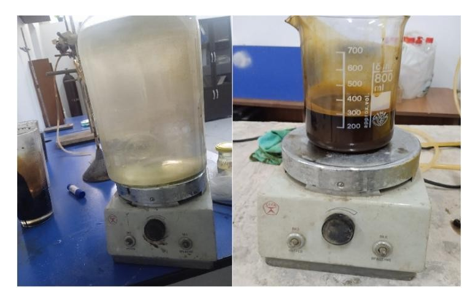
Figure 3: Mixing of Both Bemulsifier Solutions, and Emulsion
For all three petroleum products under consideration, the chemical demulsification process was conducted using five different demulsifier concentrations (75, 60, 50, 35, and 20 ppm). It was determined that the optimal demulsifier concentration is 50 ppm. The tables below present the total collected volume, the volume of free water, and the volume of oil for each product within the same intervals.
|
S.i |
Time intervals (min) |
Total collected volum(ml) |
Voil (ml) |
Vwater(ml) |
|
1 |
20 |
50 |
10 |
40 |
|
2 |
6 |
50 |
5 |
45 |
|
3 |
4 |
50 |
2 |
48 |
|
4 |
3 |
50 |
1.5 |
48.5 |
Table 1: Sweeping Process of Azeri Oil Field Product With 50 Ppm Demulsifier Solution
|
S.i |
Time intervals (min) |
Total collected volum(ml) |
Voil (ml) |
Vwater(ml) |
|
1 |
18 |
50 |
14 |
36 |
|
2 |
6 |
50 |
8 |
42 |
|
3 |
4 |
50 |
5 |
45 |
|
4 |
2 |
50 |
2 |
48 |
Table 2: Sweeping Process of Chirag Oil Field Product With 50 Ppm Demulsifier Solution
|
S.i |
Time intervals (min) |
Total collected volum(ml) |
Voil (ml) |
Vwater(ml) |
|
1 |
22 |
50 |
12 |
38 |
|
2 |
8 |
50 |
6 |
44 |
|
3 |
6 |
50 |
3.5 |
46.5 |
|
4 |
3 |
50 |
2 |
48 |
Table 3: Sweeping Process of Gunashli Oil Field Product with Ppm Demulsifier Solution
It should be noted that, prior to conducting the experiment for each emulsified petroleum product, the amount of dispersed water present in the samples was determined using the ASTM D95 method. Upon completion of the experiment, the water concentration was again measured using the ASTM D95 method and subsequently compared with the initial values. Thus, the table below presents the water concentration in all three petroleum products before and after the sweeping process with 50 ppm demulsifier solution.
|
Laboratory experiment method |
Product |
Water content before experiment (%) |
Water content after experiment (%) |
|
ASTM D 95 |
Chirag oil |
34 |
7 |
|
|
Azeri oil |
28 |
5 |
|
|
Gunashli oil |
33 |
6 |
Table 4: Water Content of Emulsified Oil Products Before and After Test
As previously noted, a new parameter referred to as the demulsification factor (D) is proposed by us to characterize the effectiveness of the innovation under discussion. Specifically, if the percentage of water contained in the crude oil before demulsification is denoted as D1, and the percentage after demulsification as D2, then the ratio of D1 to D2 can be defined as the demulsification factor (D).

In other words, the D factor indicates how many times the percentage of dispersed water in the emulsion has decreased. When D equals one, it signifies that no demulsification has occurred, whereas values of D approaching zero indicate a highly effective demulsification process. As indicated in the table above, the results corresponding to the optimal demulsifier concentration have been presented. To observe the variation trend and the optimal value of the demulsification factor, the results obtained for other demulsifier concentrations are shown graphically below.
|
D2 changes over different demulsifier concentrations |
|||
|
Demulsifier concentration |
Azeri |
Chiraq |
Gunashli |
|
0ppm |
28% |
34% |
33% |
|
20 ppm |
24% |
27% |
26% |
|
35 ppm |
15% |
17% |
15% |
|
50 ppm |
5% |
7% |
6% |
|
60 ppm |
5% |
6% |
5.50% |
|
75 ppm |
4.50% |
6% |
5% |

Graph 1: Demulsifier Factor Changes Over Demulsifier Concentrations
Results and Discussions
The experimental results demonstrate a clear relationship between demulsifier concentration and the efficiency of water separation in emulsified crude oil systems. As presented in Tables 1–4 and Figure 1, the demulsification process exhibited a pronounced dependency on chemical concentration, with optimal performance achieved at a demulsifier dosage of 50 ppm for all three crude oil samples obtained from the Azeri, Chirag, and Gunashli fields.
At lower concentrations (20–35 ppm), incomplete coalescence of dispersed water droplets was observed, likely due to insufficient availability of active surfactant molecules to destabilize the interfacial film surrounding the water droplets. Consequently, the rate of water separation and the overall demulsification factor (D) remained relatively low in this range.
Conversely, at higher concentrations (60–75 ppm), although the amount of separated water did not significantly increase, a plateau effect became evident. This suggests that beyond a critical concentration, the demulsifier molecules reach saturation at the oil–water interface, and further addition does not enhance the separation efficiency. In some cases, excessive demulsifier may even promote the re-stabilization of fine emulsions, thereby reducing performance.
The results obtained at 50 ppm indicate an optimal balance between interfacial tension reduction and the aggregation of dispersed water droplets. The uniformity of this optimal concentration across all three crude oils suggests that, despite compositional variations, the emulsions exhibit similar physicochemical behavior within the auto-model (similitude) region defined for the experimental setup. This observation confirms the validity of the laboratory model used to approximate real reservoir conditions, even though exact reproduction of in situ parameters such as temperature, pressure, and rock permeability is not feasible.
The demulsification factor (D) provides a convenient quantitative indicator of the process efficiency. For all three crude oils, the D value decreased significantly as the demulsifier concentration increased up to 50 ppm, confirming that the proportion of dispersed water in the emulsion declined markedly. These findings are consistent with previous studies [] reporting optimal demulsifier dosages in the range of 40–60 ppm for emulsified crude oils of similar composition.
Overall, the experimental data indicate that chemical demulsification under laboratory-simulated reservoir conditions can effectively reduce the water content of emulsified crude oils when the demulsifier concentration is properly optimized. The results also emphasize the importance of maintaining homogeneity during the mixing stage, as uniform distribution of demulsifier molecules in the emulsion significantly influences coalescence kinetics and phase separation.
Future work should aim to extend these findings by investigating the influence of temperature and pressure—parameters that more closely replicate true reservoir conditions on the demulsification efficiency and the interfacial behavior of crude oil emulsions.
Conclusion
The experimental investigation successfully demonstrated the influence of demulsifier concentration on the separation efficiency of emulsified crude oils obtained from the Azeri, Chirag, and Gunashli fields. The results revealed that a demulsifier concentration of 50 ppm provides the most effective performance for all three samples, ensuring the highest degree of water removal and optimal phase separation.
The introduction of the demulsification factor (D) as a quantitative parameter proved to be a reliable criterion for evaluating the effectiveness of chemical demulsification. The observed trend of decreasing D values with increasing demulsifier concentration up to 50 ppm confirms that the emulsion stability diminishes as the interfacial films surrounding the dispersed water droplets are disrupted.
Although exact reservoir conditions such as pressure, temperature, and rock permeability could not be fully replicated in the laboratory, the adopted model constructed within the auto model (similitude) region provided a valid and representative framework for experimental analysis.
Overall, the study highlights the importance of selecting an appropriate demulsifier concentration to enhance oil–water separation efficiency. The findings can be effectively utilized for optimizing chemical demulsification processes in petroleum production systems, leading to improved dehydration performance and reduced operational costs. Future research should focus on extending the experimental approach to elevated temperature and pressure conditions to more accurately simulate real reservoir environments [12-15].
References
- Sjoblom, J. (Ed.). (2001). Encyclopedic handbook of emulsion technology. CRC press.”
- McLean, J. D., & Kilpatrick, P. K. (1997). Effects of asphaltene solvency on stability of water-in-crude-oil emulsions. Journal of colloid and interface science, 189(2), 242-253.
- Abed, S. M., Abdurahman, N. H., Yunus, R. M., Abdulbari,H. A., & Akbari, S. (2019, November). Oil emulsions and the different recent demulsification techniques in the petroleum industry-A review. In IOP Conference Series: Materials Science and Engineering (Vol. 702, No. 1, p. 012060). IOP Publishing.
- Zolfaghari, R., Fakhru’l-Razi, A., Abdullah, L. C., Elnashaie,S. S., & Pendashteh, A. (2016). Demulsification techniques of water-in-oil and oil-in-water emulsions in petroleum industry. Separation and Purification Technology, 170, 377-407.
- Abdel-Raouf, M. E. S. (2012). Factors affecting the stability of crude oil emulsions. Crude oil emulsions–composition, stability and characterization. Croatia: Intech, 183-204.
- Opawale, A. O., Osisanya, S. O., Dulu, A., & Otakoro, S.E. (2011, May). An integrated approach to selecting and optimizing demulsifier chemical injection points using shearing energy analysis: A justification for downhole injection in high pressured well. In Offshore Technology Conference (pp. OTC-21151). OTC.
- Khalil de Oliveira, M. C., Fulchignoni de Paiva, L., Meireles,F. A., Mendes, R., Dias da Silva, P. M., & Gonçalves Machado, L. (2017, October). Subsea demulsifier injection to reduce emulsion viscosity and enhance crude oil production. In Offshore Technology Conference Brasil (p. D031S025R005). OTC.
- Sun, M., Mogensen, K., Bennetzen, M., & Firoozabadi, A. (2016). Demulsifier in injected water for improved recovery of crudes that form water/oil emulsions. SPE Reservoir Evaluation & Engineering, 19(04), 664-672.
- Tadros, T. F. (2013). Emulsion formation, stability, and rheology. Emulsion formation and stability, 1-75.
- Mirzajanzade, A. K., Iskandarov, M. A., Abdullayev, M. A., Agayev, R. G., Aliyev, S. M., Amirov, A. J., & Gasimov, A.F. (1960). Exploitation and development of oil and gas fields.
- Matiyev, K. I., Agha-Zadeh, A. D., Alsafarova, M. E., & Akberova, A. F. (2018). Selection of an effective demulsifier for an oil-water emulsion breaking and study to determine compatibility with a basic demulsifier. SOCAR PROCEEDINGS, (1), 75-82.
- Guskova, I. A.; Khayarova, D. R.; Abzyapparova, E. R.; Zakirov,R. R.; Khramushina, I. M. Scientific and Technical Journal Neftepromyslovoe Delo, No. 6 (654), June 2023. ISSN0207-2351.
- Saad, M. A., Kamil, M., Abdurahman, N. H., Yunus, R. M., & Awad, O. I. (2019). An overview of recent advances in state-of-the-art techniques in the demulsification of crude oil emulsions. Processes, 7(7), 470.
- Liu, J., Zhao, W., Lun, Z., Zhang, Y., Zhang, Q., Yang, P., ... & Sun, C. (2023). Factors and kinetics related to the formation of heavy oil-in-water emulsions. Energies, 16(14), 5499.
- Mather, R. R. (2017). Heriot-Watt University, Edinburgh, United Kingdom. Polyolefin Fibres, 33.