Current Research in Statistics & Mathematics(CRSM)
ISSN: 2994-9459 | DOI: 10.33140/CRSM


Research Article - (2026) Volume 5, Issue 1
A Mathematical Proof of the Strong Goldbach’s Conjecture
Received Date: Dec 08, 2025 / Accepted Date: Jan 08, 2026 / Published Date: Jan 19, 2026
Copyright: ©2026 Sora Vassilly Voinov. This is an open-access article distributed under the terms of the Creative Commons Attribution License, which permits unrestricted use, distribution, and reproduction in any medium, provided the original author and source are credited.
Citation: Voinov, V. (2026). A Mathematical Proof of the Strong Goldbach
Abstract
A proof of Goldbach’s conjecture based on the additive number theory and the theory of B-trees is presented. A core idea of the proof is the partitioning of a set of primes into parts with exactly two elements that are bounded subsets summed to a given even integer n > 2. An algorithm realizing the idea is suggested. For illustration, the R-script of the algorithm is appended. Results of this research also confirm the fact that the proposed approach for constructing Goldbach’s pairs is in complexity class P.
Keywords
Additive Number Theory, B-Trees, Linear Diophantine Equations, Partitions, Strong Goldbach’s Conjecture, Complexity Class P
Introduction
The Goldbach’s conjecture was first suggested by German mathematician Christian Goldbach in his letter to Leonhard Euler in 1742. In recent terms, it states that every even integer greater than 2 can be expressed as the sum of two prime numbers. This conjecture is also known as the Strong Goldbach’s conjecture. Using the sieve of Eratosthenes and a computer, it was shown that the conjecture is true for all even natural numbers n less than 4 â?? 1018. There were numerous attempts to solve the problem mathematically (see, e.g. [1]), but up to now the conjecture is still considered as being unsolved. Many heuristic approaches are also known. The last one dated 2025, e.g., uses empirically found symmetries in sets of prime numbers [2].
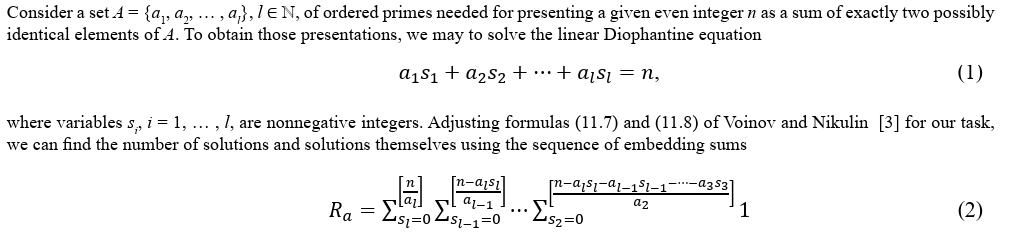
This paper is organized as follows: Section 2 provides a mathematical background for the proposed approach and considers solutions of a linear Diophantine equation used for constructing Goldbach’s pairs of primes, Section 3 discusses the infinitness of even integer numbers for which the conjecture is valid, Section 4 provides results of a computer experiment, Section 5 contains a discussion and conclusions, Appendix gives the R-script that provides Goldbach’s pairs for a given even integer n.
Mathematical Background

Alg. 1

A Note on Existing Goldbach’s Pairs for Every Even Integer

Computer Experiment

|
n |
N |
Time, sec. |
|
100 |
6 |
0.397 |
|
120 |
12 |
1.054 |
|
140 |
7 |
2.642 |
|
160 |
8 |
5.798 |
|
180 |
14 |
12.509 |
|
200 |
8 |
26.098 |
|
220 |
9 |
51.439 |
|
240 |
18 |
99.363 |
|
260 |
10 |
187.836 |
|
280 |
14 |
340.734 |
|
300 |
21 |
612.189 |
|
320 |
11 |
1063.721 |
|
340 |
13 |
1850.295 |
|
360 |
22 |
3103.453 |
Table 1: N is the number of prime pairs representing n. Computing times are given in the third column.
Section 2 states that the complexity of the proposed approach for proving Goldbach’s conjecture is O(nlogn). The statistical fit of computing times in the third column of this table shown in Fig. 2 does not contradict this conclusion.

Figure 2: Fit of times by nlogn model

A Discussion and Conclusions.
Additive number theory proves to be very powerful for solving numerous, even very hard mathematical problems like, e.g., the strong Goldbach’s conjecture. The theory permitted, e.g., to find polynomial-time solutions for subset sums, one-dimensional bin-packing, traveling salesman and other problems [10]. It is of importance to mention the difference between the approach used for analysis of these problems and that of Goldbach’s conjecture. In the first case, the analysis was based on searching for balanced binary trees with no more than two keys at every node. In the second one, we used searching the self-balanced B-tree that may have more than 2 keys at a node. Nevertheless, the one O(n) completeness for both cases is O(nlogn). Note also that the function nlogn is well approximated by a polynomial. It is worth also mentioning the decision tree problem [11], p. 282. In 1976, based on the NP- completeness of the three- dimensional matching (3DM) problem, Hyafil and Rivest [12] decided that the decision tree problem is NP-complete. Today we know that 3DM is actually in P (see [10], p. 9) and, hence, so is the decision tree problem. Summarizing all the above, we may conclude that this research provides a firm mathematical proof of the strong Goldbach’s conjecture.
Declarations
Funding: Not applicable
Conflict of Interest/ Competing Interests: The author declares that he has no competing interests.
Availability of Data and Material: All data generated or analyzed during this study are included in the manuscript.
Code Availability: R version 4.4.1, the R-script used is provided in Appendix.
Authors’ Contributions: Not applicable.
Acknowledgements: The author is grateful to Hazell Mitchell for her help in this article publishing.
References
- Goldbach’s conjecture. https://en.wikipedia.org/ goldbach’s conjecture, retrieved on November 01, 2025.
- Symmetries of prime numbers. https://habr.com/
 , retrieved on November 01, 2025.
 - Voinov, V. G., & Nikulin, M. S. (1997). On a subset sum algorithm and its probabilistic and other applications. In Advances in combinatorial methods and applications to probability and statistics (pp. 153-163). Boston, MA: Birkhäuser Boston.
- B-tree. https://en.wikipedia.org/b-tree, retrieved on November 01, 2025.
- Pya Arnqvist, N., Voinov, V., Makarov, R., Voinov, Y.: “nilde”: Nonnegative integer solutions of linear Diophantine equations with applications (2021). R-package version 1.1-7. https://CRAN, Rproject.org/package-nilde, https://doi.org/10.13140/ RG.2.2.26198.19523.P
- Mahmoudvand, R., Hassani, H., Farzaneh, A., & Howell, G. (2010). On the Number of Nonnegative Solutions to the Inequality a1x1+...+ar xr≤n IAENG International Journal of Applied Mathematics, 40(1), 1-5.
- Beged-Dov, A. G. (1972). Lower and upper bounds for the number of lattice points in a simplex. SIAM Journal on AppliedMathematics, 22(1), 106-108.
- Padberg, M.W. (1971). A remark on “an inequality for the number of lattice points in a simplex”. SIAM Journal on Applied Mathematics 20(4) 638-641.
- Lambe, T.A. (1974). Bounds on the number of feasible solutions to a knapsack problem. SIAM Journal onApplied Mathematics, 26(2),302-305.
- Voinov, V. (2025). Partitions, the P versus NP problem and applications. Curr Res Stat Math, 4(2), 01-13. https://doi.org/10.33140/ CRSM.04.02.02
- Garey, M.R. &Johnson, D.S. (1979). Computers and intractability: A guide to the theory of NP-completeness. WH Freeman andCo, New Yo
- Hyafil, L. & Rivest, R.L.(1976). Constructing optimal binary decision trees is NP-complete. Information Processing Letters 5(1), 15-17
Appendix: R-script "conjecture"