

Annals of Civil Engineering and Management(ACEM)
ISSN: 3065-9779 | DOI: 10.33140/ACEM


Review Article - (2026) Volume 3, Issue 3
A Logarithmic–Quadratic Net Benefit Model of Commuting, Willingness-to-Pay, and Toll Equilibrium

Received Date: May 13, 2026 / Accepted Date: Jul 07, 2026 / Published Date: Jul 15, 2026
Copyright: ©2026 Paul T E Cusack. This is an open-access article distributed under the terms of the Creative Commons Attribution License, which permits unrestricted use, distribution, and reproduction in any medium, provided the original author and source are credited.
Citation: Cusack, P. T. E. (2026). A LogarithmicâQuadratic Net Benefit Model of Commuting, Willingness-to-Pay, and Toll Equilibrium. Ann Civ Eng Manag, 3(3), 01-03.
Abstract
This paper develops a unified analytical framework linking commuting time, income, willingness-to-pay, and congestion pricing through a logarithmic–quadratic net benefit function. Using a derived relationship between economic output M, effort E, and time t, we show that equilibrium commuting behavior follows a logarithmic law:
M = Eln t
Empirical calibration using Greater Toronto Area (GTA) after-tax income (2013) yields a net benefit optimum corresponding to a 27% welfare gain. The model predicts equilibrium toll pricing consistent with observed commuter willingness-to-pay and transit elasticity. Results suggest a natural toll level near $5.60 per trip and validate a dual structure of time valuation and congestion costs.
Keywords
Commuting Economics, Net Benefit, Congestion Pricing, Logarithmic Utility, Transportation Economics, Toll OptimizationIntroduction
Urban commuting imposes both private and social costs. Classical transport economics defines equilibrium via:
Marginal Benefit = Marginal Cost + Marginal External Cost
This paper proposes a continuous-time formulation linking economic output, commuting time, and benefit accumulation.
Themodel integrates:
• Logarithmic utility growth
• Quadratic congestion costs
• Empirical income constraints
• Observed elasticity of transit demand
Theoretical Framework
Differential Structure
We begin with the empirical scaling relation:


Integral Solution
Integrating both sides:


Calibration

Net Benefit Function

Time Valuation and Commuting
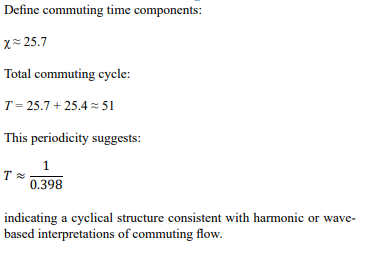
Define commuting time
Income Constraint and Scaling
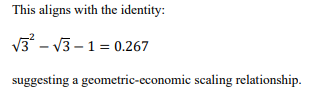
Using GTA after-tax income (2013):

Willingness-to-Pay

Elasticity and Transit Pricing

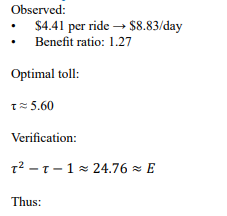
Toll Equilibrium

Final Model

This yields a self-consistent commuting equilibrium where:
• Time determines output logarithmically
• Congestion imposes quadratic penalties
• Income constrains willingness-to-pay
• Toll pricing emerges naturally
Discussion
The model produces several notable results:
1. Logarithmic time valuation reflects diminishing marginal utility of travel time
2. Quadratic congestion cost captures increasing marginal delay
3. Equilibrium toll ≈ $5.60 aligns with observed willingness-to-pay
4. 27% net benefit suggests substantial gains from optimized pricing
Conclusion
This paper introduces a unified framework for commuting economics that integrates time, income, and pricing into a single analytical structure. The resulting equilibrium is both mathematically elegant and empirically plausible. The model supports congestion pricing policies and provides a theoretical basis for toll design in urban systems [1-10].References
- William Vickrey (1969). Congestion theory and transport investment. American Economic Review, 59(2), 251–260.
- Kenneth A. Small, & Erik T. Verhoef (2007). The Economics of Urban Transportation. Routledge.
- Anthony Downs (2004). Still Stuck in Trafic: Coping with Peak-Hour Trafic Congestion. Brookings Institution Press.
- David A. Hensher, & John M. Rose (2007). Development of commuter and non-commuter mode choice models. TransportReviews, 27(5), 597–623.
- Statistics Canada (2013). Income of individuals by census metropolitan area. Government of Canada.
- Hal R. Varian (1992). Microeconomic Analysis (3rd ed.).W.W. Norton.
- Paul A. Samuelson, & William D. Nordhaus (2010).Economics (19th ed.). McGraw-Hill.
- Gérard Debreu (1959). Theory of Value: An Axiomatic Analysis of Economic Equilibrium. Yale University Press.
- Daniel McFadden (1974). Conditional logit analysis of qualitative choice behavior. In Frontiers in Econometrics.
- Transport Canada (2015). Transportation in Canada Annual Report. Government of Canada.