

Journal of Textile Engineering and Fashion Technology(JTEFT)
ISSN: 2771-4357 | DOI: 10.33140/JTEFT

Research Article - (2026) Volume 8, Issue 1
A Design-Oriented Study on the Floral Transformation of Architectural Elements from Sibs agar Monuments into Contemporary Embroidery Patterns: Integrating Field Documentation and AI-Assisted Design Development
Received Date: Apr 17, 2026 / Accepted Date: May 14, 2026 / Published Date: May 25, 2026
Copyright: ©2026 Minu Subadar. This is an open-access article distributed under the terms of the Creative Commons Attribution License, which permits unrestricted use, distribution, and reproduction in any medium, provided the original author and source are credited.
Citation: Subadar, M. (2026). A Design-Oriented Study on the Floral Transformation of Architectural Elements from Sibs agar Monuments into Contemporary Embroidery Patterns: Integrating Field Documentation and AI-Assisted Design Development. J Textile Eng & Fash Tech, 8(1), 01-04.
Abstract
The architectural heritage of Sibsagar (Sivasagar), Assam, developed under the Ahom dynasty, is distinguished by a refined integration of structural innovation and decorative expression [1]. Among its most notable features are floral motifs embedded in stucco reliefs and carved surfaces, reflecting both aesthetic and symbolic values [2]. This study investigates the transformation of these architectural floral elements into contemporary embroidery patterns through a design-oriented framework, incorporating field-based documentation and AI-assisted design processes [3]. Primary visual data (Figure 1) were collected from monuments such as Rang Ghar and Talatal Ghar, followed by motif extraction and stylization. The research further integrates self-developed design compositions (Figure 2), generated through manual and AI-assisted processes, enabling refined pattern development suitable for textile applications [4]. The findings reveal that the inherent symmetry, repetition, and adaptability of Ahom floral motifs support their effective transformation into embroidery and surface design patterns.
Keywords
Ahom Architecture, Floral Motifs, Sibsagar Monuments, Embroidery Design, Ai-Assisted Design, Textile Transformation
Introduction
Architectural ornamentation has historically served as a significant source of inspiration for decorative arts, particularly textile design [2]. In Assam, the monuments of Sibsagar represent the artistic and cultural achievements of the Ahom dynasty, characterized by elaborate surface decorations and sculptural detailing [1]. Structures such as Rang Ghar and Talatal Ghar incorporate floral motifs that reflect both aesthetic sophistication and symbolic meaning [1]. Floral ornamentation in Indian art often symbolizes fertility, continuity, and harmony with nature [2]. The adaptation of such motifs into embroidery patterns provides an opportunity to preserve traditional design elements while adapting them to contemporary contexts [3]. This study integrates field documentation (Figure 1) and design development (Figure 2) to create a systematic transformation framework from architecture to textile design.
Literature Review
Ahom architecture demonstrates a synthesis of indigenous construction techniques and external influences, resulting in distinctive ornamental styles [1]. Decorative stucco and carved motifs frequently feature floral and geometric patterns arranged in symmetrical compositions [1]. Textile design research emphasizes motif transformation as a strategy for sustaining traditional crafts through adaptation [3]. Simplification and stylization are necessary to translate architectural complexity into textile-friendly formats [4]. Recent developments in digital design highlight the role of artificial intelligence in enhancing creative processes, particularly in pattern development and visualization [5].
Research Objectives
• To document floral and architectural motifs from Sibsagar monuments
• To analyze their structural and aesthetic characteristics
• To develop a transformation methodology integrating manual and AI-assisted design
• To create contemporary embroidery and surface design patterns
Methodology
Field Documentation
Primary data were collected through photographic documentation of architectural elements including floral carvings, niches, and sculptural panels. These are presented in Figure 1 and serve as the foundational dataset for motif extraction [1]. Field Documentation of Architectural Motifs from Sibsagar Monuments Photographic samples collected from monuments in Sibsagar, Assam, including Rang Ghar and Talatal Ghar. The images include floral carvings, sculptural panels, niches, and architectural ornamentation used for motif extraction.
Source: Field photographs by the author (2026).
Motif Analysis
Motifs were analyzed based on form, symmetry, and composition, revealing dominant use of radial floral structures and repetitive patterns [2].
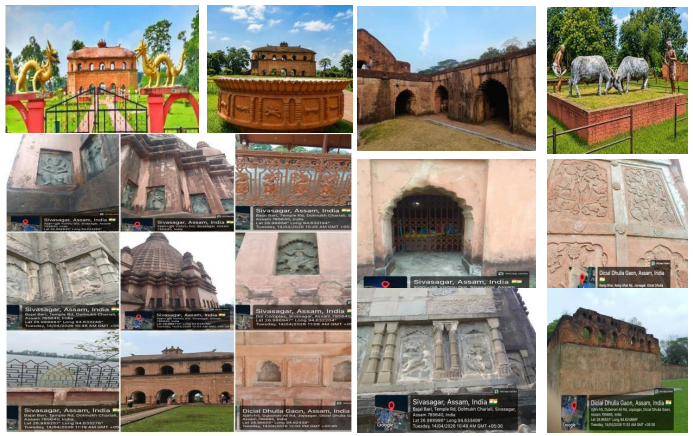
Figure 1
Design Development (Self-Created Work)
The second dataset consists of self-developed derived from the collected samples. These were created through manual sketching, digital refinement, AI-assisted enhancement (see Figure 2).
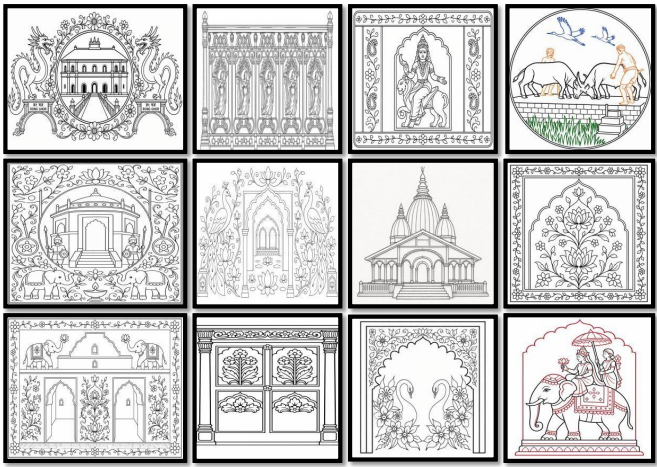
Figure 2
Developed Embroidery and Surface Design Patterns Based on Extracted Motifs
Self-created design compositions derived from architectural elements shown in Figure 1. The designs integrate floral motifs, architectural structures, and decorative compositions, refined through manual drawing and AI-assisted processes. These patterns are suitable for application in bedsheets, dining table covers, garments, and shawls.
Source: Design compositions by the author with AI-assisted refinement (2026).
Design Analysis and Results
The transformation process is clearly demonstrated through comparison of Figure 1 and Figure 2. Architectural motifs are simplified, stylized, and adapted into structured embroidery patterns [3]. The results indicate:
• Effective conversion of sculptural forms into line-based embroidery outlines
• Enhancement of symmetry for repeatable textile patterns
• Integration of floral and architectural elements into cohesive designs
Discussion
The study highlights the adaptability of architectural motifs in textile design [1]. AI assisted tools enhance visualization and refinement while maintaining the artist’s creative control [5]. This hybrid approach strengthens both efficiency and originality.
Applications
The developed designs are suitable for:
Bedsheets and home textiles
Dining table covers
Churidar and garment prints
Shawls and decorative fabrics
These applications demonstrate the practical relevance of heritage-based design innovation [4].
Conclusion
This research establishes a design-oriented framework for transforming architectural floral motifs from Sibsagar monuments into contemporary embroidery patterns. By integrating field documentation with AI-assisted design, the study demonstrates the potential for preserving cultural heritage while fostering innovation.
References
- Baruah, S. (2015). Ahom architecture and its cultural significance. Assam Publication Board.
- Mitter, P. (2001). Indian art. Oxford University Press.
- Chattopadhyay, K. (2012). Handicrafts of India. Ministry of Textiles.
- Gillow, J., & Barnard, N. (1991). Traditional Indian Textiles.
- McCormack, J., Gifford, T., & Hutchings, P. (2019, April). Autonomy, authenticity, authorship and intention in computer generated art. In International conference on computational intelligence in music, sound, art and design (part of EvoStar) (pp. 35-50). Cham: Springer International Publishing.