

Journal of Electrical Electronics Engineering(JEEE)
ISSN: 2834-4928 | DOI: 10.33140/JEEE
Impact Factor: 1.2


Research Article - (2026) Volume 5, Issue 5
A Coherence-Gated Bayesian Decision Rule
 and Payam Danesh 2 *
 2Department of Biosystems Engineering, University of Tehran, Tehran, Iran
Received Date: Jul 17, 2026 / Accepted Date: Aug 24, 2026 / Published Date: Sep 07, 2026
Copyright: ©2026 Payam Danesh, et al. This is an open-access article distributed under the terms of the Creative Commons Attribution License, which permits unrestricted use, distribution, and reproduction in any medium, provided the original author and source are credited.
Citation: Bianchetti, R., Danesh, P. (2026). A Coherence-Gated Bayesian Decision Rule. J Electrical Electron Eng, 5(5), 01-12.
Abstract
In this paper, we formulate a coherence-gated Bayesian decision rule within Viscous Time Theory (VTT) frame. A standard posterior is multiplied by a bounded gate constructed from alignment, retained coherence cost, informational support, effective informational viscosity, and local sensitivity. The result is normalized only when its total gated mass is positive; otherwise, the rule abstains. We prove boundedness and well-posedness, exact recovery of the Bayesian posterior at the neutral gate, an explicit perturbation bound, an odds decomposition, an exact Bayesian representation through an auxiliary admissibility event, and stability away from zero gated mass. A fully specified three-class synthetic study separates predictive features from an observed support-quality channel. Across convergent, bifurcation, and collapse regimes, coverage decreases from 89.3% to 15.3%, while accuracy on covered cases remains between 98.0% and 99.4%. These values demonstrate the intended selective behavior only under the stated construction.
Keywords
Bayesian Inference, Selective Prediction, Reject Option, Abstention, Viscous Time Theory, Informational Viscosity, Calibration, Uncertainty Quantification
Introduction
Bayesian inference separates prior information from the evidential contribution of observed data and combines them through a normalized posterior. The earliest published form is associated with Bayes and Price [1]. Cox later showed how probability can arise from consistency requirements for plausible reasoning [2]. These foundations establish a coherent numerical calculus, but they do not by themselves prescribe whether every computed posterior should be converted into an operational decision.
The distinction between quantified uncertainty and admissible action developed along several lines. Dempster introduced upper and lower probabilities induced by multivalued mappings [3]. Chow derived an optimal recognition rule with a reject action and characterized the error-rejection trade-off [4]. Shafer developed a broader mathematical theory of evidence [5], while Pearl provided a systematic account of probabilistic reasoning in structured intelligent systems [6]. These approaches differ substantially, but each made clear that uncertainty representation and decision policy are related without being identical.
By 2000, information geometry had supplied a differential-geometric language for statistical models, divergences, and local sensitivity [7]. Proper scoring rules then provided principled criteria for evaluating probabilistic forecasts [8]. Work on classification with a reject option replaced ad hoc confidence thresholds with explicit loss-based objectives, and selective classification formalized the trade-off between coverage and conditional risk [9,10]. The central lesson is that withholding a prediction is part of the decision problem and must be evaluated quantitatively, rather than counted as an unqualified gain in accuracy.
Two further developments are directly relevant. Amari’s later synthesis clarified the role of geometry in statistical inference and learning [11]. Bissiri, Holmes, and Walker showed that coherent belief updates may be constructed from declared losses, thereby placing non-likelihood reweighting within a generalized Bayesian framework [12]. Modern predictive systems also exposed the practical weakness of treating maximum posterior confidence as a complete reliability measure. Calibration can fail even when classification accuracy is high [13]. Selective methods for deep networks improved risk-coverage behavior, and integrated reject architectures optimized prediction and selection jointly [14,15]. Large-scale experiments under distribution shift subsequently showed that uncertainty estimates and post-hoc calibration may deteriorate together [16]. Conformal prediction supplies a different route, with finite-sample coverage guarantees under stated exchangeability conditions [17]. These methods therefore provide necessary comparators for any new abstention rule.
Viscous Time Theory (VTT) was proposed as a mathematical description of coherence-dependent temporal response [18]. Related work used coherence weights in structured statistical ensembles while retaining classical counting as a limiting case [19]. This paper adopts only a narrow operational part of that programme. It does not infer a physical law for time from statistical data. Instead, it asks whether VTT-inspired descriptors can define a bounded post-posterior gate with an explicit abstention state.
The research gap is precise. Existing selective prediction methods usually derive selection from confidence, learned risk, loss minimization, conformity scores, or out-of-distribution diagnostics. The VTT proposal uses a declared decomposition into alignment, retained coherence cost, support, viscosity, and local sensitivity. The mathematical status of the normalized gated output, however, must be stated without ambiguity. If the gate is positive, the output can be represented exactly as a conventional Bayesian posterior conditioned on an auxiliary admissibility event. If all gated mass vanishes, normalization is undefined and abstention is mandatory. Thus, the construction does not create a new probability calculus.
The contribution claimed here is limited to four points: first, the VTT diagnostic decomposition is converted into a dimensionless, bounded decision rule. Second, the zero-mass case is treated as an explicit output rather than hidden by arbitrary renormalization. Third, classical consistency, Bayesian representability, common-factor cancellation, and stability are proved. Fourth, a controlled synthetic experiment is specified completely, including its random seed, calibration rule, probability model, degradation mechanism, evaluation metrics, and uncertainty intervals.
Mathematical Frame
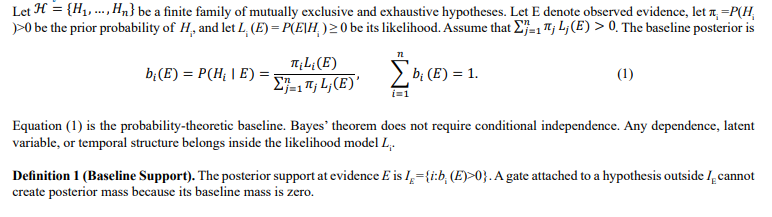
Bayesian Baseline
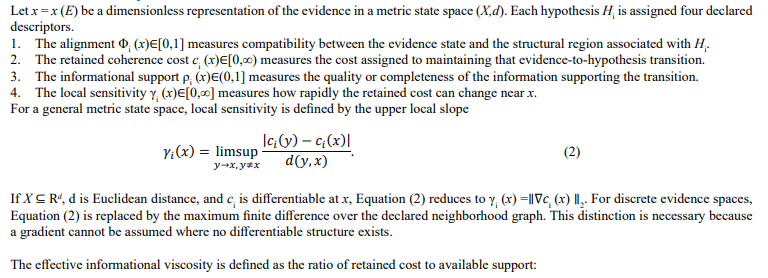
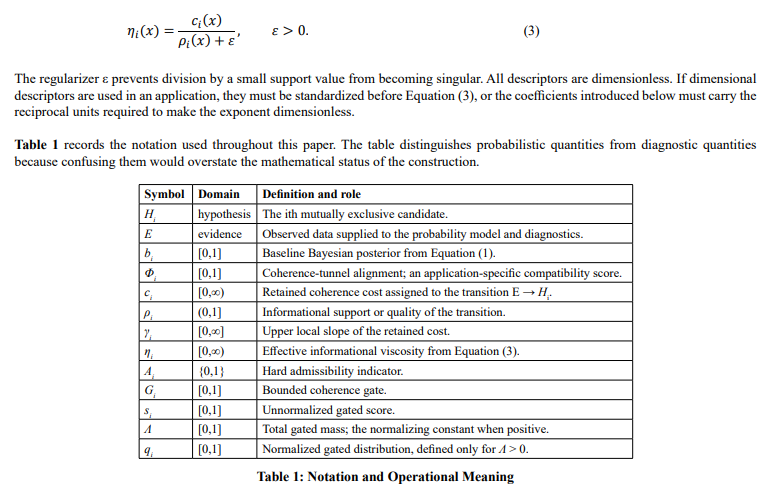
Structural Descriptors
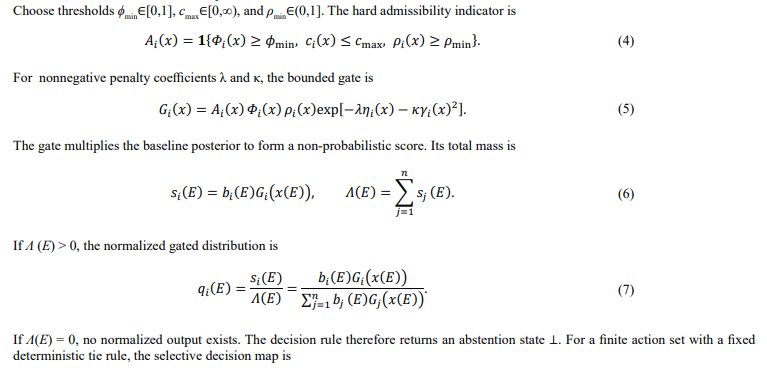
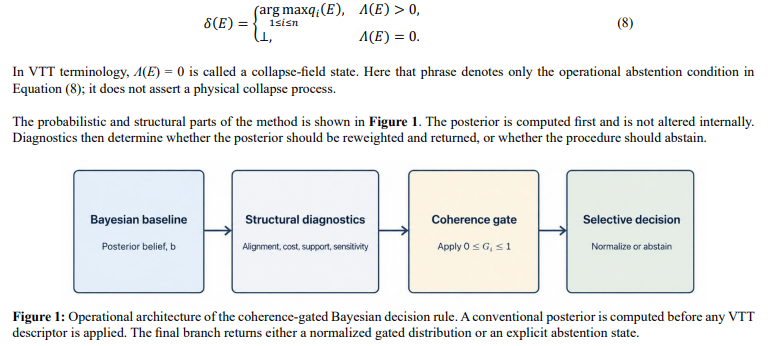
Gate, Score, and Selective Output
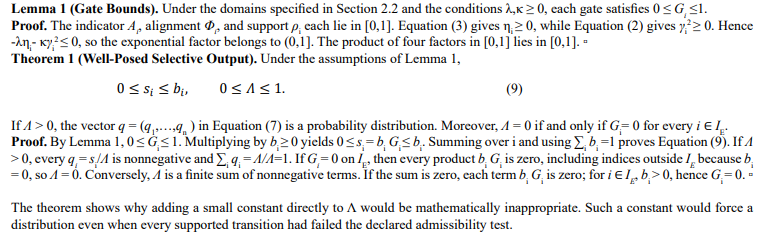
Well-Posedness and Boundedness
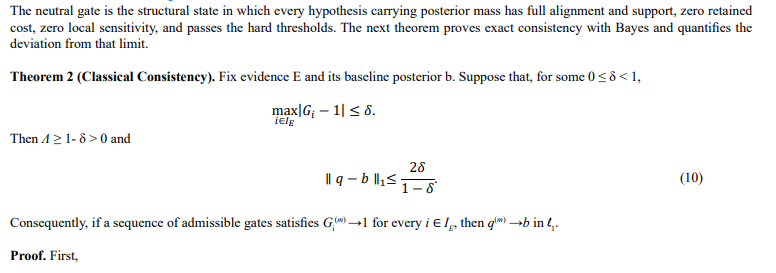
Classical Limit and A Quantitative Error Bound
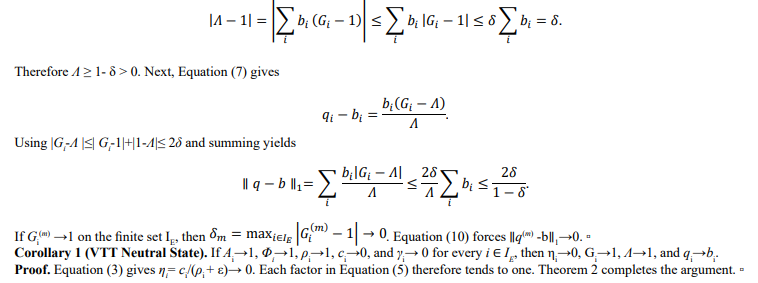
Odds Decomposition and Bayesian Representability
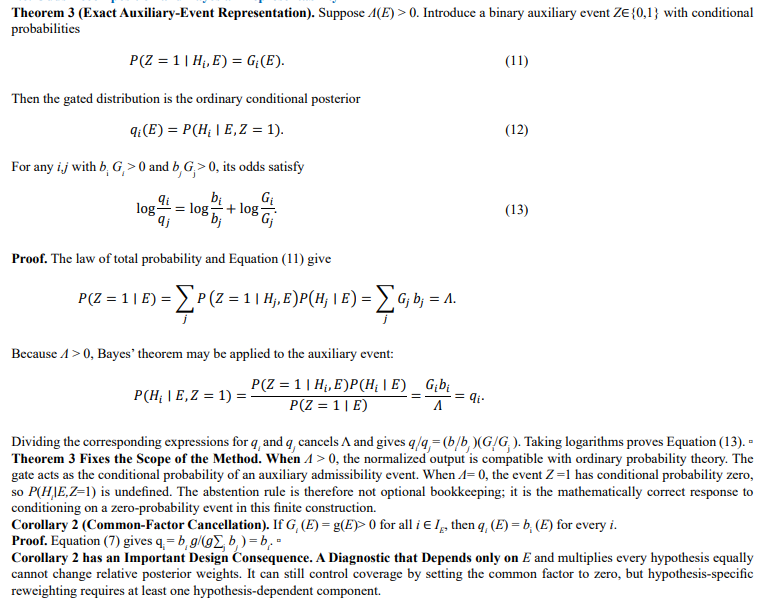
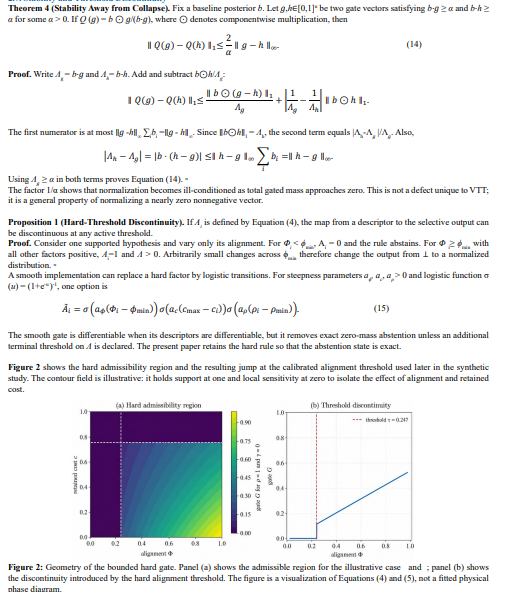
Stability and Threshold Discontinuity
Example 1 (Calibration is not Automatically Preserved). Suppose a calibrated binary posterior is b = (0.8,0.2) and the gates are G = (1,0.5). Equation (7) gives q = (0.8,0.1)/0.9=(8/9,1/9). Unless the true conditional class probabilities also change after observing the auxiliary event Z = 1, q is not calibrated for the original conditioning information E. Thus, classical consistency at G = (1,1) does not imply calibration preservation away from the neutral gate. Calibration must be measured on the covered population.
Methods
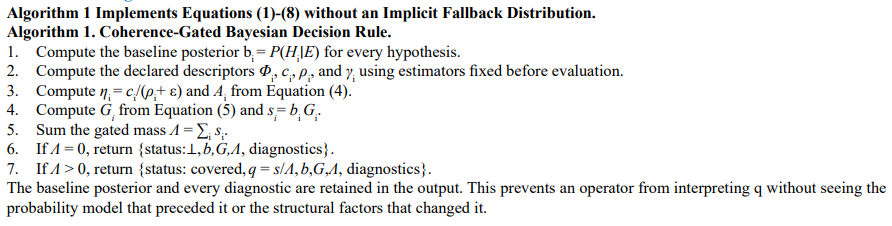
Reference Algorithm
Controlled Synthetic Design
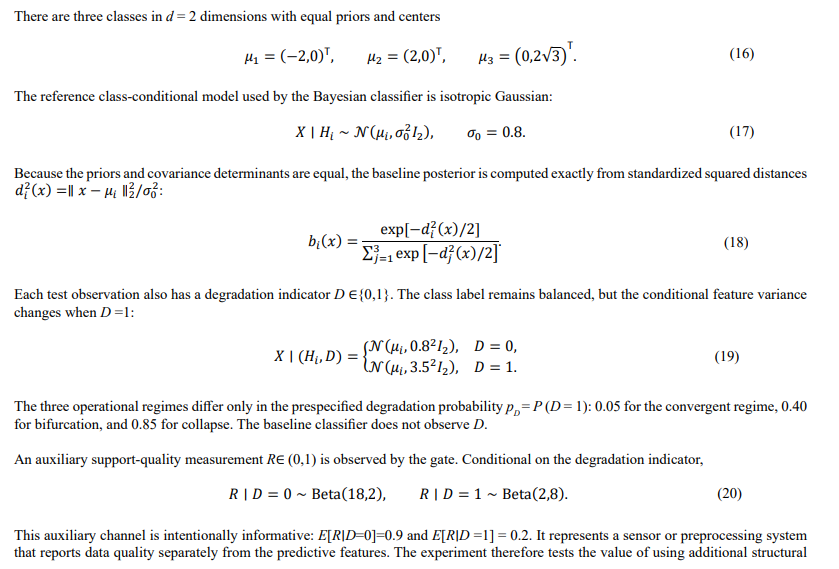
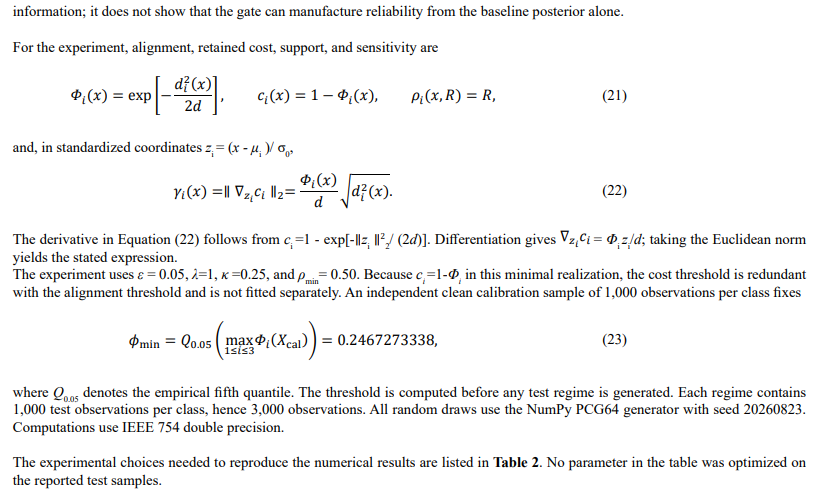
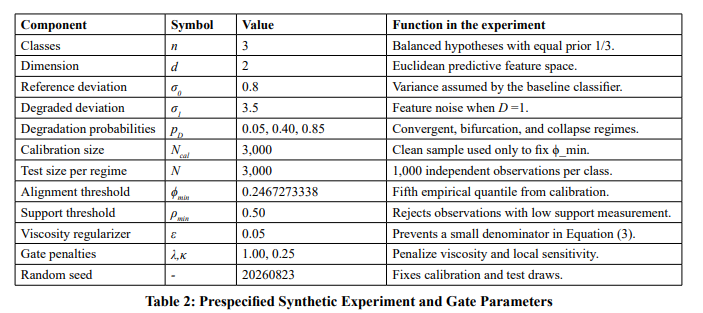
The numerical experiment was designed to answer one narrow question: can a support diagnostic that is observed at inference time but omitted from the baseline classifier control abstention in the intended direction? The design does not model a particular physical, medical, or financial system.
Evaluation Metrics

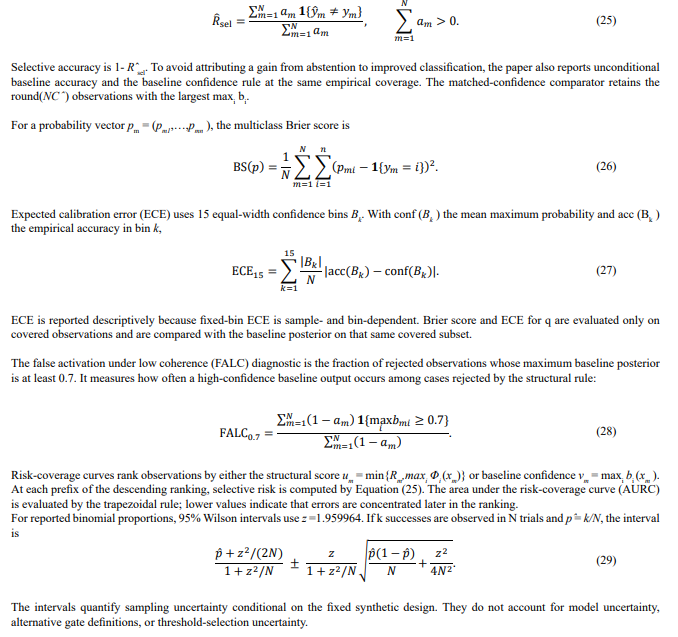
Validation Logic and Failure Tests
The method was checked at four levels. First, numerical assertions were compared with Theorem 1: every computed gate and total mass had to lie in [0,1], and every covered distribution had to sum to one within floating-point tolerance10-12. Second, the neutral gate Gi =1 was verified to return the baseline posterior. Third, the zero-gate vector was verified to return abstention without division. Fourth, the calibrated thresholds were frozen before test generation.
The synthetic study is an application test, not empirical validation of VTT as a physical theory. Its internal validity rests on exact specification and separation of calibration from testing. External validity remains untested.
Results
Analytical Results
The analytical results establish five properties. Theorem 1 proves that the gate and total gated mass remain bounded and that normalization is valid exactly when Λ > 0. Theorem 2 proves recovery of the Bayesian posterior and supplies the explicit l1 error bound in Equation (10). Theorem 3 shows that every positive-mass gated output is an ordinary Bayesian posterior conditioned on an auxiliary admissibility event. Corollary 2 proves that a positive common gate cannot change relative posterior weights. Theorem 4 shows Lipschitz stability with respect to the gate whenever total gated mass is bounded below by α > 0. Proposition 1 identifies the complementary obstruction: the hard gate is discontinuous at its thresholds. These statements delimit the framework more strongly than the unqualified claim that the method “extends Bayes.” The construction extends the decision pipeline, but its normalized output remains representable within standard conditional probability.
Synthetic Selective Behavior
The realized degraded fractions were 5.17%, 39.80%, and 84.40% in the convergent, bifurcation, and collapse samples, respectively. As the degraded fraction increased, unconditional baseline accuracy fell from 96.80% to 64.20%. This decline is expected because the classifier continues to use the reference variance0.82 I while an increasing share of test features is drawn with variance3.52 I 2.
Table 3 reports the decision results. Coverage decreased from 89.27% to 15.27%. Accuracy on covered cases remained above 98%, whereas posterior-confidence selection at the same coverage was lower in every regime. The largest difference occurred in the bifurcation sample: gated selective accuracy was 99.42%, compared with 86.10% for confidence selection at matched coverage. This difference is not evidence that the VTT formula is universally superior. It occurs because the gate observes R, an informative support-quality channel that the confidence rule does not observe.
|
Regime |
Base accuracy, % |
Coverage, % |
Gated accuracy on covered cases, % |
Confidence accuracy at matched coverage, % |
FALC0.7, % |
|
Convergent |
96.80 (96.11-97.37) |
89.27 (88.11-90.32) |
99.29 (98.89-99.55) |
98.51 |
88.20 |
|
Bifurcation |
82.03 (80.62-83.37) |
57.57 (55.79-59.32) |
99.42 (98.94-99.69) |
86.10 |
93.32 |
|
Collapse |
64.20 (62.47-65.90) |
15.27 (14.02-16.60) |
98.03 (96.31-98.96) |
79.91 |
96.34 |
Table 3: Classification, coverage, and rejection diagnostics( Values in parentheses are 95% Wilson intervals)
The FALC values are high: between 88.20% and 96.34% of rejected observations still have a maximum baseline posterior of at least 0.7. This behavior is a known consequence of extrapolating a closed-set Gaussian classifier. Far from all class centers, relative likelihoods may strongly favor one class even though absolute support is poor. The support channel detects a property that normalized posterior confidence can suppress.
Figure 3 analyzes the full risk-coverage relationship rather than one threshold. Structural ranking has a lower AURC than posterior confidence in the convergent and bifurcation regimes: 0.0027 versus 0.0297, and 0.0507 versus 0.1597, respectively. In the collapse regime, the values are close, 0.2730 versus 0.2746. Once the small high-support subset has been exhausted, neither one-dimensional ranking resolves the ordering among predominantly degraded observations.

Figure 3: Selective risk as a function of coverage
Probability Quality on the Covered Population
Table 4 separates selection from probability reweighting. On the covered subset, the baseline posterior is already highly accurate. Multiplying by the hypothesis-dependent gate does not improve Brier score or ECE consistently. In the convergent regime, for example, the covered-case Brier score changes from 0.0122 for b to 0.0142 for q, and ECE changes from 0.0034 to 0.0071. The bifurcation Brier score improves slightly, but its ECE worsens slightly. These mixed results agree with Example 1: gating does not preserve calibration by theorem.
|
Regime |
Base Brier, all |
Base ECE, all |
Base Brier, covered |
Gated Brier, covered |
Base ECE, covered |
Gated ECE, covered |
|
Convergent |
0.0551 |
0.0187 |
0.0122 |
0.0142 |
0.0034 |
0.0071 |
|
Bifurcation |
0.3398 |
0.1571 |
0.0118 |
0.0116 |
0.0047 |
0.0058 |
|
Collapse |
0.6755 |
0.3291 |
0.0385 |
0.0393 |
0.0222 |
0.0197
|
Table 4: Probability-quality metrics before and after gating
The principal numerical effect is therefore selection, not probability correction. A practical implementation should consider returning the baseline posterior together with the gate diagnostics when probability calibration is more important than reweighted class odds.
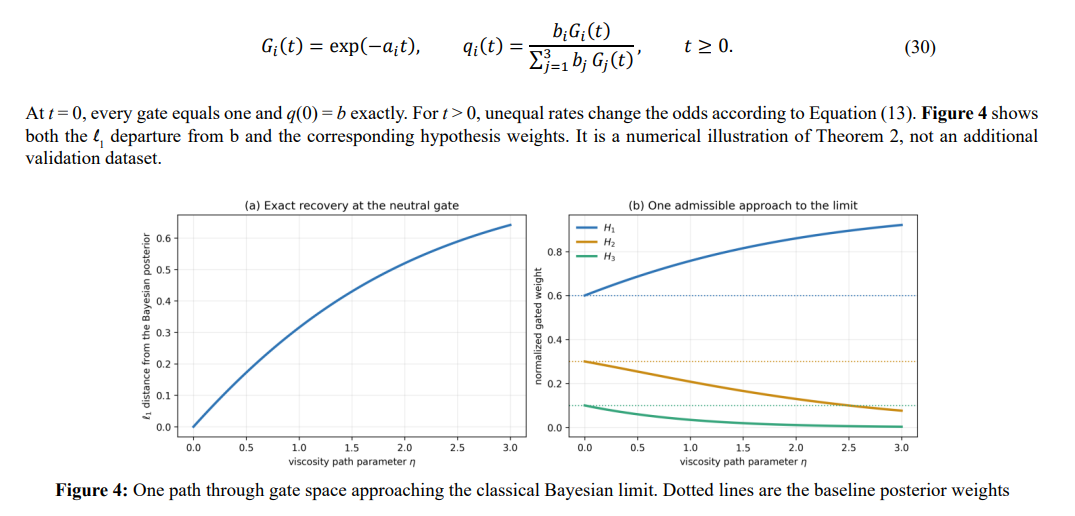
Numerical Illustration of the Classical Limit
The classical-limit theorem is independent of the synthetic classification study. To visualize one admissible path, take b = (0.60,0.30,0.10) and positive rates a = (0.20,0.80,1.50). Define
Conclusion
In this paper, we give a mathematically delimited coherence-gated Bayesian decision rule. The gate is bounded, the positive-mass output is a valid distribution, the Bayesian posterior is recovered at the neutral gate, deviations from that limit satisfy an explicit bound, and the normalized result has an exact Bayesian representation through an auxiliary admissibility event. A common positive diagnostic factor cancels from relative posterior weights, while normalization becomes sensitive as total gated mass approaches zero. The hard thresholds create an explicit but discontinuous abstention boundary. The synthetic experiment confirms the intended selective behavior under a fully stated construction. Coverage falls as the observed support channel reports more degraded data, and accuracy on covered cases remains high. This result depends on the auxiliary channel being informative. Probability calibration does not improve consistently after reweighting, so the gate should be evaluated primarily as a selection mechanism unless separate recalibration is performed.
Author Contributions
Conceptualization, R.B. and P.D.; methodology, R.B. and P.D.; formal analysis, P.D.; simulation design, R.B. and P.D.; software and validation, P.D.; visualization, R.B. and P.D.; writing - original draft, R.B. and P.D.; writing - review and editing, R.B. and P.D.; supervision, R.B. All authors approved the manuscript.
Funding
This research received no external funding.
Data and Code Availability
No external empirical dataset was used. The probability model, sample sizes, distributional parameters, calibration rule, numerical seed, metrics, and algorithm required to reproduce the synthetic study are stated in Sections 3.1-3.3 and Table 2. The generated observations contain no personal or proprietary information.
Conflicts of Interest
The authors declare no conflict of interest.
References
- Bayes, T., & Price, N. (1763). LII. An essay towards solving a problem in the doctrine of chances. By the late Rev. Mr. Bayes, FRS communicated by Mr. Price, in a letter to John Canton, AMFR S. Philosophical transactions of the Royal Society of London, (53), 370-418.
- Cox, R. T. (1946). Probability, frequency and reasonable expectation. American journal of physics, 14(1), 1-13.
- Dempster, A. P. (2008). Upper and lower probabilities induced by a multivalued mapping. In Classic works of the Dempster-Shafer theory of belief functions (pp. 57-72). Berlin, Heidelberg: Springer Berlin Heidelberg.
- Chow, C. (1970). On optimum recognition error and reject tradeoff. IEEE Transactions on information theory, 16(1), 41-46.
- Shafer, G. (1976). A Mathematical Theory of Evidence; Princeton University Press: Princeton, NJ, USA. ISBN 978-0-691-10042-5.
- Pearl, J. (1988). Probabilistic Reasoning in Intelligent Systems: Networks of Plausible Inference; Morgan Kaufmann: San Mateo, CA, USA, 1988. ISBN 978-1-55860-479-7.
- Amari, S. I., & Nagaoka, H. (2000). Methods of information geometry (Vol. 191). American Mathematical Soc.
- Gneiting, T., & Raftery, A. E. (2007). Strictly proper scoring rules, prediction, and estimation. Journal of the American statistical Association, 102(477), 359-378.
- Bartlett, P. L., & Wegkamp, M. H. (2008). Classification with a Reject Option using a Hinge Loss. Journal of Machine Learning Research, 9(8).
- El-Yaniv, R. (2010). On the Foundations of Noise-free Selective Classification. Journal of Machine Learning Research, 11(5).
- Amari, S. I. (2016). Information geometry and its applications. Springer.
- Bissiri, P. G., Holmes, C. C., & Walker, S. G. (2016). A general framework for updating belief distributions. Journal of the Royal Statistical Society Series B: Statistical Methodology, 78(5), 1103-1130.
- Guo, C., Pleiss, G., Sun, Y., & Weinberger, K. Q. (2017, July). On calibration of modern neural networks. In International conference on machine learning (pp. 1321-1330). PMLR.
- Geifman, Y., & El-Yaniv, R. (2017). Selective classification for deep neural networks. Advances in neural information processing systems, 30.
- Geifman, Y., & El-Yaniv, R. (2019, May). Selectivenet: A deep neural network with an integrated reject option. In International conference on machine learning (pp. 2151-2159). PMLR.
- Ovadia, Y., Fertig, E., Ren, J., Nado, Z., Sculley, D., Nowozin, S., ... & Snoek, J. (2019). Can you trust your model's uncertainty?evaluating predictive uncertainty under dataset shift. Advances in neural information processing systems, 32.
- Angelopoulos, A. N., & Bates, S. (2023). Conformal prediction: A gentle introduction. Foundations and Trends in Machine Learning, 16(4), 494-591.
- Danesh, P., & Bianchetti, R. (2026). Viscous Time Theory (VTT): A mathematical proposal for coherence-dependent temporal response. Journal of Applied Mathematics and Physics, 14(6), 2307-2316.
- Danesh, P., & Bianchetti, R. (2026). Coherence-Weighted Entropy for Structured Statistical Ensembles: A Conservative Extension of Boltzmann Counting. Available at SSRN 6783683