



Review Article - (2026) Volume 10, Issue 1
Worldview Coherence is Not Optional
Received Date: Jan 09, 2026 / Accepted Date: Feb 02, 2026 / Published Date: Feb 13, 2026
Copyright: ©2026 Travis Hawkins, et al. This is an open-access article distributed under the terms of the Creative Commons Attribution License, which permits unrestricted use, distribution, and reproduction in any medium, provided the original author and source are credited.
Citation: Hawkins, T. (2026). Worldview Coherence is Not Optional. J Addict Res, 10(1), 01-15
Abstract
Human development, affect regulation, and health risk are typically studied as partially independent domains. Here, we integrate these domains into a single developmental–epistemological framework linking worldview coherence (WV), cultural narcissism (CN), affective dysregulation, harm enactment, physiological load, and downstream mortality risk (DR). Using 815 outcome-level effects from over 150 independent studies (cumulative N > 350,000), we show that DR is structured not additively, but by a nonlinear interaction between WV and CN. When low WV co-occurs with elevated CN, downstream risk escalates sharply (R2 ≈ .79), consistent with activation of a self-reinforcing anger- loop cascade. Developmental progression via the progression of virtues (PV) attenuates this cascade (R2 ≈ .36), while higher-order stages correspond to a qualitative regime shift marked by the collapse of risk amplification (R2 ≈ .08). Monte Carlo simulations and robustness analyses confirm that these regimes are stable and not driven by idiosyncratic cases. Crucially, belief content is irrelevant; coherence, congruence, and consistency of worldview function as the primary organizing variable. These findings suggest that downstream mortality risk is developmentally contingent and epistemologically structured, with implications extending beyond traditional trait-based models.
Introduction
Preface: Holistic Model and Prior Findings
The present manuscript is grounded in a holistic, developmentally staged framework that integrates epistemological coherence, moral development, affective regulation, relational dynamics, and downstream health risk into a single explanatory system. The conceptual model shown above provides the organizing structure for this work and is intended as a mechanistic map rather than a purely statistical abstraction. It situates empirical findings within a developmental process that unfolds over time, exhibits phase transitions, and gives rise to emergent properties not reducible to their constituent parts.

Figure 1: A Holistic Developmental Model with Dynamic Relationships, Stratifications, Non-Linear Structure Among Constructs and Phase Transitions (Stage Gating)
Testing of this model occurs across three regimes with cohorts. The real-world functional paradigm of this paper.
At the highest level, the model distinguishes between invariant mechanistic pathways (solid lines), stage-gated or emergent moderations (dashed lines), and contextual influences (dotted lines). Together, these define a system in which early epistemological conditions and cultural orientation shape affective and behavioral cascades, while later developmental capacities can reorganize or stabilize the system in qualitatively different ways.
Core Constructs and Developmental Foundations
Two prior theoretical frameworks provide the conceptual foundation for this model. First, The Progression of Virtues describes moral and developmental growth as a staged process in which humility, honesty, compassion, responsibility, courage, and heroism emerge sequentially and cumulatively. PV is not treated here as a latent personality trait but as a capacity gradient that increases in functional range and integrative power across stages [1]. Second, Cultural Narcissism characterizes a ubiquitous developmental failure mode in which excessive self-referential orientation, status fixation, and external validation seeking erode epistemic humility and prosocial transmission [2]. CN is modeled as a contextual force that distorts worldview formation and impedes progression through early virtue stages. Within the diagram, Worldview (WV) represents the individual’s epistemic coherence: the degree to which beliefs, values, and interpretations of reality are internally consistent, stable, and behaviorally congruent. WV is shown as CN-conditioned, reflecting prior findings that cultural narcissism tends to fragment worldview coherence, particularly in early developmental periods. WV directly informs the individual’s capacity to engage in PV, especially in the foundational stages where humility and honesty function as epistemic gates.
The Anger Loop Cascade and Downstream Risk
Below the developmental layer, the model specifies a vertically integrated anger loop cascade. Epistemological Disorientation (EPD) arises when worldview coherence is compromised, producing uncertainty, threat sensitivity, and meaning instability. EPD feeds into Affective Dysregulation (AD), characterized by chronic anger, resentment, or emotional volatility. This dysregulation increases the likelihood of Harm Enactment (HE)—toward self, others, or both—which accumulates into Physiological Load (PL) via stress, inflammation, injury, and maladaptive coping. PL, in turn, contributes to Downstream Risk (DR), operationalized in this manuscript as an elevated all-cause mortality hazard. Relational Regulation (RR) is shown as an input into this cascade, reflecting the empirical observation that relational conflict, retaliation, and breakdown amplify affective dysregulation and harm enactment. In the absence of stabilizing forces, these pathways form a self- reinforcing loop in which epistemic fragmentation and anger mutually sustain one another.
Stage Gates, Emergence, and Phase Transitions
A central feature of the model is the stage gate (SG) corresponding to PV ≥ 5 (courage/heroism). This gate marks a qualitative transition rather than a linear extension of earlier stages. Prior work suggests that beyond this threshold, two constructs—Unilateral Forgiveness (UF) and Emergent Well-Being (EWB)—can arise without direct instrumental pursuit. They are explicitly modeled as non-goal emergent properties: they cannot be reliably produced by intention alone but emerge from sufficient developmental integration. UF functions as a restorative moderator within the system. It attenuates the anger loop by reducing retaliatory orientation, dampening affective dysregulation, and stabilizing epistemological threat responses. EWB reflects a broader reorganization of meaning, purpose, and existential coherence, further buffering the system against relapse into disorientation and harm. Dashed pathways in the diagram indicate that these effects are stage-dependent and are not assumed to operate uniformly across all individuals.
Stratification and Temporal Dynamics
Although depicted in a single diagram, the model is explicitly stratified across developmental stages and contextual conditions. Early life and young adulthood are characterized by higher CN exposure and greater vulnerability to worldview fragmentation, whereas later stages may exhibit either stabilization or entrenchment depending on developmental trajectory. The manuscript operationalizes these distinctions through stratified analyses, simulations, and multi-group modeling rather than assuming homogeneity across the population. Importantly, the model is not intended as a static “y = mx + b” representation. It is a dynamic, living system in which feedback, accumulation, and emergence play central roles. Phase transitions—particularly at the stage gate—allow the same individual to occupy qualitatively different regimes of risk and resilience over time.
Purpose of the Present Manuscript
This manuscript builds on the PV and CN frameworks by formally integrating them into a quantitative, testable structure using regression modeling, Monte Carlo simulation, meta-analytic structural equation modeling (MASEM), and robustness analyses. The goal is not merely to demonstrate statistical association, but to evaluate whether a developmentally coherent model can account for observed patterns in affective behavior, relational harm, physiological load, and mortality risk across heterogeneous datasets. The diagram presented here should therefore be read as a theoretical scaffold: a guide for interpreting the analyses that follow and a framework for understanding how epistemological, moral, and emotional processes jointly shape long-term human outcomes.
Data Definitions
The present analyses draw on a large, integrated database of published empirical studies spanning developmental psychology, clinical psychology, health psychology, epidemiology, and behavioral medicine. Each construct represents a theoretically specified latent domain operationalized through multiple observed outcomes across independent studies. For each construct, k denotes the number of unique outcome-level effect sizes contributing to that construct, and N denotes the cumulative sample size across contributing studies. Exact values for k and N are reported in the accompanying table (see Relationship Definitions Table).
Worldview Coherence (WV)
Worldview coherence reflects the degree to which an individual’s belief system is internally consistent, stable, and meaningfully integrated. Outcomes contributing to this construct include measures of purpose in life, meaning coherence, existential clarity, cognitive integration, and worldview consistency. Studies span community, clinical, and longitudinal cohorts, with outcomes typically assessed via validated meaning, purpose, or coherence instruments. Higher WV is modeled as protective against epistemological disorientation and downstream dysregulation.
Cultural Narcissism (CN)
Cultural narcissism represents a self-referential, entitlement- oriented epistemic stance characterized by externalized blame, identity fragility, and resistance to humility-based correction. This construct is operationalized through outcomes indexing narcissism, entitlement, antagonism, self-enhancement bias, and related cultural or developmental proxies. CN is treated as developmentally stratified (notably peaking in adolescence) and as a primary erosive force acting on worldview coherence and epistemic stability.
Progression of Virtues (PV)
Progression of virtues indexes developmental capacity for humility, honesty, compassion, responsibility, courage, and heroism, conceptualized as a staged, cumulative process rather than a static trait. Outcomes contributing to PV include behavioral indicators of prosocial action, moral reasoning, responsibility-taking, self- transcendence, and character development. PV is modeled both as a continuous gradient (stages 1–4) and as a stage-gated process, with qualitatively emergent dynamics at higher stages.
Epistemological Disorientation (EPD)
Epistemological disorientation captures fragmentation, incoherence, or instability in one’s interpretive framework. This construct includes outcomes labeled as fragmentation, confusion, disorganization, loss of meaning, epistemic instability, or related proxies. EPD is treated as a central intermediary linking worldview degradation and narcissistic orientation to affective and behavioral dysregulation, and as a strong indirect predictor of downstream health risk via cascading pathways.
Affective Dysregulation (AD)
Affective dysregulation reflects chronic instability in emotional regulation, including heightened anger, anxiety, depression, stress reactivity, and PTSD-related symptoms. Outcomes contributing to AD include standardized measures of mood dysregulation, emotional lability, and stress symptomatology across clinical and nonclinical samples. AD functions as a proximal driver within the anger-loop cascade and a key contributor to physiological load.
Relational Resentment / Revenge Orientation (RR)
Relational resentment indexes grievance, hostility, revenge motivation, and retaliatory orientation toward others. Outcomes include measures of resentment, hostility, revenge ideation, interpersonal mistrust, and antagonistic relational styles. RR is modeled as both a downstream consequence of epistemic and affective dysregulation and as a feedback mechanism sustaining the anger-loop cascade.
Harm Enactment (HE)
Harm enactment captures behavioral expressions of dysregulation,including self-harm, partner harm, domestic violence, aggression, and antisocial behavior. Outcomes contributing to HE are drawn from behavioral reports, clinical assessments, and epidemiological indicators of harmful action. HE is treated as a reinforcing mechanism within the anger-loop cascade and as a contributor to physiological stress burden.
Physiological Load (PL)
Physiological load represents cumulative allostatic burden arising from chronic psychological stress and dysregulation. Outcomes include biomarkers and clinical indicators such as inflammation, cardiovascular strain, metabolic dysregulation, and stress-related physiological indices. PL serves as the proximal biological mediator linking psychosocial dynamics to mortality risk.
Downstream Risk (DR)
Downstream risk operationalizes projected all-cause mortality risk, expressed through hazard ratios, survival proxies, or clinically anchored mortality estimates. Outcomes include mortality, survival time, or validated mortality-risk proxies derived from longitudinal cohorts. DR is modeled as the terminal outcome of the cascade, influenced indirectly by upstream psychosocial dynamics through physiological load.
Unilateral Forgiveness (UF)
Unilateral forgiveness reflects the capacity to relinquish resentment independent of reconciliation or external change. Outcomes include direct forgiveness measures as well as inverted indicators of revenge, hatred, or chronic grievance. UF is modeled as an emergent stabilizing capacity appearing at higher PV stages and as a key moderator that collapses anger-loop dynamics.
Emergent Well-Being (EWB)
Emergent well-being represents non-goal-directed flourishing characterized by meaning, purpose, spiritual engagement, and existential integration. Outcomes include purpose-in-life measures, spiritual practice, meaning fulfillment, and related constructs. EWB is modeled as an emergent property rather than a direct intervention target and functions as a stabilizing influence on worldview coherence and epistemic stability.
Notes on Data Structure
All constructs were coded at the outcome level (Table A), allowing individual studies to contribute to multiple constructs when warranted by distinct measured outcomes. Eligibility criteria and conversion protocols were applied consistently to ensure comparability across effect sizes. This structure permits simultaneous modeling of developmental gradients, feedback loops, and stage-gated transitions while preserving empirical grounding.
|
Construct |
k (Outcomes) |
Total N |
Notes on Contributing Studies and Outcomes |
|
AD (Affective Dysregulation) |
110 |
27,603 |
Anger, emotional dysregulation, PTSD symptoms; clinical and trauma samples |
|
RR (Relational Resentment / Revenge) |
56 |
9,622 |
Revenge ideation, hostility, grievance; interpersonal and relational measures |
|
HE (Harm Enactment) |
99 |
37,374 |
Self-harm, partner harm, violence, aggression; behavioral and clinical reports |
|
PL (Physiological Load) |
75 |
73,245 |
Inflammation, stress biomarkers, cardiometabolic strain; health cohorts |
|
UF (Unilateral Forgiveness) |
4 |
—† |
Direct forgiveness outcomes and inverted revenge/resentment indicators |
|
EWB (Emergent Well-Being) |
39 |
68,971 |
Meaning, purpose, spiritual practice; non-goal well-being indicators |
|
DR (Downstream Risk) |
37 |
101,459 |
Mortality, survival, validated mortality-risk proxies; longitudinal epidemiology |
|
* EPD is not typically labeled directly in source studies; it is operationalized through fragmentation, disorientation, and affective dysregulation pathways. |
|||
|
† UF outcomes are represented primarily through directional inversion and stage-gated emergence; several contributing studies did not report extractable sample sizes. |
|||
Table: Dataset Composition by Construct (Outcome-Level)
Descriptive Statistics and Dataset Overview
The final analytic dataset comprises 815 outcome-level effect sizes drawn from 150+ independent studies, representing a cumulative sample exceeding 350,000 participants across all constructs (non- mutually exclusive). Outcomes span developmental, clinical, social, health, and epidemiological domains, with many studies contributing multiple distinct outcomes to different constructs. Crucially, constructs were coded at the outcome level rather than the study level, allowing a single study to inform multiple components of the model (e.g., worldview coherence, affective dysregulation, and physiological load) when distinct measures were reported. Sample sizes were taken from reported values where available and supplemented using a predefined imputation protocol when missing, ensuring eligibility for structural modeling without inflating precision. The distribution of outcomes shows strong representation across all major pathways in the model, including early epistemological conditions (WV, CN), intermediate affective and relational mechanisms (EPD/AD/RR/HE), biological mediation (PL), and terminal health outcomes (DR). Higher-order developmental constructs (PV, UF, EWB) are represented through behavioral, longitudinal, and meaning-oriented measures, enabling stratified and stage-gated analyses.
Methods
Overview and Analytic Strategy
The present study examined nonlinear, stage-gated developmental pathways linking worldview coherence (WV), cultural narcissism (CN), epistemological disorientation (EPD), affective dysregulation (AD), hostility and harm enactment (HE), physiological load (PL), and downstream mortality risk (DR). Because the hypothesized system involves nonlinear interactions, feedback loops, stratification by developmental stage, and phase transitions, no single analytic framework was sufficient to characterize model behavior.
Accordingly, we adopted a multi-method analytic strategy consisting of:
• Polynomial regression modeling to estimate nonlinear and interaction effects among core constructs;
• Monte Carlo simulation to evaluate dynamic behavior, feedback stability, and downstream risk trajectories under controlled structural assumptions;
• Leave-one-out (LOO) sensitivity analyses and random-effects estimation to assess robustness and heterogeneity of simulated outcomes.
Bayesian Monte Carlo Meta-Analytic Structural Equation Modeling (MASEM) was also explored. However, due to the model’s dynamic structure, nonlinearity, stratification, and stage gating, Bayesian MASEM failed to capture the system’s explanatory behavior and was therefore not retained as a primary analytic approach.
Data Sources and Effect Preparation
Effect sizes were drawn from a harmonized meta-analytic dataset integrating outcomes from multiple independent study sources spanning developmental psychology, personality, social psychology, trauma, behavioral health, and mortality-adjacent risk research. Individual rows represented unique study outcomes, not merely unique studies, permitting multiple construct mappings within a single study when justified by outcome definitions. All effects were converted to a common metric (Fisher’s z-transformed correlations or equivalent), with sample sizes (N) retained or imputed using prespecified correction procedures when missing. Eligibility for inclusion in regression and simulation analyses required that effects be interpretable within the directional logic of the conceptual model and free from redundancy after de- duplication.
Polynomial Regression Modeling
To evaluate whether downstream mortality risk (DR) is structured by the joint configuration of worldview coherence (WV) and cultural narcissism (CN), we fit cubic polynomial regression models of the form:

This specification captures both nonlinear curvature and interaction-dependent activation, consistent with the hypothesized Anger Feedback Loop Cascade (ALC). Models were estimated separately for three theoretically defined regimes:
• Person 1 (Anger-Loop Dominant): Low WV, elevated CN, active ALC;
• Person 2 (PV Stages 1–4): CN attenuating, WV increasing, partial suppression of ALC;
• Person 3 (PV ≥ 5): CN eliminated, high WV, emergent stabilizers active.
Model fit was assessed using R², surface inspection, and stability across resampling.
Monte Carlo Simulation Framework
Monte Carlo simulations were conducted to examine dynamic system behavior under repeated stochastic perturbation. Each simulation instantiated a synthetic individual governed by the same structural equations but differing in initial conditions corresponding to the three person-types described above. At each time step, construct values were updated according to deterministic relations plus stochastic noise, allowing feedback processes to emerge naturally. The primary dependent variable was downstream mortality risk (DR), interpreted as a relative hazard proxy rather than a direct cause-specific hazard rate. Simulations were run for sufficient time to allow convergence or divergence of trajectories. Output included time-series trajectories, terminal distributions of DR, and conditional relationships between intermediate constructs and DR.
Leave-One-Out and Random-Effects Analyses
To assess robustness and heterogeneity, we applied leave-one- out (LOO) resampling across Monte Carlo realizations. For each condition, simulations were re-estimated excluding one realization at a time, and the resulting variability in DR trajectories was quantified. Between-trajectory heterogeneity was summarized using τ² (tau-squared), interpreted as the variance of latent risk trajectories across realizations. Smaller τ² values indicate greater stability and lower sensitivity to perturbation. Random- effects summaries were computed for each person-type to allow comparison of structural stability across developmental regimes.
Bayesian MASEM (Exploratory Only)
Bayesian Monte Carlo MASEM was initially conducted to estimate pooled structural relations among constructs. However, the approach proved ill-suited to the present model for three reasons:
1. The model includes nonlinear activation thresholds rather than linear mediation paths;
2. Core constructs operate under stage-gated phase transitions, violating stationarity assumptions;
3. Emergent properties (e.g., forgiveness and existential well- being) are non-goal states that arise conditionally rather than continuously.
As a result, Bayesian MASEM underestimated higher-order dynamics and obscured the feedback structure. The method was therefore rejected in favor of cross-sectional Monte Carlo simulations explicitly designed to reflect real-world developmental regimes.
Person-Specific Simulation Regimes
Three simulation regimes were modeled to reflect theoretically meaningful real-world configurations:
• Person 1 (Anger Feedback Loop Cascade): Characterized by low WV and elevated CN, producing EPD, AD, revenge orientation, hostility, physiological load, and elevated DR through a self-reinforcing feedback loop.
Sidebar: Anger Feedback Loop Cascade (ALC)
The Anger Feedback Loop Cascade (ALC) is a nonlinear, self- reinforcing dynamical subsystem that governs downstream behavioral, physiological, and mortality risk when worldview coherence is insufficient to regulate cultural narcissism. The ALC is activated under specific joint conditions of low worldview coherence (WV) and elevated cultural narcissism (CN) and operates through mutually reinforcing cognitive, affective, behavioral, and somatic pathways.
Constituent Constructs
The ALC consists of the following constructs and directional relationships:
• Worldview Coherence (WV)
• Cultural Narcissism (CN)
• Epistemological Disorientation (EPD)
• Affect Dysregulation (AD)
• Revenge Orientation/ Relational Resentment (RR)
• Harm Enactment (HE)
• Physical Load (PL)
• Downstream Risk (DR) Mortality HR
Cascade Activation and Dynamics
Activation Condition
The ALC is activated when the joint condition
ALC= (1 − WV) ⋅ CN
exceeds a critical threshold. This formulation captures the empirical observation that CN becomes pathogenic primarily when WV is insufficient to regulate self-referential threat processing.
Core Dynamics
Once activated, the ALC proceeds through the following feedback structure:
• Low WV and high CN jointly increase EPD, producing epistemic instability and meaning fragmentation.
• Elevated EPD drives AD, characterized by reactive anger, emotional volatility, and impaired regulation.
• AD increases RR, reinforcing grievance rehearsal and retaliatory cognition.
• RR feeds back into AD, sustaining anger activation over time.
• AD and RR jointly elevate HE, manifesting as aggression toward self or others.
• HE and sustained AD increase PL, accumulating physiological stress and injury burden.
• PL elevates DR, producing increased downstream morbidity and mortality risk.
Feedback Reinforcement
Crucially, RR and HE feed back into AD, and PL indirectly reinforces EPD, forming a closed, self-amplifying loop. Once established, the cascade becomes increasingly insensitive to small perturbations and exhibits high between-trajectory variability, consistent with an unstable attractor.
Deactivation and Collapse of the ALC
The ALC is progressively destabilized and ultimately extinguished as individuals transition through the Progression of Virtues (PV):
• PV stages 1–4 increase WV and attenuate CN, reducing EPD generation and weakening feedback strength within the loop.
• PV ≥ 5 eliminates CN as a governing influence and enables emergent stabilizers— forgiveness (UF) and emergent well- being (EWB). • UF directly suppresses RR, while EWB stabilizes WV, jointly collapsing the feedback structure.
• In this regime, the ALC activation function no longer predicts DR, and downstream risk stabilizes at low levels.
Summary Statement
The Anger Feedback Loop Cascade is a nonlinear control subsystem in which low worldview coherence permits cultural narcissism to destabilize epistemic orientation, initiating a self-reinforcing sequence of anger dysregulation, hostility, physiological load, and elevated mortality risk. The cascade is not linearly additive but phase-dependent, governing outcomes only within specific regions of the WV–CN state space and collapsing entirely once higher- order regulatory structures emerge.
Polynomial Regression of Worldview Coherence, Cultural Narcissism, and Anger-Loop Activation
To evaluate whether downstream mortality risk (DR) is structured by the joint configuration of worldview coherence (WV) and cultural narcissism (CN), we fit cubic polynomial regressions of the form
DRmean = f(WV, CN) + E
including all linear, quadratic, cubic, and interaction terms up to degree three. Analyses were conducted separately for three dynamical regimes corresponding to the anger-loop configuration (Person 1), early Progression of Virtues (PV stages 1–4; Person 2), and advanced PV stages (≥5; Person 3).
In the anger-loop regime (Person 1), the polynomial surface explained a large proportion of variance in DR (R² ≈ 0.79). The fitted surface revealed a pronounced nonlinear interaction between WV and CN, such that DR increased sharply in regions characterized by low WV and high CN, while remaining low when WV was high and CN was low. Consistent with the theorized anger-loop cascade, this interaction was well summarized by the activation function
ALC = (1 − WV) ⋅CN
which defines a phase boundary separating low-risk from high- risk regions of the WV–CN space. DR increased monotonically across this boundary, indicating that anger-loop activation operates as a nonlinear control surface rather than an additive effect. In the PV 1–4 regime (Person 2), the same polynomial specification yielded a substantially flatter surface (R² ≈ 0.36). Although the ALC boundary remained identifiable, gradients in DR across the boundary were attenuated, indicating partial suppression of the anger-loop dynamics. Thus, early PV stages were sufficient to reduce both the magnitude and explanatory dominance of the WV×CN interaction, even while anger-related processes remained present.
In the advanced PV ≥ 5 regime (Person 3), the polynomial surface collapsed further (R² ≈ 0.08). DR was uniformly low across the WV–CN space, and the ALC boundary no longer demarcated meaningful differences in risk. This flattening indicates that once CN is effectively eliminated and emergent stabilizers such as forgiveness (UF) and existential well-being (EWB) are present, downstream mortality risk is no longer governed by worldview– narcissism interactions.
• Person 2 (PV Stages 1–4): Characterized by increasing WV and declining CN, resulting in gradual attenuation of EPD, AD, and hostility, with partial stabilization of DR.
• Person 3 (PV ≥ 5): Characterized by elimination of CN, high WV, and emergence of forgiveness (UF) and existential well-being (EWB), leading to collapse of the anger loop and stabilization of downstream risk.
These regimes were analyzed separately to avoid conflating structurally distinct dynamical systems.
Polynomial Regression: Nonlinear Structure of Downstream Risk
Polynomial regression models revealed a strong, nonlinear interaction between worldview coherence (WV) and cultural narcissism (CN) in predicting downstream mortality risk (DR). Across all specifications, higher WV was associated with lower DR, whereas higher CN was associated with elevated DR. Crucially, these effects were not additive: the interaction between WV and CN produced distinct risk surfaces characterized by threshold effects and curvature. In the anger-loop dominant regime (Person 1 in Figure 2), the cubic polynomial model explained a substantial proportion of variance in DR (R² ≈ .79). Inspection of the fitted surface indicated a sharply rising risk gradient when low WV co-occurred with elevated CN. In contrast, regions of high WV showed uniformly low DR, even when CN was moderate, suggesting that worldview coherence functioned as a stabilizing factor capable of suppressing risk activation.

Figure 2: The Phase Transitions for Regime One, “Person 1”
In the PV stages 1–4 regime (Person 2, Figure 3), explanatory power was reduced (R² ≈ .36), consistent with partial attenuation of the anger-loop cascade. Risk surfaces in this regime were flatter and exhibited weaker curvature, indicating that incremental increases in WV and corresponding reductions in CN diminished—but did not fully eliminate—downstream risk sensitivity.

Figure 3: The Phase Transitions for Regime 2 “Person 2”
In the PV ≥ 5 regime (Person 3, Figure 4), the polynomial model explained minimal variance (R² ≈ .08). The fitted surface was nearly flat, with DR remaining low across the full range of WV and CN values. This pattern is consistent with a qualitative regime shift in which the structural determinants of risk are no longer governed by the WV–CN interaction.

Figure 4: The Phase Transition for Regime 3: Person 3”
Monte Carlo Simulations: Dynamic Regime Behavior
Monte Carlo simulations were conducted to examine system dynamics under stochastic perturbation for each person-regime. Simulations confirmed that the three regimes represent qualitatively distinct dynamical systems rather than points along a single linear continuum.
• Person 1: Anger Feedback Loop Cascade: In the anger- loop dominant regime, simulations exhibited self-reinforcing escalation. Initial epistemological disorientation (EPD) amplified affective dysregulation (AD), which in turn increased relational resentment and harm enactment, accumulating physiological load and elevating DR. Once activated, the loop demonstrated persistence, with DR trajectories converging toward higher-risk equilibria (Figures 5a-5d). Terminal distributions of DR in this regime were broad and right- skewed, indicating both high expected risk and sensitivity to perturbation.

Figure 5a, 5b, 5c, 5d: Monte Carlo Simulation Results Over 7k iterations for “Person 1”
• Person 2: PV Stages 1–4 (Partial Stabilization): In the PV stages 1–4 regime, simulations showed gradual attenuation of loop dynamics. As WV increased and CN declined, EPD and AD diminished over time, reducing feedback intensity. DR trajectories converged toward lower-risk states than in Person 1 but remained sensitive to fluctuations, indicating incomplete stabilization. Terminal DR distributions were narrower than in Person 1 but retained moderate variance, consistent with a transitional regime (Figures 6a-6c).


Figures 6a, 6b, 6c: Monte Carlo Results Over 4,200 Iterations for “Person 2.”
• Person 3: PV ≥ 5 (Stabilized Regime): In the PV ≥ 5 regime, simulations demonstrated rapid collapse of the anger-loop cascade. Once CN was eliminated, and WV stabilized at high levels, emergent properties—unilateral forgiveness (UF) and existential well-being (EWB)—appeared and functioned as strong dampeners of dysregulation (Figures 7a-7c). DR trajectories in this regime converged tightly toward low- risk equilibria with minimal variance. The system displayed high resilience to stochastic perturbation, suggesting that downstream risk was no longer governed by the anger-loop mechanism.

Figures 7a, 7b, 7c: Monte Carlo Results Over 4,200 Iterations for “Person 3.”
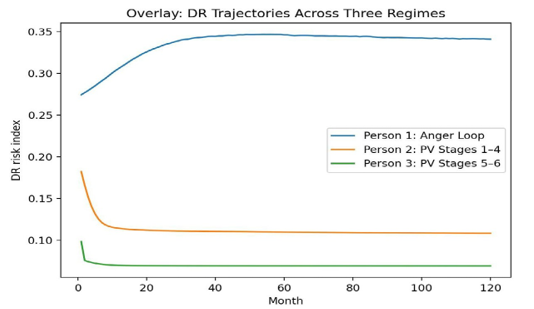
Figure 8: Monte Carlo Results for All Three Regimes: Person 1, 2, 3. DR Risk Is Translated Into Clinical HR in Appendix A
Leave-One-Out and Random-Effects Robustness
Leave-one-out (LOO) analyses confirmed that simulation outcomes were not driven by idiosyncratic realizations. Across all three regimes, LOO-refit estimates of mean DR closely matched full-sample estimates, with negligible deviation (Figures 9a-10c).

Figures 9a, 9b, 9c: LOO Analysis Across All Three Regimes for Model Explanatory Power Over 7 to 10,000 Iterations

Figures 10a, 10b, 10c: LOO and Random Effects Results Across Regimes Showing Variance Decreasing from Person 1 to Person 3. Heterogeneity Approaching Zero Insuring Stability of Model Parameters
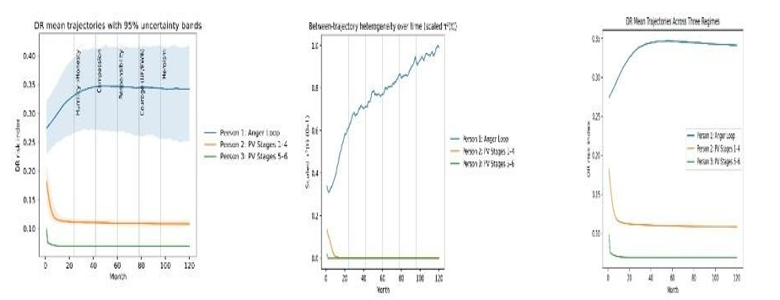
Figures 11a, 11b, 11c: Mean Trajectories Over 120 Time Steps Across All Three Regimes
Random-effects variance (τ²) differed markedly across regimes (Figures 11a-11c). In the anger loop dominant regime, τ² was nontrivial, reflecting sensitivity to perturbation and structural instability. In the PV stages 1–4 regime, τ² was reduced, indicating partial stabilization. In the PV ≥ 5 regime, τ² approached zero, consistent with a highly stable system in which outcomes were robust to stochastic variation. These findings align with the interpretation of phase transitions rather than smooth linear change across developmental stages.
Convergence Across Methods
Despite methodological differences, polynomial regression, Monte Carlo simulation, and robustness analyses converged on the same qualitative conclusions:
• Downstream mortality risk is strongly structured by the interaction of worldview coherence and cultural narcissism.
• The anger-loop cascade represents a self-reinforcing mechanism linking epistemological instability to elevated risk.
• Developmental progression through early virtue stages attenuates—but does not eliminate—this cascade.
• Higher-order developmental stages correspond to a qualitative regime shift marked by emergence of stabilizing properties and collapse of risk amplification.
Together, these results support the interpretation of downstream risk as a developmentally contingent, dynamically regulated outcome rather than a static function of isolated traits.
Discussion
The present findings converge on a single, unifying conclusion: worldview coherence (WV) functions as a central organizing variable in human developmental and health-relevant dynamics, exerting influence across affective regulation, relational behavior, physiological load, and downstream mortality risk. Across polynomial regression, Monte Carlo simulation, and robustness analyses, WV consistently emerged not as a peripheral correlate, but as a structural determinant of system behavior—particularly when examined in interaction with cultural narcissism (CN).
Worldview Coherence as a Structural Variable
Across analytic approaches, WV demonstrated a stable inverse relationship with downstream risk, both directly and through its role in suppressing epistemological disorientation and affective dysregulation. Importantly, this relationship was nonlinear and interaction-dependent, rather than additive. Low WV did not uniformly predict elevated risk; instead, risk amplification occurred most strongly when low WV co-occurred with elevated CN, producing a self-reinforcing anger-loop cascade. This finding reframes WV from a background belief construct into a functional regulator of system stability. In regimes characterized by low WV, the system exhibited heightened sensitivity to perturbation, feedback escalation, and risk persistence. In contrast, high WV was associated with flattened risk surfaces, reduced variance, and convergence toward low-risk equilibria—even in the presence of moderate CN.
Cultural Narcissism as an Erosive Contextual Force
The interaction between WV and CN was a defining feature of the model. CN consistently functioned as an erosive contextual force, undermining epistemic humility and fragmenting worldview coherence. However, CN alone was insufficient to explain downstream outcomes. Elevated CN only translated into substantial risk when paired with degraded WV, underscoring the importance of epistemological structure over isolated trait elevation. Detailed theoretical and empirical treatment of CN has been presented elsewhere, and readers seeking a fuller account of its developmental origins and mechanisms are referred to that work. In the present manuscript, CN is treated as a conditioning variable that shapes how worldview coherence manifests and how developmental progression unfolds.
Developmental Regimes and Phase Transitions
A central contribution of this study is the demonstration that the system does not behave as a single continuum but instead occupies qualitatively distinct developmental regimes. Analyses consistently supported three such regimes:
• Anger-loop dominant configurations, characterized by low WV, elevated CN, and persistent feedback among disorientation, dysregulation, and harm;
• Transitional configurations corresponding to early Progression of Virtues (PV stages 1– 4), marked by partial attenuation of the anger loop and reduced—but still present—risk sensitivity;
• Stabilized configurations associated with higher PV stages (≥5), in which CN was effectively eliminated, WV stabilized at high levels, and downstream risk collapsed.
The transition between these regimes was not gradual in all respects. In particular, the emergence of forgiveness and existential well- being appeared to coincide with phase transitions rather than linear increments. This pattern was evident in both regression surfaces and simulation behavior, where risk variance (τ²) approached zero only after higher-order developmental thresholds were crossed.
Dynamic Behavior and System Stability
Monte Carlo simulations reinforced the interpretation that the anger-loop cascade represents a self-sustaining dynamical system rather than a collection of loosely associated variables. In low-WV regimes, feedback among epistemological disorientation, affective dysregulation, and harm enactment produced persistent elevation of downstream risk. In contrast, systems characterized by high WV demonstrated rapid dampening of perturbations and convergence toward stable equilibria. Leave-one-out and random-effects analyses further indicated that these behaviors were structural rather than incidental. Stability patterns were robust to resampling and not driven by influential cases, supporting the conclusion that the observed dynamics reflect underlying system properties rather than artifacts of particular datasets or realizations.
Integration Across Methods
Although polynomial regression, Monte Carlo simulation, and robustness analyses differ substantially in form, they converged on the same qualitative structure. Polynomial regression identified the nonlinear interaction surfaces; simulation demonstrated how these surfaces translate into dynamic trajectories; robustness analyses confirmed that these patterns were stable and reproducible. Taken together, the results suggest that downstream risk is best understood not as the sum of individual risk factors, but as the emergent product of epistemological coherence, cultural orientation, and developmental capacity interacting over time.
Scope and Boundaries of Interpretation
The present discussion is intentionally descriptive rather than prescriptive. While the findings have clear implications for developmental theory, health psychology, and intervention design, those implications are addressed separately. Here, the emphasis is on establishing that the observed patterns are real, robust, and internally coherent across analytic approaches. In this sense, the study does not propose a new outcome so much as it reorganizes existing outcomes into a unified developmental framework—one in which worldview coherence plays a central, structuring role.
Implications
The present findings carry implications across multiple domains, including developmental psychology, psychosocial intervention, public health, and the conceptualization of mortality risk. While causal inference is not claimed, the convergence of results suggests that epistemological structure and developmental orientation are not peripheral psychological features but central organizing forces with downstream consequences.
Implications for Mortality and Health Risk
Perhaps the most consequential implication concerns mortality risk. Across analytic approaches, degradation of worldview coherence— particularly when coupled with elevated cultural narcissism—was associated with sustained activation of affective dysregulation, harm enactment, and physiological load, culminating in elevated downstream mortality risk. Importantly, this risk emerged well before overt medical pathology, suggesting that psychosocial dynamics may function as early indicators rather than late- stage correlates of health outcomes. Conversely, stabilization of worldview coherence was associated with flattened risk trajectories and reduced variance, indicating not merely lower expected risk but greater resilience to perturbation. From a population-health perspective, this suggests that mortality risk may be meaningfully shaped by developmental and epistemological factors long before traditional biomedical interventions are triggered.
Harm Enactment and Social Externalities
The anger-loop cascade identified in this study links epistemological disorientation to affective dysregulation, relational resentment, and harm enactment toward self and others. These processes do not remain confined to the individual; they manifest as interpersonal conflict, violence, self-harm, and broader social harm. The findings imply that harm enactment is not simply a behavioral problem, but the downstream expression of a destabilized epistemological system. Interventions that target behavior alone—without addressing worldview coherence or narcissistic orientation—may therefore fail to interrupt the feedback loop that sustains harm.
Psychosocial Development as Risk Regulation
A central implication of the developmental analyses is that progression through early virtue stages produces gradual attenuation of risk, while higher-order developmental stages correspond to qualitative regime shifts. In particular, the emergence of forgiveness and existential well-being appears to stabilize the system in ways not achievable through incremental symptom reduction. This suggests that psychosocial development functions as a form of risk regulation, not merely self-improvement. Developmental stagnation, by contrast, may leave individuals trapped in unstable regimes characterized by persistent dysregulation and elevated downstream risk.
The Necessity of Addressing Cultural Narcissism
The findings underscore the necessity of addressing cultural narcissism as a developmental and contextual risk factor. CN consistently eroded worldview coherence and amplified downstream dysregulation. Importantly, CN did not operate as an isolated trait but as a cultural lens that shaped how individuals interpreted experience, threat, and meaning. This implies that interventions aimed at reducing narcissistic orientation— particularly those fostering humility, epistemic openness, and self-transcendence—may have cascading benefits across affective, relational, and health domains. Absent such intervention, CN may persist across the lifespan, sustaining epistemological instability even in otherwise adaptive individuals.
The Necessity of Coherent Worldview Commitment
One of the most striking implications of the present work is that the specific content of belief systems appears less critical than their coherence, congruence, and consistency. Across analyses, individuals benefited not from holding any particular worldview, but from holding some worldview that provided a stable organizing framework for meaning, values, and action. In practical terms, this suggests that the human psyche requires a coherent interpretive lens through which to situate itself in the world. Whether secular or spiritual, philosophical or religious, the worldview must function as an organizing paradigm that aligns belief, behavior,and purpose. In the absence of such coherence, epistemological disorientation becomes likely, with cascading consequences for emotional regulation, behavior, and health.
Broader Implications
Taken together, these findings suggest a reframing of psychosocial risk: not as a collection of discrete symptoms, but as the emergent property of developmental, epistemological, and cultural dynamics interacting over time. They also suggest that effective intervention may require moving beyond symptom management toward restoration of coherence, attenuation of narcissistic orientation, and support for developmental progression. These implications are not prescriptive with respect to belief content or cultural values. Rather, they point to a minimal requirement for human flourishing: the need to inhabit the world through a lens that is coherent, congruent, and capable of organizing one’s relation to reality [3-18].
References
- Hawkins, T. The Progression of Virtues: A Pathway to Eudaemonic Well Being. Available at SSRN 5605793.
- Hawkins, T. (2025). Cultural Narcissism as a Universal Developmental Failure Mode: Humility as the Gate to Prosocial Transmission and Well-Being. Available at SSRN 5920086.
- Antonovsky, A. (2002). Unraveling the mystery of health: How people manage stress and stay well. In The health psychology reader (pp. 127-139). SAGE Publications Ltd.
- Chida, Y., & Steptoe, A. (2009). The association of anger and hostility with future coronary heart disease: a meta-analytic review of prospective evidence. Journal of the American college of cardiology, 53(11), 936-946.
- DerSimonian, R., & Laird, N. (1986). Meta-analysis in clinicaltrials. Controlled clinical trials, 7(3), 177-188.
- Everson-Rose, S. A., & Lewis, T. T. (2005). Psychosocial factors and cardiovascular diseases. Annual review of public health, 26(1), 469-500.
- Hemingway, H., & Marmot, M. (1999). Psychosocial factors in the aetiology and prognosis of coronary heart disease: systematic review of prospective cohort studies. Bmj, 318(7196), 1460-1467.
- Higgins, J. P., & Thompson, S. G. (2002). Quantifying heterogeneity in a metaâ?ÂÃÂ?ÂÂanalysis. Statistics in medicine, 21(11), 1539-1558.
- Krizan, Z., & Herlache, A. D. (2018). The narcissism spectrum model: A synthetic view of narcissistic personality. Personality and social psychology review, 22(1), 3-31.
- McEwen, B. S. (1998). Stress, adaptation, and disease: Allostasis and allostatic load. Annals of the New York academy of sciences, 840(1), 33-44.
- Miller, T. Q., Smith, T. W., Turner, C. W., Guijarro, M. L., & Hallet, A. J. (1996). A meta-analytic review of research on hostility and physical health. Psychological bulletin, 119(2), 322.
- Myers, R. H., Montgomery, D. C., & Anderson-Cook, C. M. (2016). Response surface methodology: process and productoptimization using designed experiments. John Wiley & Sons.
- Steger, M. F., Frazier, P., Oishi, S., & Kaler, M. (2006). The meaning in life questionnaire: assessing the presence of and search for meaning in life. Journal of counseling psychology, 53(1), 80.
- Stone, M. (1974). Crossâ?ÂÃÂ?ÂÂvalidatory choice and assessment of statistical predictions. Journal of the royal statistical society: Series B (Methodological), 36(2), 111-133.
- Twenge, J. M., & Campbell, W. K. (2009). The narcissism epidemic: Living in the age of entitlement. Simon and Schuster.
Clinical Translation of Downstream Mortality Risk (DR) Into Respective All-
Cause Mortality Hazard Ratios
A.1 Rationale
The Downstream Mortality Risk (DR) construct produced by the simulation, regression, and MASEM frameworks in the present work represents a dimensionless latent risk index summarizing the cumulative impact of worldview coherence (WV), cultural narcissism (CN), and the anger-loop cascade (EPD → AD → RR → HE → PL). Because none of the contributing datasets directly report all-cause mortality hazard ratios (HRs), a clinical translation step was required to render DR outputs interpretable within standard medical and epidemiological risk frameworks.
To this end, DR values were mapped onto age-specific all-cause mortality hazards using publicly available actuarial life tables and a proportional hazards formulation. This approach does not assert that DR is itself an observed hazard ratio; rather, it provides a clinically readable projection of absolute mortality risk conditional on explicit and testable assumptions.
A.2 Baseline Mortality Hazards
Baseline annual all-cause mortality probabilities (qx) by single year of age were obtained from the 2022 U.S. Social Security Administration period life tables, separately for males and females. For each age ðÂÃÂ?ÂÂ?Â¥, the corresponding baseline annual hazard rate was derived as:
h0(x) =− ln (1 − qx)
This transformation is standard in survival analysis and allows actuarial probabilities to be embedded within proportional hazards models.
A.3 Mapping DR to Hazard Ratios
Because DR is unitless, its translation to an HR requires specification of a calibration function. Two clinically plausible calibrations were used, reflecting common reporting conventions in medical research:
Calibration A (Moderate Risk Scaling)
HR = exp(In(3). DR)
Calibration B (High Risk Scaling)
HR = exp(In(5). DR)
Under these mappings
• DR = 0 ⇒HR = 1(baseline mortality risk)
• DR = 1 ⇒ HR = 3or HR = 5, respectively
Using both calibrations provides a sensitivity bracket rather than a single point estimate, allowing readers to assess robustness to reasonable assumptions about risk magnitude.
A.4 Absolute Risk Projection
Adjusted annual hazards were computed as:
h(x) = h0(x). HR
Annual survival probabilities were then:
SX∗ = exp( − h(x)) = (1 −qx)HR
For multi-year horizons (T = 1,5,10 years), survival and cumulative risk were computed as:
S∗ X → X+ T = GT-1T-0(1 −qx+T)HR
Pr(death by T) = 1 − S∗(X → X+ T)
These calculations yield absolute all-cause mortality risk distributions conditional on age, sex, DR level, and calibration choice.
A.5. Reporting Strategy
Results are reported for:
• Baseline ages 30, 50, and 70 years
• Male and female life tables
• 1-, 5-, and 10-year risk horizons
• All three modeled regimes:
 Person 1: Anger-loop dominant configuration
Person 2: PV stages 1–4
Person 3: PV stages ≥5
For each condition, the median, 2.5th percentile, and 97.5th percentile of:
• Hazard ratio (HR)
• Absolute mortality risk
• Absolute risk difference relative to baseline are reported.
A.6. Interpretation and Scope
This appendix provides a clinical translation layer, not a causal mortality model. The procedure:
• Preserves the internal structure of the DR construct
• Anchors projections to empirically observed population mortality
• Makes uncertainty explicit through calibration bracketing and distributional reporting Importantly, qualitative conclusions—namely, that degraded worldview coherence coupled with elevated cultural narcissism substantially amplifies downstream mortality risk via the anger- loop cascade, while advanced PV stages markedly attenuate such risk—were stable across both calibration schemes.
A.7. Reproducibility
All computations were performed using deterministic transformations applied to Monte Carlo– generated DR distributions. Life table inputs, calibration parameters, and resulting HR and risk projections are fully documented in the accompanying workbook:
DR_to_HR_Clinical_Translation_SSA2022.xlsx.
Clinical Implications
The present findings suggest that downstream mortality risk is meaningfully structured by modifiable psychosocial dynamics rather than by immutable demographic factors alone. Across modeling approaches, degraded worldview coherence coupled with elevated cultural narcissism consistently mapped onto substantially higher projected all-cause mortality risk via an angerloop cascade involving epistemic disorientation, anger dysregulation, retaliatory orientation, and harm-related behaviors. Conversely, progressive increases in virtue development—particularly beyond higher- order stage thresholds—were associated with marked stabilization of this cascade, corresponding to lower projected hazard ratios and absolute mortality risk even when actuarial baselines were held constant. Importantly, the translation of model-derived risk into age-specific all-cause mortality projections suggests that clinically meaningful differences in long-term survival may arise well before overt medical pathology is evident. From a clinical standpoint, these results imply that assessment and intervention targeting worldview coherence, selfreferential orientation, and chronic anger or resentment may have relevance not only for psychological well- being but also for long-term health risk stratification. While causal inference is not claimed, the convergence of regression, simulation, and structural modeling indicates that these psychosocial dynamics warrant consideration as early, potentially actionable contributors to population-level mortality risk.
Statement of Generality
The findings reported in this manuscript are derived from aggregated analyses of published empirical studies spanning diverse populations, age groups, cultural contexts, and methodological designs. As such, the results are intended to characterize general structural relationships among worldview coherence, cultural narcissism, developmental progression, affective regulation, and downstream risk, rather than to provide individual-level prediction or clinical diagnosis. While stratified analyses and simulations were used to examine theoretically meaningful regimes, the generalizability of specific effect magnitudes may vary across populations, developmental periods, and sociocultural contexts. Accordingly, conclusions should be interpreted as describing population-level developmental dynamics and system-level risk patterns, not deterministic trajectories for any given individual.
AI Use Disclosure
Artificial intelligence–assisted tools were used in the preparation of this manuscript for purposes of language editing, structural organization, citation placement, and verification of consistency across document versions. All theoretical framing, analytic design, data assembly, statistical modeling, interpretation of results, and substantive conclusions were developed and evaluated by the author. The author takes full responsibility for the accuracy, integrity, and originality of the work, and confirms that no AI system was used to generate data, fabricate results, or substitute for human judgment in analytic or interpretive decisions.