

Biomedical Science and Clinical Research(BSCR)
ISSN: 2835-7914 | DOI: 10.33140/BSCR
Impact Factor: 1.7


Research Article - (2024) Volume 3, Issue 4
Workplace Hazards Associated with the Use of Surgical Instruments and their Preventive Measures Among Veterinarians in Nigeria
2Department of Veterinary Public Health and Preventive Medicine, University of Abuja, Nigeria
3Department Of Veterinary Theriogenology, University of Abuja, Nigeria
4Department of Veterinary Medicine, University of Abuja, Nigeria
5Veterinary Teaching Hospital, University of Abuja, Nigeria
Received Date: Sep 16, 2024 / Accepted Date: Oct 21, 2024 / Published Date: Oct 29, 2024
Copyright: ©©2024 Jonas A. Onah, et al. This is an open-access article distributed under the terms of the Creative Commons Attribution License, which permits unrestricted use, distribution, and reproduction in any medium, provided the original author and source are credited.
Citation: Onah, J. A., Okafor, R. S., Zaifada, A. U., Enem, S. I., Uba, S. U., et al. (2024). Workplace Hazards Associated with the Use of Surgical Instruments and their Preventive Measures Among Veterinarians in Nigeria. Biomed Sci Clin Res, 3(4), 01-06.
Abstract
Many practicing veterinarians are involved in hazards associated with the use of surgical instruments. This study investigated the prevalence of surgical-instrument-injury (SSI) among practicing veterinarian in Nigeria, using structured questionnaire. Out of two hundred and twelve (212) questionnaires that were retrieved, 146 (68.9%) were males, 42 (19.8%) females and 24 (11.3 %) did not identify their sexes. Also, 37 ((17.5%) of the respondents had between 1-5 years of experience; 63 (29.7%) had 6-10; 67 (31.6%) had 11-20, while 45 (21.2%) had more than 20 years of experience. Respondents were drawn from different work places including ministries (39.6%), veterinary schools (31.6%), private practitioners (16.4%), and other sectors (12.4%). Only 193 (91.0 %) of the respondents were involved in veterinary practice, of which, 37 (19.2%) performed surgery always, 73 (37.8%) often and 83 (43.0%) rarely performed surgery. The most performed procedures were castrations 99 (51.8%), wound repair 92 ((49.2) and Caesarean Section 84 (40.4). About 75 (44.1%) and 77 (42.7%) of respondents were rarely involved in ovariohysterectomy and ear cropping respectively. Other procedures were ear notching, hoof trimming and teeth amputation. Majority of the respondents agreed that poor restraint techniques and lack of assistants were the major predisposing factors to SII. While others agreed that lack of instrument and inexperience also contributed significantly. The frequency of injuries related to surgical instrument were needle 93 (63.2%), scalpel 75 (51.4%), bites 73 (52.5%), razor 57 (42.5%) and mallet 38 (26.2%) while injuries involved were: cuts, mallet injury, animal bites/ kicks, horn goring, drug splash and needle prick/puncture. The suggested preventive measures to SII were proper restraint 80 (44%), adequate instruments 46 (25%), workforce 33 (18%), capacity building 23 (12.6%) and combination of these measures. Veterinarians should prioritize their safety during practice; Workshop and seminar for capacity building, Interest-free loans for procuring basic surgical instrument and review of Veterinary Curriculum to reflect the present challenges should be of lasting solution to SII.
Keywords
Practicing Veterinarians, Surgery, Hazard, Surgical-Instrument, Safe Practice
Introduction
Many practicing veterinarians that engage in different surgical procedures encounter various injuries associated with the use of various surgical instruments (Brodbelt, 2008; Klacik, 2011). The risks associated with Surgical Instrument Injury (SII) among veterinarians may be more complex because of ambulatory nature of some part of the profession where various surgical practices such as dehorning, ear notching, castration, teeth amputation and others, are performed in farm animals. Also included are some invasive and emergency rumenotomy, laparotomy and caesarian sections in food animals. Radiography and orthopedic procedures common among equine practitioners and tissue repairs in wild life have various cases of these SII (ILO/CIS, 2000).
Veterinary Surgery is science and art of management of animal diseases through incision, excision, reshaping, repositioning and other manipulations by the use of instruments. These instruments such as, orthopaedic, ophthalmic, dental and diagnostic and general surgical instrument require high level of technical skills to handle. The mastery of these instrument to a large extent determines the success of all the surgical procedures in veterinary hospitals, clinics and during ambulatory services.
According to the International Labour Organization (ILO), workers die each year as a result of work related injuries, resulting in a total loss of about 2.99 trillion United State Dollars (USD), or 3.94 percent of world GDP [1]. In terms of non-fatal occupational illnesses and injuries, veterinary services are ranked fifth in the United States and Veterinary Surgeons have a fair share of theses hazards due to their predisposition to surgical instruments and equipment [2].
There are limited number of para-veterinary practitioners in the field of surgery thereby exposing veterinary surgeons to most of these surgical instrument injuries from pre-operative procedures, diagnoses, intra-operative and post-operative procedures. In addition, some veterinarians are short of complete surgical instruments, complete surgical team, animal handlers, complete anaesthetic agents and other basic requirements to carry out surgical procedures. These limitations are compounded when the surgery is performed in the field due to limited number of experts in veterinary surgery, thereby exposing the surgeons to other psychological risks such as fatigue, stress and prolonged working hours (ILO, 2000) [3,4].
In humans, the operating room hazards among surgical nurses are widely documented [5]. ILO, (2000) priortized operating room hazards to include some physical, biological, chemical and psychological hazards. Physical hazards such as cuts, stabs, scratches, suture needle pricks, mallet injury, drug splash and accidental animal bites have been documented. Chemical hazards such as anesthetic gases inhalation, contact with corrosive drugs, radiation hazards, inhalation of disinfecting and sterilizing agents, all of which expose the personnel and patients to tissue irritations, tissue damages, skin burns, traumatic pain, bleeding and some other allergic conditions. Biological hazards including zoonosis and infectious diseases conditions such as toxoplasmosis, leishmaniasis, dermatophytosis, tuberculosis and exposure to some drugs such as brucella vaccine, Rabies vaccine, antibiotics and steroidal drugs. Psychological risks such as fatigue, emotional trauma, stress, anxiety and depression (ILO, 2000).
Out of the categories of occupational hazards among veterinarians, Physical health hazards (injuries) such as animal bites, scratches, needle prick injuries and radiation injuries are the most common health hazards. Reported that 79.5% of practicing veterinarians that attended NVMA national convention in 2015 have suffered needle prick injuries and most of them were unreported.
There is paucity of information on the SII among veterinarians in Nigeria. This work aims to evaluate the surgical-instrument-injury (SII) among practicing veterinarian during surgical procedures for awareness, safety, precautions, and for adequate preventive measures to be recommended.
Materials and Methods
A cross sectional study using a structured questionnaire (index 1) was conducted to determine the prevalence of surgical-instrument-injury among practicing veterinarians in Nigeria. The questionnaire was developed and pretested for validity and reliability among 18 veterinarians involved in clinical practice in a veterinary teaching hospitals in Nigeria. The questionnaire was subsequently administered to veterinarians attending the 55th Annual National Congress of the Nigerian Veterinary Medical Association (NVMA) at Usman Danfodiyo University, Sokoto. The questionnaire was administered to all willing attendee veterinarians irrespective of their places of work. Respondents who requested to know the purpose of the study were briefed and they were also at liberty to skip questions they did not want to answer. The respondents were equally informed of the possibility of more than one answer in a question, based on the design of the questionnaire. A total of two hundred and twenty-five questionnaires (225) were distributed and the questionnaire covered various aspects of demographics, years in practice, involvement in surgical practice, instruments use, injuries encountered using the instruments. A closed Ended questionnaire tool was used in this study.
Results
A total of two hundred and fifty-five (225) questionnaires were distributed, out of which two hundred and twelve (212) (85.1%) were completed and returned. The analysis of the findings were based on the 212 questionnaires that were returned. Out of the 212 questionnaires returned, 146 (68.9%) were males and 42 (19.8%) were females while 24 (11.3 %) did not indicate their sexes. Further, 37 ((17.5%) of the respondents who completed and returned questionnaire have between 1-5 years of experience; 63 (29.7%) have between 6-10 years of experience; 67 (31.6%) have between 11-20 years of experience while 45 (21.2%) have more than 20 years of experience. About 89 (39.6%) of the respondents work in government ministries; 71 (31.6%) work in veterinary schools, 37 (16.4%) were private practitioners while 28 (12.4%) respondents work in other places such as companies and NGOs. Some veterinarians work in more than one places by virtue of sabbatical or consultancy services (Table 1).
Also, 193 (91.0 %) respondents asserted that they have been involved in veterinary clinical practice while 19 (9.0%) have never been involved in any related veterinary clinical practice (Table 2). In addition, 37 (19.2%) of the respondents that have been partly or fully involved in veterinary clinical practice performed surgery always, 73 (37.8%) performed surgery often while 83 (43.0%) rarely performed surgery (Table 2).
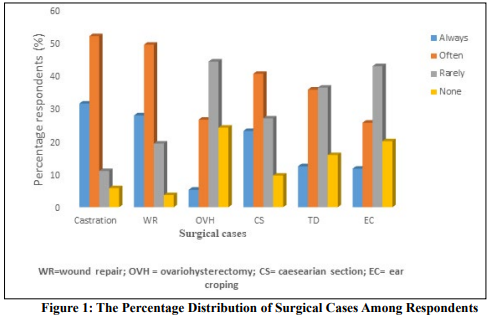
Out of the 193 (91.0 %) respondents involved in veterinary surgical practice, castration was the most often performed surgery (99 (51.8%)) followed by wound repair 92 (49.2 %) and then Caesarian Section 84 (40.4%). About 77 (42.7%) respondents rarely involved in ear cropping while 41 (24.1%) have never engaged in ovariohysterectomy (OVH). Only 7 (3.7 %) of the respondents have not encountered the case of wound repair in their practice. Respondents equally highlighted other surgical procedures such as ear notching, hoof trimming and teeth amputation, which were occasionally presented by clients and are attempted by some veterinary practitioners (Fig 1).
Majority of the respondents ((36 (23%) always and 60 (38.5%) often) asserted that poor restraint techniques was the major predisposing factor to SII. This was followed by non-availability of assistants ((22 (14.6%) always and 61 (45.2 %) often)) and lack of instrument ((23 (19.2%) always and 44 (36.7%) often)), however inexperience is also a significant contributing factor ((22 (18.0%) always 18 (14.8%) often)) (Table 3).
Although respondents agreed that they have been involved in SII, these injuries were rarely encountered. The SII related to needle prick 93 (63.2%) was the most encountered followed by those related to scalpel 75 (51.4%), bites 73 (52.5%) and razor 57 (42.5%), while SII related to the mallet was the least 38 (26.2%).
Also respondents agreed that injuries related to drug splash 63 (40.4%), razor blade 24 (17.9%) and needle prick 23 (15.7%) were often encountered while injuries related to scalpel blade 7 (4.8), and needle prick 6 (4.1%) were always encountered. The injuries involved were: cuts, mallet injury, animal bites, kicks, horn goring, drug splash and needle prick (Table 3).
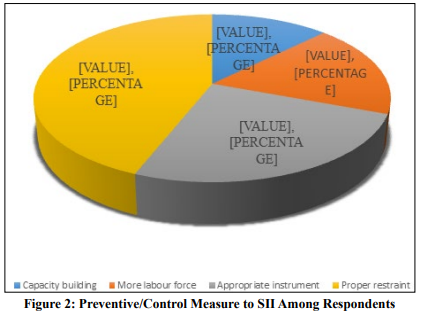
Further, 80 (44%) of the respondents believed that proper restraint of animals will be the solution or precaution against these highlighted SII, 46 (25.3%) agreed that availability of appropriate instruments for these practices is the solution, 33 (18%) agreed that improvement in workforce is the solution while 23 (12.6%) opined that capacity building is a preventive measure.. However, virtually all the respondents believed that combination of these precautionary measures will go a long way in ameliorating these problems (Fig 2).
|
Categories |
Number of individual response |
% Number of individual response |
|
SEX |
||
|
Male |
146 |
68.9 |
|
Female |
42 |
19.8 |
|
Unidentified |
24 |
11.3 |
|
Experience (Years) |
||
|
1-5 |
37 |
17.5 |
|
6-10 |
63 |
29.7 |
|
11-20 |
67 |
31.6 |
|
21 and above |
45 |
21.2 |
|
Affiliation |
||
|
Government ministries |
89 |
39.6 |
|
Veterinary schools |
71 |
31.6 |
|
Private practitioners |
37 |
16.4 |
|
Other agencies |
28 |
12.4 |
Table 1: Demography of the Respondents
|
Categories |
Number of individual response |
% Number of individual response |
|
Involved in clinical practice |
||
|
Yes |
193 |
91.0 |
|
No |
19 |
9.0 |
|
Frequency of involvement in Surgical procedure |
|
|
|
Always |
37 |
19.2 |
|
Often |
73 |
37.8 |
|
Rarely |
83 |
43.0 |
Table 2: Practicing Veterinarians Among Respondents
|
Predisposing Factors |
Distribution among Respondents |
|||
|
Always |
Often |
Rarely |
Non |
|
|
Lack of assistant (%) |
22 (16.3) |
61 (45.2) |
35 (25.9) |
17(12.6) |
|
Anaesthetic under dose/ |
|
|
|
|
|
Overdose (%) |
6 (5.3) |
24 (21.2) |
39 (34.5) |
44 (39.0) |
|
Lack of instrument (%) |
23 (19.2 |
44 (36.7) |
31 (25.8) |
22 (18.3) |
|
Poor restraint technique (%) |
36 (23.0) |
60 (38.5) |
48 (30.8) |
12 (7.7) |
|
Inexperience (%) |
22 (18.0) |
18 (14.8) |
72 (59.0) |
10 (8.2) |
|
Associated SII |
||||
|
Orthopaedic mallet (%) |
2 (1.4) |
11 (7.6) |
38 (26.2) |
94 (64.8) |
|
Scalpel blade (%) |
7 (4.8) |
16 (10.9) |
75 (51.4) |
48 (32.9) |
|
Razor blade (%) |
4 (3.0) |
24 (17.9) |
57 (42.5) |
49 (36.6) |
|
Bite/kick (%) |
3 (2.2) |
32(23.0) |
73 (52.5) |
31 (22.3) |
|
Drug splash (%) |
4 (2.7) |
61 (40.4) |
74 (49.0) |
12 (7.9) |
|
Needle prick (%) |
6 (4.1) |
23 (15.7) |
93 (63.2) |
25 (17) |
Table 3: Distribution of Predisposing Factors and Associated Surgical Instrument Injury (SII) among Respondents
Discussions
This study aims to identify surgical-instrument-injury among practicing veterinarian during surgical procedures. The higher number of male respondents compared with the female reflected the disparity in the genders among practicing veterinarians that attended the convention. This disparity might be due to progressive decline in female practicing veterinarians in Nigerian. This agreed with the reported decrease in female graduates in veterinary profession from 49% in 2007 to 35% in 2017 [6]. Also the finding that hazards in veterinary practice was reported more frequently in female than in male veterinarians might be an added factor. However, this was contrary to the increasing worldwide participation of females in the veterinary profession [7]. Although respondents have the liberty to skip some questions, the reasons why some could not indicate their sex was unknown.
Ages between 6- 20 years in practice constituted highest number of respondents, probably that age bracket represented the most active time in practice, gainful employment, youthful exuberances and willingness to brace up with latest update in the profession. While a good number of younger veterinarians were still job applicants and in post graduate schools and therefore lacking sponsorship to conferences, those above 20 years in practice may be retiring or actively engaged in other activities leading to delegation of their staff to the conference.
The higher number of respondents from government institutions might be a reflection of the ability to participate in the conference among the attendees. Government institutions may sponsor their staff or subsidize the cost of the conference making it possible for their staff to attend. This is unlike the younger veterinarians and those in private sectors with low income and may not be able to afford the cost of the conference. Attendee sponsors at such seminars were self (38.6%) and governmental (44.3%). Reported that only 38.6% of veterinarians were able to sponsor themselves to a Protective Personal Equipment (PPE) Use Seminar in Nigeria [9-16].
This also reflected in the percentage number of attendee (Table 1) with the least experienced veterinarians having the least percentage among attendees. It is also possible that these government agencies enjoy sponsorship and supply of surgical instruments from the government making it possible for them to take part in veterinary practice. There may also be a strong relationship between the place of work and involvement of respondents in surgical practice (Table 2). Many government employees may be engaged in other duties such as security, administrative and academic duties. In veterinary schools, only clinicians and few others in surgery specialty were involved in surgical procedures, thus creating the impression of rare participation in veterinary surgical practice.
Castration is the most surgical practice for all veterinarians. It is common, simple, elective and practiced in all species of animals. Also traumatic wounds is commonly sustained through bites, fall, horn goring and accident and in all species of animals. This is followed by CS which is an emergency in all species and the farmer or pet owner will have no option but to save the dam and the neonate. These are likely reasons they are mostly always and often presented before the veterinarians. Other procedures are rarely practiced because they may be selective in particular species or for only cosmetic procedures. Respondents equally highlighted other surgery procedures that are presented by clients and are attempted by most veterinarians such as ear notching, hoof trimming and teeth amputation.
According to the respondents, poor restraint technique predominate as the major causes of these injuries, followed by unavailability of assistant and lack of instrument in surgery practice. Poor restraint technique may be indication of inadequate training of young veterinarians with life animals both in the hospital theatres and in the field. Assistants and instruments may be lacking because they are capital intensive. It has been reported that factors contributing to these risks include: inadequate infrastructure, inadequate diagnostic aids, inexperience and poor restraint technique.
Injuries related to cut with scalpel and needle prick are always encountered probably because of their regular use in most common surgical procedures. These were followed by bites, drug splash and razor with little differences. This finding is in line with the report that Needle stick injury is the most common source of injury among veterinary professionals and most of this needle stick injuries are not reported . Also, out of the categories of occupational hazards among veterinarians, Physical health hazards (injuries) such as animal bites, scratches, needle stick injuries, stampeding on foot and radiation injuries are the most common health hazards. The lower percentage of injury related to orthopaedic mallet might be due to its rare use and mostly by experts in the specialty. In addition most of the moderate to severe orthopaedic cases are performed in high priced pets which are referred to few experts for management.
Although, greater percentage of the respondents believed that proper restraint will be the solution against these highlighted SII, a holistic approach to the preventive measure was generally recommended. Thus, proper restraint requires the necessary tools (appropriate instrument), adequate assistants (workforce) and the improved knowledge of the practice through capacity building.
In conclusion, Veterinary professionals should prioritize their safety during discharge of their duties. Workshop and seminar attendance for capacity building such as hands-on in veterinary surgery practice, and to maximize referral opportunities should be emphasized. Governmental and Non-Governmental Organizations through Public Private Partnership (PPP), should give interest-free loans for veterinarians to acquire these basic instruments Also veterinary schools should review their curriculum to reflect the present challenges for success of young veterinarians in the field.
References
- Kumar, A., Upender, T., & Mehra, U. S. (2021). Occupational health hazards among veterinarians: A.
- Epp, T., & Waldner, C. (2012). Occupational health hazards in veterinary medicine: zoonoses and other biological hazards. The Canadian Veterinary Journal, 53(2), 144.
- Bonini, S., Buonacucina, A., Selis, L., Peli, A., Mutti, A., & Corradi, M. (2016). Occupational Hazards in veterinarians: an updating.
- Jeyaretnam, J., & Jones, H. (2000). Physical, chemical and biological hazards in veterinary practice. Australian veterinary journal, 78(11), 751-758.
- Corvino, A. R., Manco, P., Garzillo, E. M., Monaco, M.G. L., Greco, A., Gerbino, S., ... & Lamberti, M. (2021). Assessing risks awareness in operating rooms among postgraduate students: a pilot study. Sustainability, 13(7), 3860.
- Akinbobola, J. S., Dinga, J. N., Omeje, J. N., Akinbobola,R. I., Oguntade, E. E., Babalola, J. O., ... & Tijani, K. A. (2023). Protective equipments use by veterinarians in Nigeria. African Journal of Agricultural Research, 19(1), 61-66.
- Lofstedt, J. (2003). Gender and veterinary medicine. The Canadian Veterinary Journal, 44(7), 533.
- Brodbelt, D. C., Pfeiffer, D. U., Young, L. E., & Wood, J. L. (2008). Results of the confidential enquiry into perioperative small animal fatalities regarding risk factors for anesthetic-related death in dogs. Journal of the American Veterinary Medical Association, 233(7), 1096-1104.
- Cecchini, M., Bedini, R., Mosetti, D., Marino, S., & Stasi,S. (2018). Safety knowledge and changing behavior in agricultural workers: an assessment model applied in Central Italy. Safety and Health at Work, 9(2), 164-171.
- Oluseun, A. O., Oludairo, O. O., Oloye, A. A., Muawiyyah,M. M., Aliyu, B. U., Ridwan, O. A., ... & Akanbi, I. O. (2024). Anthrax Outbreak: Knowledge, Risk Practices, and Perception Among High-risk Working Groups in Abattoirs and Slaughterhouses in Nigeria.
- Freeman, J. (2009). The role of the veterinary nurse in anaesthesia.
- Baril, M. Session 6 LOW DOSES AND STRUCTURE-ACTIVITY RELATIONSHIP. Dear participants, 90.
- Mshelbwala, P. P., Weese, J. S., & Idris, J. M. (2016). Prevalence of needlestick injury and its potential risk among veterinarians in Nigeria. Veterinary medicine international, 2016(1), 7639598.
- NJOKU, N. U., OMAMEGBE, J. O., ODIRICHUKWU,E. O., UKAHA, R. O., & JEREMIAH, K. T. (2015). The attitudes of veterinarians at two continuous education seminars in Nigeria towards pain and its management in animals.
- Paterson, R. (2002). Patients at risk from surgical Instruments. The Lancet Infectious Diseases, 2(1), 6.
- Palkhade, R., Mishra, S., & Barbuddhe, S. (2022). Occupation-Related Biological Health Hazards and Infection Control Practices among Indian Veterinarians. Veterinary Medicine International, 2022(1), 2503399.