

World Journal of Tourism Management(WJTM)
ISSN: 3070-4030 | DOI: 10.33140/WJTM


Opinion Article - (2026) Volume 2, Issue 2
When Celebration Becomes Currency: Festivals and the Future of Tourism in South Asia
 and Deepak Bansal 2
 2Mr. Deepak Bansal, Assistant. Professor at School of Law, Manav Rachna University, India
Received Date: Apr 10, 2026 / Accepted Date: May 11, 2026 / Published Date: May 19, 2026
Copyright: ©2026 S. K. Bose et. al. This is an open-access article distributed under the terms of the Creative Commons Attribution License, which permits unrestricted use, distribution, and reproduction in any medium, provided the original author and source are credited.
Citation: Bose, S. K., Bansal, D. (2026). When Celebration Becomes Currency: Festivals and the Future of Tourism in South Asia. World J Tourism Mgm, 2(2), 01-06.
Abstract
Gone are the days when festivals in South Asia belonged exclusively to the string of faith, folklore and familial intimacy. Those festivals were not designed for spectacle, nor calibrated for consumption. They were lived, not staged; inherited, not marketed. A grandmother lighting oil lamps on the threshold of her home during Diwali was not performing for an audience. A fisherman in coastal Sri Lanka offering flowers at a Buddhist shrine during Vesak was not curating an experience for foreign visitors. These were private acts of devotion, woven so deeply into the fabric of daily life that separating them from the people who practised them would have been unthinkable. Today, however, as the global tourism industry increasingly pivots toward what scholars call the ‘experience economy,’ these very festivals have been thrust into a new role-that of economic engines, cultural ambassadors, and strategic assets. This transformation invites both admiration and unease. It compels us to ask whether the marriage of celebration and commerce is one of mutual enrichment or slow erosion. For policymakers and tourism boards, festivals are low-hanging fruit, pre-existing, deeply rooted cultural phenomena that can be leveraged to attract millions with relatively modest investment. For local communities, they are lifelines of identity and livelihood, the annual rhythms around which social and economic life is organised. But for critics, and their concerns deserve serious attention, the growing commodification of festivals raises an uncomfortable question: when celebration becomes currency, what happens to its soul? It is this question that demands honest engagement, not defensive posturing from either camp.
From Sacred Ritual to Global Spectacle
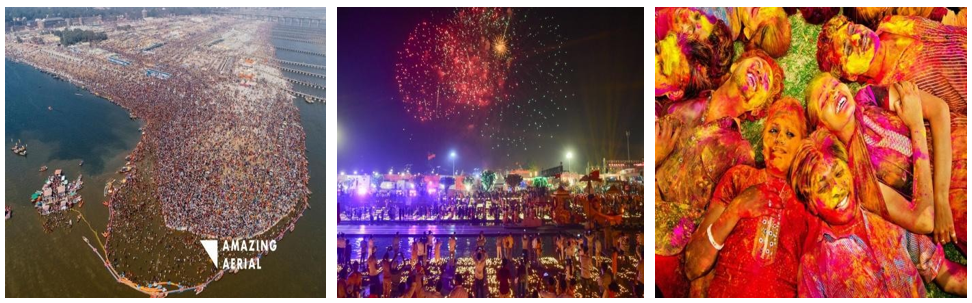
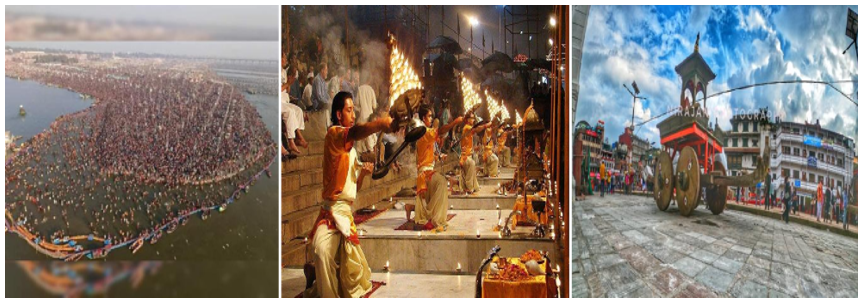
South Asia does not ‘host’ festivals; it breathes them. The sheer density of its festive calendar is unmatched-religious, seasonal, historical, and cultural celebrations overlapping in a rhythm that defines everyday life. In a single fortnight, a city like Varanasi might witness Hindu prayer gatherings at dawn, Sufi musical offerings by dusk, and Buddhist pilgrim processions crossing its ancient lanes. Yet, what has changed in the last two decades is not the festivals themselves, but their audience. Take the Kumbh Mela, a gathering so vast that it is visible from space. Once an exclusively spiritual congregation, it is now a global phenomenon attracting international tourists, documentary filmmakers, and policy planners. The Maha Kumbh Mela; the festival of the sacred pitcher—is anchored in Hindu mythology.
It is the world’s largest public gathering and collective act of faith. This congregation primarily includes ascetics, saints, sadhus, sadhvis, kalpvasis, and pilgrims from all walks of life. Kumbh Mela, in Hinduism, is a religious pilgrimage celebrated four times over a course of twelve years. The geographical location spans four sites in India, rotating between pilgrimages on four sacred rivers: in Haridwar, Uttarakhand, on the banks of the Ganges; in Ujjain, Madhya Pradesh, on the banks of the Shipra; in Nashik, Maharashtra, on the banks of the Godavari; and in Prayagraj, Uttar Pradesh, at the confluence of the Ganges, the Yamuna, and the mythical invisible Sarasvati.
When the 2025 Maha Kumbh at Prayagraj drew tens of millions of visitors, the sheer logistical machinery required, temporary townships, pontoon bridges, digital surveillance, sanitation grids-turned a pilgrimage into something resembling a small nation-state with a forty-five-day lifespan. International journalists arrived not just to report on faith but on crowd management as an engineering marvel. Somewhere in that transition, the festival acquired a double life: one sacred, one spectacular.
Similarly, the Ganga Aarti in Varanasi, once a local devotional practice conducted by a handful of priests on the ghats, has evolved into a choreographed spectacle designed as much for cameras as for the divine. Rows of young priests move in synchronised formation, wielding enormous brass lamps while loudspeakers carry Sanskrit hymns across the water. Tour operators sell ‘premium viewing’ spots on boats. Drone cameras capture the scene from above. This is not accidental. Governments across South Asia have recognised that festivals offer something modern tourism desperately seeks: authenticity. In a world of standardised hotel rooms and predictable itineraries, festivals promise unpredictability, immersion, and emotional resonance. Tourists, increasingly disillusioned with passive sightseeing, are responding with their wallets and their plane tickets.
The Political Economy of Celebration
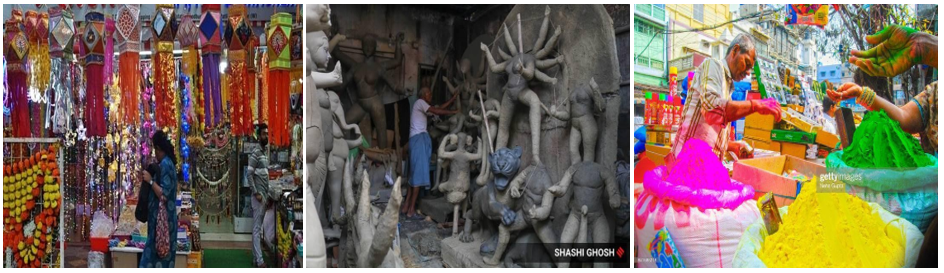
Let us be candid: the romance of festivals often obscures their hard economic logic. Festival tourism is not merely about cultural exchange-it is about revenue streams. Hotels fill, airlines surge, local transport thrives, and informal economies flourish. In cities like Varanasi, Jaipur, Colombo, and Kathmandu, festival seasons can account for a disproportionate share of annual tourism income. The Pushkar Camel Fair in Rajasthan, for instance, has grown from a livestock trading event into a week-long international spectacle generating crores of rupees for the local economy. The Esala Perahera in Kandy, Sri Lanka, has become a fixture on South-East Asian travel itineraries. These are not peripheral happenings; they are anchor events around which entire regional economies organise themselves.
But the real story lies beneath the formal economy. In South Asia, where informal labour constitutes a significant portion of the workforce, festivals are economic equalizers. The street vendor selling marigold garlands, the artisan crafting clay idols in Kolkata’s Kumartuli months before Durga Puja, the tailor stitching festive garments in Lahore’s Anarkali bazaar, the drummer leading a procession in Colombo—all become stakeholders in a vast, decentralised economic network. A single festival season in Kolkata can sustain an entire ecosystem of pandal designers, electricians, sound engineers, idol sculptors, flower suppliers, and food vendors-many of whom earn the bulk of their annual income during those ten frenzied days of Durga Puja.
This is what economists might call a multiplier effect, but such terminology scarcely captures the lived reality. For many families, a festival is not just a celebration—it is survival. The months of lean earnings find their counterweight in the weeks of festive abundance. Yet, this economic promise also invites state intervention. Governments brand festivals, package them, and market them globally. “Incredible India,” “Visit Nepal,” and “Sri Lanka: Wonder of Asia” campaigns all prominently feature festivals as flagship attractions. The implication is unmistakable: festivals are no longer just cultural artefacts; they are policy instruments, consciously deployed to drive foreign exchange earnings and project a favourable national image abroad.
Soft Power Draped in Tradition
Beyond economics lies a subtler, more strategic dimension—soft power. In an era where nations compete not just through military or economic might but through cultural influence, festivals become diplomatic tools. They narrate stories of heritage, tolerance, and diversity-qualities that shape global perception far more effectively than any government white paper ever could.
Consider the transnational appeal of Buddhist festivals like Vesak, celebrated across Sri Lanka, Nepal, Bhutan, and parts of India. These events attract pilgrims and tourists from across Asia, reinforcing civilizational linkages that predate modern nation-states. When a Japanese tourist lights a candle at a Vesak celebration in Anuradhapura, or when a Thai delegation joins festivities in Lumbini, what is being exchanged is not merely tourism revenue but a sense of shared spiritual ancestry. No bilateral trade agreement can manufacture that kind of goodwill.
Similarly, festivals like Diwali-celebrated with fervour from Delhi to Durban, from Leicester to Los Angeles—and Eid, observed across borders with communal feasting and prayer, create a shared cultural vocabulary that transcends political divides. The Nepali festival of Dashain connects diasporic communities scattered across the globe. The Sinhalese and Tamil New Year in Sri Lanka, celebrated in April, is one of the rare occasions where ethnic communities share a common festive moment. For a region often defined by geopolitical tensions, border disputes, and nuclear anxieties, festivals offer an alternative narrative—one of continuity and connection. Tourism, in this sense, becomes a conduit for diplomacy, a bridge built not by politicians but by people carrying sweets across borders.
India’s own diplomatic engagements have increasingly leaned on this festive soft power. When the International Day of Yoga was adopted by the United Nations in 2015, it was, at its core, a festival-adjacent cultural export—an annual global observance rooted in Indian tradition. The growing popularity of Diwali celebrations in Western capitals, often attended by heads of state and parliamentarians, serves a similar function. These are not mere social gatherings; they are exercises in cultural legitimacy, signals that South Asian traditions command respect and participation on the world stage. For smaller nations like Nepal and Bhutan, whose geopolitical leverage is limited, cultural festivals represent an outsized opportunity to assert presence and relevance in international conversations.
The Paradox of Authenticity
Yet herein lies the paradox. The very success of festival tourism threatens the authenticity that makes it attractive. As visitor numbers swell, festivals risk becoming performances rather than practices. Rituals are shortened to suit tourist schedules. Sacred spaces are reconfigured for better visibility and crowd flow. Traditional art forms are stylised for mass appeal— complex classical dance sequences reduced to digestible ten-minute showcases, intricate rangoli patterns simplified into selfie backdrops. What emerges is a curated version of culture— accessible, photogenic, but often stripped of its depth. When the Holi festival in Mathura and Vrindavan is marketed primarily as a ‘colour party’ for backpackers, something essential is lost in translation. The mythological roots of the festival—the story of Prahlad and Holika, the playful legends of Radha and Krishna— are sidelined in favour of Instagram-worthy imagery. The elders who once narrated these stories around bonfires find themselves peripheral to a celebration they no longer recognise.
This is not to romanticise a static past. Cultures evolve, and festivals have always adapted to changing contexts. The Durga Puja pandals of Kolkata, for instance, have transformed from modest bamboo structures into sprawling architectural installations that reference everything from political movements to global art trends. That evolution is organic, community-driven, and artistically bold. But when the impulse for transformation comes not from the community but from the market—when changes are dictated by what will attract more tourists rather than what the tradition demands—then the nature of the evolution changes fundamentally. The question is not whether festivals should change, but who should drive that change and toward what end.
The Environmental Reckoning
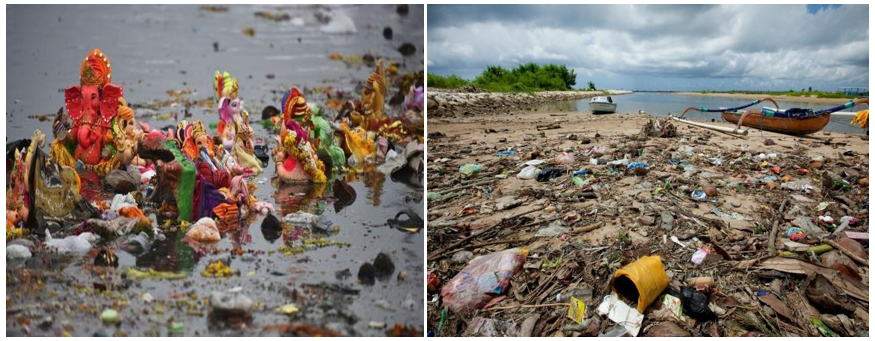
Another dimension often overlooked in celebratory narratives is the environmental cost. Large-scale festivals generate enormous waste, strain local resources, and contribute to pollution. River festivals, in particular, have come under scrutiny for the ecological damage caused by mass bathing, ritual immersions of painted idols, and the disposal of floral and chemical offerings into already-stressed water bodies. The Yamuna in Delhi, the Hussain Sagar in Hyderabad, the Sabarmati in Ahmedabad-all bear the visible scars of festive excess each year.
Cities hosting major festivals often struggle with infrastructure overload. Traffic congestion, water shortages, sanitation challenges, and waste management crises become routine features of what should be joyous occasions. The irony is stark: festivals that celebrate nature and divinity often end up degrading the very environments they revere. A harvest festival that pollutes the river feeding the harvest is a contradiction that can no longer be ignored. Encouragingly, there are signs of change. Eco-friendly clay idols are replacing plaster-of-Paris ones in several Indian cities. Plastic bans during festival seasons are being enforced with growing seriousness in states like Maharashtra and Himachal Pradesh. Sustainable tourism initiatives—such as limiting visitor numbers at ecologically fragile pilgrimage sites—are gaining traction. The Ladakh administration’s efforts to regulate tourist inflow during the Hemis Festival offer a model worth studying. But these remain fragmented efforts, lacking the systemic coherence required for long-term impact. What is needed is not piecemeal reform but a comprehensive policy framework that treats environmental sustainability as integral to festival governance, not as an afterthought.
There is also the less visible but equally pressing matter of carbon footprints. International festival tourism involves long-haul flights, chartered buses, diesel generators powering temporary stages, and mountains of single-use packaging for food and merchandise. If South Asia is serious about positioning itself as a responsible tourism destination—and it must be, given its acute vulnerability to climate change—then the environmental audit of festival tourism cannot remain a footnote in policy documents. It must move to the centre of the conversation.
Between Community and Commodity
At its heart, the debate over festival tourism is a debate about ownership. Who owns a festival-the community that nurtures it, the state that promotes it, or the market that profits from it? When a tribal community in Odisha performs its ancestral harvest dance, and that dance is later replicated in a five-star resort’s ‘cultural evening,’ something more than intellectual property is at stake. It is a question of dignity, of voice, of who gets to define what a tradition means.
The answer, perhaps, lies in balance; though balance is easier prescribed than practised. Community participation is not just desirable; it is essential. Festivals derive their authenticity from the people who celebrate them. Excluding local voices in favour of top-down commercialisation risks eroding the very foundation on which festival tourism stands. Models of community-based tourism, where local residents are not merely subjects of the tourist gaze but active agents in shaping the tourist experience, offer a promising path forward. In Bhutan, the government’s approach to cultural tourism; charging a daily tariff, limiting visitor numbers, insisting on licensed guides—has ensured that festivals like Paro Tshechu remain living traditions rather than museum exhibits. Closer home, several village-level festivals in Kerala and Odisha have shown that small-scale, community-managed tourism can deliver economic benefits without sacrificing cultural integrity. The theyyam performances of northern Kerala, for example, continue to operate on the terms set by the performing communities themselves, drawing respectful audiences precisely because they refuse to dilute their rituals for commercial convenience.
Equally important is equitable distribution of benefits. Tourism revenues must not be concentrated in the hands of a few hotel chains and tour operators while local communities bear the burden of overcrowding and environmental degradation. Revenue-sharing models, local employment mandates, and investment in community infrastructure should be non-negotiable conditions for any festival tourism policy. The artisan who makes the festival possible must not be the last to benefit from its commercial success.
Re-Imagining the Future of Festival Tourism
<img src="https://www.opastpublishers.com/scholarly-images/10724-6a196f81be152-when-celebration-becomes-currency-festivals-and-the-future-o.png" width="600" height="280">
If festivals are to remain viable as tourism drivers in the decades ahead, they must be re-imagined for the future. This means embracing sustainability not as a buzzword but as a guiding principle embedded in planning, execution, and evaluation. It means leveraging technology to manage crowds, enhance experiences, and reduce environmental impact, real-time crowd monitoring through mobile applications, digital waste-tracking systems, and virtual-reality previews that distribute tourist interest beyond a handful of overcrowded sites.
It means fostering regional collaboration to create cross-border festival circuits that reflect South Asia’s shared heritage. Imagine a ‘Buddhist Heritage Trail’ connecting Lumbini in Nepal, Bodh Gaya and Sarnath in India, and Anuradhapura in Sri Lanka, a circuit anchored not just by archaeological monuments but by living festivals that animate those sacred geographies. Such circuits would not only diversify the tourism product but deepen the cultural understanding that travel, at its best, is supposed to foster.
It also means expanding the definition of festivals. Contemporary cultural events-literature festivals, film festivals, art biennales, food carnivals are increasingly becoming part of the tourism landscape across South Asia. The Jaipur Literature Festival, the Galle Literary Festival in Sri Lanka, and the Kathmandu International Film Festival attract a different demographic: one that values intellectual and creative engagement alongside traditional celebration. In doing so, these contemporary gatherings complement rather than replace traditional festivals, creating a diversified tourism ecosystem that is more resilient to seasonal fluctuation and less dependent on any single event.
There is, finally, the matter of narrative. Who tells the story of a festival matters as much as how it is organised. For too long, the narrative has been shaped by outsiders; travel writers, foreign journalists, documentary filmmakers whose perspectives, however well-intentioned, filter the experience through a lens of exoticism. Empowering local storytellers, community historians, and indigenous media creators to narrate their own festivals is not just a matter of representation; it is a matter of accuracy. A festival explained by the grandmother who has performed its rituals for sixty years carries a depth that no guidebook can replicate.
Conclusion: The Fragile Alchemy of Celebration
Festivals in South Asia are, ultimately, acts of collective memory. They tell stories of gods and seasons, of struggle and renewal, of community and continuity. Every lit lamp, every drumbeat, every shared meal during a festival carries within it the weight of centuries. Tourism, when thoughtfully integrated, can amplify these stories, bringing them to a global audience and generating the economic resources that help communities preserve their heritage.
But this is afragile alchemy. Push too hard toward commercialisation, and the story becomes hollow—a performance emptied of meaning, a cultural shell polished for the tourist brochure. Resist change entirely, and the story risks stagnation-a tradition unable to speak to younger generations or adapt to evolving realities. The challenge lies in navigating this tension with sensitivity, intelligence, and an unwavering commitment to the communities that keep these traditions alive. It requires humility from the state, restraint from the market, and agency for the people. That is not a formula that lends itself to quick implementation, but it is the only formula that has any chance of working.
For South Asia, the stakes are extraordinarily high. Festivals are not just tourist attractions; they are cultural lifelines, the connective tissue that holds diverse, multilingual, multi-faith societies together. Their transformation into economic assets must not come at the cost of their meaning. The policymaker who sees only revenue in a festival is as mistaken as the purist who sees only tradition. Both must learn to hold complexity; to appreciate that a festival can be simultaneously sacred and commercial, ancient and evolving, local and global, without collapsing into one dimension. Eventually, what draws a traveler to a festival is not just the spectacle-the lights, the colours, the crowds but the sense that they are part of something real, something enduring, something profoundly human.