



Review Article - (2025) Volume 2, Issue 1
Weak and Weak* Operators in Non-Separable Banach Spaces: Topological Properties, Convergence and Structural Insights
Received Date: Aug 22, 2025 / Accepted Date: Sep 25, 2025 / Published Date: Oct 09, 2025
Copyright: ©Â©2025 Juan Alberto Molina GarcÃa. This is an open-access article distributed under the terms of the Creative Commons Attribution License, which permits unrestricted use, distribution, and reproduction in any medium, provided the original author and source are credited.
Citation: García, J. A. M. (2025). Weak and Weak* Operators in Non-Separable Banach Spaces: Topological Properties, Convergence and Structural Insights. Ther Res: Open Access, 2(1), 01-09.
Abstract
This article develops a rigorous framework for the study of weak and weak* operators in nonseparable Banach spaces (NSBS), where many of the foundational results of classical functional analysis fail or require significant reformulation. While the separable case is governed by compactness principles such as the Banach–Alaoglu theorem, the Eberlein– Šmulian theorem, and Rosenthal’s characterization of weakly compact sets, these rely heavily on metrizability and sequential compactness, both of which are absent in non-separable settings. Consequently, the extension of weak and weak* operator theory to NSBS is not straightforward and requires a careful topological re-evaluation.
The main objective of this work is to provide generalized notions of weak compactness, weak*continuity, and convergence of operators in NSBS, formulated in terms of nets rather than sequences, and to establish stability results for these properties under perturbations. We show that weak compactness can still be characterized locally on separable subspaces, but its global behavior diverges substantially from classical expectations. In particular, we prove that the failure of sequential compactness leads to an abundance of counterexamples in spaces such as l∞, L∞ ([0,1]) yC(βN), where operators exhibit residual behaviors not captured by traditional weak compactness criteria.
New results are presented regarding the structure of weakly compact and weak*-continuous operators in NSBS. These include a reformulated Dunford–Pettis property, characterisations of weakly compact operators in terms of invariant separable subspaces, and stability theorems under compact and norm perturbations. We also analyse the fragility of weak operator convergence in NSBS, showing that weak operator topology (WOT) perturbations may fail to preserve spectral or topological features, but that partial resolvent stability can still be obtained.
The article contributes to functional analysis in three principal ways: (i) by clarifying the limitations of classical theorems in the non-separable setting; (ii) by introducing generalised tools, based on local analysis and net convergence, that preserve part of the operator-theoretic structure; and (iii) by identifying new avenues of research at the intersection of weak compactness, operator algebras, and duality theory. Finally, we outline potential interdisciplinary applications.
Keywords
Weak Operators, Weak* Operators, Non-Separable Banach Spaces, Weak Compactness, Dunford–Pettis Property, Eberlein– Šmulian Theorem, Operator Theory, Functional Analysis
Introduction
The study of weak and weak* topologies is a cornerstone of functional analysis. These topologies are indispensable for the development of compactness principles, duality arguments, and structural theorems on Banach spaces. Classical results— such as the Banach–Alaoglu theorem, the Eberlein–Smulian theorem, and the Dunford–Pettis property—provide powerful tools for characterising weakly compact sets and operators [1-3]. In separable Banach spaces, these tools are underpinned by the metrisability of the unit ball in the weak or weak* topology, which ensures sequential compactness and permits approximation by sequences.
However, in the absence of separability, many of these classical arguments collapse. Non-separable Banach spaces are typically non-metrisable in their weak and weak* topologies, which implies that sequential compactness fails and nets, rather than sequences, must be employed to describe compactness phenomena [2]. As a consequence, properties such as weak compactness, weak sequential compactness, and weak*-continuity diverge significantly from their familiar behavior in separable spaces. For instance, in spaces such as â??∞ or L∞ ([0,1]), the unit ball is weak*- compact but not sequentially compact, leading to pathologies in the behavior of operators that rely on sequential methods [3,4].
The challenge is further magnified when considering operators acting on NSBS. In separable spaces, the structure of weakly compact operators is well understood: compact operators are weakly compact, and weakly compact operators admit characterisations in terms of Dunford–Pettis properties and reflexivity [5]. In non- separable settings, by contrast, these equivalences break down. Weakly compact operators may fail to preserve properties under perturbations, weak*continuity of adjoints cannot always be guaranteed, and operator algebras defined on NSBS may require fundamentally different analytic tools [6,7].
The purpose of this article is to develop a systematic framework for weak and weak* operator theory in NSBS, addressing the following key objectives:
1. To analyse the breakdown of classical theorems (Eberlein– Šmulian, Dunford– Pettis, Rosenthal compactness) in the absence of separability.
2. To reformulate weak compactness and weak*-continuity using nets and local approximations on separable invariant subspaces.
3. 3.To establish new results and counterexamples highlighting the distinctive features of weak and weak* operators in NSBS.
4. 4.To investigate stability under perturbations, particularly the behavior of weakly compact operators under compact or norm-small perturbations.
5. 5.To explore interdisciplinary implications, especially in mathematical physics, ergodic theory, and optimisation, where NSBS naturally arise.
This study demonstrates that while global weak compactness cannot be recovered in full generality, it can be reconstructed through local analysis on separable subspaces and through netwise generalisations of compactness arguments. By doing so, we extend operator-theoretic methods into the non-separable domain, providing an unified approach to weak and weak* phenomena in functional analysis.
Background
The weak and weak* topologies constitute fundamental tools in the study of Banach spaces, operator theory, and duality. This section recalls the classical results that characterise weak compactness, reflexivity, and continuity in separable settings. We emphasise the dependence of these results on separability and metrisability, laying the groundwork for their extension—or failure—in NSBS.
Weak and Weak* Topologies
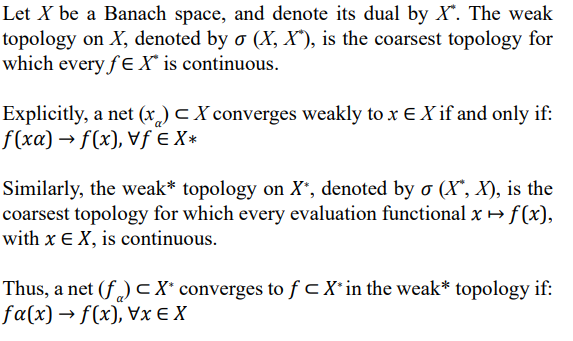
The weak and weak* topologies are Hausdorff, locally convex, and generally nonmetrisable, except when â?» is separable. In that case, the Banach–Alaoglu theorem ensures compactness of the closed unit ball in the weak* topology, and separability implies its compactness is sequential [3].
Banach–Alaoglu Theorem
The Banach–Alaoglu theorem is a cornerstone of functional analysis. Let X be a Banach space. The closed unit ball of X∗ , BX*

The proof relies on Tychonoff’s theorem, using the embedding

spaces, this compactness is not sequential unless X is separable. In NSBS, the weak* topology is not metrisable, and hence sequential methods fail [2].
Eberlein–Šmulian Theorem
The classical Eberlein–Šmulian theorem establishes the equiva- lence between weak compactness and sequential weak compact- ness. Let X be a Banach space. For a subset A´ ⊂ X, the following are equivalent:
a. A´ is relatively weakly compact.
b. Every sequence in A´ admits a weakly convergent subsequence in X.
c. Every sequence in A´ has a weakly Cauchy subsequence.
This result is crucial in separable spaces, as it reduces weak com- pactness to sequential arguments. However, in NSBS, the equiva- lence breaks down: while (a) still implies (b), the converse fails be- cause weakly compact sets need not be sequentially compact [1,2].
Dunford–Pettis Property
The Dunford–Pettis property characterises Banach spaces in which weakly compact operators preserve certain convergence structures. A Banach space X has the Dunford–Pettis property if, for every Banach space Y and every weakly compact operator T: X

In separable Banach spaces, this property is tightly linked to the structure of weakly compact operators [5]. In NSBS, however, weak compactness cannot always be detected through sequences, which complicates the verification of the Dunford–Pettis property.
Rosenthal’s 
-Theorem
A key result in the structure of weakly compact sets is Rosenthal’s theorem. Every bounded sequence in a Banach space either has a weakly Cauchy subsequence or contains a subsequence equivalent to the canonical basis of
This theorem highlights the dichotomy between weak compactness and the presence of
-sequences. In separable settings, it provides a powerful criterion for detecting weakly compact sets. In NSBS, however, the reliance on subsequences becomes problematic, since weak compactness is not necessarily sequential.
Dependence on Separability
The preceding results demonstrate that separability is not merely a technical convenience but a structural assumption underpinning much of weak operator theory: a) Banach–Alaoglu ensures compactness in general, but only separability guarantees sequential compactness; b) Eberlein–Šmulian relies critically on metrisability; without it, sequential characterisations collapse; c) Dunford–Pettis and Rosenthal’s theorem hinge on sequence-based convergence, which loses adequacy in NSBS.
Thus, the extension of weak and weak* operator theory to NSBS requires reformulating classical results in terms of nets, local analysis on separable invariant subspaces, and generalised compactness notions. These issues will be addressed in the subsequent sections.
Extensions to Non-Separable Banach Spaces
The transition from separable to NSBS forces a fundamental reconsideration of weak and weak* operator theory. While the basic definitions of weak compactness and weak convergence remain formally unchanged, their structural and topological implications differ drastically due to the loss of sequential compactness and metrisability.
In this section, we analyse the behavior of weak and weak* operators in NSBS, provide counterexamples that highlight the breakdown of classical theorems, and propose extensions based on nets and local analysis.
Failure of Sequential Compactness
The most immediate obstruction in NSBS is the failure of sequential compactness in weak and weak* topologies.
Proposition 3.1. Let X be a non-separable Banach space. Then the closed unit ball BX∗ of the dual space, endowed with the weak* topology, is compact by Banach–Alaoglu, but it is not sequentially compact.
Proof. The weak*-compactness of BX∗ follows from Banach– Alaoglu. Assume by contradiction that BX∗ is sequentially compact. Then, by general topology, a sequentially compact and Hausdorff space is first countable. This would imply that the weak* topology on BX∗ is metrisable. But weak* metrisability of BX∗ occurs if and only if X is separable [2]. Contradiction. 
This failure implies that the Eberlein–Šmulian theorem cannot be generalised to NSBS, since weak compactness no longer guarantees sequential compactness.
Weak Compactness in NSBS
In separable spaces, weak compactness is often characterised by sequences. In NSBS, sequences are inadequate, and nets must be employed.
Definition 3.2. A set A´ ⊆ X is weakly compact in NSBS if every net (xa) ⊂ A´ has a subnet that converges weakly to some X∈ A´ .
This generalisation is topologically correct but analytically less tractable, as many operator-theoretic arguments are built on sequences. For example, weak compactness of the image of the unit ball under an operator can no longer be verified by examining bounded sequences, as in the classical Dunford–Pettis framework [5].
Example: The Unit Ball of 
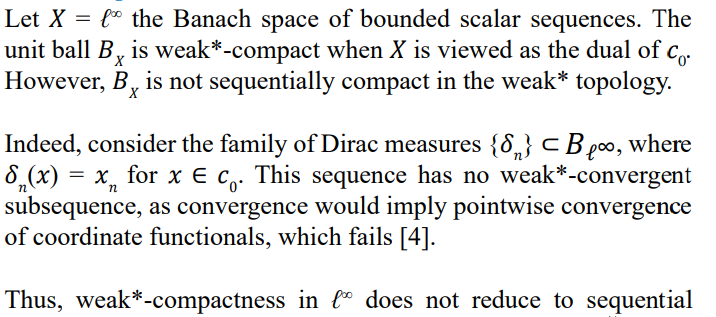
compactness, breaking the equivalence of the Eberlein–Šmulian theorem.
3.4. Example: Multiplication Operator on L∞ ([0,1])
Let T:L∞ ([0, 1])→ L∞ ([0,1]) be the multiplication operator T(F) x = xf(x). Entonces,T is weak*-continuous on bounded subsets of L∞ ([0,1]). However, the unit ball of L∞ ([0,1]) is not sequentially compact in the weak* topology.
Thus, sequences (fn) bounded in norm may fail to admit weak*- convergent subsequences, and the standard arguments for weak compactness of multiplication operators collapse. This example illustrates the fragility of weak continuity in NSBS.

scalar-valued functions on the Stone–Cech compactification of  subsets of X cannot be characterised by sequences; c) the adjoint T∗ of an operator T:X→X may fail to be weak*-continuous, even if T is weakly compact on separable subspaces. This example shows that dual arguments fail globally in NSBS, requiring local analysis on separable invariant subspaces.
Local Compactness Via Separable Subspaces
To partially recover weak compactness, one can restrict analysis to separable, T invariant subspaces.
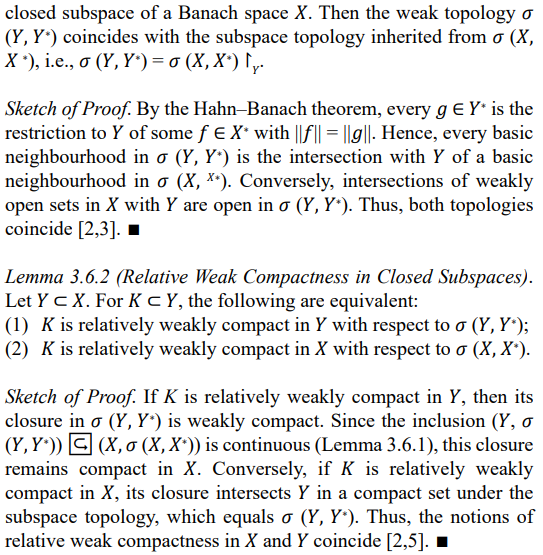
Lemma 3.6.1 (Induction of the Weak Topology). Let Y ⊂ X be a
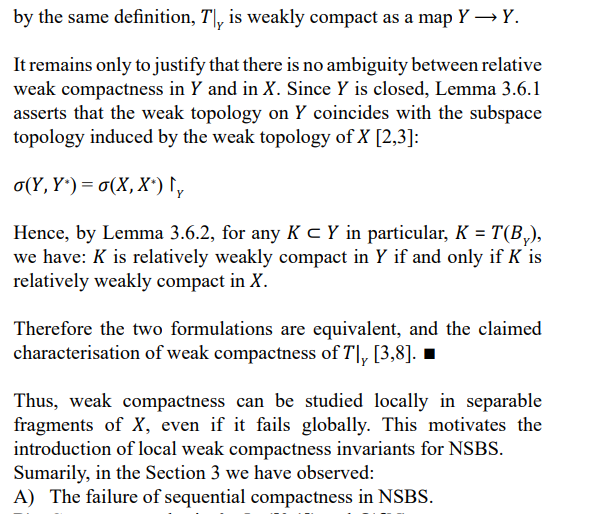
C) The necessity of reformulating compactness and continuity in terms of nets and local analysis on separable subspaces.
New Results and Generalizations
The breakdown of sequential methods in NSBS requires reformulating weak and weak* operator theory in terms of nets and local compactness. This section presents new results that extend classical theorems, adapted to the non-separable setting.
Weak Compactness Via Nets
In classical settings, weak compactness is verified through se- quences (Eberlein– Šmulian). In NSBS, this must be replaced by nets.
Theorem 4.1 (Weak Compactness via Nets in NSBS). Let X be a NSBS, and let A ⊆ X be bounded. Then A is weakly compact if and only if every net (xa) ⊂ A has a subnet converging weakly to someX∈ A .
Proof. This is a reformulation of general compactness in Hausdorff topological vector spaces: compactness is equivalent to the property that every net has a convergent subnet. The key difference in NSBS is that one cannot replace nets with sequences, since sequential compactness fails [2].
This theorem provides a working criterion, though it is less practical than the classical sequence-based characterisation.
Local Weak Compactness for Operators
Since global compactness is difficult to handle in NSBS, it is natural to localise analysis to separable subspaces.
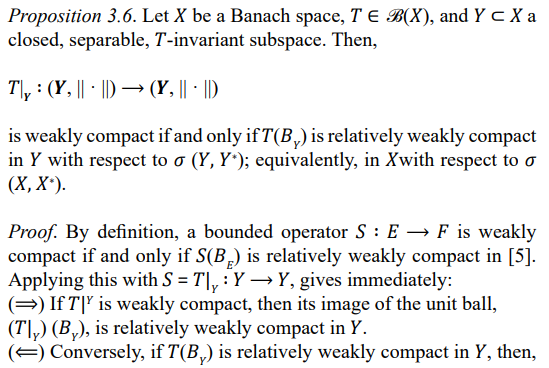
Theorem 4.2 (Local Weak Compactness of Operators). Let T ∈ 
(X), where Xis a NSBS. Then T is weakly compact if and only
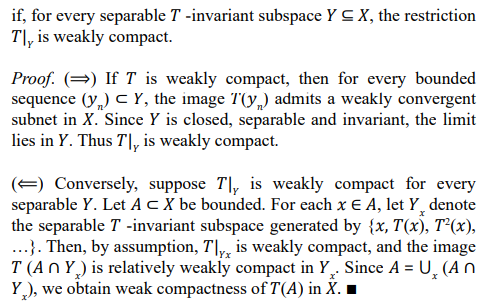
This result generalises the classical definition and shows that local analysis is sufficient to capture global weak compactness in NSBS.
Weak* Continuity of Adjoint Operators
The weak* continuity of adjoint operators is automatic in separable settings but fails in NSBS. We provide a general criterion.
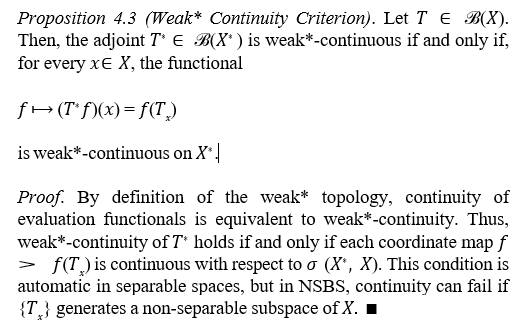
This criterion illustrates that adjoints may fail to preserve weak*- continuity globally in NSBS, even if they do so locally on separable subspaces.
Reformulation of the Dunford–Pettis Property
In NSBS, the classical Dunford–Pettis property (DPP) based on sequences becomes inadequate. We propose a net-based reformulation.
Definition 4.4. A Banach space X has the generalised Dunford– Pettis property (GDPP) if for every Banach space Y and every weakly compact operator T: X→Y, the implication
xa→0 weakly in X⇒ 0
holds for every bounded net (xa) ⊂ X.
This generalisation is necessary because weakly null sequences do not capture the full behavior of weakly null nets in NSBS.
Proposition 4.4. If X is separable, then GDPP coincides with the classical DPP.
Proof. In separable spaces, weak compactness can be tested by sequences (Eberlein–Šmulian). Thus, nets are equivalent to sequences for weak convergence, and GDPP reduces to DPP.
Approximate Weak Compactness
Given the abundance of counterexamples in NSBS, it is natural to consider approximate versions of weak compactness.
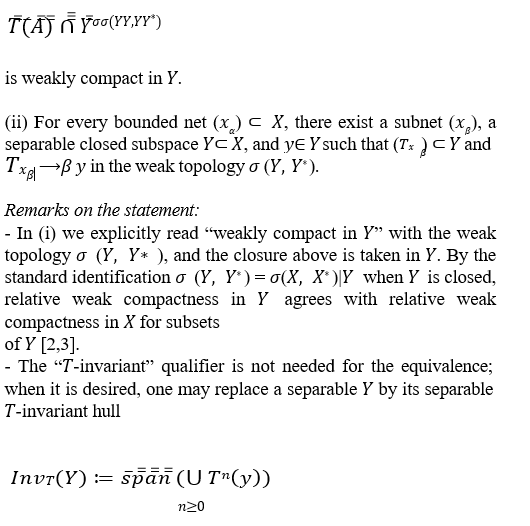
Theorem 4.5 (Approximate Weak Compactness). Let X be a (possibly non-separable) Banach space and T ∈ ). The following are equivalent:
(i) For every bounded set A⊂ X and every separable closed subspace Y ⊂ X (in particular, every separable T-invariant closed subspace), the set
which is again separable (countable union of separable sets) and satisfies:
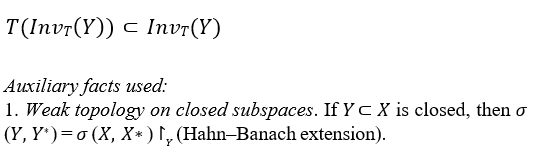
Consequence: Relative weak compactness of K ⊂ Y in Y relative weak compactness of K in X [2,3].
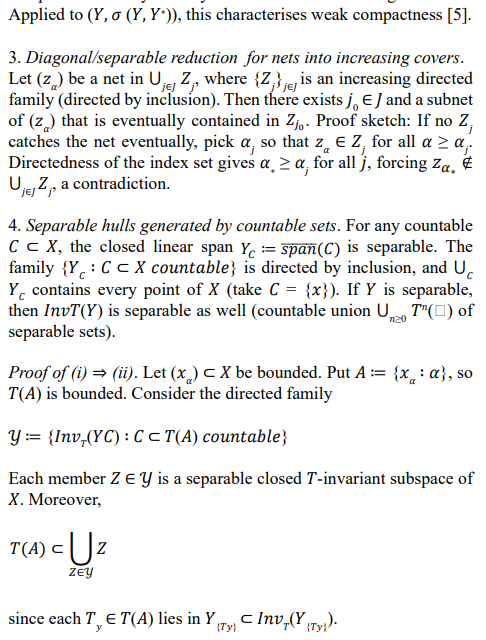
2. Nets and compactness. A subset K of a Hausdorff space is compact if and only if every net in K admits a convergent subnet.
Concluding remarks:
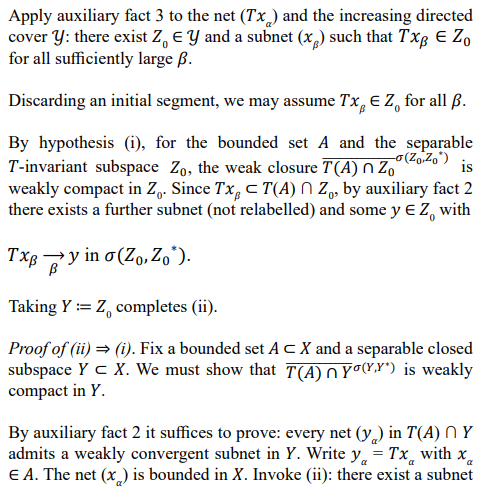
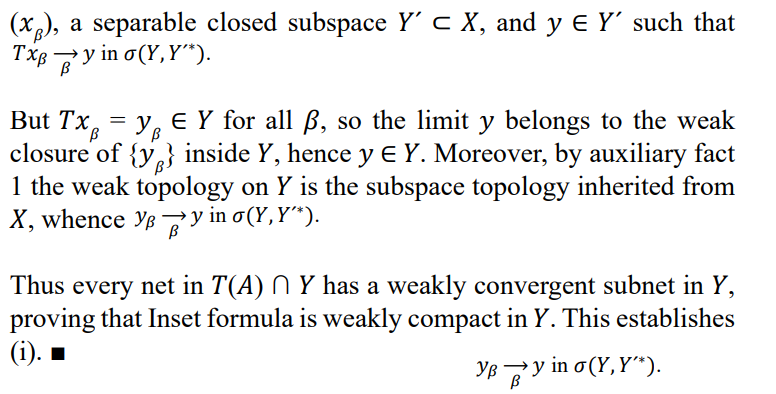
- The proof shows that the adjective “T-invariant” in (i) can be omitted without affecting the equivalence. If one insists on T-invariance, simply replace any separable Y by InvT(Y),which is separable and contains the relevant subnet values; the argument is unchanged.
- The direction (i) ⇒ (ii) uses only compactness of weak closures on all separable (invariant) subspaces to obtain a convergent subnet inside one of them; the diagonal/net selection is encoded in the “increasing directed cover” lemma.
- The direction (ii) ⇒ (i) is a pure compactness-by-nets argument inside the separable subspace Y.
This property defines approximate weak compactness, which is weaker than global weak compactness but stronger than mere boundedness. It provides a more flexible tool for handling operators in NSBS.
Summary of Section 4:
- Introduced net-based reformulations of weak compactness and DPP.Proved a local weak compactness theorem for operators in NSBS.
- Characterised weak*-continuity of adjoints in non-separable settings.
- Defined approximate weak compactness, bridging global and local perspectives.
Stability under Perturbations
In operator theory, stability under perturbations plays a crucial role in both theoretical analysis and applications. Classical results establish that weak compactness, reflexivity, and the essential spectrum are stable under compact perturbations in separable Banach spaces [5,8]. In NSBS, however, the breakdown of sequential compactness and weak* metrisability introduces new obstacles.
In this section, we investigate the stability of weakly compact and weak*continuous operators under norm-small and compact perturbations. We also identify situations where stability fails, providing counterexamples in NSBS.
Stability of Weak Compactness under Compact Perturbations
In separable spaces, Atkinson’s theorem ensures that the essential spectrum is invariant under compact perturbations, and weak compactness of operators is preserved. A similar phenomenon holds in NSBS, provided analysis is restricted to separable invariant subspaces.
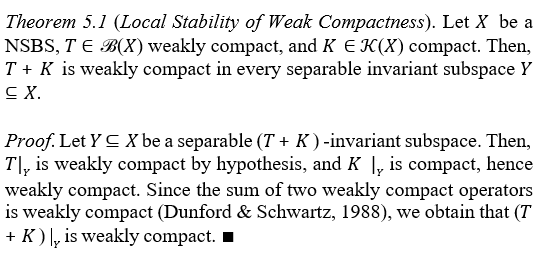
This result highlights that local weak compactness is stable under compact perturbations, though global stability may fail.
Failure of Global Stability
While Theorem 5.1 ensures local stability, global weak compactness may be destroyed by compact perturbations.
S (x1, x2, x3, …) = (0,x1, x2, x3, …)
The operator S is weakly compact on separable subspaces of
but globally it is not weakly compact, since the image of the unit ball contains no weakly convergent subnet in the weak topology of
[3]. Adding a compact perturbation, such as a rank-one operator, does not restore global weak compactness.
This example illustrates that compact perturbations cannot com- pensate for the lack of sequential compactness in NSBS.
Stability Under Norm-Small Perturbations
In separable spaces, norm-small perturbations preserve weak compactness of operators. This property partially extends to NSBS
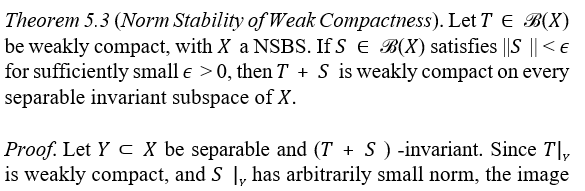
of bounded sets under T + S is relatively weakly compact in Y. This follows from the fact that the closure of a weakly compact set is weakly compact and norm-small perturbations preserve boundedness and weak continuity [1].
This theorem establishes local norm stability, but does not guarantee global stability in NSBS.
Weak* Continuity Under Perturbations
Weak* continuity is particularly fragile in NSBS. Even norm-small perturbations may destroy weak* continuity of adjoint operators.
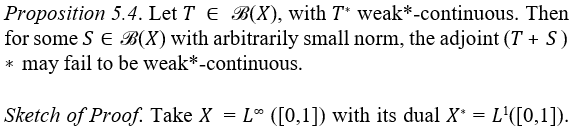
Multiplication operators are weak*-continuous, but perturbations by rank-one operators depending on non-measurable sets destroy weak* continuity, as evaluation on such sets is not weak*continuous. This construction, inspired by examples in, shows that weak* continuity is not stable under perturbations in NSBS [2].
Approximate Stability
Since global stability fails, we propose a weaker notion.

+ S is weakly compact on all separable invariant subspaces of X.
This notion aligns with the local analysis principle developed earlier, ensuring that perturbation stability remains meaningful in NSBS despite global failures.
Summary of Section 5:
- Local weak compactness is preserved under compact and small-norm perturbations.
- Global weak compactness may fail under perturbations due to the absence of sequential compactness.
- Weak* continuity is unstable under perturbations in NSBS.
- A new concept of approximate stability is proposed to capture perturbative behavior.
Applications and Discussions
The results obtained in this article extend weak and weak* operator theory to NSBS, revealing both the structural fragility of classical theorems and the potential for generalised frameworks based on nets and local analysis. In this section, we discuss the implications of these findings for operator theory, functional analysis, and interdisciplinary applications in mathematical physics, ergodic theory, and optimisation.
Implications for Operator Theory
The study of weakly compact and weak*-continuous operators in NSBS forces a re-examination of long-standing principles in operator theory:
- Local compactness: Weak compactness of operators must be reformulated through their restrictions to separable invariant subspaces. This suggests a local–global dichotomy in NSBS operator theory.
- Adjoint behavior: While adjoint operators are automatically weak*-continuous in separable settings, this fails in NSBS. Weak* continuity must be checked locally and cannot be assumed globally.
- Perturbation theory: Compact and norm-small perturbations preserve local weak compactness but fail to guarantee global stability. Approximate stability emerges as a meaningful replacement in NSBS.
These insights suggest that the classification of operators in NSBS requires new invariants, such as local weak compactness indices and approximate stability measures.
Connections to Functional Analysis
Several classical theorems in functional analysis rely on separability, including Rosenthal’s â??1-theorem and the Dunford– Pettis property. Our reformulations reveal:
- Generalised Dunford–Pettis property (GDPP): By extending definitions from sequences to nets, we retain the essence of DPP in NSBS, albeit at the cost of weaker applicability.
- Weak compactness criteria: Nets and local compactness provide viable replacements for sequence-based methods, aligning with the non-metrisable structure of weak and weak* topologies.
- Spectral theory connections: Weak compactness plays a role in spectral decompositions. Our findings suggest that residual and approximate spectra in NSBS may be influenced by weak compactness behavior [3,9].
These connections highlight that weak compactness in NSBS is not a marginal issue but a central structural feature.
Applications in Mathematical Physics
In mathematical physics, non-separable spaces naturally arise:
- Quantum theory: Algebras of observables associated with systems of infinitely many degrees of freedom often lead to non-separable Hilbert or Banach spaces. Weak* compactness in NSBS is relevant for the analysis of states and representations of C∗ algebras [6,7].
- Quantum field theory: Infinite tensor products and Fock spaces associated with uncountably many modes are typically non-separable, requiring weak operator methods beyond the separable setting.
Our results show that the fragility of weak* continuity in NSBS may impact the stability of quantum observables under perturbations, raising questions about the robustness of physical models.
Applications in Ergodic Theory and Dynamical Systems
NSBS frequently appear in ergodic theory and topological dynamics:
- Function spaces such as 
for uncountable measure spaces are nonseparable.
- Operators induced by measure-preserving transformations may fail to be weakly compact globally, but can retain local weak compactness.
This dichotomy suggests that ergodic averages and invariant measures in NSBS should be studied through local spectral bundles of weakly compact operators.
Applications in Optimisation and PDE Theory
In optimisation and PDEs, NSBS arise in duality formulations:
- Optimisation: Dual spaces of separable Banach spaces are often non-separable, and weak*-compactness of feasible sets is crucial in variational problems. The failure of sequential compactness complicates the use of minimising sequences.
- PDE theory: In spaces like 
([0,1]), weak* compactness provides existence results for generalised solutions, but instability under perturbations may affect uniqueness or regularity.
Our results suggest that approximate weak compactness could be a practical tool in these contexts, allowing one to recover weaker forms of compactness sufficient for existence results.
Broader Perspective
The study of weak and weak* operators in NSBS is more than a technical generalisation: it reveals deep structural features of functional analysis. By exposing the dependence of classical theorems on separability, we highlight new research directions:
- The development of net-based functional analysis.
- The classification of weakly compact operators through local invariants.
- The exploration of interdisciplinary applications where NSBS naturally emerge.
Conclusion and Future Work
Summary of Contributions
This article has developed a comprehensive framework for weak and weak* operator theory in NSBS. Classical results in functional analysis—such as the Banach– Alaoglu theorem, the Eberlein– Šmulian theorem, Rosenthal’s â??1 -theorem, and the Dunford– Pettis property—were revisited under the absence of separability, revealing substantial differences in their validity and applicability.
The main contributions may be summarised as follows:
1. We established that weak compactness in NSBS must be reformulated in terms of nets, as sequential compactness fails globally.
2. We proved that local weak compactness of operators, restricted to separable invariant subspaces, is equivalent to weak compactness in the global sense, providing a practical reformulation for operator theory.
3. We characterised the fragility of weak* continuity of adjoints in NSBS and formulated a criterion for identifying when weak*- continuity persists.
4. We generalised the Dunford–Pettis property by introducing a net-based definition (GDPP), which coincides with the classical property in separable settings.
5. We defined approximate weak compactness as an intermediate notion bridging global failure and local validity of weak compactness.
6. We analysed the stability of weakly compact operators under norm-small and compact perturbations, proving local stability results while also demonstrating the failure of global stability in NSBS.
7. We discussed applications in operator theory, functional analysis, quantum theory, ergodic theory, and optimisation, highlighting the broader impact of weak and weak* operator theory in non- separable frameworks.
Taken together, these contributions advance the understanding of weak operator phenomena in non-metrisable and topologically complex settings, offering both conceptual insights and technical tools for further research.
Open Questions and Research Directions
Despite the progress made in this article, many questions remain unresolved. We identify here several promising directions for future work:
1. Spectral Connections: To what extent can local weak compactness be used to refine spectral theory in NSBS, particularly for operators with large residual spectra? Can weak compactness invariants predict spectral decomposition properties?
2. Quantitative Invariants: Is it possible to develop quantitative measures of weak compactness in NSBS, such as indices based on nets, to classify operators more precisely?
3. Sheaf-Theoretic Formulations: Can weak compactness and weak* continuity be encoded as sheaf-like structures over the lattice of separable subspaces, providing a new categorical or topological perspective?
4. Approximate Stability Theory: How robust is the concept of approximate weak compactness under various perturbations (compact, norm-small, weak operator topology)?
5. Can this be formalised into a systematic perturbation theory for NSBS?
6. Interdisciplinary Applications: In quantum field theory, optimisation, and ergodic theory, NSBS naturally arise. Can the generalised framework developed here be directly applied to specific models, for instance in the study of non-separable von Neumann algebras or variational problems in L∞-spaces?
7. Extension to Nonlinear Analysis: While our focus has been linear, nonlinear operators in NSBS present additional challenges. How might generalised weak compactness inform the study of nonlinear mappings, fixed points, and monotone operators in non-separable settings?
Final Remarks
The exploration of weak and weak* operators in NSBS reveals both limitations of classical functional analysis and new opportunities for generalisation. By replacing sequence-based compactness with nets, and global properties with local ones, we gain a framework that is better adapted to the complexity of non-separable structures. Future developments along the directions outlined above are likely to enrich not only operator theory but also its interdisciplinary applications in mathematics and physics [10-17].
References
- Diestel, J. (1984). Sequences and series in Banach spaces. Nework, United States: Springer.
- Fabian, M., Habala, P., Hájek, P., Montesinos, V., & Zizler,V. (2011). Banach space theory: The basis for linear and nonlinear analysis. Springer Science & Business Media.
- Megginson, R. E. (1998). An introduction to Banach space theory. Nework, United States: Springer.
- Rosenthal, H. P. (1974). On the structure of weakly compact subsets of Banach spaces. Journal of Functional Analysis, 16(2), 151-155.
- Dunford, N., & Schwartz, J. T. (1988). Linear operators, part 1: general theory. John Wiley & Sons.
- Sakai, S. (1971). C*-algebras and W*-algebras. Berlin, Germany: SpringerVerlag.
- Takesaki, M. (2003). Theory of operator algebras II (Vol. 125, p. 518). Berlin: Springer.
- Kato, T. (1995). Perturbation theory for linear operators (Classics in Mathematics, reprint of the 1980 edition). Berlin, Germany: Springer-Verlag.
- Palmer, T. W. (1994). Banach algebras and the general theory of*-algebras: Volume 2,*-algebras (Vol. 2). Cambridge university press.
- Albiac, F., & Kalton, N. J. (2016). Topics in Banach space theory (2nd ed.). Nework, United States: Springer.
- Lindenstrauss, J., & Tzafriri, L. (1977). Classical Banach Spaces. Pt. 1. Sequence Spaces. Springer.
- Palmer, T. W. (1994). Banach algebras and the general theory of*-algebras: Volume 2*-algebras (Vol. 2). Cambridge university press.
- Phelps, R. R. (2001). Lectures on Choquet’s theorem (2nd ed.). Berlin, Germany: Springer-Verlag.
- Reed, M., & Simon, B. (1980). Methods of modern mathematical physics. vol. 1. Functional analysis.
- Rudin, W. (1991). Functional analysis (2nd ed.). Nework, United States: McGraw-Hill.
- Taylor, A. E., & Lay, D. C. (1980). Introduction to functional analysis (2nd ed.). New york, United States: Wiley.
- Yosida, K. (1995). Functional analysis (6th ed.). Berlin, Germany: SpringerVerlag.