

Journal of Clinical Review & Case Reports(JCRC)
ISSN: 2573-9565 | DOI: 10.33140/JCRC

Impact Factor: 1.823


Research Article - (2026) Volume 11, Issue 3
Victim Reversal Syndrome: A Behavioral Analysis of Why Victims of Domestic Abuse Become Abusers
Received Date: Feb 02, 2026 / Accepted Date: Feb 27, 2026 / Published Date: Mar 18, 2026
Copyright: ©Copyright: ©2026 Douglas H Ruben. This is an open-access article distributed under the terms of the Creative Commons Attribution License, which permits unrestricted use, distribution, and reproduction in any medium, provided the original author and source are credited.
Citation: Ruben, D.H. (2026). Victim Reversal Syndrome: A Behavioral Analysis of Why Victims of Domestic Abuse Become Abusers. J Clin Rev Case Rep, 11(3), 01-18.
Abstract
Domestic abuse is often understood as a one-directional dynamic in which a perpetrator harms a victim. However, emerging evidence highlights a troubling cycle in which victims of abuse later become perpetrators in subsequent relationships. This paper examines the phenomenon of victim reversal of aggression (Victim Reversal Syndrome). This is where individuals, lacking healthy repertoires for conflict resolution, resort to familiar abusive behaviors that were reinforced in prior relationships. Drawing on behavioral and interbehavioral analyses, the paper explores susceptibility factors, predictors of intergenerational victim-to-abuser transmission, and the normalization of abuse within partner milieus. Previous research demonstrated that reinforcement histories, skill deficits, rule-governed behaviors, emotional desensitization, rigid gender roles, patriarchal norms, modeling, stimulus generalization, and conditioned emotional responses (i.e., trauma exposure) contributed to the replication of abusive dynamics. An expanded behavioral analysis includes the interbehavioral fields. These fields involve reciprocal patterns of behavior and role of reactional biography as the individual moves through behavioral segments. Further refined are the causal variables of (1) rule-governed behaviors, (2) avoidance and escape behaviors, (3) response patterns (sequential and simultaneous responses, (4) matching law (allocation of behavior proportional to reinforcement availability), and (5) stimulus generalization (generic, metaphorical, and metonymical extension). Finally, discussion concludes with a proposed domestic abuse survivor recovery program to incorporate caveats against victims becoming abusers. In sum, this paper underscores the importance of recognizing redirected aggression as a critical component of domestic violence research and intervention.
Keywords
Redirected aggression, Domestic abuse, Behavioral analysis, Interbehavioral psychology, Victim-to-abuser transition, Applied behavior analysis, Matching law, Stimulus generalization
Introduction
Cassy decided she was burned-out. After fifteen years of being told she was ugly, useless, inadequate sexually, weak, meek, and stupid, she decided to leave Frank and end the vicious cycle of Frank’s verbal abuse. Three weeks after she left him and filed for divorce, she met Greg. Greg was kind, soft-hearted, tolerant, a good listener, and disliked conflict. Past the honeymoon period, Greg was still nurturing, patient, passively conceded to Cassy, and doted on her. Cassy lambasted Greg for being weak, spineless, unmasculine, a pushover, and just unexciting. She yelled at him until he listened to her. She left the relationship two weeks later.
Karl was a people-pleaser to his wife. He was placid, unassertive, made his wife dinner, cleaned the house, went grocery shopping, and worked a 50 hour per week job. He never complained. His wife Marlene was the complainer. She was forceful, unforgiving, selfish, judgmental, and kept gaslighting Karl to think everything he did was wrong. She also withheld affection and sex. Karl blamed himself for Marlene’s dissatisfaction; he kept trying to improve his actions to meet her approval. Marlene had an affair and left Karl, saying he was just too unmanly for her. One year later, Karl met Darcy. She was affectionate, over-attentive, placated Karl’s needs, and worshipped Karl. Karl felt strange by this attention and told Darcy to stop it. He criticized her for being codependent, wimpy, a terrified mouse, and lacking identity. Karl kept finding faults with Darcy and withheld affection from her. The sight of her made him angry and he yelled at her. He thought he was teaching her a lesson. Karl split from Darcy 5 weeks later.
Each of these real-life scenarios use anonymous names but are representative of the increasingly pervasive problem afflicting victims of domestic abuse. Their departure from the partner may end the cascade of verbal and physical abuse. But it does not end the behavior segments through which the victim learned to survive the abuse and now developed a repertoire or reactional biography with which to re-commit a similar abuse on subsequent partners. This reversal of behavior patterns, from victim to perpetrator, is the subject addressed in this paper. Discussion follows, first, with a review of domestic violence prevalence. Second, behaviorally explained are five causal variables transactional in the transferal of victim to perpetrator behavior without the victim realizing it. This clinical phenomenon is called Victim Reversal Syndrome (VRS). Analysis covers (1) rule-governed behaviors, (2) avoidance and escape behaviors, (3) response patterns (sequential and simultaneous responses), (4) matching law, and (5) stimulus generalization. Discussion ends by exploring the failure in therapeutic community programs or self-help groups to address this phenomenon and the preventive steps recommended to abuse survivors.
Prevalence of Domestic Violence
Prevalence of domestic violence nationwide is staggering. As of 2025, nearly 10 million people suffered physical or verbal domestic violence in households, estimated at 1 in 3 women and nearly1 in 4 men. In some longitudinal studies, 35.6 of women reported lifetime experiences of rape, physical abuse or stalking by an intimate partner. Scores of men (28.5%) equally report lifetime experiences of abuse by intimate partners [1]. Globally, estimates predict commensurate rates of life-time prevalence of physically abused women (840 million) and 316 million women, ages 15 and up in just the last 12 months [2]. Psychological aggression and coercive control are not only widespread but remain at epidemic proportions with little progress observed in the reduction of infliction over the last two decades. Why is this? The reasons abound. Blame may be cultural; social norms are permissive or indirectly encourage a patriarchy that subjugates women. Or blame is on the community, state, or federal program failures that improperly address effects of racism, misogyny, economic abuse, or weak tracking of criminally convicted perpetrators after their probation ends [3, 4]. Regardless of the social, legal, or psychological reasons, incidents of abuse are tragically rising.
But so is abuse recidivism. Estimates of domestic violence male offenders is surprisingly less discrepant from women re-offenders than one might think [5, 6]. Re-arrest rates for men and women, while not exactly equal, depends on successful or unsuccessful outcomes of probation, history of crimes or concurrent crimes. The history or reactional biography of both men and women offenders can be similar and project similar violent or criminal behaviors. The Reactional biography is more than a person’s portfolio of past behaviors. It represents the complete behavioral history of an individual, describing how a person’s responses develop through continuous interactions with their environment. It emphasizes that behavior arises from both immediate reactions and progressive, developmental processes, beginning in late prenatal life and evolving as biological and psychological maturity increases [7-9]. In this perspective, it means an assessment of a violent offender’s reactional biography includes his or her (a) childhood exposure to familial violence, (2) imitative behaviors of violence shaped by education, legal, or social consequences, (3) number of intimate partner relationships implicit with violence,
(4) comorbid behaviors contributing to violence (i.e., addiction, violent jobs, other psychopathology), and (5) intergenerational and inter-relationship transmission of violence.
Inter-generational transmission of violence: Studies abound on showing the lineage effects of domestically abusive children raised by violent parents. Longitudinal studies confirm that children exposed to domestic violence are significantly more likely to perpetrate intimate partner violence as adults. This transmission is mediated by learned aggression, trauma, and normalization of abusive dynamics. For example, Osborne, Munasinghe, & Page provided a systematic review and meta-analysis showing children at high risk of being offenders [10]. Similar conclusions of long-lasting behavioral disruptions in children also speculated the children were likely carriers who normalized violence and incorporated it into daily family practice [11- 13]. Research documented the unmistakable correlation of common risk variable with repeated family or partner abuse across generations. Variables included emotional dysregulation, attachment insecurity, learned maladaptive behaviors. and internalized beliefs about power and control. Myer et al. (2021) qualitatively expounded on these variables, citing hypervigilance and aggressive coping strategies as confluent factors. By contrast, other studies focused exclusively on cultural permissiveness and normalization of violence in the community [14, 15].
While transferability of intra-family aggression seems an easy concept to understand, behaviorally based studies lay out the framework more directly [16-21]. Each of these studies traced multiple generations of households to show replicational patterns in offspring. Factors repeatedly identified included coercive family processes, reinforcement contingencies, punishment histories, and behavioral momentum. Behavioral momentum means the effect of repeated exposure to abuse strengthening repertoires over time—a term operationally similar to the predictor measure of interbehavioral potentials. An interbehavioral potential describes a measurable macro unit of behaviors occurring over time under specific conditions (contingencies) and across sequential behavioral segments. This unit offers an empirical estimate or probability of some behavior recurrence given same or similar conditions under which it operates. Use of interbehavioral potentials, for example, in clinical and forensic analyses, proves invaluable in predicting risk of criminal recidivism and psychopathology [22, 23]. Consider the case of a murderer who used his avatar in multiplayer gaming to premeditatively rehearse how he later killed his real-life parents; here, the assessment of multiple segments of behavior history combines with the stimulus and response functions controlling his behavior [24].
Explaining domestic violence behaviorally is not new. Stitch et. al. compiled a meta-analysis of published and unpublished studies showing family-of-origin violence were due to social and observational learning [25]. Kipper convincingly outlined the step-by -steps of modeling and imitation intrinsically conditioning young children exposed to violent parents [26]. In related research, functional assessments of battered-identified contingencies prioritized the effects of antecedents and consequences, trauma reaction, behavioral exposure, and the efficacy of CBT interventions for domestic violence survivors [27, 28]. There also exists a plethora of behaviorally oriented self-help or practitioner books providing guidelines for CBT-oriented abuse-recovery methods [29-313. Healing strategies vary from restoring emotional regulation, personal boundaries and increased sense of agency to specific development of proactive social skills in assertiveness, self-compassion, empowerment, new reinforcement patterns, and reclaiming identity.
But violence recovery manuals, like research literature, fall short of the behavioral objective of inoculating the survivors from acquiring the aggressive tendencies of the perpetrator abusing them. Transmission of this behavior, is absent or elusive, or ambiguously packaged under the treatment tools for self- empowerment or assault-protective repertoires. Instructed skills may teach how to recognize subsequent assailants and regain self-validation (self-reinforcement). But skills rarely include self-monitoring (awareness) and self-abatement of copycat aggression with new partners. As exceptions, Guerin & Ortolan and Bonem, Stanley Kime, & Corbin approximated explanations for how survivors may act aggressively in subsequent partner relationships if their victim impact effects went unaltered [34, 35]. Both studies articulated the causal role of aggressive response- generalization and chronic traumatic exposure to abusive parents. Similarly, years earlier, Patterson’s research was the cornerstone to show how families unintentionally teach aggression through coercive cycles (yelling, threats, withdrawal, hitting) [36]. He showed the infinity of child aggressive and oppositional behaviors likely resulting from negative reinforcement (avoidance and escape) schedules. Similarly, Wahler’s innovative work went beyond the traditional behavior-analytic framework of coercive cycles to show the ecological factors (setting events, behavioral segments) that equally impact fluidity and intensity of aggressive reciprocal exchanges [36-38]. Wahler’s model, more than others, foreshadowed the makeover of behavioral and interbehavioral principles to discuss in the following sections.
Causal Variables in the Transmission of Victim to Abuser
Rule-Governed Behavior
To begin with, a distinction is conventional in radical behaviorism between contingency shaped and rule-governed behaviors [39- 41]. Contingency shaped behaviors are behaviors learned from direct experience with reinforcement or punishment contingencies (i.e., learned by doing). For example, an adult touches a hot oven, and the painful heat decreases their touching of the oven surface (i.e., positive punishment). A rule-governed version of the same events is the adult saying to himself or herself, on approaching the oven, “Now be careful, the oven might be hot and don’t touch it” (i.e., learned by being told). Hypothetically, the rule or self- statement made by the speaker to himself or herself is an autoclitic tact or mand. It shapes or controls the speaker’s own behavior outcome. More precisely, an autoclitic tact modifies, qualifies or comments on self-verbal behavior based on non-verbal stimulus control [42, 43].
Observation of the hot oven, the nonverbal stimulus, evokes the anticipatory self-verbal statement, “that oven might be hot.” An autoclitic mand modifies the speaker’s behavior to change, based on some motivating operator affecting the speaker at the time [44]. The motivating operator is a condition to produce (establishing) or remove or avoid something (abolishing). For example, Autoclitic mands about the hot stove operate on abolishing conditions (i.e., avoid the hot stove).
Similar interpretations of autoclitic tacts and mands are possible for domestically abused victims interpreting setting events about the abuser. Christie says to herself, “I hear the garage open, meaning he’s home drunk.” The autoclitic tact discriminatively identifies auditory stimuli in the garage prompting her reply. Following this autoclitic tact, Christie says, “I better get dinner out now before he walks in the house demanding the food.” This autoclitic mand enjoins Christie to immediately engage in meal preparation to prevent or avoid verbal or physical battering (i.e., abolishing operation). Implicit functions of motivators determine the value (importance) and rate (speed) at which Christie changes her behavior (gets the food out). For example, if setting events predicted her husband would stay in the garage for 1 hour tinkering with the car before he came into the house, she might delay preparing dinner and complete another task (e.g., do laundry). Setting events, as Kantor defined them go beyond the immediate contingencies of her husband’s actions in the garage [45-47]. Contextual variables consist of historical, environmental, organismic, and interbehavioral events. Factors considered include her husband’s recent history of tinkering with cars, whether he stays in the garage or comes in the house for tools, temperatures outside affecting his physical tolerance to stay out shorter or longer in the garage, and whether the next-door neighbor visits him in the garage.
Into these complex contingencies is also the schedule of the contingency. Does the husband always stay in the garage for 10 minutes or does it vary (fixed or variable interval)? Or, is it only after he repairs one part or many parts of the motor (fixed or variable ratio)? Schedules are never rigidly “black and white” and instead interlope when either (1) two or more schedules alternate predictably (multiple), (2) contingencies alternate unpredictably (mixed), (3) schedules occur predictably in specific sequence (chained), (4) schedules occur unpredictably in sequence (tandem), (5) two schedules occur concurrently (concurrent),
(6) either one or another schedule occurs (alternative), (7) both schedules must occur for consequences (conjunctive) and (8) the schedule changes based on idiosyncratic or arbitrary behaviors (adjusting) [48, 49]. Table 1 demonstrates each complex schedule of contingencies directly affecting Christie’s autoclitic mands and tact in anticipating the batter’s behavior.
|
Compound Schedule |
What It Is |
How It Affects Christie’s Predictions (Autoclitic Tacts & Mands) |
|
Multiple (mult) |
Two or more schedules alternate, each with its own discriminative stimulus (SD). |
If her husband uses signals (e.g., garage light on = long job, light off = almost done), she may say: Autoclitic tact: â??I see the light is off, so he‘s probably coming in soon.â?? Autoclitic mand: â??I better get the meal started now when the light is off.â?? |
|
Mixed (mix) |
Same as multiple, but no SDs to signal which schedule is active. |
Without cues, she must guess. Autoclitic tact: â??I guess he might be done soon, but I don‘t know.â?? Autoclitic mand: “I better get meal started now.â?? |
|
Chained (chain) |
Two or more schedules occur in a sequence, each with its own SD; reinforcement only after the final component. |
If she knows he always does tasks in order (diagnose → remove part → replace part → clean up), she may say: Autoclitic tact: â??He just finished cleaning up, so he‘ll be in soon.â?? Autoclitic mand: â??He’s finishing up, I need to start the meal now.â?? |
|
Tandem (tand) |
Same as chained, but no SDs for each component. |
She knows he follows a sequence, but can‘t see which step he‘s on. Autoclitic tact: â??I can’t tell which part he‘s doing, so I‘m not sure when he‘ll be done.â?? Autoclitic mand: â??I better start the meal now.” |
|
Concurrent (conc) |
Two or more schedules available simultaneously; the person chooses between them. |
If he alternates between two tasks (e.g., fixing his car vs. organizing tools), she may say: Autoclitic tact: â??He usually chooses the quicker task first, so he might come in soon.â?? Autoclitic mand: â??Don’t take a chance, prepare the meal now.” |
|
Alternative (alt) |
Reinforcement occurs when either of two schedule requirements is met. |
If he comes inside either when he finishes a task or when he gets hungry, she may say: Autoclitic tact: â??He might come in soon because it‘s almost dinnertime.â?? Autoclitic mand: â??Don’t take a chance, prepare the meal now.” |
|
Conjunctive (conj) |
Reinforcement occurs only when both schedule requirements are met. |
If he only comes in when he finishes the repair and cleans up the garage, she may say: Autoclitic tact: â??He still needs to clean up, so it‘ll be a while. Autoclitic mand: â??I have time; I‘ll do something else for now.â?? |
|
Adjusting |
Schedule parameters change based on performance. |
If he stays longer when repairs go well and comes in sooner when frustrated, she may say: Autoclitic tact: â??He seems frustrated today, so he‘ll probably come in earlier.â?? Autoclitic mand: â??Don’t take a chance, prepare the meal now.” |
Table 1: Depicts complex schedules of contingencies within a motivating (abolishing) operation affecting the autoclitic tacts and mands of a female domestic victim.
Clearly revealed in Table 1 is Christie’s frequent inference of “Don’t take a chance, prepare the meal now” This rule infers behavior of her husband based on direct contingency-shaped experiences, for which she renders a decision to start the meal now. After several repeated episodes of self-warning about food preparation, the contingency-shaped rule begins to change form. Christie does not have to repeat the entire rule but only part of it to effectively evoke autoclitic tacts and mands. This abbreviated autoclitic drops part of the longer verbal pattern while still controls the speaker’s reaction as if the longer version was said. This is similar to Kantor’s reduced interbehavioral episode [50]. Kantor explained that the speaker naturally reduces the amount of verbal behavior when the field conditions make the full form unnecessary. Referencing Table 1 above, Christie might say “See the lights? Better prepare the meal,” (multiple schedule) or “He sounds frustrated, let’s eat” (Adjusting schedule).
Language reduction in communication is common. Text users frequently use acronyms and initialisms (OMG, LOL), internet slang and dialect, abbreviated words, memes, emojis or hashtags as commentary [51, 52]. Similarly, abbreviated rules follow a systematic truncation from longer statements into smaller statements (less words). This phenomenon was discussed previously with high-risk populations, such as adult children of alcoholics (ACOAs) and abusive parents [53, 54]. ACOAs exposed to random punishment, for example, around an erratic- behaving drinking parent, learned directly how to avoid or confront that parent. The unpredictability of parental abuse usually occurred either as arbitrary, capricious, or both. Arbitrary means the child never knew when the parent might get angry. Capricious means the child never knew what he or she did wrong to deserve the punishment. Limited control over arbitrary and capricious acts results in the child paying extensive attention to subtle verbal or nonverbal cues in the setting events around which the parent’s behavior occurs. Nuances of setting events signal schedules of impending aggression. The more vigilant a child is to molecular details of the contingency (schedule of consequences; parent’s response topography, frequency, and intensity, media of contact, etc.), the more control a child has to avoid, escape, or confront aggression.
Over-alertness to excessive stimuli also produces anticipatory anxiety (i.e., hypervigilance); heightened arousal increases astuteness to permutations in the contingency likely to render the child helpless or unable to avoid or escape adversity. Hypervigilance also allows the child to dissect, analyze, and compare the current to past contingencies to form predictions about how to respond. Ruben explained this prediction process quantitatively using the risk-benefit ratio formula for behavior choices [55]. Essentially, the child weighs the reinforcer and punisher (values) in making moment to moment (immediate) versus delayed responses.
Rule truncation occurs in the following example. Celeste observes her mother drinking alcohol and then becomes unhinged with anger the moment the mother sees the messy toys on the floor. The mother swears, calls the child’s pejorative names, and threatens to spank the child if the room is not clean immediately. After multiple incidents, Celeste may describe the contingency observed as a rule or, “When my toys are messy, that is bad, mom yells, and I’ll be spanked.” This “rule” alone prompts Celeste to instantly clean up her mess and make the room look spotless. Moreover, if the time between her mother’s drinking and the angry outburst is short, thereby limiting Celeste’s time to clean, the motivating operator compels Celeste to clean her room faster [56, 57]. Since avoidance behavior co-exists with fear (anxiety), Celeste adds this emotional response to the contingency when stating the rule: “Mom’s drinking scares me and I hate that; I better clean now and clean fast.” After a month, Celeste starts to truncate the rule to “clean your room now!” She short-circuits the longer rule partly to respond faster, and partly because few words are necessary to evoke her avoidance response.
Truncated rules (i.e., autoclitic tacts, autoclitic mands) undergo further reduction to a point where words drift from the original (aversive) setting events and become declarative edicts and value statements. The rule “when my room is messy, mom will spank me” transforms into “messy rooms are bad,” or “people who are messy are imperfect or bad.” The child categorically changes the statement from observations of natural events (facts) to generalized rules about ethics, morals, and value judgments. Reifying facts into value inferences is problematic. Historically called naturalistic fallacy, this is when a person drives a moral rule from a descriptive fact. In domestic violence situations, we can see eight steps of response moralization occur over time. First, the victim makes a purely descriptive (empirical) observation: “my husband is in the garage and says he is angry.” Second, rules form from the direct observation to guide decisions (“If I prepare a meal, he’ll be happy). Third, autoclitics expand to better analyze idiosyncrasies of the abuser’s behavior. Fourth, rules gain social personal significance, in converting the rule into an emotionally loaded, identity-relevant or moralistic context (“making the meal is the right thing to do”). Fifth, predictive or “ought” statements describe the rightness, goodness, or should-ness of victim action, all still guiding avoidance or escape behaviors. These naturalistic fallacies emerge to qualify the rules as “wrong or right.” Finally, when absorbed into moralized beliefs, rules become immutable, rigid, and broadly enforceable regardless of inaccuracy, or mischaracterization of the real events (see Table 2).
|
Stage |
Description |
Example of husband in garage |
Behavior-Analytic Notes |
|
1. Direct Observation (Tacts) |
She simply reports what she sees, without adding meaning or moral judgment. |
â??He walked out angry.â?? â??He‘s working in the garage.â?? â??He came said he was angry.â?? â??He‘s not talking right now.â?? |
Pure tacts under control of observable events. No rules, no predictions, no evaluations. |
|
2.Pattern Detection (Tracking Rules) |
She begins to notice a repeated sequence and forms a descriptive rule. |
â??When he goes to the garage angry, he usually comes back in angry.â?? |
A tracking rule—a verbal statement shaped by actual contingencies. Still descriptive, not prescriptive. |
|
3.Predictive Rule-Governed Behavior |
She uses the rule to predict future events and guide her own behavior. |
â??If he goes to the garage angry, he‘ll probably come back angry and won‘t talk.â?? |
Her behavior becomes rule-governed (anticipating silence, preparing for withdrawal). |
|
4. Autoclitic Expansion |
She adds qualifiers that express certainty, probability, or emotional tone. |
â??I know he‘ll come back angry.â?? â??He always shuts down after the garage.â?? |
Autoclitics (â??know,â?? â??alwaysâ??) strengthen the rule‘s perceived reliability. |
|
5.Rule Solidification (Pliance/Augmenting) |
The rule becomes emotionally loaded or identity-relevant. |
â??He‘s supposed to calm down in the garage, but he never does.â?? |
The rule now influences value, not just prediction. This is augmental control. |
|
6.Prescriptive Drift (“Ought” Statements) |
She shifts from describing what happens to prescribing what should happen. |
â??He should come back calmer.â?? â??He shouldn’t ignore me.â?? â?? I need him angry so I know what to do.â?? |
This is the beginning of the is → ought shift. |
|
7.Naturalistic Fallacy (Moralization) |
She treats the descriptive pattern as a moral truth. |
â??Because he always comes back angry, it‘s wrong that he doesn‘t talk.â?? â??Since he shuts down, he‘s being a bad partner.â?? â??But I can handle angry people.â?? |
A descriptive pattern becomes a moral judgment. This is the naturalistic fallacy. |
|
8. Rule-Governed Rigidity |
The rule overrides actual contingencies—even if the husband‘s behavior varies. |
Even if he occasionally comes back calm, she still expects anger and silence. |
The rule persists despite contradictory evidence. |
Table 2: Depicts the progression of direct observation (of contingencies) to rule-governed behaviors to naturalistic fallacies.
Naturalistic fallacies, the last stage in rule truncation, persist despite contradictory evidence. When this contrary evidence appears, not only in the abuser, but also in non-abusers, the rule supersedes accurate or healthy interpretations of natural events. For example, Christie, a victim of domestic violence, went through the metamorphosis of contingencies shaped into rule governed behaviors. She abbreviated or truncated her rules, adding more autoclitics to them and personified the rules into moral values. She finally divorced the garage-husband abuser and after a year began dating. Online dating produced a prospect who was kind, generous, flattering, benevolent, and humble. On her first date with him, Christie was appalled by his magnanimous and gentle behavior. He never got angry, never insulted her, never made her nervous, and never triggered anxiety in her. She could neither explain his behavior nor had an effective response repertoire to respond to it. In other words, he did not fit her pre-existing set of rules and rule governed behaviors. Nonetheless, she vetted him on the first date based on her inflated rules (naturalistic fallacies) and concluded he was timid, weak-willed, gutless, and a pushover. She exploded loudly at the restaurant in abrasive language that she never had displayed with any previous abusive partner. She became the abuser.
Avoidance and Escape Behavior
Ethological research abundantly documents the species-specific reactions of avoidance and escape behavior [58, 59]. Mountjoy, the prominent psycho-historian, for example, chronicled literature showing that the immobility reaction was a common predatory behavior in premodern experimental analyses of behavior [60]. That naturalistic evidence showed it was a forerunner to Ratner’s experimental conceptualization of tonic immobility, or its clinical research analogue expanded in subsequent models of learned helplessness [55,61, 62].
Predators, according to Mountjoy, may do avoidance and escape behavior as camouflage against their intended prey. In the last 4 decades, experimental and applied research on avoidance/escape behaviors found similar results in most clinical applications [32, 64-66]. Recurrent functions identified in avoidance and escape, while not exhaustive, include the patterns are (a) immediate responses, (b) preventive strategies, (c) evolutionary significant,
(d) allow for decision-making under threats, and (e) influenced by
punishment contingencies.
The latter pattern—effects of punishment contingencies, are central to understanding the bifurcation between avoidance and escape [67]. Avoidance behavior is an attempt to avert, postpone, or mitigate impending aversive stimulation (i.e. preventing discomfort). Impact is presumed inevitable and predictable within a limited time for the organism to engage in protection. Escape behavior presumes the aversive stimulation already occurred from which the organism now seeks relief to terminate the aversive stimulation (immediate relief). The two response dimensions flow along a continuum of behavior segments complicated by setting events and often with little time for a person to navigate through the events. Avoidance is more difficult, involves responding to abstract stimuli, or in the presence of something that may or may not occur [68, 69]. Avoidance operations are also complex since they involve intermingling operant and respondent conditioning [70].
Franklin, for example, awakes ahead of his wife because she starts yelling at him when she wakes up. But her yelling is not certain, depending on whether she took Seroquel before bedtime or delays taking her Adderall in the morning. On a variable schedule, Franklin estimates or infers the probability of his wife’s attacks based on weighing several events occurring in multiple behavior segments from last evening to the moment he wakes up. Escape behavior, by contrast, is more straightforward, cleaner, and expeditious [71]. Contact with the aversive stimulus is immediate and direct. Assault on Franklin for neglecting to make the bed and open the window blinds was the obvious point at which he passively ignored his wife and went downstairs.
Comparisons of functional properties among avoidance and escape in abusive relationships reveal distinct effects on a person in terms of immediate and delayed impact (see Table 3).
|
Feature |
Escape |
Avoidance |
|
Definition |
Behavior that terminates an aversive stimulus already occurring. |
Behavior that prevents an aversive stimulus from occurring. |
|
Example in the scenario |
Husband leaves the room after his wife begins expressing anger. |
Husband wakes up earlier to prevent being present when she might become angry. |
|
Intensity of Aversive Stimulus Contact |
High — he directly experiences the anger before escaping. |
Low — he may experience little or no anger because he prevents the situation. |
|
Frequency of the Husband’s Behavior |
Often lower frequency, because escape happens only when the aversive event is already happening. |
Often higher frequency, because avoidance behaviors can generalize and occur preemptively. |
|
Immediate Reinforcement |
Strong and immediate: leaving stops the anger he is experiencing. |
Less direct: the absence of anger reinforces the behavior, but the contingency is more abstract. |
|
Long-Term Adverse Impact on Relationship |
Can maintain a cycle where conflict escalates before withdrawal occurs; may increase intensity of future anger. |
Can reduce communication opportunities, increase emotional distance, and maintain chronic tension. |
|
Behavioral Side Effects |
May reinforce the partner‘s escalation if anger reliably precedes withdrawal. |
May broaden into avoidance of neutral or positive interactions (generalization). |
|
Difficulty of Changing the Pattern |
Moderate — escape is easier to detect and intervene on because it‘s tied to visible conflict. |
High — avoidance is harder to detect because the aversive event never occurs, making contingencies less obvious. |
Table 3: Comparisons of avoidance and escape behavior in terms of intensity of aversive contact, frequency of husband’s behavior, and long-term adverse effect on the relationship.
Adaptation to avoidance and escape contingencies produces insidious and superstitious behaviors. Insidious actions are gradually harmful, debilitative, or interruptive in the afflicted victim’s lifestyle. Superstitious behaviors are strengthened by accidental or non-contingent (positive or negative) reinforcement. They involve unusual, strange and repetitively persistent behaviors contiguously related to the contingencies [72, 73]. Typologies of superstitious behavior consist of adventitious behaviors, idiosyncratic rituals, interim behaviors, and terminal behaviors. For example, Franklin only gets up early on Monday, and only if it coincides with his wife’s agitation the night before (adventitious). Every morning, he gets up, makes the bed in other bedrooms, opens the blinds, and makes breakfast to avoid his wife’s angry remarks (idiosyncratic rituals). After his wife yells at him and before she finds another fault, Franklin engages in make-nice or compensatory behaviors to please her (interim behaviors). But if he infers his wife is about to explode, at the last minute, he pacifies her with inflated promises to do tasks for her that day (terminal behaviors).
Franklin’s survival amounts to accidentally forming avoidance and escape habits to navigate around conspicuous and inconspicuous punishment contingencies. Predictable maladaptive behaviors result both while living with the abuser and persist when the abuser is gone. These behaviors include:
Adult learns to react to punishment for attention:Attention- seeking responses are instantly fueled by negative or aggressive spousal behavior. Victims learn yelling, anger, interruption, and tantrums, or noncompliance as the only response to obtain gratification regardless if the consequences are aversive.
Victim learns to pair or “associate” the properties of punishment with the person administering the punishment: Repeated anger, aggression or negativity by the abuser turns the abuser himself or herself into an aversive event. Properties defining the abuser such as tone of voice, physical stature, odor, and facial features acquire threatening messages later avoided by the victim.
Victim learns to stay away (avoid) anticipated or actual punishment: Repeated exposure to aversive situations over- sensitizes a victim to obvious and subtle stimuli surrounding the abuser or punishing situation. Hearing a drunken abuser return home late at night might cue the victim to hide or remain silent. However, hearing that abuser return home at any time, drunken or not, may cue the same response.
Victim inhibits appropriate behaviors in anticipation of punishment: Anticipation of aversive situations interrupts appropriate and inappropriate behaviors. Not only does the frightened victim hide when the abuser yells at the victim but this avoidance also prevents the victim from also (a) showing affection,
(b) doing other chores, (c) following through on promises, or (d) being honest. That is, these appropriate behaviors that never were punished per se are grouped with punished behaviors and now diminish.
Victim learns inappropriate behavior in anticipation of punishment: Suppression of some inappropriate behavior from punishment does not prevent the spontaneous learning of other, more inappropriate behaviors. Inappropriate behaviors “spontaneously” arise for two reasons. First is to replace necessary appropriate behaviors that are inhibited. Second is to replace inappropriate behaviors that receive punishment. For example, Karen’s spouse always criticizes her about her weight at mealtimes. Subsequently Karen may (a) avoid meals altogether,
(b) sneak food into her bedroom and leave it under her bed or in secret places, or (c) develop an eating disorder (bulimia, anorexia) to rapidly eliminate attacks on her weight.
Victim stops learning behaviors appropriate for peer group: Social or interpersonal behaviors suppressed at home prevent functional skills outside the home. Victims punished for speaking or freely enjoying idle time resist (a) expressing feelings, (b) sharing objects, (c) trusting people, (d) making mistakes, (e) asking questions, (f) exploring their curiosity and imagination, and
(g) dismissing criticism.
Victims become sensitive and generalize avoidance and escape in punishment situations: Avoidance and escape responses learned at home instantly transfer to other situations where there is no need for avoidance and escape. Abused victims refrain from talking, risking changes, and socializing in the community.
Victims learn inappropriate reactions that interfere with not only normal behaviors but also the “opportunities” for normal learning: Afflicted victims suffer two repercussions from constant suppression. One is development of spontaneous inappropriate behaviors. A second repercussion is that inappropriate behaviors delay, interrupt or entirely prevent access to learning opportunities for socially appropriate behaviors. Victims prefer not to visit friends, family, or even work at jobs, and especially may not join clubs, organizations, or houses of worship.
The fallout of short-term and long-term effects of avoidance and escape patterns in abusive relationships is extensive. Commonly, effects persist (generalize) when the abuse ends, and new partner relationships begin. For example, Rebecca met Craig six months after her separation from abusive husband Harold. From the onset, Rebecca never texted Craig when he came home at night, never disagreed with Craig on any controversial topics, and catered to his requests (like her driving 30 miles to see him during a winter storm). She expected Craig’s behavior to replicate Harold’s abuse, a response generalization effect [74]. She duplicated a constellation of avoidance/escape behaviors for self-protection but found the behaviors were inappropriate and not relevant. Craig displayed none of the aggressive acts that Harold did. He was tolerant, flexible, respectful, a good listener, and adapted to most of Rebecca’s requests. Instead of being relieved and celebrating this healthy relationship, Rebecca persisted at her avoidance and escape behavior until Craig got angry at her for acting peculiarly and insisted that she stop. Rebecca did not view his reprimands as therapeutic; she inferred his behavior, like Harold, was irascible, irritable, and foreshadowed aggressive tendencies. She broke up with him immediately, blaming it on his impulsiveness and unfair treatment of her.
Response (Simultaneous and Sequential) Patterns
Analyzing complex behavior episodes in abusive partner relationships sheds insight into the misguided cruelty of the victim- turned-abuser. Behaviors consist of several interlinked responses flowing simultaneously and sequentially and producing a variety of naturalistic consequences [9,75]. A simultaneous pattern is when concurrent behaviors occur under the same setting events and usually produce similar consequences. Debora threatened her husband by yelling, taking money away from him, and throwing objects at him within the same span of time. Sequential response patterns define a ritual or linear order of like or unliked behaviors preceding a terminal behavior and predictable outcome. For example, Debora first yelled at her husband, then took his keys away, then threw his clothing in the front yard, all occurring in succession along a time sequence. Guerin & de Oliveira explored the behavioral ramifications of these sequential and integrative patterns in domestic violence households. They found the cycles provided inflection points for later intervention [34]. Similarly, Walker’s cycle of battered women framed the sequence of repeated abuse and showed how victims often learn to anticipate (avoid) and respond to these events, creating predictable behavior sequences (see Table 4) [76].
|
Pattern Type |
Description |
Behavioral Mechanisms |
Example |
|
Simultaneous |
Multiple coercive behaviors used at once |
Compound reinforcement (e.g., threats + isolation + surveillance) |
Abuser yells while blocking exit and demanding phone access |
|
Sequential |
Abuse unfolds in stages over time |
Escalation shaped by antecedents and reinforcement |
Argument → verbal abuse → physical threat → apology |
Table 4: Simultaneous vs. sequential patterns in domestic violence.
While response patterns are palpable examples of anger escalation and even victim submission, the functional dynamics of pattern interactions are even more important to understand victims who became abusers. Five important dynamics occur. First, behaviors occur in patterns, not isolated units. Second, patterns become stable through multiple sources of reinforcement and punishment contingencies. Third, patterns can be maladaptive yet still reinforced. Fourth, patterns are shaped by context, not personality traits. Fifth, changing a pattern requires altering the contingencies that maintain it. Here is a schematic layout illustrating each dynamic:
Coercive cycles are response patterns: In abusive relationships, interactions often follow repetitive sequences in one behavior seg- ment. Anger escalation->aggression->withdrawal->reconciliation.
Patterns become resistant to change when multiple reinforcers are involved: Behaviors persist consisting of fear, avoidance and conflict, intermittent affection, and social isolationism.
Patterns can be maladaptive and still reinforced: Coercive and reciprocal abuse occurs in the home and in non-home settings under hostile and rewarding conditions.
Patterns are shaped by contingencies, not inherent traits: To avoid pathologizing victims, focus is on the contingency-shaped patterns and not blaming the victim’s personality or other inherent traits.
Breaking the pattern requires altering contingencies: Pattern disruption requires not only ending the flow of reinforcers and punishers maintaining aggressive patterns, but also the introduction of prosocial or healthy patterns and corresponding consequences.
Implications of response patterns for Victim Reversal Syndrome are stark. First, chained or sequential patterns conditioned repeatedly are very solid, and, in simpler language, are considered like “muscle memory.” That is, it is not really “muscle memory” but a highly practiced operant or respondent behavior that has become fluent, automatic, and under tight stimulus control. The automaticity and response strength of behaviors make these behaviors resistant to extinction or to weakness even when the setting events under which these behaviors were learned are absent [78, 79]. Max’s racing temper in response to his wife’s verbal assaults were reflexive and in an organized series of sequential behaviors. First, he repeated, “leave me alone.” Second, he walked away. Third, he put up his hands and gestured for his wife to back away. Fourth, he felt visceral arousal (interoceptive stimuli) in his chest. Fifth, he belted profanity coupled with warnings to his wife to leave him alone, which she did. Max did not have a bad temper. He engaged in a linear progression of responses routinely producing negative reinforcement (e.g., his wife walked away).
A year later, divorced from his wife and actively dating, he begins a romance with Caley. Caley is outspoken, assertive, and freely expresses her opinions in what she thought was a healthy banter with Max. But the moment she softly criticized his tie on a date, Max regressed to the entire sequence of escalating behaviors to avoid conflict like he had done with his ex-wife. Shocked and speechless, Caley backed down immediately and changed the subject. She unknowingly repeated the same consequence of negative reinforcement that previously strengthened and stabilized Max’s behavior.
Matching Law
The Matching Law is a conceptual and quantitative principle in behavior analysis stating that organisms allocate their behavior in proportion to the amount of reinforcement available for each option. In other words, when two or more choices are available, behavior “matches” the relative reinforcement each choice produces [79, 80]. In applied settings, the matching law provides guidelines for choice behavior, and problem-elimination. A child, for example, engages in smiles and frowns, both competing on concurrent schedules of reinforcement (peers laugh at smiles and make fun of him for frowns-both reinforcers). But the smile behavior generates longer and more diverse laughter and teacher support—a higher quantity and quality of reinforcer-than the shorter and low magnitude of rewarding attention for frowns.
In domestic violence interactions, the matching law is a strong measure and predictor of which behaviors the victim or abuser allocates more effort in to match or increase the probability of positive outcomes. Fundamentally, the ratio of aggressive behavior matches or corresponds to the ratio of expected (estimated) reinforcement or punishment. Three postulates underlay the matching law relative to aggression. These include:
Postulate 1: Aggressors and victims choose behaviors (aggression, withdrawal, compliance, negotiation) in proportion to the reinforcement each behavior historically produced. The more available and denser the reinforcer, the greater chances of selecting that reinforcer, even if the reinforcing events are impractical, counter-productive, or aggravate the reciprocally volatile relationship.
Postulate 2: When aggression reliably produces compliance, silence, or control over victims, matching law predicts the abuser’s increased allocation to aggression.
Postulate 3: When victims learn that appeasement or avoidance reduces harm, matching law predicts increased allocation to avoidance.
Allocation, in this respect, means distribution of operant behavior across available response options. Variables affecting this distribution are (1) time spent responding on each option, (2) rate of responding on each option, (3) proportion of total responses emitted on each option, and (4) engagement with one schedule versus another schedule. Corrinne spends more time apologizing than arguing with her wife or defending herself in any capacity. She also apologizes faster, easier, and with more success than achieved with other options. Her proportion of apologies to arguing is a ratio of 10 to 1, with the latter only occurring under unusual conditions such as her drinking alcohol or mixing alcohol with cocaine. Drug-induced disinhibition permits “liquid courage” and a small proportion of audacity lasting briefly until her wife retorts with abrasive remarks. Corrinne also found apologies were economical and efficient under many different schedules of reinforcement and punishment whereas defensiveness backfired miserably when tested with only two schedules of consequences.
In a flow chart (see Figure 1 below), the victim exposed to partner aggression learns to end conflict, gain control, and avoid shame (embarrassment, guilt, insults) by engaging in avoidance and escape behaviors. Allocation of avoidance and escape responses proportionally generates a high reinforcement history compared to any other adaptive or maladaptive responses attempted. Later in adulthood, in a new relationship, the victim maintains this allocation and becomes the abuser. Why is this? Why does the allocation remain intact and resist a confluence of changing setting events and reduced potency of the past reinforcers shaping it? It is because reinforcement history creates a durable behavioral bias that resists disruption. This inertia reflects how deeply past reinforcement patterns shape response strength and choice [81, 82]. This is also described as a behavior momentum. A high rate of reinforcement strengthens the behavior’s entire pattern (response components) as insulation against changing setting events. For changes in response strength to occur, significant loss of reinforcement can weaken but not entirely eliminate the intact behavior patterns.
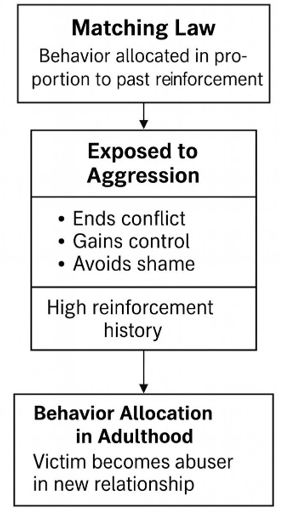
Figure 1: Depicts the transactional flow of victim allocation of avoidance/escape responses to reinforcement and how this allocation persists into a new relationship.
For example, Maria, aged 38, lived with an abusive husband for 12 years. During that time, she learned repeated reinforcement—that
certain behaviors helped her avoid escalation, conflict or physical harm. She learned to appease, be hypervigilant, avoid expressing opinions, and shutting down disagreements. Ten years later, Maria’s abusive husband dies. After a period of grief, she begins a relationship with Daniel, a gentle, patient, emotionally available man. That is, the setting events changed. Maria’s behavior momentum persists in several ways around Daniel. First, when Daniel asks where she wants to go to dinner, Maria says, “wherever you want.” Maria replicates old patterns where expressing opinions leads to punishment. Second, when Daniel asks Maria, “what is wrong,” Maria freezes, becomes quiet, and replicates old pattens where emotional expression trigger aggression. In sum, Maria’s behavior remained unchanged because
Maria’s behavior persists because:
• Her reinforcement history is massive. Twelve years of repeated reinforcement outweigh a few months of new contingencies.
• Old behaviors have high response strength. They were reinforced by survival itself.
• New reinforcers (warmth, safety, autonomy) are unfamiliar and initially weak. They cannot yet compete with the deeply ingrained reinforcement history.
• Extinction of old patterns is emotionally painful and physiologically dysregulating. Her nervous system expects danger even when none exists.
• Trauma-related cues generalize. A raised eyebrow, a sigh, or a pause in conversation may trigger old behavioral patterns.
The last item listed above, Trauma-related cues, raises the importance of discussing the ubiquity of stimulus generalization.
Stimulus Generalization (generic, metaphorical, and metonymical)
Transmission of domestic violence from victim to victim-abuser incorporates another variable from the infinite setting events directly changing people’s lives. This variable, a basic principle in behavioral literature, is called stimulus generalization. This occurs when a behavior learned in the presence of one stimulus also occurs in the presence of similar stimuli. Once a response is reinforced under certain conditions, the person tends to respond the same way to other cues that resemble the original one, even if the cues are not identical [83, 84]. Behavioral analytic discussion of stimulus generalization is prolific and ranges from the works of Clark Hull, B.F. Skinner to J.R. Kantor [42, 85, 86]. Kantor’s conceptual scheme rejected the idea of “stimulus generalization” and replaced it with a “systematic interactional process” emerging from the entire behavioral field. That field consisted of organism
+ stimulus + history + setting events + media of contact + contact conditions. The greater the similarity among behavior fields, the more probable the behavior recurrence. A broader definition avoided unilateral isolation or one or two environmental variables taking all of the credit.
By contrast, Skinner’s theoretical paradigm was more specific and identified the causal interrelations between stimulus and response relative to the unique properties of the stimulus conditions. He introduced four types of stimulus extensions: generic, metaphorical, metonymical, and solistic. These represent different ways in which verbal behavior generalizes from previously reinforced stimulus–response relations. Our focus today is on the first three extensions—generic, metaphorical, and metonymical.
Generic extension is when the new stimulus conditions under which responses occur share all the relevant features of the original stimulus conditions. When Roger says “what are you doing,” and his husband, Rick, says, “I don’t know,” that exchange occurs precisely the same way every time Roger verbalizes the question. Metaphorical extension is when the new stimulus conditions share some but not all of the defining (relevant) features of the original stimulus conditions. The shared features are usually relevant to the exertion of control over responses. Rick always said, “I don’t know,” when asked a question by husband Roger. But now Rick says “I don’t know” when Rick’s boss, who talks like Roger (same intonation, low voice) says the same question verbatim. The commonality of shared properties can vary dimensionally and still be evocative. The boss says to Rick, “Do you always need to do that?” and Rick responds predictably, I don’t know.” The variability of metaphorical stimuli can cause ambiguity for the receiver and lead to response delays or superstitious behaviors. Rick is about to respond to his boss but is uncertain. He pauses and may even spontaneously generate apologetic (avoidance or escape) behaviors to reduce the chance of verbal punishment, for example, “where you talking to me, I don’t always hear too good.”
Metaphorical extension is the most obscure one and causes long- lasting (chronic) responses in trauma-exposed victims. This is where none of the relevant (defining) properties in the original stimulus conditions appear in the new stimuli. But what does appear are irrelevant properties, or properties that are peripheral or idiosyncratic to the stimuli. Rick’s boss says “good morning” to Rick. The boss also wears a blue sweater and has a moustache similar to Roger. When Rick sees this, despite the pleasant salutation, he replies, “I don’t know.” This over-reactivity to mostly irrelevant stimulus properties maps closely onto how trauma survivors generalize fear and avoidance across loosely similar interpersonal cues. In trauma, the individual’s nervous system learns to detect partial resemblances to past threats, and these partial similarities evoke the same protective behaviors that were once reinforced by safety or conflict reduction. When stimuli are obscure, confusing, or bare secondary or tertiary properties associate with the relevant cues, trauma responses may still occur with same topography, frequency, rate, and intensity.
Betsy, physically battered by husband Jeff, left the relationship years ago. Beatings always occurred before bedtime at night, in the dark, in the house. Still today, with her new boyfriend driving at night, she gets quiet, withdrawn and anxious bordering on panic attacks. Her response patterns are maladaptive to the irrelevance of darkness and nighttime, despite other settings events assuring safety and happiness (reinforcers) (cf. Table 5).
|
Type of Extension |
Definition (Skinner) |
How It Appears in Her Learning History |
Triggering Conditions |
Resulting Behavior |
|
Generic Extension |
Responding to stimuli that share the same defining features as the original stimulus. |
She learned that any raised voice, criticism, or stern tone predicts danger. These features are the same as those present in the abusive relationship. |
Same or nearly identical cues: raised voice, sharp tone, direct criticism. |
She withdraws, becomes submissive, apologizes, or goes silent—because these behaviors were reinforced by reducing abuse in the past. |
|
Metaphorical Extension |
Responding to stimuli that share only some features with the original stimulus (some defining ones). |
She reacts to non- threatening cues that resemble past abuse only loosely—e.g., a partner sighing, a neutral facial expression, or someone speaking loudly in another room. |
Similar but not identical cues: sighs, mild frustration, someone speaking firmly but not aggressively. |
She shuts down emotionally, avoids eye contact, or becomes overly accommodating—even though the partner is not abusive. |
|
Metonymical Extension |
Responding to stimuli that are only indirectly associated with the |
She generalizes fear to contextual or symbolic cues that were present |
Partially similar or incidental cues: partner coming home late, a phrase |
She preemptively appeases, becomes anxious, or withdraws without any actual |
|
|
original stimulus (weak or incidental similarity, no defining cues). |
during past abuse—e.g., the time of day arguments used to happen, certain phrases, or even the sound of footsteps. |
her abuser used, a particular room, or even a certain posture. |
threat—because the cue evokes the old relational frame. |
Table 5: Shows effects of each stimulus extension applied to a domestically abused victim.
Dangers of metonymical extension for recovery from domestic violence are fourfold. First, the stimulus (evocative) cues do not go away; they are too exponentially diverse and impossible to prevent. Second, generalization responses expand to spurious, accidental or superstitious behaviors, drawing other reinforcers that strengthen resistance from trauma reduction. Third, the omnipresence of metonymical stimuli causes unabated hypervigilance (i.e., generalized anxiety). Fourth, weak stimuli occasion anticipatory anxiety and anticipatory aggression. Let us look closely at each problem.
First, the inextricability of relevant and irrelevant cues in the environment makes it very difficult for a traumatized victims to finally seek peace and “get closure” on past violent experiences. Remnants of the cues, both subtle and obvious, bombard the victim as constant reminders of hurtfulness and sadness and trigger avoidance and escape responses. Jane overcame her initial fears of abusive husband Jerry and even forgave him. But every time she drives past a dirt road resembling the street she lived on with Jerry, fear overwhelms her for 5 to 10 minutes.
Second, remote similarities of past trauma can engender a class of responses never done behavior and that now offer avoidance and escape from emotional trauma. Jake knows he hates large crowds of people, especially at community affairs; this is where his abusive spouse always seized the occasion to ridicule him. Now, before Jake attends an outdoor or indoor venue, he drinks a 5th of vodka or takes Xanax. He also pre-empts the outing by telling his partner, “Look, in case you’re thinking of getting angry at me at theatre, don’t do it.” Frequent pre-emptive statements are superstitious, may be unrelated to any past history with that new parter, and even risk provocation of untoward consequences. His partner snaps back, “What are you talking about? I’d never done that before, that makes me angry.” The new consequence (i.e., positive reinforcement) maintains Jake’s anxiety and adventitiously strengthens more pre-emptive remarks in the future
Third, Desiree keeps her “radar up” with hyper-alertness all of the time in anticipation of remote (metaphorical) cues signaling visceral arousal and automaticity of avoidance behaviors. She distrusts people she meets, is cautious about undertaking new tasks or jobs, and suspects people are negatively judgmental of her behavior. Fear traces to multiple settings in which her spouse and family members denigrated her in public without any forewarning or any recourse. Her randomly exposed punishment not only suppressed talking and induced anxiety, but it also taught her to expect imminent adversity under normal circumstances. She now is on guard for any person in public who looks at her funny or stares at her, toward whom she impulsively and offensively barks, “Do you have a problem with me?” This constant sense of intimidation, conspiracy, and dread, despite absence of any conspicuous aversive conditions, is frequently referred to as foreboding. Desiree says, “I cannot tell you when or where it will happen, but I know something will be rotten today.” Operationally, then, foreboding is the product of arbitrary and capricious punishment about which the person forms rules governing his or her behavior (i.e., anticipatory anxiety or anticipatory aggression).
Fourth, unclear or indiscernible cues occasion anxiety. The example above showed Desiree’s insinuation of “Do you have a problem with me?” Similar incendiary remarks function as pre- emptive or anticipatory aggression in situations mimicking trauma cues, but without the relevant properties. When Desiree is with her sensitive boyfriend, she unleashes a deluge of insults at anything wrong he does. The aggression prevents any risk of violence from the boyfriend, where she views each person as having an equal probability of hurting her. Her reactional biography included multiple episodes of violence and associations between the original trauma and infinite substitutes. She now responds indiscriminately to anything or anyone who she infers is dangerous. She is shamelessly ruthless, vitriolic, and contentious in any setting, with any person, and emits the anger before the person has a chance to be angry at her.
Victim Reversal Syndrome in Therapeutic Programs for Domestic Violence Survivors
Community rehabilitation programs currently available for domestic violence survivors abound with broad and specific emphasis on restoring dignity and safety. Among interventions used, behaviorally based programs have become one of the most widely researched and implemented treatment recovery approaches. Warshaw, Sullivan & Rivera, comprehensively reviewed behavioral models, manualized trauma treatments, and evidence based practices and found seven limitations undermining reported success rates [87]. First, few studies focused specifically on domestic violence survivors. Populations frequently sampled include veterans, sexual-assault survivors, children exposed to trauma, and general PTSD populations. Second, sample size was small. Most programs suffer from high attrition rates, small participant groups, and limited demographic diversity. Third, limited research appeared in real-world domestic violence setting. Most studies took place in university clinics, research centers, and controlled environment or crisis settings. Fourth, studies lacked long-term follow-up. Few studies longitudinally followed recovering survivors to see if they maintain self-safety or replicated intimate partner violence. Fifth, studies limited cultural and contextual adaptation. For example, research poorly addressed immigration-related trauma. Sixth, programs narrowly focused on PTSD rather than broader survivor needs such as aggression- inoculation methods to prevent redirected violence at new partners. Seventh, few studies offered treatments for comorbid issues, such as anxiety, depression or other psychopathology accompanying survivor issues.
These gaps in community programs reflected the implicit assumption that survivors would never rise to the level of repeated violence on somebody else. None of the manualized CBT programs for DV survivors, for example, are designed to teach clients “how not to become abusers.” Limited empirical research supports the notion that survivors are at elevated risk of perpetrating abuse. Instead, these interventions focus on healing trauma, reducing symptoms, enhancing safety, and rebuilding autonomy. Programs aimed at preventing abusive behavior—such as Batterer Intervention Programs (BIPs)—are entirely separate from survivor recovery programs, and target individuals who have already exhibited violence, not those who have survived it. For example, Cognitive Trauma Therapy for Battered Women (CTT- BW) is one of the few CBT programs designed specifically for adult female survivors of intimate partner violence. Kubany et al. developed these interventions to address PTSD symptoms, trauma related guilt, self blame, and fear responses [88]. The program includes structured cognitive restructuring, exposure based trauma processing, and modules targeting abuse related beliefs. Empirical studies show that CTT BW significantly reduces PTSD severity and maladaptive cognitions, with effects maintained at follow up. Its survivor specific focus makes it uniquely responsive to the psychological dynamics of violence survivors. None of the curriculum modules, howeverm address directed aggression to prospective partners or the risk of imitating what the perpetrator did to survivor.
Similar in scope to manualized therapies, other curricula-focused, survivor training programs stress correction of maladaptive cognitions, trauma, and safety seeking techniques [89, 90]. They also fall short of providing objectively measurable components aimed at preventing replication of abusive repertoires in the survivor. Why, then, should partner anger regulation be added to standard survivor education? The answer lies with one neglected fundamental goal of abuse survivor rehabilitation: This is to interrupt the (interbehavioral) potential of victim-initiated violence among new partner victims.
Designing such a behavioral program might, at first, overlap with existing psychoeducational components (such as safety and changing beliefs). Lesson plans might expand to include modules on (1) partner relationship patterns, (2) red-flags to detect survivor as abuser, (3) emotion regulation skills, (4) interpersonal
effectiveness sand communication skills, (5) identifying warning signs of unhealthy partners and acceptance of healthy partners, (6) understanding trauma bonds and attachment patterns, and (7) safety planning in new relationships. Together, violence inoculation skills are clearer, implemented more directly, and stand the test of time for generalization and maintenance.
Below is an example of a six-module program called Victim Abuser Inoculation (VAI). This program methodically prepares the traumatized survivor to avoid Victim Reversal Syndrome (see Table 6, below). Components follow 16 sessions taught manually or directly by professionals to reach urban, rural, and vastly diverse cultures (e.g., telehealth, webinars). The program intends to strengthen exact skills that support healthy, nonviolent relationships and increase survivor awareness of setting events conducive either to lapsing into victimization mode or redirective aggressive modes.
|
Module |
Focus |
Sessions |
|
1. Safety & Stabilization |
Crisis planning, control motivating operators, setting events conducive to redirected aggression. |
1–3 |
|
2. Trauma Informed Cognitive Skills |
Changing rule-governed behaviors. |
4–6 |
|
3. Emotional Regulation |
Eliminating and replacing anticipatory and reactive anxiety and aggression. |
7–8 |
|
4. Healthy Relationship Skills |
Awareness of ABCs of prosocial, functional behaviors and abatement of familiar partner patterns. |
9–11 |
|
5. Preventing Reenactment of Harmful Patterns |
Red flags, competing behaviors, sensitivity and benevolence. |
12–14 |
Table 6: Depicts the six modules of Victim Abuse Inoculation addressing the principal issue of delayed redirected aggression on new partners.
Module 1 (Safety and Stabilization): Safety and Stabilization identify the tools to control motivating operators, establishing operations, and setting events conductive to misdirected aggression. For example, survivors learn to identify and correct improper urge control under chaotic or highly stressful situations. Taught are skills in crisis planning to defuse immediate tensions and build a reservoir of options to prevent regression in a partner relationship. For example, when Sereta loses her job, exhaust funds on her food card, and is one-week sleepless, her anger potential may intensify into indiscriminate anger. Engaging in anger feels normal given her exposure to the normalcy of her ex-boyfriend’s vitriolic temper. Sereta learns to interrupt the urge, delay fulfillment of needs, enlist other people as resource surrogates, and relax her body [91].
Module 2 (Trauma-Informed Cognitive Skills): Correcting faulty beliefs or wrong rule-governed behaviors entails isolation and systematic removal of the rules in fluid daily situations. The process of dismantling rules is analogous to non-personalizing strategies in assessing children’s behavior objectively instead of adultomorphasizing the behavior [32, 92]. Steps teach how to convert belief-biased opinions into objective observations by focusing on specific behaviors and events at the time instead of underlying intradynamics. For example, Ken panics in horror and is about to yell when he witnesses his girlfriend Sheila fold his laundry sloppily and place it in the wrong drawer. Instead of rapid escalation (like his ex-abusive girlfriend did to him), he (a) detaches emotionally, (b) looks at the natural facts of the situation, (c) removes opinions, beliefs, and values, and (d) asks questions to check out his facts. Fact-finding replaces impure or wrong inferences about a misinterpreted context and guards against inventing or labeling the context like an ex-violent partner labeled wrongly toward Ken.
Module 3 (Emotional Regulation): Emotional regulation teaches self-monitoring and control of anxiety or aggression. Both conditions can be anticipatory or reactive. Anticipatory anxiety is a pending period of apprehension, doubt, distrust, and hypervigilance to subtle verbal and nonverbal cues in people’s behavior signaling some impending conflict. Anticipatory aggression also occurs under threat of criticism or conflict, but the respo0nse is more robustly malevolent, sarcastic, cynical, and vitriolic. Anticipatory anxiety and aggression function exclusively to avoid, prevent, postpone, or mitigate effects of some inevitable confrontation. By contrast, reactive anxiety and aggression occur in direct response to (unavoidable) confrontation. The “reactive” function enables escape from the confrontation. Both anticipatory and reactive anxiety and aggression were observed frequently in the violent perpetrator’s behavior in prior partner relationships.
Module 4 (Healthy Relationship Skills): Introduction of healthy relationships skills goes beyond mastery over urges (motivating operators), rule-governed behaviors, and emotional reactions. Here, training guides survivors to identify, assess, and compare prospective mates along a continuum of three classifications of behavior patterns (A’s, B’s, and C’s) [55]. This classificatory scheme outlines at risk versus low-risk partners based on their demonstrated behaviors in the functional categories of Communication, Flexibility and Consistency. Identified patterns are “healthy,” insofar as increasing reciprocity of reinforcement, reducing prevalence of punishment, and installing resourceful behaviors to dissolve conflict and adopt new solutions with minimal damage inflicted on the relationship.
Module 5 (Preventing Reenactment of Harmful Patterns): This vital component is the bulwark against Victim Reversal Syndrome. Skills are taught on self-awareness and preventive maintenance of any of the survivor’s behaviors resembling the toxicity of their former abusers. First, the survivor prepares a list of hated behavior witnessed during their abuse ordeal and uses it a menu of warning cues to self-observe or enlist other significant people to observe in them. Second, the instant these response patterns occur or precede other behaviors, self-implemented correction proceeds with (a) competing or incompatible behaviors (cf. habit reversal methods, Hienicke, et al.), and (b) humility and altruistic behaviors (sensitivity and benevolence training [92-95]. Abbie, for example, observed herself escalating loudly and insulting her new boyfriend Ralph, the two behaviors she abhorred in her abuser. Alternatively, she engaged in competing behaviors of (a) sitting down to collapse her diaphragm that prevents yelling, (2) reversed her tone to a lower, softer pitch, and (3) changed the topic. She also immediately apologized, empathized with her boyfriend, and described her future course of action. Apologies alone, incidentally, are not the functional operators reducing this behavior in Abbie.
Abusers are notorious for frequently apologizing and even making hollow promises to amend aggressive behaviors in the future. The difference here is that habit-reversal or competing components of self-change occur before Abbie shows compassion and apologies.
Module 6 (Future Planning and Empowerment): The final module is a staple in any recovery program to the extent the construction of new skills will transfer to the natural environment. Generalization-promoting strategies must be relevant and blend seamlessly into subsequent behavior segments. A correctly programmed generalization can also afford the abuse survivor more control and prediction (empowerment) over their behaviors. Four steps are prototypical in programming generalization. First, identify the exact target behavior to change and relevant setting events expected for the behavior. Second, identify the generalization-promoting strategy endemic to one or multiple settings. Third, embed the selected generalization strategies into one or many webs of settings events. Fourth, collect the data (i.e., self-recording, others recording) to measure progress made in the behavior under the chosen settings and determine if modifications to the original generalization steps are necessary. Combined in this step is the systematic thinning out of reminder cues for proper behavior in new settings and relying on new rule-governed behaviors to maintain accuracy and consistency of contra-violence skills (see Table 7).
|
Step |
Description |
Behaviors Competing with Domestic Violence |
|
1. Identify |
Define the target behavior and the exact environments, people, and conditions where it must generalize. |
-Using verbal problem solving instead of aggression -Walking away to de escalate -Calling a support person when triggered -Labeling emotions (“I’m getting overwhelmed”) instead of acting on them |
|
2. Plan |
Select generalization promoting strategies that fit the behavior and context. |
-Training multiple examples of conflict scenarios -Practicing assertive communication with different people -Embedding natural cues (tone changes, rising tension) into training -Teaching self management routines for early warning signs |
|
3. Program |
Embed the selected strategies directly into training rather than waiting until the end. |
- Role playing escalating arguments and practicing safe alternatives -Varying settings (clinic, home, community) for practice -Reinforcing early disengagement behaviors -Practicing replacement behaviors under mild stressors |
|
4. Monitor |
Collect data in natural environments and evaluate generalization and maintenance over time. |
-Checking maintenance of non violent communication over weeks/ months -Adjusting intervention if aggression precursors reappear |
Table 7: Presents each step of generalization and maintenance with a hypothetical example of violence-behavior control.
Redirected aggression represents a critical but under-recognized phenomenon in the study of domestic abuse. Victims, conditioned by reinforcement histories and interbehavioral contingencies, often replicate abusive repertoire in subsequent relationships. This trajectory reflects deeply ingrained behavioral patterns shaped by trauma, normalization, and relational dynamics. This paper attempted to functionally define the contextual transaction of specific variables responsible for the genesis and accidental transmission of this misplaced aggression under the rubric of Victim Reversal Syndrome. By acknowledging that victims can become abusers, the mental health field can develop more effective interventions, end gender-biased beliefs, reduce blind spots, and break cycles of violence. Perpetrators of domestic violence are both recidivistic offenders and the traumatized victims who adopt the abusive repertoire and unknowingly corrupt subsequent intimate partner relationships. To this extent, Victim Reversal Syndrome represents perhaps one step to reforming an antiquated (nonscientific) tradition in the study of domestic violence. It is essential for building healthier repertoires, preventing intergenerational transmission, and fostering relationships free from abuse.
References
1. South Denver Therapy. (2025). Domestic violence statistics (2025): U.S. prevalence, demographics, and impact.
2. The Global Statistics. (2025). Domestic violence statistics in the U.S. 2025.
3. Campbell, J. K., Nicolla, S., Weissman, D. M., & Moracco, K. E. (2024). The uptake and measurement of alternative approaches to domestic violence intervention programs: A scoping review. Trauma, Violence, & Abuse, 25, 3269–3284.
4. Center for Policy Research & National Resource Center on Domestic Violence. (2017). Building the evidence for domestic violence services & interventions: Challenges, areas of opportunity, and research priorities. U.S.
5. LegalClarity Team. (2025). Domestic violence repeat offenders: Statistics and analysis. LegalClarity.
6. Musumeci, L. (2024). Domestic violence reoffending. Public Health Post.
7. Delprato, D. J. (1980). The reactional biography concept: Early contribution to a perspective for the psychology of aging. Human Development, 23, 314–322.
8. Kantor, J. R. (1933). The reactional biography. In A survey of the science of psychology (pp. 44–57). Principia Press.
9. Ruben, D. H. (1983). Reactional biography: An interbehavioral analysis. In N. W. Smith & P. T. Mountjoy, and DH Ruben, (Eds.), Reassessment in Psychology: The Interbehavioral Alternative (pp. 145–162). Lanham, MD: University Press of America.
10. Osborne, K., Munasinghe, S., & Page, A. (2025). The intergenerational transmission of emotional intimate partner violence: A systematic review and meta-analysis. Journal of Family Violence.
11. Hashemi, L., Fanslow, J., Gulliver, P., & McIntosh, T. (2022). Intergenerational impact of violence exposure: Emotional behavioural and school difficulties in children aged 5–17. Frontiers in Psychiatry, 12, Article 771834.
12. The Lancet Regional Health – Europe. (2025). Intergenerational ‘transmission’ of intimate partner violence and abuse: interpretations and implications.
13. Vilches, F., Mazeyra, L., Quintanilla, A., & Ramos Vargas, L. (2025). Intergenerational transmission of domestic violence in Peruvian families: A qualitative study. Social Sciences, 14, 399.
14. Anjum, W., Watto, S. A., Yasin, S. A., Qazi, Z., Rahim, A., & Mahmood, S. (2020). Inter-generational domestic violence, causes, consequences, and rehabilitation strategies among women of shelter homes. Ilkogretim Online, 19(4), 7927– 7949.
15. Kolluri, V. (2025). Intergenerational transmission of domestic violence in Peruvian families: A qualitative study. Social Sciences, 14, 399.
16. Hamberger, L/K/ & Lohr, J.M. (1989). Proximal causes of spouse abuse: A theoretical analysis for cognitive behavioral interventions. In P.L. Caesar & L.L. Hamberger (Eds.). Treating men who batter: Theory, practice, and programs (pp. 53-76). NY: Springer Publishing.
17. Pollak, R. A. (2004). An intergenerational model of domestic violence. Population Economics, 17, 575–601.
18. Guzmán Murillo, H. J., Torres Ortega, J. M., & Leal Acosta,
K. C. (2024). Comprehensive analysis of domestic violence from an intergenerational perspective and state responsibility. Contemporary Readings in Law and Social Justice, 16(1s).
19. Kong, J., Lee, H., Slack, K. S., & Lee, E. (2021). Intergenerational transmission of violence. Child Abuse & Neglect, 117, 105117.
20. Russell, K. N., & Voith, L. A. (2025). Applying an intergenerational lens to the associations between childhood intimate partner violence exposure, child maltreatment, and adolescent dating violence perpetration. Child and Adolescent Social Work Journal.
21. Salter, M., Woodlock, D., Dragiewicz, M., Conroy, E., Ussher, J., Burke, J., & Middleton, W. (2025). “I see it running through my family”: The intergenerational and collective trauma of gender based violence. Journal of Family Trauma, Child Custody & Child Development, 22, 254–274.
22. Ruben, D. H. (1983b). Aging and drug abuse. Springer Publishing.
23. Ruben, D.H. (2020). Behavioral Forensics: Using Applied Behavior Analysis in Psychological Court Evaluation. NY: Academic Press.
24. Ruben, D. (2025). Dangers of Multiplayer Online Gaming: A Behavioral Analysis of Impulsive Driving and Simulation to Reality. Available at SSRN 5923123.
25. Stith, S. M., Rosen, K. H., Middleton, K. A., Busch, A. L., Lundeberg, K., & Carlton, R. P. (2000). The intergenerational transmission of spouse abuse: A metaâ?analysis. Journal of Marriage and Family, 62(3), 640-654.
26. Kippert, A. (2025, March 17). Intergenerational violence: How to break the cycle.
27. Anasicha, J. A. G., Coronel, A. A. R., & Suárez, P. C. M. (2022). Cognitive-behavioral therapy for psychological harm in domestically abused women: systematic review and meta- analysis. Ciencia Digital, 6(3), 61-83.
28. Austin, A., & Cowles, M. (2025). Trauma-focused cognitive behavioural therapy (TF-CBT) for domestic abuse with an individual at risk of ongoing threat of further harm; a single case experimental design. the Cognitive Behaviour Therapist, 18, e47.
29. Kubany, E. S., McCaig, M. A., & Laconsay, J. R. (2004). Healing the trauma of domestic violence: A workbook for women. (No Title).
30. Kubany, E. S., Hill, E. E., Owens, J. A., Iannce-Spencer, C., McCaig, M. A., Tremayne, K. J., & Williams, P. L. (2004). Cognitive trauma therapy for battered women with PTSD (CTT-BW). Journal of consulting and clinical psychology, 72(1), 3.
31. Davis, L. (1990). The courage to heal workbook: A guide for women and men survivors of child sexual abuse. HarperCollins.
32. Ruben, D.H. (1993a) Avoidance syndrome: Doing things out of fear. MO: Warren Green.
33. Rubin, D. H. (1993). No More Guilt: Ten Steps to a Shame- free Life. Mill and Sanderson.
34. Guerin, B., & de Oliveira Ortolan, M. (2017). Analyzing domestic violence behaviors in their contexts: Violence as a continuation of social strategies by other means. Behavior and Social Issues, 26(1), 5-26.
35. Patterson, G. R. (1982). Coercive family process Castalia Publishing Company. Pecins-Thompson, M., A. Brown, N., & Bethea, CL (1998). Regulation of serotonin re-uptake.
36. Wahler, R. G. (1990). The “distancing” of parents by deviant children. Journal of Applied Behavior Analysis, 23, 79–89.
37. Wahler, R. G., & Dumas, J. E. (1986). Maintenance factors in coercive mother-child interactions: the compliance and predictability hypotheses. Journal of applied behavior analysis, 19(1), 13–22.
38. Ruben, D. H., & Delprato, D. J. (1987). New ideas in therapy: Introduction to an interdisciplinary approach. (No Title).
39. Galizio, M. (1979). Contingencyâ?shaped and ruleâ?governed behavior: Instructional control of human loss avoidance. Journal of the experimental analysis of behavior, 31(1), 53- 70.
40. Hayes, S. C., Zettle, R. D., & Rosenfarb, I. (1989). Rule-following. In Rule-governed behavior: Cognition, contingencies, and instructional control (pp. 191-220). Boston, MA: Springer US.
41. Zauderer, S. (2025). Understanding contingency shaped vs. rule governed behavior. Cross River Therapy.
42. Skinner, B. F. (1957). Verbal behavior. Appleton Century Crofts. Psychology, 8 (11).
43. Matson, J. L. (Ed.). (2023). Handbook of applied behavior analysis: Integrating research into practice. Springer Nature.
44. Sundberg, M. L., & Michael, J. (2001). The benefits of Skinner’s analysis of verbal behavior for children with autism. Behavior modification, 25(5), 698-724.
45. Kantor, J. R., & Smith, N. W. (1975). The science of psychology an interbehavioral survey. University of Akron.
46. Hayes, L. J., & Fryling, M. J. (2009). Interbehaviorism and radical behaviorism: Some similarities and differences. The Psychological Record, 59(3), 435–448.
47. Morris, E. K. (1984). Behaviorism and the meaning of terms. The Behavior Analyst, 7, 43–52.
48. Lyon, D. O. (1987). ABA: A research methods workbook. Context Press.
49. Lattal, K. A., & Perone, M. (Eds.). (2013). Handbook of research methods in human operant behavior. Springer Science & Business Media.
50. Kantor, J. R. (1977). Psychology and logic. Principia Press.
51. Angel, M. (2022). Textese as a dialect: Why texting isn’t destroying literacy. University of Illinois Urbana–Champaign.
52. Mittal, R. (2015). Is texting really hurting our literary skills: How to overcome its effects. IOSR Journal of Humanities and Social Science, 20, 1–5.
53. Ruben, D.H. (2001) Adult children of alcoholics: A behavioral appraoch. NY: Academic Press.
54. Ruben, D.H. (2009) Effects of bad parenting and what to do about it: Alcoholism, divorce, punishment, and sex. Okemos, MI: Best Impressions International, Inc.
55. Ruben, D.H. (2026b). Rate your Date: A Primer for Selecting Healthy Partners. Denver, CO: Outskirts Press.
56. Seligman, M. E. P. (1975). Helplessness: On depression, development, and death. W. H. Freeman.
57. Laraway, S., Snycerski, S., Olson, R., Becker, B., & Poling, A. (2014). The motivating operations concept: Current status and critical response. The Behavior Analyst, 37(1), 51–75.
58. Michael, J. (1993). Establishing operations. The Behavior Analyst, 16(2), 191–206.
59. Bolles, R. C. (1970). Species-specific defense reactions and avoidance learning. Psychological Review, 77, 32–48
60. Solomon, R. L., & Wynne, L. C. (1953). Traumatic avoidance learning: Acquisition in dogs. Journal of Experimental Psychology, 47(4), 253–259.
61. Mountjoy, P.T. (1980). An historical approach to comparative psychology. In R. Denny (Ed), Comparative Psychology: An Evolutionary Analysis of Animal Behavior. NY: John Wiley & Sons, (pp. 128-152).
62. Ratner, S. C. (1967). Comparative aspects of hypnosis. In J. E. Gordon (Ed.), Handbook of clinical and experimental hypnosis (pp. 550–587). Macmillan.
63. Gallup Jr, G. G., & Rager, D. R. (1996). Tonic immobility as a model of extreme states of behavioral inhibition: Issues of methodology and measurement. In Motor activity and movement disorders: Research issues and applications (pp. 57-80). Totowa, NJ: Humana Press.
64. Seligman, M. E. P., & Maier, S. F. (1967). Failure to escape traumatic shock. Journal of Experimental Psychology, 74, 1–9.
65. Barlow, D. H. (2002). Anxiety and its disorders: The nature and treatment of anxiety and panic. Guilford Press.
66. Dinsmoor, J. A. (1954). Punishment: I. The avoidance hypothesis. Psychological Review, 61(1), 34–46.
67. Sidman, M. (1953). Avoidance conditioning with brief shock and no exteroceptive warning signal. Science, 118.
68. Herrnstein, R. J. (1969). Method and theory in the study of avoidance. Psychological Review, 76, 49–69.
69. Catania, A. C. (2013). Learning (5th ed.). Sloan Publishing. Department of Health & Human Services.
70. Michael, J. (1975). Positive and negative reinforcement, a distinction that is no longer necessary; or a better way to talk about bad things. Behaviorism, 3, 33–44.
71. Rescorla, R.A., & Solomon, R. L. (1967). Two-process learning theory: Relationships between Pavlovian conditioning and instrumental learning. Psychological Review, 74, 151–182.
72. Mullane, M. P., & Newman, Z. (2024). Behavior analytic assessment and treatment of problem behavior maintained by social escape with individuals with intellectual and developmental disabilities: A systematic review. Behavior Analysis: Research and Practice, 24, 112–134.
73. Ono, K. (1987). Superstitious behavior in humans. Journal of the Experimental Analysis of Behavior, 47, 261–271.
74. Skinner, B. F. (1948). “Superstition” in the pigeon. Journal of Experimental Psychology, 38, 168–172.
75. Stokes, T. F., & Baer, D. M. (1977). An implicit technology of generalization. Journal of Applied Behavior Analysis, 10, 349–367.
76. Delprato, D. J. (1986). Response patterns. In H. W. Reese & L. J. Parrott (Eds.), Behavior science: Philosophical, methodological, and empirical advances (pp. 61–113). Hillsdale, NJ: Erlbaum
77. Walker, L. E. (1979). The battered woman. New York: Harper & Row.
78. Palmer, D. C. (2009). Behavioral interpretation of memory. In J. A. Nevin & T. R. Zentall (Eds.), Handbook of behavior analysis (pp. 347–363). American Psychological Association.
79. Skinner, B. F. (1953). Science and human behavior. Macmillan.
80. Herrnstein, R. J. (1961). Relative and absolute strength of response as a function of frequency of reinforcement. Journal of the Experimental Analysis of Behavior, 4, 267–272.
81. Reed, D. D., & Kaplan, B. A. (2011). The matching law: A tutorial for practitioners. Behavior Analysis in Practice, 4, 15–24.
82. Cooper, J. O., Heron, T. E., & Heward, W. L. (2020). Applied Behavior Analysis (3rd ed.). Pearson.
83. Herrnstein, R. J. (1970). On the law of effect. Journal of the Experimental Analysis of Behavior, 13, 243–266.
84. Honig, W. K., & Urcuioli, P. J. (1981). The legacy of Guttman and Kalish (1956): 25 years of research on stimulus generalization. Journal of the Experimental Analysis of Behavior, 36, 405–445.
85. Terrace, H. S. (1966). Stimulus control. Psychological Review, 73, 89–113.
86. Hull, C. L. (1943). Principles of behavior. Appleton-Century- Crofts.
87. Kantor, J. R. (1959). Interbehavioral psychology. Principia Press.
88. Warshaw, C., Sullivan, C. M., & Rivera, E. A. (2013). A systematic review of trauma focused interventions for domestic violence survivors. National Center on Domestic Violence, Trauma & Mental Health.
89. Kubany, E. S., Hill, E. E., & Owens, J. A. (2003). Cognitive trauma therapy for battered women with PTSD: Conceptual bases and treatment outlines. Cognitive and Behavioral Practice, 10(1), 85–95.
90. Cloitre, M., Cohen, L. R., & Koenen, K. C. (2006). Treating survivors of childhood abuse: Psychotherapy for the interrupted life. Guilford Press.
91. Johnson, D. M., Zlotnick, C., & Perez, S. (2011). Cognitive behavioral treatment of PTSD in residents of battered women’s shelters: Results of a randomized clinical trial. Journal of Consulting and Clinical Psychology, 79(4), 542–551.
92. Ruben, D.H. (1992) Bratbusters: Say Goodbye to Tantrums and Disobedience. Gretna, LA: Selfhelp Books. Com.
93. Ruben, D.H. (2014). Tantrum Survival Kit: The Definitive Guide to Tantrum Management. Denver, CO: Outskirts Press.
94. Hienicke, M. R., Stiede, J. T., Miltenberger, R. G., & Woods,
D. W. (2020). Reducing risky behavior with habit reversal: A review of behavioral strategies to reduce habitual hand to head behavior. Journal of Applied Behavior Analysis, 53(3), 1–15.
95. Herrnstein, R. J. (1970). On the law of effect. Journal of the Experimental Analysis of Behavior, 13, 243–266.