

International Journal of Forensic Research(IJFR)
ISSN: 2767-2972 | DOI: 10.33140/IJFR
Impact Factor: 1.9

Research Article - (2020) Volume 1, Issue 1
Variations of Foramen Transversarium in Typical Cervical Vertebrae
2Rajiv Gandhi National University of Law Patiala, India
3Professor & Head Forensic Medicine & Toxicology, Ram Nagar, Punjab, India
Received Date: Oct 08, 2020 / Accepted Date: Oct 15, 2020 / Published Date: Nov 02, 2020
Copyright: ©Copyright: ©2020 Dr. Bindu Aggarwal. This is an open-access article distributed under the terms of the Creative Commons Attribution License, which permits unrestricted use, distribution, and reproduction in any medium, provided the original author and source are credited.
Abstract
The cardinal feature of cervical vertebrae is the foramen transversarium, which transmits the vertebral artery, its accompanying vein and a sympathetic plexus from the inferior cervical ganglion. The aim of the present study was to observe the variations in the size and shape and number of foramen transversarium of typical cervical vertebrae. The study material consisted of 176 typical cervical vertebrae of unknown sex and origin, taken from adult dried human bones present in archieve of department of anatomy. The maximum and minimum mean diameters of the foramen transversarium on the right side were 6.54 mm and 5.39 mm respectively. On the left side, the maximum and minimum mean diameters of the foramen transversarium were 6.28 mm and 5.27 mm respectively. The difference of parameters on the right & left side was statistically insignificant. In no case was the foramen transversarium absent though it was asymmetrical in two cervical vertebrae. Accessory foramen transversarium were present in 11 cervical vertebrae which were present bilaterally in 7 and unilaterally in 4 vertebrae (1 right-sided and 3 left-sided). These accessory foramina could be due of remnants of costal element or due to variations in the vertebral vessels. The anatomical knowledge of the variations in the F.T of cervical vertebrae can be of importance to the neurologists, clinicians and radiologists for proper interpretation of X-rays and CT scans. This knowledge can also play an important role in identification of the dead bodies if ante mortem radiographs of the deceased are available for comparison.
Keywords
Accessory, Foramen Transversarium, Cervical Vertebrae, Identification.
Introduction
The cervical vertebrae are identified by the presence of a foramen in their transverse processes called the foramen transversarium (F.T). The F.T is formed when the vestigial costal element fuses with the true transverse element to form a composite transverse process [1].
The vertebrae of the cervical and proximal thoracic part of the human vertebral column are the area undergoing the most intense transformation during phylogeny, leading to many anatomical variants [2, 3]. The aim of the present study was to study the variations in shape and size of the F.T of the typical cervical vertebrae. These variations of F.T could be due of remnants of costal element or due to variations in the vertebral vessels. The anatomical knowledge of the variations in the F.T of cervical vertebrae can be of importance to the neurologists, clinicians and radiologists for proper interpretation of X-rays and CT scans. If the ante mortem radiographs of such cases of bony variations are available then these radiographs may be helpful to the forensic experts in identification of the dead bodies.
Materials and Methods
The present work was conducted to study the variations of the foramen transversarium in typical cervical vertebrae. For this study, 176 typical cervical vertebrae were selected from a total of 299 cervical vertebrae. These vertebrae were selected from the archives of the department of Anatomy, Gian Sagar Medical & Dental College, Banur, Luxmi Bai Dental College, Patiala, Punjab and Swami Devi Dayal Dental College, Barwala, Haryana.
Each typical cervical vertebra was observed carefully for variations in the shape, size and number of foramen transversarium.
A note was made of the vertebrae where the F.T was absent or incomplete and asymmetry in the size of F.T was also observed. The sizes of the F.T were measured with the help of digital vernier calipers.
Where an accessory F.T was present, it was noted whether the accessory F.T was unilateral or bilateral and symmetrical or asymmetrical.
Observations
176 typical cervical vertebrae were separated from a total of 299 cervical vertebrae to study the variations of shape, size and number of F.T. The Variations of F.T are shown in Table 1.
Table 1: Variations oF F.T
|
Accessory F.T- Bilateral (7) |
Accessory F.T- Unilateral (4) |
||
|
Asymmetrical |
Symmetrical |
Right side |
Left side |
|
4 |
3 |
1 |
3 |
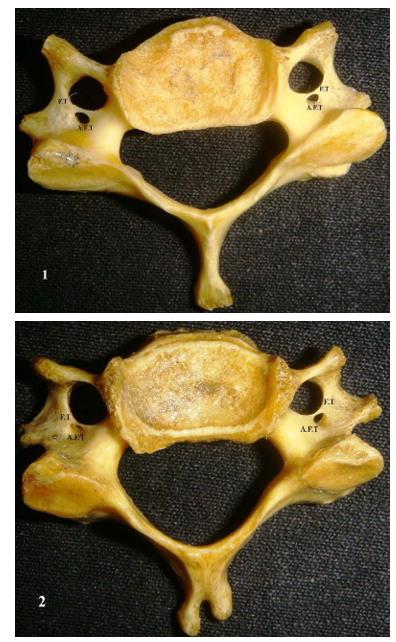
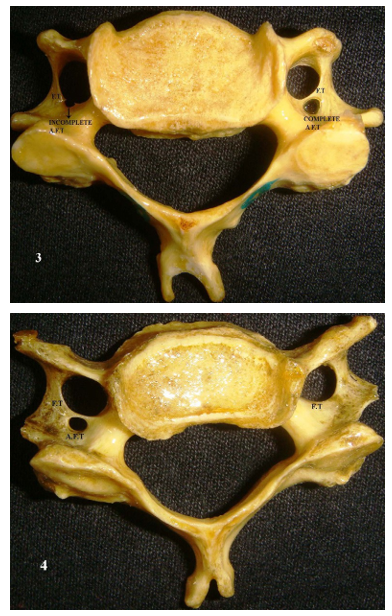
Accessory F.T was observed in 11cervical vertebrae. In 3, the accessory F.T was present bilaterally and was symmetrical (Figure 1), in 4 it was bilateral and asymmetrical (Figure 2). In one bilaterally asymmetrical accessory F.T, the accessory F.T was complete on the right side but incomplete on the left (Figure 3). In 4 cervical vertebrae, the accessory F.T was present unilaterally (Figure 4).
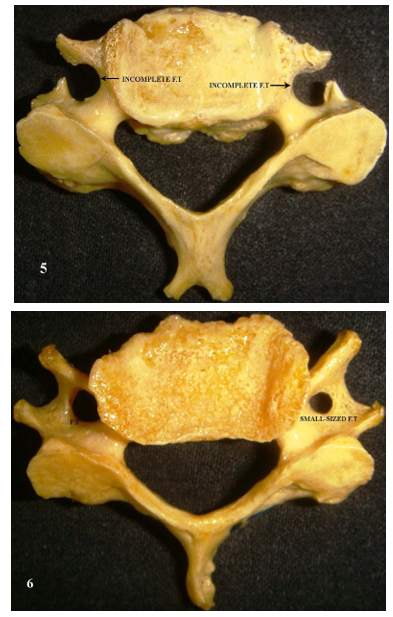
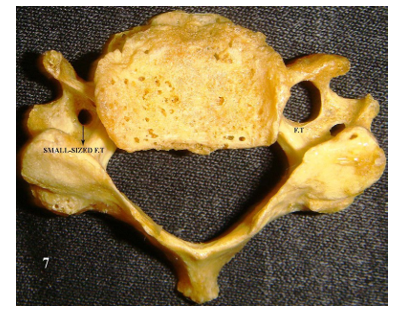
An incomplete F.T was found in 2 (Figure 5) and asymmetrical F.T was observed in 2 cervical vertebrae- small sized F.T on right side (Figure 6) and small sized F.T on left side (Figure 7). No cervical vertebra presented an absence of F.T
The size of the F.T was measured with digital vernier calipers. Each measurement was taken thrice and their mean was considered as the final measurement. The difference in measurements on the right and left side was statistically insignificant. The variation in the size of F.T is shown in Table 2. The range of maximum & minimum diameters on the right & left side are presented in Table 3
Table 2: Variation in the Size oF F.T (in mm)
|
DIAMETER |
SIDE |
Mean (mm) |
± S.D. |
t stat |
p value |
Significance |
|
Maximum |
Right |
6.54 |
0.741 |
0.8138 |
0.4208 |
Statistically insignificant |
|
Left |
6.28 |
1.205 |
||||
|
Minimum |
Right |
5.39 |
0.570 |
0.4743 |
0.6380 |
Statistically insignificant |
|
Left |
5.27 |
0.911 |
Table 3: Range of Diameters (in mm)
|
RIGHT SIDED |
LEFT SIDED |
||
|
Maximum |
5.51- 8.62 |
Maximum |
2.52-7.94 |
|
Minimum |
3.89-6.52 |
Minimum |
2.39- 6.82 |
Discussion
Studies have been conducted earlier to study the variations of F.T in cervical vertebrae [4, 5]. The present study was undertaken to see the variations in shape, size and number of the foramina transversaria of only the typical cervical vertebrae. In a study on 200 typical cervical vertebrae, Sharma found 7 unilateral and 9 bilateral accessory F.T in (0.08%) [6]. Murlimanju found accessory F.T in only 0.02%. In the present study, 11accessory F.T (0.06%) were found in 176 typical cervical vertebrae [7]. In the study by Das only one unilateral and one bilateral accessory F.T was present in 132 cervical vertebrae. Murlimanju, found only 1 bilateral and 5 unilateral accessory F.T (4 right-sided & 1 left-sided) [7, 8]. In the present study, 7 accessory F.T were bilateral and 4 were unilateral (1 right-sided & 3 left-sided). A case of triplicate accessory F.T has been reported by Wysocki while no such vertebra was found in the present study [9].
In the present study, bilaterally incomplete F.T was observed in 2 cases and asymmetry of the F.T was observed in 2 cases where the F.T was narrower than the normal F.T. It was suggested by Traitz that the narrowness of F.T suggested a small vertebral artery and a large-sized F.T may be due to the presence of big vertebral vein or connective tissue [10].
The reasons for the presence of accessory F.T can be developmental or vascular. It might be due to double rib bone element on the same side fusing to the original transverse process resulting in unusual number of F.T [10]. Accessory F.T may be correlated with variations of the vertebral artery. Bifid or duplicate origin of vertebral artery has been reported [11, 12]. Unilateral & bilateral absence of vertebral artery has also been reported [13, 14]. The absence of vertebral artery is related with absence of F.T but absence of F.T was not found in the present study [10].
Traitz suggested that the formation of accessory F.T may also be due to the tensions and stresses imposed on the vertebral vessels by relatively free movements of the cervical spine [10]. The variations in the number and size of F.T may be an important cause for complaints like headache, migraine and fainting attacks due to compression of the vertebral artery [15]. An accessory F.T may narrow the size of real transverse process and may result in pressure on vertebral vessels and sympathetic plexus embedding in it.
Conclusion
In the present study, variations of the shape, size and number of the F.T of typical cervical vertebrae were observed. An accessory F.T was observed in 11 typical cervical vertebrae. The reasons for these variations could be developmental or vascular. The anatomical knowledge of the variations in the F.T of cervical vertebrae can be of importance to the clinicians and neurologists as these variations can be responsible for headache, migraine and fainting attacks due to compression of the vertebral artery. These variations of F.T are also important for the clinicians and radiologists for proper interpretation of X-rays and CT scans. Forensic identification of a person living or dead is important and this variation can prove to be very helpful in identification of the deceased if the ante mortem records are available.
References
- Hamilton WJ (1976) Textbook of Human Anatomy in Vertebral column. 2nd edn. The Macmillan Press Ltd. London 1976: 43-52.
- Anas YI, Esomonu UG, Dimitrov ND, Modibbo MH (2009) Accessory Transversarium Foramen of Cervical Vertebrae: A Case Report. Journal of Experimental and Clinical Anatomy 8.
- Jovanovic MS, Royer J, Roy PE, Houde G, Houde JP, et al. (1990) Contents of the transversal foramen of the seventh cervical vertebra. Bull Assoc Anat 74: 17-19.
- Jovanovic MS (1990) A comparative study of the foramen transversarium of the sixth and seventh cervical vertebrae. Surgical and Radiologic Anatomy 12: 167-172.
- Shaaraway EAA, Sabry SM, Gammaroy TE (2008) Morphology and morphometry of the foramina transversaria of cervical vertebrae: a correlation with the position of the vertebral artery. Egypt J Med Sci 29: 1133-1164.
- Sharma A, Singh K, Gupta V, Srivastava S (2010) Double foramen transversarium in cervical vertebra- an osteological study. J Anat Soc India 59: 229-231.
- Murlimanju BV, Prabhu LV, Shilpa K, Rai R, Dhananjaya KVN, et al. (2011) Accessory Transverse Foramina in the cervical spine: Incidence, embryological basis, Morphology and Surgical importance. Turkish Neurosurgery 21: 384-387.
- Das S, Rajesh S, Kapur V (2005) Double foramen transversaria: An osteological study with clinical implications. Int Med J 12: 311-313.
- Wysocki J, Bubrowski M, Reymond J, Kwiatkowski J (2003) Anatomical variants of the cervical vertebrae and the first thoracic vertebra in man. Folia Morphol 62: 357-363.
- Taitz C, Nathan H, Arensburg B (1978) Anatomical observations of the foramina transversaria. Journal of Neurology, Neurosurgery and Psychiatry 41: 170-176.
- Rath G, Prakash R (1984) Double vertebral artery in an Indian cadaver. Surgical and Radiologic Anatomy 6: 117-119.
- Hashimoto H, Onishi H, Yuasa T, Kawaguchi S (2020) Duplicate origin of vertebral artery: report of two cases. Neuroradiology 29: 301-303.
- Aravindhan K, Singh AM (2009) Absence of vertebral artery. Journal of Forensic Medicine and toxicology 26: 40-41.
- Lui CC, Liu YH, Wai YY, Tsai CC (1987) Persistence of both proatlantal arteries with absence of vertebral arteries. Neuroradiology 29: 304-305.
- Caovilla HH, Gananca MM, Munhoz MS, Silva ML (2011) Sindrome cervical. Quadros Clinicos Otoneurologicos Mais Comuns. Sao Paulo: Atheneu. 2000: 95-100. Cited in: Murlimanju BV, Prabhu LV, Shilpa K, Rai R, Dhananjaya KVN, Jiji PJ. Accessory Transverse Foramina in the cervical spine: Incidence, embryological basis, Morphology and Surgical importance. Turkish Neurosurgery 21: 384-387.