



Research Article - (2025) Volume 10, Issue 2
Utilization of Virtual Clinics to Enhance Cardiac Rehabilitation Follow-Up for Post-Open-Heart Surgery Patients: Retrospective Study
Received Date: Jul 06, 2025 / Accepted Date: Aug 12, 2025 / Published Date: Aug 25, 2025
Copyright: ©Â©2025 Mohammed Takroni, et al. This is an open-access article distributed under the terms of the Creative Commons Attribution License, which permits unrestricted use, distribution, and reproduction in any medium, provided the original author and source are credited.
Citation: Takroni, M., Alfarra, N., Akomolafe, T. (2025). Utilization of Virtual Clinics to Enhance Cardiac Rehabilitation Follow-Up for Post-Open-Heart Surgery Patients: Retrospective Study. Cardio Open, 10(2), 01-07.
Abstract
Background: Cardiac Rehabilitation (CR) is a vital component of recovery following open-heart surgery, significantly improving functional outcomes, reducing hospital readmissions, and enhancing quality of life. However, adherence to in-person CR programs remains suboptimal due to barriers such as limited access, transportation challenges, scheduling conflicts and geographic barriers. The recent advancement in telemedicine offers a potential solution through virtual clinics to bridge gaps in care [1]. Objective: This paper explored the utilization of virtual clinics to enhance follow-up care in cardiac rehabilitation for post-open- heart surgery patients, focusing on patient’s outcomes, adherence, satisfaction and percentage of virtual clinic utilization from 0% to 50 %.
Methods: This retrospective study included 50 patients who underwent open-heart surgery at a tertiary care hospital March- June 2025. Patients received an 8-weeks virtual CR program involving weekly video sessions, educational materials, and remote monitoring. Outcomes included functional capacity (6-minute walk test), quality of life (SF-36), program adherence, and virtual clinic utilization from 0-50%.
Results: Study indicated that virtual cardiac rehabilitation is associated with improved program adherence, high patient satisfaction, and increasing the percentage of virtual clinic utilization from 0% to 50 %. Furthermore, virtual models reduced geographic and mobility barriers, particularly in undeserved population. The average 6-minute walk distance post-intervention was 420 meters (SD = 85; p < 0.001), and quality of life significantly improved across physical functioning, vitality, mental health, and general health domains (p < 0.01). Program adherence was high, with 50% of CR follow-conducted virtually. Patient satisfaction was positive and no significant increase in readmission or emergency visits was observed.
Conclusion: Our results showed that the utilization of virtual clinics is increased from 0% to 50% Furthermore, virtual clinics provide a viable and effective complement-or alternative-to In-person cardiac rehabilitation follow-up. Integration into post- operative care pathways could significantly enhance recovery experience, improve quality of life, and long-term cardiac health for post- open-heart surgery patients. The findings of our study may help direct policymaking for expanding the use of virtual clinics, especially in countries struggling with the development and promotion of telemedicine virtual clinic services.
Keywords
Cardiovascular Disease, Cardiac Rehabilitation, Tele Rehabilitation, Quality of Life, Self-Care
Introduction
Open-heart surgery, including procedures such as coronary artery bypass grafting (CABG) and valve replacements, is a life- saving intervention for patients with advanced cardiac disease. However, the success of such interventions depends not only on surgical outcomes but also on comprehensive postoperative care—particularly cardiac rehabilitation (CR). CR is a structured program encompassing physical activity, lifestyle education, and psychological support, all aimed at reducing cardiovascular risk and improving long-term outcomes [1].
Despite its proven benefits, participation in CR programs remains disappointingly low, with estimates suggesting that fewer than 50% of eligible patients complete a full course of rehabilitation [2]. Barriers to participation include transportation difficulties, geographic isolation, work or caregiving obligations, and limited availability of in-person programs factors that disproportionately affect rural, elderly, and low-income populations[3]. In recent years, the use of virtual clinics—telemedicine platforms delivering healthcare services remotely has emerged as a viable alternative to enhance post-operative follow-up and increase adherence to CR protocols. Virtual clinics can bridge the accessibility gap by offering flexible, home-based rehabilitation options that maintain patient engagement and monitor recovery in real-time [4]. These platforms often integrate video consultations, remote monitoring devices, digital educational materials, and real-time feedback from multidisciplinary teams, thereby ensuring continuity of care and enabling timely intervention for complications or concerns [5].
The advent of telehealth and virtual care technologies offers a transformative opportunity to address these challenges. Virtual cardiac rehabilitation (vCR) utilizes digital platforms to deliver exercise training, remote monitoring, patient education, and follow-up consultations directly to patients in their homes. Emerging evidence supports the feasibility, safety, and efficacy of these virtual models in both acute and chronic cardiac populations [6,7]. The COVID-19 pandemic further accelerated the adoption of telehealth solutions, highlighting the feasibility and acceptability of virtual care among both patients and providers [8]. Early evidence suggests that virtual cardiac rehabilitation (vCR) may be as effective as traditional models in improving functional capacity, quality of life, and adherence rates, while also being more cost- effective and accessible [6]. However, implementation challenges remain, including digital literacy, data privacy concerns, and integration into existing healthcare systems. Additionally, evidence-based study showed that vCR participants demonstrate improvements in functional capacity, depression scores, and adherence to medication and exercises program [2,9].
The development of new delivery strategies is urgently required to enhance participation in cardiac rehabilitation, with home-based cardiac rehabilitation (HBCR) emerging as a potential approach to increasing patient engagement [5]. Growing evidence supports the implementation of home-based and technology-assisted CR as viable alternatives to conventional center-based programs, particularly in low and middle-income countries where access to cardiac rehabilitation services remains limited [10]. In contrast to center-based cardiac rehabilitation, which is administered within a medically supervised facility, HBCR utilizes remote coaching with indirect supervision of exercise, taking place primarily or entirely outside the conventional clinical setting [5]. Patients are expected to participate in self-directed rehabilitation activities at home while receiving professional guidance and continuous encouragement to sustain their CR practices [11]. Physical therapists play a crucial role in patient assessment and in planning and guiding home-based cardiac rehabilitation. Their support is crucial in helping patients with self-care and continuity in their rehabilitation, in turn leading to positive outcomes in terms of patient safety, feasibility, and program effectiveness. This empowerment enables patients to regain physical and emotional fitness, allowing them to function at their best [12,13]. These programs included activities such as self- monitoring and telehealth exercises program aimed at enhancing accessibility, fostering continuous engagement in rehabilitation activities, gaining confidence in self-care, and reducing travel constraints and costs [14]. This paper investigated how virtual clinics can be strategically utilized to enhance CR follow-up for patients recovering from open-heart surgery. We reviewed current implementations, examine patient outcomes and experiences, and increase percentage of virtual clinic utilization.
Problem Statement
Despite the proven benefits of cardiac rehabilitation, many post- open-heart surgery patients fail to complete their follow-up due to logistical and accessibility barriers. This gap in care can result in higher rates of readmission, complications, and reduced quality of life.
Objectives of the Study
To enhance recovery and patient outcomes post-open- heart surgery by establishing a broader network of virtual cardiac rehabilitation follow up clinics that deliver home-based care through digital platforms.
• Increase patient adherence to cardiac rehabilitation.
• Increase percentage of virtual clinic utilization from 0% to 50 %.
Rational of study
Open-heart surgery patients require comprehensive and continuous follow-up care to ensure optimal recovery, minimize complications, and improve long-term health outcomes. Cardiac rehabilitation (CR) plays a crucial role in this process, offering structured support through physical activity, education, and lifestyle modification. However, traditional in-person CR programs are often underutilized due to various barriers including limited mobility, geographic distance, transportation issues, and patient non-compliance. This study is grounded in the need to explore innovative strategies to enhance adherence, increase access, and maintain continuity of cardiac rehabilitation services. By assessing the effectiveness, patient satisfaction and percentage of virtual clinic utilization in the physical rehabilitation department, this research aims to provide evidence-based insights that could inform future practices and policies in cardiac care. Ultimately, the study seeks to determine whether virtual clinics can serve as a viable adjunct or alternative to traditional follow-up methods— potentially improving recovery outcomes, increasing patient engagement in the critical post-operative period, and increasing percentage of virtual clinic utilization from 0% to 50 %.
Methods
Study Design
A retrospective study was conducted to evaluate the effectiveness of virtual clinic follow-up in cardiac rehabilitation for patients who underwent open-heart surgery. The study analyzed patient data collected over a 4 months period [5].
Setting and Sample
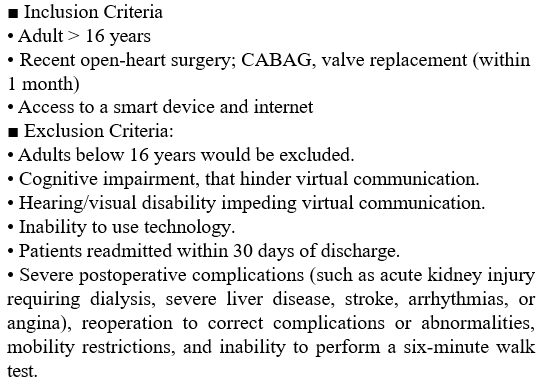
The study was carried out at KFSH&RC, a tertiary care hospital providing post-operative cardiac rehabilitation services. Patients included in the study were adults (≥16 years) who underwent coronary artery bypass grafting (CABG), valve replacement, or combined procedures between [Start 1 March 2025] and [End 30 June 2025].
Sample Size
The determination of the sample size for this study was conducted using the power analysis method with the G*Power program [15]. The significance level was set at 0.05 and the power at 0.80. The effect size was based on a similar research study [16]. With an effect size of 0.80, the sample size was calculated to be 46 participants. To account for potential dropouts or withdrawals, a 15% increase was applied, yielding a total sample size of 54 participants. Throughout the 8-week intervention program, there were four dropouts or losses to follow-up recorded.
Research Procedures
Intervention
The program’s duration was 8 weeks and included 8 contacts with the participants. The video about the CR program included education modules on exercises, warm-up exercises, walking routines, six minutes’ walk test and cool-down exercises. The video also covered abnormal signs that indicate the need to stop exercising, along with corrective measures. The CR program involved 30 min sessions at least once a week throughout the 8-week program. The researcher assessed participants’ self-care and CR knowledge before hospital discharge. The researcher performed weekly video call follow-ups every Sunday. The researcher would review the participants’ self-care activities, asking about problems and obstacles they encountered with respect to vCR and taking care of themselves, as well as encouraging discussion and creating opportunities for patients to express their concerns, providing emotional support and engaging in collaborative problem-solving during the video calls.
Data Collection
Data were collected from the hospital’s electronic medical record (EMR) system, including:
• Demographic information.
• Type of surgery.
• Follow-up attendance and completion rates.
• Functional outcomes (6-minute walk test).
• Readmission rates within 30 and 90 days.
• Patient satisfaction scores.
• Adherence to cardiac rehabilitation program.
Research Instruments
Functional capacity was assessed through the Six-Minute Walk Test (6 MWT). The 6 MWT was conducted according to the American Thoracic Society guidelines [17]. Patients’ heart rate, blood pressure, and oxygen saturation were monitored both before and after the test. If signs or symptoms of significant distress occurred during the 6 MWT, patients were permitted to stop and rest. The distance walked during the test was recorded in meters. The Arabic version of the Short Form-36 (SF-36) was used to assess quality of life. The SF-36 was initially developed by The Mental Outcome Study and translated into Arabic by Nada El Osta, Fatme Kanso, Robert Saad [18]. This questionnaire comprises 36 questions that are categorized into eight domains: physical functioning, physical roles, bodily pain, and general health are categorized under the physical health component, whereas vitality, social functioning, emotional roles, and mental health are grouped under the mental health component. An additional unscaled single item requires respondents to evaluate health changes over the past year. The item scores for each domain are coded, summed, and converted into a scale ranging from 0 (worst possible health state) to 100 (best possible health state) [19]. The total score is generated from the summation of all eight domains, with higher total scores indicating a better overall quality of life. Previous studies have confirmed that the Arabic version of the SF-36 has good reliability and validity [17].
Intended Outcome Measures
Patient adherence rate to cardiac rehabilitation (%of patients attending scheduled virtual follow-ups).
Clinical Outcomes
• Improvement in functional capacity (e.g., 6-Minute Walk Test).
• No readmission rates (30-day and 90-day post-discharge) [4].
Patient Satisfaction
• Arabic version of the Short Form-36 (SF-36) [18].
Healthcare Utilization
• Number of missed appointments (no-shows)
• Emergency visits [6].
Data Analysis
Descriptive statistics were used to summarize demographic and clinical characteristics. Chi-square and t-tests were applied to compare categorical and continuous variables, respectively.
Multivariate logistic regression was conducted to identify predictors of improved outcomes associated with virtual clinic use. A p-value < 0.05 was considered statistically significant, and quality of life questionnaire were analyzed.
Results
Table 1 shows the demographic and clinical characteristics of the participants. The study involved a total of 50 individuals, with 23 female and 27male. Most participants were aged between 16 and 87, with an average age of 51.5 years (SD = 20.5). Most participants had heart valve diseases, with. Regarding the surgical procedures, underwent either valvar repair or valve replacement surgery. The chi-square test showed no significant differences in sociodemographic characteristics and clinical characteristics of the participants (p> 0.05).
|
|
|
Experimental Group (n = 50), n (%) |
P -Value |
|
Gender |
|
|
|
|
Male |
27 |
|
0.57 |
|
Female |
23 |
|
0.57 |
|
Age (mean, SD) |
|
|
|
|
|
|
|
|
|
|
51.5 (20.5) |
|
0.60 |
|
Surgical Procedure |
|
|
|
|
CABG |
8 (16%) |
|
|
|
Valve surgery |
28 (56%) |
|
|
|
Valve surgery + CABG |
5 (10%) |
|
|
|
Double valve |
9(18%) |
|
|
Table 1: Demographic and Clinical Characteristics of the Participants (N = 50)
Functional Capacity
The functional capacity of all participants was assessed using the 6 MWT distance. The mean 6 MWT distance walked by the participants enrolled in the CR program was 420 (SD = 85). The details are presented in Table 2.
|
Functional Capacity |
SD |
Total (n = 50) |
t |
p-Value |
|
|
6 MWT |
420 |
85 |
|
6.66 |
<0.0001 |
Table 2: Functional Capacity (6 MWT) Among Open-Heart Surgery Patients (n = 50)
Quality of Life among Open-Heart Surgery Patients
The results showed that the participants overall quality of life (t = 4.55, p < 0.001, effect size = 1.25) (95% CI 49.37, 127.36), physical functioning (t = 3.57, p = 0.001, effect size = 0.97) (95% CI 6.57, 23.43), emotional roles (t = 2.34, p = 0.023, effect size = 0.97) (95% CI 1.24, 16.04), vitality (t = 3.61, p = 0.001, effect size = 0.98) (95% CI 4.12, 14.40), mental health (t = 5.34, p < 0.001, effect size = 1.45) (95% CI 6.01, 13.25), social functioning (t = 3.27, p = 0.002, effect size 0.72) (95% CI 4.65, 19.42), and general health (t = 5.05, p < 0.001, effect size = 0.72) (95% CI 13.06, 30.27). Shown in Table 3.
|
Quality of Life |
|
|
Total (n = 50) |
t |
p-Value |
|
SD |
|||||
|
Physical functioning |
86.48 |
13.07 |
|
3.57 |
0.001 |
|
Physical roles |
93.52 |
16.40 |
|
0.58 |
0.562 |
|
Emotional roles |
98.76 |
6.41 |
|
2.34 |
0.023 |
|
Vitality |
75.37 |
9.08 |
|
3.61 |
0.001 |
|
Mental health |
79.26 |
5.77 |
|
5.34 |
0.000 |
|
Social functioning |
87.96 |
12.73 |
|
3.27 |
0.002 |
|
Bodily pain |
81.57 |
19.82 |
|
1.96 |
0.056 |
|
General health |
71.67 |
13.45 |
|
5.05 |
0.000 |
Table 3: Quality of Life among Open-Heart Surgery (n = 50)
Discussion
In this study, functional capacity was assessed using 6 MWT distance and physical activity to evaluate cardiovascular system recovery after open-heart surgery. Improving functional capacity is a crucial clinical outcome for CR related to secondary prevention of cardiovascular disease (CVD) [20]. After open-heart surgery, the participants in the CR program showed significantly higher average 6 MWT distance and physical activity scores. The CR program, provided by the researchers, involved guiding patients before discharge from the hospital and providing continuous follow-ups over the ensuing 8 weeks. The CR program involved 30 min vCR sessions at least once per week throughout an 8-weeks course that consisted of exercise training involving practicing sitting, standing, and walking to facilitate efficient recovery and a rapid return to a normal state, thereby improving functional capacity [5]. vCR programs are practical and enhance patient adherence to physical activity, thereby leading to an improvement in functional capacity. Additionally, patient education contributes to increasing levels of physical activity [20]. Consistent with previous studies, the VCR program was shown to help improve functional capacity [18, 21,22].
Moreover, the vCR program uses online videos accessed through the mobile application to help patients perform exercises after open-heart surgery. These tools aim to enhance exercise capacity and build confidence in exercising. Patients can access the online video instructions at any time and perform the exercises independently at home after being discharged from the hospital. The combination of video-assisted programs and mobile-based follow-ups has greatly improved the effectiveness of home-based programs. These innovations have been key to better monitoring participant adherence and improving the quality of exercise execution at home. A previous Cochrane systematic review found that vCR was associated with slightly higher adherence than center-based CR [23]. This approach highlights the potential of technological interventions in optimizing the outcomes of home- based health programs [20,24]. The present study also showed that the participants enrolled in the vCR program had higher average scores for QOL in the physical functioning, emotional roles, vitality, mental health, social functioning, and general health dimensions.
The vCR program, implemented through self-care guidance, exercise promotion, and encouragement to maintain a continuous record of vCR progress, instills confidence in the patients’ own ability to self-manage their cardiac recovery. However, during the transition phase, when post-surgery patients return home, they often experience anxiety and uncertainty about self-managing their CR [14]. Combining the promotion of continuous vCR with the mobile application to guide post-open-heart surgery vCR can help alleviate travel limitations and costs [14,15]. The two-way communication facilitated through the mobile application allows patients to inquire about their vCR, such as asking about exercise postures at any time. This active engagement empowers patients to actively participate in their physical and cardiac recovery, enhancing their self-confidence [14]. Open-heart surgery patients who have undergone major surgery require continuous physical, physiological, and psychological cardiac recovery in the long term [14,15].
The program empowered the participants to effectively promote self- care and vCR at home post discharge from the hospital. The results of this study suggest that providing tailored knowledge, offering self-care guidance, promoting mutual learning and exchange, stimulating continuous cardiac rehabilitation, and collaboratively addressing problems can build confidence in the patients’ own ability to self-manage their cardiac recovery after discharge, on top of that increased percentage of virtual clinic utilization [25]. Consequently, when patients experience appropriate and continuous cardiac recovery, it improves physical functioning and the overall quality of life. This aligns with the findings of previous studies, which have shown that vCR programs that address other cardiovascular risk factors and provide education and social support could improve clinical outcomes in cardiopulmonary fitness, psychological factors, and the quality of life of patients with heart disease [26]. This revealed that vCR programs that provide knowledge, offer guidance on lifestyle adjustments, and promote healthy behaviors lead to improvements in the physical, mental, and social dimensions of quality of life [25,26]. The greater emphasis on self-monitoring, self-management, and unsupervised exercise in vCR programs, in comparison to center-based CR, may facilitate a smoother transition from active intervention to lifelong disease self-management. However, further investigation is required to confirm this assumption [5].
In addition, studies have found that psychological support is a critical component of the CR process. The results of this study demonstrated that post-cardiac surgery rehabilitation was associated with a greater prevalence of psychological discomfort symptoms relative to the general population. The extent of psychological distress, depression, and hostility was found to be correlated with limited improvements in rehabilitation outcomes. These findings underscore the importance of incorporating psychological support into CR programs to address these psychological challenges and improve the overall effectiveness of the rehabilitation process. Psychological distress can significantly affect a patient’s ability to engage fully in physical rehabilitation, and thus, psychological care should be integrated into CR programs to achieve comprehensive recovery [27]. Regarding physical roles, undergoing open-heart surgery has a significant impact on a patient’s physical problems due to the large incision wound caused by cutting open the sternum and intraoperative procedures, with around six to eight weeks required for the sternum and chest muscles to heal and the patient to regain physical function [28]. In terms of the bodily pain dimension, when patients attend a vCR program that includes efficient respiratory and lung exercises, effective coughing techniques, and exercise training for CR, pain symptoms might arise following exercise.
Limitations and Recommendations
• The study was conducted at a single site, which limits the generalizability of the findings to other populations, healthcare settings, or countries.
• The retrospective study design limits causal inferences; future studies should use randomized controlled trials (RCTs) and advanced statistical methods like logistic regression to control for confounders.
• The 8-weeks intervention period may not reflect long-term outcomes, as standard follow-ups often extend beyond 12 weeks. Longer-term studies (6–12 months) are recommended
• The study did not evaluate cost-effectiveness, pain management strategies, family involvement, or training needs for healthcare providers, all of which are crucial for broader adoption and sustainability, especially in resource-limited settings.
Future Study Recommendations
• Future research should explore the application of virtual CR program to diverse patient populations, such as individuals with coronary artery disease, heart failure, or other cardiovascular conditions, to assess its broader effectiveness.
• The virtual CR program could also be adapted for use in different healthcare settings, including outpatient clinics or community health centers, to expand its reach and accessibility.
• Additionally, studies should evaluate the long-term sustainability and cost-effectiveness of the program to determine its value in diverse healthcare contexts.
• Researchers should develop suitable pain management programs for patients undergoing open-heart surgery. Effective pain management leads to reduced limitations related to physical problems.
Significance of the Study
This study provided evidence on the role of telehealth in cardiac rehabilitation, potentially shaping policies and practices that enhance patient access, reduce healthcare costs, improve patient satisfaction, and increase percentage of virtual clinic utilization.
Ethical Consideration
• Approval from KFSH&RC Research committee
• Confidentiality and data security ensured through encrypted platforms
• All the collected data saved and the confidentiality of the patients protected. The patient identity protected by substituting anonymous codes for names.
Conclusion
This study demonstrated that using a vCR program through the mobile application can significantly improve the functional capacity and quality of life of post-open-heart surgery patients at home, essential for their recovery and long-term well-being. These findings highlight the significance of Virtual CR and the role of technology in making it more accessible. The program that was developed spans from pre-discharge to 8 weeks post-discharge to provide knowledge, guidance, practical training, motivation, and continuous support to promote virtual CR and enhance self- care abilities, as well as increase the percentage of virtual clinic utilization from zero to 50%. Therefore, the virtual CR program developed in this study can be adapted and implemented as a therapist practice guideline to facilitate appropriate self-care, continuous cardiac recovery, and improved patient outcomes after open-heart surgery. Additionally, it can also be applied to other patient groups requiring postsurgical cardiac rehabilitation.
References
- Anderson, L., & Taylor, R. S. (2014). Cardiac rehabilitation for people with heart disease: an overview of Cochrane systematic reviews. Cochrane database of systematic reviews, (12).
- Tzeng, Y. H., Yin, W. H., Lin, K. C., Wei, J., Liou, H. R.,Sung, H. J., & Lang, H. C. (2022). Factors associated with the utilization of outpatient virtual clinics: retrospective observational study using multilevel analysis. Journal of Medical Internet Research, 24(8), e40288.
- Ritchey, M. D., Maresh, S., McNeely, J., Shaffer, T., Jackson,S. L., Keteyian, S. J., ... & Wright, J. (2020). Tracking cardiac rehabilitation participation and completion among Medicare beneficiaries to inform the efforts of a national initiative. Circulation: Cardiovascular Quality and Outcomes, 13(1), e005902.
- Rawstorn, J. C., Gant, N., Rolleston, A., & Maddison,R. (2021). Remote delivery of cardiac rehabilitation: A systematic review and meta-analysis of controlled trials. Journal of Cardiopulmonary Rehabilitation and Prevention, 41(2), 71–80.
- Thomas, R. J., Beatty, A. L., Beckie, T. M., Brewer, L. C.,Brown, T. M., Forman, D. E., … & Wang, T. Y. (2021). Home- based cardiac rehabilitation: A scientific statement from the American Association of Cardiovascular and Pulmonary Rehabilitation, the American Heart Association, and the American College of Cardiology. Circulation, 143(1), e13– e21.
- Kraal, J. J., Van den Akker-Van Marle, M. E., Abu-Hanna, A., Stut, W., Peek, N., & Kemps, H. M. (2017). Clinical and cost- effectiveness of home-based cardiac rehabilitation compared to conventional, centre-based cardiac rehabilitation: Results of the FIT@ Home study. European journal of preventive cardiology, 24(12), 1260-1273.
- Victoria Gulick , Daniel Graves, Shannon Ames, Pavitra Parimala. (2021). Krishnamani3 Effect of a Virtual Reality– Enhanced Exercise and Education Intervention on Patient Engagement and Learning in Cardiac Rehabilitation: Randomized Controlled Trial. Published on 15.04.2021 in Vol 23, No 4 (2021).
- Babu, A. S., Arena, R., Ozemek, C., Lavie, C. J., & Thomas, R.J. (2021). COVID-19 pandemic: A time for a shift in clinical practice for exercise-based cardiac rehabilitation. American Journal of Medicine, 134(7), 870-873.
- Harzand, A., Witbrodt, B., Davis-Watts, M. L., Alrohaibani, A., Goese, D., Wenger, N. K., ... & Zafari, A. M. (2018). Feasibility of a smartphone-enabled cardiac rehabilitation program in male veterans with previous clinical evidence of coronary heart disease. The American journal of cardiology, 122(9), 1471-1476.
- Taylor, R. S., Dalal, H. M., & McDonagh, S. T. (2022). Therole of cardiac rehabilitation in improving cardiovascular outcomes. Nature Reviews Cardiology, 19(3), 180-194.
- Paorod, P., Chidnok, W., & Sayasathid, J. (2017). Effect of home-based cardiac rehabilitation program on exercise capacity in open heart surgery patients at Naresuan university hospital. Songklanagarind Medical Journal, 35(4), 285-291.
- Arjunan, P., & D'Souza, M. S. (2021). Efficacy of nurse-led cardiac rehabilitation on health care behaviours in adults with chronic heart failure: An experimental design. Clinical Epidemiology and Global Health, 12, 100859.
- Ruan, T., Xu, M., Zhu, L., & Ding, Y. (2023). Nurse- coordinated home-based cardiac rehabilitation for patients with heart failure: a scoping review. International Journal of Nursing Sciences, 10(4), 435-445.
- Ma, J., Ge, C., Shi, Y., Xu, Y., Zhao, C., Gao, L., ... & Chen,Y. (2021). Chinese home-based cardiac rehabilitation model delivered by smartphone interaction improves clinical outcomes in patients with coronary heart disease. Frontiers in Cardiovascular Medicine, 8, 731557.
- Faul, F., Erdfelder, E., Lang, A. G., & Buchner, A. (2007). G* Power 3: A flexible statistical power analysis program for the social, behavioral, and biomedical sciences. Behavior research methods, 39(2), 175-191.
- Nakon, O., Sindhu, S., & Tansawatdi, R. (2015). Effectiveness of a hospital-based comprehensive cardiac rehabilitation program on postoperative recovery of patients undergoing coronary artery bypass grafting. Nursing Science Journal of Thailand, 33(4), 51-64.
- American Thoracic Society. ATS Statement: Guidelines for the Six-Minute Walk Test. Am. J. Respir. Crit. Care Med. 2002, 166, 111–117. [Google Scholar] [CrossRef] [PubMed]
- El Osta, N., Kanso, F., Saad, R., Khabbaz, L. R., Fakhouri, J., & El Osta, L. (2019). Validation of the Arabic version of the SF-36, generic questionnaire of quality of life related to health among the elderly in Lebanon. Eastern Mediterranean Health Journal= La Revue de Sante de la Mediterranee Orientale= Al-majallah Al-sihhiyah Li-sharq Al-mutawassit, 25(10), 706-714.
- Jenkinson, C., Stewart-Brown, S., Petersen, S., & Paice, C.(1999). Assessment of the SF-36 version 2 in the UnitedKingdom. Journal of Epidemiology & Community Health, 53(1), 46-50.
- Prabhu, N. V., Maiya, A. G., & Prabhu, N. S. (2020). Impact of cardiac rehabilitation on functional capacity and physical activity after coronary revascularization: a scientific review. Cardiology research and practice, 2020(1), 1236968.
- Uddin, J., Joshi, V. L., Moniruzzaman, M., Karim, R., Uddin, J., Siraj, M., ... & Zwisler, A. D. (2020). Effect of home-based cardiac rehabilitation in a lower-middle income country: results from a controlled trial. Journal of Cardiopulmonary Rehabilitation and Prevention, 40(1), 29-34.
- Prasada, S., Rambarat, C., Winchester, D., & Park, K. (2020). Implementation and impact of home-based cardiac rehabilitation in a Veterans Affair Medical Center. Military medicine, 185(5-6), e859-e863.
- Buckingham, S. A., Taylor, R. S., Jolly, K., Zawada, A., Dean,S. G., Cowie, A., ... & Dalal, H. M. (2016). Home-based versus centre-based cardiac rehabilitation: abridged Cochrane systematic review and meta-analysis. Open heart, 3(2).
- Cristo, D. D., Nascimento, N. P. D., Dias, A. S., & Sachetti,A. (2018). Telerehabilitation for cardiac patients: systematic review. International Journal of Cardiovascular Sciences, 31(4), 443-450.
- Schopfer, D. W., Whooley, M. A., Allsup, K., Pabst, M., Shen, H., Tarasovsky, G., ... & Forman, D. E. (2020). Effects of home-based cardiac rehabilitation on time to enrollment and functional status in patients with ischemic heart disease. Journal of the American Heart Association, 9(19), e016456.
- McMahon, S. R., Ades, P. A., & Thompson, P. D. (2017). The role of cardiac rehabilitation in patients with heart disease. Trends in cardiovascular medicine, 27(6), 420-425.
- Ricci, M.; Pozzi, G.; Caraglia, N.; Chieffo, D.P.R.; Polese, D.; Galiuto, L. Psychological Distress Affects Performance during Exer-cise-Based Cardiac Rehabilitation. Life 2024, 14, 236. [Google Scholar] [CrossRef] [PubMed] [PubMed Central].
- Thai Heart Association of Thailand Under The Royal Patronage of H.M. The King. Guideline for Ischemic Heart Disease; Srimuang Printing: Bangkok, Thailand, 2014. [Google Scholar].