

Advancements in Journal of Urology and Nephrology(AJUN)
ISSN: 2689-8616 | DOI: 10.33140/AJUN
Impact Factor: 1.0


Review Article - (2020) Volume 2, Issue 2
Using Time-Series and Forecasting to Manage Type 2 Diabetes Conditions (GH-Method: Math-Physical Medicine)
Received Date: Apr 23, 2020 / Accepted Date: Apr 29, 2020 / Published Date: May 07, 2020
Copyright: ©Gerald C Hsu. This is an open-access article distributed under the terms of the Creative Commons Attribution License, which permits unrestricted use, distribution, and reproduction in any medium, provided the original author and source are credited.
Abstract
This paper describes the author’s application of Time-Series Analysis and forecasting to manage type 2 diabetes (T2D) conditions. The dataset is provided by the author, who uses his own T2D metabolic conditions control, as a case study via the “math-physical medicine” approach of a non-traditional methodology in medical research.
Introduction
This paper describes the author’s application of Time-Series Analysis and forecasting to manage type 2 diabetes (T2D) conditions. The dataset is provided by the author, who uses his own T2D metabolic conditions control, as a case study via the “math-physical medicine” approach of a non-traditional methodology in medical research.
Math-physical medicine (MPM) starts with the observation of the human body’s physical phenomena (not biological or chemical characteristics), collecting elements of the disease related data (preferring big data), utilizing applicable engineering modeling techniques, developing appropriate mathematical equations (not just statistical analysis), and finally predicting the direction of the development and control mechanism of the disease.
Method
The author utilizes the GH-Method: math-physical medicine to manage metabolic disorder diseases especially diabetes. Initially, he observed various disease phenomena. Therefore, he recorded big volume of related data, derived necessary and applicable mathematical equations, utilized suitable computational tools, including time-series analysis, spatial analysis, frequency domain analysis, and artificial intelligence. As a result, he combined them with medical domain knowledge in order to forecast the forthcoming outcomes to interpret the new findings or discoveries regarding human health.
In this paper, he disregards the theoretical discussion of time-series analysis in order to focus on application and certain results from his diabetes research by using time-series analysis and forecasting method.
Results
Here are some of the results from time-series analysis and forecasting:
1. Weight: He developed a weight prediction model based on food portion, exercise, and certain metabolism respects and achieved 99.8% linear accuracy with a correlation coefficient (R) of 90% to compare with actual weight. Weight contributes ~85% of FPG formation.
2. Fasting plasma glucose (FPG) in early morning: Using time-series analysis, he obtained R=70% between weight and FPG.
3. Postprandial plasma glucose (PPG) at two hours after fist-bite of meal: Using time-series analysis, he obtained R= +45% between carbs/sugar intake and PPG and R= -59% between post-meal walking and PPG. Combined carbs/sugar and walking contributes ~80% of PPG formation. He achieved 100% linear accuracy and R=85% between predicted and actual PPG.
4. Hemoglobin A1C or HbA1C (A1C): The medical community uses A1C as the measuring yardstick to determine the severity of the patients’ diabetes conditions. There are no consistent conversion ratios available between glucose and A1C values. Therefore, the author applied statistics tools (including time-series analysis, spatial analysis, and frequency-domain analysis) and engineering approximation modeling to build up an effective A1C forecasting model. In comparison of this mathematically forecasted A1C results and lab tested A1C results (quarterly data due to insurance constraints), he achieved a linear accuracy of 96% and R=54%.
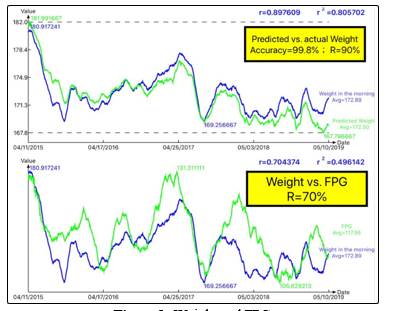
Figure 1: Weight and FPG
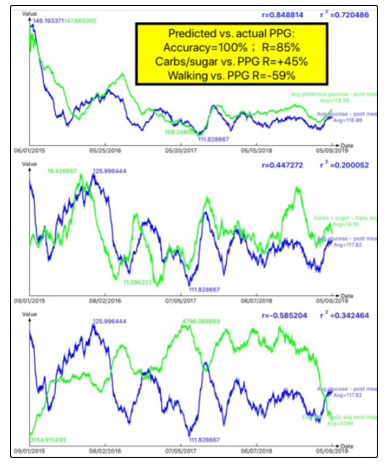
Figure 2: Carbs/sugar (+R) and Walking (-R) vs. PPG
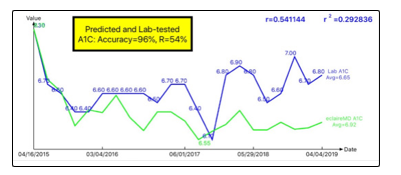
Figure 3: HbA1C
Conclusion
By using time-series analysis method, this clinical case study of more than four years, encompassing 1,488 days and ~500,000 big data, has demonstrated its powerful forecasting capability on weight, glucose, and diabetes control (figure 1-3) [1-5].
References
-
- Hsu Gerald C (2018) Using Math-Physical Medicine to Control T2D via Metabolism Monitoring and Glucose Predictions. Journal of Endocrinology and Diabetes 1: 1-6.
- Hsu Gerald C (2018) Using Math-Physical Medicine to Analyze Metabolism and Improve Health Conditions. Video presented at the meeting of the 3rd International Conference on Endocrinology and Metabolic Syndrome 2018.
- Hsu Gerald C (2018) Using Signal Processing Techniques to Predict PPG for T2D. International Journal of Diabetes & Metabolic Disorders 3: 1-3.
- Hsu Gerald C (2018) Using Math-Physical Medicine and Artificial Intelligence Technology to Manage Lifestyle and Control Metabolic Conditions of T2D. International Journal of Diabetes & Its Complications 2: 1-7.
- Hsu Gerald C (2018) A Clinic Case of Using Math-Physical Medicine to Study the Probability of Having a Heart Attack or Stroke Based on Combination of Metabolic Conditions, Lifestyle, and Metabolism Index. Journal of Clinical Review & Case Reports 3: 1-2.