

Autism Spectrum Disorders: Open Access(ASDOA)

Impact Factor: 0.98

Research Article - (2021) Volume 1, Issue 1
Understanding Symbolism and Creativity in Children on the Autistic Spectrum: Possible Aspects of Psychotherapy and Play Therapy
Received Date: Sep 26, 2021 / Accepted Date: Oct 12, 2021 / Published Date: Oct 18, 2021
Copyright: ©Copyright: ©2021 Veronika Ivanova. This is an open-access article distributed under the terms of the Creative Commons Attribution License, which permits unrestricted use, distribution, and reproduction in any medium, provided the original author and source are credited.
Citation: Veronika Ivanova (2021) Understanding Symbolism and Creativity in Children on the Autistic Spectrum: Possible Aspects of Psychotherapy and Play Therapy. Auti Spec Disord Open 1(1), 06-08.
Abstract
The tendency to view autism as a cognitive disorder has led to a sharp decline in the importance of therapeutic play as a way of finding a child with autism. The emphasis on the cognitive disorder is due in large part to a shift in focus to the child's internal experiences. This text explores the possibilities of various therapeutic techniques - as a house for play therapy, other therapeutic games that provide a possible psychodynamic viewpoint for meeting the autistic child. During the process of technique in the smaller and understanding of proverbs, proverbs and the use of symbolic messages and metaphors in interviewing with high-functioning children. The results show that the symbolic and metaphorical are used in describing inner experiences. These results lead to the conclusion that, despite the undoubted benefits of socioeducational activities that teach them, we must also take into account the risks of corrective practices based on a support and punishment system that leads to the production of falsehood through a set of learned words and skills that are not synthetic and integrated into the child's personality, create a temporary illusion of social adaptation, but do not allow the child to face new creative situations and mostly contribute to stifle and deny his own psychic life.
Keywords
Play, Autism
Introduction
Considering autism as a consequence of the violation of the devel-opment of cognitive functions and not as an affective disorder, as an emotional disorder in contact with the subjective environment, has led to a lower level of research and clinical observations in spectrum children in relation to the home experience, as if the cli¬nicians themselves do not let them into the child, probably uncon¬sciously against what they experience when meeting a nonverbal child who slides his eyes over the clinician and practically erases it.
When we are dealing with patients with dominant autistic condi-tions, the therapist himself is exposed to the experiences of non-ex-istence. These experiences are very difficult to bear and require him to work with his negative capacity [1]. In order for the analyst to penetrate the patient's autistic barrier, he must experience using his intuition based on the patient's sensory language to discover some means of establishing a sensory connexion between them. This enables the patient to feel less threatened than by the presence of the analyst - a single person - and possibly.
Clinical method: involves observation, psychodynamic psycho¬therapy sessions, working directly with the child on the individual issues of the methodology used. Play therapy methods.
Results
Example
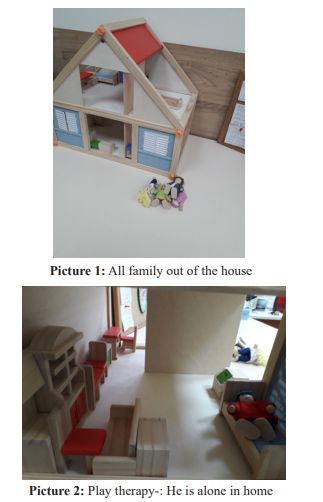
M. 8 years, boy during the session, the child usually plays with "a house for play therapy", inventing dialogues between family mem¬bers and changing the tone of voice. The child sinks into his activ¬ity, does not make contact with the psychologist, but mostly keeps his back. Stereotypical movements are observed: Jumps, arms and fingers to the face. Expressive language is developed, but does not always serve communication. The child is learning to ask for help when in trouble, but only when it is offered by an adult. When communication does not follow whether it is understood by the interlocutor, a difficulty encounters its own experiences. It is diffi¬cult to understand questions like "How?", "When?" and to look for causal connexions. It is difficult to establish and maintain commu-nication, there are problems with attention and sharing emotions and interests with other people, which makes it difficult to syn¬chronise communication.
There are also problems with non-verbal communication - he does not pay attention to facial expressions, tone of voice, gestures and is unable to understand these non-ver-bal signals when they come from other people. There is a well-developed sensory memory that has good visual and auditory memory without always understanding the repeti-tions. The information from a visual analyst takes precedence. The visual memory is phenomenal. The child has difficulty selecting information that is important to the stimulus. It focuses on non-es-sential details. Thinking is specific, literal, difficult to understand abstract concepts. Language is admitted and understood literally, characteristic of high-functioning children with an autistic person¬ality profile. It is difficult to infer the main concepts and under¬stand the meaning from a text or information. Metaphors and ab¬stract concepts are taken literally and not understood. Intellectual capacity is a high 110-120 IQ.
In question time how he feels and what happens in his family after a while (deferred response).
The child accurately arranges the furniture in the house (picture 1and picture 2), making it a pile of the family and placing the figure of the boy with whom he identifies in the ideally ordered house. What is if not a metaphor for his inner experience, on the one hand of absolute loneliness, on the other of the search for a relationship with another that is secure enough for him.
In another activity using metaphorical association cards („Healing Inner Child” is a deck of cards that are designed to address ad-hoc requests. They are associated with the inner emotional state of children.), the session takes place a month after the death of the grandfather who took care of the child. M. is silent and sits quietly in his chair, he does not want to play, but he shows that he wants to stay in the session. From the proposed cards he chooses only one and leaves it on the table and cries - grandfather keeps a boy, after the session the mother says that the grandfather died, but M. did not understand at all.
At the next session he spontaneously draws a tombstone and a ghost, when asked where it is in the drawing, he points to the spiro, and the other one is the grandfather..., the therapist asks and he just nods his head and is sad.
Discussion
The counseling and diagnostic work in families of children with suspected autism presupposes a psychotherapeutic context that makes it possible to examine the main component of the affective, disturbed relationship with the other. Only in the field of trans¬ference, in which the clinician gives words to the unspoken, he relies on the tongue of gestures, drawings, play, facial expressions, plaster figures, can a distinction be made between the depressive state with separation and autistic scars in a child. Such a diagnosis would only be possible by establishing a therapeutic relationship with the parents and the child, taking into account both the emo¬tions and experiences of the parents and the emotions and experi¬ences of the professionals, even a valuable diagnostic criterion for the affective message of the child. In the session with the parent, the clinical psychologist-psychotherapist has the main task of be¬ing a "translator" of the parent's words for the child, and for this, during the sessions, always speak to the child, not with him, the parent remains in a third person, or if he speaks for him in front of the child, this must be communicated by the specialist. Inaction during such consultations is the cause of the lack of communica¬tion with the child. In the next clinical case, the child's behavior shows the fear of losing the mother's side and increased inner rest¬lessness [2,3]. The autistic child who does not speak is involved in the language because it is spoken to him [4].
In general, it can be affirmed that autistic processes have a meaning and that this meaning lies in the construction of a struggle against a struggle in two directions: against the unbearable and unthinkable grief associated with the painful experience of separation, but also against the persecuting and painful experience of thought process¬es in which the protective activity seems to be mobilized in the service of the destruction of thought[5]. The main meanings of the autistic mechanisms are related to the disturbed body image, in which the child resorts to a self-induced sensor, dwells in the specific, has a low tolerance for change and seeks asylum in the unchanging, tries to destroy everything that has symbolic value, an attempt to reduce to meaning without sense, to empty the human experience of its meaning and of an emotional charge, the experi¬ence of a physical "rupture".
Many parents will be warned that child psychotherapy is unsuit¬able because their child has a Brian defect, but cases like this give hope that there is resonance in working with psychodynamic thera- py methods and trying to hear the inner world of the subject. Child psychotherapy is appropriate for some families whose parents are searching for meaning in their child's behavior. It is not appro¬priate for all children with ASD, but according to the theories of autism, both Trevathen and Hobson emphasize the primacy of the emotional relationship as opposed to the cognitive theories [6,7]
Conclusion
Despite the undoubted benefits of socio-educational activities in which they have their meetings with the child and many psychol-ogists to learn it, we must also take into account the risks of cor-rective practices based on a support and punishment, leading to the elaboration of false self through the A set of learned words and skills that do not synthesize and enter into the personality of the child to create a temporary illusion of social adaptation, but do not allow the child to new situations creativity and especially contribute to stifle and deny their own his psychological inner life picture [8-16].
References
- Bion WR (1970) Attention and Interpretation. London: Tavistock Publications.
- Laznik M Hacia el habla (1997) Three autistic children in psychoanalysis. New Vision. Bs.As. ISBN 950-602-369-7.
- Lefort (1995) R Nacimiento del Otro. Paidos.Barcelona. ISBN 84-7509-174-1.
- Lakan.J (2008) Semeinite kompleksi.izd.Siela. Sofiq. Family complexes. Ciela Publishing House, Sofia.
- Basso M (2013) A psychoanalytic approach to Autism. Ed. Live Letter, Buenos Aires 24
- Trevarthen Colwyn (1980) The foundations of intersubjectivity: Development of interpersonal and cooperative understanding in infants. The Social Foundations of Language and Thought: Essays in Honor of Jerome S. Bruner 316-342.
- Hobson P (2002) The cradle of thought. Macmillan Education.
- Baron-Cohen S (2001) Theory of mind in normal development and autism. Prisme 31: 174- 183.
- Frey JR, Kaiser AP (2011) The use of play expansions to increase the diversity and complexity of object play in young children with disabilities. Topics in Early Childhood Special Education 31: 99-111.
- Korbichev, Celia Fix (2016) Psychoanalyst's mind: personality and theories Analyst's theories and transformations in O. Rev. bras. Psychochannel 50: 147-160.
- Melzer (2019) Autism studies. Centar for psychosocial sup-port, Bulgarian space for psychoanalysis. Sofia.
- Nikolskaya OS (1997) Autistic child. Ways of help / Nikol-skaya OS, Baenskaya ER, Liebling MM
- O'Connor K J (2000) The play therapy primer (2nd ed.). John Wiley & Sons Inc.
- Petot JM (1990) Melanie Klein, First discoveries and first system 1919-1932. (C. Trollope, Trans.). International Universities Press, Inc.
- Rennie R, Landreth G (2000) Effects of filial therapy on parent and child behaviors. International Journal of Play Therapy 9: 19-37.
- Tendlarz S (1996) What do children suffer from? Psychosis in childhood; Publishing place Buenos Aires.