

Journal of Mathematical Techniques and Computational Mathematics(JMTCM)
ISSN: 2834-7706 | DOI: 10.33140/JMTCM

Impact Factor: 1.3

Research Article - (2025) Volume 4, Issue 2
Two Theorems To Verify Goldbach's Strong Conjecture ; or To Refute it By an Uninterrupted Sequence of Composite Odd Numbers In The Interval [n-2n]
Received Date: Feb 18, 2025 / Accepted Date: Mar 18, 2025 / Published Date: Apr 02, 2025
Copyright: ©©2025 Bahbouhi Bouchaib. This is an open-access article distributed under the terms of the Creative Commons Attribution License, which permits unrestricted use, distribution, and reproduction in any medium, provided the original author and source are credited.
Citation: Bahbouhi., B. (2025). Two Theorems To Verify Goldbach's Strong Conjecture ; or To Refute it By an Uninterrupted Sequence of Composite Odd Numbers In The Interval [n ? 2n]. J Math Techniques Comput Math, 4(2), 01-12.
Abstract
Let's assume an even number E that is one unit larger than to the largest prime number we know today. Let's call this prime number Pl. Now we have 0—E/2—E and therefore Pl > E/2. For GSC to be true E must be sum of two primes P1 and P2 such that P1 < E/2 and P2 > E/2. Therefore we have to calculate E – P2 = X. If X is composite GSC is not verified; if X = P1 then GSC is verified. We then calculate E – P2 starting with Pl and all P2 till the one which is the closest to E/2. The question is: are all the Xs resulting from calculated E – P2 = X composites? Is it possible that all Xs might be composite which means non-verification of GSC? By contrast, if only one X is prime, then GSC is true. We see that GSC is much more likley to be verified in this case because a very long sequence of composite numbers is very unlikely to be continuous from E – Pl to E – P2 which is the closest to E/2. In other words there is at least one P2 prime in [ E/2—E] such that E – P2 = P1 → E = P1 + P2. The small primes are those that give the most composite numbers because their multiples are the most frequent but it is unlikely that all P2 of [E/2—E] would give composite numbers when calculating E – P2. If anyone, using this procedure, is able to find a sequence of composite numbers E - P2 = X in the whole E/2 – E interval; then He will be the first one who finds the solution to Goldbach's strong conjecture because this means its final rejection, and no mathematician can cast any doubt on his result. However, let us not forget that if only one X is prime, then GSC is true. As long as we cannot find this very precious and historical counterexample of an uninterrupted sequence of composite numbers by E – P2 = X (P2 is in E/2- E interval); Goldbach's strong conjecture will remain true although unprovable. This article gives the TWO THEOREMS of CONGRUENCE-MODULO which always predetermine whether GSC is true or not when calculating E - P2 = X. These two theorems described in this article will predict whether X is prime or composite. Nevertheless, these two theorems require the use of Euclidean divisions in series with the calculation of the remainders for each P2.
Introduction
I'm going to give you a demonstration of Goldbach's strong conjecture (GSC) in the form of two theorems. First, I explain the relationship between the remainder of Euclidean division and GSC, with examples. Secondly, I provide the two theorems. Finally, I show a method for testing GSC with any number of any magnitude. In conclusion, is GSC true? And what are the key elements? I have previously reported that for an even E ≥ 8 to satisfy Goldbach strong conjecture (GSC), there must exist two equidistant primes P1 and P2 such that P1 < E/2 and P2 > E/2 and that E/2 – P1 = P2 – E/2 (Ref 1-5). The equidistant primes are located in the [0 - E] interval with P1 in the [0 - E/2] and P2 in the [E/2 - E] intervals. For GSC to be true either E – P2 = P1 of [0 - E/2] interval ; or E – P1 = P2 of [E/2 - E] interval. Since E/2 is any integer ≥ 4, the interval [E/2 - E] can also be named [n - 2n]. In this paper GSC is viewed as E = P1 + P2 such that P2 > P1 and the case where P1 = P2 is excluded. The first number that satisfies this condition is 8 = 3 + 5.
Results
Composite Odd Numbers are Formed By The Addition of The Remainders of Sequential Euclidean Divisions (ED)
Here is the method. Let take an integer denoted N. Determine all prime numbers (p) < N. Perform Euclidean divisions (ED) N : p and note the remainders (denoted r). In Table 1 we see that the remainders add up with the progression of odd composite numbers to infinity by two units. For instance 53 : 11 = 4 and r = 9 and since 55 = 53 + 2 then r + 2 = 11 and thus 55 is a multiple of 11.
In a similar way, 55 : 19 = 2 and r = 17 and so 57 = 55 + 2 then r + 2 = 19 and thus 57 is a multiple of 19. Note that the highest r of a number approaches its half. In contrast, when a number is prime, the remainders add up without forming a prime factor (see cases of 59 and 61).
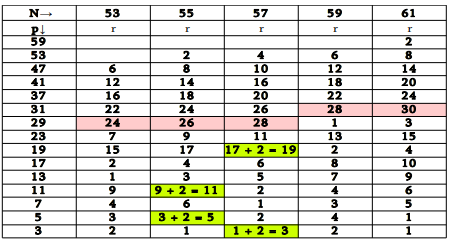
Table 1 : Remainders of Euclidean Divisions (Denoted r) of Sequential Odd Numbers.
Euclidean Divisions are Calculated N : p With the Remainders Denoted r. N= 53 : N = 55 ; N = 57 ; N =59 and N = 61.
Therefore Theorem 1 : « when two integers add up, their remainders of euclidean divisions by prime divisors add up to form the prime factors of the sum. If the sum is prime, no prime factors are produced ».
1- Goldbach's strong conjecture (GSC) results from the addition of the remainders of the Euclidean divisions
An even number E is a sum of two Composite numbers ; a composite (C) and prime numbers (P) ↔ E = C + C' ; E = C + P ; or a sum of two primes such that E = P + P'.
Table 2A: shows an example E = 100 such that E = 49 + 51 = C + C'. For example 49 : 5 = 9 and r1 =4 : and 51 : 5 = 10 with r2 = 1 and therefore rE = r1 + r2 = 4 + 1 = 5. Therefore, 100 is a multiple of 5.
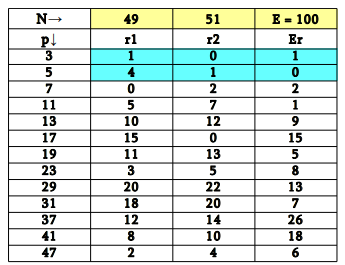
Table 2A : Remainders of Euclidean Divisions (denoted r) of Two Additive Odd Numbers. Euclidean Divisions are Calculated N: p With The Remainders Denoted r. Here E = C + C' Such That 100 = 49 + 51. N= 49 or N = 51.
Table 2B: shows an example E = 100 such that E = 33 + 67 = C + P. For example 33 : 5 = 6 and r1 =3 : and 67 : 5 = 13 with r2 = 2 and therefore Er = r1 + r2 = 3 + 2 = 5. Therefore, 100 is a multiple of 5.
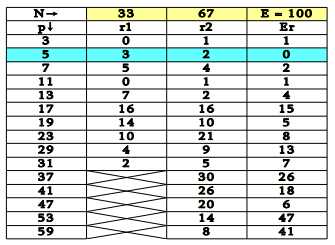
Table 2B: Remainders of Euclidean Divisions (Denoted r) of Two Additive Odd Numbers. Euclidean Divisions are Calculated N: p With the Remainders Denoted r. Here E = C + P Such That 100 = 33 + 67. N= 33 ; and N = 67
Table 2C: Shows an example E = 100 such that E = 47 + 53 = P + P' according to GSC. For example 47 : 5 = 9 and r1 =2 : and 53 : 5 = 10 with r2 = 3 and therefore Er = r1 + r2 = 2 + 3 = 5. Therefore, 100 is a multiple of 5. The addition of two primes numbers P and P' produce the prime factor of the even E if E = P + P'.
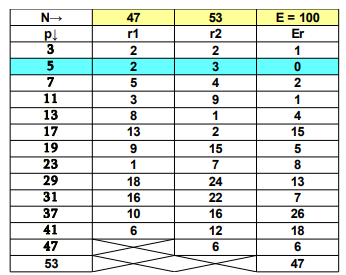
Table 2C : Remainders of Euclidean Divisions (Denoted r) of Two Additive Odd Numbers. Euclidean Divisions are Calculated N: p With the Remainders Denoted r. Here E = P + P' such that 100 = 47 + 53.
Let us take other examples such 78 = 61 + 17 ; we have 61 : 13 = 4 and r1 = 9 while 17 : 13 = 1 and r2 = 4 and r1 + r2 = 13 so that 78 = 6 x 13. Or 142 = 101 + 41 and we have 101 : 71 = 1 and r1 =30 ; and 41 : 71 = 0 and r = 41 so that r1 + r2 = 30 + 41 = 71 and 142 = 2 x 71.
Rules of Addition of Primes in GSC
If E = P1 + P2 and if E = s x t then P1 = as + r1 and P2 = bs + r2 such that r1 + r2 = s. Demonsttration E = P1 + P2 ↔ E = (as + r1) + (bs + r2) = (a +b)s + r1 + r2 = (a +b)s + s = (a + b + 1)s = st. The same applies for the other prime factor of E namely t.
If E = P1 + P2 and if E = s x t then P1 = at + r1 and P2 = bt + r2 such that r1 + r2 = t. Demonstration E = P1 + P2 ↔ E = (at + r1) + (bt + r2) = (a +b)t + r1 + r2 = (a +b)t + t = (a + b + 1)t = st. If E = P1 + P2 then one prime factor denoted s of E is the sum of the remainders of ED of P1 and P2 by s.
This is true for all prime factors of E taken separately. This is true for any even ≥ 8 such that E = P1 + P2 with P2 > P1 (the case P1 = P2 is excluded) and whatever the number of its prime factors. We use here the E = s x t (biprime) to provide a simple example but this is true whatever the number of prime factors.
A Prime Divisor p in an ED has p – 1 Possible Remainders
Any prime divisor p has p – 1 possible remainders. Therefore the equation f(x) = x – 1 gives all possible remainders of a prime divisor. For example p = 17 has 16 possible remainders and therefore ED N : 17 has 16 possible remainders (Table 3). The more a prime divisor is large the more remainders. Table 3 shows possible remainders for some sequential prime numbers. The graphic in Figure 1 shows the equation f(x) = x – 1. It is important to note that these remainders explain why a number is composite or prime.
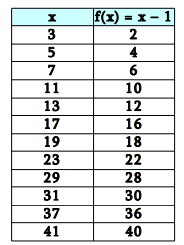
Table 3: Number of Possible Remainders for Some Sequential Primes. If we divide an Integer N by a Prime Divisor Denoted p, We have p – 1 Possible Remainders.
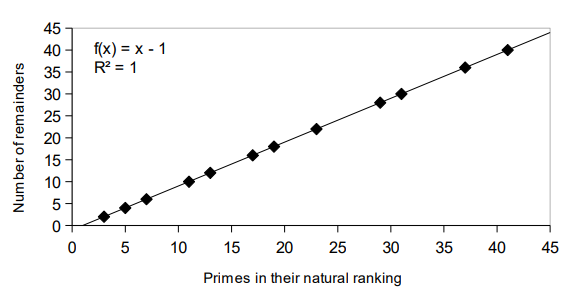
Figure 1: Euclidean Division of an Integer By a Prime Divisor (p) Produces p – 1 Possible Remainders so that f(x) = x – 1 Possible Remainder With x Being Any Prime Number > 2. If the Integer → +∞ then f(x) → +∞. ED : Euclidean Division. In f(x) = x – 1 ; x is any Prime Number p > 2.
Two Elementary Theorems That Demonstrate GSC and Set its Verification at Infinity Two Theorems with E any Even ≥ 8 and P2 > E/2 and P1 < E/2.
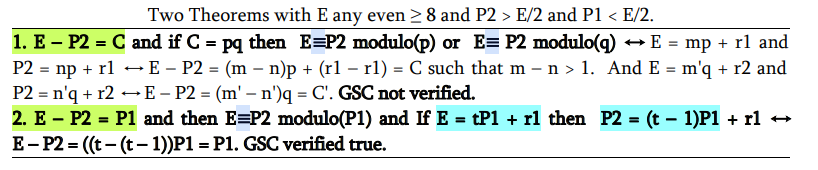
The method is as follows. For GSC to be true there must be two primes P2 and P1 such that E/2 – P1 = P2 – E/2 and P1 and P2 are said to be equidistant at E/2. We therefore determine primes P2 > E/2 and calculate E – P2. We have two cases E – P2 = P1 (prime) or E – P' = C (composite) (Table 4).
|
P2>E/2 |
200 – P2 |
|
101 |
99 |
|
103 |
97 |
|
107 |
93 |
|
109 |
91 |
|
113 |
87 |
|
127 |
73 |
|
131 |
69 |
|
137 |
63 |
|
139 |
61 |
|
149 |
51 |
|
151 |
49 |
|
157 |
43 |
|
163 |
37 |
|
167 |
33 |
|
173 |
27 |
|
179 |
21 |
|
181 |
19 |
|
191 |
9 |
|
193 |
7 |
|
197 |
3 |
|
199 |
1 |
Table 4: Be E an even ≥ 8 and E = P1 + P2 such that P1 < E/2 and P2 > E/2. We Calculate E – P2 and if E – P2 = P1 (GSC verified) and if E – P2 = C (GSC not verified). The Table Shows E = 200. E – P2 C are Highlighted. E – P2 = P1 or E – P2 = C Depend Upon the Two Theorems Cited Above.
Example of E – P2 = C. 200 – 109 = 91. We have 91 = 7 x 13. Then 200 : 7 = 28 and r = 4. We have
109 : 7 = 15 and r = 4 therefore 200 ≡ 109 modulo(7). Therefore 200 – 109 =
(28 x 7 + 4) – (15 x 7 + 4) = (28 – 15) x 7 = 13 x 7 = 91. This alway applies if E – P2 = C.
Example of E – P2 = P1. 200 – 157 = 43. We have 200 : 43 = 4 and r = 28. We have 157 : 43 = 3
and r = 28 therefore 200 ≡ 157 modulo(43). Therefore 200 – 157 = (4 x 43 + 28) – (3 x 43 + 28) = (4 - 3) x 43 = 43. This alway applies if E – P2 = P1.
Another example of E – P2 = P1. 200 – 193 = 7. We have 200 : 7 = 28 and r = 4. We have 193 : 7 = 27 and r = 4 therefore 200 ≡ 193 modulo(7). Therefore 200 – 193 = (7 x 28 + 4) – (7 x 27 + 4) = (28 - 27) x 7 = 7.
A final example 200 – 181 = 19. We have 200 : 19 = 10 and r = 10.
And 181 : 19 = 9 and r =10. 200 – 181 = (10 x 19 + 10) - ( 9 x 19 + 10) = (10 – 9) x 19 = 19. This alway applies if E – P2 = P1.

The Sum of The Gaps Between Primes is The Same at The Equidistant Primes P1 and P2 Such That E = P1 + P2 (E is any even ≥ 8)
Let's note with (e) a gap between two consecutive primes. We then sum the gaps before a given prime number. The method is as follows. We construct a table with one column reserved for numbers < E/2 including primes P1 < E/2 and another for those > E/2 including primes P2 > E/2. The numbers < E/2 are then arranged in ascending order and those > E/2 in descending order (Table 5). The gaps in the two columns are calculated. We see that the gaps cancel out at the equidistant primes P1 and P2 such that P1 + P2 = E. We start calculating gaps e at the first couple of equidistant primes and we will see that gaps are the same between two sequential couples of equidistant primes.
Equidistant primes P1 and P2 the sum of which make E are always located at the same gaps from the previous pair of equidistant primes. The additive gaps are highlighted by a same color. This means that there is a first pair of equidistant primes that occurs either around E/2 or between P1 close to 0 and P2 close to E (see also Figure 2).
|
e1 |
P1 |
P2 |
e2 |
|
|
1 |
95 |
|
|
|
2 |
94 |
|
|
0 |
3 |
93 |
|
|
|
4 |
92 |
|
|
2 |
5 |
91 |
|
|
|
6 |
90 |
|
|
4 |
7 |
89 |
6 |
|
|
8 |
88 |
|
|
|
9 |
87 |
|
|
|
10 |
86 |
|
|
2 |
11 |
85 |
|
|
|
12 |
84 |
|
|
4 |
13 |
83 |
4 |
|
|
14 |
82 |
|
|
|
15 |
81 |
|
|
|
16 |
80 |
|
|
2 |
17 |
79 |
6 |
|
|
18 |
78 |
|
|
4 |
19 |
77 |
|
|
|
20 |
76 |
|
|
|
21 |
75 |
|
|
|
22 |
74 |
|
|
6 |
23 |
73 |
2 |
|
|
24 |
72 |
|
|
|
25 |
71 |
4 |
|
|
26 |
70 |
|
|
|
27 |
69 |
|
|
|
28 |
68 |
|
|
2 |
29 |
67 |
6 |
|
|
30 |
66 |
|
|
6 |
31 |
65 |
|
|
|
32 |
64 |
|
|
|
33 |
63 |
|
|
|
34 |
62 |
|
|
|
35 |
61 |
2 |
|
|
36 |
60 |
|
|
4 |
37 |
59 |
6 |
|
|
38 |
58 |
|
|
|
39 |
57 |
|
|
|
40 |
56 |
|
|
2 |
41 |
55 |
|
|
|
42 |
54 |
|
|
0 |
43 |
53 |
0 |
|
|
44 |
52 |
|
|
|
45 |
51 |
|
|
|
46 |
50 |
|
|
|
47 |
49 |
|
|
|
48 |
48 |
|
|
38 |
|
|
36 |
|
|
13 P 1 |
8 P 2 |
|
Table 5: Be E an even ≥ 8 and E Can Be Sum of Two Primes Such That E = P1 + P2 with P1 < E/2 and P2 > E/2. Gaps Between Sequential Primes Including e1 < E/2 and e2 > E/2 are Shown.
The average gap < E/2 or > E/2 can then be calculated by dividing the total sum of the gaps by the total number of primes. Note that the fewer the primes, the greater the gap between primes. Table 5 provides a detailed example of E = 96 and E/2 = 48. For example at 7, the sum of gaps e = 6 including e = 11 – 7 = 4 and e = 13 – 11 = 2. Meanwhile at 89 the sum of e = 6 given that 89 – 83 = 6. Another example at 13 we have e = 4 because 17 – 13 = 4 and at 83 we have e = 4 with 83 – 79 = 4. At 17 we have e = 6 because 23 – 19 = 4 and 19 – 17 = 2 while at 79 we have e= 6 because 79 – 73 = 6 and so on.
In the case of E = 96 we have 13 primes P1 < E/2 = 48 and the total of gaps = 44 and so the average gap e is 44/13 ≈ 3.4 while for P2 > E/2 we have 36/8 ≈ 4.5. Lower gaps < E/2 suggest more primes < E/2 as already known. It's obvious that two equidistant primes P1 and P2 such that P1 + P2 = E are located at equal distance from the other equidistant primes, even if the distance between them is variable. However, the crucial fact is that the GSC is first verified by a very first pair of equidistant primes P1 and P2, and all other pairs follow from it by deductive calculation. This initial pair appears either between primes close to E and those close to 0; or those close to E/2 on both sides ( Figure 2). So the GSC is first verified by a pair of equidistant primes P1 and P2, which will subsequently produce all the others after variable gaps. We'll see later that this result is very important for testing the veracity of the GSC at infinity.
Let us see on example. Let us take E = 100 and E/2 = 50. The first pair of equidistant primes is a sum like 47 + 53 = 100 because 47 and 53 are the closest to E/2 = 50. Otherwise, E = 97 + 3 since 97 is the closest to E = 100 and 3 the closest to 0. Then knowing that all primes are 6x ± 1, we can deduce the other pairs using gaps e = 6 or any 2n gaps like for example E = (47 – 6) + (53 + 6) = 41 + 59 = (41 – 12) + ( 59 + 12) = 29 + 71 and so on. Or (97 – 8) + (3 + 8) = 89 + 11 (see Ref 1).
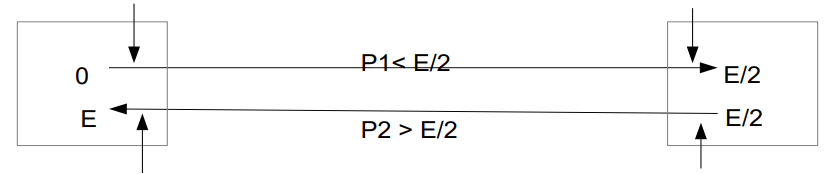
Figure 2: The first pair of equidistant primes P1 and P2 such that P1 + P2 = E should appear around E/2 or between the primes P1 close to 0 and those close to E (indicated by arrows within the rectangle). From this first pair result all the other pairs of equidistant primes. If there is no pair at this level, this means that composite numbers appear very quickly and will be numerous especially multiples of small primes like 3; 5; 7; 11 and 13 and others that are close to them.
New Empirical Method to Test GSC and Verify if it is True at Infinity
An Infinite Number of Sequences of Even Numbers That all Verify The GSC, and Which are Separated By The Same Gaps as Between Natural Primes
There's an infinitely true fact: “After a prime number always comes an even number except 2 and 3”. Let us take any prime like 19. We have 19 → +1 → 20. We'll add the known gaps between the primes to produce an infinite number of even numbers, all of which satisfy the GSC. Here we start with 1. We then have
19 → +1 → 20
19 → +1 → + 2 → 22 ↔ 22 = 3 + 19.
19 → +1 → + 4 → 26 ↔ 24 = 5 + 19.
19 → +1 → + 6 → 26 ↔ 26 = 7 + 19.
19 → +1 → + 10 → 30 ↔ 30 = 11 + 19.
19 → +1 → + 12 → 32 ↔ 32 = 13 + 19.
19 → +1 → + 16 → 36 ↔ 36 = 17 + 19.
19 → +1 → + 22 → 42 ↔ 42 = 23 + 19.
19 → +1 → + 28 → 48 ↔ 48 = 29 + 19.
19 → +1 → + 30 → 50 ↔ 50 = 31 + 19.
19 → +1 → + 36 → 56 ↔ 56 = 37 + 19.
19 → +1 → + 40 → 60 ↔ 60 = 41 + 19.
19 → +1 → + 12 → 30 ↔ 62 = 43 + 19
....to infinity. Note that all the evens produced satisfy GSC. We have the sequence of evens
20-22-24-26-30-32-36-42-48-50-56-60-62...+∞ that all share one common prime (19) to satisfy GSC and which are separated by the same gaps as prime numbers. One even satisfying GSC leads to an infinity of evens that satisfy GSC.
We take any other example and follow up to produce an infinite number of evens that satisfy GSC. For example
37 → +1 → 38
37→ +1 → + 6 → 44 ↔ 44 = 7 + 37.
37→ +1 → + 10 → 48 ↔ 48 = 11 + 37.
37→ +1 → + 12 → 50 ↔ 50 = 13 + 37.
37→ +1 → + 16 → 54 ↔ 54 = 17 + 37.
37→ +1 → + 18 → 56 ↔ 56 = 19 + 37.
...to infinity. Note that all the evens produced satisfying GSC. This time whe have the sequence 38-44-48-50-54-56. +∞ that all share one common prime (37) to satisfy GSC ad which are separated by the same as natural prime numbers of which they are sum.
Even if the even is away from the prime, we can still perform the same method.
83→ +5 → + 88
83→ +5 → + 2 → 90 ↔ 90 = 7 + 83.
83→ +5 → + 6 → 94 ↔ 94 = 11 + 83.
83→ +5 → + 8 → 96 ↔ 96 = 13 + 83.
83→ +5 → + 12 → 100 ↔ 100 = 17 + 83.
83→ +5 → + 14 → 102 ↔ 102 = 19 + 83.
83→ +5 → + 18 → 106 ↔ 106 = 23 + 83.
....to infinity. Note that all the evens produced satisfy GSC.
Here are two rules
The Even Placed after a Prime Number P1 leads to an Infinity of evens En = P1 + Pn that Satisfy GSC »
If one even denoted E satisfies Goldbach strong conjecture such that E = P1 + P2 ; then there exists an infinity of evens En = P1 + Pn sharing one common prime P1 with E that also satisfy GSC and which are separated from each other by the same gaps as natural prime numbers
Here is an example with an odd number and therefore we have to add to it odd values to get evens.
3→ +50 → 53
53→ +50 → + 9 → 112 ↔ 112 = 53 + 59.
53→ +50 → +11 → 114 ↔ 114 = 53 + 61.
53→ +50 → +17 → 114 ↔ 120 = 53 + 67.
53→ +50 → +21 → 124 ↔ 114 = 53 + 71.
53→ +50 → +23 → 126 ↔ 126 = 53 + 73.
53→ +50 → +29 → 132 ↔ 132 = 53 + 79.
53→ +50 → +33 → 136 ↔ 136 = 53 + 83.
53→ +50 → +29 → 126 ↔ 142 = 53 + 89.
53→ +50 → +47 → 150 ↔ 150 = 53 + 97.
53→ +50 → +51 → 154 ↔ 154 = 53 + 101.
...to infinity. Note that all the evens produced satisfy GSC

In fact, this sequential calculation can be performed with any even or odd number close or distant from a prime number. The latter will be a common term of the sums of two primes of an infinite number of even numbers. We see here that GSC is true to infinity because we have one even or odd number and a single prime number and we produce new evens by following the natural gaps between primes to infinity. We can go to the largest prime number known today and far beyond given that we all Know that primes are limitless and infinite.
When We Convert an Even Number E Into The Sum Of Two Primes P1 And P2, We Simply Follow The Natural Distances Between Primes
Here are some examples. Take an even number and put it in the form of addition of two odds numbers by starting with 1 and then follow the natural sequence of primes as below. Do not use the prime that is a prime factor of the even (example discard 5 for any even whose unit digit is 0 or 5). Prime factors of the tested evens below are crossed.
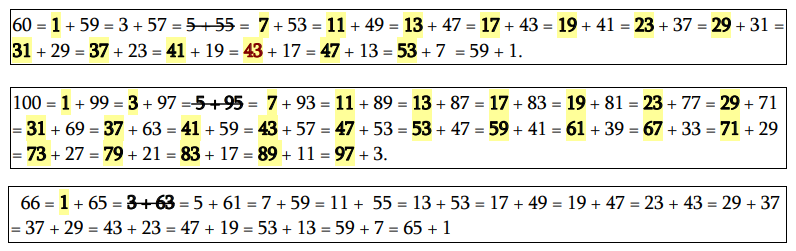
Note that in these three examples, the two terms of the sum follow the natural distances between prime numbers, but in the opposite direction. For example in the case of 60 we go from 1 to 59 and from 59 to 1 by following the natural gaps between primes. In the case of 100 we go from 1 to 97 and from 99 to 3. The first sequence is increasing and the second is symmetrically decreasing. While the first sequence contains only primes, the second can produce either a prime or a composite number. For example in the case of 66, we have the natural sequence of primes (P) in an increasing order which is 5-7-11-13-17-19-23-29-31-37- 43-47-53-59 ; and the opposite and symmetrical sequence of either prime (P) or composite (C) which is 61-59-55-53-49-47-43-37-29-23-19-13-7 with three composite numbers including 55 and 49. This latter sequence is going to be named X-sequence because we cannot know if we have a prime (P) or composite number (C) unless we verify it by calculation or factorization.
On the other hand, the opposite process can be done, as in the following example.
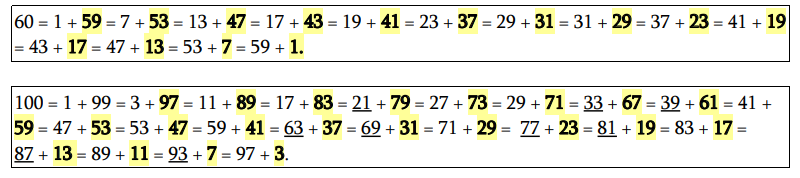
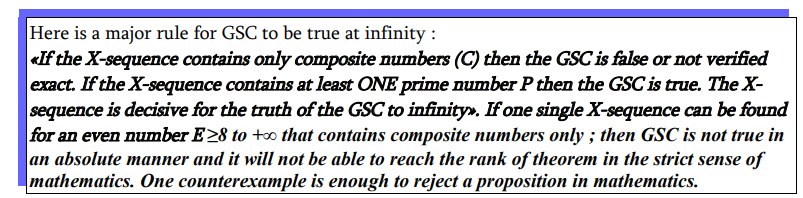
We can see that one sequence produces the primes in their natural order, and the other sequence only needs to produce ONE PRIME for the GSC to be true. This prime number must lie in the interval [1 — (E - 1)]. Would it be possible or probable for the variable X-sequence to produce composite numbers from the start to the end? This seems highly unlikely or almost impossible, especially for very large numbers, because if it were, this sequence of consecutive composite C would be a world and historical record. By following the natural gaps of prime numbers, we increase the chances of one or more primes appearing in the other term of the addition. This is truly a logical demonstration of GSC. The data show that GSC can be extended to infinity. If one of the term of the addition is a prime number in ascending or descending order according to the natural rank of known primes; the other term will undoubtedly produce at least one prime number, and only one is needed for the GSC to be proven true.
New Method To Test GSC To Infinity
The GSC can then be posed as follows. Let E be any even number ≥ 8 and convert it into the sum of two primes. Assume that E is large enough. We will then transform E into the sum of two sequences of which the first corresponds to the prime numbers in their natural order denoted P and the other variable denoted by X. E = P + X. Then we have :
E = 3 + X1 → E = 7 + X2 → E = 11 + X3 → E = 11 + X4 → E = 13 + X5 → E = 17 + X6 →
E = 19 + X7 →...E = Pn + Xn.
GSC is true if one X of the sequence X1-X2-X3-X4-X5-X6-X7-...Xn is prime. However, if the sequence X1-X2-X3-X4-X5-X6-X7-... Xn is only formed of composite odd numbers then GSC is false. Ley us recall that one single counterexample is enough to reject a conjecture. GSC means an even E = P1 + P2 and although P1 might be equal to P2, in this paper I only consider P2 > P1.
For example 100 = 1 + 99 = 3 + 97 = 11 + 89 = 17 + 83 = 21 + 79 = 27 + 73 = 29 + 71 = 33 + 67 = 39
+ 61 = 41 + 59 = 47 + 53 = 53 + 47 = 59 + 41 = 63 + 37 = 69 + 31 = 71 + 29 = 77 + 23 = 81 + 19 = 83
+ 17 = 87 + 13 = 89 + 11 = 93 + 7 = 97 + 3.
The X sequence is 3-11-17 -21-27-29-33-39-41-47-53-59-63-69-71-77-81-83-87-93-97 with composite odd numbers highlighted.
Now let's take the list of all known prime numbers we have and randomly choose a sequence of a few consecutive prime numbers. Here are some examples.
The sequence chosen starts with Pi = 91785240347 and ends with Pe = 91785240571. We then take the even E = Pe + 1. And then calculate E – P in a descending order. The results are shown in Table 6A. As said above we actually calculate E – P = X and then see the X sequence. Note that all primes here are > E/2 and if GSC is verified E – P will give a prime < E/2. Here E = Pe + 1 = 91785240571 = 91785240572. The X sequence is 33-63-85-169-183-195-199-211-225 with composite odd numbers highlighted. GSC is verified with two primes 199 and 211 in this interval. We can continue till primes close to E/2 or 91785240572/2 = 45892620286.

Table 6A: Testing GSC Anywhere in The Set of Integers By Taking The Even E Closest To One Prime and Performing E – P =X. X is Prime (GSC true); or X is C (composite) That Means GSC Not Verified.
Here is another example with E = 91785241088. We do the same E – P = X. The X sequence is 7-39-85-91-111-117-171-187-231 with composite odd numbers highlighted. GSC is verified here with only one prime which is 7. We can continue till primes close to E/2 or 91785241088/2 = 892620544 (Table 6B).

Table 6B: The Same Legends as in Table 4a Above.
Another example. E = 91785241322. We start with E - 91785241321 = 1. The X sequence is 9-63-109-141-153-171-175-213-231 (Table 6C) with composite odd numbers highlighted. GSC is verified here with only one prime which is 109. We can continue till primes close to E/2 or 91785241322/2 = 45892620661.

Table 6C: The Same Legends as in Table 4a Above
Let us now take more prime numbers like this :
|
41539 |
41543 |
41549 |
41579 |
41593 |
41597 |
41603 |
41609 |
41611 |
41617 |
|
41621 |
41627 |
41641 |
41647 |
41651 |
41659 |
41669 |
41681 |
41687 |
41719 |
|
41729 |
41737 |
41759 |
41761 |
41771 |
41777 |
41801 |
41809 |
41813 |
41843 |
|
41849 |
41851 |
41863 |
41879 |
41887 |
41893 |
|
|
|
|
We have E = 41894 and strat with E – Pe = E – 41893 = 1 till E – 41539. Here is the results in the table below (Table 6D) with odd composite numbers highlighted. GSC is verified with 6 primes (31 ; 43 ; 157 ;277 ; 283 ; and 373) while the other 30 numbers are composite. We have two sequences of 8 composites and one of 10 composites.
|
1 |
225 |
|
7 |
235 |
|
15 |
243 |
|
31 |
247 |
|
43 |
253 |
|
45 |
267 |
|
51 |
273 |
|
81 |
277 |
|
85 |
283 |
|
93 |
285 |
|
117 |
291 |
|
123 |
297 |
|
133 |
301 |
|
135 |
315 |
|
157 |
345 |
|
165 |
351 |
|
175 |
355 |
|
207 |
373 |
Table 6D: Calculation of E – P (Ps are shown in the list of primes above). E – P = C (composite) are highlighted. E – P = P are not highlighted and occurs in 6 cases. We see in this example that C sequence is more frequent and longer reaching to 10 C following each other
Conclusion
Let's assume an even number E that is one unit larger than to the largest prime number we know today (or that we could know in future). Let's call this prime number Py. Now we have [0—E/2—E] and therefore Py > E/2. For GSC to be true E must be sum of two primes P1 and P2 such that P1 < E/2 and P2 > E/2. Therefore we have to calculate E – P2 = X. If X is composite GSC is not verified; if X = P1 then GSC is verified. We then calculate E – P2 starting with Py and all P2 till the one which is the closest to E/2. The question is: are all the Xs resulting from calculated E – P2 = X composites? Is it possible that all Xs might be composites which means non- verification of GSC? Whoever answers this question or finds an X-sequence without a single prime number will be the blessed one who finally solves Goldbach's strong conjecture without any mathematician, even the most skeptical, being able to oppose any criticism to him.
Intuitively, we will say that this chain of composite numbers will have at least one prime link; but far away towards infinity, we can really be surprised and find one. It is not impossible [1-5].
By contrast, if only one X is prime, then GSC is true. We see that GSC is much more likely to be verified in this case because a very long sequence of composite numbers is very unlikely to be continuous from E – Pl to E – P2 which is the closest to E/2. In other words there is at least one P2 prime in [E/2—E] such that E – P2 = P1 → E = P1 + P2. The small primes are those that give the most composite numbers because their multiples are the most frequent but it is unlikely (unlikely does not mean impossible) that all P2 of [E/2—E] would give composite numbers when calculating E – P2. If anyone, using this procedure, is able to find a sequence of composite numbers E - P2 = X in the whole E/2 – E interval; then He will be the first one that find the solution to Goldbach's strong conjecture because this means its final rejection, and no mathematician can cast any doubt on his result. However, let us not forget that if only one X is prime, then GSC is true. As long as we cannot find this very precious and historical counterexample of an uninterrupted sequence of composite numbers by E – P2 = X (P2 is in E/2-E interval); Goldbach's strong conjecture will remain true although unprovable. This article gives the TWO THEOREMS of CONGRUENCE-MODULO which always predetermine whether GSC is true or not when calculating E - P2 = X (see above). These two theorems described in this article will predict whether X is prime or composite. Nevertheless, these two theorems require the use of Euclidean divisions with the calculation of the remainders for each P2 (See Figure 3).
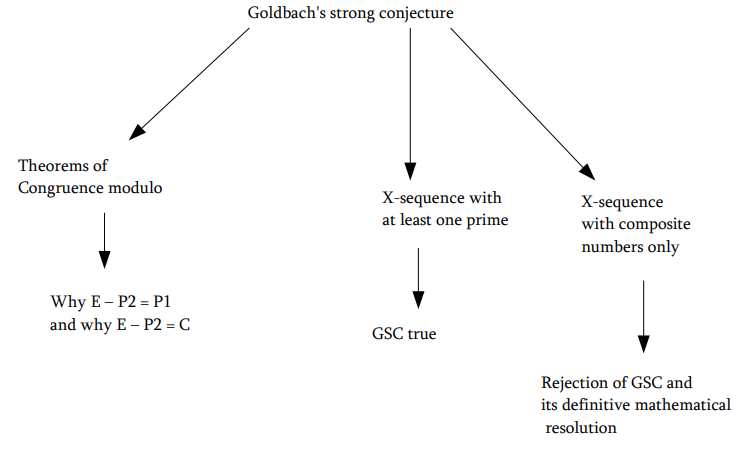
Figure 3: Connecting the dots for the understanding of the Goldbach's strong conjecture
References
- Bahbouhi., B. (2025). Proving Goldbach's Strong Conjecture by Analyzing Gaps Between Prime Numbers and their Digits. J Math Techniques Comput Math, 4(1), 01-18.
- Bahbouhi, B. (2025). New Mathematical Rules and Methods for the Strong Conjecture of Goldbach to be Verified. J Robot Auto Res, 6(1), 01-36.
- Bahbouhi, B. (2025). How to Pose the Mathematical Problem of the Goldbach's Strong Conjecture? A New Idea for a New Solution.J Robot Auto Res, 6(1), 01-03.
- Bahbouhi, B. (2025). Demonstrating Goldbach's Strong Conjecture by Deduction using 4x ± 1 Equations in Loops and Gaps of 4.J Robot Auto Res, 6(1), 01-10.
- Bahbouhi, B. (2025). Verification of Goldbach's Strong and Weak Conjectures at Infinity Using Basic and Accessible Mathematics.J Robot Auto Res, 6(1), 01-11.