

Journal of Mathematical Techniques and Computational Mathematics(JMTCM)
ISSN: 2834-7706 | DOI: 10.33140/JMTCM
Impact Factor: 1.3

Research Article - (2025) Volume 4, Issue 4
Two New Methods Based on 6x ± 1 equations To Break all Types of Evens in Sum of Two Primes
Received Date: Mar 25, 2025 / Accepted Date: Apr 21, 2025 / Published Date: Apr 28, 2025
Copyright: ©©2025 Bouchaib Bahbouhi. This is an open-access article distributed under the terms of the Creative Commons Attribution License, which permits unrestricted use, distribution, and reproduction in any medium, provided the original author and source are credited.
Citation: Bahbouhi., B. (2025). Two New Methods Based on 6x
Abstract
This article presents two methods A and B for breaking an even number into two primes. Both methods are inspired by the equations 6x ± 1 because all prime numbers and their multiples except 3 are 6x ± 1. Both methods can be very useful for even conversion in sums of two primes or to study the Goldbach's strong conjecture. Both methods can have applications in computer science.
Keywords
Method, Prime, Composite, Goldbach's strong conjecture, Congruence, Modulo, Sum of Two Primes.
Abbreviations
GSC : Goldbach's strong conjecture. P : prime. C : composite
Introduction
I have recently reported in several papers that Goldbach's strong conjecture (GSC) depends on the presence of two equidistant primes p and q such that p < S/2 and q > S/2 and such that S/2 – p = q – S/2 therefore S = p + q [1,6]. In addition I have shown that GSC depends closely on the gaps between primes especially gaps = 6 or 4 [1,5]. I have also shown that GSC might hold true to infinity [4].
In the present paper, I give a detailed description of two methods (A and B) to convert an even number into two primes according to GSC. Both of these methods are based on the equations 6x ± 1. Actually, there are three types of even numbers 6X; 6X - 2 and 6X + 2 whose conversion into sum of two prime numbers depends on the equations 6x ± 1 given that 6X = (6x – 1) + (6x' + 1) ; 6X – 2 = (6x – 1) + (6x' – 1) and 6X + 2 = (6x + 1) + (6x' + 1).
Results
|
Method A |
|
|
I. Even S = 6X |
|
|
|
S = p + c or S = p + c' such that c = np or c' = n'p. |
Example 180.
180 = 6 x 30 therefore 180 is 6X. S/2 = 90.
Tables 1 show 6x – 1 and 6x + 1 numbers < 90 and > 90 but < 180.
|
|
|
|
|
|
|
|
|
|
|
O6-- |
O6++ |
O6-+ |
O6+- |
|||
|
|
11 |
97 |
7 |
101 |
|||
|
|
17 |
103 |
|||||
|
13 |
107 |
||||||
|
|
23 |
109 |
|||||
|
19 |
113 |
||||||
|
|
29 |
121 |
|||||
|
|
41 |
127 |
31 |
119 |
|||
|
|
47 |
133 |
37 |
131 |
|||
|
|
53 |
139 |
43 |
137 |
|||
|
|
59 |
151 |
49 |
143 |
|||
|
|
71 |
157 |
61 |
149 |
|||
|
|
77 |
163 |
67 |
161 |
|||
|
|
83 |
169 |
73 |
167 |
|||
|
|
89 |
|
79 |
173 |
|||
Tables 1: Selection by the 6x ± 1 equation of odd numbers < S = 180 and either < S/2 = 90 or > S/2
Tables 2 show the next step which is selection of 6x – 1 and 6x + 1 numbers by their Unit digits. Only primes with right unit digits are involved in sum S. Prime numbers p < S/2 and q > S/2 such that S = p + q are selected (Tables 3). Results are confirmed by the calculation of congruence modulo (p) to explain why S = p + q in some cases and why S = p + c (c composite) in the other cases. Table 3 shows the final conversion of S = 180 in sums of two primes.
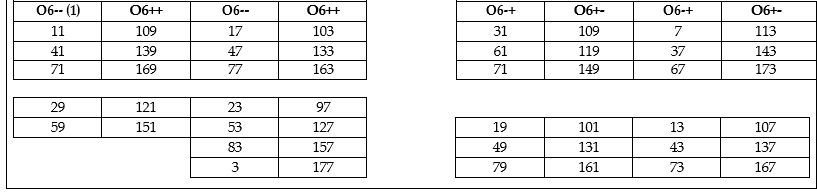
Table 2: Selection by Unit digits of odd Numbers < S = 180 and either < S/2 = 90 or > S/2. Let us Note odd Numbers < 180 such XN with N their unit digit. Then 180 = XN1 + XN2 Such that XN1 < S/2 and XN2 > S/2. We have 180 = X1 + X9 or 180 = X9 + X1 ; and 180 = X3 +X7 or 180 = X7 + X3. Indeed 0 (unit digit) = 1 + 9 or 0 (unit digit) = 3 + 7
|
p |
q |
|
3 |
177 |
|
7 |
173 |
|
13 |
167 |
|
17 |
163 |
|
19 |
161 |
|
23 |
157 |
|
29 |
151 |
|
31 |
149 |
|
41 |
139 |
|
43 |
137 |
|
71 |
269 |
|
53 |
127 |
|
67 |
113 |
|
71 |
109 |
|
73 |
107 |
|
79 |
101 |
|
83 |
97 |
Table 3: S = p + q Such That p and q are Primes with p< S/2 and q > S/2 (S = 180 ad S/2 = 90). The Method Gives all Possible Sums
Calculation of Congruence
• 180 = c + q = 131 + 49 → 180 ≡ 131 mod (7) → 180 – 131 = 7n and → 180 – 131 = 7 x 7 = 49. 180 – 131 = X → 180 = (7 x 25) + 5 and 131 = (7 x 18) + 5 → 25 – 18 = 7 > 1 → X is composite = 7n = 49 (composite).
• 180 = c + q = 77 + 103. 180 ≡ 103 mod (7) and 180 ≡ 103 mod (11) → 180 – 103 = (7 x 11)n → 180 – 103 = 7 x 11 = 77 (composite).
• 180 = p + q = 83 + 97 → 180 ≡ 97 mod (83) → 180 = (83 x 2) + 14 and 97 = (83 x 1) + 14. 180 – 97 = X and so X = (2 x 83) + 14 – (1 x 83) + 14 → 2 – 1 = 1 → X = p = 83 (prime). Given that 180≈97 mod (p ≠ 83), 83 is prime (p ≠ 83 means any p different from 83).
• 180 = p + q = 19 + 161 . 180 ≡ 161 mod (19) → 180 = (9 x 19) + 9 and 161 = (8 x 19) + 9. 180 – 161 = X and so X = (9 x 19) + 9 - (8 x 19) + 9. → 9 – 9 = 1 → X = p = 19 (prime). Given that 180 ≈ 161 mod (p ≠ 19), 19 is prime (p ≠ 19 means any p different from 19).
II. Even S = 6X – 2 1.
Be S = 6X – 2.
(6X – 2) – (6x + 1) = 6X – 3 = 3N. (6X – 2) – (6x – 1) = 6X – 1.
Determine π (S/2) with p < S/2. Calculate S – p. Either S – p = 3N or S – p = 6X – 1. Then, remove all 3N. Note S – p = 6X – 1 leads to either primes or composites ≠3N. S – p allows us to search for prime numbers p and q such that p + q = S.
Example S = 154 (Table 4). Note 154 is 6X + 4 and 6X + 4 = 6X – 2.
Either 154 = 150(6X) + 4 = (6 x 25) + 4 ; or 154 = 156 (6X) – 2 = (6 x 26) – 2.
π (154/2) = π (77) = {3 ; 5 ; 7 ; 11 ; 13 ; 17 ; 19 ; 23 ; 29 ; 31 ; 37 ; 41 ; 43 ; 47 ; 53 ; 59 ; 61 ; 67 ;
71 ; 73}.
|
π (154/2) |
154 – p = Xn |
Xn |
|
|||
|
3 |
151 |
X |
||||
|
5 |
149 |
X |
||||
|
7 |
147 |
3N |
||||
|
11 |
143 |
X |
||||
|
13 |
141 |
3N |
|
S = p + q |
|
|
|
17 |
137 |
X |
P < S/2 |
> S/2 |
||
|
19 |
135 |
3N |
||||
|
23 |
131 |
X |
3 |
151 |
||
|
29 |
125 |
|
5 |
149 |
||
|
31 |
123 |
3N |
11 |
143 |
||
|
37 |
117 |
3N |
||||
|
41 |
113 |
X |
17 |
137 |
||
|
43 |
111 |
3N |
23 |
131 |
||
|
47 |
107 |
X |
||||
|
41 |
113 |
|||||
|
53 |
101 |
X |
||||
|
59 |
95 |
5N |
47 |
107 |
||
|
61 |
93 |
3N |
53 |
101 |
||
|
67 |
87 |
3N |
||||
|
71 |
83 |
X |
71 |
83 |
||
|
73 |
81 |
3N |
|
|
||
Table 4: Search for primes by S – p (p < S) ( S = 154 ; S/2 = 77). X in the right column means P or C
Calculation of congruence
• 154 = 3 + 151 ; 154≡151 mod (3) → 154 = (3 x 51) + 1 and 151 = (3 x 50) + 11 → 51 –50 = 1 → Given that 154≈151 mod (p > 3) 151 is prime.
• 154 = 11 + 143. Give that 154 and 143 share two common factors 11 and 13, 143 is not prime.
• 154 = 17 + 137. 154≡137 mod (17) → 154 = (9 x 17) + 1 and 137 = (8 x 17) + 1 → 9 – 8 = 1 → Given that 154≈151 mod (p ≠ 17) 137 is prime.
• And so on.
Finally, S = 154 is broken 8 times in sum of two primes (Table 5). Note that this method gives all possible sums of p + q for any even S ≥ 8 with q > p or S ≥ 4 if q ≥ p.
|
S = p + q |
|
|
P |
q > S/2 |
|
3 |
151 |
|
5 |
149 |
|
17 |
137 |
|
23 |
131 |
|
41 |
113 |
|
47 |
107 |
|
53 |
101 |
|
71 |
83 |
Table 5: Final conversion S = p + q for S = 154
• Note Units digits are ignored with S = 6X – 2 numbers because we calculate S – p = X such that p and X have the right unit digits.
III. Even S = 6X + 2.
2. Be S = 6X+ 2.
(6X + 2) – (6x – 1) = 6X + 3 = 3N. (6X + 2) – (6x + 1) = 6X + 1 Determine π (S/2) with p < S/2. Calculate S – p. Either S – p = 3N or S – p = 6X + 1. Then, remove all 3N (Table 6). S – p = 6X + 1 with 6X + 1 prime or composite (C).
|
Π (98/2) |
98 – p |
Xn |
|
3 |
95 |
5N |
|
5 |
93 |
3N |
|
7 |
91 |
X |
|
11 |
87 |
3N |
|
13 |
85 |
5N |
|
17 |
81 |
3N |
|
19 |
79 |
X |
|
23 |
75 |
3N |
|
29 |
69 |
3N |
|
31 |
67 |
X |
|
37 |
61 |
X |
|
41 |
57 |
3N |
|
43 |
55 |
5N |
|
47 |
51 |
3N |
Table 6: Example 98. Calculation of 98 – p with p < 98/2 = 49. Numbers 3N or 5N are shown. The Numbers 5N are Recognized by their unit Digit = 5
Calculation of Congruence
• 98 = 7 + 91 to exclude because 91 and 98 sharing one common factor.
• Note prime factors of S can be excluded since the begining as aforementionned.
• Conversion S = p + q for S = 98 are therefore 98 = 19 + 79 ; 98 = 31 + 67 and 98 = 37 + 61. The method gives all possible sums.

IV. Algorithm Based on a Postulate Analogous To Goldbach's Strong Conjecture (GSC)
1. Proposition A: « All primes p and q are equidistant and symmetrical at an integer n = p +q/2 except 2 and 3 ». Therefore p + q = 2n. This is true because any sum of two odds is even. If you add together the primes p and q, you always get an even number S ≥ 4 and the two primes are equidistant at S/2.
2. Proposition B: « Any even number can be broken down into the sum of two primes ». Even if any even number can be the sum of any two odd numbers (Proposition A), we can't deduce from this that any even number ≥ 4 is the sum of two primes. Even if the addition of two known primes always produces an even number, we can't deduce from this that an even number can be broken into the sum of two primes. Hence breaking any even number ≥ 4 into the sum of two primes cannot be true until it has been demonstrated. Till now, this proposition known as GSC is not mathematically solved.
3. Proposition C: « A proposition is true until proven false by a counterexample or mathematical demonstration «. We can then assume that for any natural number n ≥ 4 there exists a value t such that t < n and such that n - t and n + t are both primes.
Let p = n - t and q = n + t and thus 2n = p + q. This proposition is analogous to the GSC. It can be applied to break an even number into the sum of two primes until a counterexample is found. Note here q ≥ p. GSC means an even S can be broken down to two primes p and q such that S = p + q and such that p < S/2 and q > S/2.
IVa. Even S = 6X.
To break an even 6X in two primes we calculate n = 6X/2 and then n – t and n + t. Because 6X – (6x – 1) = 6X + 1 ; and 6X – (6X + 1)= 6X – 1 ; t = 6x – 1 or t = 6x + 1. Let us pose n = S/2 and then we calculate S/2 – (6x – 1) and S/2 + (6x – 1) ; or S/2 – (6x + 1) and S/2 + (6x + 1).
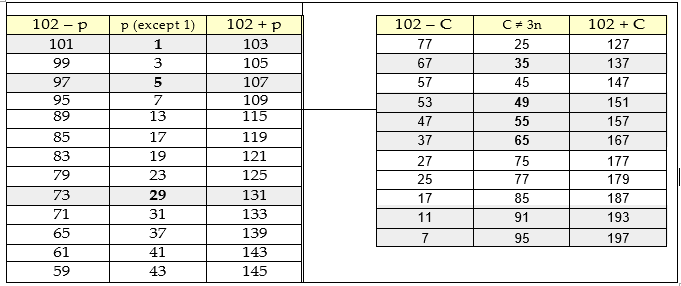
Example S = 204 and S/2 = 102. We first calculate 102 – p such that p < 102 (we add 1 although not prime). Then we calculate 102 – C with C a composite odd number ≠ 3n (Table 7). Both p and C are 6x ± 1
|
55 |
47 |
149 |
|
49 |
53 |
155 |
|
43 |
59 |
161 |
|
41 |
61 |
163 |
|
35 |
67 |
169 |
|
31 |
71 |
173 |
|
29 |
73 |
175 |
|
23 |
79 |
181 |
|
19 |
83 |
185 |
|
13 |
89 |
191 |
|
5 |
97 |
199 |
|
1 |
101 |
203 |
Table 7: Search for primes by S/2 – p (p primes < S/2) and S/2 – C (composites). Example S = 204 and S/2 = 102. Primes p and q are highlighted
Table 8 shows how 204 can be broken 14 times in two primes. This method gives all possible sums p + q.
|
|
|
5+199 |
|
7+197 |
|
11+193 |
|
13+191 |
|
23+181 |
|
31+173 |
|
37+167 |
|
41+163 |
|
47+157 |
|
53+151 |
|
67+137 |
|
73+131 |
|
97+107 |
Tables 8: S = p + q. S = 204
IVb Even S = 6X + 2 and S/2 = 6X - 2
(6X – 2) – (6x + 1) = 6X – 3 = 3N. And (6X – 2) + (6x + 1) = 6X – 1.
(6X – 2) – (6x – 1) = 6X – 1. And (6X – 2) + (6x – 1) = 6X – 3 = 3N.
For n = S/2 = 6x – 2, we can't use the (n – t) and (n + t) methods such as (t = 6x - 1) or (t = 6x + 1) because we'll always have a 3N and therefore never S = p + q.
As shown below (Tables 9 + 10 ; n = S/2 = 124) using numbers t = 6x – 1 or t = 6x + 1 we always get 3N numbers and therefore cannot break S = 248 in two primes. Numbers 6x – 1 can be obtained by 5 + 6n equation while the 6x + 1 ones by 7 + 6n (n ≥ 0).
Example S = 248. 248 = (6 x 41) + 2 ; and 124 = (6 x 20) + 4 → 248 is 6x + 2 and 248/2 = 124 is 6x + 4 or 6x – 2. We then calculate n – t and n + t such that n = S/2 = 124 and t = 6x – 1 numbers (Table 9).
|
124 – t |
t = 6x – 1 |
124 + t |
|
119 |
5 |
129 |
|
113 |
11 |
135 |
|
107 |
17 |
141 |
|
101 |
23 |
147 |
|
95 |
29 |
153 |
|
89 |
35 |
159 |
|
83 |
41 |
165 |
|
77 |
47 |
171 |
|
71 |
53 |
177 |
|
65 |
59 |
183 |
|
59 |
65 |
189 |
|
53 |
71 |
195 |
|
47 |
77 |
201 |
|
41 |
83 |
207 |
|
35 |
89 |
213 |
|
29 |
95 |
219 |
|
23 |
101 |
225 |
|
17 |
107 |
231 |
|
11 |
113 |
237 |
|
5 |
119 |
243 |
Table 9: S = 248. We calculate n – t and n + t such that n = S/2 = 124 and t = 6x – 1. The 6x – 1 numbers are obtained by 5 + 6n equation. We have no case S = p + q. Note 3N numbers present on each line
We then calculate n – t and n + t such that n = S/2 = 124 and t = 6x + 1 numbers. We get the same results as with t = 6x – 1 due to constant presence of the 3Ns, which prevents us from breaking the number into two primes (see below). Note 6x + 1 odd numbers are obtained with 7 + 6n equation (Table 10).
|
124 – t |
t = 6x + 1 |
124 + t |
|
117 |
7 |
131 |
|
111 |
13 |
137 |
|
105 |
19 |
143 |
|
99 |
25 |
149 |
|
93 |
31 |
155 |
|
87 |
37 |
161 |
|
81 |
43 |
167 |
|
75 |
49 |
173 |
|
69 |
55 |
179 |
|
63 |
61 |
185 |
|
57 |
67 |
191 |
|
51 |
73 |
197 |
|
45 |
79 |
203 |
|
39 |
85 |
209 |
|
33 |
91 |
215 |
|
27 |
97 |
221 |
|
21 |
103 |
227 |
|
15 |
109 |
233 |
|
9 |
115 |
239 |
|
3 |
121 |
241 |
Table 10 : Example S = 248. We calculate n – t and n + t such that n = S/2 = 124 and t = 6x + 1 numbers obtained by 7 + 6n equation. We have no case S = p + q. Note 3N numbers present on each line
While by contrast, we can use the odd-numbers which are multiples of 3 noted here as O3N, which are in order 3; 9; 15; 21; 27; 33. O3N. We then set t= O3N and calculate n – O3N and n + O3N for S = 248 and S/2 = 124. The O3N allows us to break 248 in two primes as shown below (Table 11).
|
124 - O3N |
O3N |
124 + O3N |
|
121 |
3 |
127 |
|
115 |
9 |
133 |
|
109 |
15 |
139 |
|
103 |
21 |
145 |
|
97 |
27 |
151 |
|
91 |
33 |
157 |
|
85 |
39 |
163 |
|
79 |
45 |
169 |
|
73 |
51 |
175 |
|
67 |
57 |
181 |
|
61 |
63 |
187 |
|
55 |
69 |
193 |
|
49 |
75 |
199 |
|
43 |
81 |
205 |
|
37 |
87 |
211 |
|
31 |
93 |
217 |
|
25 |
99 |
223 |
|
19 |
105 |
229 |
|
13 |
111 |
235 |
|
7 |
117 |
241 |
Table 11: Breaking an even number S = 248 ; S/ 2 = 124 which is 6X – 2 in two primes by calculating S/2 – t and S/2 + t such that t = O3N (note n = S/2). Primes p and q are highlighted
The number is therefore broken 6 times in two primes as below ( Table 12). The method gives all possible sums.
|
S = p + q |
|
7+241 |
|
19+229 |
|
37+211 |
|
67+181 |
|
97+151 |
|
109+139 |
Table 12: S = p + q with S = 248
IVc Even S = 6X - 2 and S/2 = 6X + 2
The even S = 196 and S/2 = 98.
196 = (6 x 32) + 4 is 6X - 2 whereas 98 = (6 x 16) + 2 therefore 6X + 2.
(6X + 2) – (6x – 1) = 6X + 3 = 3N. And (6X + 2) + (6x – 1) = 6X + 1
(6X + 2) – (6x + 1) = 6X + 1. And (6X + 2) + (6x + 1) = 6X + 3 = 3N. Therefore we cannot use n – t ad n + t such that t = 6x – 1 neither t = 6x + 1 because as seen with the previous case ; there will always be 3N numbers that prevents us from breaking the even S in sum of two primes. We only use O3N this time. We then break the numbers in two primes (Table 13).
|
98 – t |
t = O3N |
98 + t |
|
95 |
3 |
101 |
|
89 |
9 |
97 |
|
83 |
15 |
113 |
|
77 |
21 |
119 |
|
71 |
27 |
125 |
|
65 |
33 |
131 |
|
59 |
39 |
137 |
|
53 |
45 |
143 |
|
47 |
51 |
149 |
|
41 |
57 |
155 |
|
35 |
63 |
161 |
|
29 |
69 |
167 |
|
23 |
75 |
173 |
|
17 |
81 |
179 |
|
11 |
87 |
185 |
|
5 |
93 |
191 |
|
3 |
95 |
193 |
Table13: Search For Primes By n - t and n + t with n = S/2 and t = O3N. Note 95 is not 03N (the last line of the table 95 = 5 x 19) But It Is Required To Check If The Number S = 3 + q. Note that 6X + 2 and 6X – 2 even Numbers Might have 3 as an Additive Prime On The Contrary To Even 6x
|
S = p + q |
|
3+193 |
|
5+191 |
|
17+179 |
|
23+173 |
|
29+167 |
|
47+149 |
|
59+137 |
|
83+113 |
|
89+107 |
Table 14: The number 196 (S/2 = 98) Can Therefore Be Broken 9 Times In Two Primes
Table 14 shows all possible conversions in sums of two primes of S = 196.
Conclusion
This article presents two methods for breaking an even number into two primes. Both methods are inspired by the equations 6x ± 1 because all prime numbers and their multiples except 2 and 3 are 6x ± 1. Method A finds prime numbers p and q with the correct unit digits to form the even number S = p + q. Congruence rules confirm or explain why S - p = q or S - p = c (composite).
Method B is based on proposition C which, explained differently, suggests that prime numbers are always formed in pairs from an integer n ≥ 4. A prime number never appears alone but together with another one and both of them are symmetrical and equidistant to the integer n from which they come. In an interval |[0â?¬ n â?¬ 2n] where we would then have at least one value t such that t < n and such that p = n - t and q = n + t are primes and 2n = p + q. The value t differs depending on whether the even number S is 6X; 6X - 2; 6X +2. Method B shows that for 6X ; t = 6x - 1 or t = 6x + 2. Whereas it is necessary that t = 03N (multiple of 3 that are odds) to obtain pairs of prime numbers (p; q) such that S = p + q frm evens which are 6X – 2, or 6X + 2.
Both methods are not only useful to break evens in two primes but can help investigating the Goldbach's strong conjecture (GSC). There is a very common confusion to avoid, which is that even if prime numbers added together always give an even number; this does not mean at all that any even number can be broken into two prime numbers. To break an even number into two prime numbers, a method is required that can be simple or very complex. To prove the GSC, it is necessary to demonstrate by a theorem that an integer n ≥4 always produces two prime numbers p and q such that p = n - t and q = n + t (t < n). Such a theorem still does not exist. For the time being; it can only be achieved using simple or complex methods or algorithms. Both methods here are simple and accessible and could generate new algorithms of even conversion in sums of two primes.
Finally, this article defends the idea that prime numbers are formed in pairs from the same integer n ≥ 4. For the moment, only methods and congruence rules can help us achieve this, but is this fact demonstrable? Can it obey a theorem that also solves the GSC? Time will tell.
References
- Bahbouhi, B. (2025). Demonstrating Goldbach's Strong Conjecture by Deduction using 4x ± 1 Equations in Loops and Gaps of 4. J Robot Auto Res, 6(1), 01-10.
- Bahbouhi, B. (2025). How to Pose the Mathematical Problem of the Goldbach's Strong Conjecture? A New Idea for a New Solution. J Robot Auto Res, 6(1), 01-03.
- Bahbouhi, B. (2025). New Mathematical Rules and Methods for the Strong Conjecture of Goldbach to be Verified. J Robot Auto Res, 6(1), 01-36.
- Bahbouhi, B. (2025). Verification of Goldbach's Strong and Weak Conjectures at Infinity Using Basic and Accessible Mathematics. J Robot Auto Res, 6(1), 01-11.
- Bahbouhi., B. (2025). Proving Goldbach's Strong Conjecture by Analyzing Gaps Between Prime Numbers and their Digits. J Math Techniques Comput Math, 4(1), 01-18.
- Bouchaib, B. (2025). Natural Equidistant Primes (NEEP) and Cryptographic Coding of the Goldbach's Strong Conjecture. J Curr Trends Comp Sci Res, 4(1), 01-09.