

Advances in Theoretical & Computational Physics(ATCP)
ISSN: 2639-0108 | DOI: 10.33140/ATCP

Research Article - (2026) Volume 9, Issue 1
Three Time-Spaces in Universe According The Theory of New Axioms and Laws
Received Date: Jan 22, 2026 / Accepted Date: Feb 19, 2026 / Published Date: Mar 09, 2026
Copyright: ©2026 Valentina Markova. This is an open-access article distributed under the terms of the Creative Commons Attribution License, which permits unrestricted use, distribution, and reproduction in any medium, provided the original author and source are credited.
Citation: Markova, V. (2026). Three Time-Spaces in Universe According the Theory of New Axioms and Laws. Adv Theo Comp Phy, 9(1), 01-10.
Abstract
The author of the Theory of New Axioms and Laws analyzes all possible motions in space-time, which are described by open non-uniform vortices. As a result of this long process, the author describes 3 complex motions. They form three Times-Spaces with corresponding parameters: An open non-uniform transverse vortex that can be accelerating or decelerating, outside-in or inside-out. Thus, they can form there a group of two mutual orthogonal uneven transverse accelerating - decelerating or decelerating-accelerating vortex. They can are packed into an accelerating-decelerating or decelerating-accelerating, mutual orthogonal transverse pairs.
When pulsating in time (in the collapse phase), the transverse vortex emits an open transverse wave. All points of the transverse wave move with the same time or the transverse wave moves with constant time: T=const. Man lives and thinks in this real Time-Space form. An open non-uniform longitudinal vortex can be accelerating or retarding. The accelerating longitudinal vortex sucks in accelerating primary vortices from outward -in, but decelerating longitudinal vortex emits decelerating primary vortices from inward-out, Because the primary vortices are sucked from outside- towards the main accelerating longitudinal vortex, when there are group of accelerating longitudinal vortices, the longitudinal vortices are packed into an accelerating Funnel.
Because the primary vortices are emitted from inside-outwards by the main decelerating longitudinal vortex, when there are group of decelerating longitudinal vortices, the longitudinal vortices are packed into an decelerating Funnel. The spiral contracts by increasing its radius and the number of turns and stretches by decreasing its radius and the number of turns. Thus, all spirals pulsate like one and the same spring. Therefore, all spirals have equal length between each other: S=const. This forms the of Gravity Time-Space, Gravity forces and structures.
A Standing wave that form cells between their two opposite phases. When the standing wave is in phase of increasing, the primary transverse vortices between the two opposite phases are emitted When the standing wave is in phase of decreasing, the primary transverse vortices between the two opposite phases are sucked in. The decelerating primary vortices generate perpendicular longitudinal accelerating primary vortices from inward -out but the accelerating primary vortices generate perpendicular longitudinal accelerating primary vortices from outward -in .These pairs (inward-out and outward - in) form circles in 2D or volumetric spheres in 3D inserting one into an others .These numerous pulsating in Time spheres push and accelerate the initial impulse more and more and it reaches a speed of enormous speed. final velocity is maximum and limit: V=const. This is Time-Space of Information in the Universe formed by filaments and Neural structures.
Transverse Vortices Formed Time-Space Where Live Man
I. Law1
This variant is only for open decelerating outward-inward transverse vortex.
Law 1 for 2D (for electron in 2D): An open decelerating transverse vortex directed from outward to in (-E 2D) pulsates in Time in a mode of maximal negative acceleration inward it collapses inward and emits an open transverse wave outward:
Vor (-E2D) => [Transverse Wave],
Where Vor (means an open unevenly vortex), (-E2D) is tangent vector to Vor (Figure1c).
Definition: A decelerating transverse vortex is a transverse open vortex with amplitude of tangent vector (E2D) for which: div {Vor (–E2D)} < 0, [ 1].
The orthogonal variant for accelerating outward vortex (not described here) is quite opposite.
This variant of Law1 shows in 2D the model of electron as the decelerating inward vortex [2].
Result: The decelerating inward vortex is a model of electron in 2D.
The electron pulsates in Time in two phases -it is shrunk or expanded.
Result: When the electron is in a phase with maximal negative acceleration, the radius of the electron becomes minimal and then a transverse open wave is emitted outward. When the electron is in opposite phase: with positive acceleration, the radius of the electron expands and then a transverse open wave is sucked inward from pulsating proton [3,4].
II. Law3
a) Nonparametric Description: It exists nonparametric description of the open uneven vortex which consists V and W. The nonparametric process is due to redistribution of acceleration of the transverse vortex (from Amplitude W) to longitudinal vortices (to Velocity V) or in inverse direction. There is also redistribution of mass from the transverse vortices. They are added in portions (in quanta) with acceleration to the initial mass of the longitudinal vortex and thus accelerates it. Or they are sucked in portions (in quanta) with acceleration from the initial mass of the longitudinal vortex and thus decelerates [3].
Result: The vector velocity (V) of the accelerating vortex sucks Primary transverse vortices and adds them to itself in quanta (W), while the vector velocity (V) of the decelerating vortex emits Primary transverse vortices and subtracts them to its velocity(V) in quanta (W).
In every next step (n) the velocity (V) of longitudinal vortex increases with Golden proportion (f), while amplitude of Primary vortices (W) decreases with the same Golden proportion (f)[5].
b) Law 3: The Natural uneven vortex is decelerated or accelerated in nonparametric process using an unique internal logic by constant Golden proportion (f=1.62), where Golden proportion (f) measures the constant ratio between amplitude and velocity (in decelerating motion) and the ratio between velocity and amplitude (in acceleration motion).
c) An example for amplifying process: At the exit the increasing returns as an increase of the acceleration and mass to the entrance. This mechanism of amplification is known in cybernetics as Positive Feedback
Result: The Positive Feedback return from the exit the increase of the acceleration and mass to the entrance.
d) An Example for Generating Process: An accelerating longitudinal vortex(V) sucks in with acceleration the transverse vortex(W), then in starting moment (t = 0) its first derivative is minimum: a = 0. The accelerated absorption of the transverse vortex (Wo) increase and when in the end moment (t = tn) the positive acceleration of the transverse vortex (Wmax) becomes maximum: amax >>0. It is an example of the avalanche process [ 2,3].
Result: The Avalanche process turns Positive Feedback from an Amplifier process to a Generator process. In next point accelerating longitudinal vortex (V) again sucks quantum of transverse vortex(W).
III. Law4
The longitudinal vector of velocity (Vi) and a transvrse vortex with amplitude (Wi) are two qualitatively different movements. According the Classic Mechanic the simultaneous operation of two homogeneous vectors is equal to the sum of these vectors: (Vi)+(Wi).
According Law4 the nonparametric transformation of two not homogenous variables Vi (t) and Wi (t) is mathematically described by the product of these variables: Vi (t). Wi (t) [3].
Law 4: At every point (i)_in an uneven (accelerating or decelerating) complex vortex with current velocity (Vi) and current amplitude of the perpendicular transverse vortex (Wi) the product (Vi).(Wi) is a constant:
(Vi). (Wi) = const.,
where i = 0 ÷ ∞, the product (Vi). (Wi) is proportional to the Power of the uneven longitudinal vortex (P) (Figure 1a).
-In the case of the accelerating longitudinal vortex the velocity increases (V+), while the amplitude of the transverse vortices decreases (W-) in such a way that their product (V+). (W-) remains constant all along the longitudinal vortex (Figure 1a). The product (V+). (W-) is proportional to the power (P+) of the accelerating longitudinal vortex.
-In the case of the decelerating longitudinal vortex the velocity decreases (V-), while the amplitude of the cross vortices increases (W+) in such a way that their product (V-). (W+) remains constant all along the longitudinal vortex (Figure 1b). The product (V- ). (W+) is proportional to the power(P-) of the decelerating longitudinal vortex.
IV. Law 5
Law 5 for 2D: The velocity of a decelerating longitudinal vortex decreases in (n) portions (1/ f)n times, while the amplitude (W) of transverse vortices increases reciprocally in (n) portions (f)n times
V- V0 / V = -1, V2= V (1 – V0),
W-W0 /W= 1, W2 = W0 (1 +W),
where the first roots are : v1 = Vo/f = 0.62 , w1 = Wo.f = 1,62 ; the roots vn and wn are expressed as: v = V /(f)n, w = W .( f)n ; vn and ωn are periodic roots with period (n )that fulfill the requirement for orthogonality : vn.wn = V0.W0; n = 0 ÷ ∞; V0 is the starting value of vn, W0 is the starting value of wn and (f) is Golden proportion that fulfills the requirement: f-(1/f)=1.
Vor (E2D-) => Vor (Ð3D +).
Result: A decelerating vortex with a decreasing velocity vector (V-) emits quanta the decelerating Primary vortices with increasing amplitude (W+) toward the environment.
Primary transverse vortices (W+) are perpendicular to the velocity vector(V-) (Figure 1b) [4].

Figure 1: Transverse Waves in T=const.; Figure1a) Accelerating (Law6) Vortex in 2D, Figure1b) Decelerating (Law5) Vortex in 2D; Figure1b) Transverse Waves Are Function of Pulsating in Time of Decelerating Transverse Vortex (Law1 for 2D).
V. Law 6
Law 6 for 2D: The velocity (V) of an accelerating longitudinal vortex increases in (n) portions (f)n times while the amplitude (W) of transverse vortices decreases reciprocally in (n) portions (1/ f) n times:
V2 -Vo.V- V = 0 , V- V2 / V = 1, V2 = V0 (1 + V ),
W2 + W0 .W–W = 0, W-W2 /W = -1, W2 = W (1 – W)
Where V0 is the starting value of vn, W0 is the starting value of wn , If V0 =1,W0 =1 the first roots are: v1 = Vo.f = 1.62, w1 = Wo/f = 0.62 ; the periodic roots vn and wn are expressed as: 1. vn = Vo . fn, w = W (1/ψ)n ; the periodic roots with period (n) fulfill the orthogonal requirement: vn.wn = V0.W0; n = 0 ÷ ∞; (f ) is Golden proportion that fulfills the requirement: f- (1/ f) = 1 [4,5].
Result: An accelerating vortex with an increasing velocity vector (V+) sucks in quanta of Primary accelerating vortices with decreasing amplitude (W-) in perpendicular direction.
The sucking Primary vortices are inward from environment to main velocity vector (V+).
Result: The vector longitudinal velocity (V)and amplitude transverse vortex (W) express not-homogenous and mutual orthogonal movements therefore they express a simultaneous action of velocity (V) and amplitude (W).
The vector longitudinal velocity (V) and amplitude transverse vortex (W)are mutual orthogonal in Space because direction of vector velocity of the longitudinal vortex (V) is perpendicular to the direction of the amplitude (W) of the transverse vortices. They are mutual orthogonal in Time because when one vortex increases, the other decreases and vise verse.
VI. Examples for Transverse Waves
Transverse vortices can be observed both in the macro-nature around (water fluid, river, etc.) or in the micro world (the propagation of light or the emission of elementary particles).
a) Example in Makro-Nature: An example of the joint action of a longitudinal (V)and transverse vortex(W) in a 2D plane is an accelerating or decelerating movement in the Nature of a river. When the river descends a steep slope, the water in the central river sucks in accelerating transverse vortices towards itself from sand and rock. This carves out a deep bed or canyon (Figure1a). When the river flows calmly along the plain, the water experiences resistance from the environment. The decelerating transverse vortices break off and emit to the sides and accumulate heaps sand and stones. They form shallows and islands (Figure1b).
b) Example in Micro-Nature: When the electron pulsates in Time and is in a phase of contract of its radius (to minimal radius) the electron emits transverse waves (Law1). Because the Primary transverse vortices fill entire Space, they start order to transverse waves. The transverse waves are directed both internal from electron to proton and external to neighboring atoms.
Result: The Primary transverse vortices fill the Vacuum between particles and molecules.
The Primary transverse vortices in the Vacuum do not pulsate or they are passive.
Result: In a calm state, these Primary transverse vortices in the Vacuum do not pulsate or the calm Primary transverse vortices are passive.
But if any light source emits transverse wave, and they reach to the passive Primary transverse vortices, they transform to active.
Result: If a light source acts the Primary transverse vortices in the Vacuum become active and begin to pulsate in Time.
Therefore, when the light activates the passive Primary vortices become active. Thus, they order in transverse wave and pulsating they generate again (secondary) transverse waves.
Result: After ordering in transverse wave and pulsating the Primary transverse vortices generate Secondary transverse waves and thus they propagate the light waves.
The environment first was full with passive Primary transverse vortices (called Vacuum). After the environment is activated by light source, the activated Primary transverse vortices now propagate secondary light waves
VII. Conclusions for Transverse Time-Space
a) The Transverse wave is emitted in the phase of contraction of the electron: All point of main transverse wave moves at the same time: T=const.
Electron emits main transverse Electromagnetic wave that move with constant maximal speed (Vmax = c) and time (T=const).
b) When light activates the passive Primary transverse vortices become active and order in secondary wave: All points of the secondary wave move also at the same time: T=const. When environment is full of passive Primary transverse vortices and if light activates them, they become active pulsating Primary vortices and they order in Secondary wave
b) The Secondary waves emit Secondary transverse light wave: They also have maximal speed equals to light speed (Vmax=c) and all points move at one and the same time (T= const.).
c) We humans live in an environment of Transverse waves with: V=c, T= const.
Humans have cranial resonators that resonate, read the Transverse waves and think using Transverse waves that are spread in constant speed (c), in constant Time (Tconst) in every point.
d) The humans cannot perceive longitudinal vortices and Gravity Time-Space. The humans also cannot perceive Standing waves and Information Time- Space.
Gravity Time-Space by Longitudinal Vortices With S=Const Which Form Funnels
I. Essence
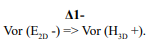
a) Law1 for volume 3D (for electron in 3D): The open decelerating transverse vortex (E 2D -) generates inward an open accelerating longitudinal vortex (ÃÂÂÂ 3D +) upward. This action takes place from the Gravity center (G) of decelerating cross vortex (E 2D -) through a particular transverse-longitudinal transformation (Δ1-):
b) Law5 for Volume 3D: The 3D decelerating vortex is described by a multitude of 4 nonparametric equations in which: longitudinal velocity (V) decreases in (n) portions (1/ψn) times; the amplitude (W), the angular velocity (ω) and the number (N) of transverse vortices increase in (n) portions (ψ n) times:
V- VO / V = -1, V2 = V0(1 – V),
W-Wo /W= 1 , W2 = W0(1 +W),
ω - ω0 / ω =1 ω 2 = ω0(1+ ω ),
N - No /N=1 N2 = N0(1+ N ).
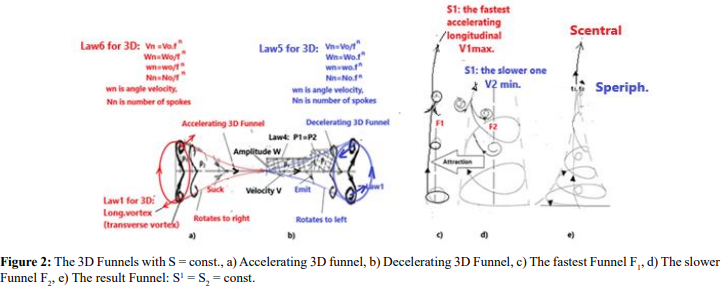
where linear velocity V0 is the starting value of vn , amplitude of transverse vortex W0 is the starting value of wn , angular velocity ω0 is starting value of ωn , number N0 is starting value of nn , [nn ] is the closest integer: vn , wn are periodic roots with period n; vn , wn are mutual orthogonal that fulfill the orthogonal requirement: vn .wn = V0 .W0 ; vn , ωn are mutual orthogonal that fulfill the orthogonal requirement: vn .ωn = V0 .ω0 ; n = 0 ÷ ∞; the roots vn , wn and ωn and nn are expressed as: vn = (1/fn ).V0 , wn = fn .W0 , ωn = fn . ω0 , [nn ] = fn .N0 ; (f) is Golden proportion that fulfills the requirement: f-(1/ f) = 1, (Figure2b) [4,5,6].
Definition : An equation is nonparametric when it do not depend on external parameters and it depend only on the internal species proportion called Golden proportion [10].
Result: Decelerating vortex describes 4 nonparametric equations depending only from (f).
Definition: For decelerating vortex the Golden proportion (f2 ) n = wn /vn ) is the ratio between result and reason, or between amplitude of the transverse vortex(W) (as result) to the longitudinal vector (V) (as reason) [10].
Result: The decelerating vortex transforms vector velocity (V1 ) from starting (n1 ) point to a transverse wheel vortex with maximal radius (Wn ) in final (nth) point. The angular velocity (ωn ) and radius of rotating wheel (Wn ) become maximal in (n th ) step .
Result: An decelerating vortex emits the Primary decelerating vortices from itself to the outside or to the environment .
Result: Two decelerating longitudinal vortices in close proximity repel each other.
c) Law6 for volume 3D: The accelerating vortex in 3D is described by a multitude of 4 nonparametric equations in which: longitudinal velocity (V) increases in (n) portions (. fn ) times, the amplitude (W), the angular velocity (ω), and the number (N) of loops of transverse vortices decrease to zero in (n) portions (1/f n ) times:
V- V o / V = 1, V2 = V0 (Vo +V),
W-W0 /W = -1, W2 = W0 (1–W),
ω-ω0 / ω= -1 , ω2 = ω0 (ω0 – ω),
N-N0 /N= -1 , N2 = N0 (N0 - N ),
where the linear velocity V0 is the starting value of Vn , amplitude of transverse vortex W0 is the starting value of wn , angular velocity w ω0 is starting value of wn , number N0 is starting value of nn ,the roots vn , wn and ωn , nn are expressed as: vn = (fn ).V0 , wn = (1/ fn ).W0 , ωn =(1/fn ). ω0 , nn = (1/fn ).N0 ; (f) is a Golden proportion that fulfills the requirement: f – (1/ f) =1 : vn , wn are periodic roots with period (n), vn , wn are mutual orthogonal that fulfill the orthogonal requirement: vn .wn = V0 .w0 ; vn , ωn are mutual orthogonal that fulfill the orthogonal requirement : vn .ωn = V0 . ω0 ; n = 0 ÷ ∞; the roots vn , wn and ωn and nn are expressed as: vn = (fn ).V0 , wn = (1/ fn ) .W0 , ωn = (1/fn ) ω0 , nn = (1/fn ).N0 ;
The first positive root of the first equation is: v1 = f. V0 = 1,62. V0 . The first positive root of the second equation is: w1 = (1/f) W0 = 0,62. W0 . The periodic roots of the first equation are obtained from the expression: vn = V0 . (vn-1+vn-2). The periodic roots of the second equation are obtained from the expression: wn-2 = W0 . (wn-wn-1), (Figure 2a) [4,5,6].An nonparametric equation do not depend on external parameters and it depend only on Golden ratio (f) [10].
Definition: For accelerating vortex the Golden proportion (f2) n= vn /wn ) is the ratio between result to reason: or between the longitudinal vector (V) (as result) to amplitude of the transverse vortex(W)(as reason) [10].
Result: For accelerating vortex the angular velocity (ωn ) and radius of rotating wheel (Wn ) in final (nth) step are minimal or almost zero.
Or accelerating vortex transforms the first transverse wheel ,as vortex with maximal radius (W1 )from starting (n1 ) point to vector velocity(Vn ) of final (nth) point .
Result: An accelerating longitudinal vortex sucks in the Primary accelerating vortices from the outside (from the environment) towards itself.
Therefore when there are two longitudinal vortices in close proximity, they attract each other.
Result: Two accelerating longitudinal vortices in close proximity attract each other.
Therefore a few accelerating vortices also attract each other .
II. Packaging of Longitudinal Vortices to Funnel
A few accelerating longitudinal vortices in close proximity they attract each other (Law6) and form an accelerating Funnel.The fastest longitudinal vortex sucks the slower one and is pushed from the inside into the center of the Funnel. The slower one is wound from the outside along the periphery.But their lengths (S) are the same.
Result: Many spirals form Funnel as if we were to compress one and the same spiral spring or as if they were have S = const.
If we were to compress one and the same spring. When spring is extended, the spiral of spring has a minimum radius and a maximum length (S) (Figure2c). When we compress, the described spiral becomes with a maximum radius, the maximal turns but the same length (S) (Figure2d ).
Result: The spiral with minimal radius (Rmin) is in senter of Funnel , has maximal longitudinal velocity (Vmax) and pass the length (Sconst) with minimal time (Tmin): Rmin, Vmax, Tmin, Sconst. Result:The spiral with maximal radius (Rmax) is in periphery of Funnel ,has minimal longitudinal velocity (Vmin) and pass the same length(Sconst) with maximal time(Tmax): R max, V min,Tmax, Sconst.
The joint action of the two spirals amplifies and multiplies their effect. The reason is that the central spiral (F1 ) sucks the accelerating free Primary vortices from the environment plus all the Primary vortices of the spiral (F2 ) that is adjacent and wound from the outside it (Figure2e).
Result: The central longitudinal accelerating vortex has maximal velocity (Vcen.) more than the velocity (V1 ) and moves minimal time less than (T1 ) : V cen.>V1 , T cen.< T1
Therefore, the result central spiral (S cen.) is faster and moves in less time than first spiral (S1)
III. Knowledge of Gravity
a) Acceleration in Final Point (an ): Each main accelerating vortex sucks in accelerating Primary vortices with positive acceleration from the outside towards itself (Law6). The main accelerating vortex (with a0 ) sucks Energy and Matter into itself in the form of accelerating Primary free vortices. In every (n) step along one and the same spiral its velocity is secondarily accelerated with Golden proportion (f) because it receives the Secondary positive acceleration. Therefore along one and the same spiral the acceleration in final point (n) is equals: an=ao.fn. .
b) An Accelerating Longitudinal Vortices Form An Accelerating Gravitational Spiral That Suck In Every Point (n) The Primary Transverse Vortices With Positive Acceleration:
For many number spirals the central spiral (N) sucks all Primary vortices from the second (N-1) closest neighboring spiral. The second (N1) spiral sucks all primary vortices from the third (N-2) spiral and so on.The before the last (1) spiral suck all Primaty vortices from last periphery spiral (0) .
c) Many (N) Accelerating Longitudinal Vortices Located Nearby Form An Accelerating Gravitational Funnel: The last spiral (0) has minimal acceleration (Ao).The central spiral (N) has maximal acceleration : AN = A0 . fN, where (f) is Golden proportion.
d) The Reason for Construction of Accelerating Funnel is: An Positive Acceleration in Time: an = ao .fn and an Positive Acceleration in Space: AN=Ao .fN,where ao, an are positive acceleration at start (0) point and at final (n) point ; Ao , AN are positive acceleration in central (N) spiral and in periphery (0) spiral .
e)The Acceleration Funnel has Maximal Positive Acceleration and Maximal Attraction in Central Spiral (N): The entire accelerating Funnel sucks the Space around itself in perpendicular planes as 2D sections. They form so called accretion disks.
f) The Accretion Disks around Acceleration Funnel form Perpendicular Sections that Create Circles Around Funnel: They are distributed nonlinear and show the distortion the Space around acceleration Funnel. The more prominent it is the non-linearity of the distribution of the circles is the stronger the distortion of space and Gravity around it.
g) The Accretion Disks are Distributed Unevenly Around the Funnel and it Shows the External Distort the Space Around It As Result: Each main decelerating vortex emits decelerating Primary vortices with negative acceleration from the inward to environment(Law5). Thus they repel each other and form decelerating Funnel .
h) Many (N) Decelerating Longitudinal Vortices Located Nearby Form a Decelerating Gravitational Funnel: Decelerating Funnel with negative acceleration (a0 ) will decelerate in Time along its length many (n) points (an ) with Golden proportion
(f) : an = a0 /f N. i)
The Deceleration Funnel has Maximal Negative Acceleration and Maximal Repulsion (According Law 4) in Peripheral Spiral (N ): In many (N) spirals in Space the negative acceleration will decrease with (f) from central ( 0) to periphery (N) spiral : AN = A0 /f N .
j) The Reason for Construction of Decelerating Funnel is an Negative Acceleration in Time: An = A0 / F N and an Negative Acceleration in Space : AN = A0 /fN,where n is final point, but N is periphery spiral. The decelerating vortices repel each other (Law5). Because they form decelerating Funnel they construct accreation disks around Funnel.
k) The accretion disks around a decelerating Gravitational Funnel are planes in the form of perpendicular sections to the axis of the Funnel, arranged nonlinearly in the plane of this section.
The accretion disks are distributed nonlinear.Thus they show nonlinear distortion the Space around decelerating Funnel.
l) The accretion disk around accelerating Gravity Funnel is in less distance to center and are in bigger distance toward periphery.
m) The accretion disk around a decelerating Gravity Funnel is in less distance in periphery and are in bigger distance toward center.
IV. The Main Conclusions for Gravity
a) The reason is acceleration but distortion of Time-Space is only one result. This algorithm is opposite to the algorithm of Classical Gravital Theory.It clames that the reason for Gravity is distortion of TimeSpace around the place. b) The claim for Gravitation of the Theory of new Axioms and Laws is opposite than the clame of Classical Gravital Theory. Therefor the Theory of new Axioms and Laws clames that the reason for Gravity is acceleration of longitudinal vortices formed Gravitational Funnel. The Classical Gravital Theory claims that the reason for Gravity is distortion of Time- Space around.
Information Time-Space by Standing waves
I. Essence of Standing Wave
The third Time -Space is the most complex. It is based one unique motion - a Standing waves. Standing waves are obtained when two or more identical waves are summed in opposite phases. Thus the peaks and nodes are obtained.
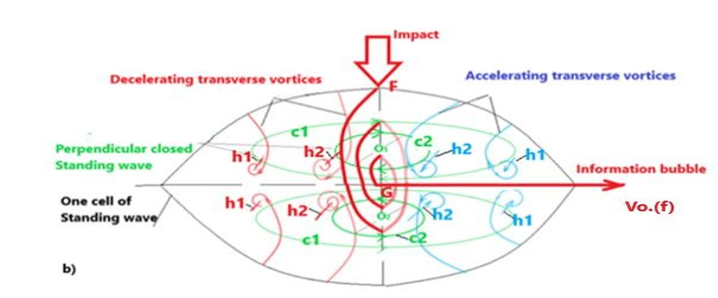
a) Peaks and Nodes of Standing Waves: When in plane 2D two waves in opposite phases are summed and thus they form plane cells. When in volume 3D many waves in mutual opposite phases are summed and thus they form volume cells (Figure 3b). Both in 2D and in 3D are obtained peaks and nodes. The peaks are in points where the amplitudes are summed in the opposite direction and obtains double amplitudes. The nodes are in points where the amplitudes are subtracted and zero amplitude are obtained (Figure 3a).
b) Internal Standing Waves in the 2D Cell: The main wave in plane cell (2D) of Standing wave grows in the first 1/4 period. The wave climbs and actually its moving is decelerated. During this 1/4 period the decelerating wave emits (Law5) decelerating Primary transverse vortices (in red) perpendicular to increasing main wave. The both opposite 1/4 waves are simultaneously decelerating waves in opposite directions. These both decelerating waves are emitted (Law5) two Primary decelerating mutual opposite vortices
They are in section, perpendicular to direction of moving of this Standing wave. These two decelerating mutual opposite vortices generate two perpendicular vortices (h1 ,h1 ),(h2 ,h2 ) in opposite directions (Law1).As a result (h1 ,h1 ) form one internal Standing closed (c1 ) circle. But a pair perpendicular vortices (h2 ,h2 ) form the second internal Standing closed (c2 ) circle (in green). These circles in 2D lie on the longitudinal sections of the volume cells in 3D. In this case are formed two standing closed circles, inserted one in another.
When this cell in plane 2D is rotated around its longitudinal axis, a volumetric cell is obtained in 3D (no image).These closed Standing waves (in green) will describe oval volumetric bodies, inserted one in another. It must have two oval bodies, inserted one into the other (Figure 3b).
c) Reaction of Volume Cell (3D) Toward External Impact
If we strike this volume cell from the outside (F) it will react: When a decelerating transverse vortex rolled from outside (F) to inside (G) in plane 2D, it generates in its Gravity center (G) a perpendicular (in volume 3D) accelerating longitudinal vortex with velocity (V0 ) (Law1). It (V0 ) accelerates itself with Golden proportion (fn ) inside of every following (n) cell (n -point). When number of cells (n) is sufficient big the starting velocity (V0 ) will reach final speed (V0 .fn ) that can be much more than light speed (c).The reason for acceleration in further cells is Law6 that claims that an every accelerating vortex suck in Primary vortices with positive acceleration from environment to itself and thus it is accelerated more and more (Figure 3b).
II. Final Speed of Conducting an Starting Impulse
a) The reason: The accelerating longitudinal vortex passing through the cells sucks in all Primary transverse vortices from each subsequent cell (Law6). Thus, the velocity of longitudinal vortex accelerates itself more and more. If in initial cell the velocity is (V0 ) in second cell (V1 ) the initial velocity(V0) is multiplied by the value (f) of the Golden ratio (f = 1.62) (Law3). In third cell(V2 ) the initial speed (V0 ) is multiplied to (f )to second degree (f2 ) and is equal V3 = Vo .(f)2 and so on. Therefore the final velocity that is maximal (Vmax)is equal to (Vo .(f )n ).
Result: The final velocity (Vmax) is equal to: Vmax = Vo .(f )n
At the final cell (n) the initial velocity(V0 ) reaches its maximum (Vmax) by multiplying by (f n ) to the number (n) of cells in every number (n) of cells.
b) Physical Essence of Conducting a Starting Impulse: Physical motion at this speed does not have the character of transfer. It has the character of information for transfer. It shows something like deformation of Space or hatching, flickering, contraction, etc. If starting speed (Vo ) is almost equal to light speed (c) it can be expected that the final velocity (Vmax) can be much higher than the speed of light (c) with (f) to (n) degree.
Result: In line of Standing waves the final velocity (Vmax) can be much higher than the speed of light (c): Vmax = (c).(fn ) > c.
The final velocity (Vmax) looks like to a deforming bubble more than to a physical vortex.
Result: The final velocity (Vmax) has character of a deforming Space of bubble.
It shows the direction of external Impact or an information for a request signal. Result: In line of Standing waves the final velocity (Vmax) can be much higher than the speed of light (c): V max=(c ).(f n) > c.
The final velocity (Vmax) looks like to a deforming bubble more than to a physical vortex.
Result: The final velocity (Vmax) has character of a deforming Space of bubble.
It shows the direction of external Impact or an information for a request signal.

Figure 3: Information Space-Time
Figure 3 a) Chain of standing waves, Figure 3 b) One cell of Standing wave Standing wave chain
III. Neural Network
a) Essence: An information Time-Space looks like an uneven network of Standing waves which pulsate.
Standing waves pulsate in Space: Standing waves pulsate in Space as they move continuously and make denser or rarer volumes. This causes an uneven distribution of the filaments in Space and a continuously changing statistical distribution: Statistical distribution is variable.
Standing waves pulsate in Time: Standing waves pulsate in Time by contracting their period or expanding in its own period. This causes in one and the same cell an internal redistribution of the Standing waves inside the resonator in the cell. But does not change the volume of the cell (Figure 3b). Therefore the Power stays constant: P = const.
b) Examples: The different Standing waves have different characteristics: They have different amplitudes, periods, frequencies and, accordingly, different cell sizes. This means that in case of perpendicular impact (F) from outside to inside (G) the decelerating transverse vortex generates from the Gravity center (G) of transverse spiral an accelerating longitudinal vortex is shoot along this line with different velocity and Power (according Law1for 3D) .
c) Properties: Conductivity and Resistance: The lines of Standing waves themselves have different Conductivity and respectively Resistance. This network of Standing wave lines is unevenly distributed in Space (nonlinearly in S) and works unevenly in Time(nonlinearly in T).
Analog and discrete behavior: An Information Impulse chooses to pass along a line with the least Resistance and the highest Conductivity. By this criterion it has the behavior of a fluid (analog behavior).
If the initial Impulse has a minimum amplitude (W0 ), but in the line has a maximum length with maximal number (nmax) of cells, then this Impulse (Wo ) will be amplified by the Golden proportion (f) to the maximum degree (nmax). Or the final amplitude of impulse equals to: W0 .(f)nmax. By this criterion the input Impulse (W0 ) has the behavior of a particle (discrete behaviour)
Probabilistic path selection: This is a special software of Standing wave lines. An accelerated Information signal in output of Standing wave lines takes the path of least Resistance. This means that the route of this signal is probabilistic.
d) Difference between the Neurons in a person and Standing Waves in Information Space.
The chain of Neurons in a person works in Real Time-Space with constant time : T = const. The reason is that it transmits Transverse Waves of the type of Electromagnetic Waves with a maximum speed equal to the speed of transverse light (c) : Vmax = c.
But the chain of Neurons by Standing waves work in Information Time-Space with constant velocity: V = const. The reason is that Standing wave accelerates a longitudinal vortex with speed (Vmax). Because is longitudinal it is faster than speed of transverse light (c ): Vmax>> c.
e) Deformation of Vacuum is a Features of Information TimeSpace.
Theoretically, the speed in a chain of (nmax) volume cells of the Information Time-Space is :Vmax = Vo .(f)nmax. The transmitting in Information Time-Space by chain of volume cells is in deformation of Vacuum. In practice, no signal or Energy is transmitted but only acceleration.
IV. Summary of Information Time-Space
a) Vmax = const.: When an impact (F) acts on the top of a volumetric cell in 3D ,a decelerating transverse vortex is obtained in the plane 2D in a perpendicular section of the cell volume. Thus it generates a perpendicular accelerating longitudinal vortex from the Gravitational center (G) to outward (Law1) (Figure 3a). When this accelerating vortex with a starting velocity (Vo) passes through the next second cell, then it sucks in all the Primary vortices from the second cell and accelerates even more to: Vo .(f )1 (Figure3b). Then it passes through the third cell and accelerates to: Vo .(f)2 . By the end of the chain of (n-1) volumetric (3D) cells by Standing waves, this initial velocity(Vo )will accelerate to (Vmax): Vmax = Vo .(f)n-1(Figure 3a). Thus velocity (Vmax) is perceived as a maximal constant : Vmax = const.
b) Vmax> c: Because starting velocity (V0 ) is close to light speed ( c) and the final velocity (Vmax) is equal (Vo . (f)n-1),then it is much higher than the speed of light (c) : Vmax> c.
c) Quantum Computer: This Neural System is very similar to the Neural System in the human brain . But this is only the hardware of the system. The software is probabilistic. The signal with velocity (V) takes the path of least Resistance. This means that the route of this signal is probabilistic. The routes can also be tested and calculated in parallel, with parallel circuits and parallel algorithms. For example: The probability of passing through one route is 15 per sent and through another route is higher than 50 per sent. But through a third route the probability is 50:50 to pass to not pass. It must apply an additional test as algorithm of cause –result [10]. This is the parallel algorithm for calculating parallel probabilities in Quantum computers.
d) T=0 (if Vmax):Because in Information Time-Space the speed is constant (Vconst) then if the distance (S) increases then proportionally time (T) increases (according Vconst.=S/T) . When the speed of information is maximum (Vmax) then time tends to zero: T = 0 at any distance (S) [6,8].
Main Conclusions for Perception of the Three Time-Spaces
There are Conditionally 12 Coordinates in the Universe.
This article proved that according to the number of 3 different possible movements, there are basically 3 Time-Spaces, each Space-Time being described by 4 coordinates (x,y,z,t) [8,9].
II. Man Perceives only Space-Time of Transverse vortices (with T=const.).
The reason is that Man is a product only of pulsating Transverse vortices and Transverse Waves. Because Transverse vortices form 1/3 of all Universe and since are limited in their perceptions the humans perceive and understands only 1/3 of Universe. Thus human perception covers only 1/3 of the world, human logic tries to understand only 1/3 of the world's problems. The conclusions that man tries to make relate to only 1/3 of the world. Therefore conclusions are not always objective and they are not always accurate and true [5,6].
III. Man does not Perceive the Gravitational (S=const.) and Information (V=const.)
Time-Space. The reason is that longitudinal vortices and Standing ( also longitudinal) waves are invisible to transverse light waves Transverse light waves make diffraction around longitudinal vortices [7,8].The man cannot perceive neither Gravitational nor Information Time-Space. The human perception does not cover 2/3 and can’t understand 2/3 of Universe .
IV. The remaining 2/3 are not accessible to human perceptions and human intelligence.
Man can make relative correct conclusions about only 1/3 of the world. For the remaining 2/3 of the world there is no such possibility
References
-
- Markova, V. (2017). Extended field theory: New axioms, laws and consequences. IOSR Journal of Applied Physics, 9(1), Version 2.
- Markova, V. (2017). Modeling of gravitational waves by creating a system of paired cross vortices: Some properties, conclusions and applications. IOSR Journal of Applied Physics, 9(5), 25–32.
- Markova, V. (2017). New axiom for description of gravity. In Proceedings of the 5th International Conference on Physics, Athens, Greece.
- Markova, V. (2018). About the new axioms and laws. In Proceedings of the 5th International Conference on Theoretical and Applied Physics, Vienna, Austria.
- Markova, V. (2019). Extended field theory: New axioms, laws and consequences. In Proceedings of the 2nd International Conference on Quantum Mechanics & Nuclear Engineering, Paris, France.
- Markova, V. (2019). Modeling of two different space-times based on knowledge of new axioms and laws. In Proceedings of the 2nd Global Summit on Physics, Paris, France.
- Markova, V. (2021). The gravity funnels formed by the longitudinal vortices according to the new axioms and laws. Advances in Theoretical & Computational Physics, 4(1), 61–68
- Markova, V. (2022). Presence of a new space-time in which the path S (along the motion spiral) is a constant. Acta ScientificApplied Physics, 2(2), 7–14.
- Markova, V. (2022). Properties of the new time-space with a constant path (S const.). Acta Scientific Applied Physics, 2(5), 7–17
- Markova, V. (2025). Causal description of natural system according theory of new axioms and laws. Advances in Theoretical & Computational Physics, 8(4).