

Journal of Neuro and Spine(JNS)
ISSN: 2836-5968 | DOI: 10.33140/JNS


Case Report - (2024) Volume 2, Issue 1
Thoracic Spinal Cord Disruption Following Trauma Without Bone Lesion: Case Report and Review of Literature
Received Date: Feb 13, 2024 / Accepted Date: Mar 15, 2024 / Published Date: Apr 03, 2024
Copyright: ©©2024 Napoleao Imbunhe, et al. This is an open-access article distributed under the terms of the Creative Commons Attribution License, which permits unrestricted use, distribution, and reproduction in any medium, provided the original author and source are credited.
Citation: Imbunhe, N., Ontsi Obame, F. L., Dokponou, Y. C. H., Saad, M. E., Mohcine, S., et al. (2024). Thoracic Spinal Cord Disruption Following Trauma Without Bone Lesion: Case Report and Review of Literature. J Neuro Spine, 2(1), 1-3.
Abstract
Spinal cord injury without radiological abnormality (SCIWORA) is a term that describes objective clinical signs of post-traumatic spinal cord injury without evidence of fracture or malalignment on plain radiographs and computed tomography (CT) of the spine. SCIWORA is poorly documented and its occurrence at the level of the thoracic spine is uncommon. We present the case of a 36-year-old man admitted for paraplegia, low blood pressure, polypnea, and sphincter dysfunction following spinal trauma. A body scan revealed bilateral poster basal lung condensation without spinal bone lesions. A complete spine MRI shows subtotal medullary transection at the dorsal D4D5 level. There was no indication of surgery. The patient benefited from medical treatment with physiotherapy. One week later, he showed spontaneous cardiopulmonary improvement but no improvement in neurological status.
Keywords
Spinal Cord Injury, Bone Lesion, Ligaments, Paraplegia.
List Of Abbreviations
SCIWORA: Spinal Cord Injury Without Radiographic Abnormality.
MRI: Magnetic Resonance Imaging.
Introduction
Spinal cord injury without radiographic abnormality (SCIWORA) is a term used to define a clinical condition in which damage to the spinal cord or column cannot be seen with conventional radiography or computed tomography (CT) [1]. However, magnetic resonance imaging (MRI) facilitates proper diagnosis [2]. Spinal injuries in adults are reported with a frequency of 10 to 12% [3]. SCIWORA more commonly affects the cervical spine than the thoracic and lumbar spine [3]. The most common causes of injury in patients with SCIWORA are sports injuries, public road accidents, and falls. Kivanc et al. reported several mechanisms that could cause SCIWORA, including spinal cord traction injury due to hyperflexion, external spinal cord injury due to hyperextension, and parenchymal injury due to edema or vascular injury [3]. We report the case of thoracic SCIWORA with complete spinal cord disruption in adult patient confirmed on MRI. There were no spinal fractures or ligament damage.
Case Presentation
Patient Information
A 36-year-old man was admitted to our department because of rapidly progressive spinal pain, heaviness in the lower limbs, and acute urinary retention. His medical history was unremarkable. The patient initially denied any changes in speech and facial, visual, swallowing, bladder, or bowel disorders.
Clinical Findings
On examination, there was arterial hypotension with a blood pressure of 90/50 mmHg, a regular heart rate of 115 beats per minute, and polypnea with a respiratory rate of 23 beats per minute. He had normal muscle tone and strength in both upper limbs with a Medical Research Council (MRC) muscle strength scale of 2/5 in both lower limbs. He was paraplegic (FRANKEL SCORE A) with hypotonia of the lower limbs. Reflexes in the 04 limbs (biceps, triceps, supinator, knee, and ankle) were brisk with extension of the plantar muscles bilaterally. The sensory modalities of pinprick, temperature, vibration, touch, and proprioception were intact, with sensory impairment at the thoracic level or T5. Examination of the cranial nerves was unremarkable.
Diagnostic Assessment
The first laboratory examination revealed a normal complete blood count. Tests of inflammatory markers (C-reactive protein and procalcitonin), electrolytes, and liver, kidney, and thyroid function were normal. The ECG was unremarkable.
ACT scan of the spine shows no post-traumatic bony involvement (Figure 1 A). Spinal MRI shows a hypo signal T1 and T2 hyper signal lesion at the T3-T4-T5 level compatible with a complete section of the spinal cord (Figure 1 B-D).
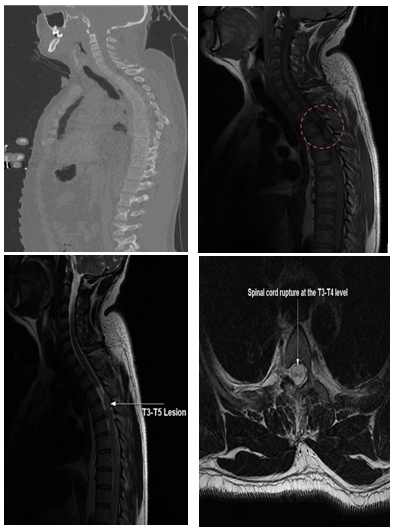
Figure 1 :
Therapeutic Intervention
The patient received medical treatment based on: Perfalgan, norepinephrine, solumedrol, and Love NOx with physiotherapy. To prevent bedsores and ulcers, an anti-bedsore air mattress with compression stockings was provided.
Follow-up and Outcome
One week later there were spontaneous cardiopulmonary improvement, but no improvement in neurological status.
Discussion
In 1982, Pang and Wilberger defined this disorder as characterized by objective signs of myelopathy resulting from trauma, without evidence of ligamentous injuries or ruptures on plain radiographs or tomographic studies [4]. Spinal cord injuries without radiological abnormalities accounted for 2.21% of cases. The biomechanical properties related to suppleness and elasticity would explain the rarity of spinal injuries with spinal cord syndrome without bone or disc damage in adults compared to children [5]. The most common causes of injury in patients with SCIWORA are sports injuries, auto collisions, falls, and abuse [3]. Most cases are due to injuries to the cervical spine. The rarity of SCIWORA in the thoracic spine may be due to the splinting effect of the rib cage preventing translation of the spine and subsequent spinal cord injury [1]. Patients diagnosed with SCIWORA present with a neurological deficit resulting from mild and transient symptoms such as quadriplegia or paraplegia [6]. It is undisputed that magnetic resonance imaging (MRI) has a prognostic value in patients with spinal cord injuries [7]. Surgical intervention may be necessary in selected cases if there are clear signs of instability with ligamentous injury and/or spinal cord compression [3,8].
Conclusion
Spinal cord injuries without radiological abnormalities are rare. MRI is the study of choice for diagnosis because it reveals neuronal and extraneural injuries and helps detect abnormalities. If there are clear signs of instability with ligament injury and/or spinal cord compression, surgical intervention may be necessary in selected cases.
Declaration
Ethics Approval and Consent to Participate
Not Applicable
Consent for Publication
Not Applicable
Availability of Data and Material
Not Applicable
Competing Interest
The authors report no conflicts of interest
Funding
No funding was received for this research.
Submission Statement
This manuscript is original and has not been submitted.
Acknowledgments
None
References
- Dubey, A., Tomar, S., Gupta, A., & Khandelwal, D. (2018). Delayed paraplegia in an adult patient with spinal cord injury without radiographic abnormality of dorsal spine: A lesson learned. Asian Journal of Neurosurgery, 13(03), 867-869.
- Acer, S., Umay, E. K., Nazli, F., Kasman, U. O., Gündogdu, I., & Çakci, A. (2018). A geriatric patient with spinal cord injury without radiographic abnormality: outcomes and causes. Spinal Cord Series and Cases, 4(1), 17.
- Atesok, K., Tanaka, N., O’Brien, A., Robinson, Y., Pang, D., Deinlein, D., ... & Theiss, S. (2018). Posttraumatic spinal cord injury without radiographic abnormality. Advances in orthopedics, 2018.
- Bansal, M. L., Sharawat, R., Mahajan, R., Dawar, H., Mohapatra, B., Das, K., & Chhabra, H. S. (2020). Spinal injury in Indian children: review of 204 cases. Global spine journal, 10(8), 1034-1039.
- Quenum, K., Coulibaly, O., Arkha, Y., Derraz, S., El Ouahabi, A., & El Khamlichi, A. (2011). Atteinte médullaire cervicale post-traumatique sans lésion osseuse du rachis chez l’adulte: analyse de neuf cas consécutifs. Neurochirurgie, 57(1), 46-50.
- Laura, B., Valentina, D., Marco, L., Davide, C., Francesca, C., & Gianfranco, C. (2018). Adult spinal cord injury without radiographic abnormality (SCIWORA). Two case reports and a narrative review. Acta Bio Medica: Atenei Parmensis, 89(4), 593.
- Martinez-Perez, R., Jimenez-Roldan, L., & Lagares, A. (2014). Ligaments disruption: a new perspective in the prognosis of spinal cord injury. Neural Regeneration Research, 9(5), 456-457.
- Wang, J. Z., Yang, M., Meng, M., & Li, Z. H. (2023).Clinical characteristics and treatment of spinal cord injury in children and adolescents. Chinese Journal of Traumatology, 26(01), 8-13.