Advances in Theoretical & Computational Physics(ATCP)
ISSN: 2639-0108 | DOI: 10.33140/ATCP
Impact Factor: 2.6

Research Article - (2025) Volume 8, Issue 4
Theory of the Universe (The Matrix)
Received Date: Oct 06, 2025 / Accepted Date: Nov 27, 2025 / Published Date: Dec 17, 2025
Copyright: ©2025 Victor D. Krasnov. This is an open-access article distributed under the terms of the Creative Commons Attribution License, which permits unrestricted use, distribution, and reproduction in any medium, provided the original author and source are credited.
Citation: Krasnov, V. D. (2024). Theory of the Universe (The Matrix). Adv Theo Comp Phy, 8(4), 01-12.
Abstract
It is shown that the world consists of two components: space and electromagnetic quanta. It is shown that space is an elastic, flexible substance infinite along all three coordinates. It is shown that space serves as a conductive medium for electromagnetic quanta. Electromagnetic quanta are embedded within space and constitute a component of space itself. It is shown that electromagnetic quanta move through space in the form of a volumetrically compressive transverse wave. It is shown that clusters of space formed by an electromagnetic quantum constitute the particles of the world, as we perceive it. It is shown that gravity is the attraction between compressed regions of space formed by electromagnetic quanta, along with the tension of the spatial substance arising between them. It is shown that the mass of the spatial substance from which perceptible particles are formed is not transported through space. It is shown that the mass of particles is formed from the spatial substance at the point where the electromagnetic quantum is located at a given moment. It is shown that the nuclear interaction is a rapidly pulsating gravitational interaction.
It is shown that stellar heating occurs through the destruction, by gravitational forces (the tension of the spatial substance), of helium nuclei into hydrogen nuclei, followed by the re-combination of hydrogen nuclei into helium nuclei with the release of energy responsible for heating stars. It is shown that supernova explosions occur when the tension of space around a star exceeds the spatial tension between molecules, nuclei, and nucleons, exceeding the magnitude of the nuclear interaction. It is shown that black holes at the centers of galaxies are the centers of stretched spatial substance that has been drawn into the formation of sur-rounding stars, planets, comets, asteroids, and so forth. It is shown that no mass, in the sense in which we ordinarily conceive it, exists at the centers of galaxies. It is shown that the center of a galaxy is a region of maximally stretched space (spatial substance), whose stretching force exceeds nuclear forces. This region of maximal spatial stretching manifests itself as an enormous mass. It is shown that the galactic center is a pseudo-mass. An experiment is de-scribed that will confirm the theory of the universe.
Structure of Universe
The foundation of the entire world is of two components:
• Space – an elastic, flexible substance infinite along all three coordinates.
• Electromagnetic Quanta, toroidal solitons embedded in space, forming with space a unified whole and moving within the structure of space in all directions at a speed of 3.10. km/s (according to current understanding).
• Space is a Conductive Medium for the motion of electromagnetic quanta.
The motion of electromagnetic quanta through the elastic, flexible medium of space occurs in the form of a volumetrically compressive transverse wave.
While in motion, an electromagnetic quantum compresses the elastic, flexible spatial substance in the direction transverse to its movement.
Within the electromagnetic quantum, a region of increased density of the spatial substance is formed (Figure 1).
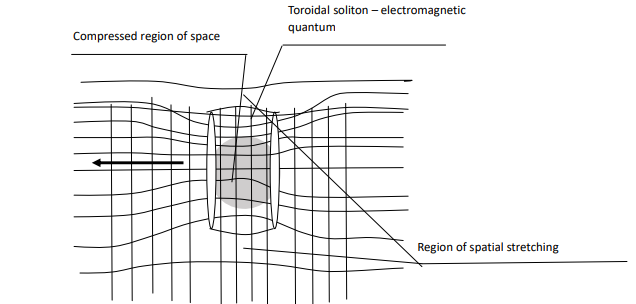
Figure 1: Within an Electromagnetic Quantum, A Region of Increased Density of The Spatial Substance is Formed
The region of increased spatial density moves at the velocity of the electromagnetic quantum, 3.10. km/s. This region of increased density of the spatial substance appears to us as the mo-tion of a particle of uniform composition. It appears as the displacement of a localized mate-rial particle, as the movement of a portion of matter. In reality, only electromagnetic quanta move through space (through the elastic, flexible substance). The material particles we per-ceive are formed by electromagnetic quanta within the spatial substance (from the spatial substance) at the location where the electromagnetic quantum is situated at a given moment. The motion of localized volumes of matter (particles) through space is an illusion created by electromagnetic quanta. Particles formed in this manner are the particles of the surrounding, perceptible world. Massless particles do not exist in Nature.
The regions of space compressed by an electromagnetic quantum constitute an asymmetric sphere (Figure 2).
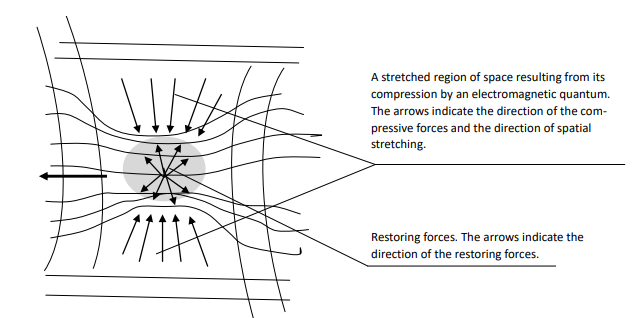
Figure 2: What Is Today Called Nuclear Matter Is A Portion of Space (A Portion of The Spa-tial Substance) Compressed by An Electromagnetic Quantum
Density of Space
Scientific literature (and online sources) provide data on the characteristics of certain particles that constitute the matter around us. The density of space (the spatial substance) can be calculated by determining the volume and mass of a particle, and by assessing the volume of space involved in the formation of that specific particle.
Estimate of Space Density Using Neutrino Parameters
Neutrino size: 10-24 m (10-22 cm) – information from the Internet, no source cited
Neutrino cross-section: 10-43 cm2, from which D=3.5917424.10- 22 cm.
Neutrino volume: V=4/3.π.r3 = 2.4261305512893033533491263566076e-65 cm3, if the neu- trino is considered spherical.
Neutrino mass = neutrino volume multiplied by the density of nuclear matter:
M=2.4261305512893033533491263566076e-65 cm3.2.8.1014 g/ cm3 = 6.7931655431584e-51 g
Over a distance of 3.10¹. cm, which the neutrino travels in one second, the neutrino fits:
3.10. / 3.5917424.10.²² = 83,524,920,940,878,165,427,453,817, 400,713 times
At each point in space, the neutrino is present for: 1/83,524,920,940,878,165,427,453,817,400,713 = 1.1972474666…6667e-32 s
During this time, an electromagnetic quantum compresses space in the direction perpendicular to the neutrino’s motion (radially) by: 3.1010.1.19724746666…6667e-32 = 3.5917423998 e-22 cm (All actions occur at the speed of propagation of electromagnetic quanta in space).
The diameter of the space for neutrino formation:
The diameter of the neutrino cross-section plus the distance by which the electromagnetic quantum compressed space radially, multiplied by two:
D=3.5917424.10-22 + (3.5917423998 e-22.2) = 10.7752272.10- 22 cm
The volume of space for neutrino formation:
V=4/3.π.r3 = 4/3.π.(10.7752272.10-22 / 2)3 = 6.5505524884811190540426411628404e-64 cm3
The density of space: The mass of a neutrino divided by the volume of space involved in its formation:
M=6.7931655431584e-51 / 6.55055248848…404e-64 = 1.037037037.1013 g/cm3
The density of space: p – 1.037037037.1013 g/cm3
Estimate using nucleon parameters:
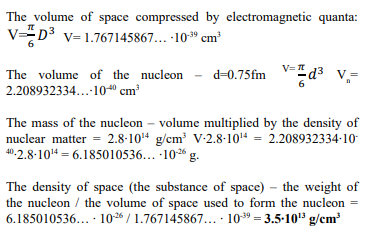
- The density of space (spatial substance) p = 3.5.1013 g/cm3 Estimate using photon parameters: - The density of space (spatial substance) p = 9.5251992720350.1013 g/cm3
Gravity
At an everyday level, a demonstration of space (as an elastic, flexible substance) in a single plane can be represented by a sheet of rubber.
Let us mark on the sheet the region captured and compressed by an electromagnetic quantum as it moves through space (Figure 3a).
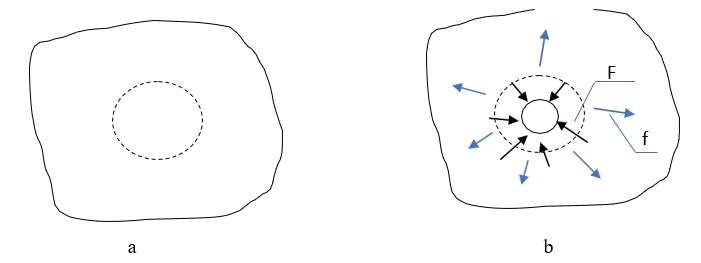
Figure 3: The Arrows Indicate the Forces F (of the electromagnetic quantum) Compressing the Spatial Substance. Blue Arrows Mark the Tension of Space.
Let us enclose this region and compress it to a point (into a small region) (Figure 3b). Around this compressed region, the rubber will stretch in all radial directions from the center of com- pression. In this case, the force stretching the rubber will decrease in all radial directions in-versely proportional to the square of the distance from the supposed center of compression: f=F/R2 Where f is the stretching force (tension) at a specific point in space.F is the compres-sion force of the designated region into a small volume, i.e., the force with which the elec-tromagnetic quantum compresses space.
Let us mark on the rubber sheet two regions, not far from each other, and similarly compress them into a point (into a small region).
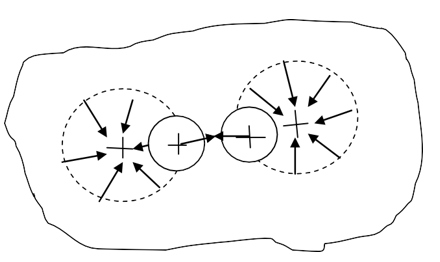
Figure 4: The Regions of Rubber (Regions of Space) Compressed into A Small Volume Have Shifted Toward Each Other As A Result of The Tension (Attraction) That Arose Between Them.
We note that the centers of the regions marked before compression moved toward each other. This convergence will be greater the closer the initially marked compression regions were, and the larger the volume of space involved in the compression. Gravity is the attraction between two regions of space compressed by electromagnetic quanta as a result of the tension that arises in space between the compressed regions. This is the gravitational attraction of two particles formed from the spatial substance by electromagnetic quanta.
Nuclear Forces
Let us return to the rubber sheet, simulating space in a single plane. If a certain area of the rubber sheet is compressed into a point (into a small region), the rubber will stretch in all radial directions. In this case, the stretching force will decrease inversely proportional to the square of the distance from the compression center. Similarly, the tension of space will decrease inversely proportional to distance. Notably, the propagation speed of the stretching in the rubber (space) in the radial direction depends on the rubber properties (the spatial substance properties). If a region of rubber is compressed into a point (into a small region) and this state is fixed, then, theoretically, the stretching will propagate to an infinitely large distance.
If the compressed region is rapidly expanded and compressed at a very high frequency (by applying a vibrator), then in the boundary zone of the previously compressed area, a zone of maximum tension is formed, at a distance depending on the frequency (compression speed). At the same time, the stretching of the rubber (spatial substance) in the radial directions that arose earlier will remain unchanged to infinity (Figure 5).
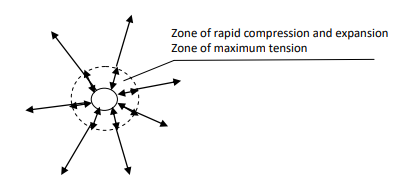
Figure 5: The Vibrator Creates a Zone of Increased Stretching (tension) in the area Bordering the Compressed Volume of Space, i.e. Around the Formed Particle.
If the regions of space depicted in Figure 4 are compressed and expanded at a frequency ex-ceeding the time required for the stretching of space to propagate to the midpoint of the dis- tance between them, these regions will remain in place. The tension established between them (gravitational interaction) will not change. At the same time, around the compressed region of space (as a result of the vibrator), a zone of maximum tension is formed. The zone (layer), whose size depends on the speed of the compressing and expanding forces, represents the range of nuclear forces, and the tension of space corresponds to nuclear forces.
When compressed regions of space (particles) approach each other, and their zones of maxi-mum compression (zones of nuclear force action) intersect, the particles entering the zone of maximum tension of space will attract each other until contact occurs.
From this moment, the restoring forces of the compressed regions (formed by electromagnetic quanta) will repel the compressed regions. Attraction will turn into repulsion.
According to current understanding, each nucleon consists of three quarks (this question is not fully resolved). A proton consists of two u-quarks and one d-quark. A neutron consists of two d-quarks and one u-quark.
Suppose that quarks (partons) move within the nucleons at the speed of light along a circular path around the center of the nucleon. Nucleon diameter: 0.75 fm. Quark (parton) diameter: 10 17 cm. The diameter of the quark’s circular path: 0.75 fm – 0.01 fm = 0.74 fm, where 0.01 fm is the quark (parton) diameter. Circumference of the path along which the parton moves: 0.74.π = 2.3247785636564469…268 fm, or 2.32477856365644699…268e-13 cm. In one se-cond, this circle is traversed by the quark moving at the speed of light: 3.1010 / 2.3247785636564469964623561036268e-13.¬ = 1.29 044 548 452 888 11... 878e23 times. Since three quarks are rotating, at each point in space, a quark occurs 1.29044548452888110082878 e23.3 = 387 133 645 358 664 330 248 636,18 e15 times per second.
This is the frequency with which quarks (formed from electromagnetic quanta) compress and expand space at each point along their orbit inside the nucleon. This is the vibrator that ex-pands and compresses the spatial substance around the formed particle. Time a quark spends at each point on its orbit: 1/1.29 044 548 452 888 110 78…e23 = 2.5916471213279599849684466962978e- 24 s. During this time, the quark compresses space from the beginning of the compression point by 2.591647....10- 24.3.1010 cm = 7.774941363983879954904e-14cm = 0.7774941363983879954904 fm.
If we assume that the stretching in the spatial substance propagates at 3.1010 cm/s, the stretch-ing of space will propagate radially outward from the center of compression by the same 0.7774941363983879954904 fm. The total stretched layer (zone of nuclear force action) will be 1.5549882726 fm, which is consistent with current experimental data. According to present data, the zone of nuclear force action between nucleons ends at a distance of 2.0–2.5 fm, i.e., at a distance of 1.0–1.125 fm from the center of each nucleon. This distance consists of the compression distance and the distance over which the tension (stretching) propagates in the radial direction. Figure 6 shows a possible quark structure
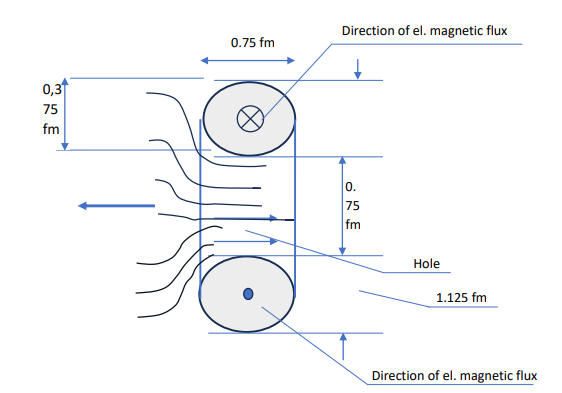
Figure 6: Quark structure (possible). Circulating Electromagnetic Vortices Create Compres-sive Forces Equal to Thousands of Tesla
Formation of the particles of the World We Perceive
Particles (compressed regions of space), formed by electromagnetic quanta, when entering the zone of maximum stretching of each other (zone of nuclear force action), are attracted by nuclear forces and form various compositions – different particles of the matter we perceive. By interacting with each other, these particles form compositions perceived by us as neutrinos, photons, nucleons, atoms, and molecules, which then form the entire diversity of the su rounding world. Each composition represents a set of electromagnetic quanta grouped in a specific way. Several examples:
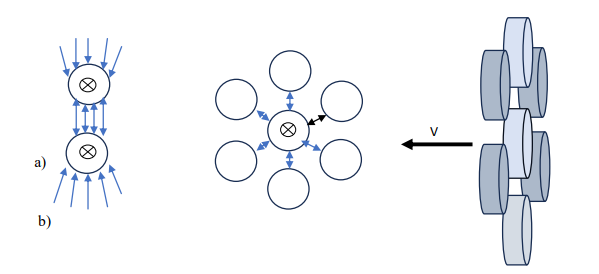
Figure 7: possible compositions moving through space at a speed of 3.104 km/s.
Composition b shows that there are at least seven particles moving at the speed of light
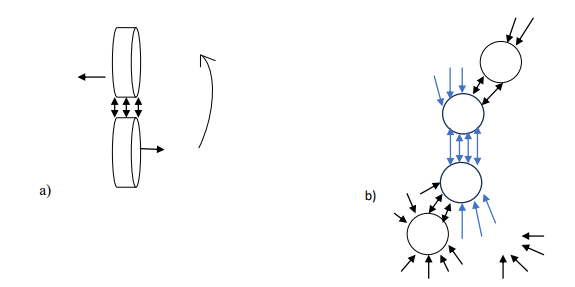
Figure 8: A Rotating pair of Quanta, not Moving through Space
Black Holes
It is known that two stars rotate around their barycenter. Between the stars, there is a point (center of mass), relative to which the stars attract each other with equal force, Figure 9a. In the simple case of two bodies, the distance from the center of the main object to the barycenter, r1, is determined as
where:
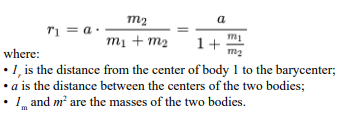
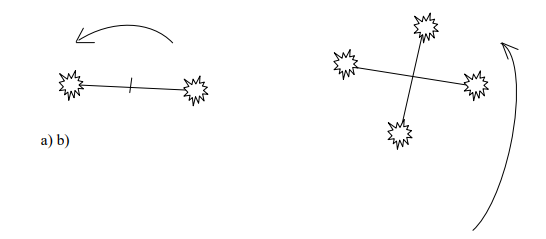
Figure 9: Rotation of Stars Around the Barycenter
Let us add another pair of stars to this pair, Figure 9b. Now, four stars rotate around the com-mon barycenter. We continue adding more and more pairs of stars. As a result, a spiral galaxy forms, in which all the stars rotate around a single barycenter, Figure 10.
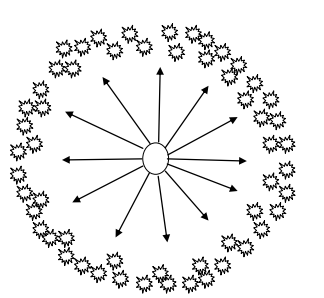
Figure 10: Stars Rotate Around the Common Barycenter. This Appears as Rotation Around One Very Large Mass.
It looks as if the stars are rotating around a very large mass, a mass that holds them on their orbits. The barycenter is the point where the tension of space (stretching of space, stress), created by the masses of stars — formed from electromagnetic quanta during the process of compressing space — is the same for any radially arranged pair and has a maximum value. The barycenter manifests itself as if it were a huge mass. In fact, the barycenter is a PSEU- DOMASS.
When all the stars formed by electromagnetic quanta are arranged in a circle, the tension of space (stress) occurs relative to a single common barycenter, relative to the center of the gal-axy, Figure 11.
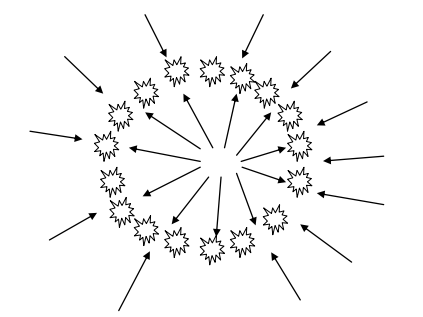
Figure 11: Tension of Space by Electromagnetic Quanta for The Formation of Galaxy Stars, Relative to The Common Barycenter. The arrows indicate the direction of the stretching of space. The point of greatest space stretching is the center of the galaxy. If all the arrows are rotated 180 degrees, they will indicate the direction of attraction acting on the stars, showing the direction of gravitational forces (attraction).
From the figure, it is clear that the greatest tension of space is at the center of the stellar formation. The magnitude of the space tension is the stress of space at each of its points.
Newton s Law of Universal Gravitation (Gravitational Constant)
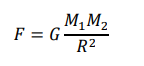
According to current understanding, the gravitational constant does not depend on the loca-tion where it is measured. Whether on Earth, the Moon, Jupiter, or any other body of any mass, whether it is measured on the surface of the body or at some distance from the surface, the value of the gravitational constant remains the same.
• The mass of a planet or the gravitational attraction of a planet (or star) does not, ac-cording to current understanding, affect the value of the gravitational constant.
• The intensity of the gravitational field also does not affect the measured value – the gravitational constant.
• That is, if we were to reach the mass at the center of a galaxy (a black hole) and measure it on its surface (if it exists) or at some distance from it (for example, not reaching the event horizon) using a torsion balance, the result should remain un-changed.
• Measurements above the surface of Earth, the Moon, or any other mass do not influ-ence the measurement result, according to current understanding.
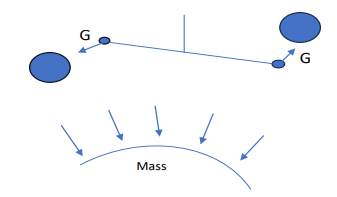
Figure 12: According to Modern Understanding, The Value of The Gravitational Constant Does Not Depend on The Location of Its Measurement. It is a fundamental physical constant of the universe.
Chapter 3, Gravitation, demonstrated that gravitational interaction arises as a result of the tension of space that occurs during particles formation. It arises during the formation of the observable (surrounding us), tangible form of the material world.
When two regions of space, compressed by electromagnetic quanta, interact, the tension of space between them attracts these formations (these particles), Figure 13.
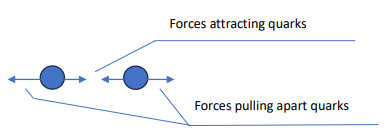
Figure 13: Gravitational Forces Between Quarks (Or Any Other Particles) Attract The Particles. Gravitational Forces Directed From The Interacting Quanta Are Directed To Break The Interaction Of The Formed Particles
• The tensions of space, directed from the particles, try to tear apart the formed interaction, the formed particle, the gravitational interaction.
• If a planet or star has formed, then stretched space arises around them.
• If one or two bodies (masses) appear in this space, around them their own space ten-sion forms, which superimposes on the background tension created by the planet or star.
The gravitational interaction of the Earth with the Moon, of two masses in the Cavendish ex-periment, or of any objects (masses) in the Solar System occurs against the background of the space tension created by the mass of the Sun, against the background of the space tension created by the center of our galaxy and all surrounding stars.
For example, the space tension in the region of the Sun, created by the assumed mass (pseu-do-mass) at the center of our galaxy, is:
Mass at the center of the galaxy (mass of the black hole) = 4.31.106 solar masses = 8.570435.1036 kg.
Distance to the region where the Sun is located = 2.46.1020 m from the center g=G.M bh. / (2.46.1020 )2 = 6.6.10-11.8.570435.1036/(2.46,1020 )2 = 9.347.10-15 N
The space tension created by the Sun at a point at the distance of 1.9.1016 km, located in the middle of the distance between the Sun and Proxima Centauri:
g=G..Ms / (1.9.1016 )2 = 6.6.10-11.1.9885.1030 / (1.9.1016 )2 = 3.635486.10-13 N
The obtained values of space tension correlate with the dimensionality of the gravitational constant in Newton’s law, measured by Cavendish near the Earth.
When calculating gravitational interaction between masses, the space tension at each specific region should be used.
From the above, one can conclude:
The gravitational constant is the space tension at a specific measurement point, formed by the surrounding masses. The gravitational constant is not fundamental. g is a variable quantity, depending on the sum of all masses surrounding a specific point in space.The intensity of the gravitational field (the space tension, the force stretching space) changes according to the in-verse- square law. It decreases inversely proportional to the square of the distance from the center of origin, and increases from a distant point toward the center, directly proportional to the square of the distance. If the space tension in the region of the Earth, or in the region of the Sun, equals 6.67.10-11, the space tension at the center of our galaxy will have the value:
g=£R2 = 6.6743.10-11.(2.46.1020)2 = 4.039019388.1030 N/kg.
This stretching force acts in all radial directions. It is the force with which the nearest stars are attracted to the center of the galaxy; it is the force with which the space tension breaks the bonds between molecules, atoms, nucleons, quarks, breaking them down to the elementary quantum. This intensity is created by the enormous space tension at the center of the galaxy.
It is the tension of the space substance, which appears as the attraction of a huge mass. Hence, the conclusion: the gravitational constant G is not a fundamental constant.
At different points in space, its value is different. G is the intensity of the gravitational field (space tension) at each specific point in space, created by the totality of distributed masses.
The same applies between nucleons. Nuclear forces (which are rapidly pulsating gravitational forces) prevent nucleons from flying apart, while the space tension around these nucleons is directed to break their bond. The space tension, the stretching of space (gravitational interaction), increases as the formed masses in a given point of space increase. When this space tension exceeds the gravitational force between nucleons, atomic nuclei will be torn apart. The intensity of the gravitational field is a characteristic of the space tension.
As shown, the intensity of the gravitational field increases toward the center of the galaxy proportionally to the square of the distance approached. When this intensity exceeds the forces binding atoms into molecules, the molecules will be torn into atoms. When the space tension exceeds the magnitude of the forces holding nucleons together, atomic nuclei will be torn into individual nucleons. When the space tension exceeds the forces forming partons (quarks), exceeding the “nuclear” gravitational forces holding quanta together, the formed, observable, tangible shape of matter will turn into a flow of radiation. This is observed in the central region of galaxies.
Heating of Stars
According to modern understanding, the energy for heating stars is released in the process of hydrogen nuclei fusion and their transformation into helium nuclei. As hydrogen is depleted, the amount of energy (heat for heating the star) decreases, which will ultimately lead to the cooling of the star, its transformation into a red giant, and further death. Chapter 3, Gravity, revealed that while forming matter perceptible to us from the substance of space, while com-pressing space into particles, around the compressed matter of space, it (space) stretches. The greater the formed mass, the greater the stretching force of space in all radial directions from the center of the formed mass (from the center of the formed object), the greater the gravita-tional attraction, and the greater the force directed toward tearing (!) the formed mass.
On the surface of the Sun, this force is 273.799 N. The radius of the Sun is 6.96.108 m. At the center of the Sun, the intensity of space (stretching forces) increases proportionally to the square of the approach to the center and equals: 273.799.(6.96.108 )2 =1.32 632 616 384.1020 N As one moves toward the center of the Sun, there is a region where hydrogen burns, turning into helium.There is a region where the intensity of space (stretching forces) tears helium atoms into hydrogen atoms. Hydrogen moves closer to the surface of the Sun and burns again, turning into helium.
No additional (external) energy is required to tear helium atoms – it is present inside the Sun. This is the tension of space; these are gravitational stretching forces. This cycle continues until the star is torn apart by entering a region where the stretching forces exceed the forces holding molecules, atoms, and nucleons together (a supernova explosion), or until the star merges with another star. Red stars are stars that have not accumulated sufficient mass.
The Matrix
Every particle, every object, every substance of the surrounding world represents an ordered, stable set of electromagnetic quanta forming in a given region of space the images perceived by us, their movements, their interactions, and their qualitative characteristics. This ordered set of electromagnetic quanta is a matrix. The surrounding world is not built from localized material particles. Matter does not move through space. Only ordered sets of electromagnetic quanta (matrices) move through space. Matrices form, in a given region of space, the images we perceive and touch, their qualitative characteristics, and their interactions. Each atom, each molecule, is a separate, independent matrix.
Conclusions
The surrounding world consists of space (a resilient, elastic substance) and electromagnetic quanta moving through space as transversely compressing waves at a speed of 3â??10⸠m/s in all directions. In the center of an electromagnetic quantum, as a result of the compression of space (the substance of space), a region of increased space density is formed. This region of increased density within the electromagnetic quantum is the elementary particle of the sur-rounding world. Matter does not move through space. The particles we perceive (volumes of compressed substance) are formed at the location of the electromagnetic quantum. Only electromagnetic quanta move through space.
Space density ρ – 1.037 037 037â??1013 g/cm3 – ρ – 9.5 251 992 720 350â??1013 g/cm3
Gravity is the force of space tension around a region of space compressed by electromagnetic quanta (the substance of space). Nuclear forces are the zone of maximum space stretching created by electromagnetic quanta. These are pulsating, high-frequency gravitational forces.
The formation of surrounding, perceptible matter occurs through the combination of electro-magnetic quanta into ordered arrangements. Black holes are regions of maximum space stretching arising during the formation (in the surrounding space of this region) of stars, plan-ets, comets, asteroids, and other objects. Inside a black hole, there is no mass in the form per-ceptible to us. The region of maximum space tension, spreading in all radial directions, mani-fests itself as a very large (enormous) mass. A black hole is a pseudo-mass.
The gravitational constant G in Newton’s law is not a fundamental universal constant. The gravitational constant is the intensity of space, created at each specific point in space by the surrounding stars, planets, and other objects. The heating of stars occurs due to the energy released when forming helium atoms from hydrogen atoms. Helium atoms, when moving deeper into the star, are torn by gravitational forces (space tension) into hydrogen atoms. When hydrogen atoms move closer to the surface (into a zone of lesser space tension), hy-drogen burning resumes. This cycle can continue indefinitely. Red giants are stars that have not accumulated enough mass. Every material object in the surrounding world represents an ordered, stable set of electromagnetic quanta. It is a Matrix.
Practical Confirmation of The Theory of the Universe
Abstract
It is noted that the observed fluctuations of the gravitational constant are correlated with the length of daylight hours (LOD) and the activity of the Sun. It is shown that fluctuations of the gravitational constant, fluctuations of the LOD, and the activity of the Sun are correlated with the cycles of Jupiter.
1. Fluctuations of the Gravitational Constant
After Henry Cavendish's experiment (using a torsion balance) to determine the gravitational constant G in 1797–1798, the measurement of this value continues to this day with greater and greater accuracy. The gravitational constant G is a key quantity in Newton's law of universal gravitation. Scientists are puzzled by the fact that the measurement results are always different. It was found that the change in the gravitational constant G occurs cyclically and corresponds to the 5.9-year period between the lowest value of G 6.672…(10-11 m3 s-2 kg-1) and its highest value 6.675…(10-11 m3 s-2 kg-1). It was found that the gravitational constant fluctuation periods corresponding to 5.9 years (P=5.899±0.062) correlate with the maximum and minimum of the solar activity, with sunspots periodicity, and with the length of day (LOD).
A positive increase in LOD values means a slower rotation of the Earth and, therefore, longer days.There is no answer to the question of what could be the cause of the observed change in G with the periodicity of 5.9 years and the phenomena correlated with it. However, all the observed (listed above) phenomena correlate with the cycles of Jupiter. Jupiter moves from aphelion to perihelion with a period of 5.9 years; its distance from the Sun, in this case, decreases (approximately) by one third. The observed phenomena also correlate with the period of 12 years – the time of a complete orbit of Jupiter around the Sun. They correlate with the intervals between the smallest and the largest values of G; however, scientists do not see a connection between the cycles of Jupiter with the observed changes in the gravitational constant G and other observed phenomena.
Chapter 3, Gravity, (The Theory of the Universe (Matrix), reveals that gravitational interaction occurs as a result of space tension that occurs in particle formation. Space tension occurs in the formation of the observable, tangible form of the material world. When two areas of space, compressed by electromagnetic quanta, interact, space tension between them attracts these formations (these particles). If a planet or a star is formed, extended space ten-sion is created around it. If one or two bodies (masses) appear in this space, their own space tension is created around them, superimposed on the background created by the planet or star.
The gravitational interaction of the Earth with the Moon, two masses in Cavendish’s experi-ment, and any objects (masses) in the solar system occurs against the background of space tension created by the mass of the Sun, by the center of our galaxy and of the entire stellar environment. This allows concluding the gravitational constant G cannot be a fundamental constant. Its value is different at different points in space. G is the tension of the gravitational field (space tension) at each specific point in space, created by the entire set of scattered masses. Space tension and stretching (gravitational interaction) increase with the number of formed masses at a given point in space.
Experimental Verification
To confirm that additional mass, appearing in the area of measuring the gravitational constant G, increases space tension and the value of G, in other words, to confirm the theory of the Universe, it is necessary to measure G while artificially increasing space tension at the point of measurement. For this purpose, the following experiment is proposed.
At a certain point, the gravitational constant G is measured using the traditional method – with the help of a torsion balance. Further, the measurement of G is performed by locating the torsion balance between two massive plates, Figure 1.
To Avoid any Doubts
The measurement of the gravitational constant has always occurred (and continues to occur) with the torsion balance placed between two masses – the Sun and the Earth (Figure 1).
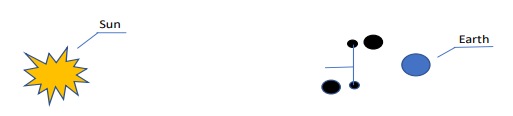
Figure 1: The Torsion Balance Is Located Between the Sun and The Earth.
The addition of two masses – between the Earth and the device and the Sun and the device – does not change the essence of the experiment (Figure 2).
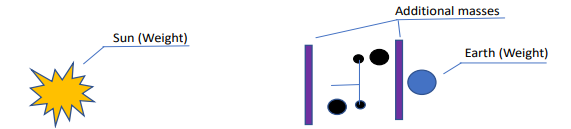
Figure 2: The Interaction of The Balls of The Device Is Affected by The Tension of Space Created by The Sum of The Masses
Massive plates create additional space stretching and tension. As a result, the gravitational constant G, at the point of its measurement, should increase. An increase in the measured value of the gravitational constant will confirm the Theory of the Universe and answer all the questions, dating back to more than two centuries and related to the observed 5.9-year (12-year) cyclical fluctuations – the gravitational constant, the LOD change, fluctuations in solar activity, and sunspots cycles.
The massive plates are to be made of non-magnetic materials (copper, tin, lead, or brass).
There are no other experiments that give answers to the questions the scientific community faces.
P. S.
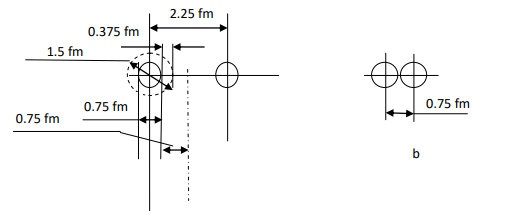
Figure 5
• Half the distance between nucleons (their centers), at which nuclear interaction is absent, is the distance to which the tension of space has spread during its compression by moving electromagnetic quanta in the process of forming the contents of the nucleon.
• Half the distance between the surface of the nucleon and the point to which the tension of space has spread is the distance at which the electromagnetic quanta forming the nucleon’s contents compress space. From that point in the opposite direction, space is stretched.
• Thus, the diameter of the sphere compressed by electromagnetic quanta to form the particles composing the nucleon is D = 1.5 fm.