

International Journal of Forensic Research(IJFR)
ISSN: 2767-2972 | DOI: 10.33140/IJFR
Impact Factor: 1.9

Review Article - (2021) Volume 2, Issue 1
The Study of Elucidation of Baiga Tribes of Madhya Pradesh
2Assistant professor, Economics, Govt. P. G. College, Ranikhet Almora, Uttarakhand, India
Received Date: Dec 26, 2020 / Accepted Date: Dec 30, 2020 / Published Date: Jan 21, 2021
Copyright: ©Copyright: ©2021 Abhimanyu kumar. This is an open-access article distributed under the terms of the Creative Commons Attribution License, which permits unrestricted use, distribution, and reproduction in any medium, provided the original author and source are credited.
Citation: Abhimanyu kumar*1 and Parul Bhardwaj2. (2020). The Study of Elucidation of Baiga Tribes of Madhya Pradesh. In j Fore Res, 2(1), 46-48.
Abstract
This paper is related to theoretical base to understand the way in which the A tribe is viewed, historically or developmentally, as a social group existing before the development of, or outside states. A tribe is a distinct people, dependent on their land for their livelihood, which are largely self-sufficient, and not integrated into the national society. Tribal’s have several sub -groups all of them known as “tribal society.” According to Oxford Dictionary a tribe is “a group of people in a primitive or barbarous stage of development acknowledging the authority of a chief and usually regarding them as having a common ancestor”. The Baigas believe themselves to be descendants of Dravid & As the name advocates, these are that society of the Gonds who fall in the priest class. It entails that they indulge into magical activities and boast about being knower about the evil spirits. Chiefly in the Mandla, there is a special settlement in the small tract of Baiga Chak. Besides practicing agriculture, they are passionate woodsman and hunter. Some of the other small sects that too fall in this category are the Pradhans, Korkus and Kols. This backward tribe of Baigas is found in Mandla, balaghat, Shahdol & Sidhi District.
Keywords
Tribe, Culture, Social Values, Development, Agriculture
Introduction
The term tribe commonly signifies a group of people speaking a common language, observing uniform rule of social organization and working together for common purpose. A tribe ordinarily has a leader and may have common ancestors as well as a patron, deity, the families, or small communities making up. The tribes are linked through economic, religious, family or blood ties A tribe is a collection of families bearing a common name, speaking a common territory and is not usually endogamous though originally it might have been so.
Encyclopedia Britannica defined “tribe” as the families or small communities that constitute or said to trace their decent from a common ancestor. The Webster’s third new international dictionary, among its several definitions, describes a tribe as “an endogamous social group held to be descended from a common ancestor and composed of numerous families, exogamous clans, bands or villages that occupies a specific geographic territory possesses cultural, religious and linguistic homogeneity and is commonly united politically under one head or chief.
The tribe also has a cultural boundary, much less well-defined, and this is the general frame for the mores, the folkways, the formal and informal interactions of these members” [1]. Hoebel opines that “a tribe is a social group speaking a distinctive language or dialect and possessing a distinctive culture that makes it off from other tribes. It is not necessarily organised politically” [2]. Majumdar gives an elaborate definition, which can be applied to the ground realities to distinguish tribes from non-tribes. He describes tribe as “a social group with territorial affiliation, endogamous, with no specialization of functions, ruled by tribal officers, hereditarily or otherwise united in language or dialect, recognizing social distance with other tribes or castes without any social obloquy attaching to them, as it does in the caste structure, following tribal traditions, beliefs and customs, illiberal of naturalization of ideas from alien sources, above all conscious of a homogeneity of ethnic and territorial integration” [3, 4].
Theoritical Perspactive of Baiga Tribes
The Baiga tribes of Madhya Pradesh are the scheduled tribes as per the prerequisite of the Constitution of India. The tribes of Madhya Pradesh have ranked in the top in terms of the tribal population. In addition, these tribes of Madhya Pradesh are subgroups into numbers of castes, which too have got high proportion. The tribes of Madhya Pradesh population constitute over 20% of the state population and are mainly concentrated in southern part of the state. The life style, culture & customs of this community mostly resemble the Hindu religion though they still strongly believe in orthodox traditions. The social customs prevalent among different types and castes very more due to variations in their habitat & surroundings geographical conditions for earnings they depend upon agriculture, forest produce & local craft. With improved communications and growth in the economy, the tribe’s way of living has changed from their original hunting and gathering existence to one near the mainstreams. The Baiga have been the forest-dwelling aboriginals from central India who claim to be harbingers of the human race and history in India, as it emanated from the conjugation of the Nanga (nude) Baiga as the Indian Adam and the Nangi (nude) Baigin (female Baiga), as the Indian Eve, who were the rightful progenitors of Indians. Baigas always believed that they were the chosen few who were hand-crafted by the God Himself and hence were the kings and rulers of the whole earth. They called God the Bhagwan or Bada Dev (big deity). They may have lived in Central India at least for 20,000 years. They practiced Bewar, a shifting, slash and burn method of growing crops. And hence the non-Baigas called them Bewadias, the practitioners of Bewar. It seems over the years, by the medieval period, Bewadia got its name distorted and was called by its derogatory name of Baigadia — those people who destroy land and forest by burning. By latter medieval times Baigadia shed the last three letters and became Baiga — by which name this community is still addressed and identified Seven sub-castes of the Baigas are: Narotias, Binjhwars, Barotias, Nahars, Rai Bhainas, Kadh Bhainas and Kath Bhainas. However, the author found that Narotias, Barotias and Bhainas account for 80% of all the Baigas from Madhya Pradesh (MP) and Chhattisgarh states. In a small village, outside Baiga-Chak, author found a few households of Dudh Bhainas and Kurka Bhainas also. Besides, there are at least 90 surnames that they use. Dhurve, Maravi, Rathudiya, Kohadiya, Kushram, Nadia, Nigunia and Nagvasia are their eight most common surnames. There are three versions of the origin of the Baiga tribal community. One school of thought suggests that they actually emerged from the ancient stock of the Santhal tribe. The second says that they emerged independently, but their ancestors had been the close kin of the Gonds.
Geografical Distribution of Baiga Tribes
Tribes in India are concentrated in certain geographical area. About two-third of the total tribal population of India are found in the fire states of Madhya Pradesh, Jharkhand, Orissa, Bihar, and Maharashtra. The highest number of tribals is found in MP in Mizoram, Nagaland, Meghalaya and Arunachal Pradesh, the tribal’s constitute 70% to 95% of the total population.
The Tribal Zones
The tribes in India are not found in any one particular region alone, but distributed in among the various states. B.S. Guha has given a threefold territorial distribution of the tribals.
1. The North and North-Eastern zone.
2. The Central or the Middle zone.
3. The Southern zone
C.B. Mamoria adds to this list as a fourth zone, consisting of Andaman and Nicobar Islands. The North and North-Eastern zone consists of the Sub-Himalayan region and the hills and mountain ranges of North Eastern frontiers of India. The tribals of this zone mostly belong to Magnolia rare and speak languages belonging to the Tibetan-Chinese family. This zone is inhabited by tribes such as, Gerung, Limbo, Khasi, Garo, Naga, Mikir and so on. It is estimated around 13% of the tribes in India is found in this zone.
The tribes of Central Zone are scattered all over the Mountain-Belt between the rivers Narmada and Godavari. It includes West Bengal, Orissa, Bihar, Gujarat, MP, Maharashtra, Jharkhand, and some parts of UP. The main tribes of this zone are the Gond, Munda, Baiga, Bhil, Santal, Juong and so on. 80% of the tribal population resides in this area The South Zone falls of the river Krishna. It includes AP, Tamil Nadu, Karnataka, Kerala, and the two union territories Andaman and Nikobar Islands and Lakshadweep. Tribes of this zone are regarded as the most ancient inhabitants in India. This zone consists of the Tribes like Kota, Kurumba, Kadar, Paniyan, and so on. This zone contains around 6-5% of the total tribal population. The main tribes in Andaman and Nikobar Islands are Jarwas, Nikobarese and Andomanese. Base on cultural factors and cultural contacts, Ghurye classifies Indian tribes into three classes. Firstly, the groups recognized as members of fairly high status within Hindu Society; Secondly the large mass that has been partially Hinduised and come in closer contact with the Hindues; and thirdly the hill tribes, which have exhibited the power of resistance to the alien cultures that have pressed upon their border.
Social Life of Baiga Tribes
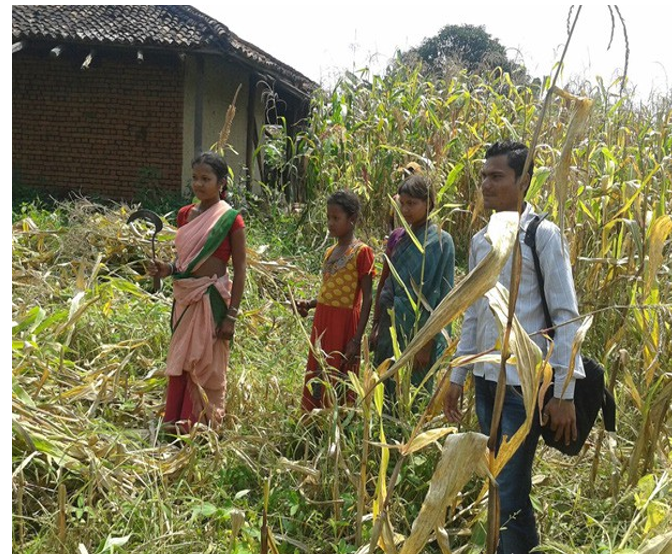
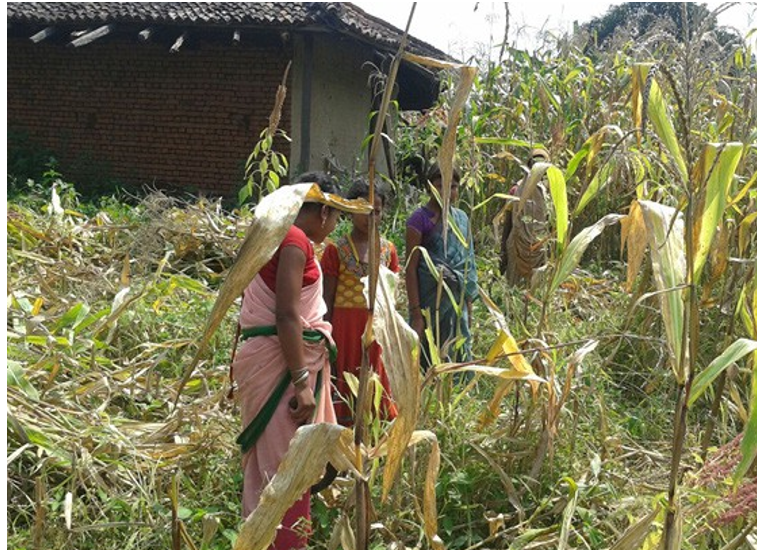
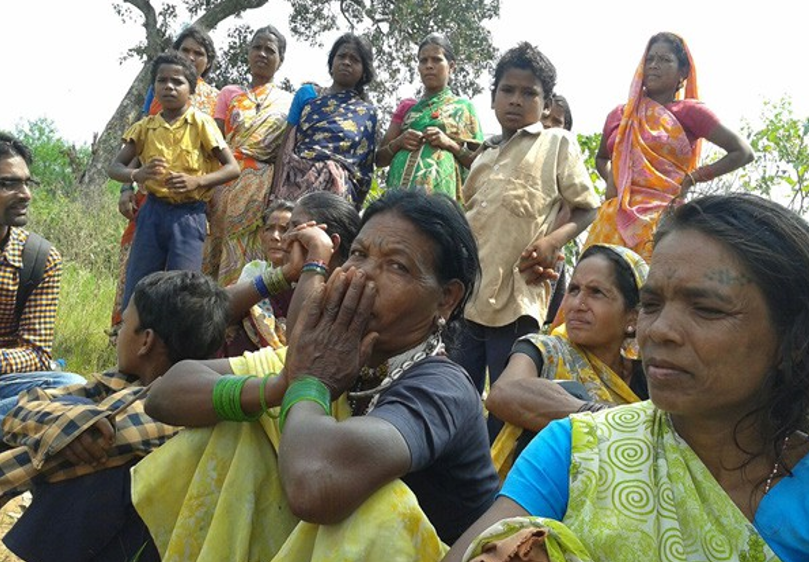
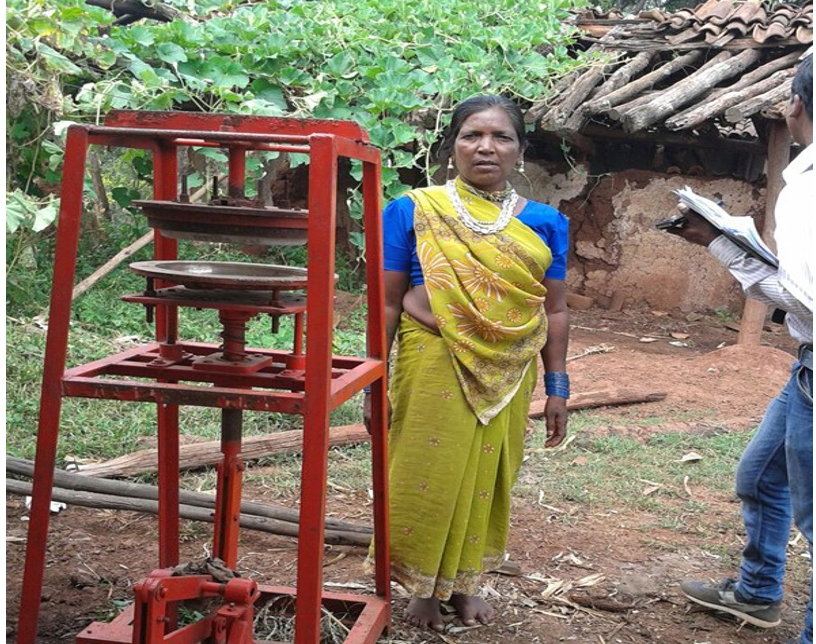
Baiga tribal women are generally busy the whole day. Since get up early in the morning first they complete their routine work and cook the food for their family members. After cooking and eating small food they move towards their farm where they work. Generally, they grow rice, maize and vegetables in their farm. Sometimes Baiga tribal women have their small children with themselves if nobody is at home to look after them at the houses. Generally, their cultivated land is around their house or it can be said that they build their house in their farm houses where they can work easily and manage their houses too.
Conclusion
Baiga tribe have their farm in front of their houses. They grow banana, mango and custard apple in front of their houses. Rice and maize are the most suitable crops from their type of the land. All women work in the field. Baiga tribal women are supposed to maintain the grain for the offseason. Rice and maize and other gains are made to dry in sunlight and are kept in dry place inside their houses. They make a big chain of maize grain and hang them to use after the season. These are used by them in offseason. Women are equally engaged in farming as their male counterparts.
References
- SC Dube (1977) Tribal Heritage of India, Vikas Publications, New Delhi 1977: 2.
- Andre Beteille (1977) “The Definition of Tribe”, in Romesh Thapar (ed.), Tribe, Caste and Religion in India, Macmillan Company ofIndia Ltd 1977: 7-8.
- EA Hoebel, LP Vidyarthi, BK Roo (1977) The Tribal Culture of India., Concept Publishing Company Delhi 1977: 167.
- DN Majumdar (1985) The Eastern Anthropologi.st, September-November.