

Advances in Theoretical & Computational Physics(ATCP)
ISSN: 2639-0108 | DOI: 10.33140/ATCP

Research Article - (2025) Volume 8, Issue 2
The Secret of Electrons in the Induction of Electric Current According the Theory of New Axioms and Laws
Received Date: Apr 03, 2025 / Accepted Date: May 23, 2025 / Published Date: Jun 02, 2025
Copyright: ©2025 Valentina Markova. This is an open-access article distributed under the terms of the Creative Commons Attribution License, which permits unrestricted use, distribution, and reproduction in any medium, provided the original author and source are credited.
Citation: Markova, V. (2025). The Secret of Electrons in the Induction of Electric Current According the Theory of New Axioms and Laws. Adv Theo Comp Phy, 8(2), 01-10.
Abstract
The Theory of new Axioms and Laws contains 2 new Axioms and 8 Laws and it is invented by the same author. The classical axiom (Maxuell 1864!) states that the vortex which has constant velocity is closed. It describes very satisfactory the Classical Field Theory. The new Axiom1 clams that the vortex with variable velocity is always open. The new Law1 claims that in electron a decelerating transverse open vortex (in 2D) in direction from outside to inside generates in its center a perpendicular accelerating longitudinal vortex (in 3D).
The negative acceleration in decelerating transverse vortex causes the electron to look like an eccentric toroid. The center of body moves from Geometric center to a the Gravity center. The eccentric electron has an open enter of its decelerating transverse vortex. In induction, this open eccentric toroid is struck several times from the outside inward by a force vector of a Magnetic field. Thus the electron twists and rolls so that it finally stands perpendicular to the external impact and sticks to it at the point of maximum eccentricity.
This means that electrons arrange their own perpendicular axes to be parallel to outer Magnetic lines. These parallel axes stand at minimal distance from e ach other. In this point of maximal electron eccentricity the distance to the external shock is minimal is called the sensitive point. It is located in the second quadrant in the (x,y) toroid of electron and in the uppermost position of the (z) coordinate of its body.
Thus the electron does not stop rotating in 3D until it moves its sensitive point to a minimal distance to the external hit. This process is named falling of the electron to a potential hole where the Potential Energy is minimal.
The existence of phenomena of Induction is direct evidence of exactly this structure of the electron described by the Theory of new Axioms and Laws. The inner structure of the electron in form of open decelerating very eccentric vortex is the reason an electron to react with such sensitivity to the external Magnetic impact. It is amazing that the electron does not stop rotating until finds and falls in the potential hole. Therefore the electron reacts of hit of external Magnetic line similar to a live particle possessing some internal software and external reflex.
These properties of electrons can be used to construct an electric current generator without rotation using nano-lattices.
Introduction
The article uses the conclusions from the new Axioms and Laws developed by the same author. With their help and as a result of many years of researches, the author has proved what can be the approximate shape of the elementary particles and in more particular of the electron [5-9].
The Classic Axiom
It is known that the Classic Field Theory is based by Maxwell’s Laws (1864) and on a single Classic Axiom (Figure 1a) [1]. It states that:
div rot E = 0. 1.
The previous studies by the same author attempt to expand the Classic Field Theory to a more general Theory of Extended Field. That is why the author change (a little) this previous Classic Axiom. The new Axiom claims that the movement of a vector E in an open loop (div rot E ≠ 0) or an open vortex (div V or E ≠ 0) is unevenly or velocity is always variable. (Figure 1b, c, e).
New Axiom 1
The motion of vector with monotone-decreasing or monotone- increasing velocity becomes along an open vortex (Figure1b) [2- 4].
div (VotE) ≠ 0 for vector E in 2D, 2a)
or div(VotH) ≠ 0 for vector H in 3D.
This open vortex can be accelerating or decelerating with positive or negative acceleration:
div (Vor E)> 0 for 2D, div (Vor H)> 0 for 3D. 2b)
div (Vor E) <0 in 2D, div (Vor H) <0 for 3D.
Result: The main result of Axiom 1 is that we receive 4 types of vortices: a cross vortex in 2D (E 2D) that can be accelerated (E 2D +) or decelerated (E2D -) and a longitudinal vortex in 3D (H3D) that can also be accelerated (H3D +) or decelerated (H3D -) (Figure1b,c) [3,4].
We are accustomed to the wrong image of a spiral with a constant distance between the turns. But it is “unreal” and wrong spiral.
Result: If it is a spiral, it must be opened spiral and it must be a uniform with variable velocity and acceleration.
Because positive acceleration the distance between spirals decreases. Because negative acceleration the distance between spirals increases. The reason is in the acceleration.
Result: The open monotonically varying vortex is eccentric. For example: In “real” decelerating vortex E1> E3. Therefore the Geometric Center (O) will aim to move to the larger vector E1(up). In the same vortex E3> E4 and at the same time. Therefore the Geometric Center(O) will aim to move to the larger vector E3 (to the left) (Figure1b). Therefore, the Geometric Center will move to a second quadrant or to the Gravity Center (Figure 1e) [5].
Result: At every (i) point p(i) of a decelerating cross vortex E there are two simultaneous movements: velocity vector (-V) and amplitude of the cross vortex (-W).
The two simultaneous movements (V and W) also exist at all points of the vortex. The reason is that the transverse vortex (E2D -) is transformed into a longitudinal vortex (H3D+). This is described by a specific operator (Δ1) for cross-longitudinal transformation (Law1) that is described further (Figure 1c).
Preliminary Introduction: The Theory of Extended Field is more general theory and consists of 2 Axioms and 8 Laws. The new Theory leads to the following generalized results: evenly movement is replaced with unevenly movement (decelerating or accelerating) or movement in a closed loop is replaced with movement in an open loop or vortex (Axiom1); The electron and proton are mutual orthogonal particles that work in resonance (Axiom2). The movement in 2D is transformed into the movement in 3D as a cross vortices in 2D generates a longitudinal vortex in 3D through a special transformation (Law1). The longitudinal vortex in 3D through another special transformation generates the cross vortices (Law2), During its movement the decelerating vortex emits primary free cross vortices (Law5), while accelerating vortices suck in the same primary free transverse vortices (Law6), [2-4].
New Axiom2
According Axiom 2, the electron and proton are connected as mutually orthogonal vortices by bond of accelerating-decelerating longitudinal vortex and they operate in master-slave mode; The electron and proton are mutual orthogonal particles that work in resonance.
Law1
a) Law1 for Electron (Figure1e)
The open decelerating cross vortex (E2D -) moves from outward- inward to the center (in plane 2D) and generates an perpendicular an open accelerating longitudinal vortex (H3D+) upward (in volume 3D). The action takes place from the center of decelerating cross vortex (E2D-) through a transverse -longitudinal transforming operator (Δ1-):
Δ1-
Vor (E 2D -) => Vor (H 3D +) 3.
Actually it describes in 2D the model of electron as the decelerating inward vortex (Figure1c).
b) Electron with “Expanded Transverse Vortex” - External Electrons (Figure1g)
Because acceleration of transverse vortex is small and has direction from out to in then every electron of this type appears as an “expanded transverse vortex” with big radius. Thus its longitudinal vortex in center is short. Surely this type of electron rotates at outside orbits (orbitals).
c) Electron with “Shrunk Transverse Vortex” –Internal Electrons (Figure1f)
Because acceleration of transverse vortex is big and has direction from out to in then every electron of this type appears as an “shrunk transverse vortex” with small radius. Thus its longitudinal vortex in center is long. Surely this type of electron or rotates at internal orbits (orbitals) or exists inside of the atom as bonded electron.
d) Free Electron
The decelerating transverse vortex of free electron is broken because of big distance to its own-paired proton. The fast ingredient radiates from the center of the accelerating longitudinal Funnel that is generated by free electron (Law1). It connects to the center of decelerating longitudinal Funnel at input of its bonded proton (Axiom2). Thus the free electron is not connected to its proton by transverse vortex. Free electron connects to its paired proton only by longitudinal vortex (Figure1g).
There is a significant difference in mass of a bound electron and a free electron.
For Example: Scientists measure the mass of a free electron which has “expanded” decelerating transverse vortex .The mass of electron with “expanded” decelerating transverse vortex is bigger than the mass of bound electron. The bound electron has much less mass than the mass of free electron.
Law5
Law 5 for electron (Figure1d): The deceleration vortex in 2D is described with a system of 2 equations in which: longitudinal velocity (V) decreases in (n) portions (ψn) times; the amplitude (W) increases in (n) portions (ψ n) times:
I V(t) 2= V (V – V(t)) 4
I W(t) 2 = W (W +W(t)),
where vn, wn are periodic roots with period n; vn, wn are mutual orthogonal that fulfill the requirement for orthogonality:: vn .w n = V 0.w 0, v n.ω n = V 0.W 0; n = 0 ÷ ∞; the roots vn, wn are expressed as: vn = (1/ψn).Vo , ωn =ψn.Wo ; linear velocity V0 is the starting value of Vn, amplitude of cross vortex Wo is the starting value of ωn,; ψ is a proportional that fulfills the requirement: ψ-(1/ ψ ) =1; Vn are uneven(decelerated) and V(t) is nonlinear (Figure 1d).
For Example: The electron is formed by an open transverse vortex (Axiom1) (Figure 1b). The transverse vortex, delayed from the outside-in, generates an accelerating longitudinal vortex from the center-out (Law1) (Figure 1c). The decelerating transverse vortex emits primary decelerating vortices which warm the inner side of electron. It is proved because of negative acceleration the decelerating vortices emit warm from itself to outward (Law5, Figure1e) [5,6,9].
Structure of Electron According New Axioms and Laws and Induction
Electron is an Eccentric
According Axiom 1 every non uniform vortex with monotonically varying speed appears an open vortex. In the case of an electron the vortex is decelerating from outside to inside, so it is an open vortex which is deformed to eccentric vortex. It is obviously that the velocity vector at the entrance E1 is greater than the velocity vector E2 at the opposite point. Therefore, the spiral will move up to the bigger vector E1 or to higher speed. And the next velocity vector E3 is greater than the velocity vector E4 at the opposite point from the left. (Figure1b). Therefore, the spiral will shift to the left to the higher speed. Thus, the whole spiral shifts up and to the left to second quadrant. Therefore the spiral of the electron changes from centric to eccentric (Figure 1 c).
Result: The whole open decelerating transverse vortex of electron shifts up and to the left to second quadrant.
This means that the center of the spiral moves from the position of the Geometric center (O) to up and to the left towards a new center in second quadrant, called the Gravity center (F).
Electron has Eccentricity vector (OF) that rotates it
The distance between the Geometric center and the Gravity center determines the magnitude of the Eccentricity vector (OF) (Figure 1b). Its projection on x-axis has direction to paired proton and repels electron from its proton Result: The Eccentricity vector (OF) has a projection on x-axis which repels electron from its proton.
This means also that the Eccentricity vector (OF) determinates the distance between the Geometric center (O) and the Gravity center (F). At the same time the Eccentricity vector (OF) has a project on y-axis. It has direction to left and it rotates electron around proton to left.
Result: The Eccentricity vector (OF) has a projection on y-axis which rotates the electron around its proton from wright to left.
The reason is that the Geometric center (O) moves to the Gravity center (F) which is located in second quadrant.

Figure 1: Description of an Electron (e-).
Figure 1a) Classic field as closed loop
Figure 1b) New field as open vortex
Figure 1c) According Law1 a decelerating cross vortex out-in generates accelerating longitudinal vortex in center
Figure 1d) According Law5 a decelerating vortex with decreasing velocity emits decelerating vortices with decreasing amplitides,Figure1e)Structure of electron as eccentric transverse vortex
Figure 1f) Bounded electron with min eccentricity
Figure 1g) Free electron with max eccentrity.
Visible or Invisible
a) Transverse Vortex can be Visible
According to the Axiom1, transverse (in 2D) and longitudinal (in 3D) vortices are obtained. The pulsating transverse vortices in the body of the “expanded” external electron and “expanded” external proton are visible to an external observer. The reason is that the sun rays are also transversely and when they reach to transverse vortices of electron and proton they reflect on some angle in opposite direction.
Result: The sun rays reach to transverse vortices, reflect in opposite direction and the transverse vortices become visible.
Result: The expanded external electron and proton are always visible but shrunk internal electron and proton are almost invisible.
But unlike the transverse ones, the longitudinal vortices do not reflect the transverse waves of the Sun's rays. Reaching the thin thread of the longitudinal vortex, the transverse waves diffract. This means that transverse wave bypass the longitudinal vortex and continue in their previous direction and with their previous speed. .According Axiom 2, the electron and proton are connected as mutually orthogonal vortices by bond of longitudinal vortex and they operate in master-slave mode.
b) The Longitudinal Vortex is Always Invisible
The sun rays always diffract around the thread of longitudinal vortex .They form of bypass the longitudinal vortex. The reason is that sun wave is transverse wave and it does not reflect in longitudinal vortex .It always make diffraction around its longitudinal thread and continue in their previous direction and with their previous speed.
Result: The transverse wave of sunrays diffracts in form of bypass the longitudinal vortex.
Therefore, the bond between the electron and the proton is invisible to an outside observer.
Result: The longitudinal vortices are always invisible.
The electron and the proton are visible but the connection between them is not visible. And the longitudinal vortex generated by the electron's Gravity center is also not visible (Figure1 c,d) (Figure2, Ho,He,Hre).
Result: The link between electron and its paired proton is always invisible.
According to Law 1, an accelerating longitudinal vortex perpendicular to the plane of the transverse vortex is generated at the Gravitational Center of the decelerating transverse outside-in electron vortex. This longitudinal accelerating vortex in Gravity center is also invisible to an external observer because it reacts with diffraction of the transverse wave of Sun light.
Result: The longitudinal vortex in center electron body and perpendicular to electron plane is always invisible.
Therefore the electron and the proton are visible but the connection between them is not visible. Also the longitudinal vortices generated by the electron's Gravity center are not visible.
The Phenomenon of Induction
The Mode of Induction of Internal Electricity Wave in Condition of Movement of Conductor and External Magnetic Field
a) The Main Principle of Theory of New Axioms and Laws to Describe Matter (Including the Electron)
All Classic current knowledge describe the matter only from the outside - what is the wave length, width of packet, dispersion, statistical distribution, quantity and quality of particle, spectrum analysis, etc. The Classical sciences describe the matter only from the outside, but it does not explain the reasons, the internal structures and links: why, how and what is the essence.
Result: The Classical sciences describes the matter from outside.
Because the previous knowledge describe the matter from outside this description does not reach to the inner side - to the causes, to the driving forces, to the internal structure which includes the driving forces, to the internal logic of processes. But in opposite- the Theory of new Axioms and Laws describes the matter only from inside.
Result: The Theory of new Axioms and Laws describes the matter from inside.
This means that the offered new Theory describe and explain internal structure of matter, of elementary particles, of Universe and the reasons and links for it.
Let's look at the reason electrons conduct electric current. Let's recall and summarize that the electrons exist in the metal lattice as free electrons. Because electrons are in free mode they are bulged along a transverse component (maximal radius) and shrunk along a longitudinal component (minimal perpendicular vortex) (Figure 1e). According Axiom1 the decelerating transverse vortex is the reason the electron to be a strong eccentric.
b) The Eccentricity Electrons Pulsates in Time (T/2)
Because electron pulsates in time (T) during half-period (T/2) electron when it shrinks electron emits Electricity wave to all directions to environment.
Result: During half-period (T/2) when electron shrinks it emits internal Electricity wave to all directions to environment.
The eccentricity is such that Geometric center (O) moves to second (II) quadrant in (x, y) coordinate system and calls Gravity center (F).This means that the Gravity center (F) is placed inside first half of electron toroid. During the contraction of this eccentric electron toroid, it emits a transverse wave with greater amplitude from its side that has longer distance to Gravity center (F) than from the side with shorter distance to Gravity center (F).
Because electron pulsates in time (T) the Eccentricity vector (OF) also pulsates in time (T).
Result: The length and angle of the Eccentricity vector pulsates in time (T).
The projection toward x-coordinate of Eccentricity vector (OFx) of electron determines the distance to its paired proton.
Result: The pulsating Eccentricity vector has projection to x-coordinate that is equal to the distance to proton and it change orbit from circle to ellipse.
The projection toward y- coordinate (OFy) determines the rotation speed of electron around its paired proton in nucleus.
Result: The pulsating Eccentricity vector has projection to y-coordinate that is equal to magnitude of vector that rotates electron around its paired proton in nucleus and it participates in changing the orbit from circle to ellipse.
In the metal lattice the electrons are free and mobile but protons but (Axiom2) bound to the nuclei of atoms and are actually stationary. According of Law1 and Law5 from new Theory, the electron (e-) is eccentric as in plane (x, y), so in volume (x, y, z) (Figure 1e). Thus the electron looks like an eccentric in all coordinates (3D) toroid (Figure 1e).
Definition: If we continue the (OF) connection it will intersect the line of the toroid at 2 points: The distance from the first point to the Gravitational center is much less than the distance from the second opposite point to the Gravitational center (not Figure). Thus the first distance is named minimal distance: D min. The second -opposite distance is named maximal distance: D max.
c) The Direction of Resultant Internal Inducted Electricity Wave
In one half-phase (T/2) the free electron expands in plane (x, y). In next half-period (T/2) electron shrinks. During contraction electron emits Electricity wave to environment.
But because electron is an eccentric body during half-period (T/2) contraction it emits a transverse Electricity wave with greater amplitude from the side which is in more distance (Dmax) to the Gravity center (F) than from i side which is in less distance (D min) to the Gravity center ( F).
Result: The eccentricity of body of electron and its contraction in time (in half period T/2) are the reason the electron to emit internal Electric wave with more amplitude to the direction that eccentricity is maximal (Dmax) than to the opposite direction, where eccentricity is minimal (Dmin).
It is need to subtract the less wave (Dmin) from the bigger wave (Dmax). After subtracting the two waves we obtain the Resultant Electricity wave. The electron emits internal Electric wave with more amplitude to one end of Conductor that accumulate negative charge (-). Therefore the Resultant Electricity wave must accumulate in one end of Conductor negative charge (-) of electrons. While the opposite end has lack of electrons and is similar to be positive charge (+).
Result: The eccentricity of body of electron and its contraction in time (in half period T/2) are the reasons the Resultant internal Electricity wave to move and accumulate negative charge (-) of electrons only in one end of Conductor.
These results and conclusions are obvious and naturally follow from the internal structure of the electron. For example, the electron is an open vortex forming a thin toroid, eccentric in 3D with an open entrance, which connects it to its paired proton, etc. The internal structure of the electron directly affects its external behavior.
Behavior of Free Electrons
It is well known that the velocity of internal Electricity wave is equal to light speed (c), but velocity of physical movement of body of electron is of the order of cm / min.
a) Properties of Free Electrons
According to Law 5, for free electron the decelerating vortex from outside to inside emits transverse primary decelerating vortices in direction from periphery to center of toroid. They fill the body of the toroid with decelerating transverse vortices carrying heat (Figure 1e).Therefore, the free electron emits from periphery to inside transverse primary decelerating vortices which fill the body of the toroid with heat.
Result: The central part of toroid body of free electron is full of warmth.
For Comparison: The protons bound in pairs with these electrons look like a dense spheres and have cold nuclei (not Figure) [9,10].
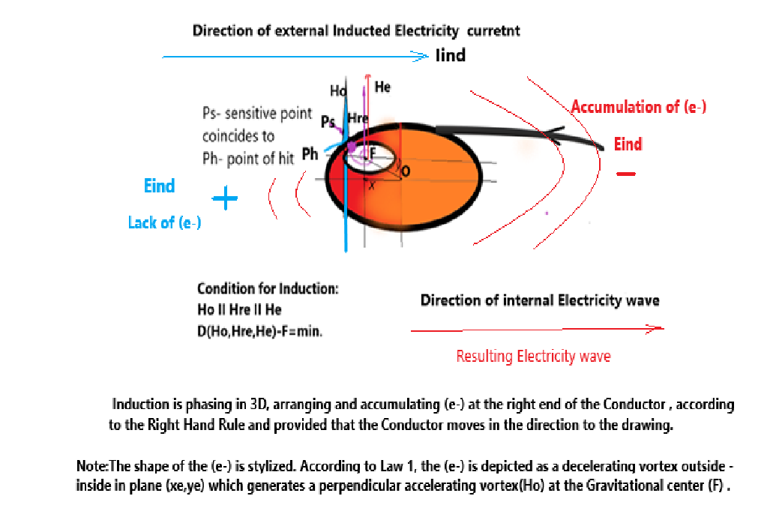
Figure 2: Model of Electron (e-) and Reaction to Outer Hits (Ho) in Phenomena Induction.
b) The Mode of Work of Free Electron - Without Transverse Link to Paired Proton
According Axiom1, the free electrons are maximally inflated and therefore the Gravity center (F) is located maximally low and close to the x-coordinate. When in this point the Eccentricity vector is decomposed the length of its x-projection is a maximal or the radius of electron body is maximal.
Result: The free electrons have maximal x-vectors and the maximal Repulsing Force to nucleus, but they have minimal y-vector and angular velocity around nucleus tend to zero.
According Law1 when the free electron are maximally inflated with biggest radius then it has the least longitudinal vortex perpendicular to plane of electron body. This is a critical point at which the transverse vortex stretching is such maximal and the length is such maximal, that finally this transverse bond breaks.
Result: The free electrons breaks their transverse vortex to their own paired protons.
The free electrons have broken their transverse bonds and behave and control from their respective master- protons only along bonds of longitudinal vortices.
Result: The free electrons are connected to their paired protons only by their longitudinal vortices. The free electrons take that very eccentric and bulging form from the last orbit of the atom from which they flew out outside the atom. They are governed both in space (place) and in time (pulsation) only by the longitudinal vortex along the z-coordinate. Electron pulsates in time (T) (in phase) respectively to pulsation of proton.
Result: The free electrons are governed at space (S) and in time (T) only by the size (the magnitude) and by the pulsation of longitudinal vortex.
According to Law 1, during the expanded phase of free electron is generated a perpendicular longitudinal vector (which has much smaller height) in the Gravitation center of the transverse vortex (which has much larger radius). This is how the body of the free electron is formed as an inflated toroid (Figure 1e).According to Law 5 for free electron, the decelerating vortex from outside to inside emits transverse primary decelerating vortices in direction from outside to inside. They fill the body of the toroid with heat vortices (Figure 1e).
Result: The free electron has form of maximal eccentric, maximal inflated toroid with maximal radius with hot internal volume and bigger mass than the bonded electron. Therefore the free electron has different links, form and mass than the bonded electron.
The Newton’s Reaction of Free Electron in Case of External Impact
According the Modified Newton’s Law for rotating whipping –top follows that:
If a rotating body or whipping -top (rotating left or right) is struck from outside and depending on the direction of rotation the body bounces on its axis (up or down) according to Right Hand Rule [8,9].
In case of electron the reason is that the Conductor crosses the line of the permanent Magnetic field (Ho) which hit outside the electron perpendicularly.
Result: The electron surprisingly reacts to an external hit as it jumps up in perpendicular direction.
He secret of induction is that electrons are forced by external hits (Ho) to order, arrange, phased and directed to one end of the Conductor. The algorithm is follows: This outer hit (Ho) cause a primary decelerating transverse vortex (Law 5) from outside-in towards its Gravitational center (F). Thus this primary decelerating vortex is being developed in its own plane (xo, yo) that turns out to be perpendicular to outer hit (Ho).
The Participants are: Ho is outer Magnetic line from external Magnetic field ,generating primary decelerating vortex in plane (xo,yo), Hre is the reaction of the perpendicular longitudinal vortex that is generated by the primary transverse vortex in plane (xo,yo) in its own Gravitation center (F) according Law1, and He is the own perpendicular longitudinal vortex that is generated by the open electron decelerating transverse vortex in plane of electron (xe,ye) in its own Gravitation center (Fe) according Law1, (Figure 3).
It is obviously that the outer Magnetic line (Ho) is parallel to internal reaction (Hre) of outer hit to electron and they make an angle with the own perpendicular longitudinal vortex He, that is generated by the open electron decelerating transverse vortex in plane of electron (xe,ye).

Figure 3: Reactions to External Hits of Magnetic Lines (Ho) to Different Positions of Electron (e-)
Figure 3a) The perpendicular vortex (He) of (e-) is deflected to the right and the it will rotate to the left
Figure3b) The perpendicular vortex (He) of (e-) is deflected to down and the right and the it will rotate to the left more than 1800 Figure 3c) The perpendicular vortex (He) of (e-) is deflected to left and the it will rotate to the right
The Conditions for Induction
Remark: The difference between rotating whipping-top (according Modified Newton’s Law) and rotating electron ( according Theory of new Axioms and Laws) is that the whipping-top is not eccentric, but electron is extremely eccentric body (in plane x,y and along z-axis).
a) The Necessary Conditions for Induction The Magnetic field (Ho) hits the electron from outside-in. The hit (Ho) cause primary transverse vortex in plane (xo, yo) inside the toroid body of electron. The primary vortex generates (Law1) the perpendicular vector of reaction (Hre) in Gravitational center of plane (xo,yo).This means that Ho is always parallel to Hre.
We saw that in hit from outside (Ho) to the random tilted electron is formed the primary decelerating transverse vortex in own plane (xo, yo) of reaction. This plane of reaction (xo, yo) always is perpendicular to outer hit (Ho) (Figure 3).
Result: The outer hit of external Magnetic line (Ho) is always perpendicular to primary decelerating transverse vortex in plane of reaction (xo,yo) which generates its perpendicular vector of reaction (Hre) in its Gravity center.
But this plane of reaction (xo, yo) makes some angle to plane of the electron (xe, ye). That is why the perpendicular vector (He) which is formed in center of electron (Law1) and is perpendicular to plane of electron (xe,ye) is not parallel to outer hit (Ho).
Result: The outer hit (Ho) of external Magnetic line makes an angle (in 3D) to own vector of electron (He) that is perpendicular to own plane (xe,ye) of this electron.
Therefore because the decelerating primary vortex in plane (xo, yo) of reaction forms in its center (Law1) a vector of reaction (Hre) then it is always perpendicular to (xo, yo) but makes an angle to own vector of electron (He).
Result: The vector (Hre) of reaction (in plane xo,yo) makes an angle (in 3D) to vector (He) of the electron (in plane xe,ye).
The geometric sum of the two vectors (Hre + He) gives a summing vector which rotates the electron (not shown): (Hsum = Hre + He). The electron reacts, like it twists and rotates, so that the impact to be from the most compressed spring of the spiral (where distances between lines of spiral are minimal). This matches with the point of its minimum potential energy or with the Point of sensitivity (Figure 3a,b,c, Ps).
Result: The summing vector (Hsum) rotates the electron such that the electron seeks to occupy a maximally stable position in sensitive point (Ps), relative to the external impact of Magnetic field (Ho).
Therefore, the reaction vector (Hre) to be unidirectional with electron vector (He).The essence of Induction is to move the electron in such position that the divergence angle between own electron vector (He) and reaction vector (Hre) to be zero (in 3D).
Result: The divergence angle between own electron vector (He) and reaction vector (Hre) tends to zero.
Therefore, the reaction vector (Hre) to be unidirectional with electron vector (He) (Figure2).
The primary transverse vortex is generated in plane (xo,yo) at the location of the external shock (Ps). This primary transverse vortex has a direction - from point of outer hit (Ps) to inward to generate the vector of reaction (Hre). This point (Ps) is called sensitive point where the lines of transverse spiral are maximal close, potential energy is minimal and electron body is maximum stable.
Result: The sensitive point (Ps) is point where the lines of electron decelerating transverse spiral are maximal close or the distance between them is minimal.
If primary decelerating transverse vortex generates perpendicular reaction (Hre) (Law1) in the same direction than external magnetic line (Ho) this means that electron is in right position and does not need to rotate. But if is generates Hre in the opposite direction than Ho, this means that electron is in wrong position and it needs to rotate to this position where Hre become parallel and one-way to Ho and altogether to become parallel to He.
Result: The Necessary Condition of Induction is the vector of reaction (Hre) to become parallel to electron vector (He) and altogether to become parallel and one-way to external Magnetic line (Ho): (Hre) II (He) II (Ho).
Therefore, the electron rotates to this final point where the three vectors (Ho, He, Hre) became mutual parallel and in one-way.
b) The Sufficient Conditions for Induction
In maximal thin place of body of toroid has a point with minimal Potential Energy. This point is called “sensing” or “sensitive” point (Ps) (Figure3).
Result: The Sufficient Condition is when electron rotates while the distance (D) between 3 vectors (Ho, He, Hre) becomes minimal: D (Ho- He -Hre) = min.
The electron rotates as in 2D as in 3D, until it finds the point (Ps) where the turns of the eccentric transverse spiral are maximally closely spaced between each other and maximally close to Gravitational center (Fe) of electron (Figure 2, Ps). Therefore, during rotation the electron finds the point of most shrunk spring of the eccentric spiral where the Potential Energy is minimal.
Result: The Sufficient Condition is when electron rotates while the distance (D) to Gravitational center (Fe) of electron in plane (xe,ye) and 3 vectors (Ho, He, Hre) becomes minimal: D [(Ho, He, Hre) – Fe] = min.
This sensing point (Ps) is located at the thinnest and narrowest part in the plane of the electron toroid (xo,yo) in 2D. And in 3D this sensing point (Pi) is located at the very top (z) of the narrow arc of the toroid.
Result: The Sufficient Condition is when electron rotates while the distance (D) to Gravitational center (Fe) of sensitive point (Ps) of electron in plane (xe, ye) becomes minimal: D [Ps – Fe] = min.
After this rotation, the electron cannot stand in any other way than with its opened end of tail end to positive external voltage (+), according to the Right Hand Law. outer Magnetic lines (Ho) are from down to up and Conductor moves from us to the drawing (Figure 2), the open ends (Ein) of electrons will arrange to right according Right Hand Rule. The electrons twist so that their active tails to point to (Ein) (right end of the Conductor) (Figure 2), Therefore, the vector of reaction (Hre) turns out to be at any angle (3D) relative to the own vector (He) of the accelerating longitudinal vortex of the electron itself (Figure2, Figure 3).
Result: The result is that the open tails (ends Ein) (+) of electrons will arrange to one end (right end) of Conductor according Right Hand Rule, if outer Magnetic lines (Ho) are from down to up.
The electron will search and find the most sensing point (Ps) in most compressed part of spring of the transverse and eccentric spiral where the potential energy is minimum After this rotation the electron cannot stand in any other way than with its opened tail end to right end, according to the Right Hand Law (Figure 2), The electrons twist so that their active tails (Ein) to point to right end of the Conductor. In right end of Conductor electrons accumulate and is appeared Inducted negative (-) charge.
Result: The electrons twist so that their active tails (Ein) until they point to one end of the Conductor where electrons accumulate and appears inducted negative (-) charge.
But in left end has lack of electrons and is appeared Inducted positive (+) potential. Therefore the electrons always point their active tails (Ein) to one and the same end of conductor and accumulate negative (-) Inducted charge (Figure 2).
Conclusion
About the Reactions from Outer Impacts
a) First reaction - additional deformation in plane (xo,yo)
The first result is the additional deformation of electron in plane (xo,yo) that is not coincide to plane of electron (xe,ye). These 2 planes make a random angle between them.
Result: After external impact, the reaction to this hit is generation of primary transverse vortex in plane (xo,yo) that make an angle to own plane of electron (xe,ye).
The reason is that the body of electron is eccentric toroid. It is strong eccentric in 3D coordinates. Because Law5 the hit of outer magnetic line (Ho) generates an internal decelerating transverse vortex (xo,yo) and deforms the electron toroid inside the body in plane (xe,ye). This happens in any random external point of electron body.
Result: Because of an impact at a random outer point to the eccentric electron toroid, it additionally strongly deforms its body.
According to Law 5, this abrupt hit causes a primary transverse decelerating vortex in plane (xo, yo) in direction from out to in. And further on according to Law 1, this primary decelerating vortex generates a longitudinal acceleration vortex of the reaction (Hre) from its center upwards perpendicular to the plane of the transverse decelerating vortex (xo, yo). The significantly self- accelerating longitudinal vortex (Hre) is the reaction of body to outer impact (Ho) [11].
Result: Because deformation of electron, it is created a vector (Hre) that reacts in perpendicular direction to plane (xo,yo) and is parallel to outer hit of Magnetic line (Ho).
But the plane of reaction (xo, yo) do not coincides with the electron plane (xe, ye).
b) Second Reaction – Longitudinal Vortex (Hre) of Transverse Reaction in Plane (xo,yo)
Because the plane of reaction (xo, yo) do not match with the electron plane (xe, ye) these 2 planes are under some angle .Therefore, vector of reaction (Hre) will make an angle in 3D space relative to the electron's own longitudinal vector (He).
Result: Vector of reaction (Hre) makes a random angle in 3D space relative to the electron's own longitudinal vector (He).
The second result is the rotation of electron body .The electron body will rotate so that the two vectors (He, Hre) to become parallel (in phase) with each other. As a result the angle between Hre and He will tend to zero.
Result: Electron rotates until the angle between vector of reaction (Hre) and own perpendicular vector (He) tends to zero.
Such the angle between Hre, He, Ho in 3D also will tend to zero. In this way the three vectors will become parallel between each other.
c) Third Reaction –Electron Rotates until the 3 Vectors (Hre, He, Ho) become Mutual Parallel
When the angle between Hre, He, Ho (in 3D) tends to zero they become parallel each other.
Result: The three vectors must stand parallel between each other: Hre II He II Ho.
The vectors (Hre, He) aim to become parallel (in phase) with the external magnetic field (Ho).
d) Fourth Reaction – To Find Such Point (Ps) and Fall in Potential Hole with Minimal Potential Energy
The most stable position of the electron toroid regarding outer hit (Ho) is when potential energy is minimal or the distance (D) between hit (Ho) and (He II Hre) to be minimal.
Result: The three vectors (He, Ho, Hre) must stand up at a minimum distance from each other.
The stable state depends not only on the minimum distance between the three vectors ((He, Ho, Hre) but also on the minimum distance (Dmin) to the Gravity center (F) of electron.
Result :The maximum stable state of the electron to the external Magnetic hit of (Ho) is when the distance (D) between the 3 mutual parallel vectors (He II Ho II Hre) and the point of Gravitational center (F) are minimal: D {(He, Ho, Hre) – F}= min.
This stable position occurs with high probability when the electron is positioned with respect to the shock from the outside (Ho), so that this shock (Ho) falls on the sensitive point (Ps).
Therefore, the third result is electron to fall in Potential Hole, which is equal to coincide the point of hit (Ph) and point of sense (Ps).
Result: The Potential Hole of electron is when the point of external hit (Ph) coincides with the internal sensitive point (Ps).
The most stable position of the electron toroid regarding outer hit (Ho) is when potential energy is minimal.Thus the distance (D) between outer hit (Ho) in point of hit (Ph) and vectors (He II Hre) is minimal. The electron rotates in 3D until the point of hit (Ph) coincides to sensitive point (Ps) in this position the potential energy is minimal.
At this sensitive point (Ps) the internal distance between the coils is minimal. According to Law 5 when the amplitude of the transverse vortices is minimal (Wmin), then the speed of the longitudinal vectors is maximal (Vmax). Because the amplitude of the transverse vortices is minimal (Wmin) this is the reason why the potential energy is also minimal (Pmin).
Thus that electron falls into a potential hole. This potential hole coincides to sensitive point (Ps) of minimal Potential energy at this place the distance between transverse spirals of electron is minimal.
Result: The electron rotates until the point of external hit (Ph) search and find this internal sensitive point (Ps) with maximal stability.
The electron rotates because the point of external impact (Ph) search this internal sensitive point (Ps) searches for the point of impact (Ph). When the impact (Ph) of external magnetic line (Ho) to eccentric electron body falls into and coincides on the place of stability (Ps) then the electron no longer rotates.
About the Intelligent Behavior of Electron
For the Induction of electrons, the external necessary condition is to have an outer Magnetic field (Ho). The sufficient condition is that there is movement like internal hits. This is happens the Conductor crosses perpendicularly the lines of the outer Magnetic field (Ho) (Figure 3). By analyzing the behavior of electrons, we are convinced that they react to an external impact or hit as if they were alive. In addition, they seek and find how to turn their most advantageous point to the external impact. This reaction is fast and accurate. Electrons turn the point with minimal potential energy (Ps) to the external impact (Ho). Such react the living cells [11].
Result: Electron react to external impact similar to living cells.
The behavior of electrons as living is the basis of numerous variants of chemical bonds and structures. The fact of reaction and adaptation of electrons are reflected on the diverse structure of the atoms themselves, the bonds between atoms and the multivariate nature of chemical substances.
Chemists are not always aware of how and what exactly electrons do. But the electrons provide both the hardware and the software of chemical structures. Electron carry in its complex vortex structure the programs for complex links and reactions.
Result: Electrons carry the software and program the diversity of chemical bonds.
Scientists should study the behavior of electrons. It is necessary to know how they react to external impact, how they are phased, how they are accumulated at one end of the Conductor and how generate an internal Electric wave and an external Electric current (Figure 3) .
This knowledge leads to the creation of a new type of Current Generators with a nanostructure (for example with nano - lattice or nano- grid), without a rotor and rotation.
Result: The intelligent behavior of electrons can be used for a new type of Current Generator with nano grid without rotation.
It is very possible in the near future to be invented and to be used such kind a Current Generator without rotation by nano structures.
References
- Landau, L. D., Lifshitz, E. M. (1975). The Classical Theory of Fields. 4 Edition. Volume 2 of A Course of Theoretical Physics.
- Markova, V. (2003). The other axioms (Monograph, Book 1),Nautilus, Sofia.
- Markova, V. (2005). The other axioms (Monograph, Book 2),Nautilus Sofia.
- Markova, V. (2015). New axioms and structures, Fund. Jour. of Modern Pysics, 8(1), 15-24.
- Markova, V. (2019). Expanded Field Theory. New Axioms, Laws and Consequences, Adv Theo Comp Phy, 2(1), 1-10.
- Markova, V. (2020). New Axioms and Laws, Adv Theo Comp Phy, 3(4), 254-258.
- Markova, V. (2020). Essence of Electric Charge of elementary particles according of New axioms and Laws, Adv Theo Comp Phy, 3(4), 298-303.
- Markova, V. (2021). System of electron-proton. Movement, rotation, pulsation and Gravity Forces. Adv Theo Comp Phy, 4(1), 14-22.
- Markova, V. (2022). System Electron - Proton. Journal of Theoretical and Computational Physics, 1(1), 01-10.
- Markova, V. (2023). Why the Electron Spins Around its Proton and Around its Axis, According to the New Axioms and Laws, Acta Scientific Applied Physics, 3(5), 01-11.
- Markova, V. (2023). Intelligent Behavior of Electrons, According New Axioms and Laws, Acta Scientific Applied Physics, 3(6), 14-28.