

Archives of Epidemiology & Public Health Research(AEPHR)
ISSN: 2833-4353 | DOI: 10.33140/AEPHR

Impact Factor: 1.98


Review Article - (2022) Volume 1, Issue 2
The Rise and Fall of the Psychosomatic Approach to Medically Unexplained Symptoms, Myalgic Encephalomyelitis and Chronic Fatigue Syndrome
Received Date: Dec 06, 2022 / Accepted Date: Dec 12, 2022 / Published Date: Dec 26, 2022
Copyright: ©Â©2022 David F Marks. This is an open-access article distributed under the terms of the Creative Commons Attribution License, which permits unrestricted use, distribution, and reproduction in any medium, provided the original author and source are credited
Citation: David F Marks. (2022). The Rise and Fall of the Psychosomatic Approach to Medically Unexplained Symptoms, Myalgic Encephalomyelitis and Chronic Fatigue Syndrome. Arch Epidemiol Pub Health Res, 1(2), 97-143.
Abstract
The psychosomatic approach to medically unexplained symptoms, myalgic encephalomyelitis and chronic fatigue syndrome (MUS/ME/CFS) is critically reviewed using scientific criteria. Based on the ‘Biopsychosocial Model’, the psychosomatic theory proposes that patients’ dysfunctional beliefs, deconditioning and attentional biases cause or make illness worse, disrupt therapies, and lead to preventable deaths. The evidence reviewed suggests that none of these psychosomatic hypotheses is empirically supported. The lack of robust supportive evidence together with the use of fallacious causal assumptions, inappropriate and harmful therapies, broken scientific principles, repeated methodological flaws and an unwillingness to share data all give the appearance of cargo cult science. The psychosomatic approach needs to be replaced by a scientific, biologically grounded approach to MUS/ME/CFS that can be expected to provide patients with appropriate care and treatments. Patients with MUS/ME/CFS and their families have not been treated with the dignity, respect and care that is their human right. Patients with MUS/ME/CFS and their families could consider a class action legal case against the injuring parties.
Introduction
This review concerns a story filled with drama, pathos and trag¬edy. It is relevant to millions of seriously ill people with condi¬tions that have no known cause or cure.1 Effective care for such patients is almost zero, with bed rest, hope and prayer being the only safe remedies. The drama began in Los Angeles in 1934 when an outbreak of 'epidemic neuromyasthenia' hit the news [1]. Similar outbreaks occurred in many other places: Iceland, South Africa, Australia, Switzerland, Denmark, and London. No medical solution has yet been forthcoming, and patients contin¬ue to suffer. Their tragic story is yet to be taken seriously and waiting to be told. This review is dedicated to them. The focus is the psychosomatic approach of psychiatrists, psychologists and others within the ‘psychosomatic school’ (PS).
In 2017, a critical analysis of the largest randomised trial of ther-apies for patients with ME/CFS (PwME/CFS) appeared in the Journal of Health Psychology: Special Issue on the PACE trial [2-4]. Since that publication, there have been major changes in the clinical and scientific approach to the spectrum known as ‘medically unexplained symptoms’(MUS)2, myalgic encephalo-myelitis (ME) and chronic fatigue syndrome (CFS). It is pos-sible that the psychosomatic approach (PA) will be offered to patients with long-term COVID-19-related conditions, which is showing a similar symptom profile to ME/CFS.3 The UK’s Office of National Statistics (2022) reported that the prevalence of long-term symptoms following COVID-19 infection on 1 De¬cember 2022 was 2.2 million people. On this estimate, the num¬ber of long-term COVID-19 cases globally could eventually be as high as two hundred million. It appears timely to review the scientific evidence concerning the PA to the syndromes falling under the ‘MUS/ME/CFS’ umbrella. This review is relevant to patients, specialists, and scholars of the history of medicine and to those concerned with the demarcation between science and pseudoscience.
This review is structured as follows. First, I introduce seven criteria that are applicable to any scientific programme. I de¬scribe the ‘Biopsychosocial Model’ (BPSM) associated with the psychosomatic approach to MUS/ME/CFS. Next, I introduce relevant clinical issues concerning MUS/ME/CFS and the prin¬cipal influencers and adopters of the approach associated with the ‘Psychosomatic School’ (PS). I proceed with an evidence review of the school’s hypotheses about the causes of MUS/ME/ CFS, which involve ‘dysfunctional thoughts’ (H1), decondition¬ing (H2) and biased attention (H3). I discuss the fundamental error of equating statistical association with causation, which is a prominent feature of PS research publications. I consider the findings on treatment harms the invalidation of patient experi¬ence in real world studies. I describe the inbuilt lack of scientific principles in the clinical trials organised by the PS. The pseudo¬scientific cults of the ‘Lightning Process’ and ‘Neurolinguistic Programming’ used by the PS and the ‘SMILE trial’ with 100 National Health Service 12-18-year-old patients are reviewed. Next, I review the political and corporate drivers of the PS ap¬proach showing the close connections with the drive to cut ben¬efits to patients with long-term illnesses and the profit motive in the insurance industry. I appraise the scientific credentials of the PS against the criteria normally expected of any scientific research programme. Finally, I draw the review to a close with a set of conclusions.
The physicist Richard Feynman coined the term ‘cargo cult sci-ence’ for the pretence of science in the absence of legitimacy [5]. In the South Seas during wartime, a cargo cult of islanders ob-served lots of airplanes landing with valued goods. After the war ended the islanders wanted the planes to continue landing and reconstructed ‘airports’ with fires beside the runway, a hut for the air traffic controller and bamboo antennas. Despite having the ‘airports’, no planes landed. Feynman’s idea of ‘cargo cult science’ refers to research that follows the form and pretence of scientific investigation yet is missing the essential component of scientific legitimacy in relying upon a strong form of confirma¬tion bias.
From the very start, it is necessary to be clear about the nature of science and the criteria that can be applied to separate a scientific from a non-scientific research programme [6, 7]. The practice of science and a scientific research programme can be defined us¬ing seven criteria: 1) Use of a scientific model to generate theo¬ries and hypotheses. 2) A statement of hypotheses to make falsi¬fiable predictions registered in advance of data collection. 3) The use of controlled investigations to determine the validity of the hypotheses. 4) The use of ethical methods in the treatment of re¬search participants who must be able to give their fully informed consent. 5) Employment of statistically appropriate procedures for the analysis of the data. 6) Making valid and logically sus¬tainable interpretations of the data in light of the hypotheses. 7) A willingness to share data to enable independent scientists to conduct further analyses. These criteria are non- controversial expectations of any enterprise labelled ‘science’ and they are helpful in processing the information that is synthesised in this review. I turn to discuss the foundation of the psychosomatic approach.
The Biopsychosocial Model
In the second half of the Twentieth Century the biomedical sys¬tem had been repeatedly challenged by multiple figures in the scientific establishment and by certain patient groups. These challenges came with a call for more attention to the psycho¬logical and social aspects of health using the ‘Biopsychosocial Model’ or ‘BPSM’ [8]. Accordingly, three domains – the ‘bio’, ‘psycho’ and ‘social’ – have been considered necessary to pro¬vide a full understanding of health, illness and health care. The BPSM has become orthodoxy both within contemporary Psy¬chiatry and mainstream Health Psychology, a unique and potent happenstance in the history of the two fields [9, 10].
Engel’s BPSM became a focus of controversy after it was ad-opted by the proponents of a cognitive-behavioural theory for illnesses known as ‘ME’ and ‘CFS’. It is fair to state that the use of the BPSM as a banner for an approach to MUS/ME/CFS has met with unbridled resistance from PW MUS/ME/CFS and their advocates, the majority of whom do not consider the BPSM to be fit for purpose. Many MUS/ME/CFS patients believe the ill¬nesses are fully organic and would strongly prefer a biomedical approach that treats the biological cause(s) of the disease rather than a behavioural-cognitive one that treats only the symptoms. The absence of an established aetiology and biomedical mark¬er means that the behavioural-cognitive approach has been the most frequent treatment option. This has been especially true in the UK where the National Institute for Health and Care Excel¬lence issued guidance recommending cognitive behaviour ther¬apy (CBT) and graded exercise therapy (GET) for PwME/CFS.
When the BPSM first appeared in the late 1970s it was viewed as ‘renaissance medicine’ appearing more wholistic in nature com¬pared with the traditional biomedical approach. In spite of its popular appeal, the BPSM is not a scientific model in any normal sense of the term. A scientific model explains and predicts the behaviour of objects, living beings or systems, e.g., Watson and Crick’s double helix model of DNA, the classical conditioning model of Pavlov, or the operant conditioning model of Skinner. It is evident that making predictions, let alone explanations, is impossible with the BPSM. In truth, the BPSM is a pseudo-mod¬el in the form of a slogan to promote a new ‘brand’ of psychoso¬cial medicine in competition with the long-standing, established ‘brand’ of biomedicine. According to Kohli, Leuthesser and Suri (2007):
Slogans are a key element of a brand's identity and contribute to a brand's equity [11]. In today's marketplace, almost all brands employ slogans; they enhance a brand's image, aid in its recog¬nition and recall, and help create brand differentiation in con-sumers' minds.
Slogans serve as rallying calls, things like ‘Early to bed, early to rise keeps you healthy, wealthy, and wise’ (folk wisdom) or ‘Every little help’s (Tesco). There is nothing intrinsically wrong with slogans. Unquestionably, they make useful rallying devic¬es. However, believing a slogan is a scientific model is a dan¬gerous delusion. As a promotional rallying call, the BPSM has merit and there are few professionals in health or medicine who would likely object to the BPSM if used only for this purpose. Notably, the BPSM appears to be mentioned more frequently in ‘softer’ areas such as Psychiatry and Health Psychology. Giv¬en that members of both of these disciplines want them to be considered ‘scientific’, it is relevant to explore how the BPSM came to be adopted by a group of psychiatrists and psychologists based at King’s College London, one of the centres of the psy¬chosomatic school.
Adoption of the BPSM
The exact circumstances of this adoption are uncertain. How¬ever, advocates of the BPSM within the PS were Mansel Ayl¬ward and Peter White. In the 1980s Simon Wessely was writing about hysteria and writing letters to have a young ME sufferer placed into care (Appendix II). Two key PS papers by David et al. (1988) and Wessely et al., (1989) did not mention the BPSM [12, 13]. At the start of the 1990s Wessely was still writing about ‘neurasthenia’ [14]. Meanwhile the BPSM had become a catch phrase within the fast-growing field of disability medicine. Scot¬tish orthopaedic surgeon Gordon Waddell (1942-2017), author of The Back Pain Revolution (Waddell, 2004), together with Christopher Main, were busily ‘transforming’ back care [14]. One possible influence was Arthur Cott (1986) working at the Behavioural Medicine Unit at St Joseph’s Hospital, Hamilton, Canada, in association with McMaster University [16]. Sir Man-sel Aylward, Chief Medical Officer at the Department of Work and Pensions (DWP), had become an ardent follower of Wad-dell’s approach and he convened a series of conferences where Main, Wessely, White and other new PS.4 members were active participants. It was at these meetings that the BPSM apparent¬ly became the slogan-model of the PS. The conferences were held at Woodstock, Oxford, in 2001, in London in 2002 and in Cardiff in 2003. It was at these three meetings that the BPSM la¬bel became simultaneously cemented onto three closely aligned organisations: the PS, the DWP and the disability insurance in¬dustry. In the latter case, the driver was profit, pure and simple. Income protection policies typically paid out for only 24 months in the case of mental illnesses whereas physically disabled peo¬ple could receive 30-40 or more years of payments running in the multimillions. Thus, to have MUS, ME and CFS reclassified as ‘mental illnesses’ was a primary concern, and the UK govern-ment was interested in this idea for reasons of its own.
The 2001 conference on ‘Malingering and Illness Deception’ at Woodstock was perfectly timed: ‘malingering’ had become an interest of the UK Prime Minister Tony Blair’s ‘New La-bour’ government and its medical advisors [17]. New Labour had committed to reducing the 2.6 million UK people who were claiming a benefit known as ‘Incapacity Benefit’. Amongst 39 participants at Woodstock was Malcolm Wicks, Parliamentary Under-Secretary of State for Work, Sir Mansel Aylward for the DWP, and John J. LoCascio Jr. (1950-2017) for Unum Prov-idence Insurance Company. As noted, a common goal was to ‘redefine the cultural meaning’ of illness so that growing num-bers of claimants could be declared capable of work and ‘helped’ back to work [17]. A Welshman (Aylward), a Scotsman (Wad¬dell), an Englishman (Wessely) and a visitor from the US (Lo-Cascio) did precisely that.
In the conference book, Halligan, Bass and Oakley (2003) assert that subjective health complaints [18]:
are very expensive and claim half or more of the funds available for sickness compensation’. In Norway, over 50 per cent of sick certification is currently based on subjective health complaints …In the United Kingdom, 70 per cent of recipients for incapac¬ity benefit have health-related problems that are not suficient to fully explain their incapacity in purely medical terms [19]. Moreover, most of these current recipients ‘and of the greater number on incapacity benefit compared with 20 years ago have less serious, musculoskeletal and mental health complaints [19].
A project to cut welfare costs at the DWP were produced on the advice of Sir Mansel Aylward who explained the rationale thus:
According to the attractive biopsychosocial model developed by Waddell (1998) and Main and Spanswick (2000), an initiating physical problem or perception, when filtered through the affect- ed individual’s attitudes, beliefs, coping strategies, cultural per¬spectives, and social context, may be experienced as magnified or amplified and predispose to illness behaviour [22, 21]. Thus, the development and maintenance of chronic pain and fatigue, chronic disability and, indeed, long term incapacity for work, particularly in the context of low back pain and chronic fatigue states, rests more on psychological and psychosocial influences than on the original benign and mild forms of physical or mental impairments [18].
A second conference in 2002 on ‘Biopsychosocial Medicine’ as chaired by Simon Wessely and convened by Peter White. This was a joint venture between the Novartis Foundation, sponsored by a consortium of pharmaceutical companies, and ‘One Health’, a not-for-profit company with Trudie Chalder, Bob Lewin, Chris Main and Brian Marien as directors. The conference book Bio¬psychosocial Medicine: An Integrated Approach to Understand¬ing Illness mentions the ‘biopsychosocial model’ 73 times, ‘fa-tigue’ 21 times and ‘chronic fatigue syndrome’ 14 times [22]. Certainly, by January 2003 Mansel Aylward and Peter White, who was leading the PACE trial, were collaborating closely to secure extra funding for the PACE trial from the Department of Work and Pensions (DWP). Aylward was able to broker some extra PACE trial funding of £1.1M from the DWP and he was engaged in confidential communication with the MRC, which initially contributed £1.9M to PACE (see Appendix I).
A third conference in 2003 on ‘The Power of Belief’ was co-sponsored by the Royal Society of Medicine, the School of Psychology at Cardiff University and the Department of Work and Pensions. The conference book mentions ‘patients’ beliefs’ 108 times. In the introduction Aylward states that “unhelpful beliefs have been increasingly recognised as powerful determi¬nants of the persistence of pain and how the affected individ¬ual adapts to.” The as-yet-undemonstrated theory of unhelpful beliefs as ‘determinants of the persistence of pain’ had already been established as dogma. Again, Sir Mansel Aylward brokered a handsome endowment of £1.6M from UnumProvident over 5 years from 2004-9 to establish the ‘UnumProvident Centre for Psychosocial and Disability Research’ in the School of Psychol¬ogy at Cardiff University. A few years later, Unum was named as the second worst insurance company in the United States by the American Association for Justice [23]. The report states that Unum Profits were US$679 million in 2007 with assets of US$52.4 billion and comments: “Unum, one of the nation’s leading disability insurers, has long had a reputation for unfairly denying and delaying claims. Unum’s claims-handling abuses have consistently been the subject of regulator and media inves-tigations” (p. 6). From all of this, it can be seen that the Psychi¬atry discipline has a few interesting bedfellows.
Another book, this time commissioned by the DWP, discussed the ‘de-medicalisation’ of illness and heralded the BPSM and behavioural approaches to MUS [15]. This book mentions the BPSM 52 times. It asserts Mansel Aylward’s and Gordon Wad-dell’s vision that long-term incapacity need not be inevitable: “There is now broad agreement that human illness and disability can only be understood and managed according to a biopsycho¬social model that includes biological, psychological and social dimensions [8, 19].” (p. 19):
“Behavioural approaches try to extinguish observed illness behaviour by withdrawal of negative reinforcements such as medication, sympathetic attention, rest, and release from duties, and to encourage healthy behaviour by positive reinforcement: ‘operant conditioning’ using strong feedback on progress [15].”
In concert with Aylward, Waddell and Burton, Wessely (2003), a complete convert, stated: “Helping people (with mental health problems) to get back to work is probably the single most effec¬tive thing we can do for them”. By acclamation in 2003, MUS, ME, and CFS were all – at least to the PS - mental illnesses. Mission accomplished - the DWP, Unum and Swiss Re could not have been more satisfied. The PS collected handsome grants totalling around £5M to run its much-vaunted PACE trial. It was a win-win-win scenario like no other. Except there was a major loser – the MUS/ME/CFS patient suffering chronic disablement.
At another conference in 2005, Aylward discussed ‘The Path to Inactivity: What is it and what can we do about it?’ Aylward asked: “Why do some people not recover as expected?” Answer-ing his own question, he stated: “Bio-psycho-social factors may aggravate and perpetuate disability…They may also act as ob¬stacles to recovery and barriers to return to work” [24]. The set of bullet points lists reasons for concern about ‘Incapacity for Work on Health Grounds’ as a growing problem in all western societies, and despite improvements in most objective measures of health, non-specific and subjective health complaints still predominate, specifically back pain and musculoskeletal disor¬ders are common along with non-specific bodily symptoms (that affect most people) such as “fatigue, worry, disturbed mood, headache, etc”. Under interventions, Aylward included ‘Chang-ing perceptions, beliefs, behaviour’. Aylward (2005) stated the existence of “Strong scientific evidence that “we could reduce sickness absence due to common health problems by 30-50%, reduce number going on to chronic incapacity by 30-50% and, in principle, by much more” [24]. Here lay the kernel of the idea that appealed to the UK government and the disability insurance industry: “Get people on sickness benefits back to work”. Under the imprint of the Royal Society of Medicine, Waddell and Ayl¬ward (2009) applied the PS version of disability to the welfare of a million or more UK citizens. But was the idea science [25]?
Science is based on theories and empirical propositions that explain the causes and symptoms of illness. If evidence from controlled investigations could be obtained, theory would be supported and there could be a gradual ascent towards accep-tance. On the other hand, the hypotheses were falsified, then the approach would have to be corrected or replaced. The correc-tion-or-replacement function is what separates normal science from pseudoscience. Pseudoscientific claims are presented so that “they appear scientific even though they lack supporting evidence and plausibility”. If no attempt at correction or re¬placement happens, a research programme can degenerate quite quickly into pseudoscientific doctrine [26, 27].
In this analysis, the PS-brand formed in the late 1980s and 1990s then, with the help of the BPSM in the 2000s, it rallied support, gathered momentum and reached a peak of ascendency around the time of the PACE trial [28]. Following the negative pub¬licity that surrounded the trial, the battle to prevent sharing of PACE-trial data and ultimately its reanalysis, the credibility of the PS brand precipitously declined [29]. However, the principals steadfastly maintain and diversify their approach and their com¬mitment appears undiminished. Unconscious confirmation bias, groupthink, institutional inertia, reputational logic and compet¬ing interests have all enabled egregious science to survive [30, 31]. Returning to Feynman’s analogy: the landing strips have been laid, the control centres built, the antennae raised, and the runway fires lit, yet no planes are landing.
The BPSM as a ‘Rescue Package’ for Psychiatry
A ‘rescue package’ for Psychiatry was in the offing but it would come at a price. To understand why, a short detour into history is required. As is often the case, it all began in the 1960s when Psychiatry was perceived to be in crisis with three schools at loggerheads: Freudian psychoanalysis, the biomedical approach and anti-Psychiatry. Finding a way out of the impasse was nec¬essary for the discipline’s survival. Roy Grinker (1956) first used the term “biopsychosocial” to reflect a new approach to medical practice, but it was not until two decades later that George En¬gel published the ‘Biopsychosocial Model’ as the ‘new way for-ward’ [32, 33]. Sadly, for all concerned, the BPSM is a scientific delusion for Psychiatry and Health Psychology.
Health Psychology organisations within the American Psycho¬logical Association and British Psychological Society adopted Engel’s BPSM like communities of lemmings running toward a cliff edge. The BPSM was said to be ‘wholistic’ and ‘broad’ in comparison with the ‘deterministic’, ‘narrow’ and ‘outmoded’ biomedical approach. In what became standard fare in Health Psychology textbooks, Figure 1 shows the BPSM with its three main boxes and the connections as double-headed arrows. Notice that the ‘Bio’ and ‘Social’ boxes are connected via the ‘Psycho’ box, with no direct connections, which seems strange. Notice also, there no health or illness outcomes in this diagram, because the BPSM does not specify any. The vacuity and vagueness of the BPSM allows multiple interpretations of how the ‘system’ is actually meant to work.

Figure 1: The Biopsychosocial Model (Ogden, 2017)
Wounded by years of attack, Psychiatry welcomed the ‘psycho’ and ‘social’ parts of the BPSM as a golden opportunity and the BPSM became embedded in psychiatric orthodoxy at the Maud¬sley Hospital5 [34, 35, 36]. The onslaught of anti-Psychiatry heavyweights such as R.D. Laing, Thomas Szasz, Silvano Arieti and Theodore Lidz had left Psychiatry in need of urgent repair. Prospective patients of couch and armchair psychotherapy from the middle and upper classes were deserting in their droves to homeopathy and other alternative therapies. Pilgrim considered that the BPSM “offered Psychiatry a challenge, but of greater importance, it was a “rescue package” (p. 589) [36]. The “rescue package” contained four elements: 1) Psychiatry might enjoy a boost in its acceptability to its recipients. 2) The BPSM seam¬lessly combined physical and psychological treatments, without undermining the doctor’s authority. 3) The BPSM offered an ap-proach to mental health problems, which looked both scientific and humanistic. 4) Critics from the ‘anti-Psychiatry’ movement could be offered a ‘credible riposte’ and their attacks defused.
In the Nineteenth Century, Jean-Martin Charcot (1825-1893) and Sigmund Freud (1856 -1939) had published famous inves-tigations of ‘hysteria’. The theory of Psychoanalysis, a neces-sity for Freud to feed a growing family, was later mercilessly attacked by Hans J Eysenck, at the Institute of Psychiatry. By a curious twist, ‘hysteria’ reappeared in the psychosomatic theo¬ry but the Eysenck legacy ensured this return would be a brief one. Under the influence of Aaron Beck in the US and Joseph Wolpe in South Africa, it was Hans Eysenck and Isaac Marks who gifted the psychosomatic approach with the cognitive-be¬havioural approach [37]. Aubrey Lewis had hired Hans J Eysen¬ck to run a department of psychology. Vehemently opposed to psychoanalysis in any shape or form, Eysenck announced a new ‘behaviour therapy’ at a psychiatric gathering in 1958. In 1962, Lewis hired Isaac Marks and Michael Gelder to develop the new therapy and to run controlled trials [37]. Simon Wessely joined the Institute of Psychiatry6 as a trainee Psychiatrist in the 1980s and remained there ever since. It was necessary to take Beck’s cognitive-behavioural model and mold it into a new ‘psychoso-matic-cognitive-behavioural’ theory of MUS/ME/CFS [12, 25, 38, 39]7 Ingenious - if only the system could be shown to work. The very idea that the BPSM could be a foundation stone for anything is delusory. Its vacuity means that ‘anything goes’ and the BPSM can be used to support any psychosocial hypothesis or intervention without the need to specify any concrete scheme [9, 36, 40, 41, 42, 43, 44, 45]. Critics observe that the BPSM does not meet even the most basic criteria for a scientific model [44, 46, 47]. Henrikus Stam (2004) suggested that the ‘model’ has simply been taken for granted with no discussion of what the term means other than an ‘interplay’ or ‘interaction’ of bi-ological, psychological and social factors [44]. Howard Leven¬thal (1996) commented: “Many of our theories are little more than broad themes that guide but do not constrain our thinking; they are frames of reference rather than theories” [48]. Other critics were more extreme, e.g. : “In its present form, the bio¬psychosocial model is so seriously flawed that its continued use in Psychiatry is not justified… Psychiatry is the only branch of medicine lacking a well-formulated, theoretical basis and logi¬cally derived models with true predictive power” and “the abil¬ity to ‘individualise treatment to the patient’, which has come to mean, in practice, being allowed to do whatever one wants to do…borders on anarchy…there is no rationale why one heads in one direction or the other” [9, 42]. Others raised serious ethical concerns and the potential for patient harms, discussed in section 5 below [29, 49, 50]. As academics divide into camps, the BPSM has endured an onslaught of criticism from MUS/ME/CFS pa¬tients since Day 1.
The Patient Perspective
The narratives about the collection of illnesses labelled ‘MUS’ and ‘ME/CFS’ have created an environment in which patients, advocates and organisations are competent to articulate original research proposals and cohesive responses towards healthcare professionals and university academics. It is fair to say that in¬terested parties, patients and organisations representing PwME/ CFS have, in the main, roundly condemned the PA, not only be¬cause they believe the theory is wrong, but because the therapies appear ineffective, and there is negative stereotyping, invalida¬tion of their lived experience, and disregard of their voices as pa-tients [51, 52]. ME/CFS patient advocacy organisations such as the ME Association (https://meassociation.org.uk/), #Millions- Missing (https://millionsmissing.meaction.net/The_MEAction_ Network) and the forums Phoenix Rising: https://phoenixrising. me/; https://www.meresearch.org.uk/ and ME-Pedia: https:// me-pedia.org/wiki/ME/CFS provide support networks, open sharing of ideas and information. The Open Medicine Founda-tion8 (https://www.omf.ngo/) is the focus of new research ini-tiatives organised and supported by patients, relatives, citizen scientists and interested professionals.
In 2017 the Journal of Health Psychology published a ‘Special Issue on the PACE trial’ following Keith Geraghty’s (2016) crit-ical review of the ‘PACE’ trial under the title ‘PACE-Gate’ [2, 3]. The Abstract states:
Science is not always plain sailing and sometimes the voyage is across an angry sea. A recent clinical trial of treatments for chronic fatigue syndrome (the PACE trial) has whipped up a storm of controversy. Patients claim the lead authors overstated the effectiveness of cognitive behavioural therapy and graded exercise therapy by lowering the thresholds they used to deter-mine improvement. In this extraordinary case, patients discov-ered that the treatments tested had much lower eficacy after an information tribunal ordered the release of data from the PACE trial to a patient who had requested access using a freedom of information request.
The day before the Special Issue was due to be published, one of the PACE trial investigators called the publisher. This person beseeched the publisher to stop the issue on the grounds that the papers had not been properly peer reviewed, a total fabrication. The JHP special issue triggered media coverage in national news¬papers, three PS sympathisers leaving the JHP editorial board, and a parliamentary debate secured by Carol Monaghan MP. On 20 February 2018 in Westminster Hall UK lawmakers discussed the status of the PACE trial, its impact upon patients, and what the principal investigators had been doing [53]. Sir Edward Dav¬ey MP, referred to and held a copy of the JHP Special Issue as he spoke [54]. The debate’s convenor, Carol Monaghan, stated: “I think that when the full details of the trial become known, it will be considered one of the biggest medical scandals of the 21st century” [53]. As a follow-on to the debate, Carol Monaghan reconvened the All Party Parliamentary Group (APPG) on ‘Ap-propriate ME Treatment’ on January 24, 2019 where this motion was unanimously passed: “That this House calls on the Govern¬ment to provide increased funding for biomedical research for the diagnosis and treatment of ME, supports the suspension of Graded Exercise Therapy and Cognitive Behaviour Therapy as means of treatment, supports updated training of GPs and med¬ical professionals to ensure that they are equipped with clear guidance on the diagnosis of ME and appropriate management advice to reflect international consensus on best practice, and is concerned about the current trends of subjecting ME families to unjustified child protection procedures.”
There have also been calls for greater humility and even repen-tance. Ola Didrik Saugstad (2020), a paediatrician, stated [55]:
A reorientation of the understanding and attitude to ME patients occurs worldwide. ME patients, especially the worse cases, suf¬fer enormously. Among them, the paediatric patients are most vulnerable, representing a special challenge due to the occur¬rence in the midst of somatic growth and emotional develop¬ment. We are waiting for a biomarker of this disease, and some are in the pipeline. And even more, we are hoping for an effective treatment. Still, it is already now time for the medical profession as well as the whole society to repent, as these patients have previously often not been treated with the respect and care they need and deserve [55].
In the next section I explore the nature of MUS/ME/CFS in more detail.
THE NATURE OF MUS, ME AND CFS
“The whole idea that you can take a disease like this and ex¬ercise your way to health is foolishness. It is insane.” Dr Paul Cheney.9
Medically unexplained symptoms (MUS) are a spectrum of ill¬nesses they are said to be “common, real and associated with sig¬nificant distress, loss of functioning and high healthcare costs”. Opinions as to the nature of MUS vary widely but according to the PS, ME/CFS is neither a neurological nor an immunological condition but a psychosomatic illness that is primarily psycho¬logical. The vast majority of patients would disagree. Estimates of prevalence also vary but one estimate suggests that one in five to one in four of all primary care consultations involve MUS [56]. The PS proposes that all MUS should be bundled togeth¬er as one syndrome [57]. Hence, for the PS at least, ME/CFS belongs in the MUS spectrum along with irritable bowel syn¬drome, non-ulcer dyspepsia, premenstrual syndrome, chronic pelvic pain, fibromyalgia, atypical or non-cardiac chest pain, hy-perventilation syndrome, tension headache, atypical facial pain, globus syndrome and multiple chemical sensitivity [57].
The severity of symptoms can range from mild to severe with in¬cidence peaking between age 10-19 years and 30-39 years with more women affected than men. Jason and Mirin (2021) updated the US prevalence and economic impact estimates of the 2015 National Academy of Medicine report on ME/CFS taking into account population growth, economic inflation, and inclusion of children [58]. They reported a doubling of ME/CFS prevalence to 1.5 million (0.45%) and an economic impact having a range of 36–51 billion dollars per year. Worldwide prevalence of ME/ CFS is estimated to be from 0.4–2.6% of the population [59]. This equates to a world prevalence of 30-35 million people.
An outbreak among staff at the Los Angeles County General Hospital in 1934 affected 198 doctors, nurses and staff and was assumed to be a new form of polio myelitis [60]. A similar out¬break in 1955 at the Royal Free Hospital in London caused the hospital to be closed on 25 July and stay closed until early Octo¬ber. By the time it was over, the total number affected was over 300, of whom two-thirds had been admitted. This outbreak, the Los Angeles outbreak and similar outbreaks in different coun¬tries and institutions was interpreted initially in the Lancet as ‘Benign Myalgic Encephalomyelitis’. The term ‘benign’ was subsequently deleted and the name became ‘Myalgic Encepha-lomyelitis’ (ME). Two psychiatrists, McEvedy and Beard (1970) of the Middlesex Hospital, London, reinterpreted the outbreak as ‘epidemic hysteria’, a view that Simon Wessely (1987) support¬ed with the suggestion that ‘abnormal personalities’ were impli¬cated [61, 62]. The misogynist origin of the term ‘hysteria’, and the misassumption that MUS/ME/CFS are forms of ‘hysteria’, are discussed in the award-winning film, ‘Unrest’, by an ME patient, Jennifer Brea (2017)10 [63, 64].
In 2015, the Institute of Medicine (2015) of the US Academy of Sciences concluded that ME and CFS are physiological disor¬ders, not psychiatric or psychosomatic [65]. The International Consensus Criteria, the Centers for Disease Control and Preven¬tion (2018), the ICD-10, and the ICD-11, all classified ME/CFS as a neurological disease [66, 67]. The latter definitions left the psychosomatic/psychiatric approach out on a limb. In spite of multiple researchers demonstrating marked biological changes in the immune and endocrine systems in ME/CFS, the disorders are viewed by PS practitioners as having a physical trigger, such as a viral infection, but psychological perpetuating processes that are ‘all in the head’ [68-75]. ‘All in the head’ (AITH) at¬tributions cause invalidation and stigmatization for PwME/CFS already suffering an uncurable, unpredictable illness (see section 4 below).
Owing to the wide support given to the AITH view among psy-chiatrists, the disorders are viewed by them as a form of mental illness along with neuroses such as obsessive-compulsive disor¬der and linked to personality traits such as perfectionism, neu¬roticism à la Eysenck and, allegedly, “high levels of personality disorder …on objective assessment of CFS patients” [76- 78]. The ‘saviour’ of the psychiatric view of ME/CFS was not to be provided by these outdated personality theories, however, but in the form of the sparkling new ‘scientific model’ in the form of the cognitive-behavioural-psychosomatic theory. The sparkle did not scintillate ME/CFS patients as much as the doctors, how¬ever.
ME/CFS involves a great deal of invisible suffering especial¬ly people who are severely and very severely affected. Fennell, Dorr and George (2021) explain: “This suffering comes from the myriad of losses these patients experience, the grief that comes from these losses, the ongoing stigma that is often experienced as a person with a poorly understood, controversial chronic ill-ness, and the trauma that can result from how other people and the health care community respond to this illness” [79]. Other suffering results from long periods of isolation, alienation and loneliness [80]. Conroy, Bhatia, Islam and Jason (2021) found that “next day soreness or fatigue after non-strenuous, every¬day activity” and “physically drained or sick after mild activi-ty” were the strongest predictors of reducing victims to ‘home-bound’ status [81]. Current diagnostic methods for ME/CFS proceed by elimination with all the incumbent problems of ‘proving a negative’. Many clinicians typically explain to patients that “nothing is wrong” because… they can find nothing wrong. One difficulty has been the wide variety of diagnostic criteria so that CFS prevalence is grossly overestimated using the Oxford criteria compared to those of the Centers for Disease Control [82, 83, 84]. The Ox¬ford criteria specify ‘unexplained physical and mental fatigue for at least 6 months, myalgia and sleep and mood disturbances; exclusion of other diseases’. The CDC criteria specify ‘unex-plained, persistent or relapsing fatigue for at least 6 months and the presence of at least four of the eight following symptoms for at least 6 months: impaired in short-term memory and/or con¬centration, sore throat, tender lymph nodes, muscle pain, joint pain, headaches, unrefreshing sleep and post-exertional malaise (PEM) (more than 24 hours)’. The Oxford case definition is the least generalizable of the definitions to the broader population PwME/CFS and there is a high risk of including patients who have an alternate kind of fatiguing illness [82]. The National In¬stitute of Health (NIH)11 agreed that the continued use of the Ox¬ford case definition “may impair progress and cause harm [82].”
In accordance with the Centers for Disease Control and Preven¬tion case definition of CFS, a physician should make a diagnosis of CFS “only after alternative medical and psychiatric causes of chronic fatiguing illness have been excluded” [85]. According to this approach, the hallmark of CFS is the presence of clinically evaluated, persistent or relapsing chronic fatigue that:
Is of new or definite onset (that is, has not been lifelong);
Cannot be explained by another physical or mental disorder; Is not the result of ongoing exertion;
Is not substantially alleviated by rest;
and Results in substantial reduction in previous levels of occupation al,
educational, social, or personal activities.
The CDC case definition requires the concurrence of 4 or more specific symptoms that persisted or recurred during 6 or more consecutive months of illness and did not pre-date the fatigue:
Post exertional malaise (PEM) lasting more than 24 hours (which may be the most common secondary symptom);
Self-reported impairment(s) in short-term memory or concen¬tration severe enough to cause substantial reduction in previous levels of occupational, educational, social, or personal activities;
Sore throat;
Tender cervical or axillary lymph nodes;
Muscle pain; Multi-joint pain without joint swelling or redness;
Headaches of a new type, pattern, or severity; and
Waking unrefreshed.
Frank Twisk (2014) makes the case that patients with or without PEM fall into two separate clinical categories, ME and CFS re¬spectively [86]. PEM is said to be the cardinal symptom of ME and is reported by many but not all patients [87-89]. In the Inter¬national Classificatory System, PEM is a mandatory feature of ME [66]. Another commonly reported feature of the illness is its tendency to wax and wane [90-92]. Schei and Angelsen (2021) report a patient survey with 5,822 ME patients in Norway [93]. This report provides critical insights into the illness, and how ME patients are met and treated by the healthcare service, the welfare administration and the educational system. In regard to the course of the illness, the authors state: “Large fluctuations, or fluctuations with gradual deterioration, are the two most typical courses of the illness” (Figure 2).

Figure 2: Typical Courses of Illness Among ME patients (n = 5,724). Reproduced by permission of the Norwegian ME Association (Schei and Angelsen, 2021).
Owing to a merging of what are likely to be two distinct syn-dromes, ‘CFS’ and ‘ME’ are considered together using the ‘um-brella’ term, ‘ME/CFS’12. This conflation is far from ideal but remains the least bad option. If possible, ME and CFS are la-belled separately whenever the nature of the information allows. Unsurprisingly, given the confusing diagnostic criteria, the onset and duration of ME and CFS have been widely debated with some researchers suggesting a sudden onset, others a gradual onset and, still others, a mixture of the two. An interview study revealed descriptions of ME/CFS onset experiences that were both varied and complex indicating that onset can be sudden or gradual in different cases [94].
The PS uses the cognitive-behavioural model of emotional dis-tress proposed by Aaron Beck (1976). Beck distinguished be-tween developmental predispositions, precipitants of distress, and perpetuating cognitive, behavioural, affective and physio-logical factors, the “three Ps”. Beck’s view converged with that of H J Eysenck in viewing personality and feelings of hope-lessness and helplessness collectively as causal determinants of diseases. In alignment with Beck’s and Eysenck’s approach, the PS also promotes the “cognitive behavioural model of MUS suggest(ing) a novel and plausible mechanism of symptom gen-eration” that beliefs about the harmful effects of activity cause poorer outcomes in ME/CFS [96]. The PS assumes that CBT “addresses the way thoughts and behaviours affect physiological and emotional processes and vice versa” [97].
Thoughts, beliefs and behaviours are assumed to have a direct, causal effect on physiological states that alter illness outcomes à la Eysenck. The three Ps and especially ‘dysfunctional beliefs’ inform behaviour such as activity avoidance and the belief that the illness has an organic basis, which causally affect physio¬logical symptoms in a vicious circle. The Eysenckian explana¬tion of fatal illnesses has been discredited because of fraud or gross incompetence in the generation datasets [98]. There are differences in detail but the psychosomatic explanation of illness is essentially the same as Eysenck’s. Eysenck’s theory (Figure 3) assigns to cortisol and immune deficiency a mediating role between feelings of hopelessness and helplessness and devel¬opment of the disease. The psychosomatic theory (Figure 4) at¬tributes a mediating role to fear, behaviour and deconditioning after the initial symptoms of fatigue have already been experi¬enced. Both theories are bio-psycho-social consisting of: 1) pre-dispositions in the form of personality and stress and 2) dysfunc¬tional thoughts and feelings as causal elements in the disease pathway. The causal pathway in the two theories is similar:
Eysenck: Predisposition (Personality and Stress) -> Dysfunc¬tional thoughts and feelings ->Biological factors (Cortisol, Im¬mune Deficiency) -> Disease
Psychosomatic: Predisposition (Personality) -> Triggering event (Virus and/or Stress) -> Fatigue -> Dysfunctional thoughts and feelings -> Biological factors -> Disease

Figure 3: Hans Eysenck’s Theory of Personality and Stress of the Aetiology of Cancer. Reproduced from Eysenck (1991) by permission.
Treatment in the PS focuses on the ‘self-perpetuating cycle’ of inactivity that disrupts the “self-maintaining interlock of cog-nitive, behavioural and physiological responses hypothesised to perpetuate the symptoms” [96, 99]. The role of doctors is claimed to be similar to that of “parents of sick children. Both can reinforce unhelpful illness behaviour and symptom interpre-tations” [96]. The analogy of doctors as parents of sick children instantiates the PS approach. One can empathise with adult and often highly intelligent patients who find this analogy patronis¬ing and insulting. A similar hypothesis was adopted by a collab¬orating group in Nijmegen, Holland [100, 101].
The next section reviews the major strands of the empirical evi¬dence concerning the psychosomatic theory of MUS.

Figure 4: The WS’s Psychosomatic Theory of the Aetiology of CFS. Reproduced from Harvey and Wessely, 2009, by permission.
THE PSYCHOSOMATIC THEORY
Looking specifically at CFS, it is plausible that an initial infec¬tive trigger may begin a cycle in which both attributional and cognitive factors fuel avoidant behaviour. The initial symptoms, in particular fatigue and myalgia, engender a state of "learned helplessness", being potent, aversive and uncontrollable, and may also trigger or exacerbate the mood disorder that is found in many patients [102].
This section offers a brief description of the influencers and con¬tributors to the PS and then a review of the empirical evidence relevant to the approach. Table 1 contains the principal influenc¬ers and collaborators of the psychosomatic approach
Table 1. Influencers and contributors to the Psychosomatic School
|
INFLUENCERS AND CONTRIBUTORS |
PUBLICATIONS AND PERSONNEL |
|
Epictetus |
“People are not disturbed by things, but by the views they take of them”. |
|
James Alexander |
Thought control in everyday life. (1928). Funk and Wagnalls, New York. |
|
Norman Vincent Peale |
The Power of Positive Thinking. (1952) New York: Prentice Hall. |
|
Aaron T Beck |
Depression: Causes and treatment. (1967). University of Pennsylvania Press, Philadelphia. |
|
Joseph Wolpe and Arnold Lazarus |
Behavior therapy techniques: A guide to the treatment of neuroses. (1966). Pergamon Press. |
|
Albert Ellis |
A cognitive approach to behaviour therapy. (1969). Internat. J Psychother, 8, 896-900. |
|
George L Engel |
The need for a new medical model: A challenge for biomedicine (1977). Science, 196, 129–136. |
|
Harold Leventhal, D. Meyer and D. Nerenz |
The common-sense model of illness danger. In: Rachman, S., (1980). Medical Psychology, Vol. 2. New York: Pergamon, pp. 7–30. |
|
Hans J Eysenck, King’s College London |
Personality, cancer and cardiovascular disease: A causal analysis (1985). Personality and individual differences, 6(5), 535-556. [A series of articles by this author have been retracted.] |
|
Isaac M Marks, King’s College London |
Fears, phobias, and rituals: Panic, anxiety, and their disorders (1987). Oxford University Press. |
|
King’s College London |
T. Chalder (Mahana Therapeutics), J Chilcot, P. McCrone, K. Goldsmith, M. Hotopf, R. Moss-Morris (Mahana Therapeutics), J. Weinman (Pharma & Atlantis Healthcare), S. Wessely |
|
Collaborators |
M. Alyward (Professor of Prudent Health and Wellbeing, Swansea University, previously Cardiff with support from Unum), C. Bass (Oxford), G. Bleijenberg (Nijmegen), K G Brurberg (Oslo, Norway), C. Burton (Sheffield), C.A. Chew-Graham (Keele), L. Clark (QMUL), A. Cleare (KCL), D. L. Cox (Cumbria), E. Crawley (Bristol), G. Davey-Smith (Bristol), A. David (UCL), V. Deary (Northumbia), L. Dennison (Southampton), Elena Garralda (Imperial College), R. Horne (UCL), A.L. Johnson (MRC Clinical Trials Unit, London), H. Knoop (Nijmegen), R. Lewin (York), M. Loades (Bath), C.J. Main (Keele), B. Marien (London), D. Oakley (UCL), K. Petrie (Auckland, Pharma & Atlantis Healthcare), M. Sharpe (Oxford, Swiss Re), A. Wearden (Manchester), P. D. White (QMUL, CMO of Swiss Re) A. Zeman (Exeter). |
The influencers and contributors are large in number but are drawn principally from a narrow geographical spread of coun-tries and institutions – mainly in the UK, with a few Dutch, Nor-wegians, Canadians and New Zealanders, but almost nobody from the US.
Turning to the science, three key processes in the psychosomatic theory of ME/CFS and MUS are hypothesized to play a causal role in the production of symptoms. These are: H1, dysfunction-al thoughts and beliefs; H2, deconditioning; and H3, biased at-tention. In any scientific study it is essential to separate cause from effect and to preclude the error of equating an association between two variables with a cause-and-effect relationship (see section 4 below). It is evident that PwME/CFS might exhibit as a consequence of their illnesses or unhelpful thoughts, decon¬ditioning and attentional bias could be the consequence of hav¬ing the illness, a classic ‘chicken-egg’ problem. If a study design precludes causal inferences, then it is illogical and unscientific to use causal language in discussing the study findings.
The scientific evidence relating to each hypothesis is discussed in turn.
Dysfunctional thoughts cause, or exacerbate, the symp-toms of ME/CFS and MUS (H1).
Dysfunctional thoughts cause, or exacerbate, the symptoms of ME/CFS and MUS (H1). One can see the importance of H1 in the content of the CBT recommended for PwME/CFS by the PS. A formative self-help book by Trudie Chalder, Coping with Chronic Fatigue, encourages people to increase their physical activity, improve their sleep habits, and avoid negative thinking [103]:
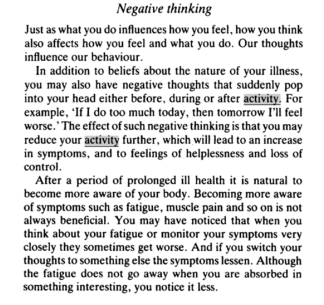
(Extract from Chalder, 1995, p. 52). A similar description appears in the ‘PACE Trial Manual for Therapists’ [104]:
“Cognitive Therapy. When they are managing their programme of consistent graded activity and rest, the second part of CBT is usually introduced, this is called cognitive therapy. Chron¬ic illness, such as CFS/ME often leads people to feel demor¬alised, helpless, hopeless and frustrated. These feelings can lead to unhelpful or negative thinking patterns which in turn affects how people behave. Cognitive therapy aims to help people to examine their “unhelpful” or “negative” thoughts and then to challenge them by thinking of a more helpful alternative one. This part of CBT is important as unhelpful thoughts may block recovery.” [104].
The role of patients’ thoughts in perpetuating ME/CFS is ax-iomatic to the psychosomatic approach and PS investigators portray the principle as a scientific fact. For example, Michael Sharpe (1991) states “Personality factors (attitudes, beliefs and thoughts) and behaviour have been shown to perpetuate disabil¬ity [105].” In similar vein, the Royal College of Psychiatrists describes CBT as follows: “CBT can help you to identify un¬helpful thoughts about yourself and your health, which can make symptoms worse [106].”
Others have not been as convinced that positive thinking im-proves well-being: “on a personal level, it leads to self-blame and a morbid preoccupation with stamping out "negative" thoughts” [107]. Since Norman Vincent Peale’s hugely success¬ful book The Power of Positive Thinking published in October 1952, “thinking positive'' has been a key element of folk wisdom and remedies. As a consequence, questionnaire responses tend to reify it while qualitative studies reveal complex discourses marked by vagueness and normative moral requirements [108]. The dysfunctional thoughts hypothesis needs to be investigated in controlled studies, which must be separated from faux forms of science where there is only a pretension of control. A huge ev-idence-base of studies relevant to H1 can be estimated to number in the thousands.
Interventions aimed at encouraging positive thinking have pro¬duced a mixed bag of findings [109, 110]. The vast majority are cross-sectional studies carrying no evidential weight. Another sizable section of articles consists of narrative reviews intended to provide an interpretation of the evidence but cannot provide a definitive case. A small number of controlled trials which, if well-designed with appropriate controls and outcome measures, could indicate causal associations between treatments and out¬comes. An even smaller number of prospective, observational studies have been conducted with PW MUS but these did not directly measure dysfunctional thoughts or beliefs. It is almost a clean slate.
A selection of representative studies is presented in Table 2 to¬gether with extracts and notes on the studies and their main findings.
Table 2. A representative sample of publications concerning dysfunctional beliefs, illness and interventions by influencers and investigators of the PS. The incidence of inappropriate causal language is indicated as ‘ICL’.
|
STUDY NUMBER |
STUDY DESIGN |
PUBLICATIONS |
FUNDING |
CONCLUSIONS |
|
1 |
Cancer prevention and prolongation of life
Narrative review |
Eysenck, H. J. (1987).
Note 1: Publications by Hans J Eysenck on this topic were deemed ‘unsafe’ by a KCL Enquiry. To date, 86 papers are retracted or have been flagged as items of concern (Retraction Watch Database, 2021). Several dozen of H J Eysenck’s publications, which used the same datasets for the papers declared unsafe, remain in the scientific literature as citable contributions to science and medicine. |
None reported.
Note 2: However, it has been established that the tobacco industry had secretly contributed large sums towards the project (Buchanan, 2010; Pelosi, 2019). |
Hans Eysenck’s conclusion: “A detailed discussion is given of work …on the relationship between psychosocial factors and cancer. including the prophylactic use of behaviour therapy …to make possible the prevention of cancer or the prolongation of life in patients who are incurably ill.”
Note 3: Eysenck’s known conflicts of interest and unsafe provenance of Eysenck’s datasets make any causal inferences about personality, fatal diseases and the behaviour therapy untrustworthy. |
|
|
|
|
|
ICL |
|
2 |
ME/CFS
Narrative review ME/CFS
Narrative review |
Wessely, David, Butler, and Chalder (1989) |
None reported. |
“You have had an acute illness, probably infectious in origin, which forced you to become inactive for a period of time. Subsequently you have begun to experience fatigue on exertion and as a result you have started to limit or avoid activity of all sorts… This means that you develop symptoms at increasingly lower levels of exercise…When you experience these symptoms, you have also experienced associated thoughts, such as 'If I carry on I may become worse', or 'There must be something seriously wrong with me to make me feel like this'. These symptoms are real, but… you may have incorrectly attributed them to a recurrence of the original infection. This is particularly likely because the symptoms of muscle pain, breathless-ness, dizziness, fatigue and others are similar to those experienced initially. This has led to a vicious circle of increasing avoidance, inactivity and fatigue.”
Note 4: No causal mechanisms or ‘vicious circles’ have been demonstrated.
ICL |
|
3 |
Coronary heart disease and mortality
Narrative review based on ‘unsafe’ data |
Eysenck, H.J. (1991). See Note 1 above. |
None reported.
However, it is known that the tobacco industry contributed large sums towards the project. |
“autonomy (i.e., the ability to be independent in one's thoughts, feelings, and actions, even under stress) is important for survival and is a valuable countermeasure as far as cancer and CHD are concerned.” See Note 3 above. ICL |
|
4 |
ME/CFS
Psychometric study |
Moss-Morris, Petrie and Weinman (1996) |
Auckland Institute of Technology Interim Research Committee. |
“organic CFS patients have distorted perceptions of effort and sensation which may contribute to their functional disability”. ICL Note 5: The Illness Perception Questionnaire (Weinman, J., Petrie, K. J., Moss-Morris, R., and Horne, R. (1996) used to measure beliefs has known psychometric problems. See Section 3. |
|
5 |
Post-traumatic stress disorder
RCT |
Marks, I., Lovell, K., Noshirvani, H., Livanou, M., and Thrasher, S. (1998) |
Wellcome Trust, London, England. |
“Patients were taught to spot dysfunctional thoughts and thinking errors, elicit rational alternative thoughts, and reappraise beliefs about themselves, the trauma, and the world.” |
|
6 |
Rehabilitation to work
Narrative review |
Waddell and Burton (2004) |
Department for Work and Pensions, UK |
“…symptoms are by definition subjective and therefore at least partly a matter of per-ceptions.” “Changing dysfunctional perceptions, attitudes and behaviour is central to rehabilitation of many common health problems.” “Offering workplace adjustments to the returning worker must be firmly rooted in ‘fa-cilitation’, which often only needs to be a temporary measure for easing the transition into work. The ultimate goal, which should be feasible for most people with common health problems, is sustained return to normal work.” |
|
7 |
ME/CFS
Narrative review |
Browne and Chalder (2009) |
|
“Two models of understanding CFS, a cognitive behavioural model and a deconditioning model, are then introduced alongside the treatments on which they are based. Both cognitive behavioural therapy and graded exercise therapy have been recommended by the National Institute for Health and Clinical Excellence as they are the treatments for which there is most evidence.” |
|
8 |
ME/CFS
Narrative review |
Knoop H, Prins JB, Moss-Morris R, Bleijenberg G (2010). |
Dutch MS Research Foundation (Sticht-ing MS Research). |
“Three different cognitive processes may play a role in the perpetuation of CFS symptoms. The first is a general cognitive representation in which fatigue is perceived as something negative and aversive and CFS is seen as an illness that is difficult to influence. The second process involved is the focusing on fatigue. The third element is formed by specific dysfunctional beliefs about activity and fatigue.” |
|
9 |
ME/CFS PACE trial
RCT with multiple methodologic-al flaws |
White et al. (2011) |
UK Medical Research Council (MRC G0200434 ), the Department of Health for England, the UK Department for Work and Pensions, and the Chief Scientist Office of the Scottish Government Health Directorates. |
“CBT and GET can safely be added to SMC to moderately improve outcomes for chronic fatigue syndrome, but APT is not an effective addition.” ICL Note 6: Conflicts of interest. PDW has done voluntary and paid consultancy work for the UK Departments of Health and Work and Pensions and Swiss Re (a reinsurance company). DLC has received royalties from Wiley. JB was on the guideline development group of the NICE guidelines for CFS and ME and has undertaken paid work for the insurance industry. GM has received royalties from Karnac. TC has done consultancy work for insurance companies and has received royalties from Sheldon Press and Constable and Robinson. MB has received royalties from Constable and Robinson. MS has done voluntary and paid consultancy work for government and for legal and insurance companies, and has received royalties from Oxford University Press. |
|
10 |
Medically unexplained symptoms
Narrative review |
Deary, V., Chalder, T., and Sharpe, M. (2007) |
None reported |
“The theoretical literature and some of the empirical literature supports this mechanism [attention] as being an important part of the cycle maintaining MUS.” ICL “The neuroticism concept captures many of the factors hypothesised to be at work in MUS.” |
|
11 |
Multiple sclerosis
Cross-sectional study |
Dennison, L., Moss-Morris, R., Silber, E., Galea, I., and Chalder, T. (2010) |
UK MS Society. NIHR Biomedical Research Centre, South London and Maudsley NHS Foundation Trust / Institute of Psychiatry KCL. |
“Illness severity factors explained only 2.2% of the variance in distress (p>.05) while cognitive and behavioural variables accounted for 37.1% (p<.001). Unhelpful beliefs about the self were the strongest predictor.” ICL |
|
12 |
Mortality and diabetic foot ulcers
Prospective observational study |
Vedhara K, et al. (2016). |
Medical Research Council, UK (MC_ U145079313). JNVM receives salary support from the RAND Corporation. |
“ illness beliefs are also influential in determining these emotional responses and could, therefore, be expected to influence outcomes in patients with diabetic foot ulcers.”
ICL |
|
13 |
Irritable bowel syndrome -------------------- Systematic review |
Windgassen et al. (2017) |
National Institute of Health Research, HTA 11/69/02. TC partly funded by the Biomedical Research Centre for the South London and Maudsley NHS Foundation Trust and the Institute of Psychiatry. TC received travel expenses and fees for workshops on irritable bowel syndrome. |
“change in illness-specific cognitions is a key process by which psychological treatments may have an effect on the outcomes of symptom severity and QoL.”
Note 7: The only significant effect related to so-called ‘identity beliefs’ (‘How much do you experience symptoms?’), which are not ‘unhelpful’ beliefs.
Note 8: Mediation analyses are used to draw causal conclusions from correlational data. This is illusory: correlation never provides evidence of causation (Trafinow, 2015).
ICL |
|
14 |
Mortality and predialysis chronic kidney disease ------------------- Prospective observational study |
Muscat, P., Weinman, J., Farrugia, E. et al. (2020) |
None reported. |
“The study aimed to assess the influence of illness perceptions on mortality in incident predialysis CKD patients.”
Note 9:The beliefs that were evaluated cannot be specifically classified as ‘unhelpful’.
ICL |
|
15 |
Paediatric chronic fatigue syndrome ------------------- Cross-sectional study |
Loades, M., Crawley, E., Chalder, T., and Flannery, H. (2021) |
National Institute for Health Research; Department of Health via the NIHR Specialist Biomedical Research Centre for Mental Health award to the South London and Maudsley NHS Foundation Trust and the Institute of Psychiatry at KCL. |
“the Lightning Process, based on Neurolinguistic Programming (NLP), when offered in addition to treatment as usual (TAU), was more clinically and cost effective compared to TAU alone (Crawley et al., 2018).”
Note 10: In spite of multiple sources of funding, the authors state: “This report is independent research.” Note 11: The Lightning Process and NLP have been discredited as pseudo-scientific treatments of MECFS with strong potential for patient harms. |
This reviewer could not find a single controlled study which pro-vided empirical evidence for the causal relationship proposed by H1. As noted, the majority of ME/CFS studies have used the weakest type of research design, which is the cross-section-al, correlational design with no evidential value in relation to causation. In discussing their findings, several PS authors are regular users of terms such as ‘predict’, ‘impact’ and ‘led to’ which lack scientific validity. I return to this issue in section 4.
A more specific set of problems concerns the psychometric properties of one of the principal questionnaires used in PS stud-ies with PwME/CFS, the Illness Perception Questionnaire-Re-vised (IPQ-R) (Moss-Morris, Weinman, Petrie, Horne, Cameron and Buick (2002) [111]. A complex array of psychometric is-sues has been discovered in regard to the IPQ-R but this is not the time or place to unravel them [112-115]. For now, it only needs to be noted that the validity of the IPQ-R in tests of H1 in cross-sectional studies is contentious. The IPQ-R measures illness identity, timeline, cyclical timeline, treatment control, personal control, coherence, causes and emotion reaction. None of these eight factors is a valid measure of dysfunctional beliefs or negative thinking. This is because illness identity is measured by symptoms in which patients report whether or not they ex- perienced a specific set of symptoms and, if so, whether they attributed the symptom to their illness. The number of symptoms attributed to their illness is summed with higher scores indicat¬ing increased illness identity. The latter is as much a measure of illness severity as of illness identity. In the MUS domain, studies with patients with foot ulcers and with chronic kidney disease have used prospective, observational designs that, in principle, should enable robust conclusions about causation [116, 117]. However, the beliefs that were measured were ‘identity beliefs’ (‘How much do you experience symptoms?’), not dysfunctional beliefs so they too fail to provide support to H1.
In sum, the evidence from a range of patient groups and methods provides no empirical support for the ‘positive thinking’ hypoth¬esis H1.
Deconditioning causes, or exacerbates the symptoms of, ME/CFS and MUS (H2).
Deconditioning refers to multiple, potentially reversible changes in body systems brought about by physical inactivity and dis¬use. The theory proposes that patient's claims of an inability to exercise or exert themselves is due to a reluctance to, or fear of, exercise. Physical exercise in GET is offered to induce patients to recondition their bodies. GET is a treatment in which the en-ergy level of exercise is systematically increased over time. It is viewed with scepticism by patients and critics who regard GET as inappropriate and harmful. The main problem, which has been overlooked by many prescribing practitioners, is the risk of PEM, which can last several days or weeks post-treatment.
The ME Association (2008) position on GET is stated as follows [118]:
• GET makes a significant proportion of people with ME/CFS worse.
• One can argue about the percentage of people whose condition becomes worse as a result of GET (i.e., 30% to 50% in patient questionnaires) but this not just due to a problem with the way in which GET is being delivered. The fact is that a progressive and sometimes rather inflexible increase in physical activity, the key component to a treatment that is based on the scientifically flawed deconditioning model of ME/CFS, is just not appropriate for a significant proportion of people with ME/CFS.
• Any treatment that causes an adverse reaction in 33 – 50% of those using it cannot be recommended as a blanket form of treatment – as is the case in the guideline for treatment of ME/ CFS that has been produced by the National Institute for Health and Clinical Excellence (NICE) 13 [118].
The deconditioning hypothesis has been investigated for 20-plus years since an early uncontrolled study suggested a possible as-sociation between CFS and deconditioning [119]. For any study to be given serious attention, it must reach the minimum criteria for a controlled study: groups matched at baseline with ‘blind-ed’ testing and objective measures. Without properly controlled trials and investigations it is impossible to determine which is cause and effect between the illness or the deconditioning.
For good reason, patients with a diagnosis of ME find the name ‘CFS’ and deconditioning hypothesis an anathema. The lived experience of ME patients is one of exertion intolerance, which includes a host of objective indicators such as: a reduced anaer¬obic threshold, errors in energy metabolism, reduced blood flow to the brain and heart, reduced oxygen uptake in haemoglobin, reduced oxygen utilization, and abnormal gene expression, none of which can possibly be explained by deconditioning [120-128]. If deconditioning causes or contributes to ME/CFS, then signs of deconditioning should be more pronounced in patients with more severe symptoms and less pronounced in those with less severe ones.
Fulcher and White (2000) measured strength, aerobic exercise capacity and efficiency, and functional incapacity in PwCFS who did not have a current psychiatric disorder [129]. Compared with sedentary controls, PwCFS were found to be physically weak¬er, had a significantly reduced exercise capacity, and perceived greater effort during exercise, but were equally unfit. Fulcher and White concluded that PwCFS were weaker than sedentary and depressed controls and as unfit as sedentary controls. The data were consistent with the hypothesis that physical decon¬ditioning helps to maintain physical disability in CFS and that a treatment designed to reverse deconditioning would help to im¬prove physical function. However, there was a problem with the procedures used to test the participants. However, as the authors acknowledge, the lack of ‘blind’ testing and other issues could have biased the results: “We would in any case advise caution in interpreting and generalising from these data because of the bias inherent in a case-control study, the need for replication of these data, the lack of blindness in some of the measures, and the few comparison patients with a major depressive illness [129].
Timmers et al. (2002) found that head-up tilt evokes postural tachycardia or (pre)syncope in a minority of CFS patients [130]. The authors concluded that “observations in head-up tilt-nega¬tive CFS patients of a higher heart rate at baseline together with a marked decrease in stroke volume in response to head-up tilt may point to deconditioning.”
A review by Clark and White (2005) concluded that: “Patients with CFS are at least as deconditioned as sedentary but healthy controls [22]. Supervised graded exercise therapy reduces fa¬tigue and disability in ambulant patients with CFS; efficacy may be independent of reversing deconditioning…Further work is necessary to elucidate the risks, benefits, and mechanisms of such treatment, especially in children and the severely disabled” (p. 237).
Moss-Morris, Sharon, Tobin and Baldi (2005) [131]. investigat¬ed GET in a sample of 49 CFS patients who were randomized to a 12-week graded exercise programme or to standard medi¬cal care. After treatment the group who had received GET rated themselves as significantly more improved and less fatigued than the control group. A decrease in symptom focusing rather than an increase in fitness mediated the treatment effect. The authors concluded that GET “appears to be an effective treatment for CFS and it operates in part by reducing the degree to which pa¬tients focus on their symptoms” (p. 245). The main problem with this study was the use of subjective measures of illness improve¬ment and the high drop-out rate of 47% (23/49) from the physio¬logical tests and the non-significant physiological improvement with ten patients refusing to have a second test which, according to the authors, they believed would be harmful to them.
The ‘FINE’ trial involved a gradual increase in activity with nurse-led counselling at patients’ homes used subjective out¬come measures and outcome changes but found no long-term effectiveness [132]. The FINE trial was a disappointment for those seeking a cost-effective, nurse-led ‘fix’ for workplace and has disappeared from the literature. A Catalonian study also obtained negative findings concerning deconditioning and con¬cluded: “the decrease in the peak workload achieved in arm or leg exercise by CFS patients would not be justified exclusively by their personal characteristics or deconditioning [133].
In a change of tack, using a large prospective birth cohort consist¬ing of 4779 participants from the National Survey of Health and Development, Harvey, Wadsworth, Wessely and Hotopf (2008) tested hypotheses relating to immune system dysfunction, phys¬ical deconditioning, exercise avoidance, and childhood illness experiences [134]. Participants were prospectively followed for the first 53 years of their lives with 20 separate waves of data collection. The authors identified CFS through self-report during a semi-structured interview at age 53 years with an additional case notes review. Of 2983 participants, 34 reported a diagnosis of CFS (1.1% of the sample) and were found to be no more like¬ly to have suffered from childhood illness or atopy. Interestingly, the authors found that “increased levels of exercise throughout childhood and early adult life and a lower body mass index were associated with an increased risk of later CFS. Participants who later reported CFS continued to exercise more frequently even after they began to experience early symptoms of fatigue…Con-tinuing to be active despite increasing fatigue may be a crucial step in the development of CFS” (p. 488). Based on Harvey et al.’s prospective evidence, which can give a valid interpretation of causality, is over-exercising while young rather than its lack, i.e., over-conditioning, a cause of ME/CFS? We cannot say, because it appears doubtful that 34 case-histories could be suf¬ficient to support the authors’ prospective interpretation of the data. This line of inquiry appears to have stopped in 2008.
In a complex review process on behalf of the Cochrane Library, Larun, Brurberg, Odgaard-Jensen and Price (2014) reviewed eight randomised controlled studies with data from 1518 par¬ticipants [135]. They observed that: “limited information makes it difficult to draw firm conclusions about the safety of exercise therapy”. In an updated review in 2017, Larun et al. (2017) again were unable to reach any definite conclusions, stating that: “People who have exercise therapy probably have less fatigue at the end of treatment than those who receive more passive ther¬apies [136]. We are uncertain if this improvement lasts in the long term. We are also uncertain about the risk of serious side effects from exercise therapy.” Their claims were disputed by critics including Robert Courtney14 and Tom Kindlon15 two pa-tient-advocates. A re-analysis of the 2017 Cochrane review by Mark Vink16 and Alexandra Vink-Niese (2018) revealed several flaws suggesting that graded exercise therapy is ineffective for PwME/CFS even in the short-term [137]. Seven kinds of flaws were evident in the Larun et al (2017) review: conflicts of in-terest; exclusion of a study that contradicted the main findings; the entry criteria were too broad; entry score requirements were not sufficiently strict; the use of subjective fatigue measured by questionnaires as the primary outcome; used the flawed Chalder Fatigue Scale17 in 7 of 8 studies; finally, concerns about dropouts [136]. Vink and Vink-Niese’s analysis of the objective outcomes in the trials reviewed by Larun et al. provided: “sufficient evi¬dence to conclude that graded exercise therapy is an ineffective treatment for myalgic encephalomyelitis/chronic fatigue syndrome18.
If ME/CFS is caused by deconditioning, as claimed, then GET should be an effective treatment for PwME/CFS. Therefore, the negative findings regarding GET are damaging to the PS claim. That GET has been found to be an ineffective treatment, and even harmful in a number of cases, is prima facie evidence that deconditioning is not causally responsible for symptoms of ME/ CFS.
Another way of testing H2 has been to compare the exercise capacity of patients and controls. Nijs et al. (2011) systematical¬ly reviewed 15 studies examining whether PwCFS differ from healthy sedentary controls in physiological exercise capacity, physical activity level and muscle strength [138]. The authors refer to the conflicting data concerning physiological exercise capacity of PwCFS but suggest that the “weighted available ev¬idence points towards a reduced physiological exercise capacity in CFS. However, once again, no cause-and-effect relationship between deconditioning and ME/CFS could be established.
A narrative review explores the deleterious immunological ef¬fects that are likely to follow the use of GET and recommends against the use of GET for PwME: “initial over-exertion (a period of metabolic stress) in conjunction with viral infection depletes concentrations of the metabolic regulator glutathione, initiating a cascade of physiological dysfunction…the exacer¬bation of symptoms for the majority is not subjective but has a physiological basis. Blanket recommendation of GET is not pru¬dent for such a heterogeneous group of patients, most of which are likely to respond negatively to physical activity” [139]. The only causal relationship that could be identified relates to that between GET and the “direct and persistently negative impacts on the physiology and quality of life of a significant subgroup of ME patients”.
After two decades of inconclusive research, Linda Van Camp¬en and Frans Visser (2018) finally carried out a crucial and well-controlled study on the deconditioning hypothesis of ME/ CFS. Their paper carries the title: “The abnormal Cardiac Index and Stroke Volume Index changes during a normal Tilt Table Test in ME/CFS patients compared to healthy volunteers, are not related to deconditioning.” There were no significant differ¬ences between three groups of patients with ME/CFS at different levels of severity (Figure 5). The authors were able to reach the definitive conclusion that: “The absence of differences between patients with mild, moderate, and severe ME/CFS suggests that the decreases in stroke volumes and cardiac output are not re¬lated to deconditioning. Other factors like decreased blood vol¬umes and autonomic dysfunction may cause this difference in the hemodynamic response between ME/CFS patients and HV”.

Figure 5: The percent change of the stroke volume and cardiac index in ME/CFS patients with mild, moderate and severe disease according to the ME criteria. Reproduced from Van Campen and Visser (2018) by permission.
The Van Campen and Frans Visser (2018) study is the only con-trolled investigation that examines disease severity in a test of the deconditioning hypothesis [72]. Contrary to H2, the study unequivocally demonstrates that deconditioning is not causally associated with ME/CFS severity.
Biased attention causes, or exacerbates, the symptoms of ME/CFS and MUS (H3)
Negative ‘illness representations’ (dysfunctional thoughts) and heightened symptom focusing towards health-threats and relat¬ed cues are claimed to be maintaining factors in PwME/CFS. One of the first studies on attentional biases in PwCFS was by Rona Moss-Morris and Keith J. Petrie (2003) at the University of Auckland. They tested whether PwCFS have an “attentional information processing bias for illness-related information and a tendency to interpret ambiguous information in a somatic fash-ion”. Twenty-five CFS patients were compared to 24 healthy matched controls on a modified Stroop task and an ambiguous cues task in which they heard a tape-recorded list of 15 ambig¬uous illness words (e.g., vein/vain) and 15 unambiguous words. The participants were asked to write down the first word that came into their heads.
Moss-Morris and Petrie found no evidence that illness or de-pressed words created greater attentional interference on the Stroop task than neutral words. However, on the ambiguous cues task, PwCFS made significantly more somatic interpretations than controls and the authors stated that this ‘bias’ was associated with the extent to which they currently reported symptoms. The term ‘bias’ carries an unwarranted pejorative connotation when a less judgmental term such as ‘tendency’ would have been equal¬ly appropriate except that, in this instance, a ‘bias’ is what the investigators were seeking. Moss-Morris and Petrie concluded that: “CFS patients have an interpretive bias for somatic infor¬mation which may play a part in the maintenance of the disorder by heightening patients’ experience of physical symptoms and helping to maintain their negative illness schemas. Although pa- tients did not show an attentional bias in this study, this may be related to the methodology employed” (p. 195). However, an in¬terpretative bias is not an attentional bias, and so this 2003 study produced a null finding that, nevertheless, was interpreted by the authors as a supportive finding Hou, Moss-Morris, Bradley, Peveler and Mogg (2008) investigated whether PwCFS show attentional bias towards health- threat information [140]. On this occasion, the sample consisted of 14 PwCFS and 18 healthy controls. Hou et al. used a visual probe task which presented health-threat and neutral words and pictures for 500 ms and self-report questionnaires to assess CFS symptoms, depression, anxiety, and social desirability. Compared to a control group, the CFS group showed an “enhanced attentional bias (AB) towards health-threat stimuli relative to neutral stimuli.” The finding of an enhanced AB towards health-threat information in PwCFS is claimed by the authors of being supportive of “models of CFS which underlie cognitive behavior therapy”. However, it would be a leap of irrationality to infer from this modest result of a difference between groups (which may have a vast number of interpretations) to cause-and-effect. However, this is a leap that often appears in papers authored in the Psychosomatic School.
Undeterred by the lack of positive findings to date, Hou, Moss-Morris, et al. (2014) continued to search for ‘attentional bias’ towards health-threat stimuli with enlarged samples of 27 CFS patients and 35 healthy controls [141]. The participants did a Visual Probe Task to measure attentional bias, and an Attention Network Test measuring executive attention, alerting and orient¬ing. They also completed self-report measures of CFS and mood symptoms. Compared to the control group, the authors state that the “CFS group showed greater attentional bias for health-threat words than pictures; and the CFS group was significantly impaired in executive attention. Furthermore, CFS individuals with poor executive attention showed greater attentional bias to health-threat related words, compared not only to controls but also to CFS individuals with good executive attention” (p. 9). Always remembering that association is not causation, these findings appear, at best, to offer a meagre level of support to H3.
Hughes, Chalder, Hirsch and Moss-Morris (2016) reviewed ex-perimental studies of attention and interpretation bias towards negative and illness-related information in Pw CFS and healthy controls to December 2014 [142]. The results were overall in-conclusive: “Some people with CFS have biases in the way they attend to and interpret somatic information. Such cognitive pro¬cessing biases may maintain illness beliefs and symptoms in people with CFS” (italics are mine). Their review highlighted methodological issues in experimental designs, many of which were of their own making.
Joining arms with two colleagues in Nijmegen, Stephanie Ni-kolaus and Hans Knoop, Hughes et al. (2018) go on to claim to have replicated the inconclusive UK study with a Dutch CFS population. They claim that, in two cultures, “people with CFS demonstrate biases in how somatic information is attended to and interpreted”. What they have not shown in either culture is that these biases cause or exacerbate ME/CFS symptoms which is a fundamental claim in the psychosomatic theory of ‘boom and bust’ ME/CFS. They have also not shown that the reported phenomenon of attentional bias toward somatic information is specific to ME/CFS patients and not a general trend in patients experiencing symptoms of any physical disorder.
In an independent research project, Teodoro, Edwards and Isaacs (2018) conducted a systematic review of 186 studies to produce a general theory of what they term “functional cognitive disorder (FCD)”, a disorder of cognitive dysfunction in the absence of an organic cause [143]. They claim FCD is becoming increasingly prevalent and that the cognitive profiles in fibromyalgia (FM), chronic fatigue syndrome (CFS) and functional neurological disorders (FNDs) provide a ‘template’ for characterising their proposed new syndrome suggesting common underpinnings. They hypothesise that “pain, fatigue and excessive interoceptive monitoring produce a decrease in externally directed attention. This increases susceptibility to distraction and slows informa¬tion processing, interfering with cognitive function, in particular multitasking. Routine cognitive processes are experienced as unduly effortful [143].
The results of the Teodoro et al. systematic review indicated that PwCFS do not show generalised abnormalities of atten-tion or any general syndrome of a functional cognitive disor-der. However, Teodoro et al. found that that CFS patients are prone to distraction in the Stroop task but this finding was not confirmed in all studies. Again, attentional bias to threat and to¬wards emotionally negative information have been observed but unconfirmed. Owing to the heterogeneous findings and meth¬odological shortcomings, the authors were unable to make any general conclusions about the proposed new syndrome or CFS in particular. As is the case for both H1 and H2, H3 involves a chicken-egg problem: which comes first, attentional bias or the illness? Without controlled prospective studies this question remains unanswered. However, the evidence to date provides no empirical support for H3.
In sum, on the basis of the current review, none of the causal hypotheses claimed by the PS as foundation stones receives sci¬entific support from the empirical literature. It must be borne in mind that the published literature is normally only a fraction of the number of studies carried out because many studies are never reported due to their non-significant results – the so-called ‘file drawer’. Another concern is that the PS studies have not gener¬ally used a placebo control treatment. It is impossible to separate out what are non-specific, placebo effects of CBT and GET pro-duced by empathy, compassionate listening and the therapeutic relationship and what is specific to the therapy itself.19
If it is true that H1-H3 really are false hypotheses, how have the PS managed for so long to justify the use of cognitive-be¬havioural approach, CBT and GET? I turn to describe one of the crucial reasons – the repeated use of a logical fallacy.
THE CORRELATION-CAUSATION FALLACY
The cognitive behavioural therapy intervention led to significant improvements in patients’ self-reported fatigue, physical func¬tioning and social adjustment.(Adamson et al., 2020, a study with no control condition) [144].
From the very beginning of the PS, a recurring logical fallacy has been made by PS investigators in their statistical inferences about their publicly reported findings. This is the fallacy that correlation means causation. This basic error lowers confidence in publications, authors and even an entire research programme. The fundamental distinction between correlation and causation is taught in first-year medicine, psychology and science classes all over the world. Yet, the distinction can elude even the most seasoned researchers. An often-cited example concerns the polio epidemics in the US and Europe during the 1940s and 50s in the pre-vaccination period. Polio crippled thousands of people, mostly children, and still does in some parts of the world. Polio epidemics occur mainly during summer and autumn when peo¬ple eat more ice cream. For a while, children were warned not to eat ice cream or they might catch polio.
In Table 2, ten examples of inappropriate causal language (ICL) are indicated. Setting aside the two cases evidenced by Hans J Eysenck which relate to his ‘unsafe’ (fake) datasets, there are eight instances of ICL in 13 studies over the period 1989-2021. Table 2 does not contain a random sample and so the baseline rate of ICL is unknown. However, even these 8 instances are 8 too many. There appears to be no ‘rhyme or reason’ for the departures from accepted scientific practice and one can only speculate as to the reasons. Perhaps these multiple occurrenc¬es were all accidental, but that explanation appears unlikely. A more likely explanation is the authors’ confirmation bias [30].
There are two principal ways in which the correlation-causation fallacy can occur. The first case relates to association between variables in cross-sectional studies. Two variables such as ice cream eating and polio can be correlated with a third variable (hot weather) causing both. We can call this a “Type I Causal Error’. Another case occurs when there is a finding of a rela- tionship but no control condition - a “Type II Causal Error’. The same fallacy has occurred, but for two different reasons, both signalling confirmation bias.
In some cases, a Type I Causal Error appears to be explicit all the way through the study, starting with the title, continuing in the Abstract and going all the way through to the conclusions. Consider Petrie, Moss-Morris and Weinman’s (1995) cross-sec¬tional investigation of the association between catastrophic beliefs and functioning in PwCFS [145]. The title of the pub¬lication in the Journal of Psychosomatic Research states: “The impact of catastrophic beliefs on functioning in chronic fatigue syndrome”. The first three words say it all: “The impact of”. The title should more appropriately have been worded: “The asso¬ciation between catastrophic beliefs and functioning in chronic fatigue syndrome”. The relationship was an association only, not causation, because the study showed no such thing. Again, the Abstract states: “The role of catastrophic beliefs and person¬al perceptions of CFS in maintaining the illness is discussed.” “The role of …in maintaining the illness” is as causal as one can become. Yet the design, methods and data do not warrant the language these authors have used about catastrophic beliefs having ‘impact on functioning’ or ‘maintaining the illnesses. It is remarkable, although not totally unexpected, that the editor and reviewers passed this paper through peer review with such a basic error.
As noted, the expectation that any association is a prelude to causation is evident in the way studies are framed from their inception. Consider Moss-Morris, Petrie and Weinman’s (1996) assertion in British Journal of Health Psychology that “we were particularly interested in how patients’ cognitive representations of their illness and their coping strategies would influence func¬tioning in CFS” (p. 16, italics mine) [146]. The design and meth¬odology of the study involved a simple cross-sectional analysis of questionnaire responses to a variety of self-reported measures yielding dozens of correlation coefficients. No inferences about coping or cognitions influencing functioning were ever possi¬ble, yet this is precisely what the authors’ have said they were interested in showing. The inferences that are possible about any study’s findings need to be closely tuned to the study’s method and design.
An instance of a Type II Causal Error occurs in Adamson, Ali, Santhouse, Wessely and Chalder’s (2020) study in the Journal of the Royal Society of Medicine that purported to demonstrate that CBT ‘led to’ significant improvements in CFS patients [2020]. Adamson et al. reached their wished-for conclusion that CBT caused improvements in CFS patients but the method used to gather this evidence warranted no such thing. The authors' aim was to examine the effectiveness of CBT for CFS in a naturalis¬tic setting and examine what factors, if any, predicted outcome. Adamson et al. analysed patients' self-reported 'symptomology' over the course of treatment and at three-month follow-up. They also explored baseline factors associated with improvement at follow-up. Data were available for 995 patients receiving CBT for CFS at an outpatient, specialist clinic in the UK. Patients were assessed throughout their treatment using self-reported, subjective outcome measures including the Chalder Fatigue Scale, 36-item Short Form Health Survey, Hospital Anxiety and Depression Scale and Global Improvement and Satisfaction. The authors state the results as follows:
"Patients’ fatigue, physical functioning and social adjustment scores significantly improved over the duration of treatment with medium to large effect sizes (|d| = 0.45–0.91). Furthermore, 85% of patients self-reported that they felt an improvement in their fa¬tigue at follow-up and 90% were satisfied with their treatment. None of the regression models convincingly predicted improve¬ment in outcomes with the best model being (R2 = 0.137)."
Inside the body of the article the authors state the conclusion that makes the CBT treatment causal.
In their response to Adamson et al. (2020), Brian Hughes and David Tuller (2021) state: “the Abstract – the section of the pa¬per most likely to be read by clinicians – contains a crucial error in the way the data are described, and requires urgent correction [144].” Hughes and Tuller point out that a conspicuous contro¬versy is overlooked. Adamson et al. write that the intervention is “based on a model which assumes that certain triggers such as a virus and/or stress trigger symptoms of fatigue. Subsequently symptoms are perpetuated inadvertently by unhelpful cognitive and behavioural responses” (p. 396). Treatment involves, among other elements, “addressing unhelpful beliefs which may be in¬terfering with helpful changes” (p. 396). The fallacy of calling associations ‘causal’ is endemic in PS publications. No cause-and-effect relationship has ever been found in their research - see section 3 above - yet with this basic ‘schoolboy error’, the PS likes to claim it has found support. Any research programme that rests on weak foundations and makes a scientific case based on fake reasoning gains only one outcome – degeneration into pseudoscience.
INVALIDATION, VICTIM-BLAMING AND TREAT-MENT HARMS
. . . trust between doctor and patient may be better served by not telling the truth [57].
As we have seen, a recurring theme in the PS world is the claim that dysfunctional illness beliefs (e.g. that ‘symptoms are the re¬sult of a virus’) are causally linked to deconditioning and a poor prognosis [14]. Curiously, in the case of ME/CFS, it is the pa-tients’ beliefs, not the doctors’, that are scientifically supported [148, 149]. In addition, inducing patients into CBT to change the way they are alleged to habitually think has not proved a successful strategy, as the revised NICE (2020) guidance has concluded. Rather than question the legitimacy of the theory and the treatment, PS clinicians attribute the failure rate of CBT to patients’ unwillingness to change their illness behaviour. Thus, a recursive vicious circle is established: doctor’s analysis ->pa-tient’s unhelpful beliefs -> CBT -> failure -> doctor’s analysis -> patients’ unhelpful beliefs. This recursive victim-blaming cy¬cle is likely to make patients feel worse, frustrated and angry. Hooper (2003) has stated: “In the UK, patients with [ME/CFS] particularly children, have suffered gross and barbaric abuse and persistent denigration as a consequence of the beliefs of certain psychiatrists who are attempting to control the national agen-da for this complex and severe neuro-immunological disorder” (see Appendix II with two illustrations of the implementation of Wessely School policy from a paper by Hooper, 2003) [150].
The contentious nature of the PS approach created an upswell of criticism and ill-feeling among the ME/CFS patient community. Unfortunately, PwME/CFS and MUS are well used to having their symptoms dismissed or not believed by practitioners of the PS persuasion. Some researchers refer to this phenomenon of invalidation as ‘All In Your Head’ [151]. Burke (2019) describes the scenario in which a practitioner communicates to patients that their symptoms are AIYH thus [152]:
…a typical physician-patient interaction may proceed as follows: (1) the physician provides a rundown of normal investigations, (2) the patient is told they have no known medical diagnoses, (3) a brief awkward exchange occurs, and (4) little further explana-tion, guidance, resources, or facilitation of an appropriate refer¬ral process is given. Even if the infamous phrase is not explicitly stated, this sequence leaves the patient to infer for themselves that it must be all in their head… The inadequate management of this segment of medicine represents a silent epidemic that is slowly eroding patient-physician relationships, perpetuating un¬necessary disability, and straining health care resources [152].20
Bontempo (2021) identifies more than 25 different terms or phrases used to describe invalidation of patients and/or symp-toms including: dismissed, ignored, passed off, fobbed off, not taken seriously, not believed, not acknowledged, delegitimized, discounted, discredited, disqualified, devalued, negated, reject-ed, trivialized, and minimized [153]. MUS are attributed by practitioners to psychological processes or pathology generally when symptoms are: i) perceived by them as ‘not real’, imag-inary, or all in the head or mind; ii) portrayed as reflective of neuroticism, stress, anxiety, depression, hysteria, somatization, or hypochondriasis; and iii) as malingering, exaggerating, or overreacting to their symptoms.
The sense of despair and helplessness that many patients feel about their labelling and treatment is aggravated by terms such as ‘malingering’ and ‘deception’ in practitioners’ pronounce-ments such as the book title, Malingering and illness deception [18]. The stigma of a presumption of malingering is inimical to patient-practitioner trust for the vast majority of decent people who are not malingerers. Stigma, unsupportive social interac¬tions, and severe symptoms can lead to depression, suicidal ide-ation, and heightened suicidal risk in PwME/CFS [154].
Mary Horton-Salway (2001) explored the narratives that some PwME/CFS use to counter accusations of malingering and psy-chological vulnerability [155]. Horton-Salway cites Wessely’s (1993) account of patients’ avoidance of the stigma of psycho¬logical illness by persuading others that their illness is physical: “I wonder if these people were emphasising these aspects of their lives to prove to you how physically and psychologically robust, they were before they became ill . . . they are emphasising a point rather than giving a true description” [156]. As Horton-Salway suggests, Wessely’s denigration of patients’ accounts as untrue entails ‘ontological gerrymandering’. It is patronising to assume that there might be a more accurate or ‘true’ description (i.e., his) beyond the constructed version. Wessely is treating patients’ accounts of their illness as disingenuous. Horton-Salway (2001) asserts: “none of us would want to treat participants in such a dismissive way” (p. 256) [155]. Well, not none, apparently.
It appears likely that the adoption of the behavioural cognitive theory may be negatively biasing how physicians’ approach Pw-MUS/ME/CFS, viewing patients’ symptoms as manifestations of psychological distress rather than as physical symptoms that require investigation [157]. This may explain why many ME/ CFS patients feel disbelieved and unsupported in seeking medi¬cal care. The PS approach fails to incorporate a substantial body of evidence showing multiple biological deficits in association with ME/CFS. Geraghty suggests that: “Medical trainees and physicians need more training and clinical exposure to ME/CFS patients, armed with better awareness of misleading and unprov¬en claims associated with the BPS model”.
The dismissive approach and inappropriate treatments offered to PwME/CFS can lead to worse outcomes than feelings of frustration and disappointment, they can lead to actual harm. A significant proportion of PwME/CFS have reported iatrogenenic and treatment harms following GET, CBT and physiotherapy. A recent study commissioned by NICE (2020; Appendix 221) re¬ported:
“Many people with severe ME/CFS report anger and frustration engaging with the medical profession, a significant proportion find getting a diagnosis an arduous task and are reporting that doctors have little knowledge of the illness… GET ranked high¬est for negative responses, followed by CBT and physiothera-py… Participants report that pushing beyond limits, often via participating in graded exercise therapy or physiotherapy, re¬sults in some type of negative symptom response that can last from days to months, and many report associated psychological distress with such relapses” (p.8).
One-third of a sample of 60 patients with severe ME reported feeling worse after GET, one-sixth felt worse after CBT and 13% felt worse after physiotherapy.
The new NICE (2020) guidance is supported by earlier studies. In a narrative review Frank Twisk and Michael Maes observed that CBT and GET are ineffective and not evidence-based, but also potentially harmful for many patients with ME/CFS [50]. Exertion is almost bound to occur with GET in patients with severe ME is likely to produce PEM, which decreases aerobic capacity, increases musculoskeletal pain, neurocognitive impair¬ment, "fatigue", and weakness, and produces a slow recovery time. Twisk and Maes concluded that treating PwME/CFS using CBT and GET is unethical.
Tom Kindlon (2011) reviewed 10 patient surveys from four countries and found that 51 per cent of respondents (range = 28%–82%, n = 4338, eight surveys) reported that GET wors-ened their health, whereas 20 per cent of respondents (range = 7%– 38%, n = 1808, five surveys) reported worsening with CBT [158]. In his review of the PACE trial data, Kindlon (2017) re-ported evidence that low-intensity exercise has the potential to exacerbate symptoms in CFS and he concluded that “the safe¬ty findings may not apply in other clinical contexts” (p. 1146) [159]. The effects of exercise can persist for more than a week after exertion e.g. gentle exercise of less than 7-minute duration can lead to worsening of fatigue, pain, sore throat and/or gener¬al health [160]. Tom Kindlon (2017) observed that: “interven-tions involving exercise could provoke a general and persistent worsening or exacerbation of symptoms in CFS [159]. They also offer an explanation as to why it might be difficult for patients with CFS to adhere to graded activity/exercise interventions” (p. 1147). As noted, PEM is a key symptom of ME/CFS. Numerous biological abnormalities have also been found following exer¬tion [50].
In a narrative scoping review, Keith Geraghty and Charlotte Blease (2019) sought to identify evidence of harm or iatrogen-esis within the literature reported by PwME/CFS in primary re-search studies or surveys [161]. They synthesized their findings under headings they termed ‘modalities of harm’. These were consensually agreed research themes that emerged from the lit-erature. The authors identified seven potential modalities of iat-rogenetic harm to patients:
1. Difficulties in reaching an acceptable diagnosis;
2. Misdiagnosis, including of other medical and psychological conditions;
3. Difficulties in accessing the sick role, medical care and so-cial support;
4. High levels of patient dissatisfaction with the quality of medical care;
5. Negative responses to controversial therapies (cognitive be-havioral therapy, CBT, and graded exercise therapy, GET);
6. Challenges to the patient narrative and experience;
7. Psychological harm (individual and collective distress). Geraghty and Blease (2019) concluded that the [162]:
“Biopsychosocial framework currently applied to ME/CFS is too narrow in focus and fails to adequately incorporate the pa¬tient narrative. Misdiagnosis, conflict, and harm are observable outcomes where doctors’ and patients’ perspectives remain in-congruent. Biopsychosocial practices should be scrutinized for potential harms. Clinicians should consider adopting alterna¬tive patient-centred approaches.”
McPhee, Baldwin, Kindlon and Hughes (2019) surveyed NHS–affiliated ME/CFS specialist clinics in England to assess how harms following treatment are detected and how patients are warned about potential harms [162]. The clinics were found to place little or no focus on the potential for treatment-related harm and not one clinic reported any cases of treatment-related harm, despite acknowledging that many patients dropped out of treatment. In light of the findings summarised above, the report¬ing of zero cases of harm by NHS clinics is unbelievable. Harms have not been properly recorded and, to put it bluntly, ‘swept under the carpet’.
The NICE (2020) guidance is welcomed. At last, NICE formal¬ly recognises the evidence on harms to ME/CFS patients from GET, CBT and physiotherapy. This change in guidance, in no small measure, pays tribute to the researchers and patients who are cited in this section.
DISREGARD OF THE PRINCIPLES OF SCIENCE
“one of the biggest medical scandals of the 21st century” [53].
In several clinical trials, there is clear evidence that the PS has disregarded or broken the basic principles of science. Starting with the PACE trial and continuing with the GETSET trial and the SMILE trial basic principles have been repeatedly broken [4, 28, 163]. The ‘PACE trial’ was concerned with the efficacy of CBT, GET and adaptive pacing compared to standardized spe¬cialist medical care. Owing to multiple methodological errors, changed endpoints and other problems, the PACE trial has been widely discredited [2, 3, 29, 164, 165]. A significant flaw has been the discarding of objective outcome indicators in favour of subjective outcome measures, which are malleable to inves-tigator expectancies [166-169]. Edwards (2017) summarises the issue: “PACE team response shows a disregard for the principles of science”.
The trial’s endpoints consisting of pre-planned objective mea-sures—the six-minute walking test, the step-test for fitness, and whether people went back to work—all failed to reveal sig¬nificant differences and these were discarded, a source of bias [170]. The principal consideration in deciding whether changing an endpoint is justifiable is knowing whether the decision is in¬dependent of the data already obtained [171]. If the decision is not independent, then the investigators are open to the charge of data manipulation meaning that the trial outcomes are likely to be unsafe and unreproducible.
The PACE trial was one of 16 trials in a systematic review by Ahmed, Mewes and Vrijhoef (2020) who assessed the method¬ological quality of studies on the effectiveness of CBT and GET for PwME/CFS [172]. Ahmed et al. reported that the method¬ological quality of the included studies was generally relatively low, with prominent biases affecting the main outcome mea¬sures of the studies (fatigue, physical functioning and functional impairment/status). The claimed benefits of GET and CBT for patient recovery in the PACE trial appear to be spurious. The explanation lies in a sequence of serious errors in the design, the changed protocol to improve the outcomes, and procedures of the PACE trial. The investigators neglected or bypassed accept-ed scientific procedures procedures of the PACE trial. The inves¬tigators neglected or bypassed accepted scientific procedures for a randomised controlled trial, as indicated in Table 3.
Table 3. A Catalogue of Errors in the PACE Trial (White et al., 2011).
|
ERROR NUMBER |
CATEGORY OF ERROR |
DESCRIPTION OF ERROR |
|
1 |
Ethical issue: Applying for ethical approval and funding for a long-term trial when the PIs knew CBT effects for pw ME/CFS were short-lived. |
On 3rd November 2000, Sharpe confirmed: “There is a tendency for the difference between those receiving CBT and those receiving the comparison treatment to diminish with time due to a tendency to relapse in the former” (www.cfs. inform/dk). Wessely stated in 2001 that CBT is “not remotely curative” and that: “These interventions are not the answer to CFS” (Editorial: JAMA 19th September 2001:286:11) (Williams, 2016). |
|
2 |
Ethical issue: Failure to declare conflicts of interest to Joint Trial Steering Committee. |
Undeclared conflicts of interest by the three PIs in the Minutes of the Joint Trial Steering Committee and Data Monitoring Committee held on 27th September 2004. |
|
3 |
Ethical issue: Failure to obtain fully informed consent after non-disclosure of conflicts of interest. |
Failing to declare their vested financial interests to PACE trial participants, in particular, that they worked for the permanent health insurance industry, advising claims handlers that no payments should be made until applicants had undergone CBT and GET. |
|
4 |
Use of their own discredited “Oxford” criteria for entry to the trial. |
Patients with ME would have been screened out of the PACE Trial even though ME/CFS has been classified by the WHO as a neurological disease since 1969 (ICD-10 G93.3). |
|
5 |
Inadequate outcome measures. Using only subjective outcome measures. |
The original protocol included the collection of actigraphy data as an objective outcome measure. However, after the trial started, the decision was taken that no post-intervention actigraphy data should be obtained. |
|
6 |
Changing the primary outcomes of the trial after receiving the raw data. |
Altering outcome measures mid-trial in a manner which gave improved outcomes. |
|
7 |
Changing entry criteria midway through the trial. |
Altering the inclusion criteria for trial entry after the main outcome measures were lowered so that some participants (13%) met recovery criteria at the trial entry point. |
|
8 |
The statistical analysis plan was published two years after selective results had been published. |
The re-definition of “recovery” was not specified in the statistical analysis plan. |
|
9 |
Inadequate control |
Sending participants newsletters promoting one treatment arm over another, thus contaminating the trial. |
|
10 |
Inadequate control |
Lack of comparable placebo/control groups with inexperienced occupational therapists providing a control treatment and experienced therapists provided CBT. |
|
11 |
Inadequate control |
Repeatedly informing participants in the GET and CBT groups that the therapies could help them get better. |
|
12 |
Inadequate control |
Giving patients in the CBT and GET arms more sessions than in the control group. |
|
13 |
Inadequate control |
Allowing therapists from different arms to communicate with each other about how patients were doing. |
|
14 |
Lack of transparency |
Blocking release of the raw data for five years preventing independent analysis by external experts. |
In the JHP Special Issue Editorial, the author stated:
The PACE Trial investigators’ defence of the trial was in a tem¬plate format that failed to engage with critics. Before submitting their reply, Professors Peter White, Trudie Chalder and Michael Sharpe wrote to me as co-principal investigators of the PACE trial to seek a retraction of sections of Geraghty’s paper, a dec¬laration of conflicts of interest (COI) by Keith Geraghty on the grounds that he suffers from ME/CFS, and publication of their response without peer review. All three requests were refused.
On the question of COI, the PACE authors themselves appear to hold strong allegiances to cognitive behavioural therapy (CBT) and graded exercise therapy (GET) – treatments they developed for ME/CFS. Stark COI have been exposed by the commentaries including the PACE authors themselves who hold a double role as advisers to the UK Government Department of Work and Pen¬sions (DWP), a sponsor of PACE, while at the same time work¬ing as advisers to large insurance companies who have gone on record about the potential financial losses from ME/CFS being deemed a long-term physical illness. In a further twist to the debate, undeclared COI of Petrie and Weinman (2017) were al-leged by two of the commentators [168]. Professors Weinman and Petrie adamantly deny that their work as advisers to Atlan¬tis Healthcare represents a COI [3].
Another desirable feature– some would say, essential feature - of any scientific research project is that the research data should be available for scrutiny and reanalysis by independent inves-tigators. This was categorically not the case in the PACE trial. The PACE trial principal investigators blocked the release of the raw data for five years and prevented independent analysis by external experts. When Alem Matthees, a ME/CFS patient, sought the original data under the Freedom of Information Act and a British Freedom of Information tribunal ordered the PACE team to disclose their raw data, some of the PACE trial data were re-analysed according to the original protocols. The so-called ‘recovery’ under CBT and GET all but disappeared [29]. The recovery rate for CBT fell to 7% and the rate for GET fell to 4%, which were statistically indistinguishable from the 3% rate for the untreated controls and can be attributable to a placebo effect.
In spite of the evidence that the PACE trial produced a weak or null effect, the investigators fail to acknowledge any faults and strenuously defended their belief that the trial was a robust one that showed significant treatment effects [162, 173]. There seems little doubt that the fall from grace of the PACE trial hurried on by a campaign led by citizen scientists and patient organisations was an important step in persuading the National Institute for Health and Care Excellence (NICE) to revise its guidance for ME/CFS. The new draft guideline states:
Because of the harms reported by people with ME/CFS, as well as the committee’s own experience of the effects when people exceed their energy limits, the draft guideline says that any pro¬gramme based on fixed incremental increases in physical ac¬tivity or exercise, for example graded exercise therapy (GET) should not be offered for the treatment of ME/CFS… The draft guideline also emphasises that CBT it is not a treatment or cure for ME/CFS. However, as a supportive therapy which aims to improve wellbeing and quality of life, the draft guideline says CBT may be useful in supporting people who live with ME/CFS to manage their symptoms.
Another PS trial, the ‘GETSET’ trial, evaluated GET but fol-lowed the PACE trial in using subjective outcomes, the physical scale of the SP-36, the CFQ (introduced mid-way through the trial) and outcome swapping [4]. The GETSET one-year fol-low-up results promoted the within-group comparison for the in-tervention arm rather than the null results of the between-group comparison, a form of outcome-swapping [174]. The PACE tri-al follow-up paper had similarly highlighted the within-group comparisons rather than the null results for the between-group comparisons. The ‘SMILE’ trial also used of subjective out-comes and switched outcomes [163]. Thus a clear modus ope-randi emerges in PS clinical trials: Non-blinding of therapists and participants, switching of outcomes and subjective outcome measures, all of which count against the accepted requirement of a scientific study to control and to equalise the conditions be¬tween the treatment and control groups. All of these deficiencies make the trial findings unsafe.
ENTRY INTO PSEUDOSCIENCE
Medical science develops and evaluates treatments according to evidence of their effectiveness and safety. Pseudoscientific activ¬ities in this area give rise to ineffective and sometimes danger¬ous interventions. Healthcare providers, insurers, government authorities and – most importantly – patients need guidance on how to distinguish between medical science and medical pseu¬doscience [175].
In its descent into a degenerated, pseudoscientific state, the PS has collaborated with a pyramid scheme called the ‘Lightning Process’ (LP). The scheme is trademarked by a British osteopath and neurolinguistic programmer, Phil Parker. On his website, Parker (2021) describes LP as: “a neuro-physiological training programme based on self-coaching, concepts from Positive Psy¬chology, Osteopathy and Neuro Linguistic Programming [176, 177]. Health psychologist Gareth Roderique-Davies (2009) sug¬gests that NLP is ‘cargo cult psychology’ [178]. NLP and LP are both certainly this. LP has attracted a following in the UK, Nor-way, and other countries, in part, because it is a treatment that has been trialed by the PS. According to the LP website (2021), LP costs between £775 and £2500 22 for a three-day course with additional sessions up to £400 23 an hour yet LP was offered free to the young participants in a recent PS trial run with NHS patients. Phil Parker describes the system as:
“Believe that the Lightning Process will heal you; Tell every¬one that you have been healed; Perform magical rituals such as standing in circles drawn on paper with positive keywords inscribed; Learn to render short rhymes when you feel the symp¬toms, no matter where you are, as many times as necessary for the symptoms to go away…a training programme that teaches you to change the way your nervous system controls your body. Its empowering tools involve gentle movement, meditation-like techniques and mental exercises. With practice you’ll learn how to switch on pathways which promote health and switch off ones which aren’t so good for you…. With practise you can use them to change the way your nervous system works, switching on pathways which promote health and switching off ones which aren’t so good for you.”
A training programme that teaches you to “change the way your nervous system controls your body”? One might wonder how that would work but participants are taught not to ask questions. Participants are told to:
Speak only in positive terms and think only positive thoughts; If symptoms or negative thoughts occur, extend your arms with the palm of your hand pointing outwards and shout “Stop!” You are responsible for having ME. You choose to have ME yourself. But you are free to choose a life without ME if you want to. If the method does not work, you are doing something wrong.
LP has been researched by PS researchers for around ten years with three peer-reviewed publications to date: a qualita¬tive study of participants’ responses to LP (Reme, Archer and Chalder, 2013, in the British Journal of Health Psychology); a randomised trial of LP called the ‘SMILE’ trial and a literature review [163]. The latter describes 14 studies of LP, six surveys, three qualitative studies, two non-survey, quantitative studies, one case report, one “proof-of-concept” study, and one random¬ized clinical trial. Only six of the 14 studies was peer-reviewed. While evidence of efficacy is unconvincing, concerning reports of pressure and unethical behaviour by LP trainers have been discussed in social media [179]:
The tutor said that if we tell people about the process it won’t work. That’s right, to talk about the process means it can’t work for you. She also told had told us no matter how she feels she tells everyone she ‘feels fabulous. I wasn’t quite ready to tell people I felt fabulous but equally I didn’t tell anyone how much the first day had tired me because that is a negative thought and that must be countered, so I did my thirty processes, went for a walk and then to bed.
According to the Norwegian ME Association, LP is one of the most harmful treatments for patients with 50% of ME patients reporting that LP made their condition worse, 25% seriously worse and another 30% that it had no effect at all on symptoms. LP training belongs with other kinds of ‘quack medicine’; quite appropriately LP was rejected in the revised NICE guidance.
The PS’s ‘SMILE trial’ is the quintessence of what Feynman must have had in mind when he discussed cargo cult science. It was published in an official journal of the Royal College of Paediatrics and Child Health, Archives of Disease in Childhood [163]. With Professor Esther Crawley at Bristol Medical School as principal investigator, 100 12–18-year-old NHS patients were ‘trained’ using funding from the National Institute of Health Re¬search. Crawley and colleagues recruited 100 patients with mild or moderate ME/CFS and randomised them to treatments of LP plus specialist medical care (SMC) or SMC alone. The lack of control for the large amounts of extra attention and training giv¬en to the LP+SMC children was perhaps the trial’s greatest of its several flaws. The full trial was registered in June 2012, almost two years after data collection had started. In plain language, the trial was a catastrophe: it was uncontrolled, used changed end¬points, subjective outcomes and dubious ethics.
The ME Association and The Young ME Sufferers Trust (2010) made a joint statement questioning whether it is “ethically right to use children in trialling an unproven and controversial pro-cess such as the Lightning Process. A survey of 4,217 people carried out by the ME Association on the management of ME/ CFS found that over a fifth of those who had tried the Lightning Process were made worse (7.9% slightly worse, 12.9% much worse). If any trial is to be held, it should first be on adults, who can give informed consent.” The statement continued by disput¬ing its underlying theory: “The theory upon which the Lightning Process is based, together with its claim that the prolonged na¬ture of the illness is caused by ‘the adrenaline, nor-adrenaline and cortisol loop’ is not scientifically proven.”
The data are controlled by Bristol University and not public-ly accessible. In an extraordinary process, the SMILE trial was actually published twice, first in 2018, then again in a corrected form in 2019 along with an explanatory editorial and a changed set of authors [163]. According to the corrected report, the find¬ings at six months from 81 of the 100 participants who started the trial showed that physical function (SF-36-PFS) was better in those allocated to SMC+LP by12.5% which increased by 2.6% at 12 months. The 6-month scores for fatigue and anxi¬ety were reduced and the 12-month scores on fatigue, anxiety, depression and school attendance improved in the SMC+LP arm. The authors concluded that LP is effective and “probably cost-effective” when provided in addition to SMC for mild/mod-erately affected adolescents with CFS/ME. The high pressure to improve that was placed on the LP + SMC group must have impacted upon the subjective outcomes, making the trial scien¬tifically worthless. The small subjective changes that occurred are consistent with the demand effect of the instructions.
Why was it necessary to correct the original trial report? The short answer is that it was due to the painstaking investigations of David Tuller (2018) who exposed several strange goings-on in this study. Firstly, the trial contained one of the fatal problems of the PACE trial – namely, the ‘fix’ of outcome swapping. As the original outcome measure, school attendance at six months, had yielded a null result, and it was necessary for Crawley to ap¬ply for clearance of a ‘fix’ of a new endpoint. Repeating the ‘fix’ used by the PACE trial investigators, SMILE used a subjective outcome of physical function rather than an objective one, which the investigators duly reported as the primary finding. This fix-ing of the outcomes is unethical and unsound from a scientific viewpoint. A second issue was that the ethical clearance of the trial had been given on specious grounds for a feasibility study not the full clinical trial.
Media coverage reported improved self-reported physical func¬tion as the main finding but tended not to mention the null result concerning school attendance. In presenting a distorted view of the findings, the trial was given a better look and authorities in other countries such as Norway have been persuaded to run fur¬ther trials on the LP and even to recommend its use, a potential disaster.
Cargo cult science travels fast and is no respecter of national boundaries. The spreading of the LP cult with the approval of UK health authorities undoubtedly will lead to further treatment harms and to dashed hopes for many parents and children.
CORPORATE AND POLICY DRIVERS
When asked to comment on benefits or insurance claims we … do not support claims for permanent disability or medical re¬tirement until all reasonable efforts at rehabilitation have been tried [180].
In this section, I review the non-scientific corporate and poli¬cy drivers of the PS which contain two elements: i) the welfare ‘reforms’ of the UK government consisting of the decision to cut disability payments and rehabilitation services at the De¬partment of Work and Pensions (DWP); ii) collaborations with private corporations who make business out of healthcare and disability insurance. Patients with subjective symptoms such as pain and fatigue with a diagnosis of MUS/ME/CFS are a natural focus of attention as they have the potential to become a ‘burden’ on the DWP, NHS and the insurance industry.
The universities and ‘institutions of learning’ are businesses and enablers of multiple transactions with the public and pri-vate sectors, and charities. Universities collect handsome returns from industrial partners as ‘overhead charges’ of 40 or more per¬cent on external income and could not survive without these. As Simon Wessely candidly states in a Swiss Re presentation, “frankly, my university will take money from anyone provided it comes with overheads” [181]. Connections between PS prin¬cipals, corporate bodies, DWP and NHS are shown in Figure 6.

Figure 6. Business Models: A: Research and Consultancy Services for Industry.
B: Private Practice for the Insurance Industry. C: Privatised Healthcare for the NHS.
The UK government’s plans for placing as many ME/CFS pa-tients back to work across a number of departments including the Departments of Social Security, Work and Pensions and Health. The Chief Medical Officer’s Working Group on CFS/ ME produced a critical report in 2000 that was never published [182] of this report obtained by a Freedom of Information re-quest is included as Appendix III. UK Labour Government’s Welfare Reform Act of 2007 laid out plans to introduce new measures such as Employment and Support Allowance (ESA) to replace incapacity benefits. The ESA proposals included a Work Capability Assessment (WCA) which was “a logical and planned development from previous assessment procedures. The WCA was designed to distinguish people who could not work due to health-related problems from people who were fit for some work or – with additional support – could eventually return to the world of work” [183]. Harrington’s report is highly critical of the privatised system for administering the new WCA:
Whilst the principles underpinning the new assessment system remain valid, I have heard of much criticism – even anger – at the way it operates. I believe there is a lot that could be done at each stage of the process to make the WCA fairer and more effective. In broad terms, the pathway for the claimant through Jobcentre Plus is impersonal, mechanistic and lacking in clar- ity. The assessment of work capability undertaken for the DWP by Atos Healthcare suffers from similar procedural problems. In addition, some conditions are more subjective and evidently more dificult to assess. As a result, some of the descriptors may not adequately reflect the full impact of such conditions on the individual’s capability for work. The final decision on assigning the claimant to one of the three categories theoretically rests with the Decision Maker at Jobcentre Plus but, in practice, the Atos assessment dominates the whole procedure. This imbalance needs correcting and the Decision Maker, using the Atos assess¬ment as part of the whole data gathering exercise, needs to take control. Such a shift in procedure and authority would almost certainly decrease the high number of referrals to the appeals process – itself a stressful and time-consuming activity for the claimant. The claimant needs to feel that they have been fairly treated and thoroughly assessed. They need to know that the ob¬ject of the whole exercise is accurately to assign them to a work or a work-related activity group but also to ensure that those who cannot work receive the full support of the state [183].
In a debate in the House of Lords on 6th February 2013, The Countess of Mar stated [184]:
“As it is cheaper for CFS/ME to be dismissed as a behavioural problem, patients are denied access to diagnostic facilities by NICE guidelines, and very few medical consultants specialise in anything but the supposed “behavioural” aspects of the disease. ME charities are inundated with cries for help as their members struggle with the benefits and social care systems. Bed-ridden and housebound claimants are put into the WRAG [work-relat¬ed activity group] of (ESA) for ESA [Employment and Support Allowance] and are too ill to appeal. If they manage to get to an Atos assessment, they feel that they are not listened to and are told that they are fit for work. The DWP part-funded the PACE trial because it was assured that CBT and GET would get people off benefits and back to work, but the promised return-to-em¬ployment figures have still not been provided by the PIs.
On behalf of the Government, Baroness Northover replied:
I can assure her that that is not the case. Entitlement to employ-ment support allowance is not based on compliance with specific treatments and anyone claiming ESA will undergo the work ca¬pability assessment. That assessment is founded on the premise that eligibility should not be based on a person’s condition or the treatment regime for it but, rather, on the way that that condition limits their functional capability.
In reality, multiple claimants have been refused benefits for non-compliance to recommended treatments. In addition, the ESA claimants have been required to undergo a contentious work capability assessment (WCA), devised by Aylward’s team at the DWP, or its replacement. I quote the experience of Mo Stewart (2021) recounted on her website and in her book, Cash Not Care: the planned demolition of the UK welfare state [185]:
As a disabled veteran of the Women’s Royal Air Force Medical Branch, I am in receipt of a War Pension (WP) as awarded until 2005 to all military personnel discharged from service due to chronic illness or disability. A WP is a medical military pension, not a disability benefit. Until December 2008, all previous WP medical reviews had been conducted by former military doctors. They always treated me with respect, asked relevant questions related to my health, and conducted a detailed medical exam¬ination which invariably led to an increase in pension due to an identified deterioration in my health.
Without warning, this situation changed in October 2008 with the introduction of an unaccountable private contractor to con¬duct ‘assessments’ on behalf of the government. In December 2008 my WP review was conducted by an unethical young man, who conducted a meaningless assessment when employed by the private contractor known as Atos Healthcare. When visit¬ing my home, the Atos staff member claimed to be a doctor but refused to offer any form of ID. He resisted eye contact and cre¬ated tension, completed a questionnaire which was unrelated to my health, and dismissed all my attempts to ask questions with an offensive wave of his hand. He failed to conduct any medi¬cal examination and the result of his visit was a refusal by the Service Personnel and Veterans Agency (SPVA) administration to increase my pension, and a hostile warning to this disabled veteran not to claim again.
What had not been considered during this disturbing experience was the fact that I am a healthcare professional by training, originally trained in the National Health Service. I was able to successfully challenge the SPVA decision in what became a two-year battle for my WP and my integrity, as I refused to accept an anonymous SPVA administrator suggesting that I was dishonest.
The two-year battle for justice introduced me to the world of research, and so began what I have described as my ‘personal voyage of research discovery’, which culminated in September 2016 with the publication of the book [185].
THE PS AS AN ENTERPRISE IN CARGO CULT SCI-ENCE
We’ve learned from experience that the truth will out. Other experimenters will repeat your experiment and find out wheth¬er you were wrong or right. Nature’s phenomena will agree or they’ll disagree with your theory. And, although you may gain some temporary fame and excitement, you will not gain a good reputation as a scientist if you haven’t tried to be very careful in this kind of work. And it’s this type of integrity, this kind of care not to fool yourself, that is missing to a large extent in much of the research in Cargo Cult Science [5].
I have suggested seven criteria for separating scientific from un¬scientific research. The PS performance can be assessed against these seven criteria:
1) Against criterion 1, namely ‘Use of a scientific model to gen¬erate theories and hypotheses’, the consensus among critics is that the BPSM is not a scientific model. I have suggested that the BPSM is a slogan. To the degree that the PS rests on the BPSM as a foundation, the PS research programme is unscientific. Be¬lieving a slogan is a model is to indulge in a scientific delusion.
2) A statement of hypotheses to make falsifiable predictions reg- istered in advance of data collection. The European Medicines Agency (1998) states that: "The primary variable should be specified in the protocol, along with the rationale for its selection [186]. Redefinition of the primary variable after unblinding will almost always be unacceptable, since the biases this introduces are difficult to assess." The outcomes of trials were altered or ‘fixed’ to offer the appearance of effectiveness when the pre-ar¬ranged measures were found to yield nonsignificant results. The PACE, GETSET, and SMILE trials all had their registered end¬points changed after data collection had started. Thus, the pub¬lished outcomes of the trials were all produced by investigator manipulation of endpoints. This unscientific, post hoc ‘fixing’ of the findings most likely makes them unsafe i.e. unreliable and irreproducible. In addition, and most importantly, the em¬pirical literature provides no support to any of the PS scientific hypotheses H1-H3. Thus, dysfunctional beliefs, deconditioning and biased attention are not the causes of ME/CFS symptoms as claimed by the PS.
3) The use of controlled investigations to determine the validi¬ty of the hypotheses. Multiple methodological issues have been documented in relation to the PACE and SMILE trials, and sev¬eral other PS studies with PwMUS/ME/CFS. A significant flaw in these unblinded trials has been the use of subjective outcome measures without placebo controls. In all four of the PACES, GETSET, SMILE and FITNET-NHS trials, the outcome mea¬sures were subjective, self-reported measures from the SF-36-PFS and CFS questionnaires [187]. In unblinded trials without placebo controls, the use of subjective outcome measures is like¬ly to produce unsafe, biased and irreproducible results.
4) The use of ethical methods in the treatment of research par-ticipants who must be able to give fully informed consent. The GETSET, PACE and SMILE trials failed to give the research participants full and accurate information about the conflicts of interest of the principal investigators raising serious questions about the ethics of the investigations.
5) Employment of statistically appropriate procedures for the analysis of the data. Setting aside the clinical trials, the majority of PS studies are cross-sectional, the lowest form of scientific research from the point of view of reliability and control. Such studies often involve multiple correlations across a few dozen questionnaire scores variables allowing the practice of p-hack¬ing in which the investigator can trawl though a set of data using basic significance tests to pick out the statistically significant findings. Correlational data leave the investigator open to inap¬propriate causal interpretations, which are observed in many PS publications of this type.
6) Making valid and logically sustainable interpretations of the data in light of the hypotheses. Causal errors based on the fallacy of imputing causation inappropriately are evident in multiple PS publications. Two types of ‘Causal Error’ have been observed in PS research: equating correlation with causation (Causal Error Type I) and attributing a causal relationship without a control condition (Type II Causal Error). These causal errors signal the confirmation bias of the investigators.
7) A willingness to share data to enable independent scientists to conduct further analyses. The PS has not scored highly on this aspect. PACE trial principal investigator Peter White’s uni¬versity, Queen Mary University of London (QMUL), vigorously fought the release of PACE trial data. Alem Matthees, a mem¬ber of the public, complained to the Information Commissioner (IC) who ordered that the information to be disclosed in October 2015. QMUL appealed the IC’s decision, which led to a three-day hearing in London. The reanalysis of the data produced a set of results that were far less significant than originally claimed [29].
None of the seven criteria for scientific research reflect well on the PS. In addition, five further indicators (8 -12 below) are con¬sistent with a pseudoscientific activity:
8) Use of exaggeratedly authoritative language and jargon to produce a scientific narrative. One hallmark of pseudoscience is an effort to portray work as scientific when the legitimacy to do so is lacking. Faux scientific legitimacy is achieved by utilizing the image, jargon and procedures of science in a disingenuous or misleading manner. In spite of the embryonic state of scientific knowledge concerning MUS/ME/CFS that existed 30 years ago, the PS has projected a confident and knowledgeable stance from the very beginning. PS publications typically have used techni¬cal meta-language drawn from psychiatric, pharmacological and psychological discourse including multiple acronyms and jargon designed to give the appearance of a well-developed, scientific understanding of pathology and therapy while the true level of understanding was and has remained almost at zero. The use of scientific jargon to create the impression of a sound foundation in science is usually termed “scientese” [188]. Scientese discourse is used by PS investigators have created a scientific-sounding narrative without substantive empirical support, appropriating scientific credibility without legitimacy.
To consider one representative example, consider the following Abstract 24 from Michael Sharpe’s (1991) paper “Psychiatric Management of Post Viral Fatigue Syndrome” in the British Medical Bulletin that states [81]:
Psychiatric management of PVFS (considered as a sub-type of CFS) is a pragmatic approach to a disorder for which strictly biomedical treatments have so far had little to offer. Psychiat¬ric assessment embraces a comprehensive (biopsychosocial) approach, and distingushes (sic) factors that perpetuate the condition from those that may have precipitated it. Treatments are targeted at perpetuating factors. Few controlled treatment trails (sic) have been reported in patients selected specifically as meeting criteria for CFS. There is evidence available, howev¬er, that suggests useful management strategies. An uncontrolled study of treatment of CFS with combined antidepressant drug and psychological treatment has produced promising results. In addition, there is useful evidence arising from the study and treatment of the individual symptoms of CFS, occurring both in isolation as part of other syndromes. The results of controlled trails (sic) of antidepressant drugs, and of psychological and re-habilitative treatment are awaited. It is already possible to offer provisional guidelines for treatment.
A Plain-English version of the Abstract could be stated as Fol-lows
As psychiatrists we do not understand the illness we call ‘Post Viral Fatigue Syndrome’ and that we guess may be a type of ‘Chronic Fatigue Syndrome’, another made-up name for an ill¬ness we do not understand. Because we do not understand these illnesses, we are using an unscientific psychological theory to speculate about what the causes are and what makes them con¬tinue. We use what we call ‘treatments’ but we have almost no data to evaluate these. We have no proper data but remain hope¬ful. We have some limited data about the symptoms of the illness. In spite of not knowing what works and what doesn’t, we are still offering treatments to patients with this illness.
In even plainer English, all that Sharpe really appears to be say¬ing is: “We psychiatrists know next to nothing about ME/CFS”. From a patient perspective, the situation is unsettling if not plainly scary.
9) Repeated denigration of critics and patients. When challenged by critics, the PS investigators tend to use ad hominem methods of special pleading by claiming there is an ‘organised campaign’ against it which has even included death threats, according to the Daily Mail (2012). At the "First-tier tribunal: Information Rights Appeal EA/2015/0269" (PDF). (p. 40) it was clear that the assessment of activist behaviour was “grossly exaggerated and the only actual evidence was that an individual at a seminar had heckled Professor Chalder”. Turning defence into attack is a recognised feature of pseudosci-entific enterprises in which every criticism is framed as an attack [189]. Patients who have criticised the PS have been vilified. Full details of these efforts by the PS are published online in an article: “The Mental Health Movement: Persecution of Pa-tients? [150]. One independent commentator observes: “In July and August 2011 Simon Wessely ran a media campaign with the BBC and the broadsheets, successfully vilifying patients who had justifiably criticised his research. In his case, the marginali-sation of ME patients was not ‘unintentional’. It was active and deliberate [190].
10) Lack of independent evaluation. The large randomised tri-als investigating the effectiveness of CBT, GET and Lightning Process have all been conducted by PS investigators themselves and their collaborators. There are almost no independent clinical trials evaluating the clinical effectiveness of the therapies and no independent replications of PS-led trials.
11) Vigorous persuasion and promotion by the PS. In spite of the absence of independent evaluation, and an overall poor show¬ing in trials and treatments, the PS has maintained a vigorous campaign to promote the PACE trial and its theories of MUS/ ME/CFS. A key outlet for the PS’s promotional activity is the Science Media Centre (SMC) where Simon Wessely was on the Board of Trustees. The SMC’s leading funders include Astra-Zeneca, Meck Sharp & Dohme, Sanofi, GlaxoSmithKline and Wellcome and the universities where the PS members are based. McKie (2002) described the SMC as a ‘lobby group’ while an article in Nature stated, "Perhaps the biggest criticism of Fox 25 and the SMC is that they push science too aggressively – act¬ing more as a PR agency than as a source of accurate science information" [191, 192]. SMC’s ‘expert reactions’ to research about ME/CFS indicate a consistent bias towards the PS’s point of view. Readers can judge the objectivity of some of the SMC’s expert opinions in Appendix III.
12) Illogical argument and unwillingness to debate. The prin¬cipals of the PS appear not to want to engage in debates and discussions with ME/CFS patients. On the rare occasions when this happens, it does not go well. Steven Lubet (2017) suggests that Petrie and Weinman (2017), in their defence of the PACE trial, had employed “a series of misleading or fallacious argu¬mentation techniques, including circularity, blaming the victim, bait and switch, non-sequitur, setting up a straw person, guilt by association, red herring, and the parade of horribles [168].” The unwillingness to enter into a reasoned discussion to defend its research programme is another sign of degeneration [26].
The large number of non-scientific features indexes the current low scientific credibility of the PS. The PS programme objec¬tively fails to meet seven out of seven criteria of a scientific pro¬gramme and produces five out of five indicators of pseudosci¬ence. Evaluated by 12 indicators of a scientific programme, the PS research programme is a degenerating programme. The PS has directly engaged with the pseudoscientific pyramid cult of the Lightning Process thereby crossing the final threshold of an egregious clinical practice [193].
Apologists might wish to assert that the broken rules are simply mistakes occurring accidently and unintentionally. However, the errors are systemic, written into the research from beginning to end. These are not unknowing acts of naïve amateurism but of seasoned investigators in world-class institutions, fully aware of the whys and wherefores of research methods, data analysis and the reporting of scientific investigations. The errors go well beyond the accepted boundaries of acceptable science but noth¬ing deliberately dishonest is assumed to have occurred. They re-flect the power of confirmation bias and groupthink, which are wonders to behold. The PS has had a point to prove and that is precisely what it has attempted to do. The truth is out: the psy¬chosomatic approach has failed.
This reviewer’s assessment of the rise and fall of the PS over the 34-year period from 1988 to 2021 is plotted in Figure 7.

Figure 7. The rise and fall of the Psychosomatic School, 1988-2021, indicating some key moments over the period. In this reviewer’s assessment, the scientific credibility of the PS made a steady ascent over the period 1988-2010, peaked around the time of the PACE trial, and steeply descended over the period 2011-2021.
In tracing the arc of decline of the PA from its 2011 apotheo¬sis, there have been several ‘hits’ to its credibility. The years from 2015 to 2020 were particularly significant. The Institute of Medicine report positioned ME/CFS as biomedical and not psychogenic. An influential 15,000-word blog post by Tuller (2015) was cited in Science and The Guardian, leading to an open letter to The Lancet in February, 2016, signed by more than 40 experts highlighting the PACE trial’s "unacceptable method¬ological lapses" [194, 195]. That letter was included in Alem Matthees’s legal brief and mentioned in the tribunal decision as part of the judges' rebuttal of the PACE authors' arguments that only patients were upset about the research [196]. The fall continued with Geraghty’s (2016) review of the PACE trial, the Centers for Disease Control (2018) decision to drop the cog-nitive-behavioural approach to ME/CFS and the reanalysis of the PACE trial data by Wilshire, Kindlon, Courtney, Matthees, Tuller, Geraghty and Levin (2018) [2, 165]. In 2020 it reached rock bottom when the revised NICE guidance appeared. Basic logical errors changed endpoints, systematic methodological er¬rors, conflicts of interests, hostility towards patients, unwilling¬ness to acknowledge errors or to make the necessary corrections present a profile of egregious science. For all of these reasons, the PA has attained the look of cargo cult science, a psychiatric version of bloodletting.
Conclusions
cases where there is no dishonesty involved but where people are tricked into false results by a lack of understanding about what human beings can do to themselves in the way of being led astray by subjective effects, wishful thinking or threshold inter¬actions. These are examples of pathological science. These are things that attracted a great deal of attention. Usually, hundreds of papers have been published upon them. Sometimes they have lasted for fifteen or twenty years and then they gradually die away [197].
The psychosomatic approach to MUS/ ME/CFS has been highly influential and its assocaites have received an extensive array of support, prizes and distinctions. MUS/ME/CFS patients and advocacy organisations have looked on in dismay as the med¬ical establishment has promoted an ill-founded cognitive-be¬havioural model of dysfunctional beliefs and deconditioning. The scientific credibility of the approach and the trust of people with MUS/ME/CFS have plummeted to rock bottom level. What is remarkable is that the whole operation has thrived in plain sight without objection from the establishment of medicine, sci¬ence, royal societies, editors and peer reviewers of prestigious journals. It is also remarkable that the proponents have not di¬minished their own commitment and beliefs. It appears that they have been fooled by their confirmation biases and groupthink with institutional inertia, reputational logic and competing inter¬ests enabling egregious science to thrive [30, 31].
A new, properly scientific framework for the understanding of MUS/ME/CFS is urgently needed, grounded in the biological bases of the illnesses. The psychosomatic focus on CBT and GET for MUS/ME/CFS has delayed scientific understanding of the disorders by 25 to 30 years. CBT and GET should be ceased as primary treatments for PwME/CFS. Using the best available evidence, none of the underlying assumptions for these treat¬ments, H1-H3, receives empirical support with all three having been disconfirmed as causal explanations of ME/CFS. Treat¬ments such as GET and the Lightning Process have worsened many patients’ symptoms and, for a significant number of pa¬tients, there has been stigma and invalidation.
Engel’s (1977) BPSM arrived as a renaissance of medicine to provide a ‘rescue package’ for the beleaguered profession of Psychiatry. The BPSM should also be jettisoned; it is not fit as a scientific model and, even as a slogan, it has outlived its pur-pose. The BPSM significantly aided the careers of individuals and academic institutions. The use of the BPSM as a lever for welfare cuts and for Unum and Swiss Re to increase profits by declining payments to people with disabling conditions has been a travesty [8].
The distress, stigma and harms caused by the psychosomatic ap-proach should not be ignored. An enquiry is necessary to inves-tigate how it was possible for public funds to be used to develop an egregious, cargo cult science at a leading medical school, which: i) employs damaging treatments with adults and children as young as 12 in the National Health Serviced, ii) forms the ba¬sis of a screening system for the denial of legitimate benefits to disabled persons by the UK Department of Work and Pensions, and iii) encourages privatisation of NHS services at tax-payers’ expense to profit private healthcare providers. 26
Patients with MUS/ME/CFS and their families have not been treated with the dignity, respect and care that is their human right. Patients with MUS/ME/CFS and their families could con-sider a class action legal case against the injuring parties. At the very least, an apology should be offered to the thousands of ME/ CFS and MUS patients and their families who have been detri-mentally affected by this 34-year exercise in failed science
Conflicts of Interest
The author declares no conflicts of interest.Funding
The author received no financial support for this research.Acknowledgement
The author thanks John Peters for valuable assistance. Brian Hughes, Keith Geraghty and David Tuller provided helpful comments on an earlier version of this paper.References
- Parish, J. G. (1978). Early outbreaks of'epidemic neuromy-asthenia'. Postgraduate Medical Journal, 54(637), 711-717.
- Geraghty, K. J. (2017). ‘PACE-Gate’: When clinical trial evidence meets open data access. Journal of Health Psychology, 22(9), 1106-1112.
- Marks, D. F. (2017). Special issue on the PACE Trial. Jour-nal of Health Psychology, 22(9), 1103-1105.
- Clark, L. V., Pesola, F., Thomas, J. M., Vergara-Williamson, M., Beynon, M., & White, P. D. (2017). Guided graded exerciseself-help plus specialist medical care versus specialist medical care alone for chronic fatigue syndrome (GETSET): a pragmatic randomised controlled trial. The Lancet, 390(10092), 363-373.
- Feynman, R. P. (1974). Cargo cult science. Engineering and Science, 37(7), 10-13.
- Nagel, E. (1961). The structure of science. New York: Harcourt, Brace.
- Chalmers, A. F. (2013). What is this thing called science?. Hackett Publishing.
- Engel, G.L. (1977). The need for a new medical model: a challenge for biomedicine. Science, 96, 129-136.
- Ghaemi, N.S. (2009). The Rise and Fall of the Biopsychosocial Model. British Journal of Psychiatry, 195, 3-4.
- Sarafino, E. P., & Smith, T. W. (2014). Health Psychology: Biopsychosocial interactions. John Wiley & Sons.
- Kohli, C., Leuthesser, L., & Suri, R. (2007). Got slogan? Guidelines for creating effective slogans. Business horizons, 50(5), 415-422.
- David, A. S., Wessely, S., and Pelosi, A. J. (1988). Postviral fatigue syndrome: time for a new approach. British Medical Journal (Clin Res Ed), 296(6623), 696-699.
- Wessely, S., David, A., Butler, S., and Chalder, T. (1989). Management of chronic (post-viral) fatigue syndrome. The Journal of the Royal College of General Practitioners, 39(318), 26-29.
- Wessely S, Butler S, Chalder S, and David A. (1991). The cognitive behavioural management of the postviral fatigue syndrome. In: Jenkins R, Mowbray J, eds. The postviral fatigue syndrome (ME). Chichester: John Wiley. Pp.305-334.
- Waddell, G., and Burton, A. K. (2004). Concepts of Rehabilitation for the Management of Common Health Problems. The Stationery Office.
- Cott, A. (1986). The disease-illness distinction: a model for effective and practical integration of behavioural and medical sciences. In Illness Behavior (pp. 71-99). Springer, Boston, MA.
- Rutherford, J. (2007). New Labour, the market state, and the end of welfare. Soundings, 36(36), 40-55.
- Halligan, P. W., Bass, C. M., and Oakley, D. A. (Eds.). (2003). Malingering and illness deception. OUP Oxford.
- Waddell, G. (2002). Models of Disability using Low Back Pain as an Example. The Royal Society of Medicine Press Ltd, London.
- Waddell, G. (ed.) (1998). The Back Pain Revolution. Churchill Livingstone, Edinburgh.
- Main, C. J., & Spanswick, C. C. (2000). Pain management: an interdisciplinary approach. Elsevier Health Sciences.
- Clark, L. V., and White, P. D. (2005). The role of deconditioning and therapeutic exercise in chronic fatigue syndrome (CFS). Journal of Mental Health, 14(3), 237-252.
- American Association for Justice (2012). The Ten Worst Insurance Companies In America How They Raise Premiums, Deny Claims, and Refuse Insurance to Those Who Need It Most.
- Aylward, M. (2005). Healthcare Conference.
- Waddell, G., and Aylward, M. (2009). Models of Sickness and Disability: Applied to Common Health Problems. Royal Society of Medicine Press.
- Lakatos, I. (1978). Science and pseudoscience. Philosophical Papers, 1, 1-7.
- Marks, D. F. (1986). Investigating the paranormal. Nature, 320(6058), 119-124.
- White, PD; Goldsmith, KA; Johnson, AL; Potts, L; Wal-wyn, R; DeCesare, JC et al. (2011). Comparison of adaptive pacing therapy, cognitive behaviour therapy, graded exercise therapy, and specialist medical care for chronic fatigue syndrome (PACE): a randomised trial. The Lancet, 377 (9768): 823–836.
- Wilshire, C., Kindlon, T., Matthees, A., and McGrath, S. (2017). Can patients with chronic fatigue syndrome really recover after graded exercise or cognitive behavioural therapy? A critical commentary and preliminary re-analysis of the PACE trial. Fatigue: Biomedicine, Health and Behavior, 5(1), 43-56.
- Nickerson, R. S. (1998). Confirmation bias: A ubiquitous phenomenon in many guises. Review of General Psychology, 2(2), 175-220.
- Janis, I. L. (1972). Victims of Groupthink: A psychological study of foreign-policy decisions and fiascoes. Houghton Mifflin.
- Grinker RR (1956) Toward a unified theory of human behavior. NY: Basic Books.
- Engel, G. L. (1980). The clinical application of the biopsychosocial model. American journal of Psychiatry, 137(5), 535-544.
- Crossley, N. (1998). RD Laing and the British anti-Psychiatry movement: a socio–historical analysis. Social Science & Medicine, 47(7), 877-889.
- Dain, N. (1989). Critics and dissenters: Reflections on “anti-Psychiatry” in the United States. Journal of the History of the Behavioral Sciences, 25(1), 3-25.
- Pilgrim, D. (2002). The biopsychosocial model in An-glo-American Psychiatry: Past, present and future? Journal of Mental Health, 11(6), 585-594.
- Buchanan, R. D. (2010). Playing with fire: The controversial career of Hans J. Eysenck. Oxford University Press.
- Deale, A., Chalder, T., and Wessely, S. (1998). Illness beliefs and treatment outcome in chronic fatigue syndrome. Journal of Psychosomatic Research, 45(1), 77-83.
- White, P. D. (2005). Biopsychosocial Medicine: An Integrated Approach to Understanding Illness. Oxford University Press.
- Álvarez A S, Pagani M, and Meucci P (2012) The clinical application of the biopsychosocial model in mental health: a research critique. American Journal of Physical Medicine and Rehabilitation, 91(13), S173-S180.
- Hatala, A. (2012). The Status of the “Biopsychosocial” Model in Health Psychology: Towards an Integrated Approach and a Critique of Cultural Conceptions. Open Journal of Medical Psychology, 1( 4), 51-62.
- McLaren,N. (1998). A Critical Review of the Biopsychosocial Model. Australian and New Zealand Journal of Psychi-atry, 32 (1), 86-96.
- Papadimitriou, G. (2017). The" Biopsychosocial Model": 40 years of application in Psychiatry. Psychiatrike= Psychi-atriki, 28(2), 107-110.
- Stam, H. (2004). A Sound Mind in a Sound Body: A Critical Historical Analysis of Health Psychology, In: M. Murray, Ed., Critical Health Psychology, Macmillian, Palgrave. Pp. 15-30.
- Weiner, B.K. (2008).The biopsychosocial model and spine care. Spine, 33:219-23.
- Armstrong, D (1987) Theoretical tensions in biopsychosocial medicine. Social Science and Medicine, 25(11), 1213-1218.
- Marks, D. F and Buchanan, R. D. (2020). King’s College London’s enquiry into Hans J Eysenck’s ‘Unsafe’ publications must be properly completed. Journal of Health Psychology, 25, 3-6.
- Leventhal, H. (1996). President’s column. The Health Psychologist, 18(4), 1, 22.
- O'Leary, D. (2019). Ethical classification of ME/CFS in the United Kingdom. Bioethics, 33(6), 716-722.
- Twisk, F. N., and Maes, M. (2009). A review on cognitive behavorial therapy (CBT) and graded exercise therapy (GET) in myalgic encephalomyelitis (ME)/chronic fatigue syndrome (CFS): CBT/GET is not only ineffective and not evidence-based, but also potentially harmful for many patients with ME/CFS. Neuro Endocrinology Letters, 30(3), 284-299.
- Blease, C., Geraghty, K.J. (2018). Are ME/CFS Patient Organizations "Militant"? : Patient Protest in a Medical Controversy. J Bioeth Inq, 15(3), 393-401.
- Jason, L. A. (2012). Small wins matter in advocacy movements: Giving voice to patients. American Journal of Community Psychology, 49(3-4), 307-316.
- Monaghan, C. (2018). PACE Trial: People with ME, House of Commons Debate, Hansard, 2018.
- Davey, E. (2018). Debate on ME Treatment and Research.
- Saugstad, O. D. (2020). Myalgic Encephalomyelitis (ME) in the young. Time to repent. Acta Paediatrica, 645-646.
- De Waal MW, Arnold IA, Eekhof JA, and van Hemert AM (2004) Somatoform disorders in general practice: prevalence, functional impairment and comorbidity with anxiety and depressive disorders. British Journal of Psychiatry, 184:470–6.
- Wessely S. (1999). “To tell or not to tell”: The problem of medically unexplained symptoms. In ; Ethical Dilemmas in Neurology (eds Zeman & Emanuel), WB Saunders, 41-53.
- Jason, L. A., & Mirin, A. A. (2021). Updating the National Academy of Medicine ME/CFS prevalence and economic impact figures to account for population growth and inflation. Fatigue: Biomedicine, Health & Behavior, 1-5.
- Bansal, A.S, Bradley, A.S, Bishop, K.N, Kiani-Alikhan, S and Ford, B. (2012) Chronic fatigue syndrome, the immune system and viral infection. Brain Behavior and Immunology, 26, 24-31.
- Gilliam, A.G. (1938). Epidemiological Study on an Epidemic, Diagnosed as Poliomyelitis, Occurring Among the Personnel of Los Angeles County General Hospital duringthe summer of 1934. Washington, DC: United States Government Printing Office United States Treasury Department Public Health Service Public Health Bulletin.
- McEvedy, C. P., & Beard, A. W. (1970). Royal Free epidemic of 1955: a reconsideration. British Medical Journal, 1(5687), 7-11.
- Wessely, S. (1987). Mass hysteria: Two syndromes? Psychological Medicine, 17(1), 109-120.
- Showalter, E. (2020). 4. Hysteria, Feminism, and Gender. In Hysteria Beyond Freud (pp. 286-344). University of California Press.
- Brea, J. (2017). Unrest. Documentary film. Shela Films & Little By Little Films.
- Clayton, E. W. (2015). Beyond myalgic encephalomyelitis/ chronic fatigue syndrome: a IOM report on redefining an illness. JAMA. 313(11), 1101-1102.
- Carruthers, B. M., van de Sande, M. I., Meirleir, K. L. de, Klimas, N. G., Broderick, G., Mitchell, T.,. . . Stevens, S. (2011). Myalgic encephalomyelitis: International Consensus Criteria. Journal of Internal Medicine, 270(4), 327-338.
- World Health Organisation (2018).
- Loebel, M., Grabowski, P., Heidecke, H., Bauer, S., Hanitsch, L. G., Wittke, K.,. . . Scheibenbogen, C. (2016). Antibodies to β adrenergic and muscarinic cholinergic receptors in patients with Chronic Fatigue Syndrome. Brain, Behavior, and Immunity, 52, 32-39.
- Marks, D. F. (2022). Converging evidence on the similar symptomatology of MECFS and PASC indicating multisys-temic dyshomeostasis. Submitted.
- Schreiner, P., Harrer, T., Scheibenbogen, C., Lamer, S., Schlosser, A., Naviaux, R. K., and Prusty, B. K. (2020). Human herpesvirus-6 reactivation, mitochondrial fragmentation, and the coordination of antiviral and metabolic phenotypes in myalgic encephalomyelitis/chronic fatigue syndrome. ImmunoHorizons, 4(4), 201-215.
- Sotzny, F., Blanco, J., Capelli, E., Castro-Marrero, J., Steiner, S., Murovska, M., and Scheibenbogen, C. (2018). Myalgic encephalomyelitis/chronic fatigue syndrome–evidence for an autoimmune disease. Autoimmunity reviews, 17(6), 601-609.
- Van Campen, C. M. C., and Visser, F. C. (2018). The abnormal Cardiac Index and Stroke Volume Index changes during a normal Tilt Table Test in ME/CFS patients compared to healthy volunteers, are not related to deconditioning. Journal of Thrombosis and Circulation JTC -107.
- Åsbring, P, and Närvänen, A-L (2002) Women's experiences of stigma in relation to chronic fatigue syndrome and fibromyalgia. Qualitative Health Research, 12(2), 148-160.
- Dickson, A., Knussen, C., and Flowers, P. (2007). Stigma and the delegitimation experience: An interpretative phenomenological analysis of people living with chronic fatigue syndrome. Psychology and Health, 22(7), 851-867.
- Ware, N. C. (1992). Suffering and the social construction of Illness: The delegitimation of illness experience in Chronic Fatigue Syndrome. Medical Anthropology Quarterly, 6(4), 347-361.
- Lloyd, S., Schmidt, U., Khondoker, M., & Tchanturia, K. (2015). Can psychological interventions reduce perfection-ism? A systematic review and meta-analysis. Behavioural and cognitive psychotherapy, 43(6), 705.
- Deary, V., & Chalder, T. (2010). Personality and perfectionism in chronic fatigue syndrome: a closer look. Psychology and Health, 25(4), 465-475.
- Henderson, M., & Tannock, C. (2004). Objective assessment of personality disorder in chronic fatigue syndrome. Journal of Psychosomatic Research, 56(2), 251-254.
- Fennell, P.A., Dorr, N., George, S.S. (2021). Elements of Suffering in Myalgic Encephalomyelitis/Chronic Fatigue Syndrome: The Experience of Loss, Grief, Stigma, and Trauma in the Severely and Very Severely Affected. Healthcare, 9, 553.
- Boulazreg, S. & Rokach, A. (2020). The Lonely, Isolating, and Alienating Implications of Myalgic Encephalomyelitis/ Chronic Fatigue Syndrome. Healthcare, 8, 413.
- Conroy, K., Bhatia, S., Islam, M. & Jason, L.A. (2021). Homebound versus Bedridden Status among Those with Myalgic Encephalomyelitis/Chronic Fatigue Syndrome. Healthcare, 9, 106.
- Sharpe, M. (1991). Psychiatric Management of Post Viral Fatigue Syndrome. British Medical Bulletin, 47:4:989-1005.
- Fukuda, K, Straus, S, Hickie, I, et al. (1994) Chronic fatigue syndrome: A comprehensive approach to its definition and study. Annals of Internal Medicine, 121, 953-959.
- Baraniuk, J.N. (2017). Chronic fatigue syndrome prevalence is grossly overestimated using Oxford criteria compared to Centers for Disease Control (Fukuda) criteria in a US population study. Fatigue: Biomedicine, Health and Behavior, 5(4), 215-230.
- Centers for Disease Control and Prevention. (2021). Myalgic Encephalomyelitis/ Chronic Fatigue Syndrome.
- Twisk, F. N. (2014). The status of and future research into Myalgic Encephalomyelitis and Chronic Fatigue Syndrome: the need of accurate diagnosis, objective assessment, and acknowledging biological and clinical subgroups. Frontiers in Physiology, 5, 109.
- Jason, L. A., Evans, M., So, S., Scott, J., and Brown, A. (2015). Problems in defining post-exertional malaise. Journal of Prevention and Intervention in the Community, 43(1), 20-31.
- VanNess, J. M., Snell, C. R., and Stevens, S. R. (2007). Diminished cardiopulmonary capacity during post-exertional malaise. Journal of Chronic Fatigue Syndrome, 14(2), 77-85.
- McGregor, N. R., Armstrong, C. W., Lewis, D. P., and Gooley, P. R. (2019). Post-exertional malaise is associated with hypermetabolism, hypoacetylation and purine metabolism deregulation in ME/CFS cases. Diagnostics, 9(3), 70.
- Friedman, K. J., Bateman, L., Bested, A., and Nahle, Z. (2019). Advances in ME/CFS Research and Clinical Care. Frontiers in Pediatrics, 7, 370.
- Morris, G., Anderson, G., Galecki, P., Berk, M., and Maes,M. (2013). A narrative review on the similarities and dis-similarities between myalgic encephalomyelitis/chronic fatigue syndrome (ME/CFS) and sickness behavior. BMC Medicine, 11(1), 1-19.
- Morris, G., and Maes, M. (2014). Mitochondrial dysfunctions in myalgic encephalomyelitis/chronic fatigue syndrome explained by activated immuno-inflammatory, oxidative and nitrosative stress pathways. Metabolic Brain Disease, 29(1), 19-36.
- Schei, T. and Angelsen, A. (2021). The course of the illness for ME patients in Norway: What are the typical courses of the illness, and what worsen or improve them? Norwegian ME Association.
- Evans, M. A., and Jason, L. A. (2018). Onset patterns of chronic fatigue syndrome and myalgic encephalomyelitis. Research on Chronic Diseases, 2, 1-30.
- Eysenck, H. J. (1991). Personality, stress, and disease: An interactionist perspective Psychological Inquiry, 2: 221-232.
- Deary, V., Chalder, T., and Sharpe, M. (2007). The cognitive behavioural model of medically unexplained symptoms: a theoretical and empirical review. Clinical Psychology Review, 27(7), 781-797.
- Chalder, T. (2006). Submission to the Gibson Inquiry, Group on Scientific Research into Myalgic Encephalomyelitis (ME), The United Kingdom Parliament.
- Pelosi, A. (2019) Personality and fatal diseases: Revisiting a scientific scandal. Journal of Health Psychology 24(4), 421-439.
- Harvey, S. B., and Wessely, S. (2009). Chronic fatigue syndrome: identifying zebras amongst the horses. BMC Medicine, 7(1), 1-4.
- Vercoulen, J. H. M. M., Swanink, C. M. A., Galama, J.M. D., Fennis, J. F. M., Jongen, P. J. H., Hommes, O. R. et al. (1998). The persistence of fatigue in chronic fatigue syndrome and multiple sclerosis: development of a model. Journal of Psychosomatic Research, 45(6), 507-517.
- Wiborg, J. F., Knoop, H., Stulemeijer, M., Prins, J. B., and Bleijenberg, G. (2010). How does cognitive behaviour therapy reduce fatigue in patients with chronic fatigue syndrome? The role of physical activity. Psychological Medicine, 40(8), 1281 ¬ 1287
- Butler S, Chalder T, Ron M, Wessely S. (1991). Cognitive Behaviour Therapy in the Chronic Fatigue Syndrome. J Neurol Neurosurg Psychiatry, 54, 153-158.
- Chalder, T. (1995). Coping with chronic fatigue. London: Sheldon Press.
- Burgess, M. and Chalder, T. (2004). PACE Trial Manual for Therapists. MREC Version 2 - November 2004.
- Sharpe, M, Archard, L, Banatvala, J, et al. (1991) Chronic fatigue syndrome: Guidelines for research. Journal of the Royal Society of Medicine, 84,118-121.
- Royal College of Psychiatrists (2021). Cognitive behaviour therapy (CBT).
- Ehrenreich, B. (2009). Bright-sided: How Positive Thinking is Undermined America. Metropolitan Books.
- Wilkinson, S., and Kitzinger, C. (2000). Thinking differently about thinking positive: a discursive approach to cancer patients’ talk. Social Science and Medicine, 50(6), 797-811.
- Lin R-M, Xie S-S, Yan Y-W, Chen Y-H, Yan W-J. (2019).Perfectionism and adolescent sleep quality: The mediatingrole of repetitive negative thinking. Journal of Health Psychology, 24(12), 1626-1636.
- Oettingen, G., and Wadden, T. A. (1991). Expectation, fantasy, and weight loss: Is the impact of positive thinking always positive? Cognitive Therapy and Research, 15(2), 167-175.
- Moss-Morris, R., Weinman, J., Petrie, K.J., Horne, R., Cameron, L.D. and Buick, D. (2002). The Revised Illness Perception Questionnaire (IPQ-R). Psychology and Health, 17, 1-16.
- Aujla, N., Vedhara, K., Walker, M., and Sprigg, N. (2020). Evaluating a stroke-specific version of the Illness Perception Questionnaire–Revised, using the Think-Aloud method. Journal of Health Psychology, 25(12), 1989-2005.
- Hvidberg, L., Jensen, L. F., Pedersen, A. F., Aro, A. R., and Vedsted, P. (2014). Measurement properties of the Danish version of the Illness Perception Questionnaire–Revised for patients with colorectal cancer symptoms. Journal of Health Psychology, 19(10), 1279-1290.
- Johnston, M., Dixon, D., Hart, J., Glidewell, L., Schröder, C., and Pollard, B. (2014). Discriminant content validity: A quantitative methodology for assessing content of theory-based measures, with illustrative applications. British Journal of Health Psychology, 19(2), 240-257.
- Rees, G., Lamoureux, E. L., Xie, J., Sturrock, B. A., and Fenwick, E. K. (2015). Using Rasch analysis to evaluate the validity of the diabetes-specific version of the Illness Perception Questionnaire–Revised. Journal of Health Psychology, 20(10), 1340-1356.
- Vedhara K, Dawe K, Miles JNV, Wetherell MA, Cullum N, Dayan C, et al. (2016) Illness Beliefs Predict Mortality in Patients with Diabetic Foot Ulcers. PLoS ONE 11(4): e0153315.
- Muscat, P., Weinman, J., Farrugia, E. et al. (2020). Illness perceptions predict mortality in patients with predialysis chronic kidney disease: a prospective observational study. BMC Nephrology, 21, 537 (2020).
- ME Association (2008). ME Association position on graded exercise therapy (GET) | 11 May 2008.
- De Lorenzo, F., Xiao, H., Mukherjee, M., Harcup, J., Suleiman, S., Kadziola, Z., and Kakkar, V. V. (1998). Chronic fatigue syndrome: physical and cardiovascular deconditioning. QJM: Monthly Journal of the Association of Physicians, 91(7), 475-481.
- Fluge, Ø., Mella, O., Bruland, O., Risa, K., Dyrstad, S. E., Alme, K.,…Tronstad, K. J. 2016. Metabolic profiling indicates impaired pyruvate dehydrogenase function in myalgic encephalopathy/chronic fatigue syndrome. JCI Insight, 1 (21), e89376.
- Armstrong, CW, McGregor, NR, Lewis, D, Butt, HL and Gooley, PR (2015) Metabolic profiling reveals anomalous energy metabolism and oxidative stress pathways in chronic fatigue syndrome patients. Metabolomics, 11 (6): 1626-1639.
- Naviaux, R.K., Naviaux, J.C., Li, K., Bright, A.T., Alaynick, W.A., Wang, L.…Gordon, E. (2016). Metabolic features of chronic fatigue syndrome. PNAS, 113(37): E5472-E5480.
- Neary, P.J., Roberts, A.D., Leavins, N., Harrison, M.F., Croll, J.C., Sexsmith, J.R. (2008). Prefrontal cortex ox-ygenation during incremental exercise in chronic fatigue syndrome. Clinical and Physiological Functional Imaging, 28, 364-72.
- Peterson, P. K., Sirr, S. A., Grammith, F. C., Schenck, C. H., Pheley, A. M., Hu, S., and Chao, C. C. 1994. Effects of mild exercise on cytokines and cerebral blood flow in chronic fatigue syndrome patients. Clinical and Diagnostic Laboratory Immunology, 1, (2), 222-226.
- Miller, R. R., Reid, W. D., Mattman, A., Yamabayashi, C., Steiner, T., Parker, S., Patrick, D. M. (2015). Submaximal exercise testing with nearinfrared spectroscopy in Myalgic Encephalomyelitis/Chronic Fatigue Syndrome patients compared to healthy controls: a case–control study. Journal of Translational Medicine, 13, 159.
- Snell, C. R., Stevens, S. R., Davenport, T. E., and Van Ness, J. M. (2013). Discriminative Validity of Metabolic and Workload Measurements for Identifying People With Chronic Fatigue Syndrome [Electronic version]. Physical Therapy, 93 (11), 1482-1492.
- Vermeulen, R. C., and Vermeulen van Eck, I. W. (2014). Decreased oxygen extraction during cardiopulmonary exercise test in patients with chronic fatigue syndrome. Journal of Translational Medicine, 12, 20.
- Light, A. R., White, A. T., Hughen, R. W., and Light, K. C. 2009. Moderate exercise increases expression for sensory, adrenergic and immune genes in chronic fatigue syndrome patients, but not in normal subjects. The Journal of Pain: Official Journal of the American Pain Society, 10 (10), 1099-1112.
- Fulcher, K. Y., and White, P. D. (2000). Strength and physiological response to exercise in patients with chronic fatigue syndrome. Journal of Neurology, Neurosurgery and Psychiatry, 69(3), 302-307.
- Timmers, H. J. L. M., Wieling, W., Soetekouw, P. M. M. B., Bleijenberg, G., Van Der Meer, J. W. M., and Lenders, J.W. M. (2002). Hemodynamic and neurohumoral responses to head-up tilt in patients with chronic fatigue syndrome. Clinical Autonomic Research, 12(4), 273-280.
- Moss-Morris, R., Sharon, C., Tobin, R., and Baldi, J. C. (2005). A randomized controlled graded exercise trial for chronic fatigue syndrome: outcomes and mechanisms of change. Journal of Health Psychology, 10(2), 245-259.
- Wearden, A. J., Riste, L., Dowrick, C., Chew-Graham, C., Bentall, R. P., Morriss, R. K., et al. (2006). Fatigue Intervention by Nurses Evaluation–The FINE Trial. A randomised controlled trial of nurse led self-help treatment for patients in primary care with chronic fatigue syndrome: study protocol. [ISRCTN74156610]. BMC Medicine, 4(1), 1-12.
- Javierre, C., Alegre, J., Ventura, J. L., García-Quintana, A., Segura, R., et al. (2007). Physiological responses to arm and leg exercise in women patients with chronic fatigue syndrome. Journal of Chronic Fatigue Syndrome, 14(1), 43-53.
- Harvey, S. B., Wadsworth, M., Wessely, S., Hotopf, M. (2008). Etiology of chronic fatigue syndrome: testing popular hypotheses using a national birth cohort study. Psychosomatic Medicine, 70(4), 488-495.
- Larun, L., Odgaard-Jensen, J., Brurberg, K. G., Chalder, T., Dybwad, M., Moss-Morris, R. E., ... and Glasziou, P. P. (2014). Exercise therapy for chronic fatigue syndrome (individual patient data). The Cochrane Database of Systematic Reviews, 2014(4).
- Larun, L, Brurberg, KG, Odgaard-Jensen, J. (2017) Exercise therapy for chronic fatigue syndrome. The Cochrane Database of Systematic Reviews 4: CD003200.
- Vink M and Vink-Niese A. (2018). Graded exercise therapy for myalgic encephalomyelitis/chronic fatigue syndrome is not effective and unsafe. Re-analysis of a Cochrane review. Health Psychology Open. July 2018.
- Nijs, J., Aelbrecht, S., Meeus, M., Van Oosterwijck, J., Zinzen, E., and Clarys, P. (2011). Tired of being inactive: a systematic literature review of physical activity, physiological exercise capacity and muscle strength in patients with chronic fatigue syndrome. Disability and Rehabilitation, 33(17-18), 1493-1500.
- Pierce, S., Pierce, P. W., and Campus, C. (2008). The physiology of exercise intolerance in patients with myalgic encephalomyelitis (ME) and the utility of graded exercise therapy. Journal of IiME, 2(2), 55-60.
- Hou, R., Moss-Morris, R., Bradley, B. P., Peveler, R., and Mogg, K. (2008). Attentional bias towards health-threat information in chronic fatigue syndrome. Journal of Psychosomatic Research, 65(1), 47-50.
- Hou, R., Moss-Morris, R., Risdale, A., Lynch, J., Jeever-atnam, P., et al. (2014). Attention processes in Chronic Fatigue Syndrome: attentional bias for health-related threat and the role of attentional control. Behavior Research and Theory, 52, 9-16.
- Hughes, A.M., Hirsch, C., Chalder, T., Moss-Morris, R. (2016). Attentional and interpretive bias towards illness related information in chronic fatigue syndrome: A systematic review. British Journal of Health Psychology, 21(4), 741-763.
- Teodoro, T., Edwards, M. J., and Isaacs, J. D. (2018). A unifying theory for cognitive abnormalities in functional neurological disorders, fibromyalgia and chronic fatigue syndrome: systematic review. Journal of Neurology, Neurosurgery and Psychiatry, 89(12), 1308-1319.
- Adamson, J., Ali, S., Santhouse, A., Wessely, S., & Chalder,T. (2020). Cognitive behavioural therapy for chronic fatigue and chronic fatigue syndrome: outcomes from a specialist clinic in the UK. Journal of the Royal Society of Medicine, 113(10), 394-402.
- Petrie, K., Moss-Morris, R., and Weinman, J. (1995). The impact of catastrophic beliefs on functioning in chronic fatigue syndrome. Journal of Psychosomatic Research, 39(1), 31-37.
- Moss-Morris, R., Petrie, K. J., and Weinman, J. (1996). Functioning in chronic fatigue syndrome: do illness perceptions play a regulatory role? British Journal of Health Psychology, 1(1), 15-25.
- Hughes BM, and Tuller D. (2021) Response to Adamson et al. (2020): ‘Cognitive behavioural therapy for chronic fatigue and chronic fatigue syndrome: Outcomes from a specialist clinic in the UK.’ Journal of Health Psychology.
- Chia, J., Chia, A., Voeller, M., Lee, T., & Chang, R. (2010). Acute enterovirus infection followed by myalgic encephalomyelitis/chronic fatigue syndrome (ME/CFS) and viral persistence. Journal of Clinical Pathology, 63(2), 165-168.
- Komaroff, A. L., & Bateman, L. (2021). Will COVID-19 Lead to Myalgic Encephalomyelitis/Chronic Fatigue Syndrome?. Frontiers in Medicine, 7, 1132.
- Hooper, M. (2003). The Mental Health Movement: Persecution of Patients? A Consideration of the Role of Professor Simon Wessely and Other Members of The “Wessely School” in The Perception of Myalgic Encephalomyelitis (ME) in the UK. Background Briefing For The House Of Commons Select Health Committee.
- Kool, M. B., van Middendorp, H., Lumley, M. A., Bijlsma,J. W., and Geenen, R. (2013). Social support and invalidation by others contribute uniquely to the understanding of physical and mental health of patients with rheumatic diseases. Journal of Health Psychology, 18, 86-95.
- Burke, M. J. (2019). “It’s All in Your Head”—Medicine’s silent epidemic. Journal of the American Medical Association Neurology, 76, 1417-1418.
- Bontempo, A. (2021). Variability and Ambiguity: For the Development of a Standardized Conceptual Term and Definition of Invalidation of Patient Symptoms. Journal of Health Psychology.
- McManimen, S. L., McClellan, D., Stoothoff, J., Jason, L.A. (2018). Effects of unsupportive social interactions, stigma, and symptoms on patients with myalgic encephalomyelitis and chronic fatigue syndrome. Journal of Community Psychology, 46(8), 959-971.
- Horton-Salway, M. (2001). Narrative identities and the management of personal accountability in talk about ME: A discursive psychology approach to illness narrative. Journal of Health Psychology, 6(2), 247-259.
- Ware, N. C. (1993). Society, mind and body in chronic fatigue syndrome: An anthropological view. In Chronic fatigue syndrome. (pp. 62–82). Ciba Foundation Symposium173. Chichester: Wiley.
- Geraghty, K. (2020). The negative impact of the psychiatric model of chronic fatigue syndrome on doctors’ understanding and management of the illness. Fatigue: Biomedicine, Health & Behavior, 8(3), 167-180.
- Kindlon, T. (2011). Reporting of Harms Associated with Graded Exercise Therapy and Cognitive Behavioural Therapy in Myalgic Encephalomyelitis/Chronic Fatigue Syndrome. Bulletin of the IACFS/ME.
- Kindlon, T. (2017). Do graded activity therapies cause harm in chronic fatigue syndrome? Journal of Health Psychology, 22(9), 1146-1154.
- Van Oosterwijck, J., Nijs, J., Meeus, M., Lefever, I., Huy-brechts, L., Lambrecht, L., & Paul, L. (2010). Pain inhibition and postexertional malaise in myalgic encephalomyelitis/chronic fatigue syndrome: an experimental study. Journal of Internal Medicine, 268(3), 265-278.
- Geraghty, K. J., & Blease, C. (2019). Myalgic encephalomyelitis/chronic fatigue syndrome and the biopsychosocial model: a review of patient harm and distress in the medical encounter. Disability and rehabilitation, 41(25), 3092-3102.
- McPhee, G., Baldwin, A., Kindlon, T., & Hughes, B. M. (2019). Monitoring treatment harm in myalgic encephalomyelitis/chronic fatigue syndrome: A freedom-of-information study of National Health Service specialist centres in England. Journal of Health Psychology, 1359105319854532.
- Crawley, E. M., Gaunt, D. M., Garfield, K., Hollingworth, W., Sterne, J. A. (2018/2019). Clinical and cost-effectiveness of the Lightning Process in addition to specialist medical care for paediatric chronic fatigue syndrome: randomised controlled trial. Archives of Disease in Childhood, 103(2), 155-164.
- Stouten, B., Goudsmit, E. M., Riley, N. (2011). The PACE trial in chronic fatigue syndrome. The Lancet, 377(9780), 1832-1833.
- Wilshire, C. E., Kindlon, T., Courtney, R., Matthees, A., Tuller, D., Geraghty, K.J., and Levin, B. (2018). Rethinking the treatment of chronic fatigue syndrome-a reanalysis and evaluation of findings from a recent major trial of graded exercise and CBT. BMC Psychology, 6(1), 1-12.
- Edwards J. (2017). PACE team response shows a disregard for the principles of science. Journal of Health Psychology, 22(9), 1155-1158.
- Nichols, A. L., & Maner, J. K. (2008). The good-subject effect: Investigating participant demand characteristics. The Journal of General Psychology, 135(2), 151-166.
- Lubet S. (2017). Investigator bias and the PACE trial. Journal of Health Psychology, 22(9), 1123-1127.
- Rosenthal, R., & Rubin, D. B. (1978). Interpersonal expectancy effects: The first 345 studies. Behavioral and Brain Sciences, 1(3), 377-386.
- Smyth, R. M. D., Kirkham, J. J., Jacoby, A., Altman, D. G., Gamble, C., & Williamson, P. R. (2011). Frequency and reasons for outcome reporting bias in clinical trials: interviews with trialists. BMJ, 342.
- Evans, S. (2007). When and how can endpoints be changed after initiation of a randomized clinical trial. PLOS Clin Trial, 2(4), e18.
- Ahmed S, Mewes J, Vrijhoef H. (2020). Assessment of the scientific rigour of randomized controlled trials on the effectiveness of cognitive behavioural therapy and graded exercise therapy for patients with myalgic encephalomyelitis/ chronic fatigue syndrome: A systematic review. Journal of Health Psychology, 25(2), 240-255.
- Sharpe, M., Goldsmith, K., & Chalder, T. (2019). The PACE trial of treatments for chronic fatigue syndrome: a response to WILSHIRE et al. BMC psychology, 7(1), 1-5.
- Clark, L. V., McCrone, P., Pesola, F., Vergara-Williamson, M., & White, P. D. (2021). Guided graded exercise self-help for chronic fatigue syndrome: Long term follow up and cost-effectiveness following the GETSET trial. Journal of Psychosomatic Research, 146, 110484.
- Mandarano, A.H., Giloteaux, L., Keller, B.A., Levine, S.M., Hanson, M.R. (2018). Eukaryotes in the gut microbiota in myalgic encephalomyelitis/chronic fatigue syndrome. PeerJ 6, e4282.
- Parker, P. (2021). Lightning Process website.
- Parker, P., Aston, J., and Finch, F. (2018). Understanding the Lightning Process Approach to CFS/ME; a Review ofthe Disease Process and the Approach. Journal of Experiential Psychotherapy, 21(2).
- Roderique-Davies, G. (2009). Neuro-linguistic programming: cargo cult psychology? Journal of Applied Research in Higher Education. 1(2), 57–63.
- Sallycats (2019). The Lightning Process Didn't Work for Me.
- Sharpe M, Chalder T, Palmer I, Wessely S. (1997). Assessment and management of chronic fatigue syndrome. General Hospital Psychiatry, 19:185-199.
- Wessely, S. (2021). Everything you always wanted to know about mental health.
- Pinching, A.J. & Another (2000). Consideration of possible changes to the social security system as it affects claimants with CFS/ME. Working Paper prepared on behalf of the Chief Medical Officer’s Working Group on CFS/ME.
- Harrington, M. (2010). An Independent Review of the Work Capability Assessment. London: HMSO.
- Hansard (2013). PACE Trial: Chronic Fatigue Syndrome/ Myalgic Encephalomyelitis.
- Stewart, M. (2021). Mo Stewart Research.
- European Medicines Agency. (1998). ICH Topic E 9 Statistical Principles for Clinical Trials Step 5 Note for guidance on statistical principles for clinical trials (CPMP/ ICH/363/96)
- Baos, S., Brigden, A., Anderson, E., Hollingworth, W., Price, S., Mills, N., ... & Crawley, E. (2018). Investigating the effectiveness and cost-effectiveness of FITNET-NHS (Fatigue In Teenagers on the interNET in the NHS) compared to Activity Management to treat paediatric chronic fatigue syndrome (CFS)/myalgic encephalomyelitis (ME): protocol for a randomised controlled trial. Trials, 19(1), 1-12.
- Haard, J., Slater, M.D., Long, M. (2004). Scientese and ambiguous citations in the selling of unproven medical treatments. Health Communication, 16(4), 411-426.
- Bunge, M. (1982). Demarcating science from pseudosci-ence. Fundamenta Scientiae, 3(3/4), 369-388.
- Reid, H. (2021). Good Reads Vilification Quotes.
- McKie, R. (2002), Lobby group 'led GM thriller critics'. The GM conspiracy.
- Callaway, E. (2013). Science media: Centre of attention. Nature, 499(7457), 142-144.
- Herbert, J. D., Lilienfeld, S. O., Lohr, J. M., Montgomery,R. W., T O'Donohue, W., et al. (2000). Science and pseudoscience in the development of eye movement desensitiza-tion and reprocessing: Implications for clinical psychology. Clinical Psychology Review, 20(8), 945-971.
- Tuller, D. (2015). Trial by error: The troubling case of the PACE chronic fatigue syndrome trial.
- Racaniello V. (2016). An open letter to The Lancet, again.VirologyBlog.
- Matthees, A. (2016). Alem Matthees’ Main Response. In The First-Tier Tribunal (Information Rights) EA/2015/0269 Between: Queen Mary University of London (Appellant) and The Information Commissioner (First Respondent) Mr Alem Matthees (Second Respondent).
- Langmuir, I. (1953/1989). Pathological science. Re-search-Technology Management, 32(5), 11-17.
- Ax, S., Gregg, V., and Jones, D. (1997). Chronic fatigue syndrome: sufferers’ evaluation of medical support. Journal of the Royal Society of Medicine, 90, 250-254.
- Booth, N.E., Myhill, S., and McLaren-Howard, J. (2012). Mitochondrial dysfunction and the pathophysiology of myalgic encephalomyelitis/chronic fatigue syndrome (ME/ CFS). Int J Clin Exp Med. 5:208–20.
- Browne, T. and Chalder, T. (2009). Chronic fatigue syndrome. Psychiatry, 8 (5), 153-157.
- Chilcot, J., and Moss-Morris, R. (2013). Changes in ill-ness-related cognitions rather than distress mediate improvements in irritable bowel syndrome (IBS) symptoms and disability following a brief cognitive behavioural therapy intervention. Behaviour Research and Therapy, 51(10), 690-695.
- Chu L, Valencia IJ, Garvert DW, Montoya JG. (2018). Deconstructing post-exertional malaise in myalgic encephalomyelitis/ chronic fatigue syndrome: a patient-centered, cross-sectional survey. PLoS ONE, 13, e0197811.
- Committee on the Diagnostic Criteria for Myalgic Encephalomyelitis/Chronic Fatigue Syndrome (2015).
- Cortes Rivera, M., Mastronardi, C., Silva-Aldana, C. T., Arcos-Burgos, M., Lidbury, B. A. (2019). Myalgic encephalomyelitis/chronic fatigue syndrome: a comprehensive review. Diagnostics, 9(3), 91.
- Daily Mail (2012). ME is possibly a mental illness not an infection after all - but that does not mean that it is not real.
- Deale, A., Husain, K., Chalder, T., and Wessely, S. (2001). Long-term outcome of cognitive behavior therapy versus relaxation therapy for chronic fatigue syndrome: a 5-year follow-up study. American Journal of Psychiatry, 158(12), 2038-2042.
- Dennison, L., Moss-Morris, R., Silber, E., Galea, I., and Chalder, T. (2010). Cognitive and behavioural correlates of different domains of psychological adjustment in early stage Multiple Sclerosis. Journal of Psychosomatic Research, 69(4), 353-361.
- Dinan, T.G. and Cryan, J.F. (2012). Regulation of the stress response by the gut microbiota: implications for psychoneuroendocrinology. Psychoneuroendocrinology, 37 (9), 1369-1378.
- Eysenck, H. J. (1985). Personality, cancer and cardiovascular disease: A causal analysis. Personality and Individual Differences, 6(5), 535-556.
- Greco, M. (2012). The classification and nomenclature of ‘medically unexplained symptoms’: Conflict, performativ-ity and critique. Social Science & Medicine, 75(12), 2362-2369.
- Hansard (2019). Appropriate ME Treatment.
- Hansson, S O (2021). Science and Pseudo-Science, The Stanford Encyclopedia of Philosophy (Summer 2021 Edition), Edward N. Zalta (ed.)
- Hatziagelaki E, Adamaki M, Tsilioni I, Dimitriadis G, Theoharides TC. (2018). Myalgic encephalomyelitis/chron-ic fatigue syndrome—metabolic disease or disturbed homeostasis due to focal inflammation in the hypothalamus? J Pharmacol Exp Therap, 367, 155-67.
- Haunhorst, S., Bloch, W., Wagner, H., Ellert, C., Krüger, K., et al. (2022). Long COVID: a narrative review of the clinical aftermaths of COVID-19 with a focus on the putative pathophysiology and aspects of physical activity. Oxford Open Immunology, 3(1), iqac006.
- Haywood, K.L., Staniszewska, S. & Chapman, S. (2012). Quality and acceptability of patient-reported outcome measures used in chronic fatigue syndrome/myalgic encephalomyelitis (CFS/ME): a systematic review. Qual Life Res 21, 35-52.
- Hodson, D. (2003). Time for action: Science education for an alternative future. International journal of science education, 25(6), 645-670.
- Hughes, A. M., Hirsch, C. R., Nikolaus, S., Chalder, T., Knoop, H., et al. (2018). Cross-cultural study of information processing biases in chronic fatigue syndrome: comparison of Dutch and UK chronic fatigue patients. International Journal of Behavioral Medicine, 25(1), 49-54.
- Institute of Medicine (2015). Beyond myalgic encephalomyelitis/chronic fatigue syndrome: redefining an illness. The National Academies: Washington, DC, USA.
- Jason, L. A., and Richman, J. A. (2007). How science can stigmatize: the case of chronic fatigue syndrome. Journal of Chronic Fatigue Syndrome, 14(4), 85-103.
- Kerr, N. L. (1998). HARKing: Hypothesizing after the results are known. Personality and social psychology review, 2(3), 196-217.
- King’s College London (2019) King’s College London enquiry into publications authored by Professor Hans Eysenck with Professor Ronald Grossarth-Maticek.
- Knoop, H., Prins, J. B., Moss-Morris, R., Bleijenberg, G. (2010). The central role of cognitive processes in the perpetuation of chronic fatigue syndrome. Journal of Psychosomatic Research, 68(5), 489-494.
- Komaroff, A.L. (2019). Advances in understanding the pathophysiology of chronic fatigue syndrome. JAMA, 322, 499-500.
- Loades, M. E., Crawley, E., Chalder, T., & Flannery, H. (2020). Paediatric chronic fatigue syndrome: 25 year perspective. Clinical Child Psychology and Psychiatry, 1359104520978461.
- Lightning Process Website (2021).
- Lim, E. J., Ahn, Y. C., Jang, E. S., Lee, S. W., Lee, S. H.,et al. (2020). Systematic review and meta-analysis of the prevalence of chronic fatigue syndrome/myalgic encephalomyelitis (CFS/ME). Journal of translational medicine, 18(1), 1-15.
- Marks, D.F. (2019) The Hans Eysenck affair: Time to correct the scientific record. Journal of Health Psychology 24(4), 409-420.
- Marks, D.F. (2021). Harms to ME/CFS patients caused bytreatment. Qeios, March 10 (preprint).
- Marks, E. M., & Hunter, M. S. (2015). Medically unexplained symptoms: an acceptable term?. British Journal of Pain, 9(2), 109-114.
- Marks, I. M. (1987). Fears, phobias, and rituals: Panic, anxiety, and their disorders. Oxford University Press on Demand.
- Marks, I.M., Lovell, K., Noshirvani, H., Livanou, M., and Thrasher, S. (1998). Treatment of posttraumatic stress disorder by exposure and/or cognitive restructuring: A controlled study. Archives of General Psychiatry, 55(4), 317-325.
- Matarazzo, J.D. (1980). Behavioral Health and Behavioral Medicine: Frontiers for a New Health Psychology. American Psychologist, 35, 807- 817.
- ME Association and the Young ME Sufferers Trust. (2010). The Lightning Process and SMILE trial is an “unethical” study involving children | 20 September 2010.
- Montoya, J. G., Holmes, T. H., Anderson, J. N., Maecker,H. T., Rosenberg-Hasson, Y., Valencia, I. J et al. (2017). Cytokine signature associated with disease severity in chronic fatigue syndrome patients. Proceedings of the National Academy of Sciences, 114(34), E7150-E7158.
- Morris, G., Berk, M., Galecki, P., and Maes, M. (2013). The emerging role of autoimmunity in Myalgic Encephalomyelitis/Chronic Fatigue Syndrome (ME/CFS). Molecular Neurobiology, 49(2), 741-756.
- Moss-Morris, R., and Petrie, K. J. (2003). Experimental evidence for interpretive but not attention biases towards somatic information in patients with chronic fatigue syndrome. British Journal of Health Psychology, 8(2), 195-208.
- Myhill, S., Booth, N. E., & McLaren-Howard, J. (2009). Chronic fatigue syndrome and mitochondrial dysfunction. International Journal of Clinical and Experimental Medicine, 2(1), 1.
- Myhill, S. Booth, N.E. and McLaren-Howard, J. (2013). Targeting mitochondrial dysfunction in the treatment of Myalgic Encephalomyelitis/Chronic Fatigue disease. – a clinical audit. International Journal of Clinical and Experimental Medicine, 6(1), 1-15.
- Nacul, L., O'Boyle, S., Palla, L., Nacul, F. E., Mudie, K., Kingdon, C. C., ... and Lacerda, E. M. (2020). How Myalgic Encephalomyelitis/Chronic Fatigue Syndrome (ME/CFS) Progresses: The Natural History of ME/CFS. Frontiers in Neurology, 11, 826.
- National Institute for Health and Care Excellence (2007). Chronic fatigue syndrome/myalgic encephalomyelitis (or encephalopathy): diagnosis and management. Clinical guideline [CG53].
- National Institute for Health and Care Excellence (2020). Myalgic encephalomyelitis (or encephalopathy)/chron-ic fatigue syndrome: diagnosis and management [GID-NG10091].
- Neuman, H., Debelius, J.W., Knight, R. and Koren, O. (2015). Microbial endocrinology: the interplay between the microbiota and the endocrine system. FEMS Microbiology Review, 39 (4): 509–21.
- Office of National Statistics (2022). Prevalence of ongoing symptoms following coronavirus (COVID-19) infection in the UK: 1 December 2022.
- Ogden, J. (2017). The Psychology of Health and Illness: An Open Access Course.
- O’Sullivan, S. (2015). All in Your Head: True Stories of Imaginary Illness. Chatto & Windus.
- Patarca, R. (2001). Cytokines and chronic fatigue syndrome. Annals of the New York Academy of Sciences, 933(1), 185-200.
- Peale, N.V. (1952). The Power of Positive Thinking. New York: Prentice Hall.
- Peters, S., Stanley, I., Rose, M., and Salmon, P. (1998). Patients with unexplained symptoms: Sources of patients’ authority and implications for demands on medical care. Social Science and Medicine, 46, 559-565.
- Petracek, L. S., Suskauer, S. J., Vickers, R. F., Patel, N. R.,Violand, R. L., Swope, R. L., & Rowe, P. C. (2021). Adolescent and Young Adult ME/CFS After Confirmed or Probable COVID-19. Frontiers in Medicine, 8, 525.
- Petrie, K. J., and Weinman, J. (2012). Patients’ perceptions of their illness: The dynamo of volition in health care. Current Directions in Psychological Science, 21(1), 60-65.
- Powell, R., Dolan, R., and Wessely, S. (1990). Attributions and self-esteem in depression and chronic fatigue syndromes. Journal of Psychosomatic Research, 34(6), 665-673.
- Prasad, V., Vandross, A., Toomey, C., Cheung, M., Rho, J., et al. (2013). A decade of reversal: an analysis of 146 contradicted medical practices. In Mayo Clinic Proceedings 88, 790-798).
- Reme, S. E., Archer, N., Chalder, T. (2013). Experiences of young people who have undergone the Lightning Process to treat chronic fatigue syndrome/myalgic encephalomyeli-tis–a qualitative study. British Journal of Health Psychology, 18(3), 508-525.
- Retraction Watch (2021). The Retraction Watch Database.
- Rhodes, L. A., McPhillips-Tangum, C. A., Markham, C., Klenk, R. (1999). The power of the visible: The meaning of diagnostic tests in chronic back pain. Social Science and Medicine, 48, 1189-1203.
- Rimes, K. A., and Chalder, T. (2010). The Beliefs about Emotions Scale: validity, reliability and sensitivity to change. Journal of Psychosomatic Research, 68(3), 285-292.
- Roberts, A. D., Wessely, S., Chalder, T., Papadopoulos, A., Cleare, A. J. (2004). Salivary cortisol response to awakening in chronic fatigue syndrome. The British Journal of Psychiatry, 184(2), 136-141.
- Sharpe, M., Goldsmith, K., Chalder, T. (2019). The PACE trial of treatments for chronic fatigue syndrome: a response to WILSHIRE et al. BMC psychology, 7(1), 1-5.
- Shepherd, C., Chaudhuri A. (2019). ME/CFS/PVFS: An Exploration of the Key Clinical Issues. 11th ed. Gawco: The ME Association.
- Shukla, S.K., Cook, D., Meyer, J., Vernon, S.D., Le T, Clev-idence, D., et al. (2015). Changes in Gut and Plasma Micro-biome following Exercise Challenge in Myalgic Encephalomyelitis/Chronic Fatigue Syndrome (ME/CFS). PLoS ONE, 10(12), e0145453.
- Soares-Weiser, K. (2019. Publication of Cochrane Review: ‘Exercise therapy for chronic fatigue syndrome’.
- Spector, N. H., and Korneva, E. A. (1981). Neurophysiolo-gy, Immunophysiology, and Neuroimmunomodulation. Academic Press, New York, 449.
- Stewart, D. C., and Sullivan, T. J. (1982). Illness behavior and the sick role in chronic disease: The case of multiplesclerosis. Social Science and Medicine, 16, 1397-1404.
- Stewart, M. (2016). Cash not care: the planned demolition of the UK welfare state. London, New Generation Publishing.
- Strawbridge, R., Sartor, M. L., Scott, F., and Cleare, A. J. (2019). Inflammatory proteins are altered in chronic fatigue syndrome—a systematic review and meta-analysis. Neuroscience and Biobehavioral Reviews, 107, 69-83.
- Suls, J., and Rothman, A. (2004). Evolution of the biopsychosocial model: prospects and challenges for Health Psychology. Health Psychology, 23(2), 119.
- Sweetman, E., Kleffmann, T., Edgar, C., de Lange, M., Vallings, R., and Tate, W. (2020). A SWATH-MS analysis of Myalgic Encephalomyelitis/Chronic Fatigue Syndrome peripheral blood mononuclear cell proteomes reveals mitochondrial dysfunction. Journal of Translational Medicine, 18(1), 1-18.
- Sweetman, E., Noble, A., Edgar, C., Mackay, A., Helliwell, A., et al. (2019). Current research provides insight into the biological basis and diagnostic potential for myalgic encephalomyelitis/chronic fatigue syndrome (ME/CFS). Diagnostics, 9(3), 73.
- Trafimow, D. (2015). Introduction to the special issue on mediation analyses: What if planetary scientists used mediation analysis to infer causation? Basic and Applied Social Psychology, 37, 197-201,
- Tuller, D. (2018). Trial by error: My Latest Letter to Archives of Disease in Childhood 8 October 2018.
- Verdino, J. (2017). The third tier in treatment: Attending to the growing connection between gut health and emotional well-being. Health Psychology Open, 4 (2).
- Vermeulen, R. C., Kurk, R. M., Visser, F. C., Sluiter, W., Scholte, H. R. (2010). Patients with chronic fatigue syndrome performed worse than controls in a controlled repeated exercise study despite a normal oxidative phosphorylation capacity. Journal of Translational Medicine, 8(1), 1-7.
- Vink, M., Vink-Niese, A. (2021). The draft updated NICE guidance for ME/CFS highlights the unreliability of subjective outcome measures in non-blinded trials. Journal of Health Psychology.
- Waddell, G. (1987). A new clinical model for the treatmentof low back pain. Spine, 12, 632-44.
- Waddell, G, (1998), A Biopsychosocial Model. In: The Back Pain Revolution. ChurchillLivingstone, London, 225-240.
- Wessely, S. (2003). Patients - their employment and their health: a Department of Work and Pensions Corporate Medical Group DVD.
- Wessely S, Nimnuan M and Sharpe M (1999) Functional somatic syndromes: one or many. Lancet, 354, 936-939.
- Wessely, S., White, P. D. (2004). There is only one functional somatic syndrome. The British Journal of Psychiatry, 185(2), 95-96.
- White, P. D., Nye, K. E., Pinching, A. J., Yap, T. M., Power, N., et al. (2004). Immunological changes after both exercise and activity in chronic fatigue syndrome: a pilot study. Journal of Chronic Fatigue Syndrome, 12(2), 51-66.
- White, PD., Goldsmith, K., Johnson, AL., Chalder, T., Sharpe, M., PACE Trial Management Group (2013). Re-covery from chronic fatigue syndrome after treatments given in the PACE trial. Psychol Med, 43 (10), 2227-2235.
- White, P. D., Chalder, T., Sharpe, M., Angus, B. J., Baber,H. L., Bavinton, J., ... & Wilks, D. (2017). Response to the editorial by Dr Geraghty. Journal of Health Psychology, 22(9), 1113-1117.
- Whitehead, L. (2009). The measurement of fatigue in chronic illness: a systematic review of unidimensional and multidimensional fatigue measures. Journal of pain and symptom management, 37(1), 107-128.
- Windgassen, S., Moss-Morris, R., Chilcot, J., Sibelli, A., Goldsmith, K., et al. (2017). The journey between brain and gut: A systematic review of psychological mechanisms of treatment effect in irritable bowel syndrome. British Journal of Health Psychology, 22(4), 701-736.
Endnotes
1. One recent systematic review estimated the prevalence of CFS/ME to be 0.89% according to the most commonly used case definition CDC-1994, with women approximately 1.5 to 2 folds higher than men (Lim et al., 2020).
2. The term ‘medically unexplained symptoms’ is a conten-tious E M Marks and Hunter (2015) suggest ‘Persistent Physical Symptoms’ or ‘Functional Symptoms’ as alterna-tives. Other equivalent terms in the literature are ‘Function-al Disorders’ and ‘Somatization Disorder’. See also Greco (2012).
3. Petracek, Suskauer, Vickers, Patel, Violand, Swope & Rowe (2021). Haunhorst et al. (2022).
4. Some critics of the PS assume that the BPSM was there from the beginning. The PS began in 1988 using Beck’s cognitive-behavioural model and the BPSM was added 12 years later to help to promote the PA to government and industry via Mansell Aylward.
5. The Maudsley Hospital, Denmark Hill, London, the base of the Institute of Psychiatry.
6. The Institute of Psychiatry (IoP) is currently the Institute of Psychiatry, Psychology & Neuroscience (IoPPN).
7. Anthony S David, MRCP, MRCPSYCH, then registrar in psychiatry, Simon Wessely, MRCP, MRCPSYCH, senior registrar in psychiatry General Practice Research Unit, Institute of Psychiatry, London, Anthony J Pelosi, MRCP, MRCPSYCH, research fellow, General Practice Research Unit, Institute of Psychiatry. In an interesting snippet, “We thank Dr Peter White for helpful advice.” The PS was form-ing.
8. The Scientific Advisory Board Director of the OMF is Ron-ald W. Davis Professor of Biochemistry & Genetics, and Director of the Stanford Genome Technology Center at Stanford University, USA.
9. https://me-pedia.org/wiki/Paul_Cheney
10. This film is commended to any reader unfamiliar with the nature and potential severity of ME/CFS.
11. Available at: https://prevention.nih.gov/research-prior-ities/research-needs-and-gaps/pathways-prevention/ad-vancing-research-myalgic-encephalomyelitischronic-fa-tigue-syndrome-ME/CFS
12. Many publications use the term ‘ME/CFS’.
13. The NICE (2020) draft revised guideline has rejected the use of GET.
14. 1Sadly, Robert Courtney died on March 7, 2018 at the age of 48. See: https://me-pedia.org/wiki/Robert_Courtney.
15. See: https://me-pedia.org/wiki/Tom_Kindlon
16. See: https://me-pedia.org/wiki/Mark_Vink
17. The Chalder Fatigue Scale (CFS) has severe psychometric problems especially when it is necessary to detect chang¬es in fatigue levels at different points of time (Haywood, Staniszewska, & Chapman, 2012; Whitehead, 2009). The CFS was used in the PACE trial and in multiple studies car¬ried out using the PA.
18. In 2019, the new editor-in-chief of the Cochrane Library, Karla Soares-Weiser, stated: “a new approach to the publi¬cation of evidence in this area is needed; and, today we are committing to the production of a full update of this Co¬chrane Review, beginning with a comprehensive review of the protocol, which will be developed in consultation with an independent advisory group that we intend to convene. This group will involve partners from patient-advocacy groups from different parts of the world who will help us to embed a patient-focused, contemporary perspective on the review question, methods and findings.” (Soares-Weis-er, 2019, https://www.cochrane.org/news/cfs). The edi-tor-in-chief recently announced the new review group will be convened by Hilda Bastian, a health consumer advocate. See: https://en.wikipedia.org/wiki/Hilda_Bastian.
19. Prasad, Vandross, Toomey, Cheung, Rho, Quinn and Cifu’s (2013) review of 2044 original articles published in the New England Journal of Medicine from 2001 to 2010 iden¬tified a high proportion of medical practices that offer no net benefits. Reversal of established medical practice was also commonly reported.
20. Suzanne O’Sullivan’s (2015) “Is It All In Your Head?” was the winner of the Wellcome Book Prize in 2016.
21. The NICE commissioned the survey from the University of Manchester Centre for Primary Care with Professor Anees Esmail, Dr Keith Geraghty, Dr Charles Adeniji and Dr Stoy-en Kurtev.
22. Between €898 - €2896 or US$1077-3476.
23. €463 or $556.
24. This Abstract contains spelling errors that are left as printed in the original copy.
25. According to the SMC website, Fiona Fox, the chief execu¬tive of the Science Media Centre, has a degree in journalism and many years of experience working in media relations for high profile national organisations (https://www.sci-encemediacentre.org/about-us/staff/).
26. Hooper (2003) reported that a leading QC and member of the House of Lords was asked for an Opinion on the Wes¬sely School approach to ME. That Opinion is unequivocal; it states: “On the document you have sent me there is an overwhelming case for the setting up of an immediate in¬dependent investigation as to whether the nature, cause and treatment of ME as considered by the Wessely School is ac¬ceptable or consistent with good and safe medical practice. There is substantial doubt as to whether such could be the case. A formal request should be made to set up an enquiry. It is essential that a reputable firm of solicitors should be instructed”.
Appendix I
Item 1
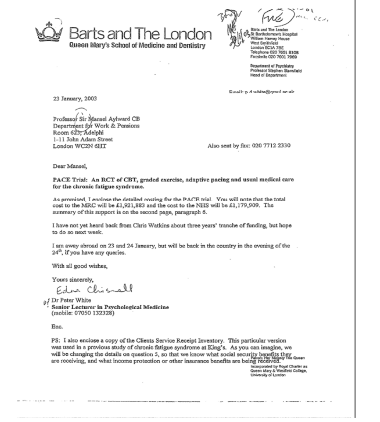
Letter dated 23 January 2003 from Dr Peter White to Sir Mansel Aylward concerning the funding of the PACE trial. Ob-tained by a Freedom of Information request.
Item 2
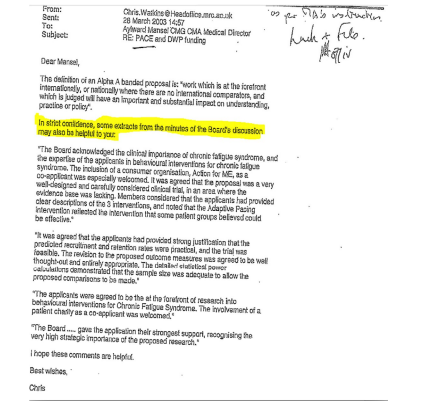
Email dated 28 March 2003 from Chris Watkins, MRC, to Sir Mansel Aylward, Department of Work and Pensions confirm¬ing strong support for PACE trial application.
APPENDIX II
Two illustrations of the implementation of Wessely School policy.
Reproduced from Hooper (2003) by permission.
The Case of Ean Proctor
In 1988, a formerly healthy 12 year old boy named Ean Proc¬tor from the Isle of Man had been suffering from ME since the autumn of 1986; his symptoms included total exhaustion, feel¬ing extremely ill, abdominal pain, persistent nausea, drenching sweats, headaches, recurrent sore throat, heightened sensitivity to noise and light and loss of balance; he was also dragging his right leg. [These are all ‘classic’ symptoms of ME observed in the outbreak at the Royal Free Hospital in 1955]. In 1987 his condition had rapidly deteriorated; he had gradually (not sud¬denly as may occur in hysterical disorders) lost his speech and was almost completely paralysed (which lasted for two years). He had been seen by Dr Morgan-Hughes, a senior consultant neurologist at the National Hospital in London, who had reaf¬firmed the diagnosis of ME and advised the parents that ME patients usually respond poorly to exercise until their muscle strength begins to improve; he also advised that drugs could make the situation worse.
Although he did not obtain his MRCPsych until 1986, during one visit by the Proctors to the National Hospital in 1988, Wes-sely (then a Senior Registrar in Psychiatry) entered the room and asked Ean’s parents if he could become involved in his case; desperate for any help, they readily agreed. Wessely soon in-formed them that children do not get ME [incorrect informa-tion], and unknown to them, on 3 June 1988 he wrote to the Principal Social Worker at Douglas, Isle of Man (Mrs Jean Man-son) that “Ean presented with a history of an ability (sic) to use any muscle group which amounted to a paraplegia, together with elective mutatism (sic). I did not perform a physical examination but was told that there was no evidence of any physical patholo-gy…I was in no doubt that the primary problem was psychiatric (and) that his apparent illness was out of all proportion to the original cause. I feel that Ean’s parents are very over involved in his care. I have considerable experience in the subject of ‘my-algic encephalomyelitis’ [he was a Senior Registrar with one or two years clinical experience] and am absolutely certain that it did not apply to Ean. [Royal Free Hospital outbreak ignored, apparently, although SW also indicated that hysteria was likely to be responsible for that outbreak also] I feel that Ean needs a long period of rehabilitation (which) will involve separation from his parents, providing an escape from his “ill” world. For this reason, I support the application made by your department for wardship. [This appears a draconian step to take after meet¬ing Ean’s parents for only a brief time].
On 10 June 1988 Wessely provided another report on Ean Proc¬tor for Messrs Simcocks & Co, Solicitors for the Child Care De¬partment on the Isle of Man. Although Wessely had never once interviewed or examined the child, he wrote “I did not order any investigations….Ean cannot be suffering from any prima¬ry organic illness, be it myalgic encephalomyelitis or any other. Ean has a primary psychological illness causing him to become mute and immobile. Ean requires skilled rehabilitation to regain lost function. [The rehabilitation Ean later received is described below. It including water immersion, deliberate fright, isolation and being thrown out of a wheelchair resulting in mental and physical trauma.] I therefore support the efforts being made to ensure Ean receives appropriate treatment”. Under his signa¬ture, Wessely wrote “Approved under Section 12, Mental Health Act 1983”.
In that same month (June 1988), without ever having spoken to his parents, social workers supported by psychiatrists and armed with a Court Order specially signed by a magistrate on a Sunday, removed the child under police presence from his distraught and disbelieving parents and placed him into “care” because psy¬chiatrists believed his illness was psychological and was being maintained by an “over-protective mother”. Everything possible was done to censor communication between the child and his parents, who did not even know if their son knew why they were not allowed to visit him.
In this “care”, the sick child was forcibly thrown into a hospi¬tal swimming pool with no floating aids because psychiatrists wanted to prove that he could use his limbs and that he would be forced to do so to save himself from drowning. He could not save himself and sank to the bottom of the pool. The terrified child was also dragged out of the hospital ward and taken on a ghost train because psychiatrists were determined to prove that he could speak and they believed he would cry out in fear and panic and this would prove them right. Another part of this “care” included keeping the boy alone in a side-ward and leav¬ing him intentionally unattended for over seven hours at a time with no means of communication because the call bell had been deliberately disconnected. [This treatment of a 12-year-old boy, or anybody, is nothing less than barbaric.] The side-ward was next to the lavatories and the staff believed he would take him¬self to the lavatory when he was desperate enough. He was un¬able to do so and wet himself but was left for many hours at a time sitting in urine-soaked clothes in a wet chair. Another part of the “care” involved the child being raced in his wheelchair up and down corridors by a male nurse who would stop abrupt¬ly without warning, supposedly to make the boy hold on to the chair sides to prevent himself from being tipped out; he was un-able to do so and was projected out of the wheelchair onto the floor, which on one occasion resulted in injury to his back. This was regarded as a huge joke by the staff.
In a further medical report dated 5th August 1988 for Messrs Simcocks, Wessely expressed a diametric opinion from that of Dr Morgan-Hughes, writing: “A label does not matter so long as the correct treatment is instituted. [Really? Normally treatment matches the label. If the label is wrong, so will the treatment be wrong.] It may assist the Court to point out that I am the co-au¬thor of several scientific papers concerning the topic of “ME” …. I have considerable experience of both (it) and child and adult Psychiatry (and) submit that mutism cannot occur (in ME). I disagree that active rehabilitation should wait until recovery has taken place, [the recommended rehabilitation for ME at that time was bed rest] and submit that recovery will not occur until such rehabilitation has commenced…….it may help the Court to emphasise that…active management, which takes both a physi¬cal and psychological approach, is the most successful treatment available. [Incorrect advice for a severe ME patient.] It is now in everyone’s interests that rehabilitation proceeds as quickly as possible. I am sure that everyone, including Ean, is now anxious for a way out of this dilemma with dignity”.
Ean Proctor was kept in “care” and away from his parents for over five months.
Although this took place in 1988, such brutality is still happen-ing in the UK: the continued barbaric “treatment” of sick chil-dren by certain psychiatrists who profess to specialise in ME was the subject of a Panorama programme transmitted on 8th November 1999 and was profoundly disturbing (a videotape re¬cording is available). Nothing seems to have been learnt from the appalling case of Ean Proctor and there is no question that children with ME continue to be forcibly removed from their parents and home; this issue was raised by Dr Nigel Speight, a consultant paediatrician at the University Hospital of North Durham with 20 years’ experience of children with ME, who in April 1999 reported to the Chief Medical Officer’s Working Group on “CFS/ME” that the frequency of psychiatrists diag-nosing the parents of children with ME as having Munchausen’s Syndrome by Proxy now amounted to an epidemic. Jane Colby, Executive Director of The Young ME Sufferers Trust (TYMES Trust) says “To have your sick child taken from you, to be sus¬pected of damaging them yourself, just when they most need your care, is an appalling experience”.
2. The Case of Child X: Some ten years after her own night-mare experience, Mrs Proctor answered a knock at her door on the Isle of Man and was surprised to find herself confronted by a police officer who had been directed to question her by the Met¬ropolitan Police. Although at the time she did not know it, anoth¬er child with ME in southern England was being threatened with forcible removal from his home if his parents did not agree to his being admitted to a psychiatric hospital: in an effort to protect the child from inappropriate treatment and medical harm, his fa¬ther had surreptitiously taken him abroad. When police officers broke into the house, it seems they found Mrs Proctor’s name and address and she was therefore suspected of assisting the boy’s parents in his disappearance and of harbouring him, which was untrue. Believing his son to be safe, the father returned to the UK where he was arrested and sentenced to two years im¬prisonment, a sentence he was happy to endure, thinking that his son was safe. However, the child’s mother was then targeted and threatened with imprisonment if the boy was not handed over to a particular psychiatrist at a Teaching Hospital. The physically sick child was forced to spend seven months under the “care” of this psychiatrist and was subjected to “active rehabilitation”, during which time his condition deteriorated considerably. He is now severely ill and terrified of health professionals.
The lengths to which these psychiatrists who have focused their careers on “eradicating ME” will go in order to obtain parental obedience, and the control they wield, is extremely disquieting. Professor Wessely, though, seems to be curiously affected by elective amnesia over the compulsory removal of children with ME from their parents: his involvement with the wardship of Ean Proctor is incontrovertibly established, yet in a Channel 4 News programme on 26th August 1998 in which the case of Child X was being discussed, when asked by the presenter Sheena Mc-Donald if there can ever be a case for the coercive approach in situations involving forcible removal of a child with ME from the parents, Wessely stated (verbatim quote) “You know very well I know nothing about these cases” and when Sheena Mc-Donald asked “So you would agree that unless there is criminal abuse, there is never a case for a coercive approach to take chil¬dren away from parents?”, Wessely replied (verbatim quote) “I think it’s so rare. I mean, it’s never happened to me”. Despite this denial on national television, there is unequivocal evidence that Wessely had been personally involved in Ean Proctor’s wardship and that he had advised the local authorities to take the action they did. (Copies of Wessely’s letters and reports and a videotape recording of the Channel 4 News item are available).
APPENDIX III
Expert Reactions concerning CFS, the PACE trial, the SMILE trial on the Science Media Centre Website. The Sci¬ence Media Centre describes itself as: “an independent press office helping to ensure that the public have access to the best scientific evidence and expertise through the news media when science hits the headlines.” (https://www.sciencemedi-acentre.org/)
NOVEMBER 10, 2020
expert reaction to NICE draft guideline on diagnosis and management of ME/CFS Prof Michael Sharpe, Professor of Psychological Medicine, University of Oxford, said:
“As the NICE report says, it is paramount that patients are lis¬tened to and their symptoms and concerns taken seriously. [!] It is also essential that evidence-based rehabilitative treatments (graded activity/exercise and cognitive behaviour therapy) are given only to those patients who want them and then given in a personalized expert fashion in partnership with them.[!] It is to be hoped that these new guidelines improve the quality of deliv¬ery of these treatments. It is also to be hoped that the strongly stated concerns about the effect of badly delivered treatments [badly delivered, or just bad? this is spin and a distraction] do not make it even harder for patients to access the well delivered, evidence-based treatments.”
Prof Trudie Chalder, Professor of Cognitive Behavioural Psychotherapy, Institute of Psychiatry Psychology & Neuro¬science (IoPPN), King’s College London, said:
“Cognitive behaviour therapy (CBT) and graded exercise ther¬apy (GET ) are evidence-based treatments for chronic fatigue syndrome (CFS) in that they facilitate reductions in fatigue [measured by the Chalder Fatigue Scale, with all its flaws] and improve people’s quality of life if delivered by a qualified thera¬pist. Previous reviews of the science provide the evidence [which the NICE (2020) report finds to be of low or very low quali¬ty]. Our clinics are full of patients who are very keen to receive these evidence-based treatments and our patient reported out- comes support their use. My concerns are a) that patients should be offered these treatments to avoid a situation in which their condition stays the same or worsens [which is what the NICE report suggests happens with GET] b) that health profession¬als will stop offering evidence-based treatments.” [NICE (2020) recommends against the use of GET and Lightning Process, so if health professionals stop offering these treatments, that would be a desirable outcome of the revised NICE guidance.]
Prof Sir Simon Wessely, Regius Chair of Psychiatry, King’s College London, said:
“As someone who has been treating patients with ME/CFS for over 30 years [starting with Ean Proctor?] I am in no doubt of the importance of continuing to treat CFS patients with empa-thy and respect, and offering individualised patient centred care. [Putting them into swimming pools, scaring them on ghost trains and with vigorous wheel chair projection?] This was in the pre-vious NICE guidelines in 2007, and it is depressing that this still needs to be said today. [Especially for hundreds of thousands of ME/CFS patients.] If even one patient feels that they are not been taking seriously, there is more work to be done. [There is a huge amount of work to be done because, as you are aware, thousands of ME/CFS patients feel that they have not been taken seriously and many attribute this to the PS approach that claims the symptoms are psychological rather than neurological or im¬munological.] 13 years ago there were only two treatments with clinical trial support, namely graded exercise therapy (GET) or cognitive behavioural therapy (CBT), and that has not changed over the years. In the new guidelines NICE has again empha¬sised that these approaches should not be fixed or set in stone, [This is a gross distortion of the NICE report that clearly states that GET should not be used and CBT should have only a sup¬portive role] which is already the case for those few centres with proper supervision and expert leadership that do provide such services at present. Such services will agree that “unstructured exercise that is not part of a supervised programme” [forms of GET] should be avoided. There is a lot of helpful detail as to how such programmes should be implemented, but still some odd inconsistencies.[Innuendo without any substance.] Final¬ly, sufferers should rightly beware any claims of miracle cures from any quarter, [such as the Lightning Process which you and your colleagues have promoted in three publications including a clinical trial] but be reassured that existing programmes that take a cautious, collaborative, clinically supervised approach, backed by evidence from randomised controlled trials, [none of the trials run by PS controlled for placebo effects] the gold standard of assessing effectiveness, offer some hope [to whom?] of meaningful improvement in what remains a complex, little understood and still sometimes misunderstood condition.”
Prof Peter White, Emeritus Professor of Psychological Med-icine, Queen Mary University of London, said:
“NICE is usually commended by being led by the science. It is therefore a great surprise that this guideline proscribes or quali-fies treatments for CFS/ME for which there is the best evidence of efficacy, namely graded exercise therapy (GET) and cognitive behaviour therapy. [Really? A great surprise? Has Peter White not been paying attention to the huge amount of criticism that his trials have produced over the last 10 years?]
“It is also remarkable that the committee use the symptom of post-exertional fatigue as a reason for not providing GET, when the largest ever trial of GET showed that it significantly reduced this symptom more than staying within one’s energy envelope. [Misleading]. Should this guideline be adopted as suggested, I fear that it will discourage healthcare professionals from offer¬ing the two treatments that give patients the best chance to safely improve their health.” [This so-called ‘discouragement’ is called ‘evidence-based practice’].
APRIL 29, 2019
expert reaction to study investigating a potential biomarker for chronic fatigue syndrome / ME Prof Sir Simon Wessely, Regius Chair of Psychiatry, Insti¬tute of Psychiatry Psychology & Neuroscience, King’s Col¬lege London (IoPPN), and President, Royal Society of Med¬icine, said:
“There have been many previous attempts to find a specific bio¬marker for CFS. The problem is not differentiating patients with CFS from healthy controls. The issue is can any biomarker dis¬tinguish CFS patients from those with other fatiguing illnesses? And second, is it measuring the cause, and not the consequence, of illness? This study does not provide any evidence that either has finally been achieved. [Excellent point. The same issue ap¬plies to the entire research programme of the PS but is rarely mentioned. Instead, multiple occurrences of inappropriate caus¬al language are employed in PS papers.] It is also regrettable that it is claimed that such a test would give “scientific proof” of the existence of the condition, and prove it is “not imaginary”. You don’t need a blood test to prove that an illness exists, and nor does the absence of such a test mean that it is “all in the mind”. Any sub who runs a headline that says ‘new test proves CFS is real and not psychiatric’ should be ashamed of themselves.” [Any sub or Psychiatrist who says CFS is psychiatric and not organic should be ashamed of themselves because this has never been scientifically demonstrated.]
MARCH 22, 2018
reanalysis of the PACE trial Comment from three authors of the original PACE trial Prof Michael Sharpe, Professor of Psychological Medicine, University of Oxford, Prof Trudie Chalder, Professor of Cog¬nitive Behavioural Psychotherapy, Institute of Psychiatry Psychology & Neuroscience (IoPPN), King’s College Lon¬don, & Dr Kimberley Goldsmith Senior Lecturer in Medical Statistics, Institute of Psychiatry Psychology & Neuroscience (IoPPN), King’s College London, said: “Wilshire et al have written a critique of several papers reporting on the PACE trial of treatments for CFS/ME, of which we are authors. They also report a reanalysis of the PACE trial data. We note that most of the analyses they report have already been published, either in peer re¬viewed journals or by ourselves on the PACE trial website (https://www.qmul.ac.uk/wolfson/research-projects-a-z/cur-rent-projects/pace-trial/). [Where exactly? I could not find this, only the message: Sorry, the page you requested could not be found]
“They report different results from the original trial. However this is not surprising as their analyses used only part of the trial dataset and followed a preliminary PACE analysis plan, rather than the final approved and published one. Furthermore they do not refer to the many other trials and meta-analyses that have replicated the findings of the PACE trial.[Why should they? Wilshire et al. conducted a reanalysis of the PACE trial not the entire literature. NICE (2020] did that.]
“In conclusion we find little of substance in this critique and stand by our original reports. [These are all available through the trial website (see above). [Sorry, the page you requested could not be found.] The PACE trial found that CBT and graded exercise therapy are safe and moderately effective treatments; a positive message for people who suffer from this otherwise long-term debilitating illness.”
SEPTEMBER 20, 2017
The Lightning Process – a controversial treatment for chil-dren with chronic fatigue
The Lightning Process is a controversial treatment that is some-times used for children with chronic fatigue syndrome (CFS)/ myalgic encephalomyelitis (ME), a disabling illness that means 1% of UK secondary school children miss a day a week or more of school. Describing itself as “a training course that focuses on the science behind how the brain and body interact”. The Lightning Process has been met with scepticism in the scientific community. [Because it is a pseudoscientific cult based on Neu¬rolinguistic Programming, rituals and osteopathy.]
Researchers decided to test the robustness of this treatment so, despite activists trying to stop them, [Denigration of critics and protesters like those inconvenient people who protest about GM foods?] they ran its first [and, almost definitely, the last] ever trial – an RCT that looked at the effectiveness and cost-effec¬tiveness in children with CFS/ME. The results are published in the Journal of Archives of Disease in Childhood [twice – the second time with major corrections – after revelations by ‘activ-ist’ David Tuller about the trial’s changed endpoints and ethical shortcomings.]
SEPTEMBER 20, 2017
expert reaction to controversial treatment for CFS/M * ‘Clinical and cost-effectiveness of the Lightning Process in addition to specialist medical care for paediatric chronic fa-tigue syndrome: randomised controlled trial’ by Crawley et al. published in Journal of Archives of Disease in Childhood on Wednesday 20th September. Prof. Alastair Sutcliffe, Professor of General Paediatrics, UCL, said: “A recent systematic review of neurolinguistic programming (NLP) stated “There is little evidence that NLP interventions im-prove health-related outcomes. This conclusion reflects the lim-ited quantity and quality of NLP research, rather than robust evi-dence of no effect. [An interesting distinction. There is currently insufficient evidence to support the allocation of NHS resources to NLP activities outside of research purposes.” [Br J Gen Pract. 2012 Nov; 62(604): e757–e764. Published online 2012 Oct 29. doi: 10.3399/bjgp12X658287, PMCID: PMC3481516]. But now we have this interesting study by Crawley, a well-conduct¬ed single blind clinical trial that suggests NLP, in combination with other therapies and described as the ‘Lightning Process’, is effective for some children with the very hard to treat condition of chronic fatigue syndrome (CFS).
“Although in my view the effects described show some benefit and are therefore to be welcomed, this could be due to placebo which would still be GOOD news. Costs are modest [Really? They range between £775 and £2500 per patient] and therefore this study is to be welcomed.
“These press releases are accurate, [hype] however, there is no reference to the fact that the effect may be due to placebo as this is a single-blind trial. But in a sense this is not so important [illogical spin] and as the trial shows convincing evidence of benefit [convincing to whom?] and as placebo is impossible to quantify [especially in any trial that does not include a placebo control group] we are left with the alternative possibility that these children benefited from the package of care per se, rather than the nebulous placebo effect.[Hype and spin.]
“CFS is a difficult to treat and common disorder, so overall I welcome this step in the direction of evidence-based care as, at present in the UK, there is little agreement about what is the best way to treat this illness.” [Translates as: “ It’s perfectly OK and welcomed to treat children with a quacky set of techniques that may only consist of a nebulous placebo effect because we hav-en’t really got a clue about else to give them.]
Prof. Dorothy Bishop, Professor of Developmental Neuro-psychology, University of Oxford, said:
“The gains for patients in this study do seem solid, however, I am still rather uneasy because while the patient allocation and statistical analysis of the trial appear to be done to a high stan¬dard, the intervention that was assessed is commercial and asso¬ciated with a number of warning signs. The Lightning Process appears based on neurolinguistic programming, which, despite its scientific-sounding name, has long been recognised as pseu¬doscience. [How did this get past the SMC editors?]
“I am sympathetic to the authors’ decision to evaluate the Light¬ning Process (LP), given that they had patients who had used it and reported favourably on it, and it could be argued that to fail to do so would indicate a degree of closed-mindedness [This is absurd. Then, must everything any patients anywhere have tried, no matter what, be evaluated in a clinical trial includ¬ing hyperbaric oxygen therapy, “chi deficiency”, acupuncture, naturopathy and chiropractic (invented by D. D. Palmer, who took his instructions from a talking ghost!) to avoid a ‘degree of closed-mindedness’? What about potential harms and wastage of research resources investigating all these quack practices?] But the commercial nature of LP really creates problems. We cannot tell which aspect of LP is responsible for the gains in patients who took part.
“I noticed, for instance, that LP involves group sessions, where-as the comparison group undergoing standard medical care were treated individually. So it may be that the benefits derive from interacting with other children with chronic fatigue syndrome/ ME, rather than the specific exercises and training. This is, of course, something that could be investigated in future research [!] but meanwhile the concern is that this report will in effect act as positive publicity for a programme that is being proposed for a wide range of physical conditions (including chronic pain, low self-esteem, multiple sclerosis, and depression, to name just a few) and has to date been promoted largely through celebrity en-dorsements.” [You already said, the technique is based on pseu¬doscience, yet you are really suggesting further research with improved controls? Bizarre!]
Dr James Thompson, Honorary Senior Lecturer in Psychol-ogy, UCL, said:
“The treatment in this study looks like it had an effect, at least by the standard of most clinical trials. To be extra robust I would have liked to see more objective measures, but unfortunately chronic fatigue syndrome is not an objective diagnosis, it is a leftover category and fatigue is subjective.[ Not having an ob-jective diagnosis does not prevent objective measurements of improvement, e.g. activity measures.]
“One limitation is that self-report scales can be subject to place¬bo effects, however if the patients feel better in the experimen¬tal condition in which they receive extra help, even if everyone knows it, then that is something and the pupils miss less school, which is an objective measure. In this case it may not have been the CBT element of the treatment [?], but it looks like it.” [How can you possibly tell?]
Prof. Michael Sharpe, Professor of Psychological Medicine, University of Oxford, said:
“Chronic fatigue syndrome (CFS) is a name for an illness with symptoms of long lasting and disabling fatigue. It affects many young people and can interfere with their education. Whilst some people call it myalgic encephalomyelitis (ME) it is not clear if this is the same or a different condition.
“This trial tests the effectiveness of a commercially available brief intensive talking therapy for CFS called the Lightning Pro-cess. The treatment has similarities to cognitive behaviour ther-apy (CBT) and is given in groups. [Except CBT does not require participants to: Tell everyone that you have been healed; Per-form magical rituals such as standing in circles drawn on paper with positive keywords inscribed; etc etc]. The treatment was found to be better than usual care in fatigue, physical function and school attendance, with benefit seen as long as a year later. It was also safe. The study does not tell us how it works however. “This is a robust study because patient was allocated to one of the two treatments at random ensuring that any difference seen in outcome between these treatments, is not due to pre-existing differences in the patients. The main limitation is that, as it is not possible to hide which treatment they received from the patients, their self-ratings of fatigue and functioning could potentially be biased by their views on the treatment they received. [These crit- icisms are true of all trials run by the PS including the PACE trial but you have never acknowledged these.] However, differences in the school attendance a year later were also noted; it seems [un?] likely that these could be due to such a bias.
“Commercially available treatments like this one that are being used by patients should be rigorously tested. This is especially important for an illness like this one about which much misin¬formation is spread using social media. [And by using medical journals that pass defective trials though peer review and refus¬ing to retract them.] We need more studies and less polemic.”
JULY 31, 2017.
expert reaction to Journal of Health Psychology’s Special Is¬sue on The PACE Trial The Journal of Healthy Psychology has published a special issue focusing on the PACE trial – originally published in The Lancet (2011). ‘Special Issue on The PACE Trial’ edited by David Marks published in Journal of Health Psychology on Monday 31st July 2017.
Prof. Malcolm Macleod, Professor of Neurology and Trans¬lational Neuroscience, University of Edinburgh, said:
“The PACE trial, while not perfect, provides far and away the best evidence for the effectiveness of any intervention for chron¬ic fatigue; and certainly, is more robust than any of the other research cited. Reading the criticisms, I was struck by how little actual meat there is in them; and wondered where some of the authors came from. [Ad hominem]. In fact, one of them [a repu¬table and well-published family doctor in Amsterdam] lists as an institution a research centre (Soerabaja Research Center) which only seems to exist as an affiliation on papers he wrote criticis¬ing the PACE trial. [It is normal practice to consider the quality of a critic’s argument not their institution. For the record, other affiliations of PACE critics include University College London, Northwestern University, DePaul University, the University of Hertfordshire, Victoria University of Wellington New Zealand, UC Berkeley, and the ME Association.]
“Their main criticisms seem to revolve around the primary out¬come was changed halfway through the trial: there are lots of reasons this can happen, some justifiable and others not; the main think is whether it was done without knowledge of the outcomes already accumulated in the trial and before data lock – which is what was done here. [Evidence on this point remains uncertain.]
“So, I don’t think there is really a story here, apart from a group of authors, some of doubtful provenance [a family doctor has doubtful provenance?] kicking up dust about a study which has a few minor wrinkles (as all do) but still provides information reliable enough to shape practice. If you substitute ‘CFS’ for ‘autism’ and ‘PACE trial’ for ‘vaccination’ you see a familiar pattern…” [This statement is a shameful ad hominen argument.]
A Spokesperson for University of Oxford said:
“The PACE trial of Chronic Fatigue Syndrome treatments was conducted to the highest scientific standards and scrutiny. This included extensive peer review from the Medical Research Council, ethical approval from a Research Ethics Committee, independent oversight by a Trial Steering Committee and further peer review before publication in high-impact journals such as The Lancet.
“The allegation that criteria for patient improvement and re-covery were changed to increase the reported benefit of some treatments is completely unfounded. As the study authors have repeatedly made clear, the criteria were changed on expert ad¬vice and with oversight committee approvals before any of the outcome data was analysed.
“Oxford University considers Professor Sharpe and his col-leagues to be highly reputable scientists whose sole aim has been to improve quality of life for patients with ME/CFS. [For he’s a jolly good fellow.] While scientific research should always be open to challenge and debate, this does not justify the unwar-ranted attacks on professionalism and personal integrity which the PACE trial team have been subjected to.” [Nor does it justi-fy vilification of patients who have criticized poorly done trials such as the PACE trial.]
OCTOBER 28, 2015
expert reaction to long-term follow-up study from the PACE trial on rehabilitative treatments for CFS/ME, and accom-panying comment piece
A paper published in The Lancet Psychiatry reports results of a long-term follow-up study to the PACE trial for CFS/ME. The study has assessed the original trial participants’ health in the long-term, and asks whether their current state of health, two and a half years after entering the trial, has been affected by which treatment they received in the trial.
‘Rehabilitative treatments for chronic fatigue syndrome: long-term follow-up from the PACE trial’ by Michael Sharpe et al. published in the Lancet Psychiatry on Wednesday 28 October 2015.
‘Chronic fatigue syndrome: what is it and how to treat?’ by Steven Moylan et al. published in the Lancet Psychiatry on Wednesday 28 October 2015.
Prof. Rona Moss-Morris, Professor of Psychology as Applied to Medicine, King’s College London, said:
“I think this is a robust study with some limitations that the au-thors have been clear about. [The authors have not been at all clear about the limitations and they refuse to accept that the many methodological flaws in the PACE trial.] The original PACE trial published in 2011 showed that at one year people with CFS/ME who received either graded exercise therapy (GET) or cognitive behavioural therapy (CBT) in addition to standard medical care were significantly less fatigued than those who received stan¬dard care alone or those who received adapted pacing therapy. The authors concluded GET and CBT were moderately effective treatments for CFS. Now, moderately effective may not sound all that impressive until you consider that many of our com¬monly used pharmaceuticals for medical conditions have sim- ilar moderate treatment effects. When using pharmaceuticals as treatment, maintaining these effects may mean taking ongoing medicines. This study shows that even two years or more after treatment has completed, patients receiving GET and CBT sus¬tain their clinical benefits. A small percentage of these patients accessed some further treatment, but even so, these sustained effects are impressive. [Hype].
“Despite these impressive results [repeated hype], this isn’t time for complacency. Some patients do not benefit from the treat¬ment. [Many patients do not benefit from the treatment.] We need to do more to understand why. [Examine the underlying theory?] We also need to develop and tailor existing treatment to get larg¬er effects. It is also important to note that the CBT and GET protocols used in PACE were developed specifically for CFS. They are not the same as CBT for depression and anxiety or the exercise training you may receive at a local gym. The therapies are based on a [non-scientific] biopsychosocial understanding of CFS and the health care professionals in PACE received specific training and supervision in these approaches. This is an import¬ant note for commissioners as not all CBT and exercise therapies are equal. Specialist knowledge and competence [and a failure to take account of placebo effects] in these therapies is needed to obtain these sustained [questionable] treatment effects.”
Declared Interests
Prof. Rona Moss-Morris: “Two authors of this study, Trudie Chalder and Kimberley Goldsmith, are colleagues of mine at King’s College London. I work with Trudie on other CFS work and with Kimberley on different work. I published a small study on GET in 2005. I am a National Advisor for NHS England for improving access to psychological therapies for long-term conditions and medically unexplained symptoms. Peter White (another author of the present study) is Chair of trial steering committee for an HTA NIHR-funded RCT I am working on with people with irritable bowel syndrome.” [Totally conflicted and biased, but that’s the reason the SMC selected you.]
FEBRUARY 17, 2011
expert reaction to Lancet study looking at treatments for Chronic Fatigue Syndrome/ME. Comparison of adaptive pacing therapy, cognitive behaviour therapy, graded exercise therapy, and specialist medical care for chronic fatigue syndrome (PACE): a randomised trial, by Peter White et al, published in the Lancet at 00.01hr UK time Friday 18 February 2011.
The study made the first definitive comparison of various treat¬ments for CFS/ME to deduce the most effective treatments.
Dr Alastair Miller, Consultant Physician at Royal Liverpool University Hospital, Clinical lead for CFS services in Liver¬pool, Independent assessor of trial safety data for PACE trial and Principal Medical Advisor, Action for ME, said: '
“Although NICE have previously recommended graded exercise and CBT as treatments for ME/CFS, this was on the basis of somewhat limited evidence in the form of fairly small clinical trials. This trial represents the highest grade of clinical evidence – a large randomized [uncontrolled] clinical trial, carefully de-signed, rigorously conducted and scrupulously analysed and re-ported [but full of well-recognised flaws, nevertheless.] It pro-vides [un]convincing evidence that GET and CBT are safe and effective and should be widely available for our patients with CFS/ME.
“It is clearly vital to continue our research into biological mech-anisms for ME/CFS but recent ‘false dawns’ for example, over the role of retroviruses (XMRV) have shown how difficult this can be. In the current absence of a biomedical model for the causation and the absence of any pharmacological intervention, we have a pragmatic approach to therapy that works and we should use it.” [even if it is only is a placebo effect.]
Dr Derick Wade, Consultant and Professor in Neurological Rehabilitation and Clinical Director, Enablement Director-ate, Oxford Centre for Enablement, said:
“CFS is common, and it is vital to know whether treatments proposed and/or used are safe and are effective. Randomised controlled trials provide the best and only reliable evidence on safety and effectiveness of any intervention in any condition. The trial design in this study was very good, [but it was not a controlled trial] and means that the conclusions drawn can be drawn with confidence. [An untrue statement.]
“This is a very significant finding. It identifies that one common-ly used intervention is not effective (and therefore should not be used), and it confirms the effectiveness of two treatments, and their safety. The study suggests that everyone with the condition should be offered the treatment, and every patient who wishes to be helped should be willing to try one or both of the treat¬ments. It also means that we can allocate resources to treatments that will benefit patients and, more importantly, stop allocating treatments that do not have proven efficiency. Further research should identify ways that treatments derived from these may de¬liver greater benefits.
[All of the above paragraph is spin.]
“Research needs to investigate both treatments and factors that increase the risk of developing CFS. However, it is probably more effective to research treatments, and proving a treatment is ffective starts to give clues about causative factors.”
Dr Fergus Macbeth, Director of the Centre for Clinical Prac-tice at NICE, said:
“We welcome the findings of the PACE trial, which further sup-port cognitive behavioural therapy and graded exercise therapy as safe and effective treatment options for people who have mild or moderate CFS/ME. These findings are in line with our current recommendations on the management of this condition.
“We will now analyse the results of this important trial in more detail before making a final decision on whether there is a clinical need to update our guideline. Until then, healthcare professionals should continue to follow our existing recommendations, especially as this latest research appears to endorse them as best practice for the NHS.
[NICE, 2020, reported its revised guidance that GET should be dropped and CBT only used in a supportive role.]
Dr Esther Crawley, Consultant Paediatrician and Clinical Lead for the Bath Specialist Paediatrics Chronic Fatigue Syndrome/ME Service, said:
“All children with chronic fatigue syndrome and their parents are desperate for new research to understand how to treat this condition. The next step is to do a study like this for children to find out if these treatments work.” [Promotes her forthcoming SMILE trial grant application.]
Prof Willie Hamilton, GP in Exeter and Professor of Primary Care Diagnostics, Peninsula College of Medicine and Den¬tistry, said:
“At least half of patients improved with CBT or GET. The study also allays fears that CBT or GET may be harmful. [Not among patients at the receiving end.] There are a minority of patients who didn’t see improvement so the next step must try and find treatments to help them.
“This study matters: it matters a lot. CFS/ME is common, and causes a lot of suffering. Up until now we have known only that CBT and GET work for some people. We didn’t know if pacing worked. This caused a real dilemma – especially for those in primary care. We didn’t know whether to recommend pacing, or to refer for CBT or GET. Worse still, not all GPs have access to CBT or GET, so ended up suggesting pacing almost by default. This study should solve that dilemma.
“At a patient level, I now know what to suggest to my patients. Almost as important, it sends a powerful message to PCTs – and the soon-to-be-formed GP consortia – that they must fund CBT or GET. NICE proposed that before this study came out – the evidence is even stronger now.”
[For good reasons, patient organisations did not accept the PACE trial evidence. CBT and GET continue to fail patients' health care needs.]