

Plant Biology Soil Health Journal(PBSHJ)
ISSN: 2996-2609 | DOI: 10.33140/PBSHJ


Short Communication - (2023) Volume 1, Issue 1
The Revision of Lipomycetaceae
2Department of Microbiology, Faculty of Biology and Biotechnology, University of Science, Vietnam National University-HCM City, 227 Nguyen Van Cu Street, Ward 4, District 5, Hochiminh City, Vietnam
3Department of Biochemistry and Microbiology, Faculty of Pharmaceutical Sciences, Chulalongkorn University, 254 Phayathai Road, Wangmai, Pathumwan, Bangkok 10330, Thailand
4Laboratory of Applied Microbiology (Professor Emeritus), Department of Agricultural Chemistry, Faculty of Agriculture, Shizuoka University, 836 Ohya, Suruga-ku, Shizuoka 422-8529, Japan
Received Date: Dec 01, 2023 / Accepted Date: Dec 22, 2023 / Published Date: Dec 30, 2023
Copyright: ©©2023 Yuzo Yamada, et al. This is an open-access article distributed under the terms of the Creative Commons Attribution License, which permits unrestricted use, distribution, and reproduction in any medium, provided the original author and source are credited.
Citation: Yamada, Y., Vu, H. T. L., Yukphan, P., Tanasupawat, Somboon. (2023). The Revision of Lipomycetaceae. Plant Biol Soil Health J. 1(1), 73-81.
Abstract
In the family Lipomycetaceae, the seven genera Waltomyces, Zygozyma, Babjevia, Smithiozyma, Kawasakia, Limtongia and Kockiozyma were introduced. However, all of them were neither accepted nor recognized. This paper described the historical surveys in the systematics of the Lipomycetaceous yeasts and confirmed the total of ten genera within the family Lipomycetaceae, i.e., the genus Lipomyces sensu stricto (the type genus), the above-mentioned seven genera, the monotypic genus Dipodascopsis and the new genus Neoaidaea from the phylogenetic and the phenotypic points of view.
Supplementary Abstract
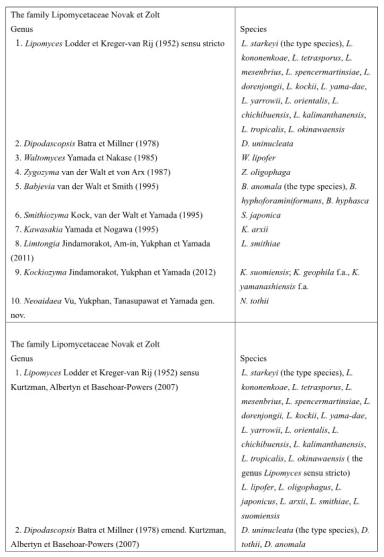
In the family Lipomycetaceae Novak Zsolt, the seven genera Waltomyces, Zygozyma, Babjevia, Smithiozyma, Kawasakia, Limtongia and Kockiozyma were once introduced [2-8]. All of them were respectively taxonomic-homogeneous natured, i.e., morphologically, physiologically, chemotaxonomically, geneti-cally and phylogenetically. However, Kurtzman et al. divided the family into two, i.e., the monophyletic genus Lipomyces sensu and the paraphyletic genus Dipodascopsis emend instead [9, 10].
This paper describes the historical surveys in the systematics of the Lipomycetaceous yeasts and recovers the seven genera mentioned above as taxonomic criteria, in addition to the genus Lipomyces sensu stricto, the monotypic genus Dipodascopsis and the new genus Neoaidaea from the phylogenetic and the phenotypic points of view [1, 7, 8]. Accordingly, the family is comprised of ten genera in total as follows.
The family Lipomycetaceae Novak et Zsolt
The type genus is Lipomyces Lodder et Kreger van-Rij.
Ten genera are included.
Genus I. Lipomyces Lodder et Kreger-van Rij sensu stricto
The type species is Lipomyces starkeyi Lodder et Kreger-van Rij.
Fourteen species are included.
1. Lipomyces starkeyi Lodder et Kreger-van Rij [11]
2. Lipomyces kononenkoae Nieuwdorp, Bos et Slooff (1974)
3. Lipomyces tetrasporus Nieuwdorp, Bos et Slooff (1974)
4. Lipomyces mesembrius Botha, van der Walt et Smith (1997)
5. Lipomyces spencermartinsiae van der Walt et Smith (1997)
Basionym: Lipomyces kononenkoae Nieuwdorp, Bos et Slooff subsp. spencermartinsiae van der Walt et Smith [5]
6. Lipomyces doorenjongii van der Walt et Smith (1999)
7. Lipomyces kockii Smith et van der Walt (1999)
8. Lipomyces yamadae van der Walt et Smith (1999)
9. Lipomyces yarrowii Smith et van der Walt (1999)
10. Lipomyces orientalis Thanh (2006)
11. Lipomyces chichibuensis Yamazaki et Kawasaki [12]
12. Lipomyces kalimantanensis Kanti, Yamazaki et Kawasaki [13]
13. Lipomyces tropicalis Kanti, Yamazaki et Kawasaki [13]
14. Lipomyces okinawensis Yamazaki, Yanagiba et Naganuma [14]
The species classified in the genus Lipomyces sensu stricto were tightly coupled with one another in all the three phyloge¬netic trees based on the concatenated four-gene sequences of 18S rRNA, 26S rRNA, mitochondrial small subunit rRNA, and EF1-a derived from the neighbour-joining, the maximum parsi¬mony and the maximum likelihood methods [8]. On the other hand, the phylogenetic positions of the Lipomyces species new¬ly designated by Kurtzman et al. were quite changeable in the monophyletic genus Lipomyces sensu [8, 9]. In fact, the result-ing genus has an extremely wide range of DNA G+C contents (14.2 mol%, from 41.5 - 55.7 mol% G+C; Jindamorakot et al. 2012) and three kinds of ubiquinone isoprenologues [15, 16]. According to Nakase and Komagata and Yamada et al., such a genus was a taxonomically heterogeneous-natured taxon, just as found in the genus Pichia Hansen once designated [17, 18].
Genus II. Dipodascopsis Batra et Millner
Dipodascopsis uninucleata (Biggs) Batra et Millner (1978)
Basionym: Dipodascus uninucleatus Biggs (1937).
Two varieties are described.
1. Dipodascopsis uninucleata var. uninucleata
2. Dipodascopsis uninucleata var. wickerhamii Kreger-van Rij (1974)
When the phylogenetic tree based on the 26S rRNA gene D1/ D2 domain sequences was constructed by the neighbour-joining method, the paraphyletic genus Dipodascopsis emend. Kurtz¬man et al. was split into two and produced a monotypic genus (Fig. 1), as reported previously, indicating that D. uninucleata, D. tothii and D. anomala were not tightly coupled within the genus Dipodascopsis emend [7-9].

Figure. 1: The phylogenetic relationships of the Lipomycetaceous yeast species. The phylogenetic trees based on the 26S rRNA gene D1/D2 domain sequences (526 bases) were constructed for the Lipomycetaceous yeast species by the neighbour-joining method (A) and by the maximum parsimony method (B). Saccharomyces cerevisiae and its related species were utilized for reference standards. Schizosaccharomyces pombe was used as outgroup. The evolutionary distances were computed using the Kimura 2-parameter method (Kimura, J Mol Evol 1980; 16: 111). The numerals at the nodes of the respective branches indicate bootstrap values (%) deduced from 1000 replications (Felsenstein, Evolution 1985; 39: 783). The bootstrap values below 50% were deleted. For the additional phylogenetic trees based on the concatenated four-gene sequences, i.e., 18S rRNA, 26S rRNA, mitochondrial small subunit rRNA, and EF1-a, derived from the three methods, refer to Jindamorakot et al. [7]. According to the theory of Kurtzman et al., the Lipomycetaceous yeast species are designated as L. starkeyi and its relatives, Lipomyces lipofer, L. oligophagus, L. japonicus, L. smithiae, L. arxii, L. suomiensis, Dipodascopsis uninucleata, D. anomala and D. tothii instead [9].
Such a phylogenetic data was also given by Kurtzman, i.e., the phylogenetic tree based on the concatenated three-gene sequences of 26S rRNA, 18S rRNA, and EF1-a derived from the neighbour-joining method represented that D [19]. Uninucleata was connected first to L. starkeyi but not to D. anomala (= B. anomala) and then the resulting cluster was done to D. anomala. In fact, the calculated sequence similarity (95.7%) between D. uninucleta and L. starkeyi was much higher than that (90.4%) between D. uninucleara and B. anomala (Table 1).

Genus III. Waltomyces Yamada et Nakase (MB 25779)
Waltomyces lipofer (Lodder et Kreger-van Rij ex Slooff) Yamada et Nakase (MB 103899)
Basionym: Lipomyces lipofer Lodder et Kreger-van Rij ex Slooff [2, 11, 17].
The three partial base sequencings in positions 468-622, 155 bases (designated as region a) and in positions 1611-1835, 225 bases (designated as region b) of 26S rRNA and in positions 1451-1618, 168 bases (designated as region c) of 18S rRNA showed that the Q10-equipped species, W. lipofer had 88% maximum homology in region a, along with B. anomala (= D. anomala), to L. starkeyi, L. tetrasporus and L. kononenkoae in the genus Lipomyces sensu stricto. In contrast, the above-mentioned three Lipomyces species constituted a cluster with 97% or more maximum homologies within the genus, indicating that the species is accommodated to a different genus from the genus Lipomyces sensu stricto (Table 1). Such similar experimental data were shown, since the species was used as outgroup in the phylogenetic trees concerned [9, 12].
Genus IV. Zygozyma van der Walt et von Arx (MB 25149) Zygozyma oligophaga van der Walt et von Arx (MB 131108) Synonym: Lipomyces oligophagus (van der Walt et von Arx) Kurtzman, Albertyn et Basehoar-Powers [3, 9].
Four Zygozyma species were reported [3, 20-22]. However, the four were not tightly coupled with one another in the phylogenetic trees based on the concatenated four-gene sequences derived from the three methods, i.e., the neighbour-joining, the maximum parsimony and the maximum likelihood methods and chemotaxonomically grouped into two based on the ubiquinone isoprenologues, i.e., Q-8 and Q-9 (Fig. 1) [7, 8, 16]. Especially, the Q8-equipped species, Z. oligophaga had extremely long branches (Fig. 1) and quite low sequence similarities (81.6-86.6%) (Table 1) [8].
Genus V. Babjevia van der Walt et Smith (MB 27435)
The type species is Babjevia anomala (Babjeva et Gorin) van der Walt et Smith.
Three species are included.
1. Babjevia anomala (Babjeva et Gorin) van der Walt et Smith (MB 363215) Basionym: Lipomyces anomalus Babjeva et Gorin (1975) [4]. Synonym: Dipodascopsis anomala (Babjeva et Gorin) Kurtzman, Albertyn et Basehoar-Powers [9].
2. Babjevia hyphoforaminiformans Yamazaki, Lorliam et Kawasaki (MB 829051)
3. Babjevia hyphasca Yamazaki, Lorliam et Kawasaki (MB 829053)
Kurtzman et al. accommodated B [9]. anomala to the paraphyletic genus Dipod-ascopsis emend. as D. anomala. However, Jindamorakot et al. insisted that the species, D [8]. anomala should be transferred again to the genus Babjevia as B. anomala, since the species was not tightly coupled with the type species, D. uninucleata (Fig. 1). In fact, Yamazaki et al. did not classified two new species to the genus Dipodascopsis emend. but the genus Babjevia as already suggested by Jindamorakot et al., indicating that the generic concept of Kurtzman et al. completely lost its validity [8, 9, 23].
In the phylognetic tree based on the concatenated four-gene sequences derived from the maximum likelihood method , L. lipofer, L. smithiae, Zygozyma arxii (= L. arxii), L. japonicus, L. oligophaga [sic] and Zygozyma suomiensis (= L. suomiensis) were preferable to be improved to Waltomyces lipofer, Limtongia smithiae, Kawasakia arxii, Smithiozyma japonica, Zigozyma oligophaga and Kockiozyma suomiensis [7, 8, 23].
Genus VI. Smithiozyma Kock, van der Walt et Yamada (MB 27638) Smithiozyma japonica (van der Walt, Smith, Yamada et Nakase) Kock, van der Walt et Yamada (MB 414161) Basionym: Lipomyces japonicus van der Walt, Smith, Yamada et Nakase [5, 22].
In the three partial base sequencings mentioned above, the Q9-equipped species, S. japonica represented 89% maximum homology in region a, two base differences in region b and five base differences in region c to L. starkeyi, L [24]. Tetrasporus and L. kononenkoae in the genus Lipomyces sensu stricto. In contrast, the above-mentioned three Lipomyces species constituted clusters with 97% or more maximum homologies (region a) and no base differences (regions b and c) within the genus, indicating that the species is accommodated taxonomically to a different genus from the genus Lipomyces sensu stricto (Table 1) [16]. In the phylogenetic trees based on the concatenated four-gene sequences, S. japonica was not tightly coupled, i.e., the species was connected to the cluster comprised of the Q9-equipped species including L. starkeyi, D. uninucleata and so on, when constructed by the neighbour-joining method, but to the cluster of Q8-equipped species including Z. oligophaga and Kockiozyma suomiensis, when constructed by the maximum parsimony method [8].
Genus VII. Kawasakia Yamada et Nogawa (MB 27831)
Kawasakia arxii (van der Walt, Smith et Yamada) Yamada et Nogawa (1995) (MB 442988)
Basionym: Zygozyma arxii van der Walt, Smith et Yamada [12]. Synonym: Lipomyces arxii (van der Walt, Smith et Yamada)
Kurtzman, Albertyn et Basehoar-Powers [9].
The Q9-equipped species, Kawasakia arxii was very unique in representing considerably large base differences (six) from the above-mentioned three Lipomyces species in the partial base sequencing of 18S rRNA (region c), in contrast to W. lipofer, which had only one base difference in the same region [6, 16]. In the remaining regions a and b, the maximum homology and the base differences of the species were 93% and only one. The calculated 26S rRNA gene D1/D2 domain sequence similarities of Kawasakia arxii were 85.7 - 97.5% (Table 1). In the phylogenetic trees based on the concatenated four-gene sequences, the phylogenetic positions of Kawasakia arxii were considerably changeable, indicating that the species was not tightly coupled to any of other species [8].
Genus VIII. Limtongia Jindamorakot, Am-in, Yukphan et Yamada (MB 582716)
Limtongia smithiae (van der Walt, Wingfield et Yamada) Jindamorakot, Am-in, Yukphan et Yamada [7] (MB 582717) Basionym: Zygozyma smithiae van der Walt, Wingfield et Yamada [25].
Synonym: Lipomyces smithiae (van der Walt, Wingfield et Yamada) Kurtzman, Albertyn et Basehoar-Powers [9].
In the three partial base sequencings mentioned above, the Q9-equipped species, Limtongia smithiae represented 89% maximum homology, four base differences and three base differences respectively to L. starkeyi, L. tetrasporus and L. kononenkoae in the genus Lipomyces sensu stricto [16]. The calculated 26S rRNA gene D1/D2 domain sequence similarities of the species were 82.9 - 92.4%, indicating that the species is accommodated to an independent genus (Table 1).
Genus IX. Kockiozyma Jindamorakot, Yukphan et Yamada (MB 587737)
1. Kockiozyma suomiensis (Smith, van der Walt et Yamada)
Jindamorakot, Yukphan et Yamada [8] (MB 587754)
Basionym: Zygozyma suomiensis Smith, van der Walt et Yamada [21]. Synonym: Lipomyces suomiensis (Smith, van der Walt et Yamada) Kurtzman, Albertyn et Basehoar-Powers [8].
2. Kockiozyma geophila f.a comb. Nov [24].
Basionym: Myxozyma geophila van der Walt, Yamada et Nakase, Syst. Appl. Microbiol.
9: 122, 1987. The type strain is CBS 7219 = NRRL Y-17252.
3. Kockiozyma sirexii f.a. comb. nov.
Basionym: Myxozyma sirexii Spaaij et Weber, Syst. Appl.
Microbiol. 15: 429, 1992.
The type strain is UOFS Y-2054 = NRRL Y-27626 4. Kockiozyma yamanashiensis f.a. comb. Nov [14].
Basionym: Lipomyces yamanashiensis f.a. Yamazaki, Yanagiba et Naganuma, Int. J. Syst. Evol. Microbiol. 67: 2945, 2017. The type strain is NBRC 110621 = CBS 14748.
In the three partial base sequencings mentioned above, the Q8-equipped species, Kockiozyma suomiensis represented 83% maximum homology in region a, 12 base differences in region b, and four base differences in region c respectively to L. starkeyi, L. tetrasporus, and L. kononenkoae in the genus Lipomyces sensu stricto [16]. The calculated 26S rRNA gene D1/D2 domain sequence similarities of the species were 85.9 - 90.6%, indicating that the species is accommodated to an independent genus (Table 1). On the other hand, Myxozyma geophila, the Q8-equipped anamorphic species showed 92% maximum homology, and one and one base difference to Kockiozyma suomiensis in the three partial base sequencings [16]. In addition, the sequence similarity between Kockiozyma suomiensis and Myxozyma geophila was 98.0%, the value of which was almost identical with that (98.1%) between Octosporomyces octosporus and Octosporomyces osmophilus [26]. From the results obtained above, the generic name of Kockiozyma was able to be given to the anamorphic species as Kockiozyma geophila f.a. As well as Kockiozyma melibiosi f.a., Kockiozyma mucilagina f.a., Kockiozyma sirexii f.a., Kockiozyma neotropica f.a., Kockiozyma vanderwalti f.a. and Kockiozyma neglecta f.a. [27].
Dipodascopsis tothii and B. anomala (= D. anomala) were tightly coupled in the three phylogenetic trees (Jindamorakot et al. 2012), so that the two species appeared to be classified in a single genus (Fig. 1). Due to the priority of B. anomala, the single genus was to be named Babjevia. However, the distance between the two species, D. tothii and B. anomala was not so short, when compared with Kluyveromyces polysporus and Saccharomyces cerevisiae [8, 28]. In fact, the calculated pair-wise sequence similarity (95.6%) between the two species was interestingly almost the same as that (95.7%) between D. uninucleata and L. starkeyi and that (95.2%) between W. lipofer and L. starkeyi, and not so high to accommodate the two species to the single genus Babjevia (Table 1), indicating that an additional genus can be phylogenetically introduced for D. tothii. Phenotypically, the species was quite different from B. anomala, e.g., in the morphology of asci and ascospores and the mode of asexual reproduction [10].
Yamazaki et al. Constructed the phylogenetic trees based on the translation elongation factor 1-alpha (EF1-â?») gene sequences derived from the neighbour-joining method [13, 14]. In the phylogenetic trees, it is of interest that D. tothii was found inside and distantly separated from B. anomala as well as D. uninucleata. In contrast, the cluster including L. starkeyi and its relatives and the cluster including Kockiozyma suomiensis and its related Myxozyma species were tightly coupled without any exception. In this respect, D. tothii was quite different phylogenetically from the remaining two species of the paraphyletic genus Dipodascopsis emend. Kurtzman et al., and thus the introduction of a separate new genus was confirmed [1, 8].
Genus X. Neoaidaea Vu, Yukphan, Tanasupawat et Yamada gen. nov. Neoaidaea (Ne.o.a.i’da.e.a. N. L. fem. n. Neoaidaea, new Aida, in honour of Dr. Ko Aida, Professor Emeritus, The Institute of Applied Microbiology, The University of Tokyo, Tokyo, Japan, who introduced the isoprenoid quinone analyses into the microbial systematics.
The colonies are cream-coloured, moist and creamy after 10 d [10]. Budding cells are absent. Hyphae are firm with inflated cells and intensely amyloid. Arthroconidia are absent. Gametangia are formed laterally on hyphae as curved branches. Asci arises after fusion of a terminal cell with its penultimate cell. Asci is acicular, 50 - 100  m long and contain 30 - 100 ascospores. Asci opens by rupturing at the apex. Ascospores are subhyaline to hyaline, broadly ellipsoidal, occasionally bean-shaped, 1×1.5 - 2 m and without slime. Fermentation is absent. Grows on glucose, inulin, sucrose, raffinose, galactose, lactose, trehalose, maltose, methyl--glucoside, starch, cellobiose, salicin, L-sorbose, xylose, arabinose, L-arabinose, ethanol, glycerol, ribitol, mannitol, glucitol, myo-inositol, succinate (w) and gluconate (v), but not on melibiose, L-rhamnose, ribose, methanol, erythritol, galactitol and DL-lactate. No growth on vitamin-free medium [10]. Ubiquinone-9 (Q-9) is present [29].
Mycobank number is 846280.
Neoaidaea tothii (Zolt) Vu, Yukphan, Tanasupawat et Yamada comb. Nov.
Basionym: Dipodascus tothii Zolt, Acta Bot. Hung. 9: 226, 1963.
Synonym: Dipodascopsis tothii (Zolt) Batra et Millner (1978).
The characteristics of the species are the same as those described in the genus [10].
The holotype is CBS 759.85T = NBRC 10813T.
MycoBank number is 846281.
For the detailed characteristics of the taxa mentioned above and the type strains concerned, refer to the related monographs and/ or articles.
Kurtzman introduced ‘clade’ or ‘phylogenetic circumscribed genuses as generic concept [28]. However, it was not yet perfect to get the taxonomic homogeneous-natured taxon for the genus. Namely, the branch lengths should be additionally considered in the phylogenetic trees.
In the seven ranks used for the systematics of plants and animals, the homogeneous-natured taxa can be available only when the lower-ranked two taxa, i.e., species and genus are dealt with taxonomically. Therefore, the present authors naturally selected the homogeneous-natured taxon in the generic designation, since the longer the phylogenetic distances are the more taxonomic heterogeneities will be increased.
Thus, the monophyletic genus Lipomyces Lodder et Kreger-van Rij sensu Kurtzman et al. contained the phylogenetic-distant and the phenotypic-different species, i.e., L. lipofer, L. oligophagus, L. japonicus, L. arxii, L. smithiae and L. suomiensis, all of which were re-classified as Waltomyces lipofer, Zygozyma oligophaga, Smithiozyma japonica, Kawasakia arxii, Limtongia smithiae and Kockiozyma suomiensi respectively, in addition to L. starkeyi, the type species and its closely related Lipomyces species that constituted the genus Lipomyces sensu stricto, and so corresponded taxonomically to the so-called family [7-9].
On the other hand, the paraphyletic genus Dipodascopsis Batra et Millner emend. Kurtzman et al was a monotypic genus, which included only D. uninucleata [8, 9]. For the remaining two species, one was transferred again to the genus Babjevia as B. anomala and the other was classified in the new genus Neoaidaea as Neoaidaea tothii gen. Nov., comb. Nov. [1, 8, 23].
Acknowledgement
The present authors express their sincere thanks for citing a number of articles for detailed discussions.
Funding information
The authors received no specific grant from any funding agency.
*This article is dedicated to Professor Dr. Johannes Petrus van der Walt, South Africa for his excellent taxonomic study on the Lipomycetaceous yeasts, especially in the findings of Zygozyma oligophaga and its related species.
*This work was presented at the 27th annual meeting of Japan Society for Microbial Resources and Systematics (JSMRS) on June 23-30, 2021 [1].
References
- Vu, H. T. L., Yukphan, P., Tanasupawat, S., & Yamada, Y. (2021). The revision of the family Lipomycetaceae. 27th Ann Meet JSMRS, 15.
- YAMADA, Y., & NAKASE, T. (1985). Waltomyces, a new ascosporogenous yeast genus for the Q10-equipped, slime-producing organisms whose asexual reproduction is by multilateral budding and whose ascospores have smooth surfaces. The Journal of General and Applied Microbiology, 31(5), 491-492.
- Van der Walt, J. P., Von Arx, J. A., Ferreira, N. P., & Richards,P. D. G. (1987). Zygozyma gen. nov., a new genus of the Lipomycetaceae. Systematic and applied microbiology, 9(1-2), 115-120.
- Smith, M. T., Van Der Walt, J. P., & Batenburg-Van Der Vegte, W. H. (1995). Babjevia gen. nov. —a new genus of the Lipomycetaceae. Antonie van Leeuwenhoek, 67, 177-179.
- Kock, J. L. F., Van der Walt, J. P., & Yamada, Y. (1995). Smithiozyma gen. nov. (Lipomycetaceae). S. Afr. J. Bol, 61(4).
- Yamada, Y. and Nogawa, C. Kawasakia gen. nov., for Zygozyma arxii, the Q9- equipped species in the genus Zygozyma (Lipomycetaceae). Bull Fac Agric Shizuoka Univ 1995b; 45: 31–34.
- Jindamorakot, S., Am-in, S., Yukphan, P., & Yamada,Y. (2011). Limtongia gen. nov. for Zygozyma smithiae (Lipomycetaceae). Annals of microbiology, 61, 689-693.
- Jindamorakot, S., Yukphan, P., & Yamada, Y. (2012). Kockiozyma gen. nov., for Zygozyma suomiensis: the phylogeny of the Lipomycetaceous yeasts. Annals of microbiology, 62, 1831-1840.
- Kurtzman, C. P., Albertyn, J., & Basehoar-Powers, E. (2007). Multigene phylogenetic analysis of the Lipomycetaceae and the proposed transfer of Zygozyma species to Lipomyces and Babjevia anomala to Dipodascopsis. FEMS Yeast Research, 7(6), 1027-1034.
- Smith, M. T., & de Hoog, G. S. (2011). Dipodascopsis Batra & P. Millner emend. Kurtzman, Albertyn & Basehoar-Powers (2007). In The Yeasts (pp. 379-384). Elsevier.
- Smith, M. T., & Kurtzman, C. P. (2011). Lipomyces Lodder & Kreger-van Rij (1952). In The Yeasts (pp. 545-560). Elsevier.
- Yamazaki, A., & Kawasaki, H. (2014). Lipomyces chichibuensis sp. nov., isolated in Japan, and reidentification of the type strains of Lipomyces kononenkoae and Lipomyces spencermartinsiae. International journal of systematic and evolutionary microbiology, 64(Pt_8), 2566-2572.
- Yamazaki, A., Kanti, A., & Kawasaki, H. (2017). Three novel lipomycetaceous yeasts, Lipomyces maratuensis sp. nov., Lipomyces tropicalis sp. nov., and Lipomyces kalimantanensis fa, sp. nov. isolated from soil from the Maratua and Kalimantan Islands, Indonesia. Mycoscience, 58(6), 413-423.
- Yamazaki, A., Yanagiba, M., & Naganuma, T. (2017). Two novel Lipomycetaceous yeast species, Lipomyces okinawensis sp. nov. and Lipomyces yamanashiensis fa, sp. nov., isolated from soil in the Okinawa and Yamanashi prefectures, Japan. International Journal of Systematic and Evolutionary Microbiology, 67(8), 2941-2946.
- Yamada, Y., Nakase, T., & Van der Walt, J. P. (1986). The coenzyme Q system in strains of species in the ascosporogenous yeast genera Lipomyces and Waltomyces. Transactions of the Mycological Society of Japan (Japan).
- Yamada Y, Nogawa C. The phylogeny of the Lipomycetaceous yeasts based on the partial sequences of 18S and 26S ribosomal RNAs. Bull Fac Agric Shizuoka Univ 1995a 45: 13–23.
- Nakase T, Komagata K. Significance of DNA base composition in the classification of the yeast genus Pichia. J Gen Appl Microbiol 1970; 16: 511–521.
- YAMADA, Y., OKADA, T., UESHIMA, O., & KONDO, K. (1973). COENZYME Q SYSTEM IN THE CLASSIFICATION OF THE ASCOSPOROGENOUS YEAST GENERA HANSENULA AND PIGHIA. The Journal of General and Applied Microbiology, 19(3), 189-208.v
- Kurtzman, C. P. (2011). Discussion of teleomorphic and anamorphic ascomycetous yeasts and yeast-like taxa. In The yeasts (pp. 293-307). Elsevier.
- Van der Walt, J. P., Smith, M. T., Yamada, Y., & Richards,P. D. G. (1989). Zygozyma arxii sp. n. (Lipomycetaceae), a new species from southern Africa. Systematic and applied microbiology, 12(3), 288-290.
- Van der Walt, J. P., Wingfield, M. J., & Yamada, Y. (1990). Zygozyma smithiae sp. n. (Lipomycetaceae), a new ambrosia yeast from Southern Africa. Antonie van Leeuwenhoek, 58, 95-98.
- Smith, M. T., Van Der Walt, J. P., Yamada, Y., & Batenburg-Van Der Vegte, W. H. (1989). Zygozyma suomiensis, sp. nov. (Lipomycetaceae), a new species from Finland. Antonie van Leeuwenhoek, 56, 283-288.
- Yamazaki, A., Lorliam, W., Kawasaki, H., Uchino, M., & Suzuki, K. I. (2020). Fourteen novel lipomycetaceous yeast species isolated from soil in Japan and transfer of Dipodascopsis anomala to the genus Babjevia based on ascospore production phenotype. International Journal of Systematic and Evolutionary Microbiology, 70(2), 1372-1397.
- Van der Walt, J. P., Smith, M. T., Yamada, Y., Nakase, T., & Richards, P. D. G. (1989). Lipomyces japonicus sp. nov. from Japanese soil. Systematic and applied microbiology, 11(3), 302-304.
- Van der Walt, J. P., Wingfield, M. J., & Yamada, Y. (1990). Zygozyma smithiae sp. n. (Lipomycetaceae), a new ambrosia yeast from Southern Africa. Antonie van Leeuwenhoek, 58, 95-98.
- Malimas, T., Vu, H. T. L., Yukphan, P., Tanasupawat, S., Mikata, K., & Yamada, Y. (2022). The Revision of Schizosaccharomycetaceae.
- Vu, H. T. L., Yukphan, P., Tanasupawat, S., & Yamada, Y. (2022). The generic circumscription of Kockiozyma (Lipomycetaceae).
- Kurtzman, C. P. (2003). Phylogenetic circumscription of Saccharomyces, Kluyveromyces and other members of the Saccharomycetaceae, and the proposal of the new genera Lachancea, Nakaseomyces, Naumovia, Vanderwaltozyma and Zygotorulaspora. FEMS yeast research, 4(3), 233-245.
- Cottrell, M., & Kock, J. L. (1989). The yeast family Lipomycetaceae Novak et Zsolt emend. Van der Walt et al. and the genus Myxozyma Van der Walt et al. 1. A historical account of its delimitation and 2. The taxonomic relevance of cellular long-chain fatty acid composition and other phenotypic characters. Systematic and applied microbiology, 12(3), 291-305.