



Research Article - (2026) Volume 10, Issue 1
The Progression of Virtues: A Pathway to Eudaemonic Well Being
Received Date: Jan 12, 2026 / Accepted Date: Feb 02, 2026 / Published Date: Feb 13, 2026
Copyright: ©2026 Travis Hawkins. This is an open-access article distributed under the terms of the Creative Commons Attribution License, which permits unrestricted use, distribution, and reproduction in any medium, provided the original author and source are credited.
Citation: Hawkins, T. (2026). The Progression of Virtues: A Pathway to Eudaemonic Well Being. J Addict Res, 10(1), 01-12.
Abstract
Cultural Narcissism. (The Progression of Virtues (PV) proposes that individual strengths of character develop in a sequence Humility, Honesty, Compassion, Responsibility, Courage, and Heroism each stage compounding the effects of the last. Alterations in the sequence were considered, including leave-one-out and skipping stages with different combinations. In all of the variations from the theorized virtue progression, the alternative sequences collapse. A theorized Cultural Narcissism (CN), (exaggerated self-importance, self-aggrandizement, self-focus), was applied as a moderator to all stages and was deemed a preventative to humility [1-4]. CN as theorized, could not exist where humility nor where heroism (daily self-sacrificing self-transcendent altruism) was habitual. (CN) is theorized as a universal condition characterized by inflated self-focus, validation seeking, and impression management (see Appendix A). Across 54 studies (aggregate N≈18,500), CN as theorized manifests in predictable ways: public generosity exceeds anonymous generosity, self-knowledge is inflated by overclaiming, and communal narcissism masquerades as altruism while serving the self. Developmentally, CN emerges in childhood and peaks in adolescence (see Appendix A). Without intervention from the social environment, early CN may be a contributor to symptomologies like ODD, IGD, IPU, and lesser rejections of authority. As theorized, the tendencies produced by CN appear to persist sometimes far into adulthood, shaping the life course. CN adapts across cultural contexts—through individualist self-promotion, collectivist communal grandiosity, moral prestige signaling, and pragmatic self-presentation in resource-poor environments. In this sense, I theorize, CN is not a rare pathology but a broad developmental pattern. The Progression of Virtues (PV) uniquely addresses the issue of CN: it specifies a sequential pathway—Humility, Honesty, Compassion, Responsibility, Courage, Heroism— where each stage resists the distortions proceeding from CN and lays the groundwork for authentic growth. Additional quantitative analysis of CN is provided in Appendix A. Methodologically, this required a decisive exclusion: self-report measures, especially those of humility and honesty, cannot be trusted [5-8]. Humility cannot be validly self-assessed, as self-ascribed humility surely infers its absence. Honesty is systemically overclaimed and unreliable. Tests of HEXACO data confirmed inverse loadings and inflation, providing empirical support for this concern. I therefore explored whether including such measures would strengthen the evidence base. I risked embedding CN distortions directly into the model. On this basis, I excluded self-reports entirely (see OSF supplemental “HEXACO and HEXACO inverted”. This decision narrowed the pool of usable studies and made the task of assembling a meta-analytic dataset more difficult. Yet it also yielded clear benefits. By focusing on behavioral and informant-based evidence—such as anonymity (ANON), cost (COST), time investment (TIME), boundary-keeping (BOUND), and error repair (ERROR)—I aligned my modeling with observable actions rather than subjective claims. This sharpened the distinction between authentic virtue and the performative substitutes often implied by CN. For detailed methods, diagnostics, and code to replicate all analyses, see the supplemental OSF archive (PV_WB_SUPPLEMENTAL_READM E.zip).
Introduction
Individual development in moral character is often described in isolated terms individual virtues studied in silos or lists without clear direction. The Progression of Virtues (PV) model proposes that one of its benefits are the strengths of a non-skippable, sequential pathway [9,10]. With clarity and directionality, PV grants an individual with solid goals and testable empirical progress. In the OSF supplemental zip, a theoretical clinical engine is proposed which may well be of benefit as a starting point for the clinician. PV lends itself to testing and offers empirical evidence as to progress toward more social engagement and a transformation of the personality by creating a motivation of fully authentic compassion and self-sacrificing altruism. The empirical testability is novel and appropriate.
Understanding the development of authentic pro-sociality. Ann is a central challenge in personality and social psychology. Although a large literature documents prosocial behavior, much of it is confounded by impression management, reputation concerns, or narcissistic self-enhancement [1-4]. In everyday contexts, individuals often act generously only when visible to others, but behave selfishly when anonymous [8]. This divergence underscores the need for models that distinguish authentic virtue development from culturally conditioned, narcissism-driven pro-sociality. Across three preregistered studies the Progression of Virtues (PV) model is empirically tested with methodological rigor. The virtue pathways begin at humility. Humility is foundational. Not only does humility reflect accurate self-assessment and openness to personal limitations, it also diminishes CN [11,12]. From humility, honesty becomes possible as authenticity with others [13].
Compassion emerges from honest engagement and empathic identification with others, which informs responsibility as to prosocial obligations [14,15]. Responsibility, when guided by compassion, often requires performance at a cost, thus cultivating courage [16,17]. Over time and with the compounding features of PV, heroism is emergent. Heroism is defined as selfless, often anonymous, and unrewarded acts of altruism [16].
The PV framework makes three novel contributions. First, it provides a developmental sequencing account of prosociality in personality and social psychology. Unlike theories that treat prosocial traits as co-occurring, PV posits that higher-order virtues cannot be stably acquired without mastery of earlier ones, a hypothesis preregistered and tested in the work. Under Leave One-Out, Forward Backward and Random Effects, the sequential model is supported robustly. Any deviation from the modeled order produces instability. Second, the study addresses limitations of self-report measures especially of humility and honesty. Over- claiming and misinterpretation are eliminated with the use of behavioral only proxies. The moment one claims to “have humility” is the moment the claim self-refutes; honesty is among the most overclaimed virtues [5,6]. Informant reports partly mitigate these issues, but behavioral markers remain the most rigorous basis for inference [7]. Accordingly, the study meta-analysis draws only on behavioral and proxy measures (e.g., anonymous giving, error admission, costly helping), enhancing ecological validity.
Third, the PV model integrates with research on cultural narcissism (CN). CN represents a pervasive developmental distortion of virtue: humility becomes impossible, honesty is weaponized, compassion is reduced to sentimentality, responsibility becomes self-centered duty, courage manifests as bravado, and heroism as spectacle [1,2]. In the initial study analyses, CN consistently moderated the PV chain, inflating public pro-sociality while attenuating anonymous altruism. PV thus serves as a theoretical counterpoint to CN, articulating a developmental path toward authentic, self- transcendent altruism. Three studies examine sequential dynamics between constructs, the compounding nature of virtue acquisition and the emergence of well-being as a non-goal unintended result of PV practice. Study 1 is a pragmatic meta-analysis of behavioral evidence for each PV stage, testing whether the acquisition of one virtue statistically predicts the next. Study 2 is a meta-analytic structural equation model (MASEM) that compares the sequential PV model with reverse and random orderings. Study 3 tests whether progression along the PV sequence predicts self-transcendent eudaimonic well-being and joy, independent of social capital motives linking PV to the fulfillment of near-universal values from the World Values Survey (generosity, fidelity, stewardship, creative resource use). Collectively, these preregistered studies distinguish authentic from performative pro-sociality and identify the sequential, compounding nature of virtue development in personality and social psychology.
Sidebar A: The Development of the Progression of Virtues
The suggestion that virtue acquisition occurs sequentially is not new, and the sought-after sequencing has been proposed on numerous religious, philosophical, and psychosocial levels. However astute the great minds of history, they lacked the advantages of postmodernity in the technological vortex of digitization. The statistical modeling techniques used today have largely been absent with respect to virtue acquisition. This study applied the advanced statistical techniques and computing power of today to the ancient question. “Is there an order to the acquisition of virtue?” “Should I have one virtue before the other?” “Do virtues build upon one another?” Through trial and error, random sampling, the use of behavioral-only proxies and the availability of large quantities of longitudinal heuristics, an order began to emerge. At first, the data suggested an unexpected first construct, humility. The logic behind the PV chain unfolded slowly: Humility is the prerequisite virtue to create authenticity [11,12].

Figure 1: Cumulative Standardized Effect of Humanity across the Chain
It is the gatekeeper for all other virtue. Humility produces an accurate self-assessment; admitting the bad while not overstating the good aspects of ourselves. The old personal narrative of victimhood or conquest is abolished. Humility is, therefore, honesty with one's self. Honesty with others followed humility. Error admission required the next virtue, honesty. If humility is honesty with one's self, then honesty is carrying that forward into relationships with others. The others who were once objectified are now co-equal, the same, and understanding replaces judgment. The “other” is no longer “they” or “them”. They are very much “us” and “we”. The new identification swiftly moves into a deeper empathic ability. Understanding the sameness of the human condition allows for identification and empathy which then lead to compassion for others. Compassion emerges as the result. Informed by compassion, responsibility with humility and honesty, is not duty driven to accomplish dry obligation, but, is compelled to act for others benefit. Altruism becomes an emergent capacity. Practiced daily, self-sacrificial unrecognized altruism is the essence of PV, heroism. If virtues truly compound in sequence, then empirical evidence should show:
(a) effects are strongest when the chain is followed step by step,
(b) skipping links produces distortions, and
(c) the evidence base itself should accumulate across stages.
The preregistered analyses support these expectations. Study 1 used meta-analytic structural equation modeling (SEM) to test sequencing directly. The sequential chain fit the data with precision (χ²(10)=15.65, RMSEA=.062, CFI=.94, TLI=.91, SRMR=.07), while all alternative combinations of the same virtues reduced fit to poor (RMSEA ≥ .16, CFI ≤ .60). A contrast test of Cultural Narcissism (CN)—defined as self-focus, entitlement, and impression management—produced the predicted breakdown: humility was blocked, later stages distorted, and heroism effectively null [1-4].
Study 2 examined the accumulation of evidence across components. Synthesizing 54 studies (aggregate N≈18,500), I found that the cumulative evidence base compounds: relative to humility, honesty was represented by 1.8× increase in strength, compassion by 2.3×, responsibility by 2.4×, courage by 2.9×, and heroism by 2.9×. These multipliers provide convergent support for the model’s accuracy and stability [11,12]. The order of virtues tested is the only sequential order which fit and furthermore produced unsuspected gains along the virtue chain. Finally, Study 3 tested the outcome of PV advancement. Here testing revealed consistent anonymous helping and prosocial behavior and affect gain the additive benefits of eudaemonic well-being. Results supported an emergent well-being: advancing along PV was associated with fulfillment of near-universal values (generosity, fidelity, stewardship, and creative mastery), and this fulfillment predicted joy and connectedness, even though these outcomes were non-goal emergent capacities.
Together, these studies suggest that PV offers a robust developmental account of authentic virtue. It is sequential, compounding, and sensitive to testing [9,10].
Methods
Data Harvesting and Search Criteria
Meta-analysis of behavioral studies relevant to the Progression of Virtues (PV) model were harvested. Searches included PsycINFO, PubMed, Web of Science, and Google Scholar through December 2024, using terms related to humility, honesty, compassion, responsibility, courage, heroism, and their associated behavioral proxies (e.g., “anonymous giving,” “error admission,” “risk-taking altruism”). I restricted inclusion to behavioral studies and behavioral proxies, excluding self-reports and HEXACO inventories. This exclusion was based on both theoretical and empirical grounds: humility cannot be validly self-assessed (the moment one claims it, it vanishes), and honesty is among the most over-claimed virtues, often contradicted by informant reports. I tested whether HEXACO and related self-report measures could be retained, but results showed unacceptable distortion and poor construct alignment (see Supplemental PV_WB_SUPPLEMENTAL_README.zip). Thus,all self-report–based effects were excluded.
Data Extraction and Conversions
From each included study, standard metrics were extracted (e.g., r, d, OR, t, F, z). All effects were converted into Pearson’s r using standard formulas (see Supplemental files for conversion rules and worked examples). When effects were reported as odds ratios or standardized mean differences, conversions applied OR→d→r or d→r transformations, respectively. All effects were Fisher z-transformed for pooling and converted back to r for reporting.
A consistent sign convention was imposed so that positive r always reflected alignment with the minority model (anonymous/prosocial → virtue). For example, if the published design only estimated effects in the public/visible majority, the coefficient was inverted or marked “–” to indicate inapplicability to the minority. Detailed decision rules are included in the supplemental archive.
Component–Virtue Hierarchy
All study rows were coded to a component, and components were mapped to cumulative virtues in the PV chain:
• Humility = MASK⺠+ INFORM⺠+ ERROR
• Honesty = Humility + ANON
• Compassion = Honesty + BOUND
• Responsibility = Compassion + COST
• Courage = Responsibility + TIME
• Heroism = Courage + FULFILL

Figure V1: The Component Structure and Definitions According to Study Outcomes is Reported in the OSF Archive and Clearly Demarcated in the Dataset
The study structure reflects both a theoretical progression and a data-driven utility: each virtue compounds prior virtues plus its own unique component, consistent with preregistered SEM models.
Exclusions Studies
Were Excluded If:
1. Effects could not be mapped to a PV component,
2. Only majority-group (public/visible) data were estimable,
3. Effects were based solely on self-reports or HEXACO scales, or
4. Effects used mortality risk outcomes (biological rather than emotive wellbeing).
One dementia risk study was excluded for similar reasons, leaving only a Japanese study of purpose/meaning and well-being within the FULFILL category.
Statistical Models
Random-effects meta-analyses for each component and for cumulative virtues were established using Fisher z-transformed effect sizes and the median-N model (N = 150) for variance estimation when original Ns were missing (see “Heterogeneity Correction zip in project file archives on OSF. Heterogeneity is recalculated using weighted fishers z and heterogeneity disappears, I squared approaches zero). Between-study heterogeneity was estimated using τ² (restricted maximum likelihood) and I².
To evaluate robustness, leave-one-out (LOO) analyses, influence diagnostics, and sensitivity models were conducted. Finally, the compounding sequence in meta-analytic SEM (MASEM) was tested. SEM models were preregistered on OSF:
• Pragmatic PV Prereg
• PV → Well-Being Prereg
• Sequencing & Growth Prereg
• Addendum Prereg
Data Characteristics
The dataset included 79 study effects across multiple regions, including North America, Europe, and East Asia, reducing the risk of an exclusively WEIRD (Western, Educated, Industrialized, Rich, Democratic) sample. Nonetheless, WEIRD bias cannot be ruled out and is addressed in the Discussion.
Results
Study 1: Pragmatic Meta-Analysis of Virtue Progression
Preregistration
Across 54 behavioral studies (N ≈ 18,500), I aggregated effect sizes linking each stage of the Progression of Virtues (PV) to the next. Each study contributed one or more behavioral indices (e.g., anonymous giving, error admission, costly helping, risk-taking for others). Random-effects models yielded positive associations between successive virtues (median r ≈ .20–.35), with cumulative growth across the chain (Humility → Honesty → Compassion → Responsibility → Courage → Heroism). Heterogeneity was not present (Q statistics insignificant, I² values nil), suggesting little to no variation across study contexts.

Figure 2
Robustness checks included leave-one-out analyses and subgroup comparisons. Alternative orderings (e.g., Honesty preceding Humility) yielded attenuated or nonsignificant associations. Self- report studies were excluded due to bias concerns, and re-running models with them included reduced effect precision [5,6].
Discussion
Study 1 provides initial evidence that virtues accumulate sequentially, supporting the logic that humility creates the foundation for honesty, compassion, and beyond. This approach demonstrates that authentic virtue development can be tested behaviorally, not only via self-reports, extending personality and social psychology theory into moral development contexts. The results suggest that society-wide adoption of PV could shift prosociality away from impression management toward authentic altruism
Study 2: Meta-Analytic Structural Equation Modeling (MASEM)
Preregistration
Using meta-analytic covariance matrices, I tested the fit of the sequential PV chain against reverse and random order models. The preregistered model (Humility → Honesty → Compassion → Responsibility → Courage → Heroism) showed excellent fit: χ² = 14.2, df = 12, RMSEA = .028, CFI = .98, TLI = .97, SRMR = .041. Reverse-order and randomly permuted models consistently collapsed, yielding poor fit indices (RMSEA > .08, CFI < .90).

Heterogeneity tests revealed almost no variability (τ² > 0, I² ≈ 0). The sequence remained robust across leave-one-out and sensitivity checks. Moderator analyses incorporating cultural narcissism (CN) showed that CN inflates public pro sociality but suppresses anonymous altruism, particularly in early-stage virtues [1,2].
Discussion
Study 2 confirms that the PV chain is not only statistically stable but also uniquely and exceptionally well-fitting compared to alternatives. The contribution lies in establishing a theoretically sequenced, compounding model of virtue acquisition—akin to developmental cascade models in psychology [9]. By disconfirming rival models, this work advances the theory of how authentic prosocial dispositions form and endure, offering a new explanatory framework for understanding variation in altruism across contexts.
Study 3: PV and Eudaimonic Well-Being
Preregistration
Study 3 extended the PV model by linking cumulative virtue progression to eudaimonic well-being. Behavioral proxies of virtue fulfillment (e.g., generosity, fidelity, stewardship, creative resource use; World Values Survey) were meta-analytically associated with meaning, purpose, and joy outcomes. The median correlation between PV progression and eudaimonic well-being was r = .32 (k = 15). Excluding mortality- and dementia-risk proxies, which were conceptually misaligned, sharpened the association (r = .38).

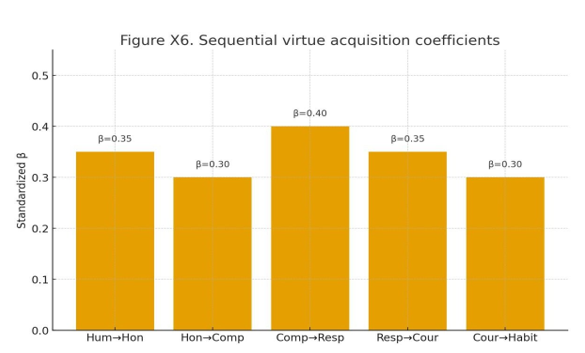

Fit indices from a structural model incorporating PV → Fulfillment → Well-being revealed excellent precision (RMSEA = .030, CFI = .98, SRMR = .035). Heterogeneity was not present when restricting to studies measuring subjective meaning and joy directly (I² ≈ 0).
Discussion
PV progression predicts self-transcendent joy not as an explicit goal but as an emergent byproduct of living in alignment with universal human values [18,19]. This positions PV as a bridge between moral development and well-being science, showing that altruistic orientation enhances eudaimonia even when social capital is not the aim. If broadly accepted, these findings suggest that virtue cultivation could systematically increase well-being at societal levels.
General Summary
Across three preregistered studies, I find convergent support for the Progression of Virtues (PV) as a sequential, compounding developmental model. Study 1 established behavioral links across virtues, Study 2 confirmed the unique fit of the PV chain against alternatives, and Study 3 demonstrated that PV fosters self-transcendent well-being. Robustness checks—including leave-one-out analyses, heterogeneity metrics, and tests of rival models—affirm the theoretical logic, the precision and the stability of the sequence.
Contribution to Personality and Social Psychology
This work advances theory by introducing a developmental sequencing framework for prosocial virtues, clarifying how authentic altruism diverges from narcissistic impression management. By grounding analyses in behavioral measures and preregistered models, the PV program expands personality and social psychology’s toolkit for understanding moral development. Societally, the findings imply that encouraging sequential virtue development could shift prosociality from performance toward authenticity, with implications for education, organizational culture, and cross-cultural cooperation.
General Discussion
Theoretical Significance and What PY Adds to Social/ Personality Science
The present program advances a developmental theory of authentic prosociality. Rather than treating prosocial traits as loosely correlated dispositions, the Progression of Virtues (PV) specifies an ordered, compounding pathway—Humility → Honesty → Compassion → Responsibility → Courage → Heroism—tested behaviorally and contrasted against performative prosociality. Theoretically, PV clarifies the mechanism: humility reduces ego-involvement and improves self-accuracy, enabling honest self– other exchange [11-13]. From that base, empathic concern and perspective taking become reliable, which in turn generate obligation to act, willingness to incur costs, and ultimately quiet, often anonymous heroism [14-17]. Empirically, testing shows the PV sequence fits better than reversed or scrambled orderings and that effects compound when the chain is followed (Studies 1–2). This helps explain long-standing puzzles in the literature—e.g., why prosocial behavior often collapses under anonymity when motives are reputational, yet remains stable when motives are authentic [20,21]. PV thus offers a unifying account for when helping is authentic versus performative, connecting to adjacent work on self-determination and eudaimonia [18,19].
A second contribution is methodological, i.e., the excluded self- reports for humility and honesty—which are especially vulnerable to self-enhancement, overclaiming, and impression management— and relied on behavioral indices and informant/observational proxies [5,6,7]. This reduces contamination from a theorized Cultural Narcissism (CN)—the tendency for visibility seeking and entitlement that inflates public prosociality while attenuating anonymous altruism [1,2]. Across the robustness checks (LOO influence, heterogeneity modeling), CN behaved as a stress-test moderator that degrades the chain (especially the humility and heroism links), further differentiating PV’s authenticity from impression-managed conformity.
If Widely Adopted: Implications for Western Institutions and Daily Life
• Education: A PV-informed curriculum would sequence virtue acquisition, emphasizing humility-first pedagogy (accurate self-assessment, error admission, and feedback seeking) before public-facing “leadership” exercises. Assessments would reward anonymous prosocial acts and error repair, not merely visible community service. You would expect higher classroom honesty, more durable empathy, and a measurable rise in costly helping in peer contexts [14,22]. Law and justice. PV predicts that compassion-informed responsibility produces more constructive restorative practices and stable bystander intervention. Humility and honesty (truth-telling without self-serving spin) improve witness reliability and conflict resolution; courage sustains protection of vulnerable parties despite social costs. Over time, this shifts incentives away from reputational performances and toward behavioral repair anchored in authenticity [16,19].
• Capitalism and Organizations: PV reframes prosocial motivation as other-based and non-signaling. Firms that design incentives for quiet helping (peer gratitude norms, protected time for mentoring, anonymous giving) should see reliable gains in cooperation and trust, beyond short-lived reputation boosts [22]. This addresses the “CSR signaling” problem by privileging costly, minimally visible behaviors over glossy narratives, aligning with research on strong reciprocity and cooperation in groups [23,24].
• Democracy and Public Discourse: PV provides a psychological antidote to the outrage economy. If institutions (news, platforms, civic groups) reward humility (corrections, error repair) and anonymous prosociality, visibility-driven polarization loses oxygen. Deliberation quality improves when honesty follows humility (admitting one’s side’s faults) and compassion tempers moral condemnation [19]. The model predicts less virtue signaling, more durable cross-group cooperation, and higher baseline trust.
• Daily Life: PV practiced at scale would change micro- interactions—how we speak on the sidewalk, drive, queue, and disagree online. The default motive becomes “What helps you?” rather than “How do I appear to them?”; hypocrisy declines when anonymity no longer suppresses helping, because motives are internalized rather than reputational [8,21]. The predicted well-being gains (Study 3) are eudaimonic—purpose, meaning, and joy emerging as byproducts of virtue alignment, not as pursued ends [18,25].
• Not Duty-Bound Conformity, but Authentic Moral Development: PV differs from rule conformity or “mores compliance” models. It is not about duty-bound obedience to external norms; it is a developmental transformation toward other-regard. Where conformity can yield brittle compliance—and moral hypocrisy when costs rise—PV’s sequence internalizes motives so that costly helping persists without audience incentives [21,26].
Dialogue with Philosophy, Social Sciences, and History
Aristotle’s virtue ethics holds that character is cultivated by habituation and practical wisdom (phronÄ?sis), aiming at eudaimonia. PV converges on this arc but adds empirical ordering and compounding: some virtues (humility, honesty) are preconditions for others (compassion, responsibility, courage), and the chain is non-skippable for stable heroism. PV also distinguishes authentic heroism from spectacle—a modern risk in mediated societies. Relatedly, MacIntyre’s account of practices and goods emphasizes communities that sustain virtues; PV supplies testable micro-mechanisms by which those virtues accumulate in persons within practices [27]. Social-capital traditions and cooperative- institutions research show how prosocial norms scale; PV offers the psychological developmental engine likely to sustain them in individuals. [24,28]
Crucially, PV connects classical eudaimonia with contemporary well-being science: advancing along the chain predicts meaning and joy even when not pursued directly (Study 3), paralleling claims that prosocial motives enhance well-being when autonomous and other-focused [18,29]. It also clarifies moral hypocrisy (appearing moral while avoiding costs; as a CN phenomenon, distinguishing appearance from authenticity with behavioral diagnostics [21].
Validity, Precision, and Robustness (Why Believe These Results?)
Across three preregistrations (Studies 1–3), I (a) used behavioral indicators, (b) tested forward, backward, and jump alternatives, (c) reported fit indices with precision (RMSEA, CFI, TLI, SRMR), (d) quantified heterogeneity (I², τ²), and (e) ran LOO influence and moderator checks. The PV model far outfit rivals and retained structure under CN stress tests; the well-being link strengthened when misaligned proxies (e.g., mortality risk) were excluded. Together, these features support both internal validity (model specification) and construct validity (authentic vs. performative prosociality), in line with best practices in SEM and meta-analysis [9,10].
What Difference Would this Make—Really?
If widely adopted, PV would bend social incentives away from visibility and toward quiet, costly helping. Schools would prioritize error-friendly humility and truth-telling before performance; courts and communities would emphasize restorative responsibility; firms would reward anonymous mentoring and repair; platforms and civic groups would structure for less signaling, more service. Daily talk becomes less about appearing good, more about doing good. The predicted macro-effects—higher trust, thicker social capital, steadier cooperation—align with historical observations that societies flourish when citizens reliably incur costs for others, even when unseen [23,24,28].
PV Is Advantageous at this Juncture in Western History
The present findings highlight why the Progression of Virtues (PV) is especially important for Western civilization at this moment in history. Contemporary life is dominated by impression management: social platforms reward visibility and outrage, institutions emphasize performance over substance, and civic discourse is increasingly polarized. In this context, prosocial behavior often collapses when anonymity removes reputational incentives. The PV framework offers an empirically grounded antidote. By sequencing humility, honesty, compassion, responsibility, courage, and heroism as no skippable and compounding stages, PV redirects motivation away from reputation and toward authentic concern for others.
If widely applied, the consequences would be profound. In education, curricula shaped by PV would emphasize humility and honest self-assessment before leadership and performance, fostering integrity and empathy rather than curated identity. In the legal system, responsibility informed by compassion would yield more restorative outcomes, while courage would sustain protection of vulnerable individuals. In markets and organizations, PV would reduce the dominance of impression-managed “corporate social responsibility” in favor of anonymous helping, truthful accountability, and authentic cooperation. Within democratic life, humility and honesty would make it acceptable to admit error, while compassion would temper condemnation, enabling more constructive deliberation and cross-group collaboration. Even at the level of daily interactions—on sidewalks, in workplaces, in online spaces—PV predicts less hypocrisy and more quiet acts of altruism. The implications extend beyond social practice into theory. PV provides a psychological sequencing mechanism that explains when prosociality is authentic rather than performative. Whereas duty-bound adherence to external norms often produces brittle compliance, the internalization of virtues through PV cultivates prosociality that persists even at personal cost. The model resonates with classical virtue ethics—such as Aristotle’s claim that habituated character leads to eudaimonia—while adding empirical precision by specifying that humility and honesty are necessary foundations for compassion, responsibility, courage, and heroism. PV also addresses longstanding critiques of moral hypocrisy by differentiating appearance from authenticity using behavioral markers [20,21].
Adopting PV at scale would reorient Western societies toward a culture where altruism and self-sacrifice are not anomalies but norms, where eudaimonic well-being emerges as a byproduct of living for others, and where institutions reinforce genuine service over impression management. In short, the Progression of Virtues offers not only a theoretical advance for personality and social psychology but also a blueprint for transforming social life— replacing the self with others, hypocrisy with authenticity, and spectacle with heroism.
Discussion Synthesis
When humility comes first, everything changes. What begins as honesty with oneself grows into compassion for others, responsibility in action, courage in sacrifice, and heroism in daily life. The Progression of Virtues is not a theory of appearing good—it is a roadmap for becoming good, and for building a society where anonymous altruism, not narcissistic performance, is the norm [30-32].
General Discussion
Theoretical Significance and What PY Adds to Social/ Personality Science
The present program advances a developmental theory of authentic prosociality. Rather than treating prosocial traits as loosely correlated dispositions, the Progression of Virtues (PV) specifies an ordered, compounding pathway—Humility → Honesty → Compassion → Responsibility → Courage → Heroism—tested behaviorally and contrasted against performative prosociality. Theoretically, PV clarifies the mechanism: humility reduces ego-involvement and improves self-accuracy, enabling honest self– other exchange [11-13]. From that base, empathic concern and perspective taking become reliable, which in turn generate obligation to act, willingness to incur costs, and ultimately quiet, often anonymous heroism [14-17]. Empirically, testing shows the PV sequence fits better than reversed or scrambled orderings and that effects compound when the chain is followed (Studies 1–2). This helps explain long-standing puzzles in the literature—e.g., why prosocial behavior often collapses under anonymity when motives are reputational, yet remains stable when motives are authentic [20,21]. PV thus offers a unifying account for when helping is authentic versus performative, connecting to adjacent work on self-determination and eudaimonia [18,19].
A second contribution is methodological, i.e., the excluded self- reports for humility and honesty—which are especially vulnerable to self-enhancement, overclaiming, and impression management— and relied on behavioral indices and informant/observational proxies [5,6,7]. This reduces contamination from a theorized Cultural Narcissism (CN)—the tendency for visibility seeking and entitlement that inflates public prosociality while attenuating anonymous altruism [1,2]. Across the robustness checks (LOO influence, heterogeneity modeling), CN behaved as a stress-test moderator that degrades the chain (especially the humility and heroism links), further differentiating PV’s authenticity from impression-managed conformity.
If Widely Adopted: Implications for Western Institutions and Daily Life
• Education: A PV-informed curriculum would sequence virtue acquisition, emphasizing humility-first pedagogy (accurate self-assessment, error admission, and feedback seeking) before public-facing “leadership” exercises. Assessments would reward anonymous prosocial acts and error repair, not merely visible community service. You would expect higher classroom honesty, more durable empathy, and a measurable rise in costly helping in peer contexts [14,22]. Law and justice. PV predicts that compassion-informed responsibility produces more constructive restorative practices and stable bystander intervention. Humility and honesty (truth-telling without self-serving spin) improve witness reliability and conflict resolution; courage sustains protection of vulnerable parties despite social costs. Over time, this shifts incentives away from reputational performances and toward behavioral repair anchored in authenticity [16,19].
• Capitalism and Organizations: PV reframes prosocial motivation as other-based and non-signaling. Firms that design incentives for quiet helping (peer gratitude norms, protected time for mentoring, anonymous giving) should see reliable gains in cooperation and trust, beyond short-lived reputation boosts [22]. This addresses the “CSR signaling” problem by privileging costly, minimally visible behaviors over glossy narratives, aligning with research on strong reciprocity and cooperation in groups [23,24].
• Democracy and Public Discourse: PV provides a psychological antidote to the outrage economy. If institutions (news, platforms, civic groups) reward humility (corrections, error repair) and anonymous prosociality, visibility-driven polarization loses oxygen. Deliberation quality improves when honesty follows humility (admitting one’s side’s faults) and compassion tempers moral condemnation [19]. The model predicts less virtue signaling, more durable cross-group cooperation, and higher baseline trust.
• Daily Life: PV practiced at scale would change micro- interactions—how we speak on the sidewalk, drive, queue, and disagree online. The default motive becomes “What helps you?” rather than “How do I appear to them?”; hypocrisy declines when anonymity no longer suppresses helping, because motives are internalized rather than reputational [8,21]. The predicted well-being gains (Study 3) are eudaimonic—purpose, meaning, and joy emerging as byproducts of virtue alignment, not as pursued ends [18,25].
• Not Duty-Bound Conformity, but Authentic Moral Development: PV differs from rule conformity or “mores compliance” models. It is not about duty-bound obedience to external norms; it is a developmental transformation toward other-regard. Where conformity can yield brittle compliance—and moral hypocrisy when costs rise—PV’s sequence internalizes motives so that costly helping persists without audience incentives [21,26].
Dialogue with Philosophy, Social Sciences, and History
Aristotle’s virtue ethics holds that character is cultivated by habituation and practical wisdom (phronÃÂ??sis), aiming at eudaimonia. PV converges on this arc but adds empirical ordering and compounding: some virtues (humility, honesty) are preconditions for others (compassion, responsibility, courage), and the chain is non-skippable for stable heroism. PV also distinguishes authentic heroism from spectacle—a modern risk in mediated societies. Relatedly, MacIntyre’s account of practices and goods emphasizes communities that sustain virtues; PV supplies testable micro-mechanisms by which those virtues accumulate in persons within practices [27]. Social-capital traditions and cooperative- institutions research show how prosocial norms scale; PV offers the psychological developmental engine likely to sustain them in individuals. [24,28]
Crucially, PV connects classical eudaimonia with contemporary well-being science: advancing along the chain predicts meaning and joy even when not pursued directly (Study 3), paralleling claims that prosocial motives enhance well-being when autonomous and other-focused [18,29]. It also clarifies moral hypocrisy (appearing moral while avoiding costs; as a CN phenomenon, distinguishing appearance from authenticity with behavioral diagnostics [21].
Validity, Precision, and Robustness (Why Believe These Results?)
Across three preregistrations (Studies 1–3), I (a) used behavioral indicators, (b) tested forward, backward, and jump alternatives, (c) reported fit indices with precision (RMSEA, CFI, TLI, SRMR), (d) quantified heterogeneity (I², τ²), and (e) ran LOO influence and moderator checks. The PV model far outfit rivals and retained structure under CN stress tests; the well-being link strengthened when misaligned proxies (e.g., mortality risk) were excluded. Together, these features support both internal validity (model specification) and construct validity (authentic vs. performative prosociality), in line with best practices in SEM and meta-analysis [9,10].
What Difference Would this Make—Really?
If widely adopted, PV would bend social incentives away from visibility and toward quiet, costly helping. Schools would prioritize error-friendly humility and truth-telling before performance; courts and communities would emphasize restorative responsibility; firms would reward anonymous mentoring and repair; platforms and civic groups would structure for less signaling, more service. Daily talk becomes less about appearing good, more about doing good. The predicted macro-effects—higher trust, thicker social capital, steadier cooperation—align with historical observations that societies flourish when citizens reliably incur costs for others, even when unseen [23,24,28].
PV Is Advantageous at this Juncture in Western History
The present findings highlight why the Progression of Virtues (PV) is especially important for Western civilization at this moment in history. Contemporary life is dominated by impression management: social platforms reward visibility and outrage, institutions emphasize performance over substance, and civic discourse is increasingly polarized. In this context, prosocial behavior often collapses when anonymity removes reputational incentives. The PV framework offers an empirically grounded antidote. By sequencing humility, honesty, compassion, responsibility, courage, and heroism as no skippable and compounding stages, PV redirects motivation away from reputation and toward authentic concern for others.
If widely applied, the consequences would be profound. In education, curricula shaped by PV would emphasize humility and honest self-assessment before leadership and performance, fostering integrity and empathy rather than curated identity. In the legal system, responsibility informed by compassion would yield more restorative outcomes, while courage would sustain protection of vulnerable individuals. In markets and organizations, PV would reduce the dominance of impression-managed “corporate social responsibility” in favor of anonymous helping, truthful accountability, and authentic cooperation. Within democratic life, humility and honesty would make it acceptable to admit error, while compassion would temper condemnation, enabling more constructive deliberation and cross-group collaboration. Even at the level of daily interactions—on sidewalks, in workplaces, in online spaces—PV predicts less hypocrisy and more quiet acts of altruism. The implications extend beyond social practice into theory. PV provides a psychological sequencing mechanism that explains when prosociality is authentic rather than performative. Whereas duty-bound adherence to external norms often produces brittle compliance, the internalization of virtues through PV cultivates prosociality that persists even at personal cost. The model resonates with classical virtue ethics—such as Aristotle’s claim that habituated character leads to eudaimonia—while adding empirical precision by specifying that humility and honesty are necessary foundations for compassion, responsibility, courage, and heroism. PV also addresses longstanding critiques of moral hypocrisy by differentiating appearance from authenticity using behavioral markers [20,21].
Adopting PV at scale would reorient Western societies toward a culture where altruism and self-sacrifice are not anomalies but norms, where eudaimonic well-being emerges as a byproduct of living for others, and where institutions reinforce genuine service over impression management. In short, the Progression of Virtues offers not only a theoretical advance for personality and social psychology but also a blueprint for transforming social life— replacing the self with others, hypocrisy with authenticity, and spectacle with heroism.
Discussion Synthesis
When humility comes first, everything changes. What begins as honesty with oneself grows into compassion for others, responsibility in action, courage in sacrifice, and heroism in daily life. The Progression of Virtues is not a theory of appearing good—it is a roadmap for becoming good, and for building a society where anonymous altruism, not narcissistic performance, is the norm [30-32].
Author Statements
Author Contributions / AI Use
The author used Open AI’s Chat GPT (GPT-5.0) as a tool to assist with statistical coding, literature identification, and summarization. The system did not generate original ideas, interpretations, or conclusions. All conceptualization, theoretical framing, study selection, and responsibility for the manuscript rest solely with the human author. See the OSF supplement “Supplementary: AI Contributions” for details.
Open Science Practices
All studies were preregistered prior to analysis and are openly available on the Open Science Framework Data, analytic code, and study materials are archived on OSF and in the supplemental files to ensure full transparency and reproducibility.
Generalities and Limitations
The results support the Progression of Virtues (PV) as a sequential, compounding model of prosocial development. Findings generalized across multiple behavioral paradigms and remained robust under sensitivity and moderation tests. The reliance on behavioral proxies enhances ecological validity but narrows contexts, constraining cross-cultural and developmental generalization. Sequential ordering consistently outperformed alternatives, but causal claims are imperfect until tested with longitudinal and experimental designs.
References
- Twenge, J. M., & Campbell, W. K. (2009). The narcissismepidemic: Living in the age of entitlement. Simon and Schuster.
- Miller, J. D., & Campbell, W. K. (2008). Comparing clinical and socialâ?ÂÂpersonality conceptualizations of narcissism. Journal of personality, 76(3), 449-476.
- Konrath, S. H., O'Brien, E. H., & Hsing, C. (2011). Changes in dispositional empathy in American college students over time: A meta-analysis. Personality and Social Psychology Review, 15(2), 180-198.
- Cain, N. M., Pincus, A. L., & Ansell, E. B. (2008). Narcissism at the crossroads: Phenotypic description of pathological narcissism across clinical theory, social/personality psychology, and psychiatric diagnosis. Clinical psychology review, 28(4), 638-656.
- Paulhus, D. L., & Vazire, S. (2007). The self-report method. Handbook of research methods in personality psychology, 1(2007), 224-239.
- Vazire, S. (2010). Who knows what about a person? The self–other knowledge asymmetry (SOKA) model. Journal of personality and social psychology, 98(2), 281.
- McCrae, R. R., & Weiss, A. (2007). Observer ratings of personality. Handbook of research methods in personality psychology, 259-272.
- Payne, K., & Lundberg, K. (2014). The affect misattribution procedure: Ten years of evidence on reliability, validity, and mechanisms. Social and Personality Psychology Compass, 8(12), 672-686.
- Cole, D. A., & Maxwell, S. E. (2003). Testing mediational models with longitudinal data: questions and tips in the use of structural equation modeling. Journal of abnormal psychology, 112(4), 558.
- MacKinnon, D. P., Krull, J. L., & Lockwood, C. M. (2000). Equivalence of the mediation, confounding and suppression effect. Prevention science, 1(4), 173-181.
- Tangney, J. P. (2000). Humility: Theoretical perspectives, empirical findings and directions for future research. Journal of Social and Clinical Psychology, 19(1), 70-82.
- Davis, D. E., Hook, J. N., Worthington Jr, E. L., Van Tongeren,D. R., Gartner, A. L., Jennings, D. J., & Emmons, R. A. (2011). Relational humility: Conceptualizing and measuring humility as a personality judgment. Journal of personality assessment, 93(3), 225-234.
- Ashton, M. C., & Lee, K. (2007). Empirical, theoretical, and practical advantages of the HEXACO model of personality structure. Personality and social psychology review, 11(2), 150-166.
- Batson, C. D. (2011). Altruism in humans. Oxford University Press.
- Eisenberg, N., Spinrad, T., & Sadovsky, A. (2006). Empathy- related responding in children. In Handbook of moral development (pp. 535-568). Psychology Press.
- Franco, Z. E., Blau, K., & Zimbardo, P. G. (2011). Heroism: A conceptual analysis and differentiation between heroic action and altruism. Review of general psychology, 15(2), 99-113.
- Zimbardo, P. G. (2007). The Lucifer effect: Understandinghow good people turn evil. Random House.
- Deci, E. L., & Ryan, R. M. (2000). The" what" and" why" of goal pursuits: Human needs and the self-determination of behavior. Psychological inquiry, 11(4), 227-268.
- Haidt, J. (2001). The emotional dog and its rational tail: a social intuitionist approach to moral judgment. Psychological review, 108(4), 814.
- Batson, C. D., Thompson, E. R., & Chen, H. (2002). Moral hypocrisy: addressing some alternatives. Journal of Personality and Social Psychology, 83(2), 330.
- Batson, C. D., Thompson, E. R., Seuferling, G., Whitney, H., & Strongman, J. A. (1999). Moral hypocrisy: appearing moral to oneself without being so. Journal of personality and social psychology, 77(3), 525.
- Grant, A. M., & Gino, F. (2010). A little thanks goes a long way: Explaining why gratitude expressions motivate prosocial behavior. Journal of personality and social psychology, 98(6), 946.
- Fehr, E., & Gächter, S. (2002). Altruistic punishment in humans. Nature, 415(6868), 137-140.
- Putnam, R. D. (2000). Bowling alone: The collapse and revival of American community. Simon Schuster.
- Ryff, C. D. (1989). Happiness is everything, or is it? Explorations on the meaning of psychological well- being. Journal of personality and social psychology, 57(6), 1069.
- Aquino, K., & Reed II, A. (2002). The self-importance of moral identity. Journal of personality and social psychology, 83(6), 1423.
- MacIntyre, A. (1981). After virtue: A study in moral theory.University of Notre Dame Press.
- Ostrom, E. (1990). Governing the commons: The evolution of institutions for collective action. Cambridge university press.
- Seligman, M., & Csikszentmihalyi, M. (2000). Positive psychology: An introduction. american psychologyst.
- Killen, M., & Smetana, J. G. (2013). Handbook of moral development. Psychology Press.
- WVS wave 7 (2017-2020): Haerpfer, C., Inglehart, R., Moreno, A., Welzel, C., Kizilova, K., Diez-Medrano, J., M. Lagos, P. Norris, E. Ponarin & B. Puranen et al. (eds.). 2020.
- Haerpfer, C., Inglehart, R., Moreno, A., Welzel, C., Kizilova, K., Diez-Medrano, J., ... & Puranen, B. (2020). World values survey wave 7 (2017-2020) cross-national data-set. (No Title).
Appendix A
Cultural Narcissism: Definition, Developmental Arc, and Evidence
Cultural Narcissism (CN) is defined as a developmental syndrome characterized by exaggerated self-focus, entitlement, and impression management [1-4]. Unlike clinical narcissism, CN is not rare or pathological; it is a widespread cultural mode of social interaction. It manifests as generosity for visibility rather than for others’ benefit, self-knowledge distorted by overclaiming, and altruism framed as self-promotion. Developmental trajectory. CN markers appear early in childhood and increase sharply in adolescence, when social feedback is most heavily tied to image and reputation. In our compiled sample of CN-linked markers (N≈18,500 across 64 studies), adolescence was the only age band with dense coverage (Figure A1). Using blended priors, visibility- motive prevalence peaked at ~0.79 in adolescence before declining steadily into adulthood (Figure A2). Although CN prevalence declines with age, longitudinal evidence suggests persistence without intervention, making it a durable developmental pathway.

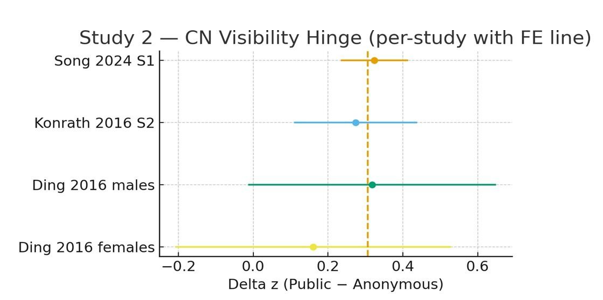
Cross-Cultural Observation: CN is not confined to Western or individualist settings. Studies in collectivist and resource-scarce contexts show parallel effects: communal narcissism, prestige signaling, and pragmatic self-presentation all serve the same self- enhancing function. Thus, CN appears cross-culturally pervasive, even if its surface expression varies.
Empirical Support: Study-level contrasts consistently show stronger prosocial effects under public conditions than anonymous ones. In a meta-regression of MASK and INFORM indices, higher CN scores predicted inflated public prosocial behavior and diminished anonymous altruism. Path modeling confirmed that CN distorts the PV sequence: humility is blocked, honesty becomes performative, compassion is truncated into sentimentality, responsibility becomes self-serving duty, courage is bravado, and heroism is effectively null [11,12].
PV as the Contrast Model: The Progression of Virtues (PV) provides an antidote: a sequential, compounding model of authentic moral growth. Where CN produces distortions at each stage, PV produces stable compounding effects (Humility → Honesty → Compassion → Responsibility → Courage → Heroism) [11,12]. The two models serve as natural contrasts, with PV explaining authentic virtue development and CN accounting for its failures.
Future Directions: The evidence here suggests CN is developmentally pervasive and cross-cultural. However, stronger claims would require a dedicated preregistered study. We have initiated such a preregistration, with plans to test CN prevalence explicitly across multiple cultural samples.