

Advances in Theoretical & Computational Physics(ATCP)
ISSN: 2639-0108 | DOI: 10.33140/ATCP

Review Article - (2025) Volume 8, Issue 3
The Pan-Cosmic Evolution of The Universe and A View on The Cosmic History of Human Beings
Received Date: Jul 03, 2025 / Accepted Date: Sep 05, 2025 / Published Date: Sep 10, 2025
Copyright: ©2025 Hans J. Fahr. This is an open-access article distributed under the terms of the Creative Commons Attribution License, which permits unrestricted use, distribution, and reproduction in any medium, provided the original author and source are credited.
Citation: Fahr, H. J. (2025). The Pan-Cosmic Evolution of The Universe and A View on The Cosmic History of Human Beings. Adv Theo Comp Phy, 8(3), 01-04.
Abstract
To many people in our present era of mankind it appears already as a blasphemy to only aim at a purely physics-based explanation of the phenomenon of the "whole universe". This appears, as if already the attempt of a purely physical interpretation of this huge real entity of creation would be equivalent to the complete loss of its creational beauty, independence, and wonderfullness, rather degrading the cosmic creation to something like a simple, trivial-mechanic clockwork. But, to the contrary, is not in a first line just the human interpretation of the present cosmic world a merely wonderfull sign that this cosmic world - as the "completely transcendental phenomenon" with respect to the human consciusness talks to our consciousness -, thereby even entering into an authentic interaction? - Mankind understands the universe, - and the universe thereby becomes an ontic entity understood by the human ratio.
Introductory Considerations
To many people in our present era of mankind it appears already as a blasphemy to only aim at a purely physics-based explanation of the phenomenon of the "whole universe". This appears, as if already the attempt of a purely physical interpretation of this huge real entity of creation would be equivalent to the complete loss of its creational beauty, independence, and wonderfullness, rather degrading the cosmic creation to something like a simple, trivial-mechanic clockwork. But, to the contrary, is not in a first line just the human interpretation of the present cosmic world a merely wonderfull sign that this cosmic world - as the "completely transcendental phenomenon" with respect to the human consciusness talks to our consciousness -, thereby even entering into an authentic interaction? - Mankind understands the universe, - and the universe thereby becomes an ontic entity understood by the human ratio.
Under the aspect of a modern astrophysicist the evolution of the universe is simply guided by the sheer mechanics of physical causalities, and the corresponding arrangements of causal constellations. According to this fact, the cosmic evolution appears much more like a causal determination of upcoming facts than as an evolution of novelties understood in a original biological sense. After those basic reminders one in principle has to ask, whether at all nature can create something new, because according to our understanding nature only creates what causal constellations have caused her to be created. This excites the urging question whether or not nature simply creates what by causal constellations is forced to be created? So to say: The causal constellations are creational elements of nature! This automatically excites the next urging question whether the cosmic evolution, understood in pure terms of physics, is nothing else but a predetermined way from an arbitrarily fixed ontic begin to an associated, end-determined cosmic entropy maximum without any further interruptory eventlike new history. But, why at all does it seem, as if the universe tries to correspond and adapt to the explanation principles of the human ratio? The understandability of the cosmic principles by the human brain is an unexplained, completely surprising and by far not a self-evident phenomenon of the human coexistence with the independent cosmic reality, - unless this interrelated coexistence of mankind and the universe is not a casuality, but is a strong ontologically commanded and unavoidable necessity! Namely: mankind and this universe simply representing an amalgamatic, nondivorcible unity. Imagine mankind would allways have lived subground of the Earth: Would it ever have thought of an infinite universe with its birth in the singularity of a Big-Bang?
Nontheless, as conclusion from the above, solely by the enlightment of our human ratio one also has to realize that one cannot construct and create a selfconsistent and selfmaintaining universe. This becomes totally clear when looking at the deficiencies of the presentday cosmologic views on the universe. Our actual cosmology could by far not replace or maintain this universe which is evidently confronting us, but instead delivers inspite of the strong entanglement a universe which all around needs assistence and help in order not to collaps into its complete cosmo-human garbidge. We all can be deeply glad that we do not need to life in a universe constructed according to the insights of the human brain. Let us only think of the fate that we had to life in a universe that our human ratio has conceptualized by its own geniality - starting with the event of the Big-Bang. Namely, without this newly invented miraculous fascinosum, called by present physicists: "vacuum energy", mankind would not at all have managed to escape from the matter singularity of the Big-Bang! we instead would be staying forever prisoners of this BB [1]!
And, be it simply granted for the sake of a juggle with ideas, if according to the standard view of present-day cosmologists, the universe, how at all this may have been arranged, would have orig- inated in the Big-Bang, then it is all the more absolutely ununder- standable, how from its yet today absolutely ununderstandable and undiscribable, physical conditionings the most precise determinis- tic directives for the later origin of mankind with its typical, well known virtues could be implanted into this universe. - If to the contrary this present universe would rather represent a self-main- taining thermodynamic equilibrium state, which conserves his complexity by multicausal backreactions to all its actual action- states , a so-called "cosmic attractor state" - so to say, then it could much better be understood that associated with such an infinitely recoupled action system also naturally phenomena like "cosmic mankind" do gain their places - like our earthbound mankind with its life, history and thinking as well of course as its famous think- ers like for instance Platon, Kusanus, Kant, Heidegger, Hegel, Sar- tre or Camus and those coming after them [2].
Thus it is not worth asking the question whether the cosmic evolution has the "anthropic" task to generate somewhere in the universe mankind in the form we are familiar with. Rather more positively it should be asked, how it may have come about that this universe is a transzendental subject for our human brain nevertheless really serves as a conversation partner for us? Up to now the best answer to this question has perhaps been given already by Nikolaus Kusanus (1440), the Dominican monk from Berndkastell Kues at the Mosella river in Germany who later in his life became bishop of Brissona in Northern Italy. As he wrote in his book "De docta ignorantia" he emphasizes, that this cosmos is just the mirror view of the human brain, as reversely at the same time our human brain is the mirror view of this cosmos. We do understand this universe as a fact-corresponding mirror view of our brain. As will be shown in the following part of the article,the present standard cosmology however delivers only a badly conceived universe with its interpretations which need permanent readaptations, corrections and auxiliary improvements in order not to only serve as the presentation of a fake-world.
Would the universe be like we do understand it presently - as originating in a Big-Bang, then as we already described above,there would be no place for us, namely for mankind, in it. We would still and forever be prisoners of the matter singularity, a thermodynamic hell! So let us now look deeper into this primordial Big-Bang conditions.
How does gaseous cosmic matter react to compressions near the big-bang event?
Gaseous cosmic matter - being forced to reduce or enhance its volume – usually increases or decreases its temperature T as reaction to this enforced gas volume changes. In normal standard thermodynamics for a radially symmetric gas volume with the radial scale R this is regulated by the standard polytropic relation given by the following differential equation [3]:
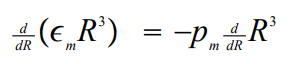
where εm = ρmKTm and pm = nmKTm are the thermal energy density and the thermal pressure of the gaseous matter, ρm denotes the mass density and nm the particle density of the gas. In subsequent papers the authors had shown that under the sole validity of this above equation the Big-Bang explosion of the universe never at all could have happened. However, in combination with an active vacuum pressure pvac of positive value the needed explosive force is in fact physically established which can let the Big-Bang explosion really occur. A little hesitation towards this cosmologic prophecy, as being the final and conclusive, theoretical view, only comes up from the fact that Big-Bang matter temperatures near the begin of the cosmic expansion close to the space- and matter- singularity may need the application of a relativistic thermodynamics (since KTm ≥ m0 c2) with a correspondingly reformulated polytropic relation compared to the above one.
This is due to the fact that when particles start becoming relativistic (i.e. particle velocities approach the velocity of light: v → c) further energy addition will not only change their velocities v, but also will change their masses m = m(v), and Newton’s very fundamental

important question how this circumstance needs to be expressed thermodynamically for the case near the Big-Bang where one has to expect that particle densities grow towards infinity ρm → ∞.
Correspondingly one could imagine that the upper equation at least should perhaps be reformulated into the following more general form:

where ε*m,ε*kin p*m denote energy density mean kinetic energy, and pressure of the relativistic baryonic gas. Hereby we have excluded, as a result of energy changes, the creation of new cosmic particles (i.e. generation of baryons of mass m0! At temperatures with KT m≥ c2). The mean kinetic energy ε+kin relativistic baryons with particle density n = n(R) thereby is given by the following expression:
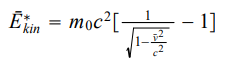
where the average thermal particle velocity v¯ is given by means of the isotropic baryon velocity distribution function f*(v, R) through:

Not knowing apriory anything better, we may assume that in the initial phase of the cosmic expansion under conditions of very dense cosmic gases the distribution function is very likely close to an LTE equilibrium Maxwellian, - of course however one, which takes care that no superluminal particles with v ≥ c are admitted [4]. The latter can be taken care of by introducing, instead of v, the kinetic particle energy as a variable and then finally obtaining the function f*(v, R) in the following form of an asymptotic Kappa- function:
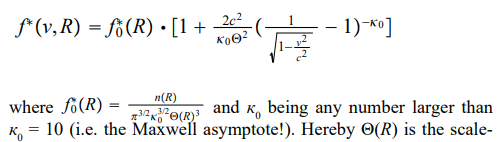
dependent , mean thermal spread of the distribution function f*, meaning that this quantity Θ = Θ(R) is only indirectly defined. But here we shall not follow this detailed problem further, as was done in Fahr (2025), we rather shall look to a final solution of the problem of the thermodynamics of cosmic matter at Big-Bang times.
An Attempt Towards A Final Solution
As already in the standard cosmology the presumed homogeneity of the cosmic energy distribution and the presumed curvature isotropy permit to use the so-called Robertson-Walker metric which allows to reduce Einsteins General Relativistic field equations to a set of only two non-trivial differential equations for the cosmic expansion scale R = R(t) which by the functions 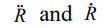
desribe the acceleration and time-dependence of the cosmic scale R [5-7]. In these equations it also has been assumed that the massive cosmic particles seen over the whole universe lead to a homogeneous, cosmic mass density ρm(t, R) = ρm(R(t)). If in addition mass conservation in the universe is assumed, then the mass density behaves evidently inversely proportional to the cosmic volume meaning:

This can clearly be expected as long as one has to do with non- relativistic matter temperatures KTm«m0 c2. If one however is aiming to go back to cosmic times near the Big-Bang, where cosmic matter appears strongly condensed and thus strongly heated, then one has to take into account that thermal energies of the particles come into the order of magnitude of the rest mass, the energy, i.e. 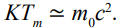 With this phenomenon the expression for the i.e. cosmic mass density ρ(R) however becomes much more complicated. This in line complicates evidently the treatment of the relevant physics in the neighbourhood of the Big-Bang. In that case one has to use much more complicate for mulisms for the adequate thermodynamics of the cosmic gas as they have been sketched recently by Fahr and Heyl (2025). The authors assume that according to Einstein‘s theory of relativity the masses of the cosmic particles increase with their velocities v according to the relativistic relation:
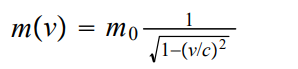
which means that luminal particles with 
will essentially not anymore be accelerated by acting forces, but they will increase their kinetic masses. Since Newton´s gravity does not differentiate between rest masses and kinetic masses, this effect of kinetic masses directly enters in the corresponding enforcement of the active cosmic gravitational field and thus takes direct influence on the active cosmic expansion dynamics. While in the non- relativistic case the following thermodynamc relation would be valid: for the thermal energy:

in the relativistic case the thermal energy of the particles is partly converted into a change of the gravitational cosmic binding energy. But unfortunately it is not directly evident by which parts this conversion is taking place.
For the system of the universe we thus with some deep sense may require that this conversion happens according to the law of conservation of the total cosmic energy, i.e. positive and negative forms of cosmic energy added up. The negative cosmic energy then would naturally be represented by the cosmic gravitational binding energy εbind of matter, and when including it into the above relation would then bring us to the following extended thermoynamic relation for the universe:
The latter relation could make sense in case one can consider the universe as a "zero-energy"- system in which the sum of positive and negative energies, E + U, as consequence of internal rearrangements of energy depositions in the cosmic system always cancels.

Such a zero-energy universe has already been studied in more details by Fahr (2023) and would lead in the upper case to the following conclusion:

where M = (4π/3)ρ m.0 · (R3/R30) denotes the total mass of this universe, and Λ = const denotes that cosmic vacuum energy density which was introduced by Einstein and De Sitter (1922) as a world-stabilising quantity [8]. From the above equation one finds two possible solutions for the zero-energy universe with E + U = 0!, namely:
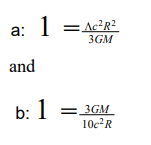
As evident the possibility a) is only fulfilled, together with Λ = const, if the mass of the universe varies according to M ~ R2 which requires an up to now unidentified mass loss process connectedwith the expansion of the universe with scale R.
The possibility b) instead would require a cosmic mass increase proportional to the scale R according to the relation M ~ R. This possibility in fact has at least already seriously been discussed by several physicists in the near past like E.Mach (as Machìan principle, 1983) or H.Thirring (as cosmic angular momentum principle, 1918) and could indicate into the right direction [9,10]. The idea of Mach originally was that the inertial mass of particles (like baryons) cannot be a predetermined quantity, fixed independent of everything else ad-hoc by a discrete number, it must rather be a relational quantity and must have to do with the cosmic mass constellations all around in the universe and the cosmic space geometry - as it is discussed in a paper by Fahr and Zoennchen (2006) [11]. In conclusion here, if we can adopt the Machian Principle (M~R) to be true for this universe, then we can also assume that the upper possibility b: 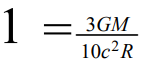
is fulfilled for our present universe, and, connected with that, that we are living in a zero-energy universe [12-15].
References
- Fahr, H. J. (2023). The cosmic big-bang: how could mankind escape from it?. Physics & Astronomy International Journal, 7(1), 74-75.
- Fahr, H. J. (2025). The Relativistic Big-Bang and the Thermodynamic Importance of Initial Cosmic Kinetic Masses. Adv Theo Comp Phy, 8(1), 01-06.
- Fahr, H. J. (2021). The baryon distribution function in the expanding universe after the recombination era. Physics & Astronomy International Journal, 5(2), 37-41.
- Fahr, H. J., & Heyl, M. (2007). Cosmic vacuum energy decayand creation of cosmic matter. Naturwissenschaften, 94(9), 709-724
- Robertson, H. P. (1933). Relativistic cosmology. Reviews of modern Physics, 5(1), 62.
- Friedman, A. (1922). Über die krümmung des raumes. Zeitschrift für Physik, 10(1), 377-386.
- Friedmann, A. (1924). Über die Möglichkeit einer Welt mit konstanter negativer Krümmung des Raumes. Zeitschrift für Physik, 21(1), 326-332.
- Einstein, A. (1917). Kosmologische Betrachtungen zur allgemeinen Relativitäts-theorie. In Das Relativitätsprinzip: Eine Sammlung von Abhandlungen (pp. 130-139). Wiesbaden: Vieweg+ Teubner Verlag.
- Mach, E. (1988). The Development of Mechanics: A Historical and Critical View. Walter de Gruyter GmbH & Co. KG.
- Thirring, H. (1918). Über dieWirkung rotierender ferner Massen in der Einsteinschen Gravitationstheorie. Physikalische Zeitschrift, 19, 33.
- Fahr,H.J.,&Zoennchen,J.H.(2006).Cosmologicalimplications of the Machian principle. Naturwissenschaften, 93(12), 577- 587.
- Goenner, H. (1996). Einführung in die spezielle und allgemeine Relativitätstheorie. Spektrum, Akad. Verlag.
- Robertson, H. P. (1929). On the foundations of relativistic cosmology. Proceedings of the National Academy of Sciences, 15(11), 822-829.
- Cercignani, C. (Ed.). (1988). Kinetic theory and gas dynamics. Springer.
- Bonnor, W. B. (1957). Jeans' formula for gravitational instability. Monthly Notices of the Royal Astronomical Society, 117(1), 104-117.