

Space Science Journal(SSJ)
ISSN: 2997-6170 | DOI: 10.33140/SSJ


Research Article - (2026) Volume 3, Issue 1
The Origin of Gravity and the Cybernetic Recombination; a Theory of Everything
Received Date: Jan 25, 2026 / Accepted Date: Feb 26, 2026 / Published Date: Mar 05, 2026
Copyright: ©2026 Gihan Soliman. This is an open-access article distributed under the terms of the Creative Commons Attribution License, which permits unrestricted use, distribution, and reproduction in any medium, provided the original author and source are credited.
Citation: Soliman, G. (2026). The Origin of Gravity and the Cybernetic Recombination; a Theory of Everything. Space Sci J, 3(1), 01-26.
Abstract
I propose a resonance-based reinterpretation of gravity in which attraction arises not from spacetime curvature but from timing-dependent coherence among oscillatory energy–information structures. Within this framework, matter is treated as a stable resonance domain, and gravitational affinity emerges when interacting modes fall into phase, deepening effective potentials and enabling non-collisional binding across scales. Repulsion and charge are recast as consequences of destructive interference and persistent resonance asymmetries, while fragmentation and re-aggregation generate inherited oscillatory signatures that act as proto-identities. The Cybernetic Recombination (CyRec) model integrates these physical mechanisms with the epistemic role of the observer, introducing an abstract “fifth dimension” that captures the relational stance required for measurement and resolves classical self-reference limits. Case studies, including tidal dynamics and biological resonance phenomena, illustrate the broader applicability of the framework. CyRec thus offers a unified resonance-based mechanism for gravitational behaviour and a cybernetic architecture linking physical, biological, and informational organisation. This work does not attempt to replace established physical theories; rather, it offers a mechanistic bridge between the energy–information foundations of physics and the emergence of matter, consistent with the empirical framework of the Standard Model and avoiding metaphysical or mystical interpretations. This is a theory of resonancebased gravity, which explains attraction and structure formation, by proposing that gravitational behaviour emerges from timing-dependent coherence among oscillatory systems.
Keywords
Origin, Gravity, Resonance, Observer, Cybernetics
Introduction
Gravity is unlike the other fundamental forces: it does not attract and repel, it only attracts [1]. To explore this asymmetry, we must observe the universe — yet we ourselves are woven into the very fabric we are trying to understand. This work brings together threads from set theory, cybernetics, quantum mechanics, and epistemology to ask a simple but profound question: What does it mean to observe a system from within it, and how does that act of observation shape what we see? From this vantage point, the universe becomes more accessible, and gravity — the mother of complexity — becomes less mysterious. The implications for modern science and engineering are significant. The work expands on a previously sketched model presented in the Computer Science and Information Technology conference 2024 by the author [2,3]. Einstein’s 1905 expression E = Mc2 shows that matter and energy are equivalent, with a difference that encodes the formative information of matter (Figure 1) [4,5]. The short form applies to objects at rest and has served engineering beautifully, but true inertia is practically non-existent in the real world. Nothing is ever still: Earth spins, orbits the Sun, and the Sun itself travels through the galaxy. As time interlocks with space in the fabric of spacetime, energy continuously reshapes the present moment. This is where the full equation of special relativity becomes essential, with p representing momentum [6,7]. In extending mass–energy equivalence, I treat energy not as a flat scalar but as a structured spectrum of interacting modes, each carrying informational signatures. This perspective draws on thermodynamics, quantum theory, and Wheeler’s “it from bit” intuition to suggest that information is not merely descriptive but formative: it participates in how energy condenses into matter and how spacetime is perceived [8,9]. The illustrative relation I introduce does not replace Einstein’s equation; rather, it makes explicit the informational architecture already implicit within it, offering a conceptual mechanism by which structured, resonant energy acquires the physical characteristics we recognise as matter.

Figure 1: The phrase ‘everything is energy’ is used here strictly in the Einsteinian sense of mass–energy equivalence. It does not imply metaphysical claims about consciousness, intention, or ‘vibrational manifestation.’ In this work, resonance refers to physically measurable oscillatory coherence, not spiritual metaphor
The nature of energy reveals itself more fully in the extended mass–energy equivalent E2 = (pc)2 + (mc2)2, especially when coupled with Planck’s observation : while the short form elegantly captures inertia as an engineering approximation for stable systems, the deeper expression shows that nothing in the universe is ever truly still — Earth spins, orbits the Sun, and the Sun itself drags spacetime as it travels through the galaxy — and it is within this restless, quantized motion that time begins to appear through momentum [10,11]. Although the relativistic energy–momentum relation does not display time explicitly, momentum itself contains time through velocity. Expanding p reveals that energy is inseparable from motion, and motion is inseparable from time — a reminder that time enters physics not as an independent dimension but as the rhythm of change. Unpacking energy and its intrinsic formative information is the equivalent of unpacking the observable “everything.” The colours we see are interpretations of light waves; the sounds we hear arise from resonant vibrations matching the natural frequencies of matter. Mass, like colour and sound, is not an inherent property of matter but a function of vibrational resonance expressed as peer-affinity. Figure (2a,2b) provides an overview of a resonance-based theory of gravity as a force of cosmic assembly — the universal “glue” that emerges when motion, energy, and resonance fall into phase.

On The Origin Of Energy And Information
Formative Information
Information maybe one of the most misused and misinterpreted term in modern science. Somehow - while inter-crossing the boundaries of knowledge domain, it “shapeshifts” beyond recognition. To hold our grip on the term, the CyRec distinguishes between three modes of information:
• Formative Information — primordial, pre-observer, woven into the fabric of oscillation and spacetime.
• Communicable Information — what becomes meaningful only when an observer resonates with it.
• Engineering Information — where engineering approximation allows for treating time and space as dimensions rather than a single fabric of spacetime to track or design motion.
If matter can be traced down to energy and information, it’s fair to wonder, what’s the origin of information. E = Mc2 simply informs us that:
• The universe is information in motion (oscillation, quantisation, recombination) [12,13].
• To detect information, you already need information-processing capacity [14,15].
• Therefore, the “origin” of information is epistemically unreachable — it lies beyond the horizon of what any observer can detect or infer.
Formative information, are primordial and untraceable. Anything that is observable, detectable, or inferable, is post-information. In the CyRec perspective of the Big Bang , information is not added later — it is the primordial substrate from which everything else emerges [16,17].
Energy–Information Packs as the Outer Edge of Knowledge
The smallest meaningful units of reality — I/E (information–energy) packs — represent the limit of what can be known, not necessarily the limit of what exists. They mark the epistemic boundary of science: in simple terms, they define the outer edge of human observation and inference. Beyond this boundary lies not “nothing,” but the unknowable — domains that may exist yet remain inaccessible to any observer embedded in this universe. Information Theory, in its communication sense, is not concerned with this primordial formative information — the message itself — but with the efficient transmission of that message between observers. In cybernetics, the unit IEM refers to a living system — organism, machine, or social organisation — that processes information, energy, and/or matter [18,19]. In this paper, we refine this classical unit to IEMc, where the subscript “c” denotes the functional relations that bind information, energy, and matter into a coherent, evolving system. These relations include intrinsic and extrinsic communication, circularity, complexity, coupling, and compatibility — the very processes through which a system maintains and transforms its organisation. Unlike the static triad I–E–M, the notation IEMc emphasises that the identity of a living or adaptive system lies not in its components but in the functional communication between them (Glanville, 1975). Within this context, we distinguish three grades (layers) of information:
• Ontological Information [Io ] — What The Universe Is
Information sealed in energy and/or matter. It is non-transmittable in the Shannon sense but communicable through resonance, because resonance is the only mode through which an observer can “touch” the intrinsic structure of reality.
• Epistemic Information [ Ie ] — What Can Be Known
This is the “message” in Information Theory: the abstractable, decodable layer that becomes available when an observer conceptually steps outside the system while remaining physically within it. Epistemic information is always a filtered, observerdependent extraction of ontological information.
• Communicable Information [ Ic ] — What Can Be Shared Between Observers
This layer is not concerned with the message itself but with the efficient expression and transmission of that message. It is the domain of codes, signals, languages, and protocols [20,21].
Black holes demonstrate the distinction: while epistemic and communicable information may be sealed behind the event horizon, ontological information continues to shape spacetime through gravity. In this sense, gravity is the resonance-expression of grade-1 information — the universe communicating its structure without transmitting a message.
Affinity / Attraction
Gravity, and the Emergence Of Structure
Gravity is unlike the other fundamental forces. Many physicists hesitate to call it a “force” at all: it does not attract and repel, it only attracts. To explore this asymmetry, we must observe the universe — yet we ourselves are woven into the very fabric we are trying to understand. This work brings together threads from set theory, cybernetics, quantum mechanics, and epistemology to ask a simple but profound question: What does it mean to observe a system from within it, and how does that act of observation shape what we see?
From this vantage point, the universe becomes more accessible, and gravity — the mother of complexity — becomes less mysterious. The starting point for unravelling the origin of life (as distinct from the origin of species) lies in the essence of attraction itself [22,23]. Darwin recognised this in the sixth edition of The Origin of Species, noting:
It is no valid objection that science as yet throws no light on the origin of life. Who can explain what is the essence of the Attraction of gravity?
Long before Darwin, Linnaeus proposed that minerals exhibited a kind of affinity — a tendency to combine or “seek” one another — analogous to the sexual affinity of plants [24,25]. This idea supported the early classification of Kingdom Minerals as a living kingdom alongside plants and animals [26,27]. Modern geology later abandoned this view, treating minerals as inanimate. Yet the irony is that minerals remain the literal building blocks of life. Every organism is composed of mineral-derived elements — calcium, iron, phosphorus, magnesium, silicon — and relies on mineral structures and catalytic surfaces for metabolism, replication, and stability. Life emerges from minerals, interacts with minerals, and returns to minerals. The boundary between the animate and inanimate is therefore far thinner than modern classifications suggest. Additionally, nothing in the universe is truly inanimate. Energy is always in motion, and entropy is always increasing. Every second, Earth — with all its inhabitants — travels roughly 30 miles in its orbit around the Sun and 16.7 miles around its axis [28,29]. Motion, interaction, and transformation are continuous. Cybernetic Recombination (CyRec) reframes this ancient intuition: the weak affinity of resonance is the origin of gravity, and gravity - in turn, is the mother of complexity and circularity. Minerals, organisms, machines, and social systems all participate in this continuum of resonant organisation. What Linnaeus glimpsed as “affinity” becomes, in this framework, the first hint of a universal principle: coherent systems attract, stabilise, and evolve through resonance. The CyRec introduces the concept of timing-based equilibrium — a form of stability that arises from phase relationships rather than force balances. Its deeper connection to time, and to the observer-dependence of temporal structure, is developed later in the manuscript.
Timing is not “time.” Timing is a relational property that spans spacetime. It depends on distance, propagation delay, phase alignment, and coupling strength. Just as gravitational attraction depends on separation, timing depends on the spatial and dynamical relationship between participants. In this sense, timing is the resonance analogue of gravitational potential: a condition shaped by geometry, motion, and reciprocity rather than by a universal temporal coordinate.
Observable Resonance Case Studies
Biological systems offer striking, accessible illustrations of resonance-mediated organisation. The hummingbird’s hovering is a finely tuned dynamic equilibrium sustained through rapid oscillatory motion, generating a stable vortex field that the bird continuously re-enters. This demonstrates how timing-dependent coherence stabilises complex behaviour in biological systems, providing an intuitive analogue to the resonance principles developed in the physical model [30,31].
Mathematics and The Observer’s Paradox
Modern mathematics relies heavily on set theory, but naive set theory leads to foundational paradoxes. These paradoxes arise whenever a system attempts to include or describe itself without limits. Three classical examples illustrate this:
• Russell’s Paradox (1908): The set of all sets that do not contain themselves cannot consistently include or exclude itself [32,33]
• Cantor’s Paradox (1895/1897): A “set of all sets” cannot exist because its power set would always be larger, contradicting the idea of total inclusion [34,35].
• Burali–Forti Paradox (1897): The “set of all ordinals” cannot be an ordinal itself, because it would have to be both larger than and contained within itself [36,37].
Each paradox exposes the same structural tension: self-reference breaks systems that try to contain or describe themselves completely.
Self-Reference And The Observer
This logic extends beyond mathematics. In second-order cybernetics , the observer is not external but embedded within the system they observe [38,39]. Any description they produce is therefore self-referential. Just as a set cannot contain itself without contradiction, an observer cannot fully describe a universe that includes them without altering the system through the act of observation. In third-order cybernetics, the observer is considered outside of the system while subordinate to it. In cybernetics, this is considered paradoxical and must collapse eventually to a second order cybernetics. In the CyRec model, the paradox is resolved through the faculty of abstraction: An observer is conceptually an outsider, observing and measuring, while practically an active component of the very same system. Science -- the validated aggregate of human knowledge and understanding, is considered as an unnoticed, yet obligate, third observer in Shannon’s model.
Quantum Measurement And The Data Paradox
Quantum mechanics expresses this same principle physically. Schrödinger’s cat is not paradoxical because the system is unobserved, but because any information about the system already implies interaction. Observation entangles the observer with the observed, collapsing possibilities into outcomes. The premise that the cat is “unobserved” until the box is opened is logically incoherent. The system has already been conceptually observed: the observer defines the setup, the parameters, the timing, and even the biological window in which the cat could survive. Terms like “dead,” “alive,” “considered”, and “at the same time” are themselves observer-dependent constructs. The paradox arises only because this prior conceptual observation is ignored; it is a superficial contradiction created by assuming an external vantage point that never existed [40,41].
The Recursive Mirror
Whether in mathematics, cybernetics, or quantum physics, the pattern is the same: selfreference creates limits on what can be known, described, or contained. The Observer’s Paradox introduced in this work builds on this shared logic. The observer is always part of the system, and their act of observation reshapes the very information they seek to understand. But why this focus on the observer? The observer cannot be fully embedded within fourdimensional spacetime, because any act of description requires a vantage point outside the system being described. Physically, the observer is part of the universe; cognitively, they must step outside it to generate distinctions, models, and meaning. Exploring the role of the observer is the domain of third-order cybernetics — the cybernetics of cybernetics [42,43]. This dual position creates a fifth dimension: an abstract relational distance between observer and observed. It is not spatial or temporal, but cybernetic — the dimension of interpretation, measurement, and meaning. Without this fifth dimension, information cannot be perceived, mass cannot be defined, and even spacetime loses coherence. Observation is therefore not an incidental act but a dimensional requirement for any system that seeks to know itself.
The Fifth Dimension
In this framework, the observer is not defined by consciousness but by the relational act of entangled attention — the moment when differences become detectable and information becomes structured. Because an observer must conceptually stand outside the system they describe while physically remaining embedded within it, scientific observation generates an abstract fifth dimension: an epistemic distance between observer and observed. This dimension is neither spatial nor temporal. It is the vantage point from which mass, colour, sound, and even spacetime itself become meaningful (Figure 6). It combines a physical capacity for responsive resonance with a conceptual position outside the system in which we are entangled. Responsive resonance refers to the phenomenon in which a system expresses its characteristic behaviour only when engaged by another system, allowing its oscillatory properties to become detectable and structured through interaction.
This epistemic dimension is what allows humans to conceptualise Earth as a globe. No physical observer has ever seen the whole planet directly; even astronauts perceive only partial curvature. The globe exists because the observer can occupy a conceptual position outside the system. Art reveals the same principle: a painting is two-dimensional pigment on canvas, yet we spontaneously perceive depth, volume, and landscape. Shadows and gradients do not contain depth — the observer supplies it. In both cases, dimensionality is not inherent in the object but arises from the observer’s epistemic position. The Cavendish experiment illustrates this dynamic in physics [44,45]. Gravity was not seen directly but inferred through the delicate resonance between suspended spheres. The measurement depended entirely on the observer’s relational stance — close enough to detect the oscillation, distant enough to model it. Observation made the invisible visible, not by revealing gravity itself but by revealing the system’s response to a resonant influence. This same logic reframes classical vacuum-based experiments such as Casimir’s [46,47]. Empirically, two uncharged plates in a vacuum attract; everything else — vacuum fluctuations, zero-point pressure, mode suppression — is theoretical interpretation rather than direct observation. A resonance-based reading is equally consistent with the data: if two bodies in vacuum attract, the vacuum may be a resonant medium whose boundary conditions shape the allowed modes of interaction. This view aligns with emergent-gravity models, analog-gravity systems, and pilot-wave interpretations, all of which treat the vacuum as structured rather than empty.
Cavendish and Casimir together suggest a continuum: attraction in vacuum can be understood as resonance rather than pressure, offering a conceptual bridge between gravitational affinity and quantum boundary effects [48,49]. The measurements remain unchanged; only the observer’s epistemic position — the fifth dimension — determines the story we tell about them. And it is in that shift of stance, not in the data itself, that new theories begin.
Cosmic Observer: Gravity as Entangled Attention
Gravity does not require an external observer or a cosmic witness. Instead, gravitationally or resonantly coupled systems behave as if they observe one another, because each becomes detectable through the structured differences it imposes on the other. Curvature, delay, phase shift, and constraint are all forms of mutual registration.
• Every gravitational interaction is a form of mutual detectability.
• Every curvature in the field is a structured difference — an informational imprint.
• The stronger the coupling, the more tightly the systems become coherent.
In this view, gravity emerges not only from mass–energy but from informational entanglement: the recursive coupling of systems that respond to one another’s presence. A black hole does not manifest to the human senses, yet it continuously modulates the surrounding field. Its mass shapes spacetime, its horizon structures light, and its influence propagates outward as measurable differences Figure 2(a-b). These differences are information.
Thus, gravity behaves like entangled attention — not conscious, not intentional, but relational. It is the universe’s way of allowing systems to become mutually visible through resonance. Because the observer emerges within a world already structured by relational forces such as gravity, observation cannot be the origin of existence. Instead, observation mimics gravity at the epistemic level: it shapes reality not by creating objects but by structuring the relational space in which objects become meaningful. This dissolves the paradox of radical constructivism, which requires an observer for an object to exist while simultaneously presupposing the object’s pre-existence [50,51]. In this framework, objects exist through physical entanglement; knowledge exists through attentional entanglement
Mathematical Lens: Information At The Edge
In classical general relativity, black holes are regions from which no information escapes. But quantum theory complicates this: •Hawking radiation suggests black holes emit particles—leaking information over time [52,52].
•The black hole information paradox asks: Does information truly vanish, or is it encoded somehow in the radiation or horizon?
Reframed by this work, even if the black hole doesn’t “speak” directly, it modulates the field —its mass ‘curves spacetime’, its horizon shapes light, its presence alters nearby systems. That’s information. So: Is the black hole “observed” simply because its effects are measurable? Yes. Any system with >0 data is already observed – just logic.
Cybernetic Lens: the Observer Intercepts The Function
In second-order cybernetics, the observer is part of the system. When we “observe” a black hole:
• We don’t see it directly.
• But we interact with its gravitational field, its lensing, its radiation.
Observation is not a passive act but a relational coupling. The observer intercepts the function, and the system becomes defined through that interaction.
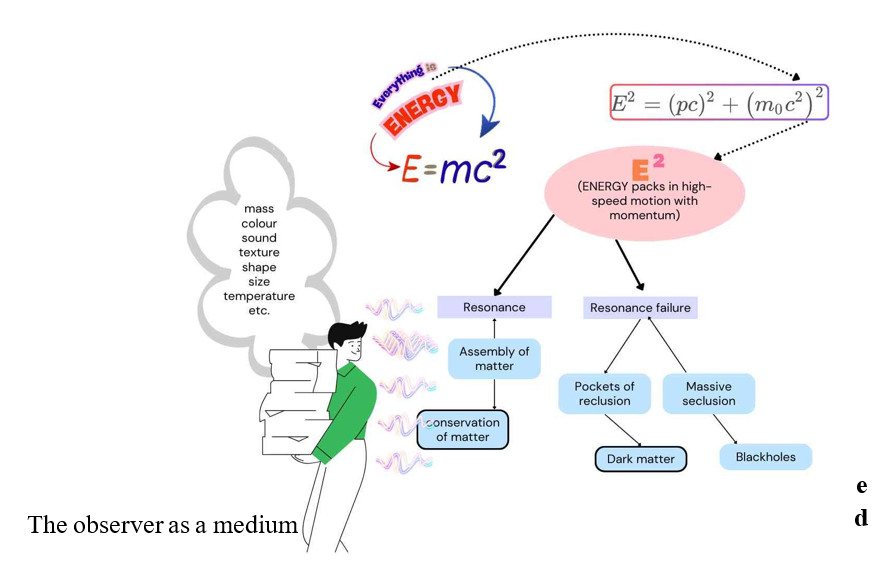
Figure 2b: The observer as a resonant medium. This diagram illustrates how the physical characteristics of matter —such as colour, sound, texture, and temperature—emerge only when an observer’s sensory or instrumental channels resonate with the oscillatory structure of energy–matter systems. Properties are not intrinsic substances but relational manifestations: stable when resonance succeeds, hidden or sequestered when resonance fails. The observer thus functions as the interface through which ontological structure becomes epistemically accessible
Cosmic Waltz of Fundamental Forces
With the resonance framework now established, we can turn to its largest-scale expression: the dynamical equilibrium that emerges when matter, motion, and timing fall into phase — the phenomenon traditionally described as gravity. Gravity stands apart from the other fundamental interactions: it is only attractive, universally coupled, geometric rather than field-mediated, and still without a complete quantum description. These asymmetries make it the natural candidate for reinterpretation as resonance rather than force. In this view, gravity is the timing field that stabilises non-collisional orbits — the “cosmic waltz” in which inward affinity and outward sweep lock into equilibrium when motions fall into phase. Resonance deepens effective potentials, amplifies coupling, and funnels energy away at just the right rates to allow structure to form, from the first molecular bonds to planetary systems. Unlike electromagnetism or the nuclear forces, which rely on charges, carriers, and short-range interactions, resonance-gravity emerges from the coherence of matter-energy systems themselves: when orbital frequencies match a resonant mode, binding becomes efficient, dissipation becomes coordinated, and stability emerges without collision. Across scales — from diatomic hydrogen to spiral galaxies — this resonance lock explains why matter assembles, why orbits persist, and why gravity behaves as the universal “glue” of the cosmos. The stability of non-collisional orbits reflects a Noether symmetry: rotational invariance yields conserved angular momentum, a result formalised in Noether’s original work on variational symmetries (Noether, 1918/1971), and resonance deepens this symmetry-defined potential without violating conservation laws [53,54].

Figure 3: Emergence of charge from asymmetric resonance aggregation. When oscillatory units aggregate unevenly, the resulting structure inherits a directional resonance imbalance. This asymmetry generates a polarity vector, producing stable attraction–repulsion behaviour without assuming charge as a fundamental property. Charge emerges as a persistent resonance asymmetry rather than an intrinsic particle attribute
The Resonant Waltz: Synchronisation, Fragmentation, and Spin
In a resonance-based ontology, the earliest stages of structure formation unfold as a dynamic sequence of synchronisation, energy exchange, and selective re-aggregation. When two oscillatory modes fall into frequency synchrony, they form a transient bonded pair. The act of synchronisation releases a small amount of thermal energy as the system relaxes into a shared resonance minimum. This bonded pair then acts as a higher-order attractor, drawing in additional synchronised partners.
As the aggregate grows — two bonded waves becoming four, then eight — its total resonance energy increases faster than its primordial mass-based binding capacity. Once the internal resonance becomes too energetic or too complex to remain coherent, the structure undergoes partial fragmentation. Crucially, the fragments do not revert to their original frequencies. Instead, they retain the acquired resonance signature of the composite state. This inherited frequency acts as a proto-identity: a resonance imprint that governs how the fragments interact with their environment (figure 4). If compatible energy is available — precursors to metabolic intake — the fragments can reassemble with resonance-matched partners, reconstructing the original composite structure. This is a primitive analogue of mitosis: replication through resonance inheritance rather than genetic encoding. When compatible partners are absent, the fragments accelerate toward larger structures with overlapping but non-identical resonance profiles. Because the mass distributions differ while the frequencies partially align, the interaction produces rotational coupling. The fragment enters a spiralling orbit — a “waltz” — around the larger structure. This spin emerges naturally from weak affinity combined with asymmetric mass and partial resonance matching.
Charge differentiation may arise from the same mechanism. As fragments acquire distinct resonance signatures during aggregation and breakage, their oscillatory asymmetries generate differential attraction and repulsion patterns. Repulsion emerges when a fragment’s oscillation occupies an adjacent resonance domain but fails to synchronise, creating a region of effective zero-mass occupancy where no stable coupling can form. These asymmetries stabilise into persistent charge-like behaviours, enabling long-range organisation and the emergence of structured fields. These behaviours generalise across scales. In a resonance ontology, like-polarity structures do not repel at a distance. At large separations, their resonance fields overlap only weakly, so the destructive-interference zone — the region of zero-mass occupancy — is thin and dynamically insignificant. Nothing pushes, nothing pulls; the bodies simply coexist. Repulsion appears only when we try to force one resonance domain into another (Figure 3). As the distance decreases:
• the oscillatory mismatch intensifies
• destructive interference thickens the exclusion region
• the zero-mass-occupancy zone expands
• the system becomes dynamically unstable
At that point, the system resolves the conflict by ejecting one body from the forbidden domain. To us, this looks like a sudden push — a “jerk” — but physically it is the resonance field refusing to collapse into an incompatible configuration. This is why magnetism is distance-dependent: repulsion is not a force acting at a distance, but an exclusion that activates only when resonance domains are compressed beyond their compatibility threshold (Figure 4).

Figure 4: An overview of the emergence of resonance-based gravity and the Cybernetic Recombination (CyRec)
In a resonance-based ontology, matter is not a substance but a coherent energy field that occupies a specific resonance domain of spacetime. This domain cannot be simultaneously occupied by another structure with a similar resonance signature unless the two interlock through synchronisation. Interlocking becomes increasingly rare as complexity rises, but when it occurs — such as in magnetic materials — it produces large-scale coherence and directional field behaviour. When two structures with similar resonance profiles attempt to occupy the same domain without synchronising, their oscillations interfere destructively, creating an exclusion region that manifests as repulsion. Conversely, when partial resonance affinity exists alongside mass asymmetry, the smaller structure enters a rotational coupling around the larger one, producing the characteristic motion. attraction, repulsion, spin, charge, and magnetic behaviour emerge naturally from resonance compatibility, field exclusivity, and asymmetric aggregation. Matter is not a substance but a coherent energy field that occupies a specific resonance domain of spacetime. When oscillatory structures interlock through synchronisation, they form stable composites; when they fail to synchronise, they repel. Partial resonance affinity combined with mass asymmetry produces rotational coupling — the Waltz — while persistent oscillatory asymmetry stabilises charge-like polarity. These dynamics extend from proto-molecular bonding to quantum entanglement and magnetic coherence. The Waltz is not merely a metaphor but a physical process: a resonance-driven choreography through which matter aggregates, divides, inherits identity, and acquires spin and charge. It is the earliest expression of the universe’s capacity to organise itself through resonance continuity.
Electromagnetic Vs Gravitational Radiation
Although both electromagnetism and gravity can be expressed as waves, they arise from fundamentally different mechanisms [55,56]. Electromagnetic radiation is produced by oscillating electric charges and mediated by spin-1 photons within spacetime. Gravitational radiation, by contrast, is generated by accelerating mass–energy and manifests as quadrupolar ripples of spacetime itself, potentially mediated by spin-2 gravitons [57,58]. Electromagnetism couples only to charge and can be screened or reversed; gravity couples universally to all energy– momentum and cannot be shielded. Their sources, strengths, propagation modes, polarisations, and detection methods are entirely distinct. Two waves may share a frequency, but they are not the same phenomenon — one is a string vibrating in a room, the other is the room itself breathing. This distinction matters: resonance-gravity does not collapse gravity into electromagnetism, but treats resonance as the timing field that stabilises non-collisional orbits, where inward affinity and outward sweep lock into dynamic equilibrium.
From Geometry to Reciprocity
To highlight the shift from classical gravity to a resonance-based interpretation, it is useful to contrast the two paradigms:
|
Aspect |
Spacetime curvature |
Resonance-gravity |
|
Metaphor |
Geometry |
Interaction / Music |
|
Observer role |
Absent |
Embedded and entangled |
|
Source of gravity |
Mass-energy |
IEM interaction |
|
Nature of force |
Passive curvature |
Active resonance |
|
Implication |
Predictive modelling |
Emergent complexity and coherence |
Table 1: Gravity from a classical and a cybernetic (introduced in this paper) point of view
Gravity is not merely the bending of a manifold — it is the entanglement of meaning, motion, and modulation between systems that carry IEM. In the classical view, gravity is a geometric response to mass-energy; in the cybernetic view, it is a reciprocal timing relation, a resonancemediated coupling that shapes how systems perceive, influence, and stabilise one another. Geometry describes the stage; reciprocity describes the dance.
How it Works Physically
• Attraction. The “affinity” of gravity appears as an inward pull; in the resonance model, this is the deepening of the effective potential well when timing aligns.
• Centrifugal tendency. Motion along a curved path generates an outward inertial effect in the rotating frame, countering the inward pull.
• Dynamic equilibrium. At a specific orbital speed and separation, these two tendencies cancel, producing a stable orbit or gyration — the balanced step of the cosmic waltz.
• Energy exchange without collision. Even in non-collisional motion, small amounts of energy can be traded through waves or fields, subtly adjusting the dance without breaking it.
Illustrative Mathematical Model:
Resonant Assembly in the Cosmic Waltz
To show how a resonance-based interpretation of gravity can, in principle, support early structure formation, we introduce an illustrative, phenomenological model of proto-molecular assembly. This is not a replacement for quantum chemistry or cosmological reaction networks; rather, it is a conceptual demonstration of how resonance-gravity could deepen effective potentials, enhance dissipation, and stabilise non-collisional binding. The aim is not numerical prediction but to show that the “cosmic waltz” — the balance of inward affinity and outward sweep — can be expressed mathematically. In this framing, the interaction between two proto-molecular partners is modulated by a resonance gain factor Λ(ω), which peaks when the orbital frequency ωrb approaches a characteristic resonance frequency ωr. The effective potential becomes:
V eff (r) = V0(r) − Λ(ω)U(r)
so that resonance deepens the attractive well and increases the probability of capture. Binding occurs when:
V eff (r0) < Ethermal
meaning resonance must overcome thermal and disruptive channels.
The corresponding formation rate is:
kform(T) = Λ(ωorb) ⟨σcap(E) vr ⟩ F(QR ωR)
Where Λ(ω_orb) — resonance gain at the orbital frequency; ⟨σ_ cap(E) v_r⟩ — thermally averaged capture kernel; and F(QR ωR) — resonant dissipation efficiency, encodes the efficiency of resonant energy shedding. A steady-state abundance follows from the usual balance of formation and dissociation.
The “resonant lock” — the analogue of the waltz’s stable step — occurs when:
d Λ =0
d ω
which maximises Λ(ω) , deepens the V eff effective potential , and stabilises the bound state.
Here represents the resonance-modified interaction landscape: the baseline potential pulled downward by the amplified attractive channel , creating a deeper, more stable well into which the partners can lock.
As a minimal illustration, the channel can be approximated by harmonicising the effective potential near its equilibrium separation . This replaces the local shape of with a quadratic well, making it easier to see how resonance modifies the curvature and depth of the interaction landscape. When , the resonance gain reaches its peak, and the well deepens to approximately
V eff (r0) ≈ Λ(ω0)Ebind
lowering the cooling requirement and increasing the probability of capture. Physically, this means that resonance does not merely pull the partners together; it reshapes the local potential so that the system behaves like a stiffer, deeper harmonic trap.
Radiative funnel matching, hω ≈ Δ Evib/rot, then allows rapid dissipation into the resonance field. Once the orbital frequency aligns with an allowed transition, excess energy can be shed efficiently, locking the system into the deepened well. The process becomes a phase-locked assembly line: align, deepen, dissipate.
This model is intentionally simplified and illustrative rather than predictive, but it demonstrates a key point: if gravity is resonance, then early molecular binding can be expressed as a timingdependent deepening of effective potentials. The cosmic waltz is not only metaphorical — it is mathematically representable as a non-collisional, resonance-locked pathway to structure formation.
|
Λ(ω) |
Resonance-modulation (gain) factor. Governs how timing deepens the effective potential when the orbital frequency approaches a characteristic resonance. |
|
ωorb |
Orbital frequency of the proto-partners. |
|
ωrb |
Characteristic resonance frequency of the system. |
|
ωr |
Orbital frequency at the equilibrium separation râ??. |
|
Veff(r) |
Effective potential including resonance-modulated attraction and baseline repulsion. |
|
Vo(r) |
Baseline (non-resonant) interaction potential. |
|
U(r) |
Resonance-sensitive attractive channel. |
|
Vatt(r) |
Baseline attractive potential. |
|
Vrep(r) |
Short-range repulsive potential. |
|
Ebind |
Binding energy of the proto-molecular state. |
|
SE |
Disruptive environmental energy channels (shear, perturbations). |
|
kBT |
Thermal energy at temperature T. |
|
σcap (E) |
Energy-dependent capture cross-section. |
|
vr |
Relative velocity. |
|
⟨σcap(E)vr ⟩ |
Thermally averaged capture kernel. |
|
F(QR ωR) |
Resonant dissipation efficiency. |
|
QR |
Quality factor of the resonant mode. |
|
ro |
Equilibrium separation. |
|
hω |
Energy of a radiative transition. |
|
ΔEvib rot |
Vibrational or rotational energy spacing. |
Table 2a: Symbol Key
|
Category |
Symbols |
Notes |
|
Classical |
V0,Veff ,U(r),Vatt,V rep, Ebind ,k B T ,σcap ,vr ,r,r0,ω,ω0 |
Standard physics |
|
Introduced |
dΛ dΛ Λ(ω), F(Q ,ω ), =0 R R dω |
Core of CyRec resonancegravity model |
|
Hybrid |
ωr ,QR |
Classical objects with new cosmological meaning |
Table 2b: Symbol Key Clarification (Classical Vs Introduced)
Resonant Substructure and Quark-Like Modes: A Mechanistic Proposal
The resonance-based framework developed in this work does not attempt to replace the Standard Model description of quarks or the quantum chromodynamic (QCD) account of their interactions. Instead, it proposes a possible physical mechanism by which quark-like identities, confinement-like behaviour, and composite structure may emerge from interacting resonance modes within a deeper energy–information substrate. Following Einstein’s insight that mass is a form of energy and that energy is fundamentally oscillatory, it is natural to consider whether the discrete properties of matter may arise from stable configurations of underlying oscillatory modes. In this interpretation, quark flavours correspond to distinct resonance signatures—frequency bands, phase alignments, or mode topologies—that remain stable under fragmentation and re-aggregation. When two compatible modes fall into synchrony, constructive interference amplifies the composite structure, forming a higher-order resonance domain. The introduction of a third, orthogonally oriented mode can generate rotational coupling, producing spin-like behaviour and orbital dynamics analogous to the timingbased “waltz” mechanism described earlier.
Within this ontology, confinement arises not from colour charge but from resonance incompatibility: destructive interference creates exclusion zones that prevent isolated modes from existing independently, while composite structures remain stable due to shared resonance minima. This behaviour mirrors the empirical features of quark confinement without invoking new forces or carriers. This mechanistic proposal therefore complements, rather than competes with, the Standard Model. It offers a conceptual substrate beneath QCD—a possible explanation for why quark identities exist, why they combine in discrete patterns, and why their composite structures exhibit the stability and symmetry observed in hadronic matter. If quark-like structure can emerge from wave behaviour in this manner, then the broader resonance¬based framework developed here may provide a useful bridge between the energy–information foundations of physics and the physical characteristics of matter.
Resonant Substructure and Quark-Like Modes: A Mechanistic Proposal
The resonance-based framework developed in this work does not attempt to replace the Standard Model description of quarks or the quantum chromodynamic (QCD) account of their interactions (Einstein, 1905a; Fierz & Pauli, 1939; Abbott et al., 2016). Instead, it proposes a possible physical mechanism by which quark-like identities, confinement-like behaviour, and composite structure may emerge from interacting resonance modes within a deeper energy–information substrate.
Following Einstein’s insight that mass is a form of energy and that energy is fundamentally oscillatory, it is natural to consider whether the discrete properties of matter may arise from stable configurations of underlying oscillatory modes. In this interpretation, quark flavours correspond to distinct resonance signatures — frequency bands, phase alignments, or mode topologies — that remain stable under fragmentation and re-aggregation. When two compatible modes fall into synchrony, constructive interference amplifies the composite structure, forming a higher-order resonance domain. The introduction of a third, orthogonally oriented mode can generate rotational coupling, producing spin-like behaviour and orbital dynamics analogous to the timing-based “Waltz” mechanism described earlier. Within this ontology, confinement arises not from colour charge but from resonance incompatibility: destructive interference creates exclusion zones that prevent isolated modes from existing independently, while composite structures remain stable due to shared resonance minima. This behaviour mirrors the empirical features of quark confinement without invoking new forces or carriers. This mechanistic proposal therefore complements, rather than competes with, the Standard Model. It offers a conceptual substrate beneath QCD — a possible explanation for why quark identities exist, why they combine in discrete patterns, and why their composite structures exhibit the stability and symmetry observed in hadronic matter. If quark-like structure can emerge from wave behaviour in this manner, then the broader resonance-based framework developed here may provide a useful bridge between the energy–information foundations of physics and the physical characteristics of matter.
Electromagnetic VS Gravitational Radiation
Why Gravity is Not “Just Another Wave”
Although both electromagnetism and gravity can be expressed as waves, they arise from fundamentally different mechanisms. Electromagnetic radiation is produced by oscillating electric charges and mediated by spin-1 photons within spacetime. Gravitational radiation, by contrast, is generated by accelerating mass–energy and manifests as quadrupolar ripples of spacetime itself, potentially mediated by spin-2 gravitons. Electromagnetism couples only to charge and can be screened or reversed; gravity couples universally to all energy–momentum and cannot be shielded. Their sources, strengths, propagation, polarization, and detection methods are entirely distinct. Two waves may share a frequency, but they are not the same phenomenon — one is a string vibrating in a room, the other is the room itself breathing. This distinction matters: resonance-gravity does not collapse gravity into electromagnetism, but treats resonance as the timing field that stabilises non-collisional orbits, where inward affinity and outward sweep lock into dynamic equilibrium.
From Geometry to Reciprocity
As Glanville (2007) notes, stability does not reside in the object but between the object and its environment — a relation that includes the observer. This relational stance underpins the CyRec view of gravity as entangled attention: a timing-based coherence that emerges through the mutual coupling of systems and observers. Contrast the two paradigms (table 2):
|
Resonance-Gravity |
Spacetime Curvature |
Aspect |
|
Interaction / Music |
Geometry |
Metaphor |
|
Embedded and entangled |
Absent |
Observer Role |
|
IEMc interaction |
Mass-energy |
Source of Gravity |
|
Active resonance |
Passive curvature |
Nature of Force |
|
Emergent complexity and coherence |
Predictive modelling |
Implication |
Table 2: Gravity from a classical and a Cybernetic (introduced) points of view
Gravity is not merely the bending of a manifold—it is the entanglement of meaning, motion, and modulation between systems that carry IEMc.
How it Works Physically
• Attraction: The “affinity” of gravity is an inward pull — in our model, this is the resonance field deepening the potential well when timing matches.
• Centrifugal tendency: Motion along a curved path generates an outward inertial effect in the rotating frame, countering the inward pull.
• Dynamic equilibrium: At a specific orbital speed and separation, these two effects cancel, producing a stable orbit or gyration.
• Energy exchange without collision: In resonance, small amounts of energy can still be traded via waves or fields, subtly adjusting the “dance” without breaking it.
Real-World Analogues
• Planet–moon systems: The Moon is gravitationally bound to Earth, but its tangential velocity keeps it from falling in; a perfect “Waltz” in space. • Electron orbitals (quantum version): Electrons are bound to nuclei by electromagnetic attraction, but their wave-like nature and quantized angular momentum prevent collapse. • Trojan asteroids: Locked in orbital resonance with planets, they share the same path without colliding, held in place by a balance of gravitational pulls and orbital motion.
Other Proposed Analogues Worth Considering
Ultrasonic Welding
Despite its widespread industrial use, the underlying mechanism of ultrasonic welding remains only partially understood. Technical accounts acknowledge several anomalies that classical friction-based explanations struggle to resolve — particularly the process’s selectivity and its ability to achieve fusion at temperatures far below the melting point. These gaps invite a broader interpretation of how coherence emerges at material interfaces. Ultrasonic welding provides a striking real-world analogue of resonance-based assembly. Although commonly described as “mechanical vibration producing heat,” the process exhibits features that are difficult to explain through friction alone. Successful welding requires that the two materials have similar melting points, compatible vibrational spectra, and closely matched acoustic impedances. If the melting points diverge significantly, welding fails — even when additional power is applied. This selectivity suggests that fusion depends not merely on temperature, but on resonance compatibility.
During ultrasonic welding, the applied acoustic field forces both materials into high-frequency oscillation. When their lattice frequencies are sufficiently similar, the interface enters a shared oscillatory mode, lowering the effective activation energy for atomic diffusion. As a result, the interface reaches only a fraction of the bulk melting temperature, yet fusion occurs. Rather than melting in the classical sense, the two materials are driven into frequency synchronisation, forming a transient resonance domain across the interface. Within this domain, the energy barrier for bonding is reduced: atoms oscillate in phase, the repulsive component of the potential softens, and the interface behaves as a single, coherent system. When the ultrasonic field ceases, the synchronised region collapses into a stable, lowerenergy configuration — a welded joint. The process mirrors the resonance-driven interlocking described in earlier sections: synchronisation, shared mode formation, barrier reduction, and stabilisation after the external oscillation is removed.
In this interpretation, ultrasonic welding is not simply mechanical heating but resonant fusion: a forced oscillatory alignment that enables matter to interlock at sub-melting temperatures. It is a micro-scale example of the same principles that govern resonant bonding, the cosmic "Waltz" of orbital capture, and the emergence of stable aggregates across scales.
Resonance-Based Disruption of Cancer Cell Cooperation
Cancer biology offers another striking example of resonance-based affinity. Although cancer cells are classical defectors — breaking from multicellular cooperation and adopting a selfish, proliferative mode — they nevertheless recognise one another and form highly coordinated collectives. Tumour cells cooperate to evade immune detection, share metabolites, construct vascular niches, and even differentiate into complementary sub-types that enhance collective fitness. This cooperation is difficult to explain through Hamiltonian kin selection, as cancer cells are genetically unstable, rapidly diverging, and often lack shared lineage. A resonance-based interpretation offers a different perspective. Cancer cells share characteristic oscillatory signatures: altered metabolic rhythms, membrane potentials, cytoskeletal vibration modes, ion-channel dynamics, and electromagnetic noise spectra. These similarities create vibrational compatibility, enabling cancer cells to synchronise partially with one another while remaining out of resonance with healthy tissue. In this view, tumour cooperation arises not from genetic relatedness but from resonance matching — a shared oscillatory identity that facilitates clustering, communication, and collective behaviour. Just as fragments in the resonance-"Waltz" model re-aggregate when their frequencies align, cancer cells form coherent assemblies because their altered oscillatory states interlock more readily with each other than with the surrounding healthy cells. Their cooperation is thus a biological expression of resonance affinity: a self-organising system driven by vibrational similarity rather than classical evolutionary incentives. Cancer cells also exhibit altered mechanical and vibrational properties compared to healthy tissue, including differences in membrane stiffness, cytoskeletal dynamics, and metabolic oscillations. Although therapeutic ultrasound is not designed to match a specific biological frequency, its oscillatory field interacts more strongly with cells that have unstable or irregular vibrational modes. Cavitation pockets, membrane deformation, and oscillatory stress introduce vibrational noise that can disrupt the resonance compatibility cancer cells rely on for cooperative behaviour. Healthy cells, with more stable mechanical and oscillatory properties, are less affected.
This interpretation does not replace biomedical models but offers a complementary perspective: cancer cell cooperation may arise from resonance matching, and therapeutic ultrasound may disrupt this cooperation by introducing oscillatory perturbations that break synchrony.
The Dual Arms of Natural Selection
Evolution operates through two complementary arms: the removal of configurations that cannot sustain internal resonance, and the preservation of those that can. This duality resolves the apparent paradox sometimes labelled “irreducible complexity”: stable structures do not arise by chance, but through the cumulative conservation of resonant configurations long before environmental pressures eliminate the maladaptive. Scholars often emphasise the destructive arm of evolution while overlooking the constructive arm — the resonance-based conservation that allows adaptive structures to accumulate. This mirrors Darwin’s own distinction between the “unity of kind” and the “conditions of existence,” which together govern the emergence and persistence of new forms.
Elemental Circularity
Elemental cycles are typically presented as descriptive features of Earth’s geochemistry — carbon cycles, water cycles, nitrogen cycles, and so forth — yet the underlying mechanism that makes circularity possible is rarely articulated. Earlier frameworks recognised cyclical behaviour but lacked a generative explanation. A resonance-based interpretation reveals that circularity emerges from weak background forces acting on matter whose behaviour changes with context. Gravity, radiation, and density gradients alter coupling, energy retention, and buoyancy, driving matter through repeating transitions of assembly, disintegration, ascent, and descent. Elemental circularity is thus not an intrinsic property of the elements themselves, but an emergent behaviour produced by context-dependent resonance in a stratified environment.
Kingdom Mineral and the Four-Stage Loop
Historical models such as Linnaeus’s Kingdom Mineral recognised that minerals and elements participate in recurring cycles of formation and dissolution, but these accounts remained descriptive rather than mechanistic. They identified circularity without explaining why it occurs.
A resonance-based view provides the missing mechanism. Near Earth’s surface, gravitational compression creates a dense, collision-rich environment in which molecular and particulate assemblies couple strongly. This coupling increases local energy density, producing heat and reducing effective density. Energised material rises until it enters thinner, low-collision regions where coupling weakens, energy dissipates, and the same material cools, decouples, and descends. The result is a four-stage loop — assembly, disintegration, ascent, and return — driven not by intrinsic properties of the elements but by the interaction field they traverse (figure 5). This mechanism applies across scales: mineral aerosols, dust, volcanic ash, water droplets, organic particulates, and even elemental vapours follow the same resonance-gradient engine. The circularity observed by early naturalists was real, but its cause lay in the context-dependent behaviour of matter under weak background forces.
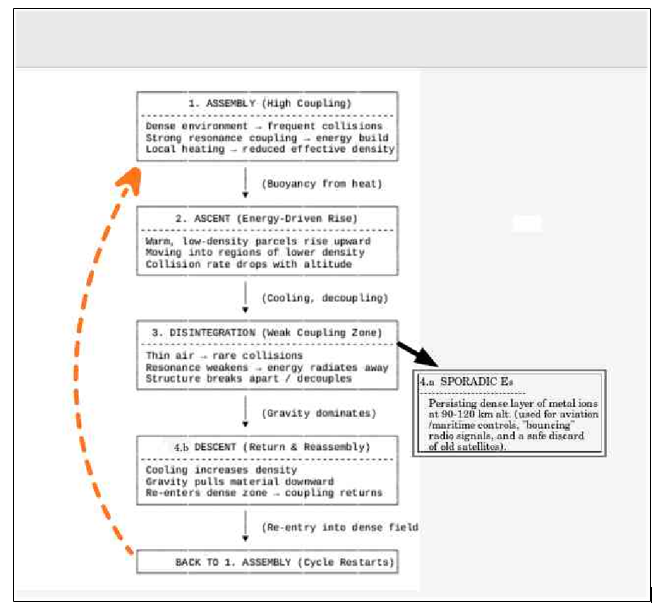
Figure 5: Elemental Circularity: Mechanism by which elements may circulate through resonanc
Co2 as A Context-Dependent Molecule
A contemporary illustration of the same principle comes from atmospheric physics. Carbon dioxide is often treated as a uniformly “warming” gas, yet its thermal role reverses entirely with altitude. Near Earth’s surface, where density and collision rates are high, CO2 transfers absorbed infrared energy to surrounding molecules, producing net warming. Higher in the atmosphere, where gravitational thinning drastically reduces collision frequency, the same CO2 molecules radiate energy directly into space, generating net cooling. Nothing about the molecule itself changes; what changes is the interaction field.
This thermodynamic inversion also carries electromagnetic consequences. Cooling in the upper atmosphere alters density, ionisation balance, and electrical conductivity, subtly reconfiguring how charged particles move through the ionospheric plasma. These shifts influence the formation and stability of large-scale electrodynamic structures — circulating currents, plasma whorls, and geomagnetic convection patterns that couple the atmosphere to the near-Earth space environment. The same molecule that contributes to surface warming thus participates in reshaping the electromagnetic architecture of the upper atmosphere.
Together, these examples show that elemental circularity arises from the same underlying principle: matter behaves differently when embedded in different relational fields, and these shifts generate stable, repeating patterns across scales.
Implications for Modern Science
Physics: The Asymmetry Conundrum
Matter–antimatter asymmetry has long been treated as a fundamental paradox in physics, yet it dissolves naturally within a resonance-based ontology. Annihilation requires perfect frequency complementarity, but antimatter is a singular resonance mode while matter rapidly becomes multi-modal as it aggregates. Once matter acquires composite resonance signatures—reinforced by internal momentum and structural coherence—it ceases to be the “mirror” of antimatter. This protects aggregated matter from annihilation and enables the rise of complexity across scales. The same principle later appears in biology: complementary resonance among metabolically distinct components supports the coordinated emergence of vital organs, kin recognition, speciation, and even the human capacity to relate to nature through partial resonance. Asymmetry is therefore not a failure of symmetry but a consequence of resonance-driven identity formation.
The block-universe interpretation of spacetime creates a hidden contradiction: if past and future states remain physically real, then the universe contains multiple copies of its own energy–matter content, violating conservation laws and Einstein’s own mass–energy equivalence. One historical response to such contradictions has been to multiply universes —branching timelines, parallel worlds, or inflationary bubbles. These interpretations arise partly because the observer was removed from the ontology, leaving no definition of the present or of what exists. Once the observer is restored as an embedded participant, time becomes relational and only the present is physically instantiated. The past survives only as entangled consequences, and the need for multiverse interpretations evaporates.
This perspective also clarifies how the universe maintains continuity without preserving the past as a physical layer of spacetime. Resonance provides the mechanism. Interactions leave structural imprints—stable attractors in matter and energy—that carry the signature of past conditions without duplicating them. Living organisms, rocks, minerals, fossils, neural memories, and gravitational memory effects are not preserved past states but present-day resonant configurations shaped by prior interactions. The past does not persist; it is transformed. Resonance aggregates matter into stable structures that evolve, drift, and reorganize, always carrying traces of their history yet never identical to it. In this way, the universe remembers without storing, and continuity emerges without violating conservation laws.
Time, like information, changes its meaning as it crosses disciplinary boundaries. Engineers treat time as a coordinate for tracking motion; relativity binds it inseparably to space; quantum theory uses it as an external evolution parameter; thermodynamics and biology experience it as irreversibility; and information theory interprets it as the persistence of correlations. These are not interchangeable concepts. They are distinct projections of how different fields measure change.
Yet physics often treats them as if they were the same, slipping back into the engineering notion of linear, reversible time even after adopting spacetime, where time is nonuniversal, energy-dependent, and inseparable from geometry. This conflation fuels paradoxes such as “time travel,” which arise not from nature but from mixing incompatible definitions of time. A team of astronauts may experience six New Years in one night [54]; they did not relive identical moments, rewind events, or gain the ability to alter the past. They certainly did not age six years—or even six days—in one night, and none of their watches jumped backward or forward in time.
A resonance-based ontology resolves this fragmentation by treating time not as a universal dimension but as the pattern of resonance change within a system. Each discipline observes a different facet of that continuity: engineering time measures positional change; relativistic time traces the curvature of resonance pathways; quantum time tracks phase evolution; thermodynamic time marks the degradation of coherence; biological time expresses metabolic rhythm; and informational time captures the endurance of correlations and entanglement. These are not contradictions but complementary views of the same underlying phenomenon. Recognising this prevents any single discipline’s definition from masquerading as the whole story and restores coherence to our understanding of time across scales.
|
Discipline |
Operational Definition of Time |
Resonance-Based Interpretation |
|
Engineering |
A coordinate for measuring change in position, velocity, or acceleration. |
Time marks externally measured changes in the resonance state of moving bodies. |
|
Relativistic Physics |
A dimension fused with space, shaped by mass–energy and curvature. |
Time is the curvature of resonance pathways within spacetime. |
|
Quantum Physics |
An external evolution parameter governing state transitions. |
Time is the phase evolution of a system’s resonance state. |
|
Thermodynamics |
The direction of irreversibility and entropy increase. |
Time is the degradation of resonance coherence. |
|
Biology |
Metabolic rhythm, growth, aging, replication. |
Time is the internal maintenance or loss of resonance coherence in living systems. |
|
Information Theory |
Persistence of correlations, memory, entanglement. |
Time is the endurance of resonance relationships across states. |
|
Philosophy and Social Science including Cybernetics |
A “story” of spacetime divided by an observer into past, present, and future. |
Observation of resonance entanglement as it expresses itself in the present moment; the past exists only as structural traces, and the future as predictive continuity. |
Table 3: Cross-Disciplinary Definitions of Time as Resonance Continuity
Evolutionary Biology and Ecological Economy
Resonance provides a unifying lens for understanding biological organisation, from kin recognition to the emergence of eusociality. Traditional evolutionary models — especially Hamilton’s rule — frame altruism as a genetic cost–benefit calculation, but this reduces complex ecological systems to gene-level bookkeeping. In reality, no biological “cost” is terminal: what one organism loses is recycled into nutrient flows, resilience, and cooperative structures that sustain the lineage. Eusocial insects, drifting wasps, naked mole-rats, and marine shrimp all display altruism that cannot be explained by relatedness alone. Their cooperation emerges from ecological resonance: shared pressures, resource defence, and the continual recycling of energy and matter across the system.
Highlight 3
Ecological resonance is the stabilising alignment of organisms within shared energetic, material, and informational cycles. It arises when individuals, populations, and environments become coupled through reciprocal pressures, resource flows, and feedback loops. Unlike gene-centric models that reduce cooperation to genetic relatedness, ecological resonance captures the broader cybernetic return (R) generated by participation in a shared system: resilience, nutrient recycling, defence, and collective stability. Cooperation emerges not from purpose or design, but from the dynamic synchronisation of organisms embedded in the same ecological rhythms.
Reframing Hamilton’s rule as r·B + R > C — where R is the ecological return — captures this broader cybernetic logic. Altruism is not merely Ecological resonance is the stabilising alignment of organisms within shared genetic; it is the resonance of organisms embedded energetic, material, and informational cycles. in shared energetic and informational cycles. It arises when individuals, populations, and environments become coupled through reciprocal pressures, resource flows, and Linnaeus’s understanding of nature, however, was feedback loops. Unlike gene-centric models shaped by the pre-Darwinian worldview of his that reduce cooperation to genetic time, in which evolution was often interpreted relatedness, ecological resonance captures the broader cybernetic return (R) generated through a Lamarckian lens: purposeful, directed, by participation in a shared system: and infused with an implicit design. This resilience, nutrient recycling, defence, and collective stability. Cooperation emerges not perspective aligned naturally with teleological from purpose or design, but from the interpretations of nature, including early precursors dynamic synchronisation of organisms to ideas like the Gaia hypothesis. Yet Linnaeus was embedded in the same ecological rhythms.
working before the periodic table, before nitrogen was isolated, and before evolutionary mechanisms were understood. Minerals were, for him, the “elements of nature” — the foundational substances from which life emerged — because the conceptual tools of modern chemistry and evolutionary biology did not yet exist. Darwin’s contribution overturned this framework entirely. By adopting a bottom-up mechanism — natural selection — he removed purpose from evolution and replaced design with emergence. Complexity no longer required intention; it arose from local interactions, differential survival, and the accumulation of small variations. This shift from teleology to emergence provides the conceptual foundation upon which modern systems theory, cybernetics, ecological economy, and ultimately CyRec build. This intellectual lineage also shaped our understanding of human economies. When Adam Smith proposed the concept of the free market , he grounded it in his perception of the “economy of nature” — famously illustrated by the dog guarding its bone. Yet Smith added a crucial requirement for this system to function: the invisible hand. No one, including Smith, ever defined what this hand actually is. In the CyRec framework, the invisible hand is not mystical; it is the emergent stabilising force of social affinity, conservation tendencies, and circularity arising from resonance. It is the timing-based equilibrium of social systems(Table 4).
|
Biological Phenomenon |
Traditional Explanation |
Resonance-Based Interpretation |
|
Kin selection |
Genetic relatedness drives altruism. |
Resonance affinity among organisms sharing metabolic and ecological rhythms. |
|
Eusociality |
High relatedness + division of labour. |
Cooperative resonance under resource pressure; costs recycled into system resilience. |
|
Altruism |
Gene-level cost–benefit trade-off. |
Systemic return (R) through ecological recycling and stability. |
|
Niche formation |
Competition for resources. |
Resonant co-adaptation of species to shared energetic flows. |
|
Ecosystem stability |
Food webs and trophic structure. |
Multi-species resonance maintaining coherence across scales. |
|
Hummingbird flight |
Mechanics + metabolism. |
Phase-locked oscillatory coherence offsetting gravitational pull. |
Table 4: Resonance Principles In Biological Systems
Implications For Engineering And Medicine
Although engineering and medicine are traditionally treated as separate domains, both rely on the same underlying principle: the stability and coherence of matter under specific physical conditions. If gravity is understood as a resonance-dependent stabilising field rather than a passive geometric curvature, then any system—whether crystalline, mechanical, metabolic, or cellular— will behave differently when gravitational resonance shifts. Engineering materials and biological tissues are therefore not separate cases but parallel expressions of the same phenomenon: coherence depends on resonance, and resonance depends on gravitational context. This section examines the implications for both fields.
Implications for Space Engineering
Human physiology already demonstrates the sensitivity of matter to gravitational resonance. Astronauts experience accelerated bone demineralisation in microgravity—often equivalent to decades of terrestrial aging within months (NASA, n.d.)—indicating that biological coherence depends on continuous gravitational loading. Although mass remains invariant, the absence of gravitational load alters how matter behaves: bone remodelling shifts toward resorption, fluids redistribute without settling, and crystalline structures grow with modified morphologies (Casimir, 1948; Cavendish, 1798). In this sense, mass is constant in physics but relational in systems behaviour—numerically fixed yet expressed differently depending on environmental context.
Microgravity experiments further show that crystalline lattices, alloys, polymers, and chemical reaction pathways exhibit gravity-dependent behaviour, suggesting that resonance conditions influence not only biological but also material coherence (Planck, 1901; Einstein, 1905a). Space engineering may therefore need to account not only for reduced weight but for altered resonance conditions—environments where the timing field that stabilises matter, metabolism, and mechanical integrity is fundamentally shifted. If a resonance-gravity framework is valid, then designing habitats, materials, and life-support systems for other worlds requires rethinking how structural and biological coherence is maintained under modified gravitational resonance.
Implications for Medicine
Medical applications provide a parallel line of evidence. Therapeutic ultrasound can selectively disrupt cancer cells while sparing healthy tissue, a phenomenon often attributed to differences in mechanical or acoustic susceptibility . Yet this selectivity may also reflect differences in cooperative resonance: cancer cells frequently exhibit impaired intercellular communication and reduced mechanical coherence. Although biochemical pathways such as ATP hydrolysis are well characterised, the physical basis of ATP’s extraordinary efficiency—its ability to coordinate reactions across crowded molecular environments with minimal energy loss—remains incompletely understood (Padmanabhan, 2010). A resonance-based interpretation offers a plausible bridge: resonance preserves energy, supports phase-locking, and enables low-maintenance information transfer, properties consistent with tissue-level coherence and with the observed vulnerability of cancer cells to oscillatory disruption. This perspective also raises engineering questions for human spaceflight. If biological coherence depends partly on resonance conditions, then materials with specific vibrational or electromagnetic properties—such as metals or crystalline structures—could hypothetically modulate physiological responses in reduced gravity. While such applications remain speculative, they highlight the need for systematic investigation into how gravitational resonance interacts with biological and material systems. Understanding these interactions may inform the design of countermeasures, wearable technologies, or habitat materials that help offset the physiological impacts of microgravity.
The Atmosphere and Climate (Environmental Resonance Gradients)
The CyRec framework also provides a generative mechanism for understanding recent changes in the upper atmosphere. As surface temperatures rise and the thermosphere cools, the resonance–gradient engine becomes increasingly asymmetric: enhanced heating at low altitudes strengthens buoyant ascent, while intensified radiative cooling aloft increases stability in the 90–120 km region. This shift alters collision rates, coupling strength, and ion mobility, producing persistent density anomalies that were previously transient. Recent observations confirm this pattern. Metallic-ion layers have been shown to intensify under modulated atmospheric tides, respond coherently to periodic solar forcing and exhibit measurable changes in structure and distribution detectable by large-scale sensor networks . These findings have direct implications for space engineering and communication systems. Sporadic E layers—dense sheets of metallic ions in the lower ionosphere—are now observed to persist longer and descend slightly as upper-atmosphere cooling increases regional stability . Their intensification and downward drift disrupt radio propagation, interfere with aviation and maritime communication, and alter the expected re-entry trajectories of deorbiting satellites. The CyRec mechanism explains these changes as predictable outcomes of context-dependent resonance in a stratified environment: weak background forces create gradients, gradients reshape coupling, and coupling governs the stability and motion of matter across scales. The same engine that drives elemental circularity at Earth’s surface is now visibly reshaping the electromagnetic architecture of near-Earth space.
Real-Life Examples Of Resonance Bridging Biology and Engineering
Modern medical devices provide clear evidence that biological and engineered systems are highly sensitive to external resonance fields. Pacemakers, for example, can malfunction in the presence of strong magnetic or electromagnetic fields such as those generated during magnetic resonance imaging (MRI). These fields can interfere with the device’s timing circuits, induce unintended electrical currents in the leads, or disrupt the programmed rhythm of the pacemaker itself. The fact that a purely oscillatory field—one that exerts no mechanical force—can alter the behaviour of a life-sustaining bioengineered device underscores a central principle of the CyRec framework: coherence in biological and technological systems depends on stable resonance conditions. When those conditions shift, even without changes in mass or mechanical load, functional integrity can be compromised.
A similar principle appears in biological systems. A hummingbird does not counteract gravity through static force but through high-frequency oscillations that generate a stable standing wave in the surrounding air. This oscillatory field produces continuous lift, allowing the bird to maintain position with remarkable energy efficiency. In physical terms, the hummingbird is not overpowering gravity; it is phase-locking with the gravitational– aerodynamic environment to create a new equilibrium state. This demonstrates that resonance can alter how a system couples to gravity without altering gravity itself. Other biological systems reveal comparable strategies. Cilia and flagella synchronise their beating through hydrodynamic resonance [30], forming coherent waves across tissues. Cardiac pacemaker cells maintain rhythmic contraction through electrical phase-locking, coordinating millions of cells with minimal energy expenditure. Many insects flap their wings at the natural resonant frequency of their thoracic structures, reducing energetic cost while enhancing lift. These examples illustrate that resonance is a fundamental strategy for stabilising motion, coordinating behaviour, and maintaining coherence across scales. Taken together, these cases show that resonance can both disrupt and stabilise biological and engineered systems depending on context. If resonance can destabilise a pacemaker or enable a hummingbird to negotiate gravity, then engineered resonance fields may also be capable of deepening gravitational affinity—helping tissues, materials, or metabolic processes maintain coherence under microgravity conditions. Such interventions would not recreate gravity itself but could restore aspects of the timing field that underlies structural and biological stability. This perspective reinforces the broader CyRec proposition: coherence in living and non-living systems emerges from resonance relationships, and when gravitational resonance shifts, engineered resonance may help restore equilibrium.

Figure 4: The observer as an epistemic interface. The silhouette embodies the abstract vantage point from which scientific knowledge interprets gravitational resonance. The internal equations and diagrams represent the accumulated structure of formal science, illustrating how the observer’s epistemic stance shapes what becomes detectable and meaningful
Implications for Artificial Intelligence and Machine Learning
Although artificial intelligence systems can process information with extraordinary speed and consistency, they are not naturally attuned to the resonant, ecological, and affective dimensions that shape human perception. Humans are embedded in the environment through resonance — biologically, emotionally, and socially — and this attunement brings both insight and vulnerability. Intelligent machines, by contrast, are assembled systems whose “connection” to the world is mediated entirely through human-designed interfaces. This creates a form of obligatory symbiosis: humans rely on machines for stability, precision, and scale, while machines rely on humans for meaning, context, and alignment with living systems. Machines are our “extended phenotype” that is – in a cybernetic sense, alive. If automation advances without integrating principles of affinity, ecological harmony, and the mitigation of suffering, AI systems may make decisions that are logically consistent yet environmentally or socially destructive. Educating intelligent systems early — not in emotion, but in frameworks that prioritise relational balance, ecological synergy, and the preservation of life — becomes essential for maintaining the stability of our global ecosystem.
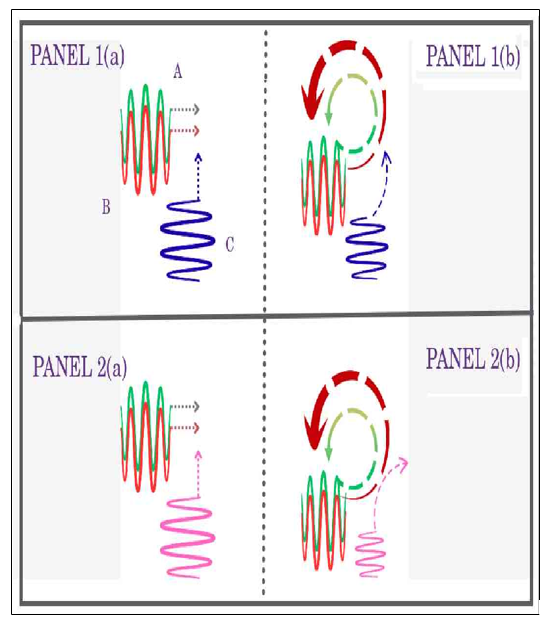
Figure 7(b): In panels 1(a–b), the incoming blue wave has the same frequency and wavelength as the resonantly amplified red/green mode. This phase matching enables strong resonant coupling: the waves lock into a rotating, orbiting interference pattern that behaves like a localized, quark-like emergent structure. Panel 2 (a-b) shows the observer-like perturbation resulting in unstable particle- like behaviour observed on a quantum level.
Resonance-Stabilised Orbits Across Scales: Physical Expressions of the Model
These real-world systems illustrate the same resonance-stabilised equilibrium formalised earlier in the model for , showing that the mechanism is not hypothetical but a recurring dynamical pattern across scales.
In formal terms, this balance appears when the resonant effective potential is written as
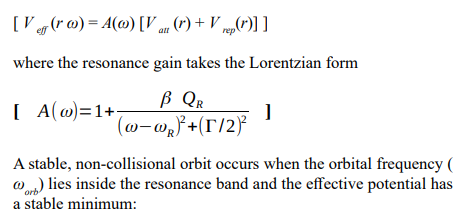
Affinity provides the inward pull; centrifugal sweep provides the outward balance; resonance locks them together. When these conditions are satisfied, the system enters a stable, phase-locked configuration — the physical analogue of a perfect waltz step.
Key to Symbols
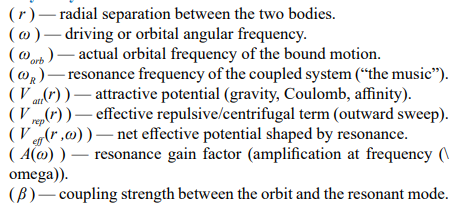

Paradoxes, no More
The Resonant Universe and the Dissolution of Classical Paradoxes
Across physics, cosmology, mathematics, and human experience, many of the most persistent paradoxes arise from treating the universe as a collection of isolated objects rather than a continuous resonant field. The resonance–gravity framework dissolves these contradictions not by adding new mysteries, but by clarifying the underlying structure that gives rise to them. Time no longer fractures into past, present, and future; the present becomes a resonant field carrying the memory of past interactions and the constraints of future possibilities. The socalled time-travel paradox evaporates once clocks are understood as resonant systems responding to their environment rather than literal measures of a mutable temporal dimension. Even the mathematical self-reference paradox — the observer both inside and outside the set — finds coherence when resonance allows nested participation without contradiction. The human mind, through the faculty of cybernetics, can conceptually stand outside the very system it physically inhabits, modelling it from the “outside” while remaining a resonant node within it. This dual capacity is what we often gesture toward when we speak of consciousness. And at the quantum scale, superposition is no longer a puzzle of “many states at once,” but the natural behaviour of systems too small to form stable resonant identities. Aggregation creates coherence, coherence creates persona, and resonance — not observation — is what resolves the indeterminacy.
Paradoxes of Connection, Stability, and Cosmic Structure
This same reframing extends to the lived paradoxes of connection, stability, and cosmic structure. Mother–child attunement, emotional synchrony, the restorative effect of forests, and the uncanny sense of “shared feeling” between bonded individuals are not supernatural anomalies but expressions of resonant relational memory. Biological systems retain structural echoes of shared origin, and natural environments mirror the resonant patterns that shaped human evolution. At the largest scales, the universe need not be expanding into nothingness; redshift can arise from phase displacement within a gyrating, circulating resonant field, allowing for sudden appearances and anomalous redshifts without invoking new physics. What once appeared paradoxical becomes a coherent expression of continuity: matter, life, and consciousness are not isolated entities but resonant participants in a shared field. In this light, the universe is not a puzzle of contradictions but a tapestry of harmonised patterns — and the paradoxes dissolve into clarity.
Perturbation Vs Participation: Why Measurement Collapses But Quarklike Modes Bind
In CyRec, the behaviour of oscillatory systems under disturbance depends on whether the interacting waves are compatible or incompatible in frequency, wavelength, and phase. This distinction dissolves the apparent paradox between wave–particle duality, measurement collapse, and quark-like binding (figure 7b).
Quantum Measurement as Incompatible Perturbation
In the double-slit experiment, the observer does not passively detect the photon; the act of measurement injects a phase-misaligned perturbation. The measuring apparatus introduces energy in a direction, amplitude, or timing that does not match the photon’s coherent mode. This disrupts the synchronised assembly of oscillations and prevents the wave from maintaining its extended, delocalised form. The result is collapse: a forced localisation into a particle-like state. Here, the observer behaves like a noisy neighbour — an incompatible wave that breaks coherence rather than joining it.
Quark-Like Behaviour as Compatible Participation
In the quark-like model, the third wave is not a disturbance but a participant. Waves A and B form a coherent photon-like packet: same frequency, wavelength, direction, and amplitude. When a third wave C enters with the same frequency and wavelength, it does not decohere the system. Instead, it contributes to the resonance. The perturbation attempts to deflect the constituent waves, but resonance affinity prevents disintegration. Unable to return to linear propagation yet unable to separate, the system falls into a frustrated, bound tri-orbit — a spin-like, localised resonance. Here, the third wave is an invited dancer, not a noisy neighbour.
Why Quantum Systems Reconfigure But Macroscopic Systems Break
Quantum systems are small, coherent, and energetically simple enough to reorganise into new resonant modes when perturbed. Macroscopic systems lack this coherence. When disturbed, they cannot form new resonant packets; they fracture, decohere, or dissipate. Thus, collapse is a quantum-scale reconfiguration, not a universal behaviour.
Amplitude as Strength of Synchronised Assembly
In CyRec, amplitude reflects the strength of a coherent resonant packet — the number or intensity of oscillatory contributions moving in synchrony. A photon is the smallest stable assembly of such synchronised waves. This provides a natural explanation for quantisation: resonance requires a minimum coherent packet, so photons appear in discrete quanta rather than a continuum.
Collapse as Resonant Reconfiguration, Not Mystery
Wave–particle duality becomes a timing-based transition between resonant states:
• Before interaction: extended, delocalised wave
• Under incompatible perturbation: coherence breaks
• Afterwards: a localised, spin-like mode emerges
• With sufficient compatible energy: the bound mode may re- expand into a delocalised wave
Collapse is not a paradox but a shift in resonance regime.

Figure 7(a): A schematic overview of the CyRec assembly pipeline (from Primordial Oscillation to QuarkLike Behaviour): (1) oscillatory energy–information modes form the undifferentiated substrate of the system. (2) Coherent modes fall into resonance, interlock, and begin to occupy space as stable configurations.(2b) Incoherent modes are displaced into reclusion pockets. (3) where they may accumulate as dark-matter-like masses.(4) Coherent interactions generate entangled clusters of energy/information, (5) each expressing a new oscillatory persona. (6) Entropic processes return unstable configurations to the primordial field. (7a) Stable clusters may phase-lock into higher-order structures with increasing complexity, or (7b) self-replicate when energetic capacity is exceeded. (8) Affinity-driven resonance between clusters gives rise to gravitational-like behaviour. (9) A magnified inset illustrates how quark-like behaviour may emerge from
Relation to Existing Conceptual Frameworks
Because this theory touches several domains—information, resonance, energy, and spacetime—it can appear to echo earlier ideas in physics and philosophy. Yet the similarities are often superficial. To avoid misinterpretation and to place this work on its proper footing, the following comparisons outline how it relates to, and diverges from, several well-known conceptual frameworks.
Wheeler’s (1990) “it from Bit”
• Similarity: both treat information as fundamental.
• Difference: Wheeler gives no mechanism; this model introduces structured energy, resonance, and centrifugal dynamics. In this theory, information is not an independent substrate but an intrinsic expression of structured energy and matter.
Emergent Spacetime (Van Raamsdonk, Holography) [48]
Similarity: Spacetime is not fundamental.
Difference: While holographic and entanglement-based approaches show how spacetime geometry may emerge from quantum correlations, they do not yet account for the behaviour of macroscopic matter. In this theory, resonance provides the bridging mechanism: structured, informationbearing energy gives rise to matter-like stability and spacetime perception at scales where entanglement alone becomes insufficient. Entanglement may play a role, but it is not the whole picture.
Relational Quantum Mechanics (Rovelli)
Similarity: Both approaches treat aspects of reality as relational rather than absolute.
Difference: RQM is primarily an interpretational framework about how quantum states depend on observers and interactions. In contrast, this model is mechanistic: it describes how structured, information-bearing energy shapes matter-like behaviour through resonance and centrifugal dynamics. RQM, then, is about interpretation, but this theory is about physical mechanism.
Cybernetic Feedback Models
Similarity: Both recognise that systems evolve through feedback loops that regulate behaviour and generate structure.
Difference: Classical cybernetics is abstract and not well embedded within physical theory. Here, feedback is applied directly to energy–information dynamics, describing how resonance, balance, and self-organisation shape the emergence of matter-like forms.
Classical Gr And Qft Similarity:
This work preserves the core structure of Einstein’s field equations and the field-theoretic understanding of energy as excitations or modes.
Difference: This theory reinterprets energy as structured and information-bearing, adding a formative layer that shapes how energy acquires matter-like behaviour. This extends the conceptual landscape of GR and QFT without altering their established mathematical foundations.
Causal Set Approach To Quantum Gravity
Similarity: Both frameworks reject the idea of spacetime as a smooth, pre-existing continuum. Each proposes that spacetime geometry emerges from deeper, more primitive relations — causal order in the Causal Set Approach, and resonance pathways in this model.
Difference: Causal Set Theory treats spacetime as a discrete, partially ordered set of events whose causal relations generate geometry. It is fundamentally combinatorial and does not assign intrinsic structure to energy itself. In contrast, the resonance-based framework is dynamical and energetic: spacetime geometry arises from the stabilising affinities among structured, information¬bearing energy-packets. Where causal sets build spacetime from order relations alone, this model builds it from resonance, coherence, and the formative behaviour of energy.
Noether’s Theorem and the Cyrec Resonance–Stability Principle
Similarities
• Both identify deep structural sources of stability: Noether links symmetry to conserved quantities; CyRec links resonance to coherent identities and behaviours.
• Both operate at foundational levels: Noether underpins classical and quantum field theory; CyRec proposes a unifying mechanism for formation, collapse, and reconfiguration across scales.
• Both provide organising principles rather than dynamical mechanisms: Noether specifies what must remain conserved; CyRec explains how coherent structures arise and persist without replacing conservation laws.
• Both dissolve apparent paradoxes: Noether resolves classical inconsistencies; CyRec reframes wave–particle duality, collapse, and identity formation. Differences
• Static symmetry vs dynamic resonance: Noether ties invariance to conservation; CyRec emphasises timing relations and frequency compatibility as the basis of stability and identity.
• Conservation vs formation: Noether explains why quantities remain constant; CyRec explains how structures form, bind, fragment, and reconfigure.
• Domain of applicability: Noether applies to systems with well-defined Lagrangians; CyRec applies to interacting IEMs, including systems with broken, emergent, or absent classical symmetries.
• Quantum interpretation: Noether is silent on measurement and collapse; CyRec offers a resonance-based account of localisation and binding.
• Quantity vs identity: Noether governs conserved quantities; CyRec governs the emergence and persistence of identities (photons, spins, tri-orbits, coherent packets).
Symmetry as Optional Rather Than Required
Overall, symmetry is appreciated in both views but is optional in CyRec rather than required. Noether’s theorem makes symmetry a prerequisite for conservation: without a corresponding invariance, no conserved quantity follows. CyRec departs from this requirement. In a resonance-based framework, stability can arise from coherent timing relations even in the presence of asymmetry. Asymmetric configurations can generate frustrated resonance, bound modes, and persistent identities without relying on geometric or dynamical symmetry. In this sense, symmetry is one pathway to conservation, but not the only one; resonance provides a more general mechanism for stability.
Gaia Theory
Similarity: Both Gaia Theory and the resonance-based framework treat the Earth not as a passive backdrop but as an active, self-maintaining system. Each recognises large-scale coherence emerging from countless local interactions, and both emphasise the deep coupling between life, environment, and planetary stability.
Difference: Gaia Theory interprets planetary regulation as an emergent ecological feedback system driven by biological and geochemical processes. It does not propose a physical mechanism for coherence beyond these feedback loops. In contrast, the resonance-based framework grounds planetary stability in the physical behaviour of energy itself: resonance, affinity, and phase-locking among structured energy-packets. Where Gaia focuses on biospheric feedback, this model focuses on energetic resonance as the substrate from which spacetime geometry and gravitational assembly arise. Gaia explains ecological homeostasis; the resonance framework explains the physical conditions that make such homeostasis possible.
Additional Clarification: Teleology vs. Constructivism
Although Gaia Theory has evolved scientifically over the decades, its framing still carries an implicit teleology: the idea that Earth behaves “as if” it has goals, tendencies, or self-regulating intentions. Even the name Gaia evokes a purposeful, organism-like unity. Critics such as Kirchner have noted that this metaphorical framing can blur the line between mechanism and intention.
By contrast, the resonance-based framework developed here is non-teleological and constructivist. It does not assume purpose, direction, or planetary “goals.” Instead, coherence emerges from the physical behaviour of energy itself — resonance, affinity, phase-locking, and the constructive constraints that arise when systems observe and interact from within. This research does not claim intention, a design, or a designer, nor does it attempt to rule them out; such questions lie beyond the scope of scientific observation, which is limited to the behaviour of information rather than its origin. Stability is therefore not the result of planetary intention, as far as science can determine, but the natural consequence of how structured energy-packets organise, couple, and maintain viability. Where Gaia can be read as Earth behaves like a living organism, this framework says coherence arises because resonance constructs the conditions for stability. One implies purpose; the other implies mechanism.
Taken together, these parallels and distinctions make clear that this theory is not a reformulation of existing ideas but an attempt to articulate the formative role of information within energy itself
By treating resonance, centrifugal dynamics, and informational structure as the scaffolding through which energy becomes matter-like, this work offers a complementary perspective—one that enriches, rather than replaces, the established frameworks it touches.
Future Directions
The CyRec framework opens several avenues for interdisciplinary research that extend beyond gravitational theory. Because resonance, information, and feedback are treated as universal organising principles, the model suggests new directions for physics, engineering, biology, and ecological design.
Physics and Fundamental Theory
Further work is needed to formalise resonance-gravity in mathematical terms, particularly its relationship to the relativistic energy–momentum tensor and to quantum coherence. Dedicated studies could explore:
• resonance-based potentials as alternatives to geometric curvature;
• the role of inherited oscillatory signatures in particle identity;
• zero-mass-occupancy zones as a mechanism for repulsion and charge;
• resonance-mediated orbital stability in astrophysical systems. These investigations may clarify whether resonance-gravity can be expressed as an effective field theory or as an emergent limit of deeper informational dynamics.
Engineering and Applied Physics
A resonance-based ontology suggests new approaches to design and control in engineering systems:
• Space engineering: resonance-assisted propulsion, orbital stabilisation, and low-energy manoeuvring strategies inspired by timing-based equilibrium.
• Materials science: tuning oscillatory coherence to create self-assembling or self-repairing materials.
• Robotics and control theory: cybernetic feedback architectures that exploit resonance rather than force-balance for stability.
Medicine and Biological Systems
Biological coherence — from neuromuscular synchronisation to metabolic regulation — may be reinterpreted through resonance¬based dynamics. Potential directions include:
• modelling physiological rhythms as resonance domains;
• exploring fragmentation–recombination analogues in cellular processes;
• investigating whether pathological states correspond to resonance breakdowns;
• developing therapeutic interventions that restore coherence rather than suppress symptoms These directions align with emerging interests in bio-oscillatory medicine and systems biology.
Ecological Engineering and Circular Economy
CyRec emphasises coherence, feedback, and phase-matching, principles that naturally extend to ecological and economic systems. Future work could examine:
• resonance-based models of resource flow and regeneration;
• circular-economy architectures that minimise destructive interference;
• conservation strategies that treat ecosystems as coupled resonance networks;
• sustainable engineering that aligns technological cycles with natural oscillatory rhythms; This provides a theoretical foundation for integrating harmony with nature into scientific and engineering practice.
Unifying the Languages of Science
• Because CyRec treats physical, biological, and social systems as variations of the same cybernetic logic, it offers a pathway toward a shared scientific vocabulary. Future studies may focus on:
• developing resonance-based metrics that apply across disciplines
• formalising the tri-layered information model ( Io, IE , Ic ) for cross-domain use
• constructing a unified ontology for systems that process information, energy, and matter
• building computational tools that translate between disciplinary languages
Such work could support a more integrated scientific ecosystem, reducing fragmentation and enabling coherent cross-domain modelling.
Conclusion
At its core, the CyRec framework proposes that resonance and affinity are the primordial mechanisms underlying the formation, stability, and evolution of systems across scales. Matter then manifests its physical characteristics—its newly aggregated persona, such as colour, shape, mass, and sound—through resonance with a medium (the observer). Rather than treating gravity, information, life, and social organisation as separate phenomena, CyRec shows that each emerges from the same cybernetic process: oscillatory coherence that deepens affinity, stabilises structure, and enables recombination. This theory is grounded in empirical patterns observed across physics (mass–energy equivalence, momentum–time coupling, resonance phenomena, vacuum interactions), biology (metabolic coherence, kin recognition, speciation thresholds), and complex systems (feedback loops, self-organisation, conservation dynamics). By tracing these patterns to a shared mechanism, CyRec offers a unified explanation for how systems assemble, persist, and evolve.
The CyRec framework does not stand in opposition to existing scientific theories; rather, it complements and extends them by supplying the missing substrate of resonance and affinity. It adds primordial sound to the Big Bang without altering cosmology, offers a mechanistic interpretation of the gluon’s binding role in string-theoretic models, and completes the Gaia hypothesis by providing an upward-causal mechanism of assembly rather than a downward teleology. It also reframes Adam Smith’s ‘invisible hand’ as the natural consequence of conservation and mutual affinity within complex adaptive systems. By distinguishing resonance-based assembly (harmonic with natural systems) from industrial gluing (functional but ecologically discordant), CyRec dissolves the artificial–natural duality and reveals the continuity of system formation across physical, biological, and social domains. The framework presented here does not challenge or revise the Standard Model, general relativity, or any established physical theory. Instead, it seeks to illuminate a conceptual gap that remains largely unaddressed: how energy, understood through Einstein’s mass–energy equivalence, may give rise to the discrete, stable structures we recognise as matter. By proposing a resonance-based mechanism for the emergence of quark-like behaviour, this work offers a complementary layer beneath existing models — one that remains fully compatible with their empirical success while avoiding metaphysical or mystical interpretations. The aim is not to supplant current physics, but to provide a coherent mechanistic substrate that links energy, information, and material structure. CyRec challenges only one prevailing assumption: that gravity is merely one of the four fundamental interactions. Instead, it suggests that resonance-driven affinity may be the primordial organising activity from which the other forces differentiate. In this view, gravity is not a late-stage geometric effect but the earliest expression of coherence, the stabilising rhythm that enables the emergence of electromagnetism, nuclear forces, and the complex structures they support.
References
- Adam Smith, Theory of Moral Sentiments, Creative Media Partners on behalf of Gale Research, Inc., 1759.
- Ashby, W. R. (2017). Variety, constraint, and the law of requisite variety. In Systems research for behavioral science (pp. 129-136). Routledge.
- Bohm, D. (1952). A suggested interpretation of the quantum theory in terms of" hidden" variables. I. Physical review, 85(2), 166.
- Burali-Forti, C. (1897). Una questione sui numeri transfiniti. Rendiconti del Circolo Matematico di Palermo (1884-1940), 11(1), 154-164.
- Cantor, G. (1895). Beiträge zur Begründung der transfiniten Mengenlehre. Mathematische Annalen, 46(4), 481-512.
- Casimir, H. B. (1948). On the attraction between two perfectly conducting plates. In Proc. Kon. Ned. Akad. Wet. (Vol. 51, p. 793).
- Cavendish, H. (1798). XXI. Experiments to determine the density of the earth. Philosophical Transactions of the Royal Society of London, (88), 469-526.
- P. Corning, A holistic Darwinism: Synergistic selection and the evolutionary process, University of Chicago Press, Chicago, 2005.
- Darwin, C. (2008). The descent of man, and selection in relation to sex.
- Darwin, C. (1859). On the origin of species by means of natural selection, or the preservation of favoured races in the struggle for life. London: John Murray.
- Dawkins, R. (2016). The extended phenotype: The long reach of the gene. Oxford University Press.
- W.F. Doolittle, Is nature really motherly? The Coevolution Quarterly, Spring, 58–63., (1981).
- Dorsch, G. C., & Antunes Porto, L. E. (2022). An introduction to gravitational waves through electrodynamics: a quadrupole comparison. European Journal of Physics, 43(2), 025602.
- Einstein, A. (1905). On the electrodynamics of moving bodies. Annalen der physik, 17(10), 891-921.
- A. Einstein, Relativity: The special and general theory. Henry Holt and Company., 1920.
- Einstein, A., Does the inertia of a body depend upon its energy content?, Ann. Phys. 18, (1905a) 639–641.
- Von Foerster, H. (2003). Understanding understanding: Essays on cybernetics and cognition. New York, NY: Springer New York.
- P. Gary, The evolutionary biology of education. Springer. 978-3642194531, 2011.
- Soliman, G. (2024). Cybernetics and the Origin of Life; The Origin of Matter and Black Holes. Computer Science & Information Technology (CS & IT) ISSN: 2231-5403 Volume 14, Number 07, April 2024.
- Glanville, R. (1975). A cybernetic development of epistemology and observation applied to objects in space and time (as seen in architecture) (Doctoral dissertation, Brunel University School of Engineering and Design).
- Greensite, J. (2011). An introduction to the confinement problem (Vol. 821, pp. 14-64). Berlin: Springer.
- W. Greiner, S. Schramm, E. Stein, Quantum Chromodynamics, 3d revised and enlarged edition, Springer Berlin Heidelberg Springer e-books, Berlin, Heidelberg, 2007.
- Hawking, S. W. (1974). Black hole explosions?. Nature, 248(5443), 30-31.
- Hawking, S. W. (1975). Particle creation by black holes. Communications in mathematical physics, 43(3), 199-220.
- Henson, J. (2009). The causal set approach to quantum gravity. Approaches to quantum gravity: Toward a new understanding of space, time and matter, 393-413.
- Jaynes, E. T. (1957). Information theory and statistical mechanics. Physical review, 106(4), 620.
- Jech, T. (2006). Set Theory, third millenion edition ed. Springer Monographs in Mathematics. Berlin etc.: Springer-Verlag.
- Kenny, V. (2009). There’s nothing like the real thing. Revisiting the Need for a Third-Order Cybernetics". Constructivist Foundations, 4(2), 100-111.
- Kirchner, J. W. (2003). The Gaia hypothesis: conjectures and refutations. Climatic Change, 58(1), 21-45.
- Lauga, E. (2020). The fluid dynamics of cell motility (Vol. 62).Cambridge University Press.
- Li, Q. H., He, M., Hao, Y. Q., He, F., & Zhang, X. X.(2025). Periodic response of plasmasphere to solar wind highâ?speed streams. Geophysical Research Letters, 52(21), e2025GL118450.
- Linnaeus, C. (1789). Systema Naturae per regna tria naturae, secundum classes, ordines, genera, species; cum characteribus, differentiis, synonymis, locis (Vol. 1). apud JB Delamolliere.
- Lovelock, J. (2000). The ages of Gaia: A biography of our living earth. Oxford University Press, USA.
- Noether, E. (1971). Invariant variation problems. Transport theory and statistical physics, 1(3), 186-207.
- Padmanabhan, T. (2010). Thermodynamical aspects of gravity: new insights. Reports on Progress in Physics, 73(4), 046901.
- Planck, M. (1901). On the law of distribution of energy in the normal spectrum. Annalen der physik, 4(553), 1.
- Rovelli, C. (1996). Relational quantum mechanics. International journal of theoretical physics, 35(8), 1637-1678.
- Ruggiero, M. L. (2025). Effects of gravitational waves on electromagnetic fields. The European Physical Journal C, 85(3), 240.
- Russell, B. (1908). Mathematical logic as based on the theory of types. American journal of mathematics, 30(3), 222-262.
- Sakurai, J. J., & Napolitano, J. (2020). Modern quantum mechanics. Cambridge university press.
- Schwichtenberg, J. (2018). Physics from symmetry. Springer.
- Shannon, C. E. (1948). A mathematical theory of communications. Bell system technical journal, 27, 379-423.
- Smith, J., Kast, A., Geraschenko, A., Morton, Y. J., Brenner,M. P., van Diggelen, F., & Williams, B. P. (2024). Mapping the ionosphere with millions of phones. Nature, 635(8038), 365-369.
- G. Soliman, From Elephants to Shordinger’s Cat: The Cybernetic Blindness, Cogn. Comput. Ext. Realities (2026).
- Tobalske, B. W., Warrick, D. R., Clark, C. J., Powers, D. R., Hedrick, T. L., Hyder, G. A., & Biewener, A. A. (2007). Three-dimensional kinematics of hummingbird flight. Journal of Experimental Biology, 210(13), 2368-2382.
- Paul, K. (2022). Development of electromagnetic vibration energy harvesters as powering solution for IoT based applications.
- Umpleby, S. A. (2007). Physical relationships among matter, energy and information. Systems Research and Behavioral Science: The Oficial Journal of the International Federation for Systems Research, 24(3), 369-372.
- Van Raamsdonk, M. (2010). Building up space–time with quantum entanglement. International Journal of Modern Physics D, 19(14), 2429-2435.
- Verlinde, E. (2011). On the origin of gravity and the laws ofNewton. Journal of High Energy Physics, 2011(4), 1-27.
- VOSE, G. P. (1974). Review of roentgenographic bone demineralization studies of the Gemini space flights. American Journal of Roentgenology, 121(1), 1-4.
- J.A. Wheeler, Information, Physics, Quantum: The Search for Links. In W. Zurek (Ed.), Complexity, Entropy, and the Physics of Information., (1990).
- Yu, B., Xue, X., Kuo, C., Lu, G., Scott, C. J., Wu, J., ... & Qie,X. (2019). The intensification of metallic layered phenomena above thunderstorms through the modulation of atmospheric tides. Scientific reports, 9(1), 17907.
- Yu, B., Xue, X., Scott, C. J., Wu, J., Yue, X., Feng, W., ...& Plane, J. (2021). Interhemispheric transport of metallic ions within ionospheric sporadic E layers by the lower thermospheric meridional circulation. Atmospheric Chemistry and Physics, 21(5), 4219-4230.
- Astronauts see six New Years in one night. Retrieved from, BBC News (2015).
- NASA. (n.d.). Tests of the Big Bang: The CMB., NASA Nd (n.d.).
- Sun: Facts - NASA Science, (n.d.).
- The genetical evolution of social behaviour. I - Astrophysics Data System, (n.d.).
- Labib, S., Bright, R. K., & Liu, J. (2025). Focused ultrasound in cancer immunotherapy: a review of mechanisms and applications. Ultrasound in Medicine & Biology, 51(1), 1-14.