




Research Article - (2025) Volume 3, Issue 2
The Jigsaw Recovery of the Earth's Unique Supercontinent 66 Million Years Ago
Received Date: Apr 15, 2025 / Accepted Date: May 26, 2025 / Published Date: May 28, 2025
Copyright: ©©2025 Henghua Yan. This is an open-access article distributed under the terms of the Creative Commons Attribution License, which permits unrestricted use, distribution, and reproduction in any medium, provided the original author and source are credited.
Citation: Yan, H. (2025). The Jigsaw Recovery of the Earth's Unique Supercontinent 66 Million Years Ago. J Water Res, 3(2), 01-06.
Abstract
According to the principle of thermal expansion and cold shrinking, it is found that there is a magic one-to-one correspondence between the existing eight ancient plates of the earth and the eight planets of the solar system. It is found with further study that there is a one-to-one correspondence between the nine celestial bodies of the solar system with the sun as the core and the nine ancient plates splitting from the unique prehistoric supercontinent.
The unique prehistoric supercontinent reconstructed by such a jigsaw recovery is similar to the shape of the solar system or an egg, presenting with a clear core and circle structure. The core ancient plate, which is recovered from the occult ancient plate on the ocean floor, determines the uniqueness, irreversibility and unrepeatability of the prehistoric supercontinent.
The sudden extinction of the dinosaur family at the end of the cretaceous about 66 million years ago provides the easiest reasonable guess as to the time point when the Earth's unique supercontinent broke-up.
The clam shape distribution of the geological age on the Northwestern Pacific Ocean floor gives us a hint meaning for the symbolization of the black hole in the universe which always dominates the spiral galaxy.
Keywords
Supercontinent, Jigsaw Recovery, Thermal Expansion and Cold Shrinking, Dinosaur Extinction, Black Hole
Introduction
A new method based on basic natural principle is applied to jigsaw and recover the unique supercontinent of the Earth at the end of cretaceous about 66 million years ago [1,2]. It is found that the unique supercontinent recovered in this way has a similar pattern of the solar system distinguished by its core and circle layer distribution. Compared with the solar system, it is reasonably deduced that the core ancient plate of the Earth is hidden under the ocean floor of the Northwestern Pacific Ocean which is covered by the particular implied pattern of the geological age distribution.
Text
The Discovery of the Corresponding Relationship Between the Earth's Ancient Plates Group and the Solar System's Celestial Body Group
The ancient plates in the eastern and western hemispheres of the earth present obvious characteristics of contraction and expansion. The Asian plate, African plate, European plate and India plate in the eastern hemisphere show the state of compression and contraction, which constitute a contraction plates group. The South American plate, the North American plate of the Western Hemisphere and the Antarctic plate and the Australian plate show the state of enlarging and expanding (the plate spacing increases obviously), which constitute an expanding plates group.
The eight planets of the solar system also have obvious group characteristics, The four rocky planets in the inner solar system (Mercury, Venus, Earth and Mars) are close to the sun and they are hot planets group. The four gas planets of the outer solar system (Jupiter, Saturn, Uranus and Neptune) are far away from the sun and belong to the cold planet group.
According to the principle of expansion with heat and contraction with cold, the contraction plate group of the Earth corresponds to the cold planet group of the solar system, and the expanding plate group of the Earth corresponds to the hot planet group. According to the plate area and planet volume, the corresponding relationship between the eight existing plates of the Earth and the eight planets of the solar system is shown in Figure 1 below.
The rocky asteroid belt of the solar system lies between Mars and Jupiter and it is the boundary between the cold and hot planetary groups. From the above correspondence, it could be concluded that the rocky asteroid belt of the solar system corresponds to the S-shaped equatorial island chain ribbon of the earth.
The island chain is located at the northern and eastern part of the Australian plate, mostly located in the south of the equator, mainly composed of Philippines Islands, Indonesia Islands, New Guinea Island, Solomon Islands, Fiji Islands, Tonga Islands and New Zealand Island and which is similar to S shape. The western end of the island chain is connected to the Asian plate, which is the submarine extension of the Asian plate and it can be called the "S- shaped (equatorial) island chain ribbon" of the extension of the Asian plate.

Figure 1: Correspondence Between the Earth's Ancient Plates System and the Celestial Bodies of the Solar System
According to the above relationship, it is deduced that the core of the earth's ancient plates is the ancient plate of the northwestern Pacific Ocean floor, and it is corresponding to the sun, the core of the solar system.
Therefore, the corresponding relationship between the Earth's ancient plates system and the solar system is shown as following table 1,
|
System |
Earth's ancient plate system |
solar system |
|
Core |
Ancient plate of the Northwestern Pacific Ocean floor |
sun |
|
Thermal expansion group |
Antarctic ancient Plate |
Mercury |
|
South American ancient Plate |
Venus |
|
|
North American ancient Plate |
earth |
|
|
Australian ancient Plate |
Mars |
|
|
Boundary |
S-shaped equatorial island chain ribbon |
rocky asteroid belt |
|
Cold-shrinking group |
Asian ancient plate |
Jupiter |
|
African ancient Plate |
Saturn |
|
|
European ancient Plate |
Uranus |
|
|
Indian ancient Plate |
Neptune |
Table 1: The Relationship Between the Earth's Ancient Plates System and the Solar System
Jigsaw Recovery and Related Interpretation of the Earth's Unique Supercontinent 66 Million Years Ago
The Jigsaw Recovery of Earth's Unique Supercontinent 66 Million Years Ago
66 million years ago, the unique supercontinent of the earth subsided, separated, drifted and evolved after cracking, and the geographical position and shape of each ancient plate changed greatly, and the name of each ancient plate changed greatly accordingly. The name corresponding relationship is shown in table 2 below,
|
plate code |
name in jigsaw recovery |
current name |
|
X1 |
ancient Jiazhou plate |
Ancient plate of the Northwestern Pacific Ocean Floor (Core) |
|
A2 |
ancient Asian Plate |
the asian ancient plate and its s-shaped island chain |
|
B3 |
ancient North American Plate |
North American ancient Plate |
|
C4 |
ancient South American Plate |
South American ancient Plate |
|
D5 |
ancient Jingzhou Plate |
Antarctic ancient Plate |
|
M6 |
ancient European Plate |
European ancient Plate |
|
N7 |
ancient African Plate |
African ancient Plate |
|
O8 |
ancient Indian Plate |
Indian ancient Plate |
|
P9 |
ancient Australian Plate |
Australian ancient Plate |
Table 2: Comparison of Names of the Ancient Plates 66 Million Years Ago and Nowadays
As shown in Figure 2 below, the schematic diagram of the Earth's unique supercontinent 66 million years ago is recovered from the jigsaw of the existing eight dominant ancient plates and the recessive ancient plate hidden in the Northwestern Pacific Ocean floor.

Figure 2: Jigsaw Recovery of Earth's Unique Supercontinent 66 Million Years Ago
Earth's unique supercontinent is recovered by nine ancient plates, so it may be called the nine ancient plates jigsaw recovery.
Analysis of the Reconstructed Diagram of the Earth's Unique Supercontinent 66 Million Years Ago
Circle Structure and Area Distribution of the Unique Supercontinent
it is shown as following table 3,
|
plate name |
code |
color |
area (million Km2) |
proportion |
|
The unique supercontinent |
/ |
/ |
214 |
100% |
|
Ancient Jiazhou plate (core) |
X1 |
red |
61 |
28.5% |
|
Middle circle four ancient plates |
ABCD |
blue |
101 |
47.2% |
|
Four affiliated ancient plates of peripheral layer |
MNOP |
yellow |
52 |
24.3% |
Table 3: Circle Structure and Area Distribution of the Unique Supercontinent
The schematic diagram is shown in Figure 3 below,
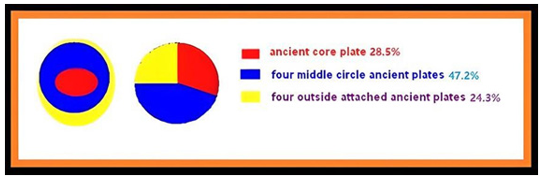
Figure 3: Area Distribution of Core and Circle Structure of the Earth's Unique Supercontinent 66 Million Years Ago
The distribution diagram shows that the unique supercontinent has obvious egg-shaped structure, and the core, middle layer and peripheral layer structure are obvious.
66 million years ago, the area of the earth 's unique supercontinent was about 214 million km2, among which, the area of ancient Jiazhou plate (red) is about 61 million km2, accounting for about 28.5%; the area of the other eight ancient plates is about 153 million km2, accounting for about 71.5%.
Among the eight ancient plates, the middle layer ancient plates (ABCD blue) composed of ancient Asian, ancient North American, ancient South America and ancient Jingzhou plates covered an area of about 101 million km2, which accounted for about 47.2%; the four peripheral layer affiliated ancient plates (MNOP yellow) composed of ancient European, ancient African, ancient Indian and ancient Australian plates covered an area of about 52 million km2, which accounted for about 24.3%.
The Sequence of the Nine Ancient Plates of the Unique Supercontinent
The sequence of the nine ancient plates by area is shown in table 4 (unit of area, million Km2),
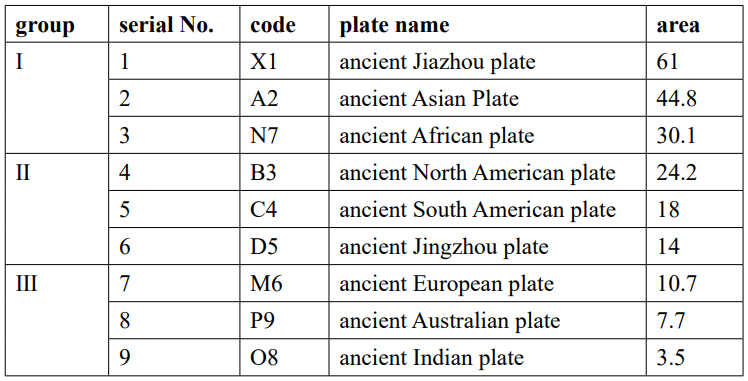
Table 4: Sequence of Nine Ancient Plates (Divided by Three Groups)
It is shown by the following figure 4,
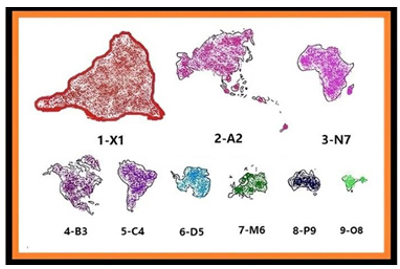
Figure 4: The sequence of the nine Ancient Plates of the Jigsaw Recovery of the Unique Supercontinent 66 Million Years Ago.
The Recovery Outline of the Unique Supercontinent 66 Million Years Ago
Figure 5 below shows the recovery outline of the unique supercontinent 66 million years ago.
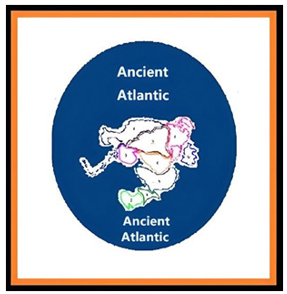
Figure 5: An Imaginary Outline of the Unique Supercontinent Surrounded by the Ancient Atlantic Ocean 66 Million Years Ago.
It is known that the unique supercontinent on Earth's surface was surrounded by the unique ancient Atlantic Ocean 66 million years ago with the drawing.
Comparative Analysis of Present Situation and the Area Distribution of the Earth's Land and Sea 66 Million Years Ago
Assuming that the Earth's surface area did not change significantly during 66 million years, and that the Earth's surface area was still about 510 million km2 66 million years ago, the area of the land and sea 66 million years ago can be obtained as follows, The area of the unique supercontinent is about 214 million km2, accounting for 42%. The area of the unique ancient Atlantic Ocean is about 296 million km2, accounting for 58%. Today's Earth: the land area is about 149 million km2, accounting for 29%. The ocean area is about 361 million km2, accounting for 71%. Comparison area distribution of the land and sea is shown in Figure 6, comparison of the present situation and the distribution of the earth's land and sea 66 million years ago is shown in table 5.\

Figure 6: Land and Sea Area Distribution 66 Million Years Ago Versus Nowadays
|
Time |
analog item (unit of area, 100 million km2) |
||||
|
total area of the earth |
Land area |
Proportion % |
sea area |
Proportion % |
|
|
66 million years ago |
5.1 |
2.14 |
42 |
2.96 |
58 |
|
Current situation |
5.1 |
1.49 |
29 |
3.61 |
71 |
|
increase or decrease |
0 |
-0.66 |
-13 |
+0.66 |
+13 |
Table 5: Comparison of Present Situation and the Distribution of the Earth's Land and Sea 66 Million Years Ago
In 66 million years, the land area decreased by 13 per cent while the sea area increases by exactly 13 per cent.
The Hint Meaning of the Clam Shape Distribution of the Geological Age on the Northwestern Pacific Ocean Floor.
The distribution of the geological age on the Northwestern Pacific Ocean floor is similar to the graphic pattern of the clam shell. I t is shown by the following figure 7.

Figure 7: Clam Shell Distribution of the Geological Age on the Northwestern Pacific Ocean Floor.
It is the symbolization of the black hole in the universe when it is transformed into the next following figure 8 [4].
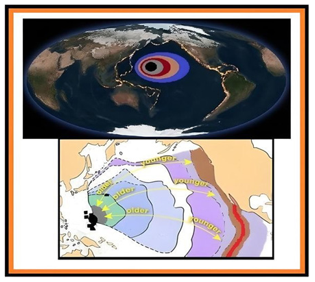
Figure 8: Black Hole Symbolized by the Clam Shell Distribution of the Geological Age on the Northwestern Pacific Ocean Floor.
It is always considered by the astronomers that there is a giant black hole in the center of the spiral galaxy [3]. In other words, the giant black hole is supposed to be the core of the spiral galaxy [6]. Therefore, the clam shape distribution of the geological age on the Northwestern Pacific Ocean floor gives us a hint meaning that it is the core of the evolving combination of the ocean and the ancient plates system. So, it is reasonable for the ancient plate of the Northwestern Pacific Ocean to be corresponding with the sun, the core of the solar system.
Conclusion
66 million years ago, the primary purpose of the breaking up of the earth's unique supercontinent was the birth of the recessive ancient core plate and then evolved into the ancient plate group similar to the core and circle structure of the solar system. The ancient plate group has distinct dominant and recessive characteristics. The dominant part is the ancient plates where human beings set foot and venture, and the recessive part is the ancient core plate which is hidden deep in the ocean floor and unknown but controls the overall situation.
It is only when the recessive ancient plate is recovered from the hidden state in the ocean floor, and take it as the core, then could we finish the task of jigsaw recovery of the unique supercontinent 66 million years ago.
Discussion
1. What is the Core and Circle Structure of the Solar System? It is well known that the core of the solar system is the Sun, the biggest celestial body of the solar system. And its circle structure is obvious with four rocky planets lying in the inner circle and the other four gas planets lying in outer circle.
2. What is the Core and Circle Structure of the Jigsaw Recovery of the Supercontinent 66 Million Years Ago? The jigsaw recovery of the supercontinent mentioned above shows the significant core and circle structure which is similar to that of the solar system. And nowadays the core ancient plate is hidden deep in the ocean floor of the Northwestern Pacific Ocean.
3. What is the Real Meaning by the Clam Shell Distribution of the Geological Age on the Northwestern Pacific Ocean Floor? It is the symbolization of the black hole in the center of the spiral galaxy of the universe generally and implies the core of the ocean- plates system of the Earth [5].
References
- Chiarenza, A. A., Mannion, P. D., Lunt, D. J., Farnsworth, A., Jones, L. A., Kelland, S. J., & Allison, P. A. (2019). Ecological niche modelling does not support climatically-driven dinosaur diversity decline before the Cretaceous/Paleogene mass extinction. Nature communications, 10(1), 1091.
- Condamine, F. L., Guinot, G., Benton, M. J., & Currie, P.J. (2021). Dinosaur biodiversity declined well before the asteroid impact, influenced by ecological and environmental pressures. Nature Communications, 12(1), 3833.
- Yang, H. Y. K., Ruszkowski, M., & Zweibel, E. G. (2022). Fermi and eROSITA bubbles as relics of the past activity of the Galaxy’s central black hole. Nature Astronomy, 6(5), 584- 591.
- Eatough, R. P., Falcke, H., Karuppusamy, R., Lee, K. J.,Champion, D. J., Keane, E. F., ... & Wex, N. (2013). A strong magnetic field around the supermassive black hole at the centre of the Galaxy. Nature, 501(7467), 391-394.
- Gaskell, C. M. (1985). Astronomy: A giant black hole at the centre of a dwarf galaxy. Nature, 314(6013), 672-672.
- Reines, A. E. (2014). Giant black hole in a stripped galaxy.Nature, 513(7518), 322-323.