

World Journal of Tourism Management(WJTM)
ISSN: 3070-4030 | DOI: 10.33140/WJTM


Research Article - (2025) Volume 1, Issue 1
The Inheritance of Chinese Civilization in 5000 Years the Trinity of Eagle, Palace and King
Received Date: Jun 10, 2025 / Accepted Date: Jul 21, 2025 / Published Date: Jul 29, 2025
Copyright: ©Ã?©2025 Guangbao Liu. This is an open-access article distributed under the terms of the Creative Commons Attribution License, which permits unrestricted use, distribution, and reproduction in any medium, provided the original author and source are credited.
Citation: Liu, G. (2025). The Inheritance of Chinese Civilization in 5000 Years the Trinity of Eagle, Palace and King. World J Tourism Mgmt 1(1), 01-17.
Abstract
By comparing the form of Horus Name in ancient Egypt with the symbols of "Bird Stand Altar" in Liangzhu, the three- in-one monarchy marking elements of eagles, palaces and kings, were extracted. Furthermore, the architectural forms of ancient Chinese palaces were compared with them. It is concluded that the architectural styles of Chinese palaces are related to the expression forms of Horus Names in ancient Egypt.
The culture of Bird and Snake is the symbol of ancient civilization, and it has spread all over the world since prehistory. The culture carried by Bird and Snake runs through the origin and development of human civilization, and the cultural phenomenon of worship of Eagle (bird) and Snake has become a global cultural phenomenon.
Introduction
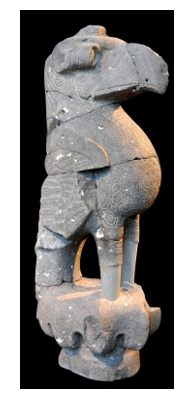
Colossus of Stone bird, unearthed in the palace of Halaf ruins in Syria Pergamon Museum, Berlin, from Wiki
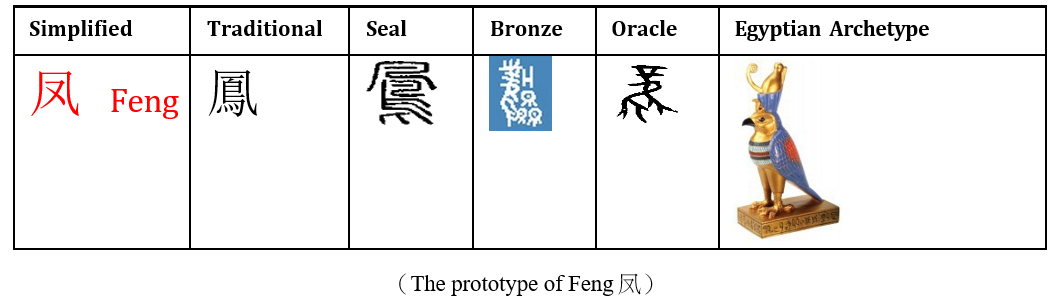
Dragon and Phoenix are two kinds of totem animals of the Chinese nation, and they are also two kinds of magical animals closely related to royal power. But for thousands of years, people have been full of disputes about whether there are animals like dragons and phoenixes or what their prototypes are. So far, there is no clear answer in academia. However, in ancient Egyptian culture, the kingship was represented by falcons. Westerners call the Falcon as Horus in ancient Egyptian Culture.In fact, the Falcon wearing the double crown image of Lower Egypt is the prototype of the Chinese character " Feng"

Horus, the symbol of ancient Egyptian kingship
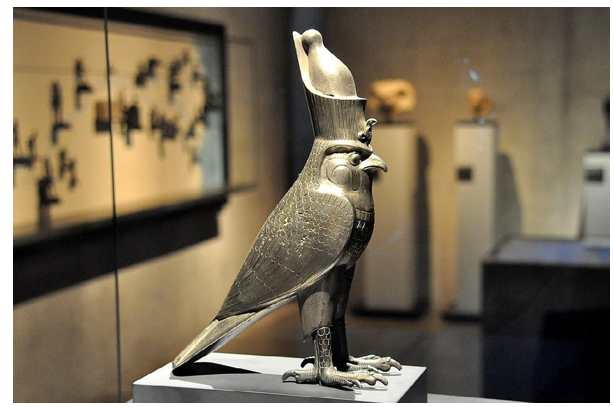
The crowned Horus, the 27th Dynasty of ancient Egypt, ca.500 BC Egyptian Art Museum, Munich, Germany, from Wiki

A statue of Khafra of the Fourth Dynasty in ancient Egypt, Horus hawk guard behind the head, ca 2570 BC;Egyptian Museum in Cairo, photographed by the author on March 17, 2018.
Since 5000 years ago, the culture of Eagle and Snake from Sumer and ancient Egypt has spread all over the world, especially in the Neolithic period in China, a large number of cultural phenomena of bird worship were actually closely related to the culture spread of Sumer and ancient Egyptian [1]. There is a record in Chinese ancient books that "the destiny of Xuan Bird is to come down and born the Shang people".
This is also the connection between kingship and bird. The people in the Eurasian steppe also associate Eagles with kingship. Bird culture also spread to Europe. The pronunciation of "Eagle" in English is similar to that of the Chinese character "Eagle", which should be the result of the global influence of ancient Egyptian pronunciation [2]. As for the fact that later Nazi Germany and the United States took the eagle as their national emblem, that was later.

Pottery Eagle unearthed from Shimao site in Northern Shaanxi of China.
At the beginning of ancient Egyptian civilization, Falcon was just the symbol of the king's power. The king's name of Upper Egypt was placed under Falcon to mark the king. However, the king of Lower Egypt used "the facade of the palace" to mark the king's name.

The façade entrance to the Djoser pyramid ca.2686-2649 B.C, Saqqara Necropolis, photographed by the author on March 10, 2018
With the unification of Upper and Lower Egypt by the Scorpion King of Upper Egypt, the falcon representing the kingship of Upper Egypt and the palace facade representing the kingship of Lower Egypt began to combine. The seal unearthed in Nubia, as well as the names of the kings Falcon, the double Falcon, the Crocodile and the Iry-Hor in the period of the Dynasty 0, all have the symbols of falcon standing above the palace [3]. From the beginning of the king Ka of the Dynasty 0, the king's name was placed in the palace courtyard above the extended front of the palace. This became the standard form of the Horus name of the king of ancient Egypt, which had been handed down for more than 3000 years. For example, this is the original image of the name of the last king of the First Dynasty:

Tomb stone of Raneb, the Decond Dynasty of ancient Egypt, ca. 2880 BC, Metropolitan Museum of art, New York, from wiki
The Horus name is composed of the falcon, the palace facade and the name of the king. The shape of the palace facade is drawn according to the shape of the outer wall of the palace where the King actually lives. So the Horus name is actually the image of the king sitting in the palace with the Falcon above the palace. Finally, the title of ancient Egyptian king evolved into the common name of Pharaoh in the late 18th dynasty, which means the person sitting in the big house, that is, "Majesty". The Chinese character "Zi" should come from the expression of Horus name. The upper point represents the falcon, the middle cover represents the Royal Palace, and the lower " " represents the king's name.
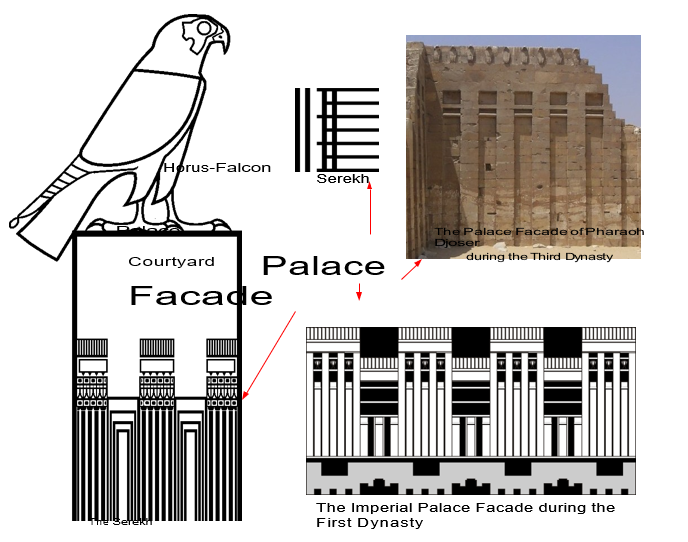
Serekh, the expression form of Horus name in ancient Egypt
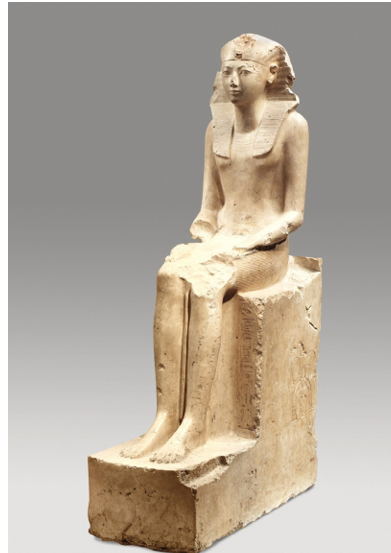
A statue of Hatshepsut of the 18th Dynasty of ancient Egypt, 1479-1458 B.C Metropolitan Museum of art, New York, from wiki
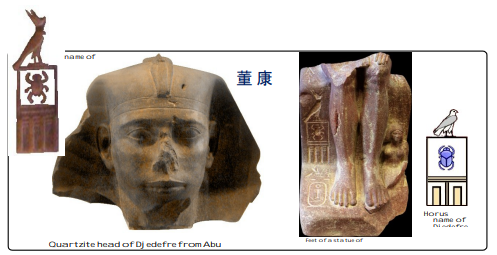
According to the textual research of the book Discovering Xia Dynasty and the theory of the Integration of ancient Egypt and Xia, the Liangzhu Civilization in China was the result of ancient Egyptian civilization spreading to East Asia in the first millennium. A large number of trinity of birds, ‘Palace’ and symbols (ruler's name) in the palace, were found on the Liangzhu jades. Some of the "bird standing altar" symbols on Liangzhu jades can even be directly regarded as the names of ancient Egyptian pharaohs, such as Raneb of the Second Dynasty and Djedefre of the Fourth Dynasty.

A typical image of "bird standing altar" on Liangzhu jades
The figure below shows several jade artifacts from the Liangzhu Civilization, the inscriptions on which highly resembled the scarab, the Horus Name of pharaoh Djedefre in the Fourth Dynasty, which was also the prototype of the Chinese character Kang.
 The lower part of a jade artifact, with a bird standing on an altar, kept the Egyptian style of the Serekh, with the altar representing the palace facade. However, the uppper roof of the palace was not flat, very much like the shape of ‘horse-headed wall’ found in the Huizhou architecture in the souther Anhui province. This kind of architecture is popularly in southern Anhui, Zhejiang, Jiangxi, Hunan, Hubei, and southern Henan districts as the shape of found residential gables [4]. The architectural style can be deemed as the development by the ancient Egyptian people in the region of Yangtze River in China.
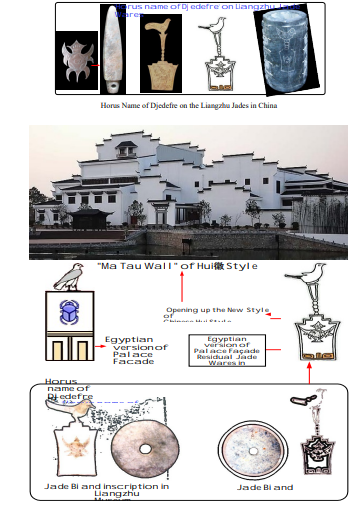
Comparison of the inscription of ‘Bird standing on Altar’ on Liangzhu Jade Wares and the Huizhou architecture style
In addition to the Horus name of Djedefre, the Horus name of pharaoh Raneb of the Second Dynasty, which contained sun and basket like the moon, was also discovered on Liangzhu jade artifacts. This symbol appeared in Dawenkou 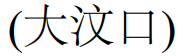
culture as well. The third frequent symbol looked like a silkworm pupa as shown in the figure. Further investigation is required to find out whom it may refer to.
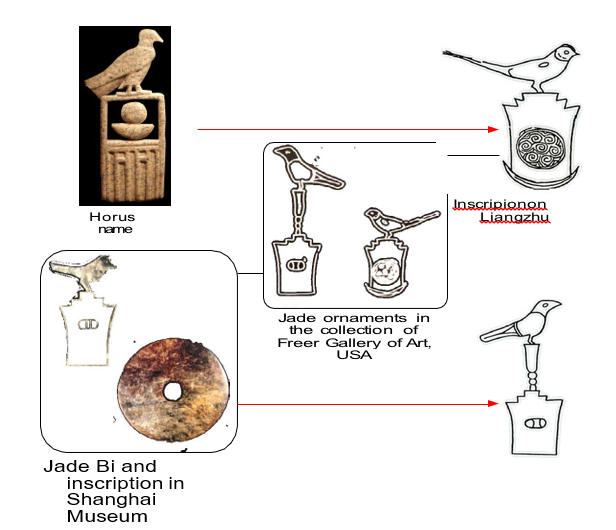
More Horus names of ancient Egyptian kings on Liangzhu jades wares
An interesting question is: has this trinity of three elements, namely the falcon(bird), the palace and the king's name, been passed down in later China? In oracle bone inscriptions, it can be seen that the name of the king of Shang is generally marked with the sign of a bird (according to Tang Jigen).
In December 2014, I visited Luoyang Ancient Tomb Museum (Luoyang Ancient Art Museum), and was surprised to see a big bird standing above the main building! Later, I learned that this was an imitation of the ridge of the building in the Han Dynasty! In Han Dynasty, there was a Rosefinch bird standing above the palace!

Luoyang Ancient Tomb Museum, Photographed by the author on December 14, 2014
Comparison of the inscription of ‘Bird standing on Altar’ on Liangzhu Jade Wares and the Huizhou architecture style
In 2015, the journal ‘Central Plains cultural relics’ published an article, ‘roof decoration on buildings in the Han Dynasty’ (by Han Bing), which said that many buildings in the Han Dynasty were decorated with Phoenix or flame beads in the center of the ridge. In many documents, there are also a lot of records about the decoration of Phoenix Ridge in Han Dynasty, such as the record of the Phoenix Watchtower at the north gate of Jianzhang palace in Chang'an city of Han Dynasty, ‘three auxiliary stories’ quoted by Yan shigu in the annals of Han Dynasty suburban sacrifice said:
‘there was a copper phoenix above the watchtower.’Volume 179 of‘Taipingyulan’quoted ‘Guan Zhong Ji’ said: ‘The round watchtower of the palace of Jianzhang, near the North Road, there was a phoenix on it, so it is called Phoenix Watchtower.’
In the stone (brick) architectural drawings of Han Dynasty, there are often Phoenix perched on the roof ridge. Han Bing believes that this is not a casual depiction of the general animal image, but a true reflection of the architectural style at that time. For example, on the portrait stone of "East Gate of Hangu pass" collected
by the Boston Museum of fine arts, two parallel four story wooden buildings are depicted, which are covered with four roofs and decorated with phoenix flying on the ridge. This is a legend of Phoenix Decoration on the city gate.

Phoenix on the portrait stone of "East Gate of Hangu pass"
On the brick with the image of double watchtower unearthed in Dayi County, Sichuan Province, there is a group of wooden courtyard building with rafters under the eaves of the building. The two towers are connected by a bridge, and there is a phoenix on them.

The brick with the image of double watchtower unearthed in Dayi County, Sichuan
This is a picture of the pavilion of the Han Dynasty stone tomb in Mao village, Xuzhou City, Jiangsu Province. It describes the manor architecture of the Eastern Han Dynasty. There is a hall between the two watchtowers. There is a pair of Phoenix above the hall!

Stone portraits of Mao village
The architectural drawing of the small ancestral hall in Yuanhe three years unearthed in the east of Dongyan village in Xuzhou mountain area shows that the width and thickness of the front ridge are inverted triangles, and a phoenix stands in the middle of the front ridge.

Stone portraits of Dongyan village
Birds are also found on the roofs of some ceramic buildings unearthed in archaeology. For example, the roof decoration of the pottery building unearthed from the Old City Post Office of Xiangcheng County and the roof decoration of the pottery warehouse building unearthed from Baizhuang of Jiaozuo city in Henan Province

Pottery House of Xiangcheng
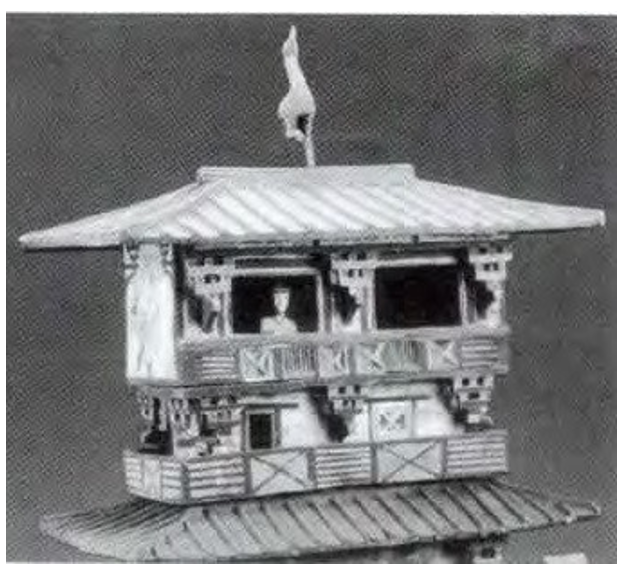
Pottery Storage Building of Baizhuan
In the early stage, the raised part at both ends of the ridge of Chinese palace building was the sharp wing symbolizing the wings of birds. As shown in the figure below, it is still the ridge performance of another building photographed by the author in Luoyang Ancient Tomb Museum.

Luoyang Ancient Tomb Museum, Photographed by the author on December 14, 2014
According to the illustration of the roof style in ancient Chinese architecture, in the northern and Southern Dynasties and later, the Chi tail gradually replaced the image of Rosefinch bird in the Han Dynasty, and became a new style of ridge decoration. Li Daoyuan recorded in Shuijingzhu·hot spring that 'A wide range of buildings, all with Chi tails'. 'Chi' first appeared in Shanhaijing'·Xishanjing, the original text : 'there was a kind of bird with one head and three bodies, its shape was like music bird, its name was called Chi.' It can be seen that there are still some images of birds about Chi in this period. That is to say, although the Chi tail was developed from the tip wing of the Rosefinch in the Han Dynasty, there were still some shadows of birds. The wings at both ends of the ridge of the roof were also known as the 'Chi tail' before the middle of Tang Dynasty, however it was called 'Chi kiss' after the middle of Tang Dynasty. It can be seen that even the name of Chi tail changed after the middle of Tang Dynasty. The 'Chi kiss' is a mythical animal, one of the nine sons of the dragon, in ancient Chinese Mythology. Later, the pattern of the 'Chi kiss'changed. In the middle Tang Dynasty, the head of the animal with its mouth open appeared at the lower part of the 'Chi tail', also known as 'dragon kiss'. Later, the 'Chi tail' gradually transited to the tail of the fish, and the implication changed to that 'Chi kiss' can avoid fire. It can be seen that the decoration at both ends of the ridge changes from bird wings to 'dragon beast'. From this phenomenon, we can understand how cultural heritage sometimes changed.

Chi Tail Chi Kiss

Chi Kiss on both sides of the ridge of Taihe Hall of the Forbidden City
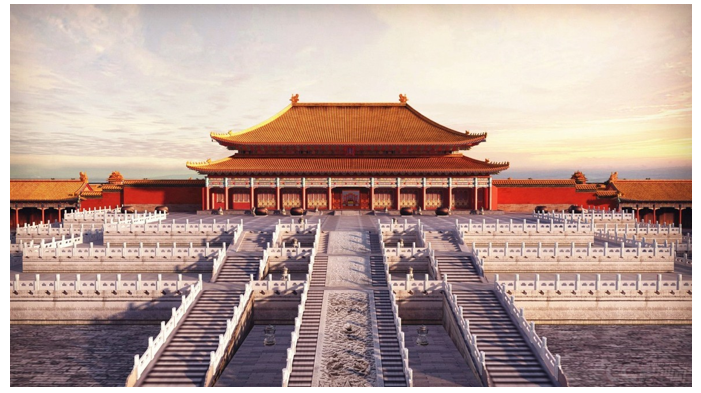
Taihe Hall of f the Forbidden City
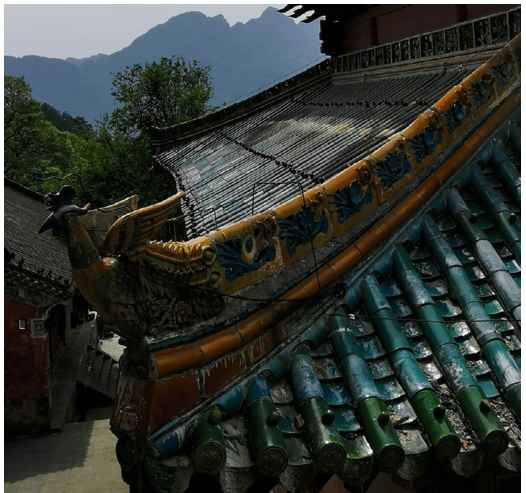
Zixiao Palace in Wudang Mountain, photographed by the auther On May 3, 2019
Although the eagle (or Rosefinch, or Phoenix) on the ridge of the palace was replaced by the ‘Chi kiss’, the author still saw the Phoenix on the vertical ridge of Zixiao Palace in Wudang Mountain!

Golden Top in Wudang Mountain, photographed by the auther On May 6, 2019
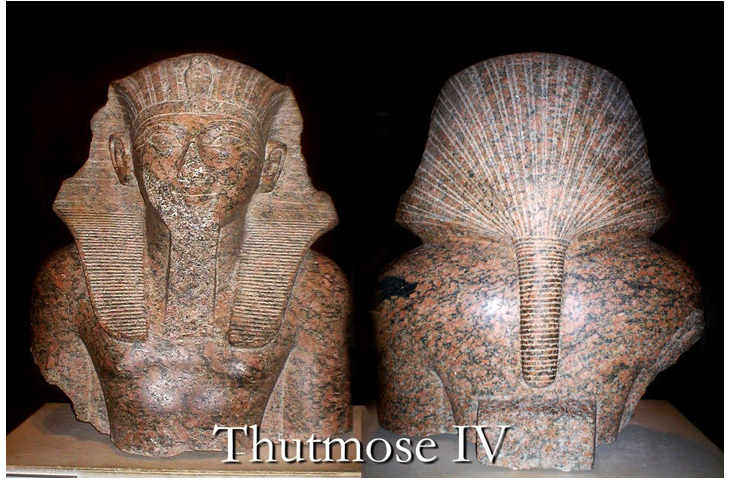
A Statue of Thutmose IV of the Eighteenth Dynasty
So can't we see the shadow of birds in palace buildings like Taihe Hall? When I look at the roof tiles, I suddenly thought that they belong to the same principle as the blue and white stripes on the Nemes turban crown worn by the ancient Egyptian Pharaoh, that is, they all represent the feathers of the eagle wings! The Pharaoh's Nemes crown was designed according to the shape of the eagle, and the cobra, another Egyptian protection god, was coiled on the top of the head. Therefore, the Nemes crown can also be regarded as the combination of the two kinds of protection animals of the Eagle and the Snake.

The golden Nemes Crown unearthed from Tutankhamun Towb tomb
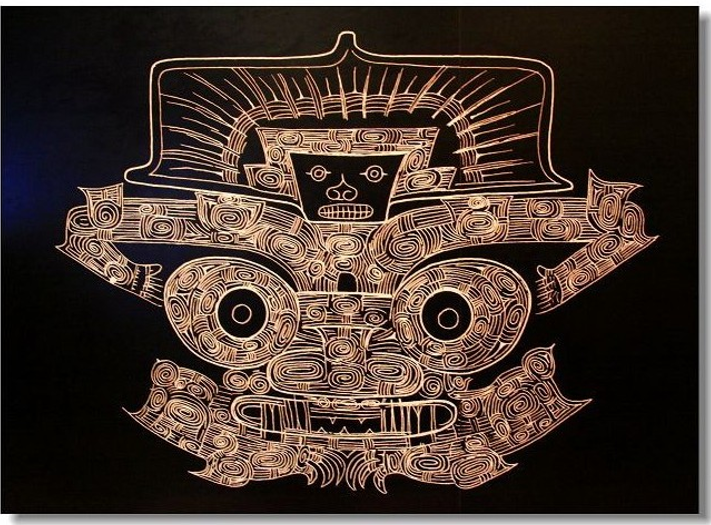
Liangzhu God Emblem
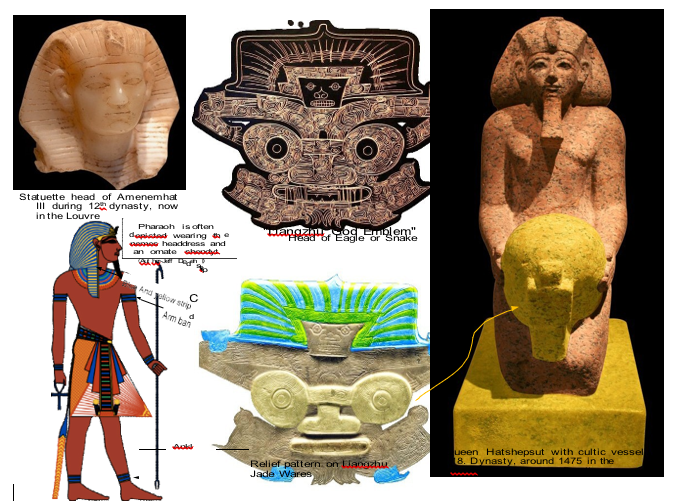
(Liangzhu God Emblem and Pharaoh’s Nemes)
In addition to the Nemes crown, which symbolizes the eagle, according to relevant information, ancient Egyptian also had a feather crown similar to that of native Americans. Similar to the Horus name, this kind of scarf crown symbolizing eagle is also reflected on the emblem of Liangzhu God in China. According to the interpretation of â??Discovering Xia Dynasty', the image of Liangzhu God emblem comes from the image of the ancient Egyptian pharaoh holding a magic instrument to sacrifice to the God. Pharaoh's sacrifice is the "magic weapon" in his hand, which is often changed.

The kneeling statue of Hatshepsut of Eighteenth Dynasty, the artifact in her hands was replaced by two jars. 1479-1458 BC, Metropolitan Museum of art, New York.
Here, we can clearly see that from the trinity of the names of eagles, royal palaces and kings in ancient Egypt, to the 'bird standing altar, in Liangzhu, to the ridge of Rosefinch standing on the buildings of Han Dynasty, to the elements of Taihe Hall in the Forbidden City (Chi kiss, eagle wings, three-layer stepped- roof of Liangzhu altar), Chinese culture is in one continuous line. Although 5000 years of inheritance has evolved, we can still find the track of its evolution and inheritance. The patterns of birds and
snakes can be seen everywhere in Chinese Neolithic and Bronze Age cultural relics, and it was in the later period that the images of dragons and phoenixes were developed.
References
- Liu, G. B. (2018). The Inheritance of Chinese Civilization in 5000 Years: The Trinity of Eagle, Palace and King. Palace and King August 9.
- Witteveen, W. (2018). The crowns of the pharaohs.
- Bing, H. (2015). Roof decoration on buildings in the Han Dynasty. Central Plains cultural relics. Issue 2.
- The illustration of the roof style in ancient Chinese architecture.