

Journal of Democracy Research(JDR)
ISSN: 3070-4006 | DOI: 10.33140/JDR


Research Article - (2026) Volume 2, Issue 1
The Industrial Heritage of Casablanca: Historical Development, Urban Transformations, and Preservation Challenges
Received Date: Dec 11, 2025 / Accepted Date: Jan 07, 2026 / Published Date: Jan 22, 2026
Copyright: ©2026 Najat Fares et al. This is an open-access article distributed under the terms of the Creative Commons Attribution License, which permits unrestricted use, distribution, and reproduction in any medium, provided the original author and source are credited.
Citation: Fares, N., Saidi, J. (2026). The Industrial Heritage of Casablanca: Historical Development, Urban Transformations, and Preservation Challenges. J Demo Res, 2(1), 01-09.
Abstract
Casablanca’s industrial heritage, once the driving force of Morocco’s modernization, has been profoundly transformed by urban expansion and shifting economic priorities. Iconic sites such as the Lafarge Cement Plant in Roches Noires, the Bata Shoe Factory, the Lincoln Hotel (Immeuble Bessonneau), and the Cinema Vox illustrate a broader trend of demolition, abandonment, or partial preservation. While some façades, like those of the Lincoln Hotel, have been granted heritage status, many industrial landmarks have disappeared, erasing material traces of the city’s working’class memory. These trajectories reveal a central tension between rapid urban development and the preservation of cultural identity, underscoring the urgent need for integrated strategies that combine heritage conservation, adaptive reuse, and sustainable urban planning.
Keywords
Industrial Heritage, Casablanca, Factories, Demolition, Neglect, Memory, Preservation, Urban Transformation, Adaptive Reuse, Cultural Identity
Resume
Le patrimoine industriel de Casablanca, jadis moteur de la modernisation du Maroc, a été profondément bouleversé par l’expansion urbaine et l’évolution des priorités économiques. Des sites emblématiques tels que l’usine Lafarge de Roches Noires, l’usine Bata, l’Hôtel Lincoln (immeuble Bessonneau) et le Cinéma Vox illustrent une tendance générale de démolition, d’abandon ou de sauvegarde partielle. Si certaines façades, comme celles de l’Hôtel Lincoln, ont obtenu un statut patrimonial, de nombreux repères industriels ont disparu, effaçant une partie de la mémoire ouvrière de la ville. Ces trajectoires mettent en évidence la tension entre développement urbain rapide et préservation de l’identité culturelle, soulignant l’urgence de stratégies intégrées alliant conservation patrimoniale, réutilisation adaptative et planification urbaine durable.
Introduction
Casablanca, Morocco’s economic capital, has long been recognized as the country’s primary industrial hub. Since the early twentieth century, the city has attracted major industries in textiles, food processing1, cement, and energy, largely due to its strategic coastal position and the development of its port. This industrial growth not only shaped the city’s economy but also left behind a distinctive architectural and cultural legacy that continues to define Casablanca’s urban identity [1].
Yet, this industrial heritage is increasingly endangered. Rapid urban expansion, speculative real estate development, and the relocation of industries to suburban or offshore zones have resulted in the abandonment, transformation, or even demolition of historically significant industrial sites. As a result, a crucial question emerges: how can casablancas industrial heritage preserved amid rapid urban transformation?
To address this question, the article adopts a dual methodology. First, it provides a historical review of Casablanca’s industrial development, highlighting the major phases of growth and decline. Second, it presents a case study of the Old Slaughterhouses of Casablanca, a site that illustrates both the challenges of heritage preservation and the potential for adaptive reuse through cultural revitalization. By combining historical analysis with a concrete example, this approach seeks to shed light on the broader issue of industrial heritage preservation in a rapidly changing urban environment.
Casablancas Industrial Development: A Historical Perspective
The industrial trajectory of Casablanca is inseparable from the city’s transformation into Morocco’s economic capital. Beginning in the early twentieth century, the expansion of the port of Casablanca (1907–1912) provided the necessary infrastructure for large’scale trade and the inflow of foreign investment [2]. This infrastructure laid the foundation for the establishment of agro’industries (such as flour mills, oil processing, and food canning) and later textile production and cement manufacturing, which became strategic pillars of Morocco’s modernization. From the 1920s onward, Casablanca witnessed the growth of specialized industrial neighborhoods. Roches Noires, located near the port, hosted warehouses, energy facilities, and textile workshops.
By mid’century, Aïn Sebaâ and Sidi Bernoussi emerged as major industrial hubs, accommodating heavy industries, chemical plants, and large factories like COSUMAR (sugar), Lesieur (oils), and Lafarge (cement). These zones were directly connected to rail and maritime routes, reinforcing Casablanca’s position as a regional manufacturing powerhouse. The social impact of this industrialization was profound. Thousands of rural migrants were drawn to Casablanca in search of employment, contributing to the city’s explosive demographic growth [3]. The emergence of workers’ housing estates, the rise of a new working’class identity, and the spread of trade unions reshaped the social fabric of the metropolis. However, industrialization also generated challenges2, including overcrowding, the proliferation of informal settlements, and increased social tensions [7].
|
Period |
Key Industrial Developments |
Social and Urban Impact |
|
1910s–1920s |
‘Expansion of the Port of Casablanca (1907–1912). ‘Emergence of agro’industries: flour mills, oil refineries, canning factories. ‘Early textile workshops established near Roches Noires. |
‘ Beginning of rural migration toward the city. ‘ Creation of first workers’ housing estates. ‘ Casablanca positioned as Morocco’s industrial capital. |
|
1930s–1940s |
‘Growth of heavy industries (cement, energy, metallurgy). ‘Establishment of Lafarge cement plant. ‘Expansion of textiles and food industries. |
‘ Strong demographic growth linked to industrial jobs. ‘ Development of Roches Noires as a strategic industrial hub. ‘ Increased urban density around the port. |
|
1950s |
‘Industrial diversification: chemicals, mechanical industries, sugar refining (COSUMAR). ‘Rise of large’scale factories in Aïn Sebaâ. |
‘ Acceleration of rural migration. ‘ Birth of trade unions and workers’ movements. ‘ Expansion of social housing for workers. |
|
1960s |
‘ Growth of Sidi Bernoussi industrial zone. ‘ Expansion of petrochemicals, metallurgy, and textile export industries. ‘ Consolidation of multinational presence (Bata, Lesieur, etc.). |
‘ Rapid urban sprawl, creation of new worker neighborhoods. ‘ Increased pressure on urban infrastructure. ‘ Casablanca as a regional industrial hub for North Africa. |
|
1970s–1980s |
‘ Industrial modernization programs (mechanization, large’scale production). ‘ Relocation of some industries to suburban areas. ‘ Decline of older industrial sites in city center. |
‘ Growth of informal settlements (bidonvilles) near industrial zones. ‘ Social tensions linked to urban inequality. ‘ Beginning of industrial heritage abandonment. |
Table 1: Chronology of Casablanca’s Industrial Development (1910–1980)
|
Period |
Key Developments |
|
1910s–1920s |
Port expansion; establishment of agro’industries (flour mills, oil pressing). |
|
1930s–1940s |
Growth of textiles, cement, and food processing industries; industrial clusters emerge. |
|
1950s |
Development of Roches Noires district; massive rural migration; workers’ housing programs. |
|
1960s |
Heavy industry expansion (chemicals, mechanics); consolidation of Aïn Sebaâ and Sidi Bernoussi. |
|
1970s–1980 |
Industrial diversification; extension of industrial belt towards Mohammedia; rise of labor movements. |
|
Source: Cattedra, 2009 |
|
Table 2: Chronology of Casablanca’s Industrial Development (1910–1980)
According to Cattedra (2009), Casablanca’s industrialization followed a progressive eastward shift from the port toward new industrial districts3, accompanied by massive social change through labor migration and the growth of working’class neighborhoods. By 1980, Casablanca had consolidated its role as Morocco’s leading industrial and economic hub, though at the cost of deepening urban inequalities and rising environmental pressures.
Map 1. Location of Casablanca’s Main Industrial Districts Description (to be represented visually):
• Base map: Casablanca metropolitan area (urban core + coastal line).
• Reference points: Port of Casablanca (central), city center (Medina, Maarif).
• Highlighted industrial districts:
i. Roches Noires – located directly east of the port, close to the city center. Historically linked to textiles, warehouses, and energy facilities.
ii. Aïn Sebaâ – northeast coastal belt, heavily industrialized since the 1950s (sugar, oils, cement, chemicals).
iii. Sidi Bernoussi – further northeast, extension of Aïn Sebaâ, became the main heavy’industry zone in the 1960s–70s.
iv. Hay Mohammadi – inland, southeast of Roches Noires, associated with workers’ neighborhoods and proximity to the Old Slaughterhouses.
v. Maârif / Central districts – smaller industrial and artisanal units integrated into the urban fabric during early growth (1920s–40s).
Suggested Map Layout (if created in GIS/Illustrator):
• Color coding:
i. Roches Noires → Blue
ii. Aïn Sebaâ → Orange
iii. Sidi Bernoussi → Red
iv. Hay Mohammadi → Green
v. Maârif → Yellow
• Icons:
i. Factory icons to represent industrial zones.
ii. Port icon for Casablanca’s harbor.
• Labels: Each district name placed clearly, with arrows pointing to boundaries.
• Legend: “Industrial districts of Casablanca (1910–1980)”
The Case Study: The Old Slaughterhouses of Casablanca
The slaughterhouses of Casablanca represent one of the most emblematic examples of the city’s industrial heritage.
Construction and Early Development
The slaughterhouses were first built in 1912, shortly after the French Protectorate was established in Morocco. In 1922, they were modernized under the urban development plan of Henri Prost, the French architect and urban planner responsible for reshaping Casablanca.
Architectural Style
The design of the complex combined neo’Moorish elements (horseshoe arches, decorative motifs) with Art Deco influences, reflecting the hybrid aesthetics of colonial’era industrial architecture. The slaughterhouses thus embodied both functional modernity and symbolic identity, serving as a bridge between tradition and modernity. Fonctions industrielles Pendant des décennies, le site a joué un rôle crucial dans l'économie de Casablanca, en tant que principal centre de transformation, de stockage et de distribution de la viande. Il desservait non seulement la population en croissance rapide de Casablanca, mais aussi l'ensemble de la région, reflétant le statut de la ville en tant que principal centre industriel et commercial du Maroc.
Decline and Closure
By the late 20th century, rapid urban expansion and the decentralization of industrial functions led to the gradual decline of the slaughterhouses [4]. In 2002, the facility was officially closed, leaving behind a vast and abandoned industrial site.
Cultural Reconversion
In 2009, the site was reborn as the “Fabrique Culturelle des Abattoirs”4, a creative space for artists, performers, and cultural associations. This reconversion illustrates a new trend in heritage preservation: transforming obsolete industrial sites into cultural and social hubs [5]. Today, the former slaughterhouses host art exhibitions, concerts, theater performances, and community workshops, highlighting the adaptive reuse of industrial heritage in a rapidly changing urban environment.
|
Year |
Event |
|
1912 |
Construction of the slaughterhouses under the French Protectorate. |
|
1922 |
Modernization and urban integration by Henri Prost; adoption of neo’Moorish and Art Deco styles. |
|
1950s–1970s |
Peak activity: meat processing, storage, and distribution for Casablanca’s growing population. |
|
1980s–1990s |
Gradual decline due to urban expansion, sanitary concerns, and aging infrastructure. |
|
2002 |
Official closure of the slaughterhouses; site abandoned. |
|
2009 |
Cultural reconversion into “La Fabrique Culturelle des Abattoirs,” hosting artistic and community events. |
|
Casamémoire (2010). Les Abattoirs de Casablanca: Patrimoine en devenir. Casablanca Casamémoire. |
|
Table 3: Timeline of the Old Slaughterhouses of Casablanca (1912–2009)
|
Year |
Event |
|
1912 |
Construction of the Old Slaughterhouses in Hay Mohammadi. |
|
1922 |
Modernization and expansion under Henri Prost’s urban plan. |
|
1930s |
Consolidation as a major neo’Moorish / Art Deco industrial facility. |
|
1980s |
Decline in activity due to changing urban’industrial dynamics. |
|
2002 |
Closure of the slaughterhouses and site abandonment. |
|
2009 |
Cultural reconversion into “La Fabrique Culturelle des Abattoirs.” |
|
Source: Casamémoire, 2010 |
|
Table 4: Timeline of the Old Slaughterhouses of Casablanca (1912–2009)
According to Casamémoire (2010), the Old Slaughterhouses symbolize Casablanca’s industrial modernity of the early 20th century, with their hybrid architecture (neo’Moorish and Art Deco) and central role in urban food supply. Their closure in 2002 reflected the shift of industry and logistics outside the city core, while their reconversion in 2009 into a cultural hub marked an important adaptive reuse model for Moroccan industrial heritage [16].
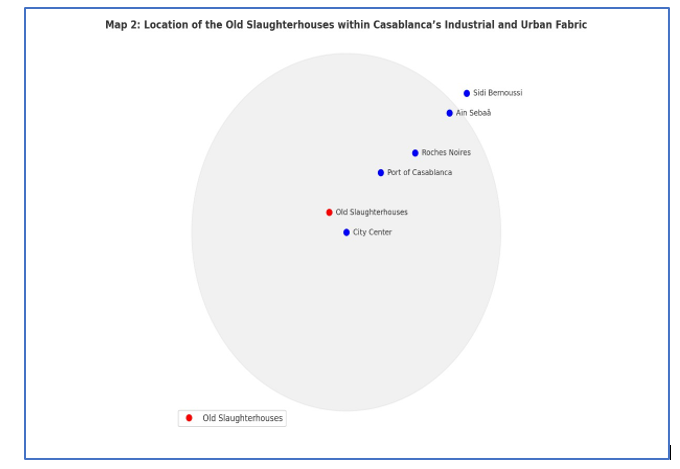
Figure 1: Spatial Location of the Old Slaughterhouses within Casablanca’s Industrial and Urban Fabric
The map highlights the strategic location of Casablanca’s Old Slaughterhouses (1912–2002) within the city’s industrial and urban system:
1. Central positioning: Located between the city center and the industrial’port zones (Roches Noires, Port, Ain Sebaâ, Sidi Bernoussi), the slaughterhouses served as a logistical hub for meat supply to the growing metropolis.
2. Urban’industrial interface: Their proximity to the port and main industrial zones illustrates the integration of food industries within the broader colonial industrial planning of Casablanca.
3. Urban expansion and obsolescence: As the city grew, the slaughterhouses became surrounded by dense neighborhoods, making their industrial function increasingly incompatible with residential and urban uses.
4. Heritage significance: The map underscores how the site is now caught between industrial memory and urban regeneration, representing a symbolic anchor of Casablanca’s industrial past within its modern metropolitan fabric.
Challenges in Preserving Industrial Heritage
The preservation of Casablanca’s industrial heritage faces multiple obstacles, often linked to rapid urban transformation and speculative development [6]. One major challenge is the demolition of emblematic industrial landmarks, 5such as the Lafarge cement plant and Bata shoe factories, which once stood as symbols of Morocco’s early industrial modernity. Their disappearance illustrates the tension between economic growth and cultural memory [7].
Another pressing issue is real estate speculation, which prioritizes land profitability over historical continuity. Industrial sites are frequently replaced by residential or commercial complexes, erasing not only physical structures but also the social and cultural practices associated with them.
Moreover, Casablanca suffers from a lack of robust legal frameworks for industrial heritage protection. Unlike monuments of architectural or religious value, industrial buildings are rarely listed or safeguarded under heritage laws. This institutional gap leaves many sites vulnerable to neglect, abandonment, or redevelopment.
Finally, the erosion of collective memory presents an intangible challenge. As generations of workers retire or pass away, their lived experiences and knowledge risk being forgotten. Without active documentation and community involvement, the human dimension of industrial heritage may fade, leaving behind only fragmented traces of the past [8].
|
Site / Industry |
Approximate Year of Change |
Type of Change |
New Function / Current Use |
|
Lafarge Cement Plant (Roches Noires) |
1987 |
Closure |
Consolidated industrial activity moved elsewhere; original site deindustrialized (encyclopedia.homes) |
|
Bata Shoe Factory |
Mid–late 20th century |
Industrial decline / transformation |
No longer operational; site repurposed/ abandoned (exact new function unspecified) (world.tomasbata.org) |
|
Immeuble Lincoln (Hotel Lincoln) |
2000 |
Partial demolition / heritage designation |
Façade classified as heritage, building abandoned/ruinous |
|
Cinema Vox |
Mid’1970s |
Demolition |
Site cleared; replaced by urban redevelopment |
|
Naciri, M. (2009). Casablanca: Mythes et figures d’une aventure urbaine. Casablanca: Éditions La Croisée des Chemins. |
|||
Table 5: Major Industrial Sites in Casablanca — Demolition or Transformation (20th Century)
Notes :
• Lafarge Cement Plant (Roches Noires): Closed in 1987 after decades of operation. Its closure reflects the broader trend of relocating heavy industry away from the urban core.
• Bata Shoe Factory: Operated throughout the mid’20th century; declined later on. The factory reportedly ceased operations, with the site either reused or neglected.
• Hotel Lincoln (Immeuble Bessonneau): After structural failures, part of the building was demolished. However,6 its façades were later protected as heritage—though the rest was left to deteriorate.
• Cinema Vox: A cultural icon from the colonial era, demolished in the mid’1970s. Its footprint has since been absorbed by new urban changes
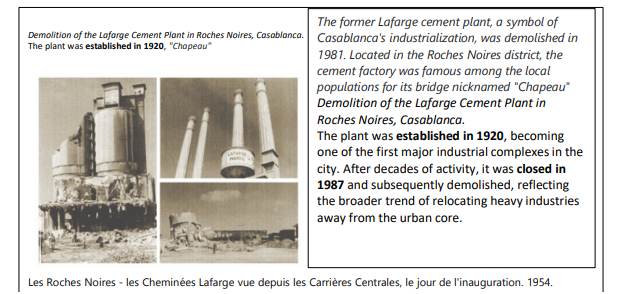
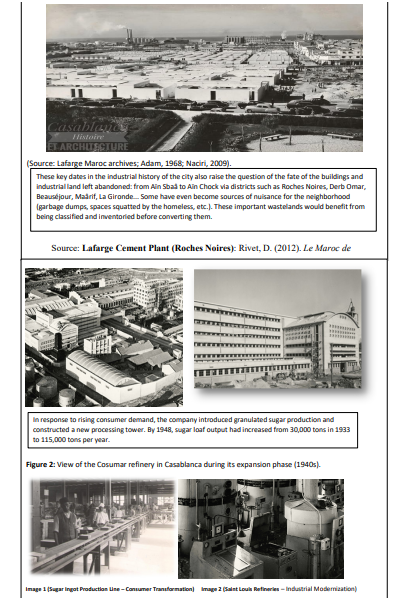
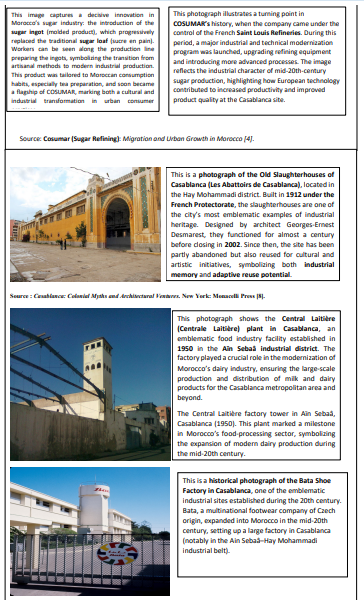

With Morocco’s independence, Casablanca inherited a network of companies that were still in operation, employing nearly 60,000 workers. However, from the 1980s onwards, 7many industries began to migrate toward the suburbs, leaving behind vast abandoned lands and empty buildings [9]. Some of these sites were absorbed into the city’s urban expansion, while others were left vulnerable to real estate speculation [10]. Among the most emblematic symbols of Casablanca’s industrialization are the Lafarge cement factory in Roches Noires, the Bata shoe factory on Boulevard Ibn Tachfin, the Central Laitière dairy plant in Aïn Sebaâ, the Unified Printing Press, and the monumental Old Slaughterhouses of Casablanca. These sites, captured in the archival photographs of demolished silos, factory towers, and abandoned warehouses, stand today as silent witnesses of the city’s industrial memory.
While many of these brownfields now form the basis for urban regeneration projects, experts stress the urgent need to establish a dedicated body to inventory this industrial heritage [11,12]. Only through such systematic documentation can Casablanca develop coherent strategies for rehabilitation and adaptive reuse. Initiatives such as transforming the Old Slaughterhouses into a cultural hub demonstrate the potential of combining heritage preservation with cultural innovation, sustainable housing, and new manufacturing activities [13,14]. In this sense, safeguarding Casablanca’s industrial heritage is not only about protecting memory, but also about shaping the future of the urban fabric.
General Summary
Casablanca’s industrial heritage represents a central chapter in Morocco’s economic and urban history [15-17]. Beginning with the expansion of the port in the early 20th century, the city rapidly evolved into the nation’s primary industrial hub. Districts such as Roches Noires, Aïn Sebaâ, and Sidi Bernoussi became the engines of industrialization, hosting cement plants, textile workshops, oil refineries, sugar factories, and food’processing industries [18,19]. These activities attracted tens of thousands of rural migrants, reshaping Casablanca’s demographic and social fabric while fostering the rise of trade unions and working’class neighborhoods.
By the 1950s and 1960s, heavy industries and multinational companies consolidated Casablanca’s role as a manufacturing powerhouse in North Africa. However, this growth also generated challenges, including urban sprawl, informal settlements, environmental degradation, and the gradual neglect of older industrial sites in the city center [20]. The decline of emblematic sites—such as the Lafarge cement factory, the Bata shoe factory, and the old slaughterhouses—highlights the tension between urban expansion and heritage preservation [21].
Today, Casablanca’s abandoned factories and warehouses are increasingly recognized as valuable elements of industrial memory8 Scholars and urban planners argue that safeguarding this heritage requires systematic inventorying, expert oversight, and adaptive reuse strategies. Transforming wastelands into cultural, residential, or economic projects—such as the rehabilitation of the slaughterhouses into a cultural hub—offers an opportunity to reconcile the city’s industrial past with its contemporary urban identity [22]. Preserving this heritage is thus not only about conserving buildings but also about protecting the collective memory and socio’economic trajectory of Morocco’s largest metropolis.
References
- Barthel, P.’A. (2008). Casablanca: Des projets de la grandeur aux fabriques du territoire. Paris: Parenthèses.
- Bata, T. J. (2016). Remembered. Zlín: BaÅ¥a Foundation.
- Bennani’Chraïbi, M. (1994). Soumis et rebelles: Les jeunes au Maroc. Paris: CNRS Éditions.
- Boujrouf, S., & Naciri, M. (2005). Migration and urban growth in Morocco: The case of Casablanca. Mediterranean Journal of Social Sciences, 6(3), 211–229.
- Boussaa, D. (2020). Industrial heritage and urban regeneration: The case of Casablanca. Journal of Cultural Heritage Management and Sustainable Development, 10(3), 245–262.
- Boussaa, D. (2023). Rethinking industrial heritage in North Africa: Urban memory and sustainability. Sustainability, 15(8), 6623.
- Cattedra, R. (2009). Casablanca: Mythes et figures d’uneaventure urbaine. Paris: Autrement.
- Cohen, W. B. (2001). Urban growth and colonial planning in Casablanca. Urban History Review, 29(2), 34–52.
- El Mansour, M. (1996). Urbanization in Morocco: The case of Casablanca. The Journal of North African Studies, 1(2), 245–259.
- El Oualidi, L., & El Amrani, S. (2020). Heritage’led regeneration in Casablanca: The challenge of preserving industrial identity. Journal of North African Studies, 25(6), 999–1017.
- Ennaji, M., & Sadiqi, F. (2014). Multiculturalism and democracy in North Africa. Aftermath of the Arab Spring. London & New York: Routledge, 10, 9781315817439.
- Gatti, A. (2004). Chausser les hommes qui vont pieds nus: Bata-Hellocourt, 1931-2001: enquête sur la mémoire industrielle et sociale. Serpenoise.
- Lehár, B. (1960). DÄ?jiny BaÅ¥ova koncernu [History of the BaÅ¥a Concern]. Prague: Nakladatelství Ä?eskoslovenské akademie vÄ?d.
- Minca, C., & Rowan, R. (2016). The industrial ruins of modernity: Heritage, memory, and the urban landscape. Urban Studies, 53(6), 1255–1271.
- Moravský zemský archiv v BrnÄ? – Státní okresní archiv Zlín.(n.d.). Archival records on BaÅ¥a industrial expansion. Czech Republic.
- Navez’Bouchanine, F. (2018). Urban transformations and social practices in Moroccan metropolises. Habitat International, 75, 23–33
- Pospíšil, J. (2012). Rub a líc baÅ¥ovských sporů. Kniha Zlín.
- Rivet, D. (2012). Le Maroc de Lyautey à Mohammed V: Le double visage du Protectorat. Paris: Denoël
- Schrijver, L. (2004). Modern architecture and the Mediterranean: Vernacular dialogues and contestedidentities. London: Routledge.
- Trigg, D. (2022). The memory of ruins: Industrial heritage and postcolonial cities. Journal of Urban Cultural Studies, 9(1), 57–74
- Vermeulen, F., & Boussaa, D. (2019). Post’industrial urban spaces and the challenge of preservation in North Africa. Sustainability, 11(9), 2578.
- Ammar, A., & Fassi, D. (2021). Industrial landscapes and identity in Moroccan cities: Between heritage and redevelopment. Urban Planning International, 36(2), 84–99.