

Archives of Epidemiology & Public Health Research(AEPHR)
ISSN: 2833-4353 | DOI: 10.33140/AEPHR
Impact Factor: 1.98

Perspective Article - (2025) Volume 4, Issue 2
The Forgotten Miracle: God's Revelation for Lifestyle Transformation Amidst the COVID-19 Pandemic
2Indonesian College of Lifestyle Medicine, Indonesia
3Department of Cardiology, Faculty of Medicine, Prima University, Medan, Indonesia
Received Date: Jun 01, 2025 / Accepted Date: Jun 30, 2025 / Published Date: Jul 03, 2025
Copyright: ©Â©2025 Dasaad Mulijono. This is an open-access article distributed under the terms of the Creative Commons Attribution License, which permits unrestricted use, distribution, and reproduction in any medium, provided the original author and source are credited.
Citation: Mulijono, D. (2025). The Forgotten Miracle: God's Revelation for Lifestyle Transformation Amidst the COVID-19 Pandemic. Arch Epidemiol Pub Health Res, 4(2), 01-04.
Abstract
During the early phase of the COVID-19 pandemic, a profound spiritual insight catalysed a transformative public health intervention centred on a whole-food, plant-based diet (WFPBD). Rooted in ancient biblical teachings—particularly the dietary example found in the Book of Daniel—this approach was implemented at Bethsaida Hospital in Indonesia under the leadership of Prof. Dasaad Mulijono. Over 3,500 high-risk patients, primarily elderly with multiple comorbidities such as diabetes, cardiovascular disease, and obesity, were placed on a strict WFPBD regimen. The outcomes were astonishing: zero hospitalizations and zero mortality, with all patients experiencing complete recovery. These remarkable results preceded scientific validation, which was not achieved until 2022 through peer-reviewed studies demonstrating the protective role of WFPBD against severe COVID-19 outcomes. Yet, despite the evidence, public behaviour post- pandemic has largely regressed to unhealthy, unsustainable dietary patterns. This article examines the clinical, theological, and public health implications of this often-overlooked miracle, advocating for a lasting transformation grounded in both divine revelation and scientific validation.
Keywords
COVID-19, Whole-Food Plant-Based Diet, Biblical Diet, Lifestyle Medicine, Daniel Fast, Bethsaida Hospital, Prof. Dasaad Mulijono, Preventive Health, Faith-Based Healing, Pandemic Resilience
Introduction
The COVID-19 pandemic shattered global illusions of control and exposed the fragility of modern healthcare systems. While science raced to develop vaccines and therapies, it was clear early on that those individuals with chronic lifestyle-related conditions—diabetes, hypertension, obesity, and heart disease— were at the highest risk of severe outcomes and death [1-4]. Amid this backdrop of fear and uncertainty, one truth emerged with clarity and conviction: the answers to some of our most significant modern health challenges had already been given—long ago.
Not through the latest technology, but through the timeless wisdom of scripture. This article chronicles an extraordinary intervention undertaken at Bethsaida Hospital during the pandemic. A biblically inspired WFPBD saved thousands of lives. It is a testimony of healing and a call to realign modern medicine with spiritual truth and lifestyle integrity.
Personal Testimony and Clinical Implementation
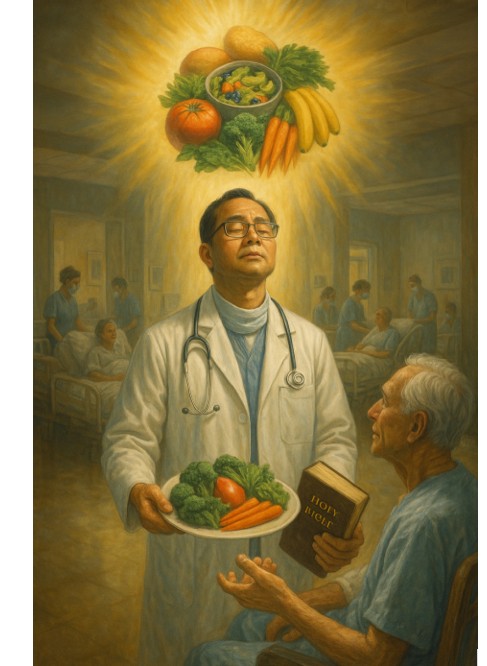
In March 2020, when hospitals were overwhelmed and the medical community grasped for guidance, I turned not to the latest protocols, but to prayer. Amid this spiritual seeking, a powerful conviction settled in: the story of Daniel, who rejected the king’s rich diet and thrived on vegetables and water, was not just a tale of faith, but a divine blueprint for healing.
Daniel 1:12-15 recounts how Daniel and his friends were healthier and more vigorous than their peers who ate from the royal table after 10 days on a simple plant-based regimen [5]. The spiritual message was unmistakable—and scientifically intriguing.
Taking this revelation seriously, I instituted a comprehensive WFPBD program for over 3,500 high-risk patients. These patients, many over the age of 60 and with multiple comorbidities, were among those most vulnerable to COVID-19.
Defying conventional expectations, the results were miraculous:
-
- Zero mortality.
- Zero hospital admissions.
- 100% recovery rate, with many reporting enhanced energy, stabilized blood pressure, improved blood sugar, weight loss, and resolved chronic symptoms.
Even more astonishing, many of these patients chose to remain on the diet after recovery, experiencing continued improvement in their overall health and a dramatic reduction in medication dependence.
At the time, this intervention was met with scepticism. It went against the grain of mainstream pandemic protocols, especially during early vaccine uncertainty and fears surrounding alternative approaches. But for those who experienced it, this was no alternative—it was truth made manifest.
Biblical and Theological Foundations
This dietary prescription is not new. It is the first given by God to humankind: Genesis 1:29 [6] — “I have given you every plant yielding seed... They shall be yours for food.”
This Edenic diet is God's ideal—pure, untainted by violence or disease, and perfectly aligned with the human body's design. Daniel 1:12–15 [5] offers an applied case study. Daniel and his companions, committed to faithfulness, refused the king’s rich foods (likely animal-based and alcohol-laden). Instead, they requested only vegetables and water. The outcome? They looked better, felt stronger, and outperformed their peers within 10 days.
Isaiah 65:25 [7] prophetically envisions a future of peace and restoration, symbolized by plant-based harmony even among predators: “The lion shall eat straw like the ox.” The message? A return to the Creator’s plan brings healing not only to individuals but to creation itself. These verses are more than poetic. When put into practice during a global crisis, they saved lives.
Scientific Corroboration
Although initially countercultural, the intervention was vindicated when scientific publications, starting in mid-2021, confirmed that WFPBD was significantly associated with a reduced severity of COVID-19 infections [8-19]. Multiple studies, including those published in reputable journals, have documented:
-
- Enhanced immune system modulation
- Reduction in inflammatory cytokines
- Improved metabolic health markers
- Lower hospitalization and mortality rates among plant-based individuals
What scripture revealed thousands of years ago, science is only beginning to understand.
Discussion: Why Was This Miracle Forgotten?
Despite these compelling outcomes, the world quickly returned to its pre-pandemic dietary habits. Ultra-processed foods, animal- based diets, and sedentary lifestyles surged again, especially as lockdowns lifted. Why?
The reasons are complex [20-26]:
-
- Convenience culture outweighs long-term health.
- Food industry interests push back against plant-based initiatives.
- Spiritual messages are often dismissed in secular health discourse.
- Lack of education about lifestyle medicine limits patient understanding.
- Lack of support from the medical community
Yet the real tragedy is this: A proven intervention that saved thousands was ignored because it required discipline, not a prescription. This forgotten miracle is not just a missed opportunity but a warning.
Conclusion: A Call to Remember and Transform
The COVID-19 pandemic was both a judgment and a mercy—a disruption that exposed the disease within our lifestyles and gave us a chance to repent, return, and rebuild. The success of the WFPBD program at Bethsaida Hospital stands as a divine signpost: God’s original plan still works. His healing is available—not only through hospitals, but through humble obedience to His design.
This is not just an appeal to adopt a plant-based diet. It is a call to remember what was revealed during the valley of death—a forgotten miracle that calls for permanent change.If embraced widely, this approach could:
-
- â?»Reduce the global burden of chronic disease
- â?»Prepare populations for future pandemics
- â?»Reconcile faith and medicine in a holistic model of healing
The path is ancient, but the time is now. Let us remember the miracle and walk in it.
References
- Ganazaâ?Domingues, K. L. T., Ramosâ?Milaré, Á. C. F. H., Leraâ? Nonose, D. S. S. L., Brustolin, A. Á., de Oliveira, L. F., Rosa,vJ. S., ... & Teixeira, J. J. V. (2025). Effect of Comorbidities on the Mortality of Patients With COVIDâ?19: A Systematic Review of Reviews and Metaâ?Analyses. Reviews in Medical Virology, 35(2), e70024.
- Djaharuddin, I., Munawwarah, S., Nurulita, A., Ilyas, M., Tabri, N. A., & Lihawa, N. (2021). Comorbidities and mortality in COVID-19 patients. Gaceta sanitaria, 35, S530-S532.
- Péterfi, A., Mészáros, Á., Szarvas, Z., Pénzes, M., Fekete, M., Fehér, Á., ... & Fazekas-Pongor, V. (2022). Comorbidities and increased mortality of COVID-19 among the elderly: A systematic review. Physiology international.
- Daef, E., Mohamed-Hussein, A., Mostafa, E. F., Hassany,vS. M., Galal, H., Hassan, S. A., ... & k Hashem, M. (2020). Impact of comorbidities on COVID-19 outcome. medRxiv.
- Daniel 1:12–15 (Holy Bible, ESV)
- Genesis 1:29 (Holy Bible, ESV)
- Isaiah 65:25 (Holy Bible, ESV)
- Kim, H., Rebholz, C. M., Hegde, S., LaFiura, C., Raghavan, M., Lloyd, J. F., ... & Seidelmann, S. B. (2021). Plant-based diets, pescatarian diets and COVID-19 severity: a population- based case–control study in six countries. BMJ nutrition, prevention & health, 4(1), 257.
- Kahleova, H., & Barnard, N. D. (2023). The role of nutrition in COVID-19: taking a lesson from the 1918 H1N1 pandemic. American journal of lifestyle medicine, 17(1), 161- 163.
- Soltanieh, S., Salavatizadeh, M., Ghazanfari, T., Jahromi, S. R., Yari, Z., Mansournia, M. A., ... & Hekmatdoost, A. (2023). Plant-based diet and COVID-19 severity: results from a cross- sectional study. BMJ Nutrition, Prevention & Health, 6(2), 182.
- Papadaki, A., Mc Coy, E., Anastasilakis, D. A., Peradze, N., & Mantzoros, C. S. (2024). The role of plant-based dietary patterns in reducing COVID-19 risk and/or severity in adults: a systematic review and meta-analysis of observational studies. Clinical Nutrition.
- Acosta-Navarro, J. C., Dias, L. F., de Gouveia, L. A. G., Ferreira, E. P., de Oliveira, M. V. P. F., Marin, F. A., ... & Soares,vP. R. (2024). Vegetarian and plant-based diets associated with lower incidence of COVID-19. BMJ Nutrition, Prevention & Health, 7(1), 4.
- Sharma, S., Di Castelnuovo, A., Cerletti, C., Donati, M. B., de Gaetano, G., Iacoviello, L., & Bonaccio, M. (2023). Diet quality and risk of SARS-CoV-2 infection or COVID-19: a systematic review of observational studies. Advances in Nutrition, 14(6), 1596-1616.
- Kahleova, H., & Barnard, N. D. (2022). Can a plant-based diet help mitigate Covid-19?. European journal of clinical nutrition, 76(7), 911-912.
- Rust, P., & Ekmekcioglu, C. (2023). The role of diet andvspecific nutrients during the COVID-19 pandemic: what havevwe learned over the last three years?. International Journal of Environmental Research and Public Health, 20(7), 5400.
- Park, E., & Kim, S. B. (2022). Veganism during the COVID-19 pandemic: Vegans' and nonvegans' perspectives. Appetite, 175, 106082.
- Hou, Y. C., Su, W. L., & Chao, Y. C. (2022). COVID-19villness severity in the elderly in relation to vegetarian and non-vegetarian diets: a single-center experience. Frontiers in Nutrition, 9, 837458.
- Kwiatkowska, I., Olszak, J., Formanowicz, P., & Formanowicz,vD. (2023). Dietary habits and lifestyle, including cardiovascular risk among vegetarians and omnivores during the COVID-19 pandemic in the Polish population. Nutrients, 15(2), 442.
- Lange, K. W., & Nakamura, Y. (2020). Lifestyle factors in the prevention of COVID-19. Global health journal, 4(4), 146- 152.
- Rickerby, A., & Green, R. (2024). Barriers to adopting a plant-based diet in high-income countries: A systematic review. Nutrients, 16(6), 823.
- Alcorta, A., Porta, A., Tárrega, A., Alvarez, M. D., & Vaquero,vM. P. (2021). Foods for plant-based diets: Challenges and innovations. Foods, 10(2), 293.
- Bryant, C. J., Prosser, A. M., & Barnett, J. (2022). Going veggie: Identifying and overcoming the social and psychological barriers to veganism. Appetite, 169, 105812.
- Storz, M. A. (2018). Is there a lack of support for whole-food, plant-based diets in the medical community?. The permanente journal, 23, 18-068.
- Kassam, S., & Smith, L. J. (2025). Why is the medical profession reluctant to talk about diet change?. Future Healthcare Journal, 12(1), 100231.
- Fehér, A., Gazdecki, M., Véha, M., Szakály, M., & Szakály, Z. (2020). A Comprehensive Review of the Benefits of and the Barriers to the Switch to a Plant-Based Diet. Sustainability, 12(10).
- Lehmann, J., Trübner, M., Patzina, A., Jeitler, M., Hoffmann, R., & Kessler, C. S. (2025). The willingness to transition to a more plant-based diet among omnivores: Determinants and socioeconomic differences. Appetite, 206, 107765.Lehmann J, Trübner M, Patzina A, Jeitler M, Hoffmann R, Kessler CS. The willingness to transition to a more plant-based diet among omnivores: Determinants and socioeconomic differences. Appetite. 2025 Feb 1;206:107765. doi: 10.1016/j. appet.2024.107765. Epub 2024 Nov 12. PMID: 39536905.