

Journal of Electrical Electronics Engineering(JEEE)
ISSN: 2834-4928 | DOI: 10.33140/JEEE
Impact Factor: 1.2


Research Article - (2025) Volume 4, Issue 5
The Evolution of the Universe from the Big Bang to the Big Bounce
Received Date: Aug 29, 2025 / Accepted Date: Sep 30, 2025 / Published Date: Oct 10, 2025
Copyright: ©Â©2025 Yvan-Claude Raverdy. This is an open-access article distributed under the terms of the Creative Commons Attribution License, which permits unrestricted use, distribution, and reproduction in any medium, provided the original author and source are credited.
Citation: Raverdy, Y. C. (2025). The Evolution of the Universe from the Big Bang to the Big Bounce. J Electrical Electron Eng, 4(5), 01-03.
Abstract
The hypothesis of a Superfluid Space-Time (granular quantum) is consistent with knowledge acquired in Cosmology and, moreover, conform to the Standard Model. We show, here, that the relationships arising from this hypothesis can also allow to go further in predicting the numbered evolution of the Universe. They lead to the accreditation of a cyclical evolution incorporating a rebound (Big Bounce), identical to the Big Bang, through an explosive phase transition.
Introduction
The past and future of our universe have been a major concern of cosmologists since it was recognized that it is expanding [1]. The Standard Model assumes that the future of the universe is either eternal expansion or limited expansion and contraction, depending on the energy density around a critical value (General Relativity). The theoretical approach of a Super-Fluid Space-Time allows to consider an answer to this question and provide numerical elements for the characteristics of the universe at different stages of its evolution [2,3].
The Cycle of the Universe
In a previous publication we outlined the reasons why we consider the "Big Bang" as a rebound due to an explosive phase change in the universe [4]. According to the standard model in the absence of inflation (*), this event is the beginning of an expansive period whose temperature (very high at the beginning) will decrease as the first building blocks of matter (gluons, quarks, protons, electrons, etc.) are created in a plasma expanding at the speed of light. This plasma is initially composed of photons whose energy decreases with temperature; in accordance with Wien's law, they can be likened to gluons in the very first moments. This first phase is called “opaque plasma.
" Some "380,000 years" after the explosion, according to analyses of the cosmic microwave background, the Standard Model indicates the creation of a second expansive period, called "transparent," after the proton electron combination to form a hydrogen atom, which releases photons whose energy no longer allows them to ionize these atoms. We will analyze the evolution of the characteristics of this second period, during which black holes, gas clouds, stars, and galaxies were created; this period is the one we live in today. This second period will be followed by a third, which we call the "compression phase"; during this phase, most of the energy is transformed into black holes, which will rapidly consume the remaining energy from the fundamental level (dark energy), i.e., space (**), up to a critical value of the energy density, which will produce a new big bang.
(*) The inflation hypothesis disappears if the initial nucleus, perfectly homogeneous, has a macroscopic dimension (…). (**) Photons generate physical space by creating the QFs that constitute the fundamental level.
Basic Elements for Describing the Evolution
This concerns the knowledge acquired by the Standard Model of cosmology and the results we have obtained by considering a corpuscular Universe; a quantum fluid presenting different evolutionary phases [2]. The Standard Model, initiated by Georges Lemaitre and Alexandre Friedman, has been confirmed and greatly refined by the WMAP and PLANK missions for the analysis of the cosmic microwave background (see Wiki page. This analysis provides precise values for the expansion speed (Hubble constant) and the composition of energy in its different forms, with all the knowledge gaps we know about their nature [1]. Therefore, we have tried to give concrete meaning to these forms of energy based on the different possible phases of the Universe fluid according to three types of engagement of fundamental corpuscles (QF):
• The fundamental level (Eo) of the fluid, consisting of a network of perfectly identical dipole vibrators (or waves), which are all extremely low energy quantum’s (QFs) belonging to the same wave function. The average distance between two QFs (l) defines the fundamental wave number ko (= pi/l), the whole constituting what is called "dark energy."
• The "Dark matter," which we have equated with gravitational energy, constitutes a nonstructured matter of high entropy where the QFs are in a "Brownian" state. It is traversed by gravitons, which are waves of negative energy corresponding to a progression of QF deficits. This phase ensures the stability of ordinary matter.
• Finally, ordinary (or baryonic) matter consists of particles that can be likened to vortices in the quantum fluid. It consists of QFs in perfectly synchronous rotational motion, governed by the fundamental wave number ko.
These three phases are in quasi-equilibrium, through reciprocal interactions, in the same location. We consider that the global Universe presents an "horizon" which corresponds to the gravitational range Ru of its mass, that we had established and which represents the radius of the Universe [2].
Ru = (GMT/2c) ^0.5 (1)
Where T is the age of the Universe, M its mass, c the speed of light, and G the gravitational constant.
"The goal is to know" the function Ru(T) that defines the spatial evolution of the Universe. To do this, we need to know the dependence of M and c on T, assuming that G is a constant because gravitation is not influenced by electromagnetic properties.
"We have indicated" that the evolution of the Universe was driven by the increase in its mass energy Em at the expense of that of the ground state Eo [2].
"This can also" be expressed by the pressure difference between gravitons and the QFs of the ground state on the Ru horizon. In the second expansion period, the density of Eo is always slightly greater than that of Eg (gravitons energy), which induces a little acceleration in the expansion, decreasing with the difference in density.
"We had explained" that the rate of increase in mass is proportional to its proper value, i.e., dM/dT = aM, so we are led to the expression (by integration) [3].
M = a(e^T – 1) (2)
For the speed c; we hypothesize that it is variable according to the formula:
c = c*(Et/Eo)^0.5 (3)
Et is the total energy of the universe.
"This formula support" that the permittivity of the vacuum is proportional to Eo (decreasing function of T), that is compatible with a granular Universe constituted by vibrating dipoles (...), so it justify the hypothesis.
"One last relationship" must be taken into account: the total energy balance:
Et = Eo + Em (4)
Em is the sum of the energy of dark matter 2M (dark matter is made up of black holes of mass M with equivalent gravitational energy) and ordinary matter (0.05 Et).
"Taking into account" relations (2), (3) and (4) and adopting as the unit of time (for T): 10 billion years, and as the unit of length (for R): 10^25 m, relation (1) becomes, after some calculations:
Ru = A [T (e^T – 1) (11 – e^T)] ^0.5
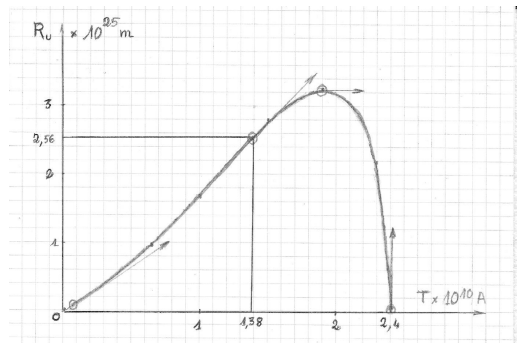
For the current universe, we have T = 1.38 (Analysis of the cosmic microwave background) and Ru = 2.56, this allows to evaluate the only coefficient (A); whose we find approximately 0.48 [5].
"The very simple" function Ru(T) allowing the calculation of the evolution is then:
Ru = 0.48 [T (e^T – 1) (11 – e^T)] ^0.5,
With an estimated precision of 3%
The graph of this function (see curve in appendix) shows:
• A first period of slightly accelerated expansion that ends with an inflection at T = 1.5, in the meantime, the expansion speed has been multiplied by 1,6 factor.
• A second period of decelerated expansion that ends in a steady state at T = 1.9
• The accelerated contraction period; up to T = 2.4 (big bounce).
The duration of the cycle period would therefore be 24 Billion years.
We find that the current expansion rate is very close to :
V = 0.58 10^8 m/s, which corresponds to a Hubble constant value
H = 2.2 10^-18/s, very close to the known value.
This verifies the accuracy of our curve.
The contraction rate tends to infinity at the end (new big bang),
which is consistent with equation (3) because Eo, then, tends toward zero.
Conclusion
The combination of knowledge acquired by the Standard Model of cosmology and the results we have obtained within the framework of a “superfluid quantum" space-time has allowed to propose an evolution curve of the "big bang/big bounce" type. This curve accounts for the slightly accelerated expansion period in which we are living, and provides the expansion rate of the present Universe.
This value corresponds to that of the measured Hubble constant, which is a justification.
To complete the "cyclical" aspect, an analysis is necessary to describe the transformation reaction called the "big bang", that must produce the cyclical renewal, which will be the subject of a future publication.
Appendix
References
- Friedmann, A. (1924). On the possibility of a world with constant negative curvature of space. Journal of Physics, 21(1), 326-332.
- Raverdy, Y.C. “A corpuscular space-time to explain the gravitation” J. Mod. Appl. Phys. 2023; 6(2):1-4.
- Raverdy, Y. C. (2025). “The nature of Vacuum energy”.
- Raverdy, Y. C. (2025). The Big Bounce of the Universe. J Electrical Electron Eng, 4(3), 01-02.
- Raverdy, Y.C. A formula for electron mass calculation based on new fundamental concepts. J Pure Appl Math. 2023;7(2):129- 133.