

International Journal of Media and Networks(IJMN)
ISSN: 2995-3286 | DOI: 10.33140/IJMN
Impact Factor: 1.02


Research Article - (2024) Volume 2, Issue 2
The Effectiveness of Behavior Modification Therapy on Level Of Anxiety Among Substance Addicted Patients in Selected De-Addiction Center Meerut
Received Date: Jan 29, 2024 / Accepted Date: Feb 20, 2024 / Published Date: Feb 29, 2024
Copyright: © 2026 This is an open-access article distributed under the terms of the Creative Commons Attribution License, which permits unrestricted use, distribution, and reproduction in any medium, provided the original author and source are credited.
Citation: Jensi J, D. P., Sharma, S. (2024). The Effectiveness of Behavior Modification Therapy on Level Of Anxiety Among Substance Addicted Patients in Selected De-Addiction Center Meerut. Int J Med Net, 2(2), 01-03.
Abstract
Statement of the Problem: A study to assess the effectiveness of behavior modification therapy on level of anxiety among substance addicted patients in selected de-addiction center Meerut, U.P. Objectives: 1. To assess the level of anxiety among substance addiction patients in experimental and control group. 2. To deliver the behavioral modification therapy in experimental group. 3. To evaluate the effectiveness of behavioral modification therapy on level of anxiety among substance addiction patients in experimental group. 4. To compare the level of anxiety among substance addiction patients in experimental and control group. 5. To associate the level of anxiety and their selected variables among the substance addiction patients in experimental and control group .
Methods: A quasi experimental study was conducted on 60 substance addicted patients, 30 in experimental group and 30 in control group selected by purposive sampling technique having kept the inclusion and exclusion criteria. The tools used for this study was Standardized Hamilton Anxiety scale for assessing the level of anxiety among substance addicted patients and its demographic variables.
Results: Major findings of the study: Findings of the study reveals that the effectiveness of behavioural modification therapy is help to decrease the level of anxiety Among Experimental Group Pre-test scores shows that that majority of samples 16(53%) had mild to moderate anxiety, 08 (27%) had mild anxiety and 04 (13%) had moderate to severe anxiety and post-test data represented that majority of samples 20(66%) had mild anxiety, 06 (20%) had mild to moderate anxiety, and 02 (7%) had severe anxiety.
Conclusion: The results and findings of this study shows that Behavior modification therapy is very effective and significant to decrease the level of anxiety among substance use patients from selected rehabilitation center, Meerut.
Keywords
Effectiveness, Level of Anxiety, Substance Use Patients, De Addiction Centre.
Introduction
Alcoholism, also known as alcohol use disorder (AUD), is defined as a condition for drinking of alcohol upto that extent that results in mental or physical health problems. Alcohol use affects the brain, heart, liver, pancreas, and immune system. It can result in mental illness. Substance abuse is a significant problem in India we have many serious substance misuse problems like alcoholism, illegal drugs etc. these problems not only detoriates the financial cost of the family but also it lowers the quality of life, health, education, social system. Behavioural modification therapy (BMT) for substance use disorders has shown efficacy as both a monotherapy and as part of combination treatment strategies. This article provides the evidence supporting the use of BMT, clinical elements of its application, novel treatment strategies for improving treatment response, and dissemination efforts.
• Statement of the Problem
A Study to assess the effectiveness of behavior modification therapy on level of anxiety among substance addicted patients in selected de-addiction center Meerut, U.P.
• Objectives of the Study:
1. To assess the level of anxiety among substance addiction patients in experimental and control group.
2. To deliver the behavioural modification therapy in experimental group.
3. To evaluate the effectiveness of behavioural modification therapy on level of anxiety among substance addiction patients in experimental group.
4. To compare the level of anxiety among substance addiction patients in experimental and control group.
5. To find out the association between the pre-test score on level of anxiety with their selected variables among the substance addiction patients in experimental and control group.
Hypothesis:
H:- There is a significant association between the post test scores of level of anxiety and their selected demographic variables at <0.05 level of significance.
Ethical Consideration: Ethical clearance obtained from the university ethical committee. The permission received from the concerned authority in the de-addiction centre to conduct the study. Written consent obtained from the patients after explaining the purpose of the study.
Conceptual Framework: Hildegard E. Peplau’s Theory of interpersonal relationship was used in this study.
Methodology
An evaluative research approach, quasi-experimental non-equivalent control group post-test design and Non – probability purposive sampling technique was used in the study. Settings - Sanskriti Foundation De-addiction centre, Meerut. Samples: De-addiction admitted in Sanskriti Foundation De-addiction centre. Sample Size: 60. The reliability was assessed by testing the instruments is co-relation of knowledge test was calculated by using (Kuder Richardson 20 Formula), it was found r=0.8. It indicates tool is reliable.
The tools used for this study was Standardized Hamilton anxiety inventory for assessing the level of anxiety of substance addiction patients and its demographic variables.
Section 1: Demographic variables of the samples It included variables like age, gender, religion. Occupation, type of family, , duration of substance use, etc…..
Section 2: Standardized Hamilton Anxiety scale It contains total 14 points. Scoring _ each item is scored on a scale of 0 (not present) to 4 (severe), with a total score range of 0–56, where Level of anxiety is categorized as Mild (<17), Mild to Moderate (18-24), Moderate to Severe (25-30), Severe (31-56).
Data Collection Procedure: Official administrative permission was taken from the respective authority. Final data collection has been done according to date decided by the committee members 30 samples in each group i.e 30 in experimental group and 30 in control group was selected. To obtain free response, the motive of the study was explained and the subjects was assured about confidentiality of their response.
The investigator introduced herself to the De-addiction people and developed good inter personal relationship with them. Obtained consent from each subject. De-addiction people were assessed for level of anxiety with Standardized Hamilton Anxiety scale, In which 30 subjects were found to have anxiety related problems and were explained that data will be maintained confidential. During the first week, assessment of level of anxiety among de-addiction people was done. After the application of behavior modification therapy in experimental group the level of anxiety were assessed by Standardized Hamilton Anxiety scale.
Data Analysis and Interpretation:
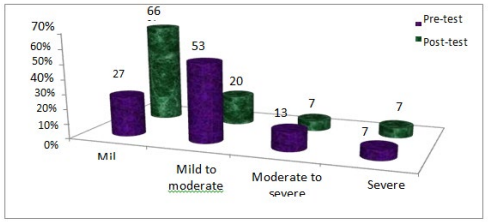
Figure 1: Frequency and Percentage Distribution of Level of Anxiety of the Experimental Group
The fig.1 explains that in pre-test data represented that majority of samples 16(53%) had mild to moderate anxiety, 08 (27%) had mild anxiety and 04 (13%) had moderate to severe anxiety. In post-test data represented that majority of samples 20(66%) had mild anxiety, 06 (20%) had mild to moderate anxiety, and 02 (7%) had severe anxiety.
|
|
MEAN |
SD |
DF |
T TEST |
TABLE VALUE |
P VALUE |
|
PRE- TEST |
20.30 |
7.64 |
29 |
2.8113 |
2.045 |
0.0088 P>0.05 |
|
POST TEST |
|
|
Table 1: Effectiveness of behavior modification therapy on level of anxiety among substance addicted patients In Experimental Group N= 30
The table 1 revealed that the calculated t-value (2.811) is higher than the table value (2.045) and p value is 0.0088at 0.05 level of significance which shows that the behaviour modification therapy on level of anxiety among substance addicted patients regarding adverse was effective.
|
|
MEAN |
SD |
DF |
T TEST |
TABLE VALUE |
P VALUE |
||
|
POST TEST |
Cont. |
Exp. |
Cont. |
Exp. |
58 |
0.765 |
2.00 |
0.447 P>0.05 |
|
19.53 |
18.00 |
7.74 |
7.79 |
|||||
Table 2: Comparison of Post-Test Level of Anxiety Among Substance Addiction Patients in Experimental and Control Group N- 60
After comparison of post test score between the control and experimental group the calculated t test value (0.765) is lower than the table value (2.00) which shows the effectiveness of behavioural modification therapy to decrease anxiety among substance addiction patients.
Association Between Post-Test Level of Anxiety Score with Selected Demographic Variables in Experimental Group
There was a significant association between post-test level of anxiety with the selected demographic variables such as Religion and the types of substance. This indicated that the demographic variables of de-addiction patients and their level of anxiety have some significant association and were not independent of each other. Hence the research hypothesis H was accepted.
Conclusion
Based on the above findings the following conclusion could be drawn. The Behavior modification therapy is very effective and significant to decrease the level of anxiety among substance use patients from selected rehabilitation center.
Recommendations
Based on the present study, the following recommendations have been made for further studies: Similar study can be conducted for a larger group for a longer period. Same kind of study can be conducted to adolescents. A comparative study can be conducted between rural and urban people. A study can be done to assess the knowledge about behavioral modification therapy and its effect on psychological condition of the substance addicted patients. A study can be conducted to identify the educational needs of the patient regarding health issue and positive effect on mental health. Similar kind of study can be done by using other research strategies.
Declarations
Funding: This research paper received no specific grant from any funding agency in the public, commercial or not-for-profit sectors.
Conflict of interest: The authors declare no competing interests.
References
- Gurumani N. An Introduction to Biostatisticsâ??. 1st Ed. New Delhi. MJP Publishers. 2004
- Hungler, B.P., & Polit, D.F. Nursing Research. 6th Ed. Philadelphia. Lippincott. 1999.
- Dr Lalitha, K. (2007). Mental health and psychiatric Nursing; An Indian Perspectives. VMG Book House Bangalore, 16.
- Sreevani R. A Guide to Psychiatric and Mental Health Nursing. 3rd edition. New Delhi: Jaypee Brothers Publish-ers.2009.
- Stuart, G. W. (2012). Principles and Practice of Psychiatric Nursing-E-Book: Principles and Practice of Psychiatric Nursing-E-Book. Elsevier Health Sciences.
- Townsend M C. Psychiatric Mental Health Nursing. 7th edition (Indian). New Delhi, Jaypee brothers publisher. 2012.
- Ahuja Niraj. A short text book of psychiatry. 2nd Edition.New Delhi. Jaypee Publishers.2002. P.P:47-49.
- Basavanthappa.B.T. Nursing research. 2nd edition. Bangalore. Jaypee Publishers.2000.
- Barke. Psychiatric and mental health nursing. 2nd edition.London. Edward Arnold publishers.
- Bhatia, M.S.Text Book of Psychiatry, 3rd edition. New Delhi: C.B.S Publishers and Distributors.2007.
- Polit and Hungler. Nursing Research Principles and methods. 5th ed. New York. J.B. Lippincott Company.2000