



Research Article - (2022) Volume 7, Issue 4
The Effectiveness of Applying for Formative Assessment Objective Structured Clinical Examination (OSCE) for Undergraduate Students in Faculty of Medicine King Abdulaziz University, Jeddah, Kingdom of Saudi Arabia
Received Date: Feb 07, 2022 / Accepted Date: Aug 21, 2022 / Published Date: Dec 15, 2022
Copyright: ©Rajaa Fahad Allhiani, et al This is an open-access article distributed under the terms of the Creative Commons Attribution License, which permits unrestricted use, distribution, and reproduction in any medium, provided the original author and source are credited.
Citation: Allhiani, R, F., Abdulwahab,S., Alamri, S, H. (2022). The Effectiveness of Applying for Formative Assessment Objective Structured Clinical Examination (OSCE) for Undergraduate Students in Faculty of Medicine King Abdulaziz University, Jeddah, Kingdom of Saudi Arabia. Cardio Open, 7(4): 288-290.
Abstract
The use of formative and summative assessment for students have been always a concern for medical professionals such as teachers and students especially when students are at graduating level. This can be supported with increasing the effectiveness and comprehensiveness of the students with appropriate clinical training using a defined structure with questionnaire-based system defined in the methodology to support student’s skills using clinical competencies to form perspective. It has been found that with Objective Structured Clinical Examination can be used as the method to assess the adequacy to support clinical skills of medical students following their competence level. This can be used to support a variety of tests to work on underpinning emergency procedures to interpret investigational data to ensure in-depth and breadth coverage of clinical skills following 5thyear medical students.
Keywords
OSCE, Formative Assessment, Clinical, Undergraduate Medical
Introduction
This study of monitoring the effectiveness of the formative OSCE conducted over five years from 2014 until 2018 and still monitoring is going on for 2019 [1]. The OSCE is a form of performance-based testing used to measure candidates’ specif- ic clinical competencies. As the OSCE developed throughout the years, there was a debate about its applicability as an as- sessment tool especially in terms of its validity and reliability [1,2]. Therefore, this study aims to determine the effectiveness of applying formative assessment Objective Structured Clinical Examination (OSCE) for undergraduate 5th year medical stu- dents in clinical module. The clinical module took the initiative in applying the formative (OSCE) and had invited residents to participate and practice their assessment skills [2]. Also, to mea- sure the effectiveness of Self Direct Learning (SDL) sessions.
Objectives
Following the purpose of the study, the researcher has put to- gether the key objectives for further research to be considered while collecting and analyzing data for this subjective theme. It has been found that two types of assessment are undertaken in educational institutions-summative and formative to evaluate the student’s learning progress and give them concrete grades to improve their learning behavior. The objective is to determine the effectiveness of applying formative assessment objective structured clinical examination (OSCE) for the undergraduate 5th-year medical students in clinical module. The initiative was applied for the formative OSCE had invited residents to partic- ipate and practice their assessment skills to measure the effec- tiveness of Self Direct learning (SDL) session. The objectives include,
• To test the effectiveness of formative assessment (OSCE) for undergraduate students
• To determine the acceptability of the formative (OSCE) since it’s not compulsory
• To identify the strengths and weaknesses of the formative (OSCE) on undergraduate students.
Methods
Check list of 10 questions survey (questionnaire) were distrib- uted to all undergraduate medical students who had participated in the formative (OSCE) to measure their competency and pro- ficiency [3]. In the clinical skills and simulation center (CSSC), the twelve rooms were set up for the formative OSCE. Since there were three identical panels of rooms, so six rooms assigned for inactive stations that contained instructions how to answer the questions and other had X-ray films to diagnose. The other six rooms were active stations that contained standardized pa- tients (SP) and Manikins. The formative OSCE lasted for (full) day and residents were involved as examiners. This method was applied in 2014 and sustained until 2016. In 2018, this method amended to accept more challenges in inviting house officers (interns) to be the standardized patients (SP) [4]. Since most of the (Interns) who are participating in the formative OSCE have finished their rotations in all the clinical departments and were retained in the stations.
Results
The analyses were done thru cross tabulation by (NCSS)similar to SPSS version 20 of all the survey, and the data was summa- rized in the following table of Figure 1
Figure 1: Summarization of all undergraduate medical students who had participated in the formative (OSCE) to measure their competency and proficiency.
|
Year |
2014 |
2015 |
2016 |
2017 |
2018 |
|||||
|
Male |
90 |
43% |
55 |
35% |
43 |
29% |
96 |
44% |
98 |
43% |
|
Female |
100 |
48% |
83 |
53% |
62 |
40% |
118 |
55% |
120 |
53% |
|
incomplete |
18 |
8% |
20 |
12% |
48 |
31% |
12 |
1% |
10 |
4% |
|
Total |
208 |
91% |
158 |
88% |
153 |
69% |
216 |
99% |
228 |
96% |
In 2014, the number of students was 208 (95 males& 113 fe- males) who participated in the formative assessment who all of them reported not enough time since the allotted time for each station of formative (OSCE) was 5 minutes, it should more than 10 minutes. About 8% (18) were incomplete questionnaire noth- ing to report. 90 of the students reported that it was helpful in highlighting area of weaknesses in their clinical skills and 100 felt safe to make errors without accountability and confidential- ity. Nevertheless, students had reported difficulty with the resi- dents; they had not enough experience to provide feedback and debriefing since they were not involved in their teaching plane in Figure 2. Residents should be involved in teaching undergradu- ate to practice their teaching skills [4].
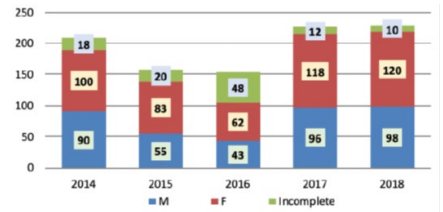
Figure 2: Feedback and debriefing of the teaching plane
In 2015 and 2016, about half of the students did not participate in the formative assessment OSCE since it was not compulso- ry shown in Figure 3. According to adult learning theory, there are several key differences to consider with applying formative OSCE:
1. Adults are self-regulated meaning that they will decide on what and when they want to learn.
2. Adult learners are intrinsically motivated, often by their self-efficacy or their belief in their ability to complete a task, when their feelings of competence and their psychological safety
3. Adults use analogical reasoning in learning and practice [4].
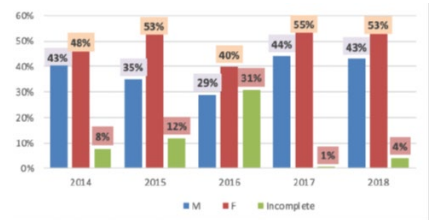
Figure 3: Formative Assessment of OSCE
In 2017, after observing the withdraw of students from partici- pating in formative OSCE, corrective actions were taken by con- ducting workshops of orientation and pre-briefing, set ground rules and clarified the expectations of the Formative OSCE to all the students. After participation in the formative assessment, 99% they were motivated after allowing enough time for each station where they can learn Figure 4.
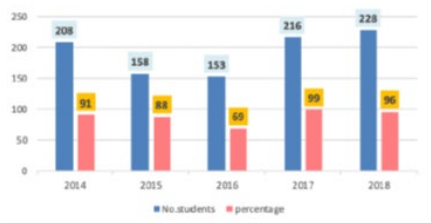
In 2018, we have accepted more challenges in inviting house officers (interns) to be examiners [4]. 96% they had faced this challenge by accepting interns as their peers who had assisted them in learning and in overcoming their weakness shown in Figure 5. All the incomplete surveys were discarded and omitted from the analysis.
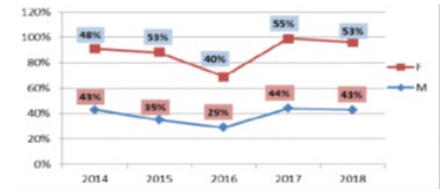
Figure 5: Formative OSCE heighted and weaknesses
Conclusion
The formative assessment is powerful tools had assisted 5th year medical students' in learning and to overcome their weakness. Their feedback was in favor of having formative (OSCE) more often in clinical skills module, which gave them the opportunity to improvement and prepare them for the summative (OSCE), as result repetition and re-sit of this module was reduced. Also suggested that residents should be involved in teaching their cur- riculum to be familiar with students’ syllabus. The faculty mem- bers had diversity of opinion about formative OSCE overseen as time consuming, budget consumption and lack of incentive; on the other hand, students expressed high satisfaction with this type of assessment and their outcome after participating was found remarkably outstanding [5-11].
Take Home Messages
• OSCE is an effective and widely used method of assessment around the world, but in some places, according to the stu- dents, it is not as much as expected to be.
• OSCE exam, and the way of introducing it in KAU, needs to be more evaluated and assessed to achieve the purpose of this method.
• Although this survey is assessing the perception of students, we should take it in consideration especially the most sig- nificant parament.
Declarations
This research was conducted after receiving the approval of bio- ethical committee at the faculty of medicine in king Abdelaziz university and all students who had participated in the study were informed thru completing consent forms.
References
- Rushforth, H. E. (2007). Objective structured clinical ex- amination (OSCE): review of literature and implications for nursing education. Nurse education today, 27(5), 481-490.
- Marcyjanik, D. L., & Johnson, N. L. (2016). Use of Ob- jective Structured Clinical Examination in a Senior Bacca- laureate Nursing Course for Assessment of End-of-Program Outcomes.
- Alghamdi, K. S., Katib, B. H., Alhoqail, A. A., & Al-khatib,T. A. (2016). Perception and acceptance of senior medical students at King Abdulaziz University of the use of Objec- tive Structured Clinical Examination as a tool of assess- ment. MedEdPublish, 5.
- Alaidarous, S., Mohamed, T. A., Masuadi, E., Wali, S., & AlMalki, A. (2016). Saudi internal medicine residents׳ per- ceptions of the objective structured clinical examination as a formative assessment tool. Health Professions Education, 2(2), 121-129.
- Zayyan, M. (2011). Objective structured clinical exam- ination: the assessment of choice. Oman medical journal, 26(4), 219-222.
- Bakhsh, T. M., Al Kashgari, R. H., Sibiany, A. M., Al Mashat, F. M., Meccawy, A. A., & et al. (2005). Running OSCE for a Large Group of Students: Experience of the Surgical Department King Abdulaziz University, Faculty of Medicine. Journal of King Abdulaziz University-Medical Sciences, 12, 43-52.
- Kadeangadi, D. M., Naik, V. A., Shivaswamy, M. S., & Mallapur, M. D. (2014). Objective Structured Clinical Examination; A Tool for Formative Assessment. National Journal of Integrated Research in Medicine, 5(1).
- Obizoba, C. (2018). Mitigating the challenges of objective structured clinical examination (OSCE) in nursing educa- tion: A phenomenological research study. Nurse education today, 68, 71-74.
- Shen, L., Zeng, H., Jin, X., Yang, J., Shang, S., & et al. (2018). An innovative evaluation in fundamental nursing curriculum for novice nursing students: an observational research. Journal of Professional Nursing, 34(5), 412-416.
- Massey, D., Byrne, J., Higgins, N., Weeks, B., Shuker, M. A., & et al. (2017). Enhancing OSCE preparedness with vid- eo exemplars in undergraduate nursing students. A mixed method study. Nurse Education Today, 54, 56-61.
- Solà, M., Pulpón, A. M., Morin, V., Sancho, R., Clèries, X., & et al. (2017). Towards the implementation of OSCE in undergraduate nursing curriculum: A qualitative study. Nurse education today, 49, 163-167.