

Journal of Humanities & Social Sciences(JHSS)
ISSN: 2690-0688 | DOI: 10.33140/JHSS
Impact Factor: 1.1

Research Article - (2026) Volume 9, Issue 2
The Development of Mongolian Landscape Painting
2School of Fine Art and Technology, Mongolia
3Mongolian National University of Education, Mongolia
Received Date: Jan 05, 2026 / Accepted Date: Feb 06, 2026 / Published Date: Feb 16, 2026
Copyright: ©2026 Selenge Tumur-Ochir, et al. This is an open-access article distributed under the terms of the Creative Commons Attribution License, which permits unrestricted use, distribution, and reproduction in any medium, provided the original author and source are credited.
Citation: Khuyag, E., Tumur-Ochir, S., Purevdorj, A. (2026). The Development of Mongolian Landscape Painting. J Huma Soci Scie, 9(2), 01-06.
Abstract
Since the early twentieth century, Mongolian fine arts have developed through a dynamic synthesis of European academic painting traditions and indigenous visual aesthetics. By the mid-twentieth century particularly during the 1950s and 1960s landscape painting emerged as an autonomous and increasingly significant genre within Mongolian art. During this period, artists began to rely extensively on direct observation of nature through systematic plein-air sketching practices, which became central not only to artistic exploration but also to the formation of technical and perceptual mastery. Within watercolor practice in particular, landscape sketch studies assumed a crucial role in professional training, creative inquiry, and the cultivation of visual sensitivity.
This study investigates watercolor landscape sketches produced by leading Mongolian artists across different historical periods, with specific attention to technical procedures, color relationships, the treatment of light and shadow, compositional organization, and spatial construction. Through comparative visual analysis supported by historical contextualization, the paper traces the developmental trajectory of Mongolian watercolor landscape painting from its academic foundations to its contemporary expressive diversity.
The findings demonstrate that plein-air sketching in Mongolia has functioned as more than a preparatory exercise; it has operated as a methodological core of artistic research through which artists refine observational acuity, interpret atmospheric conditions, and construct a culturally grounded visual language within the framework of realism. Furthermore, the study highlights the pedagogical significance of sketch practice within Mongolian art education and underscores its continuing relevance for developing artists capable of engaging meaningfully with both national artistic traditions and international discourse.
Keywords
Mongolian Watercolor, Painting, Sketch Study, Realism, Light and Shadow, Technique
Introduction
The development of Mongolian fine arts since the early twentieth century has been closely intertwined with European academic painting traditions while remaining responsive to indigenous visual aesthetics. Through sustained artistic exchange, institutional reform, and formal education abroad, Mongolian artists adopted realist principles of representation linear perspective, tonal modeling, and spatial construction while rearticulating these principles through locally grounded modes of perception. Over time, this dual orientation fostered a distinctive visual language in which academic discipline and national sensibility coexisted within modern Mongolian painting.
By the mid-twentieth century, particularly during the 1950s and 1960s, landscape painting emerged as an increasingly autonomous genre. This shift evolved from pedagogical practices that privileged direct observation of nature. Artists relied extensively on plein-air sketch studies, where changing light, atmosphere, and spatial breadth required rapid perceptual translation into pictorial form. Such practices strengthened technical proficiency while shaping aesthetic judgment and laying a durable foundation for realist landscape painting in Mongolia [1,2].
Sketching in natural settings demands heightened observational acuity, sensitivity to color transitions, and effective spatial organization under fluctuating environmental conditions. Artists must capture the general atmospheric impression before attending to detail. Consequently, sketch studies functioned as both professional training and research-based creative inquiry through which artists investigated visual reality empirically. In this context, watercolor proved particularly valuable because its transparency and immediacy require decisiveness and clarity of perception [3]. This study examines watercolor sketching as both an artistic and pedagogical practice by analyzing works of prominent Mongolian artists, including G. Odon, N. Tsultem, Ts. Dorjpalam, and S. Jamts, in order to trace the historical development, technical characteristics, and educational significance of watercolor landscape sketching in Mongolia.
Modern Mongolian painting took shape through a historically layered process in which European academic methods were introduced and reinterpreted through local sensibilities. Beginning in the 1930s, artists increasingly adopted oil-painting techniques emphasizing light and shadow, volumetric modeling, and perspective construction establishing professional standards for spatial illusion [1,2,4].
During the 1950s, historical narratives and portraiture dominated institutional agendas, often relegating landscape to a secondary role. Nevertheless, the discipline cultivated through figure painting supported the maturation of landscape painting by strengthening tonal organization and compositional unity. From the 1960s onward, landscape gained prominence as an independent genre, supported by the recognition of plein-air sketching as essential to artistic training and creative research [1].
Artist-educators such as O. Tsevegjav and G. Odon emphasized outdoor studies, training students to perceive light as a structuring force, color as relational, and space as atmospheric rather than geometric. Their sketch practices demonstrate the capacity to capture chromatic transformation and atmospheric immediacy within coherent compositional structures [1,4].
A further milestone was the overseas training of Mongolian artists at major Russian academies. Artists returned with strengthened academic skills and contributed to curriculum structures centered on observation, sketch discipline, and technical progression. Within this framework, landscape sketching functioned as a bridge between observation and studio production, enabling artists to build visual memory while maintaining compositional clarity [5]. Within this tradition, watercolor, due to its portability and responsiveness, became not merely preparatory but an independent artistic practice. Thus, the rise of Mongolian landscape painting is inseparable from the pedagogical centrality of sketch practice,reflecting a dialogue between observation and construction, environment and technique, and tradition and innovation.
The Educational and Artistic Importance of Sketch Studies
Sketching in natural environments differs fundamentally from studio practice because perceptual conditions light direction, atmospheric density, weather variability, and color temperature shift continuously. Plein-air sketching requires artists to interpret changing visual information rapidly and to prioritize tonal mass, chromatic relationships, structural rhythm, and spatial depth in real time. For this reason, landscape sketch study operates not merely as preparatory practice but as a rigorous mode of visual inquiry [1,4].
Within Mongolian art pedagogy, sketch studies-ranging from rapid studies to extended observational works have long functioned as a foundational training method. They cultivate core competencies: observational acuity, the capacity to generalize complex natural forms into coherent compositional structures, sensitivity to tonal and chromatic transitions, and spatial construction through perspective and atmospheric recession. These competencies are developed through repeated empirical engagement with real environments в Sketching also has a distinctive epistemic role. It trains artists to distinguish between local color (the inherent color of objects) and optical color (color modified by light, atmosphere, and reflected hues). This distinction is central to realist painting and is especially evident in watercolor, where transparency and layering make optical effects, both technically demanding and aesthetically expressive. Because time outdoors is limited and environmental conditions change rapidly, artists develop a hierarchy of pictorial priorities, often beginning with the capture of the overall atmospheric impression before addressing detail. This process shapes not only technical skill but also aesthetic judgment, teaching artists when to omit, simplify, or emphasize visual elements to preserve compositional integrity.
Repeated sketch practice further contributes to the formation of professional identity and stylistic language. While academic training establishes shared standards, sustained sketching enables artists to develop individual strategies of mark-making, color selection, and compositional framing. In Mongolian landscape traditions, this often results in a balance between disciplined realism and sensitivity to vast space, climatic mood, and the temporal rhythm of nature.
Consequently, sketch study performs two complementary functions: it supports larger studio works by strengthening pictorial memory and observational accuracy, and it operates as an independent artistic form capable of conveying complete atmospheric statements with economy of means. In this sense, sketching is both an educational methodology and a legitimate artistic genre within Mongolian fine arts.
Early Development of Mongolian Watercolor (1940-1960)
The early development of Mongolian watercolor painting (c. 1940–1960) was shaped by institutional education models strongly influenced by Russian academic pedagogy. Artists trained within these frameworks emphasized drawing discipline, tonal logic, and representational clarity, reflecting academic priorities of structural coherence and visual legibility.
Subject matter frequently aligned with social and cultural narratives, depicting herders, everyday life, and rural landscapes. Within this context, watercolor sketches often resembled academic studies in their controlled value structure, clear compositional hierarchy, and disciplined brushwork. Color application tended to be direct rather than optically layered, aiming to establish stable tonal relationships efficiently.
Watercolor served as an effective medium for outdoor study because of its portability and immediacy. However, its transparency required careful planning and decisiveness, as corrections were limited. Early watercolor landscape sketches therefore reveal a preference for clear spatial cues foreground, middle ground, and background separation along with simplified silhouettes and stable horizon placement [1].
Pedagogically, watercolor practice reinforced broader academic training by strengthening artists’ ability to translate complex natural phenomena into coherent pictorial statements. These early technical foundations later enabled expanded expressive experimentation without sacrificing structural discipline.
Present-Day Watercolor Painting After 1990
After 1990, Mongolian watercolor painting underwent significant transformation due to political change, expanded cultural exchange, and increased exposure to international art movements. Artists gained opportunities for travel, study, and exhibition abroad, encouraging experimentation and expressive freedom in watercolor practice [1].
This stylistic openness, however, introduced a tension between innovation and technical discipline. In response, many artists renewed their commitment to realist standards grounded in observational rigor. Contemporary watercolor artists demonstrate advanced technical control while incorporating expressive approaches rooted in national visual perception.
Technically, artists expanded watercolor language through atmospheric construction, reserve techniques, controlled diffusion, and layered transparency. Improved materials paper, pigments, and brushes enabled refined control over granulation, edge variation, and depth [4]. Thematic and compositional range also broadened. Contemporary watercolor sketches explore urban and transitional environments alongside natural scenery, often reinterpreting realism through atmospheric emphasis and selective abstraction. Visual truth is conveyed through light, temperature, and spatial rhythm rather than exhaustive detail.
Professional networks and associations further strengthened Mongolian watercolor’s presence in international contexts. Participation in exhibitions and competitions fostered technical and conceptual standards aligned with global discourse while preserving nationally grounded visual sensibilities. As a result, watercolor landscape sketching now operates both as a national tradition and as a platform for international artistic dialogue [1].
Conclusion
This study has demonstrated that Mongolian landscape painting particularly the tradition of watercolor sketch studies has served as a foundational axis for both professional artistic formation and research-oriented creative practice. Throughout the twentieth and twenty-first centuries, sustained engagement with plein-air sketching has enabled artists to refine observational acuity, interpret complex atmospheric conditions, and construct coherent spatial relationships under constantly changing visual circumstances. In this context, sketch practice has functioned not merely as preparatory work, but as a primary methodological approach through which artists investigate and translate visual reality into pictorial form [1,2].
From the mid-twentieth century onward, Mongolian painters have consistently demonstrated the ability to synthesize European academic principles with nationally grounded visual sensibilities. This synthesis is particularly evident in the treatment of light, color temperature, atmospheric depth, and expansive spatial composition qualities that reflect Mongolia’s environmental character while remaining anchored in realist discipline.
The early masters established the technical and pedagogical foundations of watercolor landscape practice through disciplined attention to tonal structure, compositional clarity, and decisive brushwork. Subsequent generations expanded watercolor’s expressive and technical range through experimentation with wet techniques, masking, layering, and textural processes, yet without departing from the observational rigor inherited from academic training. Contemporary artists continue to extend this lineage, achieving international recognition while maintaining a distinctly Mongolian atmospheric and spatial sensibility.
Analysis of these techniques, working methods, and sketch practices reveals not only the historical evolution of Mongolian watercolor landscape painting but also the continuity of a pedagogical philosophy grounded in direct observation, disciplined execution, and atmospheric truthfulness. These findings carry important implications for art education, suggesting that sustained engagement with plein-air sketching remains essential for cultivating artists who are technically proficient, perceptually sensitive, and conceptually grounded for future artistic practice.
References
- Ariunbold, A., et al. (2019). Fine arts and art education.Ulaanbaatar: MNUE Press.
- Mongolian National University of Education (MNUE). (2019). Fine arts and art education. Ulaanbaatar: MNUE Press.
- Selenge, T. (2025). Reading paintings: Foundations of artistic understanding and cognition.
- Erdenetsog, Ts. (2020). Creative explorations in painting.Ulaanbaatar.
- Delgermaa, B. (2012). History of Mongolian fine arts. Ulaanbaatar.
- Sharav Printing House. (1981). S. Jamts. Ulaanbaatar.
- Tsultem, N. (1988). Mongolian art. Ulaanbaatar: State Publishing House.
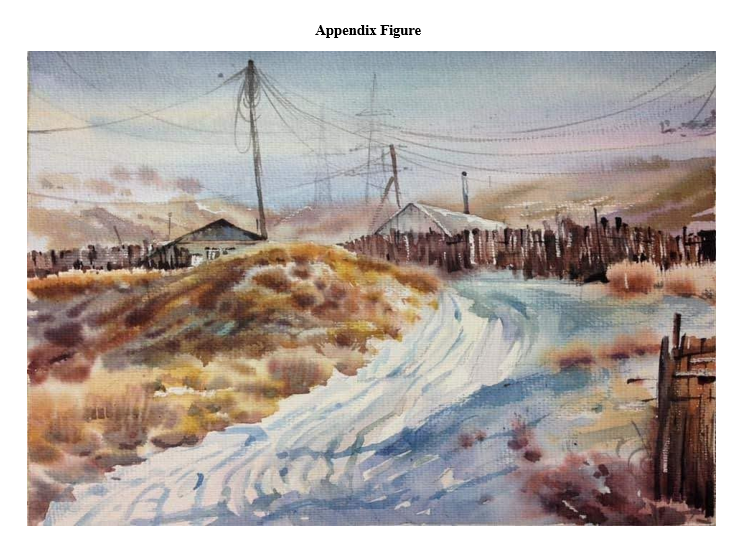
1..Artist Kh. Enkhbold
2.“Gachuurt” Sketch Study
3.Paper, watercolor
4.30 × 42 cm
5.2024

Artist Kh. Enkhbold
“Dari-Ekh” Sketch Study Paper, watercolor
27 × 38 cm
2020

Artist Kh. Enkhbold
“Saikhany Khötöl” Sketch Study Paper, watercolor
27 × 38 cm
2022