

International Journal of Women's Health Care(IJWHC)
ISSN: 2573-9506 | DOI: 10.33140/IJWHC

Impact Factor: 1.011

Research Article - (2023) Volume 8, Issue 1
The COVID-19 Pandemic in Japan: Its Impact on a Newborn's Childcare Environment and on the Mother's Sense of Loneliness
2Department of Pediatrics, Osaka University Graduate School of Medicine, Osaka, 567-0871, Japan
3Department of Social Environmental Medicine, Osaka University Graduate School of Medicine, Osaka, 56, Japan
4Clinical Psychology, Graduate School of Human Science, Osaka University, Osaka, 567-0871, Japan
Received Date: Mar 03, 2023 / Accepted Date: Mar 25, 2023 / Published Date: Mar 31, 2023
Copyright: ©Yutaka Ueda, et al. This is an open-access article distributed under the terms of the Creative Commons Attribution License, which permits unrestricted use, distribution, and reproduction in any medium, provided the original author and source are credited.
Citation: Miyoshi, A., Ueda, Y., Taniguchi, M., Yagi, A., Kimura, T., et al. (2023). The COVID-19 Pandemic in Japan: Its Impact on a Newborn's Childcare Environment and on the Mother's Sense of Loneliness. Int J Women's Health Care, 8(1), 21-27.
Abstract
The COVID-imposed social isolation of Japanese mothers has significantly increased their already existing sense of loneliness. We report here on the changes that have occurred in the environment of home childcare and in the mother’s feelings of loneliness during the pandemic. In 2019, we conducted an online survey of mothers who had infants aged 4-12 months. Many of the survey questions concerned the home childcare environment and the mother’s sense of loneliness. In 2020, we conducted a follow-up COVID impact survey using the same questionnaire to determine the impact of the pandemic on the mothers. Because of the impact on mothers of the COVID pandemic, specifically around their methods of gathering information concerning childcare, we found that the child-rearing environment in Japan has detrimentally changed since 2019. Whether or not the mother felt stressed or felt they lacked sufficient information concerning childcare associated with their changed patterns of behavior due to the declaration of a state of emergency were associated with having an impact on the mother’s sense of loneliness. The importance of the appropriate transmission of information concerning childcare had increased due to this pandemic.
Keywords
COVID-19, Pandemic, Loneliness, Social Isolation, Young Children
Introduction
There is a growing feeling of isolation among mothers raising very young children that is becoming a serious social problem in Ja-pan. Mothers having a high degree of loneliness are more likely to be depressed and to have decreased self-esteem and poor health, which consequently leads to the poor health of their children and to a rise in child abuse [1]. Official statistics in Japan have shown that one-third of our families now have a small-nuclear structure, rather than the extended-family structure of the past, and 7.0% of families were fatherless [2]. The time spent doing childcare by Japanese fathers with children younger than 6-years is the lowest among many countries [3-5]. In Japan, the small-nuclear family is slowly becoming the predominant family structure. With increas¬ingly weaker family connections regionally, good information concerning childcare is often sparse and difficult to gather. That has led to societal concerns about the mother’s sense of loneliness in raising her children.
In Japan, the COVID-19 pandemic broke out early in the spring of 2020. The pandemic has been almost relentless and has had a huge impact on all our different lifestyles. The pandemic has led Japan to declare a state of public health emergency, with most Japanese taking active preventative measures against infection by wearing a mask, disinfecting their hands, refraining from going out if not necessary and not socializing in person with friends or out-of-household family. Thus, a significant degree of social isolation has developed and it is easily to presume that the ‘normal’ sense of loneliness any new mother suffers has grown only deeper as the pandemic has been prolonged.
Social isolation for children and loneliness for adolescents have been reported to be linked to an increased risk of depression and possibility of anxiety as late as 9 years later. The duration of the loneliness had a stronger correlation with later adverse mental health symptoms than did the acute intensity of the loneliness [6].
We report here on the changing environment of childcare and the mother’s sense of loneliness during the first pandemic year of 2020 and we compared these results with those we obtained in 2019. We warn that the potential societal harm to young children requires immediate societal and professional actions to mitigate that harm.
Materials and Methods
On January 29th and 30th of 2019, we conducted an online survey of Japanese mothers listed in an internet survey panel as having an infant 4-12 months of age at the time the survey was taken. Valid survey answers were obtained from 412 respondents. The survey questionnaire had several sections, consisting of questions regarding the mother’s background (the age of the mother, her cur¬rent employment, household income, level of economic anxiety, whether she had co-habiting family members, and whether or not the child was her first), the status of their childcare (whether there was anyone else helping her with the childcare, whether there was anyone who she could consult with easily about raising her child/ children, and whom did she consult with about raising her child), their methods of gathering information about child healthcare and childrearing, the mother’s personal sense of loneliness, whether she was satisfied with her current childcare environment, and how often she interacted with other parents having children of similar age to her child (Other details of this study will be described else¬where). Just 22 months later, on November 18th and 19th of 2020, we re-conducted the same survey to determine the detrimental effects of the COVID-19 pandemic shutdown on the new-moth-er’s perceived loneliness and the childcare environment she felt she was providing. Valid survey answers were obtained from 618 mothers. We reused the 2019.
Statistics
Using MedCalc, differences between the two groups were calcu¬lated by the chi-square test and the logistic regression test for cat¬egorical variables. The level of statistical significance was set at p=0.05.
Results and Discussion
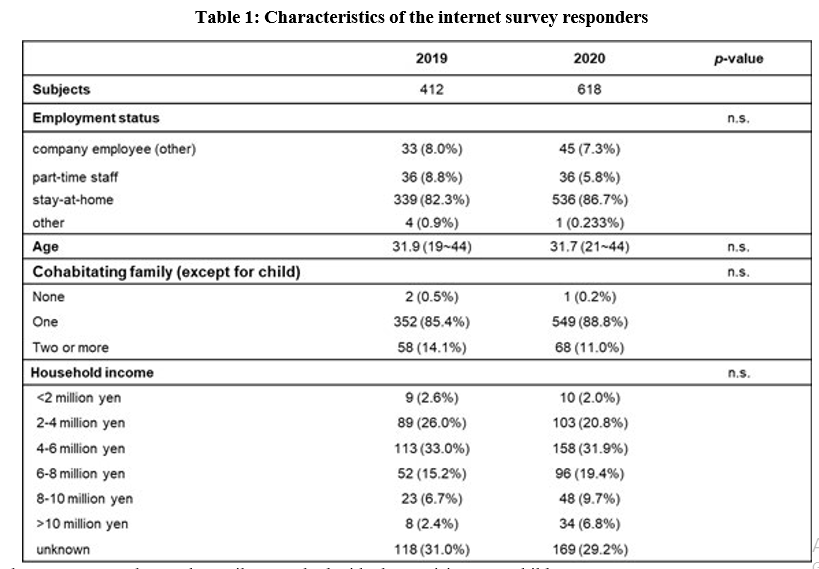
Characteristics of the internet survey responders. The relevant characteristics of the responders in the two survey years of Jan 2019 and Nov 2020 are shown in Table 1. No statistically signifi¬cant differences existed between the characteristics of the two re¬spondent groups.
Q. – Do you have someone who can be easily consulted with about raising your child?
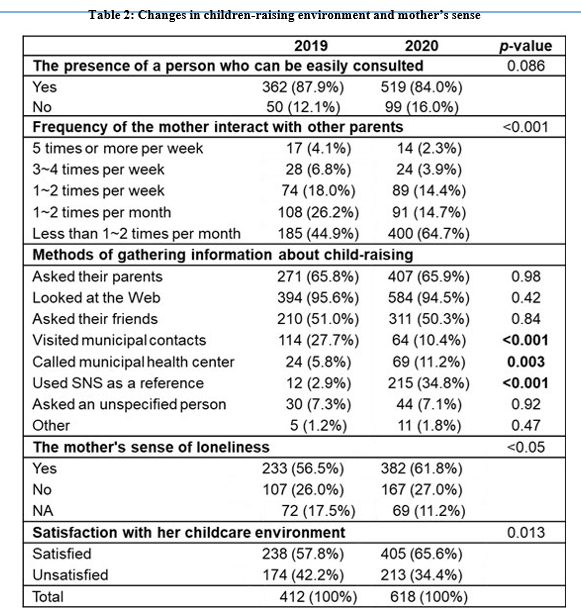
In 2019, 87.9% of the mothers answered that they had someone and 12.1% answered that they did not. In 2020, 84.0% answered yes. Mothers thus tended to have lost a person who could be easily consulted with about raising her child (Table 2).
Q. - Whom do you consult with about raising your child
Back in 2019, 71.8% of the mothers answered that they consulted with their mother; in 2020, now 78.2% gave that answer, which was a significant increase (p=0.029) (Figure). In 2019, 64.6% of the mothers consulted with their friends, whereas 53.8% gave that answer in 2020, a significant decrease (p=0.001) (Figure). In 2019, 11.0% of mothers answered that they consulted with their neigh¬bors, but in 2020 it was only 5.4% of the answers, a significant decrease (p=0.002) (Figure). Back in 2019, 71.8% of the mothers answered that they consulted with their mother; in 2020, now 78.2% gave that answer, which was a significant increase (p=0.029). In 2019, 64.6% of the moth¬ers consulted with their friends, whereas 53.8% gave that answer in 2020, a significant decrease (p=0.001). In 2019, 11.0% of moth¬ers answered that they consulted with their neighbors, but in 2020 it was only 5.4% of the answers, a significant decrease (p=0.002).

Figure: Whom she consulted with about raising her child
Q. - How often do you interact with parents having children the same age as your child? In 2019, 4.1% of mothers were interacting with other parents hav¬ing children as old as their own child five times or more per week, 6.8% interacted 3-4 times per week, 18.0% interacted 1-2 times per week, 26.2% interacted 1-2 times per month and 44.9% interacted less than 1-2 times per month. In 2020, 2.3% of mothers interacted with other parents having children as old as their own child 5 times or more per week, 3.9% interacted 3-4 times per week, 14.4% in¬teracted 1-2 times per week, 14.7% interacted 1-2 times per month and 64.7% interacted less than 1-2 times per month. The rate in all categories of interaction-frequency was decreased significantly (p<0.001) (Table 2).
Q. - What methods do you use for gathering information about child-rearing? 27.7% of the mothers visited a municipal contact for gathering in¬formation about raising their child in 2019 and 10.4% in 2020, a significant decrease (p<0.001) (Table 2). It was a municipal health center that 5.8% of the mothers called in 2019 and 11.2% in 2020 a significant increase (p=0.003) (Table 2). Social networking ser¬vices (SNS) were used by 2.9% of the mothers as a reference for gathering information about child raising in 2019, whereas 34.8% used it in 2020, a significant increase (p<0.001). (Table 2).
Q. – Did you feel the sense of loneliness while raising a newborn child? In 2019, 56.5% of the mothers surveyed felt loneliness when rais¬ing her own child, 26.0% did not feel loneliness, and 17.5% did not answer the question. In 2020, 61.8% of mothers felt loneliness, 27.0% did not, and 11.2% did not answer. The number of mothers who felt loneliness increased significantly (p<0.05) (Table2).
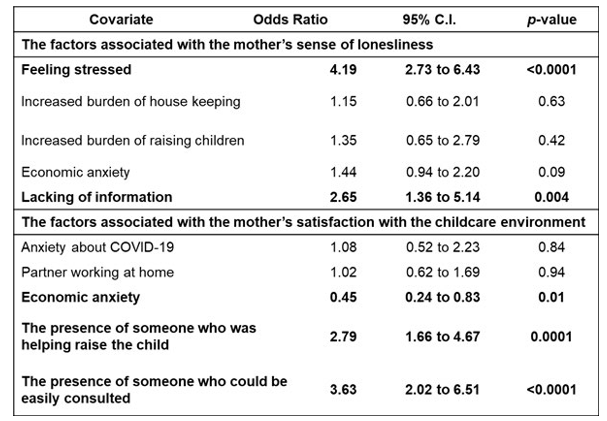
Q. – What was the correlation between any changes in childcare environment during the COVID-19 pandemic and the mother’s sense of loneliness? Multivariate analysis for correlations between the changing of the childcare environment during the COVID-19 pandemic and the mother’s sense of loneliness revealed that whether or not the mother felt stressful (p<0.0001, increased odds ratio: 4.19, 95% CI: 2.73~6.43) and whether or not she felt she lacked sufficient information concerning childcare (p=0.004, increased odds ratio: 2.65, 95% CI: 1.36~5.14) were associated with an impact on the mother’s sense of loneliness (Table 3).
Q. – What was the mother’s sense of satisfaction with her child-care environment? In 2019, 57.8% of the mothers surveyed were satisfied with their childcare environment. This sense of satisfaction increased signifi-cantly, to 65.6%, in 2020 (p=0.013) (Table 2).
Multivariate analysis of the correlation between the changing of her childcare environment during the COVID-19 pandemic and her satisfaction with her childcare environment revealed that less economic anxiety (p=0.01, increased odds ratio: 0.445, 95% CI: 0.24~0.83), the presence of someone to help raise her child (p=0.0001, increased odds ratio: 2.79, 95% CI: 1.66~4.67), and the presence of someone who could be easily consulted (p<0.0001, increased odds ratio: 3.63, 95% CI: 2.02~6.51), were each associ¬ated with a positive improvement on the presence of the mother’s sense of loneliness (Table 3).
Discussions
During this ongoing COVID-19 pandemic, mothers in Japan have not significantly lost people whom they can easily consult with about raising their child, but the type of person whom mothers have been consulting with has changed significantly. In 2019, most mothers were consulting with their primary partner about raising their child. In contrast, during the pandemic year of 2020, the fre¬quency with which new mothers consulted with their neighbors or friends had dropped significantly, and the person whom they now consulted with the most had shifted to their own mother. There was also a parallel shift in the methods of gathering child-rear-ing information, away from face-to-face information gathering to now visiting municipal contacts, in particular to calling municipal health centers and to using SNS as a reference for SARS-CoV-2 infection prevention.
The frequency of the mother’s interactions with other parents hav¬ing children as old as her own child was also increased signifi¬cantly. Before the COVID-19 pandemic, mothers often interacted with other parents having children the same age as her own child at a child support center or on the way to and from a childcare center. They could obtain childcare information and release stress at the same time. However, the declaration of a state of emergen¬cy caused childcare centers and elementary schools to be closed, work attendance was regulated, and staying by at home was rec¬ommended. They had dramatically lost the opportunity for person¬al peer interactions and felt more stressed as a result.
The percentage of mothers who felt lonely has increased signifi¬cantly during the COVID-19 pandemic. Mandai et al. reported that the mother’s sense of loneliness was also significantly associated with being financially worse-off, having a smaller family social network, having fewer friends, and having a smaller SNS network, thus it is highly relevant that COVID-19 has robbed many mothers of their financially security, their family social networks, and their contact with friends [7].
We evaluated the causes of the mother’s increased sense of lone-liness during the COVID-19 pandemic in a way that allows us to draw a comparison between two periods, one immediately before and the other during the COVID-19 pandemic. The increased bur¬den of housekeeping and childcare, an economic anxiety from los¬ing job opportunities and fulfilments, the lack of information con¬cerning childcare, and the novel difficulties surrounding modern childcare were all associated with the mother’s sense of stress and loneliness. These factors’ impact on the mother’s sense of loneli¬ness was confirmed by multivariate analysis.
During the prolonged pandemic, the accompanying reduced social networks and stressful feelings couldn’t be easily helped because of the need for maintaining COVID-19 social distancing, even though loneliness was clearly adverse for the mother, her small children and for adolescents. However, it still may be possible for society to resolve the lack of childrearing information.
Chen et al. have reviewed the positive effects of information com¬munication technology (ICT) for interventions that reduce social isolation in the elderly. ICT use was consistently found to positive¬ly affect social support, social connectedness, and social isolation in general. They assessed the mechanisms for the positive effect of ICT and it was found to be the result of connecting to the outside world, gaining social support, engaging in activities of interests, and boosting self-confidence [8-11].
Blažun et al. found that Slovene participants at nursing homes re¬ported no change of loneliness level after their use of Skype vid¬eoconferencing, while the loneliness of Taiwanese nursing home participants was significantly lessened after their use of Skype or Windows Live Messenger [12-14]. Sum et al. reported that com¬puter and Internet use functioned differently for various types of loneliness: social loneliness, family loneliness, and romantic lone¬liness. Using computers and the Internet to communicate with ac¬quaintances alleviated elderly people’s social loneliness, whereas using the computer and Internet to make new contacts resulted in family loneliness [15].
As above, ICT has the potential to resolve the lack of information concerning childcare and also alleviate the mother’s feelings of isolation and loneliness. As a result, the importance of transmis¬sion of information concerning childcare had been increased. We need to rapidly think of new ways to send information, including Skype, SNS, Instagram, and so on.
Unexpectedly, given what we found for other aspects of the new-born’s mother’s lives, mothers in 2020 seemed more satisfied with their childcare environment than in 2019. We assessed some of the factors associated with this sense of satisfaction, which revealed that the mothers were feeling less economic anxiety, they felt they had someone else who was helping them raise their child, and they had someone who could be easily consulted about raising their child. These feelings were all significantly associated with their sense of satisfaction with the child rearing environment they were providing. A sense of anxiety toward COVID-19 infection was not associated with their child-rearing satisfaction. In what would nor¬mally be seemingly an inconvenient lifestyle during the COVID-19 pandemic, mothers in Japan have had a change of heart, now find¬ing that small things, such as having helping hand to raise her child and someone to easily consult with about child-raising, could lead to improved satisfaction with their own child-raising environment.
Our study does have several limitations. First, other studies use a formal index, such as the revised UCLA Loneliness Scale, to evaluate the ‘sense of loneliness’. However, in our study, it was difficult to accurately compare our survey results to such a formal classification system because we only questioned the mothers as to self-evaluate whether they had a sense of loneliness. Second, it was not at all clear that the many changes in the mother’s lifestyle, childcare environment and feelings were all direct effects caused by the COVID-19 pandemic. It’s possible that the interpersonal communication tools have changed between the times of the two surveys, although the interval was only 22 months. Lastly, we have not investigated whether any changes of the mother’s lifestyle, childcare environment or feelings have caused adverse effects to their children or actual harm beyond the sense of isolation to the mother.
Conclusions
Our recent survey has found that, because of the social impacts of the COVID-19 pandemic on Japanese mothers, their childcare environment and their methods of gathering childcare information have changed. Mothers have felt an increased loneliness while child raising. Feelings of stress and a perceived lack of informa¬tion about childcare were associated with their sense of loneli¬ness. Our study highlights the importance of rapidly improving the transmission of information concerning childcare in fighting a newborn mother’s sense of loneliness.
Data Availability
Authors can also make data available on request through a data access committee, institutional review board, or the authors them¬selves. In this case, they should name who should be contacted to request the data and provide appropriate contact details. When au¬thors have used third party data and therefore do not own the data, this source must be credited as appropriate and details of how to access the data should be given.
Ethics Approval and Consent to Participate
This study was approved by the Institutional Review Board and the Ethics Committee of the Osaka University Hospital (#14361). The researchers obtained informed consent from participants of the survey on the questionnaire. We included only those who con¬sented to participate. All methods were carried out in accordance with relevant guidelines and regulations.
Acknowledgments
We would like to thank Dr. G.S. Buzard for his constructive cri-tique and editing of our manuscript.
References
- Chung, E. K., McCollum, K. F., Elo, I. T., Lee, H. J., & Cul-hane, J. F. (2004). Maternal depressive symptoms and infant health practices among low-income women. Pediatrics, 113(6), e523-e529.
- Ministry of Health, Labour and Welfare.
- Gender Equality Bureau Cabinet Office.
- Eurostat. (2004). How Europeans spend their time - Everyday life of women and men - Data 1998 - 2002.
- Bureau of Labor Statistics [Internet]. http://www.bls.gov/tus/(2016) [last reviewed Feb 11, 2023].
- Loades, M. E., Chatburn, E., Higson-Sweeney, N., Reynolds, S., Shafran, R., Brigden, A., ... & Crawley, E. (2020). Rapid systematic review: the impact of social isolation and loneliness on the mental health of children and adolescents in the context of COVID-19. Journal of the American Academy of Child & Adolescent Psychiatry, 59(11), 1218-1239.
- Mandai, M., Kaso, M., Takahashi, Y., & Nakayama, T. (2018). Loneliness among mothers raising children under the age of 3 years and predictors with special reference to the use of SNS: a community-based cross-sectional study. BMC women’s health, 18(1), 1-12.
- Cattan, M., Kime, N., & Bagnall, A. M. (2011). The use of telephone befriending in low level support for socially isolated older people–an evaluation. Health & social care in the community, 19(2), 198-206.
- Cotten, S. R., Anderson, W. A., & McCullough, B. M. (2013). Impact of internet use on loneliness and contact with others among older adults: cross-sectional analysis. Journal of medical Internet research, 15(2), e2306.
- Karimi, A., & Neustaedter, C. (2012, February). From high connectivity to social isolation: communication practices of older adults in the digital age. In Proceedings of the ACM 2012 conference on Computer supported cooperative work companion (pp. 127-130).
- N. Khvorostianov, N., Elias, N., & Nimrod, G. (2012). ‘With-out it I am nothing’: The internet in the lives of older immigrants. new media & society, 14(4), 583-599.
- Blažun, H., Saranto, K., & Rissanen, S. (2012). Impact of computer training courses on reduction of loneliness of older people in Finland and Slovenia. Computers in Human Behavior, 28(4), 1202-1212.
- Tsai, H. H., Tsai, Y. F., Wang, H. H., Chang, Y. C., & Chu, H.H. (2010). Videoconference program enhances social support, loneliness, and depressive status of elderly nursing home residents. Aging and Mental Health, 14(8), 947-954.
- Tsai, H. H., & Tsai, Y. F. (2011). Changes in depressive symptoms, social support, and loneliness over 1 year after a minimum 3-month videoconference program for older nursing home residents. Journal of medical Internet research, 13(4), e1678.
- Sum, S., Mathews, R. M., Hughes, I., & Campbell, A. (2008). Internet use and loneliness in older adults. CyberPsychology & Behavior, 11(2), 208-211.