

International Journal of Endocrinology Research and Reviews(IJERR)
ISSN: 2993-656X | DOI: 10.33140/IJERR


Research Article - (2022) Volume 2, Issue 1
The Association of Esquirol-Séguin-Down Syndrome with Bilateral Cryptorchidism: Educational Report and Ultrasound Image
Received Date: Jan 23, 2022 / Accepted Date: Jan 31, 2022 / Published Date: Feb 05, 2022
Copyright: ©Copyright: ©2022 Aamir Jalal Al-Mosawi. This is an open-access article distributed under the terms of the Creative Commons Attribution License, which permits unrestricted use, distribution, and reproduction in any medium, provided the original author and source are credited.
Citation: Aamir Jalal Al-Mosawi (2022) The Association of Esquirol-S
Abstract
Background: Esquirol-Séguin-Down syndrome (Trisomy 21) was first described by Jean-Etienne Dominique Esquirol in 1838 and later by Edouard Séguin in 1846. Thereafter, in 1862, John Langdon Down, a British physician emphasized that the syndrome is a distinct form of mental retardation.
Patients and methods: A four-year boy old with Esquirol-Séguin-Down syndrome, developmental delay, and bilateral undescended testes is presented, and the recent relevant literatures were reviewed.
Results: Dysmorphic facial features included low set ears, depressed nasal bridge and oblique eye fissures. Ultrasound showed that both testicles were of normal size, but they were located in the pelvis.
Conclusion: In this paper, the association of Esquirol-Séguin-Down syndrome with bilateral undescended testes is highlighted, and an education ultrasound is presented.
Keywords
Esquirol-Séguin-Down syndrome, bilateral cryptorchidism.
Introduction
Esquirol-Séguin-Down syndrome (Trisomy 21) was first described by Jean-Etienne Dominique Esquirol (Figure-1A) in 1838 and lat-er by Edouard Séguin (Figure-1B) in 1846. Thereafter, in 1862, John Langdon Down (Figure-1C), a British physician, emphasized that the syndrome is a distinct form of mental retardation. The syn¬drome was recognized as a chromosome 21 trisomy by Dr Jérôme Lejeune (Figure-1D) in 1959, and the condition became known as trisomy 21[1, 2, 3].
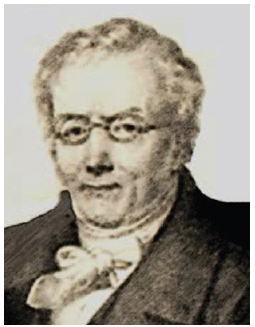
Figure 1A: Jean-Etienne Dominique Esquirol (3 February 1772-12 December, 1840), a French psychiatrist

Figure 1B: Edouard Séguin (January 20, 1812-October 28, 1880), a physician and educationist born in Clamecy, Nièvre, France. He was best known for his work with children with cognitive impairments in France and the United States

Figure 1C: John Langdon Down (18 November, 1828-7 October, 1896), a British physician
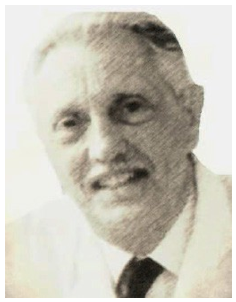
Figure 1D: Jérôme Jean Louis Marie Lejeune (13 June, 1926-3 April, 1994) was a French pediatrician and geneticist, best known for discovering the link of diseases to chromosome abnormalities and for his subsequent opposition to prenatal diagnosis and abortion
Patients and methods
A four-year boy old with Esquirol-Séguin-Down syndrome, devel¬opmental delay, and bilateral undescended testes is presented, and the recent relevant literatures were reviewed.
Results
Dysmorphic facial features included low set ears, depressed nasal bridge and oblique eye fissures (Fifgure-2A). The boy had poor speech development, and when the boy was convinced to take a pen to draw something: He couldn’t copy a line or a circle (Fig-ure-2B) suggesting a mental age under the three years. Ultrasound showed that both testicles were of normal size, but they were lo¬cated in the pelvis (Figure-3).

Figure 2A: A four-year boy old with Esquirol-Séguin-Down syndrome and undescended testes: Depressed nasal bridge and oblique eye fissures

Figure 2B: When the boy was convinced to take a pen to draw something: He couldn’t copy a line or a circle
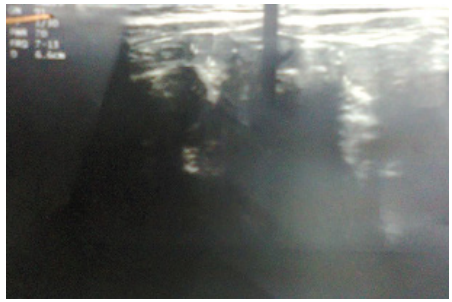
Figure 3: Ultrasound of a four-year old boy with Esquirol-Séguin-Down syndrome showed that both testicles were of normal size, but they were located in the pelvis
Discussion
Salemi et al (2012) emphasized that cryptorchidism is the most common congenital abnormality of the urogenital in males, and patients with Esquirol-Séguin-Down syndrome have a higher risk of cryptorchidism [4].
Satgé et al (1997) and Papatsoris et al (2003) emphasized that the association of Esquirol-Séguin-Down syndrome and undescended testes [5, 6].
Ebert et al (2008) reported the urological abnormalities in 24 patients with Esquirol-Séguin-Down syndrome (23 males and female) with a mean age of 79.4 months. Thirteen male patients had uni- or bilateral cryptorchidism. Two patients had posterior urethral valves, two patients had bladder exstrophy, and two pa-tients had hypospadias. Three patients had neurogenic and eight non-neurogenic functional bladder dysfunction [7].
Miki et al (1999) reported the association of typical testicular sem-inoma with bilateral undescended testes in Esquirol-Séguin-Down syndrome [8].
Conclusion
In this paper, the association of Esquirol-Séguin-Down syndrome with bilateral undescended testes is highlighted, and an education ultrasound is presented.
Acknowledgement
The author would like to express his gratitude for the parents of the child who willingly accepted publishing his photos. Some of the figures in this paper were included in author’s previ-ous publication, but the author has their copyright.
Conflict of interest: None.
References
- Al-Mosawi AJ. Down syndrome Atlas. 1st ed., Saarbrücken; LAP Lambert Academic Publishing: 2018 (ISBN: 978-613-9-58120-7).
- Al-Mosawi AJ. Atlas of Down syndrome in Iraqi children. Scholars’ Press: Nov, 2021(ISBN-13: 978-613-8-96521-3, ISBN-10:6138965213).
- Al-Mosawi AJ. Atlas of Esquirol-Séguin-Down syndrome in Iraq. LAP LAMBERT Academic Publishing November 23, 2021 (ISBN-13:978-620-4-72537-6, ISBN-10: 6204725378).
- Salemi M, La Vignera S, Castiglione R, Condorelli RA, Cimi-no L, Bosco P, Romano C, Romano C, Calogero AE. Expression of STRBP mRNA in patients with cryptorchidism and Down’s syndrome. J Endocrinol Invest 2012 Jan; 35(1):5-7. Doi: 10.1007/BF03345414. PMID: 22391137.
- Satgé D, Sasco AJ, Curé H, Leduc B, Sommelet D, Vekemans MJ. An excess of testicular germ cell tumors in Down’s syndrome: three case reports and a review of the literature. Cancer 1997 Sep 1; 80(5):929-35. PMID: 9307193.
- Papatsoris AG, Mpadra F, Karamouzis M, Likaki-Karatza E, Karatzas T. Torsion of undescended testis in a man with Down’s syndrome. Int J Urol 2003 Apr; 10(4):233-5. Doi: 10.1046/j.0919-8172.2003.00600.x. PMID: 12657105.
- Ebert AK, Brookman-Amissah S, Rösch WH. Urologische Manifestationen des Down-Syndroms : Bedeutung und Langzeitkomplikationen: eigenes Patientengut mit Ubersicht [Urological manifestations of Down syndrome: significance and long-term complications: our own patient cohort with an overview]. Urologe A 2008 Mar; 47(3):337-41.Doi:10.1007/ s00120-007-1614-0.PMID:18210071 [Article in German].
- Miki M, Ohtake N, Hasumi M, Ohi M, Moriyama S. Semino-ma associated with bilateral cryptorchidism in Down’s syndrome: a case report. Int J Urol 1999 Jul; 6(7):377-80.Doi: 10.1046/j.1442-2042.1999.00078.x. PMID: 10445309.