

International Journal of Media and Networks(IJMN)
ISSN: 2995-3286 | DOI: 10.33140/IJMN
Impact Factor: 1.02


Research Article - (2025) Volume 3, Issue 3
Technopanic, a Metamodern Phantasmagoria
Received Date: May 13, 2025 / Accepted Date: Jun 02, 2025 / Published Date: Jun 16, 2025
Copyright: ©Â©2025 David F. van der Merwe. This is an open-access article distributed under the terms of the Creative Commons Attribution License, which permits unrestricted use, distribution, and reproduction in any medium, provided the original author and source are credited.
Citation: van der Merwe, D. F. (2025). Technopanic, a Metamodern Phantasmagoria. Int J Med Net, 3(3), 01-09.
Abstract
This paper examines the anaesthetic effect of labour and production that dulled audience perception in the face of urban phantasmagoria within the cities of Western Europe during modernity, as noted in the works of Walter Benjamin. It then likens this effect to the narcosis and fear responses generated by the overwhelming spectacle of digital media content within the contemporary era of metamodernity. The objective is therefore to explore the historical concept of phantasmagoria, as per Benjamin, and summarily distil its essential nature via phenomenological interrogation before aligning this conceptual framework with clear supporting examples drawn from both eras in order to reinforce this parallel phenomenon. In so doing, the argument can thus be put forward that metamodern digital media and the associated impact it has on its users can indeed be labelled as phantasmagoric in nature.
Keywords
Phantasmagoria, Modernity, Metamodernity, Digital Media, Social Contagion, Media Effects, Phenomenology, Walter Benjamin
Introduction
(Re) Defining Phantasmagoria
A phantasmagoria, or “illusory performativity that masks its own material conditions of production”, is an aggregate of tradition, interpretation and history [1]. Its theatrical usage, describing magic lantern-style entertainments wherein the audience were treated to illusory projected ghosts, first enters the modernist lexicon at the turn of the 19th century with celebrated ‘performances’ in Paris over the December 1797 and January 1798; these entertainments leveraged the rampant supernaturalism of the period, employing sorcerous, necromantic tropes in an effort to overwhelm spectators with hallucinatory images [2].
The name of the entertainment allows for several interpretations: the portmanteau of ‘phantasm’ and ‘allegory’ first, obviously references the projected ghosts that make up the entertainment, but also the fantastical and dreamlike. The French ‘phantasm’ in Baudrillard’s (2001) “Seduction” is substituted in English for both illusion and simulacrum [3]. Given Baudrillard’s ever- present concern that technologies are obfuscating line between the real and mediated illusion, this observation’s significance in the context of this paper is apt. Following it with the ‘allegory’-based suffix ‘-goric’ implies the need for ethical interpretation: a moral message embedded in the work itself. In other words, awareness of where phantasmagoria ends and reality begins is essential when navigating mediated environments.
This paper leverages a phenomenological lens to examine the historical antecedents surrounding phantasmagoria and the influence they exerted urban life in modernity. Then, similar observations of the effect of digital media on their users within metamodernity are identified and explored, suggesting that these digital media and their platforms can indeed be labelled as phantasmagoric in nature.
A Supernatural Legacy
Arthur Rimbaud’s use of phantasmagoria establishes its supernat- ural connotations: in Night in Hell (2008, p. 18), he proclaims him- self a “master of phantasmagoria” while recounting a near-death experience, framing the term within visions of death, the cosmos, and the unknown. This supernatural dimension influenced Edgar Allan Poe, who in Ligeia (1985, p. 122) describes a scene where “[t]he phantasmagoric effect was vastly heightened” by eerie, wind-stirred draperies, reinforcing the term’s association with the unsettling [4]. These literary precedents cemented phantasmago- ria as a descriptor of the horrific, a legacy that persists in contem- porary horror and fantasy media.
Walter Benjamin’s predilection for Charles Baudelaire (whose work, as evidenced by the likes of Les Fleurs du Mal, was also steeped in the supernatural), informs his usage of the term: less a confined and heavily mediated theatrical space than an open urban one. Baudelaire (1917, p. 66), defines modernity as an ephemeral symptom of the phantasmagoric when stating that “la modernité, c'est le transitoire, le fugitif, le contingent” [5]. Phantasmagoria is thus, in Baudelaire’s (and later, Benjamin’s) view a visual metaphor for the dreamlike impressions of modern urban life, wherein sensory experiences are chaotic, occasionally frightening, but always captivating – and usually overwhelming for the inhabitants of these spaces, where the rapidity of change evokes a sense of disconnection and transience. As a result, within Benjamin’s work phantasmagoria become a dense aggregate that demonstrates societal crises obscured behind layers of spectacle and distraction [6]
Phantas magoria in Modernity
Distraction and Spectacle
The phenomenon observed above in Benjamin’s epoque is typified by a need for escape from these conflicting and overwhelming sensations: conditions describes as an environment wherein [e] very organ of sense is injured in an equal degree by artificial elevation of temperature, by the dust-laden atmosphere, by the deafening noise, not to mention danger to life and limb among the thickly crowded machinery [7].
Social conditions like these are thus tied to the motivations underlying viewer engagement with media. “No matter how sophisticated, how cynical the public may become about publicity methods, it must respond to the basic appeals, because it will always need food, crave amusement, long for beauty, respond to leadership”; but more than any other motivating force, it is escaping that audiences pursue [8].
As such, phantasmagoria in the “Arcades Project”, are an “intentional correlate of immediate experience”, spectacles that celebrate the exchange value of commodities, radiant constructions of light and commerce that distract passersby from the embodied experience that is city life [9]. Essentially, Benjamin’s adoption thereof is derogatory, if not outright pejorative; the illusory nature speaking to both the material and immaterial occlusion of authentic experience, mediated by external means – human and technological alike. In the case of the former, phantasmagoria takes on the character of fashion, of layering the material self in the hope of altering external perceptions. Benjamin (1999, p. 429) speaks, for example, of the flâneur’s ability to read personal narratives encoded in the external appearance of passersby, thereby rendering the lived phantasmagoric experience “one where we constantly spend our energies as we dress ourselves in the simulacra of human subjectivity” [6,9]. As we assume guises - or faceted personas of identity – to navigate interactions, we perforce take on different characteristics based on the perception we want to inspire; whether Shakespearean or Goffman-esque in tone, we stage and perform personae based on our audience, making the assumption of these temporary and illusory identities phantasmagoric in nature as well [10].
In terms of illusion, phantasmagoria are cast in a more sinister role. Benjamin’s (1999, p. 905) “phantasmagoria of society [and] atmosphere of the dream” are imbued with an inherent deception that dazzles rather than informs in a less immediate, but more sustained manner: if phantasmagoric approaches and methods – or ones which favour obfuscation – constitute historical structures in society, the very sense-making capabilities of those societies are shaped by these agendas, technologies and ideologies [9]. In the context of commodity capitalism, for example, every step of the value chain (through creation, production, promotion and distribution to consumption) is siloed from the other, purposefully separating every stakeholder within the process. Division thus breeds distrust, but the spectacle of the marketplace where the commodity is sold is carefully designed for distraction, and the consumer forgets their instinctive distrust in favour of the aspirational bourgeois ideology of possession that another layer of the phantasmagoria has enforced through the messages of the urban landscape, “a medium through which global capitalism and its spectacular imagery operate efficiently” [11].
The original usage of the term within modernity, literally translat- ing to a ‘gathering of ghosts’, implies an affective spectacle; and its popularity with the abovementioned Romantic writers like Poe, Rimbaud and Baudelaire have kept its unsettling – even disturbing – associations alive in common usage. Mitchell’s (2015) position- ing of the phenomenon on the “historic borderline between en- lightenment and terror”, implies as much potential to inform as it to overwhelm and even harm [12]. Casetti (2022, p. 351) suggests that a phantasmagoria, as media interface between other/world/ self, implies an optical and environmental spatial arrangement where technology and imagination collide [2]. By allowing them- selves to be transported by the phantasmagoria and submitting to sensory nullification, urban inhabitants enter a “world in which religion, the supernatural, classical references, current events, and voyeurism converge and often merge” (Ibid, p. 362) to effect es- cape.
Benjamin, however, decried such ‘romantic’ thought processes, instead employing the term to expose the mythic foundations of commodity fetishism within urbanity, as per his Marxist grounding in the harsh and real. The bright lights illuminating the myriad seductive attractions of the city thus exemplify “combined material and psychic dissonance of advanced industrial capitalism against the larger ideal of humanity” it is in that dissonance that we find the inhabitants of the urban cityscape seeking escape (or nullification) from day-to-day drudgery [12].
Phantasmagoric Experiences
As a result, contemporary media spectacles can deductively be conflated with historical phantasmagoria. Society has transitioned from commodity exchange – food, furs and the raw materials fulfilling life’s basic needs – to an exchange of products refined and manufactured from said commodities, to services offering to refine, manufacture and maintain these processes, through to turnkey operations that offer consumers immersive escapes from daily life. Pine and Gilmore (1998) summarise the process as one
that transitions from extraction to making to delivering and finally, to staging: crafting spectacles that deliver memorable, personal and sensational experiences [13]. While Merleau-Ponty (2002) posits that sensation is the unit by which we measure experience, it is our perception and summary cognition that summarily make sense of, categorise and store the experience in memory: an economical model founded in sensation (and by extension, experience) therefore is a more resonant one in terms of human appeal [14]. Unfortunately, the pointed term ‘staging’ mentioned above brings the model into question from a phantasmagoric perspective; if perception builds on sensation (and reception builds on perception), then experience is an entirely subjective abstract. In fact, if “only what is can be seen” (Ibid, p. 47) then the potential for manipulation through illusion is even greater. Even on reflection, second-order perception overlays primary sensations with thought and meaning, inferring a semblance of judgement o– mirroring the way phantasmagoria overlay reality with projected simulacra.
In a literal example of projection, the Fabrique des Lumiéres is “a modern take on the museum, or an immersive, titillating, audiovisual experience ... created to excite, to incite, and to overwhelm” [15]. Within the protected heritage confines of Amsterdam’s Westergasfabriek, itself an homage to modern industry, carefully animated sequences built from the likes of Dali, Mondrian, and Vermeer are projected onto the bare brick walls, celebrating artistic tradition brought to moving, interactive life via technology. Quite literally, a digitally mediated simulacrum projected over reality.
Yet immersion and escape via experiences like this are, despite the underlying technological framework, no novelty: throughout history, spaces have been imbued with stories in order to embody human experience and memory. In the words of Bär and Boshouwers (2018, p. 7) [t]his happens in the churches of Reims, where edifying parables are depicted on stained glass, on Moscow squares, where bold architecture shows people who’s the boss, and in galleries that want to tempt the public to come in and marvel at their treasures [16]. It’s as present in 18th century English landscaped gardens as it is in contemporary public attractions.
It follows that Benjamin saw the same phenomenon at work in the streets of Paris, a series of stories overlaid on spaces to occlude production and emphasise consumption. And narrative structures like these, consequently, have their own developmental value chain, as previously observed in the case of commodities: the most basic elements are facts, incontrovertible truths, upon which stories can be built. And once intangible and unproven ideas are added, these stories can be elevated to becoming experiences as well. These cohesive constructs thus engage the body through sensory stimulus, the mind by way of interest value, the heart by forming a relationship between story and audience and finally, the soul by embedding meaning into the story experience [16].
The Fabrique des Lumiéres is just one example of the form these experiences adopt in contemporary society; what historical equivalent did they take in Benjamin’s epoch? Daub’s (2019, p. 274) description of Benjamin’s trip to the Moscow opera presents a peculiar insight: Benjamin makes very little mention of the performance of “The Tsar’s Bride” itself, while carefully describing the minutiae of the rows of vestibule seating, the carpeting, and interactions during intermissions [1]. The overwhelming nature of the opera’s phantasmagoric of the operatic performance no doubt anaesthetised Benjamin to the sensations he experienced: in the face of its sublimity, extending beyond his capacity to assimilate the experience as a whole, he instead focused on tangential, sensible details. Consequently, Adorno’s (1981, p. 85) classification of opera as Gesamtkunstwerk, or ‘total artwork’ echoes its qualification as phantasmagoric, where he describes the sum total of all art forms – song, dance, music, painting, sculpture, costume and more – seen in Wagner’s bombastic productions as a “perfection of the illusion that the work of art is reality sui generis” [17].
This revisits Baudrillard’s (1994, p. 23) concept of hyperreality, a “hallucinatory resemblance of the real to itself” wherein a perceived reality is constructed by representational models without reference to a real-world original [18]. In this light, many contemporary media experiences are hyperreal and, by extension, phantasmagoric. To elaborate: the ubiquity of mobile phones enforces a screened and thus mediated experience of reality. Whether recording and sharing banal daily interactions and activities, or vicariously living through others’ content, or replacing face-to-face communications with text messages, emojis and photographs, the dominance of the screen as an interface with daily life is undeniable. Lanier (2011, p. 7) asserts that the technologies – and technologists – behind the media “make up extensions to your being, like remote eyes and ears (web-cams and mobile phones) and expanded memory (the world of details you can search for online)” [20]. Through the purposeful manipulation of your per
And we have yet to factor in platform modification. One of Snapchat’s more widely used features is the face filter, or “lens”, an overlay that deforms, modifies or edits the image being recorded on the screen in real time [22]. Popular face filters run the gamut from digital ‘makeup’ all the way to transforming the recorded camera image into a cartoon, but there are also a large number of Augmented Reality (AR) lenses that insert additional computer- generated imagery into the picture frame: from dog ears and noses through to dancing babies.
AR, a digital overlay on a screened image, is not as immersive as the full-body experience popularised by Virtual Reality (VR) in films like the Lawnmower Man or Ready Player One, but is more suited to the mobile nature of contemporary digital interactions: adding virtual content to a screened environment is far less cumbersome than the prosthetic devices and accessories required to access VR environments. Perhaps the commitment to full immersion in VR environments, as opposed to the immediacy of mobile access, has prevented VR from ever truly gaining mainstream popularity.
Phantasmagorically speaking, an AR overlay is far more insidious and, consequently, more dangerous than VR’s physical detachment. When mediated environments coexist with ‘real’ ones, it is that much harder to differentiate between the two; in the words of the comedian Dave Chappelle (2021), “the internet is not a real place” [23]. A comment made in response to the ‘cancel culture’ backlash he repeatedly receives on social media regarding his controversial views, it finds its scholarly equivalent in an “outrage society” unable to engage in meaningful online discourse due to the “fractiousness, hysteria, and intractability that… do not admit tactful or matter-of-fact communication” (Ibid). The result of this outrage is ephemeral, lacking the lasting injustice that drives real-world mobilisation, but if this were otherwise, the online complaints that characterise cancel culture would have far worse repercussions [24]. Now, the objects of public outcry are quickly forgotten in the overwhelming news cycle; digital mobs may call for the heads of those that dare disagree, but it is unlikely that these online Robespierres will ever be dragged before a real Madame Guillotine.
Building on Baudrillard’s concepts and speaking directly to this outrage, the research designer Keiichi Matsuda presents a grim vision of an over-mediated digital experience of physical reality in his short film, Hyper-Reality [25]. The project’s dystopian – yet still believable – near-future scenario demonstrates technologies inextricably intertwined with lived experience. Through this vision, Matsuda (Ibid) suggests that illusionary digital experiences “will be the glue between every interaction and experience, offering amazing possibilities, while also controlling the way we understand the world”. Collected screenshots in Figure 1 include one scenario (in the lower left corner) where the overlay is switched off temporarily, exposing a grey, bland and wholly unappealing alternative, even in the face of overwhelming information overload and advertising messages.
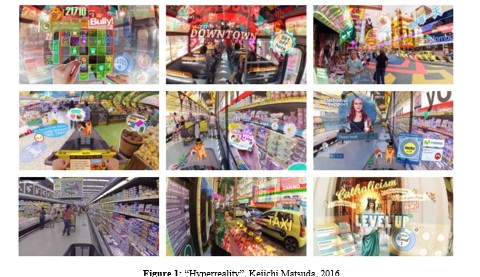
Matsauda’s example is undeniably extreme and, consequently, shocking: representative of Kantian sublime in that it “goes beyond our sensibilities and we are thus induced to imagine more than we see” [26]. A distracted reception mode is thus needed to effectively negotiate phantasmagoric experiences: one less contingent on momentary perception than on apperception. This aggregate experience of immediate sensation and residual memory results in a new receptivity where the authenticity of the experience is never questioned, only its momentary impact that is swiftly replaced by the next stimulus to come along in the ongoing cycle of “the sudden, shock-filled, multiform life that carries us away”– in itself a fitting echo of the Dada manifesto’s declaration of an “art which has been rightly shattered by the explosions of last week” [9,27].
Technopanic and Metamodernity
Manifesting Fear
The phantasmagoric attractions of Benjamin’s modern era were an alluring snare cloaked in novelty, promising desensitivity, and Baudrillard (2001, p. 138) reminds us that we do “not escape meaning by dissociation, disconnection or deterritorialization” but only by replacing our experience of reality with a subverted technological simulacrum, a trap into which we willingly walk (or scroll) [3]. As such, we are not the digital panopticon’s prisoners, but consenting participants who “communicate not because of external constraints but out of inner need” (Han, 2013, p. 72) to click, create, share, like and comment in a desperate paean to exhibitionist representation.
Many of the digital denizens of met modernity rely on hyper communicated representations of themselves to be seen and consequently validated in the eyes of an audience that is more often than not an algorithm rather than a human. For example, on the extramarital dating service Ashley Madison, of approximately 32 million registered users, 20 million male users were actively checking messages, while only 2,500 female users were doing the same – implying that nearly 12 million ‘female’ accounts were actually bots maintaining interest (and subscription payments, obviously) from the male contingent [28]. Worse, the platform threatened these users with exposure of their extramarital affairs if they complained about the infringement.
In this example, we see a clear example of manipulation through fear: cultivation theory at work. This longitudinal, passive media effect, shaped by consistent exposure to carefully crafted, fear- based messaging rooted in othering is designed to shape social reality on a large scale [29]. Here, the particular fear is that the hidden identities of the male users will be discovered by the very people they have tried to deceive. In a Hegelian sense, this action defines the identity of the male user as inherently deceptive, but this interpretation prioritises the observer’s perceived reality over the experiential reality of the user [30]. There is, in the heavily mediated and richly diverse digital domain, “no way to provide one – and only one – base plane from which to describe homogeneity within the fundamentally different experiences of globally diffused media”, inevitably engendering any delineation of these users with observer bias [31].
We, as observers or critics cannot simply detach from the world to achieve a transcendent consciousness thereof; our individual experiences are inextricably tied to our embodied bias, so who are we to judge the actions of another?
We can judge the phantasmagoric nature of the phenomenon, however. As Benjamin (2006, p. 103) noted how “authenticity eludes technological – and of course not only technological – reproduction”, the same can be said for ethnographic examinations of behaviours within a technologically mediated space [32]. Users of digital platforms inhabit a “socially constructed reality”and, as such, any recording or interpretation of their actions within this space is a simulacrum at best, lacking in real-world reference or validation [33].
Before the birth of the internet, Stephen Tyler (1986, p. 34) prophesied obfuscation in phantasmagoric online spaces, describing post-modern ethnography as “an enigmatic, paradoxical and esoteric conjunction of reality and fantasy that evokes the constructed simultaneity we know as naïve realism” [34]. The technological filter overlaid on real interactions when phatic friendships and parasocial relationships take precedence is thus an embedded illusion, wherein participants find themselves “quasi- organically interlocked in the medium of a new immediacy”, mirroring the same societal structures Benjamin observed happening between urban citizens and the phantasmagoria shaping their experiences within modernity [35].
Due to interactions like these, the phantasmagoric nature of social media and digital content in metamodernity inspires a moral crisis surrounding media usage, or technopanic in its users. This is especially common among parents who fear reckless online behaviour on the part of their children, leading to secondary concerns like cyberbullying, sexualization and over-disclosure, not to mention gratification addictions [36].
Metamodern Media
Phantasmagorically speaking, by providing platform users the illusion of freedom of expression, te line between public and private, between isolation and connection, is blurred to the point where the two frames are indistinguishable from each other. Users operating within this liminal and often unregulated space are driven by a fear of invisibility, their need for attention driving them to autoexploitation, wherein the fear of “giving up one’s private and intimate sphere yields to the urge to put oneself on display, without shame” [24]. In this way, freedom of choice is subverted by the controlling platform politics: every user is watching every other, abolishing any difference between seeing and surveillance in the digital panopticon.
Technopanic as a term is thus often seen as a dystopian construct symptomatic of the over-pathologisation of everyday behaviours: even the Apparatgeist parents imagine when discussing their children’s media usage is largely unchanged from the television addiction narrative dominating the 1980s [37]. The social and cultural conceptions of what exemplifies deviant or pathological media usage are thus cyclical; by substituting a contemporary medium, case or technology, historical examples take on contemporary relevance.
The prevailing concern surrounding cyberspace, that the “virtual metropolis is as dangerous and confusing as actual city streets” is again grounded in fear [38]. The fear in this case is that parents expressing moral outrage are actually manifesting their own guilt. The primary audience of TikTok, for example, are tweens (eight to twelve year olds) despite their not being legally allowed to ‘own’ a social media account on the platform – making the parents the actual mediators, moderators and navigators of their children’s accounts [36]. Their own failures to properly manage this role generates guilt, leading to a fear that they are exposing their children to reckless and even dangerous behaviour, which they then classify in terms like ‘gratification addiction’ to minimise that guilt.
Which is not to say that the fear of predatory threats is unfounded: merely that the danger is less one of physical harm than of emotional. Gianluca Bonifazi et al (2022) identify several ways TikTok communities build rapidly and with greater cohesion when the connecting factor implies danger – usually sexual or otherwise exploitative. Even what seems tame, as far as challenges go, can often become sexualised; the #bugsbunny challenge, for example
wherein “participants lie on their stomachs and lift their legs upwards to show their feet sticking out of their heads like the ears of a rabbit” (Ibid, 6) regularly involves nudity and the purposeful revealing of intimate parts of their bodies.
Overdisclosure is the common theme here. Regardless of the content, all social media posts are intended to elicit a response. Whether engaging the lust of an imagined public, ‘sadfishing’ for sympathy, promoting products or sharing news, content creation always carries an agenda of attention engagement. And that attention is no discriminator: algorithms make no determination of value when “matters of historical import, like a civil rights issue, for instance, are now flattened into the same homogenous, empty digital space as a cute critter or obnoxious celebrity” [39]. Only through over disclosure, by sharing more than we would outside of the digital domain, can users elicit enough reaction to make their voices heard in the competing swarm. Our “complete capitulation to the forces of libidinal destruction” (Ibid, p. 45) is a necessary price to pay for visibility in a programmed sociality where identity is always a performance reliant on external observation [40].
Social Learning or Social Contagion?
The Addiction Epidemic
Perception requires summary cognition in order to be re-classified as reception, and the “theoretical foundation for behaviour modelling” that is social learning theory requires a similar twofold process of observation and instruction in order to instil cognitive processes among youth audiences [41]. Social platforms are designed to teach accessibility through observation of others: platform design encourages automatic viewing that seems effortless, even uncontrolled and instinctual, to a non-immersed observer. The resulting fatigue from overuse, in turn, encourages further automatic scrolling and unconscious media consumption, further motivating parents’ panic in the face of unregulated media usage as described earlier [42].
This raises a neuraesthetic concern: Kaczmarczyk (2014) notes how superstimulus in the face of affective visual media can cut a viewer off from the real world until an overriding (usually physical) stimulus overrides the involuntary attention loop [43]. Media addiction may therefore be neither individual pathology or deficiency, despite associated biomedical implications, but a planned exploitation of our own human tendencies towards desire and gratification by tech companies who continuously push us to small, constant doses of dopamine via our smartphones [37]. This nefarious agenda was confirmed in 2017 by Napster cofounder and ex-Facebook President Sean Parker through a process called ‘variable reinforcement’, where platforms are purpose-built to maintain attention through regulated ‘hits’ of dopamine via likes, comments and push notifications – simultaneously generating raw user data for the platform to profit off of [44]. The ‘Like’ button is thus the digital equivalent of the hypodermic needle in a contemporary addiction epidemic, fusing user and supplier in a reinforcement loop and, like other addictions, leaving a trail of victims in its wake.
Consequently, Tuikong’s (2022, p. 76) technopanic, “an unreasonable fear of what technology might bring to society” balances the immediacy of perceived risks with tangible threats; these spread beyond the dangers of cyberbullying and harassment and return, once again, to the spectre of behavioural modification via contemporary communication media [41]. Wylie (describes technopanic as a very real threat, calling it “information warfare” hidden behind sociality and connectedness [44]. This phantasmagoric illusion is, in Wylie’s (Ibid) words, “worse than bullying, because people don’t necessarily know it’s being done to them. At least bullying respects, the agency of people because they know”.
Once terms like ‘warfare’ are used, risks rapidly transition from being merely perceived to being all too real. And in that light, it is best to move from calling digital phantasmagorias examples of social learning towards what they really are: social contagions. Sociology, physics and computer sciences agree that epidemic spreading models are employed when examining digital social spaces, given the “remarkable similarities between the social contagion and epidemic diffusion processes where global cascades may emerge through the microscopic interactions between individuals” [45]. Furthermore, where most closed systems tend towards homogeneity, negative feedback (or infection) weakens the dynamic structure of all systems observed using this model, rather than positively informing decision-making (Ibid, p. 7). Even when the majority of nodes within a social contagion model are largely insensitive to pressures, imitation speeds up the cascade process: “as rationality decreases, the adoption density speeds up” [
Social contagion thus influences behaviour across networks: perhaps its only saving grace is its transitory nature. Often finding its outlet in outrage – with technopanic as just one example thereof – the enraged and outspoken swarms that aggregate around a common ‘trigger event’ rarely “demonstrate concern for the whole of the social body so much as for themselves” and, as a result, the initial contagion quickly passes [24]. Jean Baudrillard (2005, p. 134) identifies the human condition’s desire for events and spectacles that become a “pathetic contagion that sweeps through crowds … a spontaneous reaction to an immoral situation”, which, like most mediated illusions, find no real-world equivalent and dissipate as spontaneously as they flare [48].
The resultant disconnection, even in the paradoxical context of global hyperconnectivity via social media, as suggested by Buck- Morss (1992) and Kang (2014) is an auto-immune response [21,49]. This “defensive mechanism instigated by the sensorial overload” is a neuraesthetic response to the manipulation of our instincts by the platform’s governing logic. The anaesthesis experienced by users, in a vicious cycle of dopamine addiction, then requires further stimulus to be dismissed. When faced with a “spectator, who flees from boredom and demands to be permanently entertained”, the algorithms can only give in to that desire and re-ignite (or re- infect) the cycle again [50].
Systemic Infection
The phantasmagoric stimulus-response cycle suggests larger systems at work than the targeting of individuals and their isolated agendas. Edward Bernays (1936, pp. 53-54) observed how the reiterative approach of reaction psychology, wherein one message would be repeated continuously to instil a habit, fails in the context of larger, more diverse populations and systems. An emotive current that can be applied to larger systems, so-called “associative processes” (Ibid, p. 56) has a wider radius of effect because it considers broader systems at work: cascade effects result in greater reach and greater impact groups and individuals. Even where the connections between nodes in the system are tenuous, diffusion of ideas happens very quickly as social contagion spreads, especially in modern social media networks where connections are parasocial at best, echoing the epidemic modelling at work described above [46,51].
Following the conflation of social contagion with epidemic spread models and, in the light of symptoms like those described here, it becomes clear that phantasmagoric media and their associated culture of surveillance capitalism are indeed diseased, and that “every successful vaccine begins with a close understanding of the enemy” [44]. Bernays (1936, p. 10) describes a hidden force who “pull the wires which control the public mind, who harness old social forces and contrive new ways to bind and guide the world” in a near-textbook illustration of an external force invading, infecting and even controlling the afflicted. And even when the afflicted merely retreats into the narcotic state of distraction in the face of phantasmagoria, the ends of the puppetmasters have been met. Baudrillard (2001, p. 166) also suggests that we move along a trajectory from narcissus (the autoexploitative oversharing by which we feed our egos) to narcosis, where alienation from real experience makes us the “predisabled people … am
This revisits technopanic: the discomfort experienced – usually by third parties – in what Mitchell (2015) calls a “shared sense of technophilia, the feeling that we are in the midst of a media revolution” and the resulting “unreasonable fear of what technology may bring to society” recalls affective responses to images of the grotesque and horrific [12,41]. Outraged parents make the medium the antagonist in the relationship, delegating responsibility from their own failures to navigate digital phantasmagoric experiences, rendering this ‘other’ “the bug-eyed monster … the personification of all enemies … the ultimate incarnation of the devil” [52].
The question remains, however, whether a victim of this metaphysical ailment can ever be free of extrinsic influence, in much the same way an addict is never ‘cured’, they merely learn mechanisms by which to ameliorate the worst manifestations of their disease. The social contagion we call ‘media addiction’ is no different: like alcoholism, it is a moral infirmity as much as it is physiological.
Conclusion
Benjamin (2006, p. 120) noted that film, “by virtue of its shock effects”, was unmatched in its degree of stimulation during his era [32]. Today’s media sources fail to produce shock on a similar scale, however, as the “totalization of consumption is eliminating every form of immunological recoil” we may once have experienced when confronted with the ugly or repellent. Eco (2007) would argue that ugliness is in itself merely a symptom of impending transformation, but the transformation demonstrated in contemporary neuraesthetic responses is a dulling of the senses rather than a heightened sense of outrage, fear or disgust [52]. Shock effects are almost annihilated in the face of the depressive narcissism that accounts for the echo chambers today’s denizens of the digital domain routinely occupy.
Clear parallels can thus be observed between Benjamin’s era, modernity, and the current digital age, or metamodernity. And the parallel phenomenon is less one of technology or media format, but one of effect. Arguably, this could reference affect as easily: over and above the observable phenomena of convergence, cultivation or even technopanic described above, there is still an undeniable sense of the raw, non-conscious sensation or pre- personal potential demonstrated in users of this technology, before these pre-emotional responses can be fully coded as emotion or meaning. This transition from existential to empirical content, as per Merleau-Ponty (2002, pp. 61-62) mirrors the transition from perception to reception in its pre-cognitive reaction requiring summary assimilation to form rational interpretation [14]. This paper, through engagement with both academic and popular sources, has shown that the phenomenon of phantasmagoria within metamodernity is best read as a metaphor for media immersion; not a re
The primary observable phenomenon can thus be summarised as follows: in the face of phantasmagoric media, a common response is self-anaesthesis. This narcosis is a form of escape, of not wanting to confront the experience directly. This illustrates the sublime, given the overwhelming quantity of media that are overlaid on the daily lived experience of metamodernity, conforming to Kant’s mathematical, rather than dynamic, “excess of sensuous form” that outweighs natural potential [53].
Given the results above, the phenomenon can indeed be validated as demonstrative of a real parallel between modernity and metamodernity; the medium and technological catalysts may have changed radically, but the cost in human experience remains largely unchanged.
References
- Daub, A. (2009). Sonic Dreamworlds: Benjamin, Adorno, and the Phantasmagoria of the Opera House. na.
- Casetti, F. (2022). Rethinking the Phantasmagoria: an enclosure and three worlds. Journal of Visual Culture, 21(2), 349-373.
- Baudrillard, J. (2001). Seduction. Translated by Brian Singer. Montreal: Culturetexts.
- Poe, E. A. (1985). Sixty-seven Tales and the Narrative of Arthur Gordon Pym of Nantucket; The Raven and Other Poems. New York: Gramercy Books.
- Baudelaire, C. 1917. Oeuvres Completes de Charles Baudelaire. Quelques-uns de mes Contemporains L'Art Romantique. Edited by M. Jacques Crépet. Paris: Louis Conard.
- Panfilio, K. M. (2013). Awakening from the nightmarish slumber of phantasmagoria: Meditations on Walter Benjamin and the Arcades Project. Philosophy & Social Criticism, 39(3), 243-261.
- Marx, K. (1976). Capital. A Critique of Political Economy. Translated by Ben Fowkes. Penguin Classic Paperback Edition. Middlesex: Penguin.
- Bernays, E. L. (1936). Propaganda. Fifth paperback edition.New York: Liveright Publishing Corporation.
- Benjamin, W. (1999). The arcades project. Harvard University Press.
- Grayson, T. R. D. (2003). Philosophy of Identity (Part of theIdentity Planet series). Semantic Scholar.
- Lahiji, N. (2015). Phantasmagoria and the architecture of the contemporary city. Architecture_MPS, 7(4), 1-17.
- Mitchell, W. J. T. (2015). Image science: Iconology, visual culture, and media aesthetics. University of Chicago Press.
- Pine, B. J., & Gilmore, J. H. (1998). Welcome to the experience economy (Vol. 76, No. 4, pp. 97-105). Cambridge, MA, USA: Harvard Business Review Press.
- Merleau-Ponty, M. (2005). Phenomenology of Perception. Translated by Colin Smith. Routledge Classics Ebook Edition. London: Routledge.
- Culturespaces. (2023). About Us. Fabrique des Lumiéres. Accessed 13 November 2024.
- Bär, E., & Boshouwers, S. (2018). WOW Worlds of Wonder: Experience Design for Curious People. Bis Publishers.
- Adorno, T. (1981). In Search of Wagner. Translated by RodneyLivingstone. London: NLB.
- Baudrillard, J., & Glaser, S. F. (1994). Simulacra and simulation (Vol. 312). Ann Arbor: University of Michigan press.
- Lanier, J. (2011). You Are Not a Gadget: A Manifesto. London:Vintage.
- Kang, J. (2014). Walter Benjamin and the media: The spectacle of modernity. John Wiley & Sons.
- Snapchat. (N.d.) Check out popular Snapchat lenses. Snapchat. Accessed 4 December 2024.
- Chappelle, D. (2021). The Closer. Directed by Stan Lathan. Los Gatos: Netflix.
- Han, B. C. (2017). In the swarm: Digital prospects (Vol. 3). MIT press.
- Matsauda, K. (2016). Hyper-reality by Keiichi Matsua.
- Eco, U. (2004). On Beauty. translated by AlastairMcEwen. Secker & Warburg.
- Hughes, R. (1991). The Shock of the New. Revised Edition. New York: Alfred A. Knopf.
- Morris, D. (2016). Ashley Madison used chatbots tolure cheaters, then threatened to expose them when they complained. Fortune.
- Turow, J. (2020). Media today. Seventh edition. New York: Routledge.
- Sullivan, P., & McCarthy, J. (2007). The relationship between self and activity in the context of artists making art. Mind, Culture, and Activity, 14(4), 235-252.
- Rocha, J. C. 2003. Museums of the Present: Rimbaud Reads Benjamin. In H. U. Gumbrich & M. Marriman, Mapping Benjamin: The Work of Art in the Digital Age (pp. 249-255). Stanford: Stanford University Press.
- Benjamin, W. (2018). The work of art in the age of mechanical reproduction. In A museum studies approach to heritage (pp. 226-243). Routledge.
- Watson, C. (2009). Picturing validity: Autoethnography and the representation of self?. Qualitative Inquiry, 15(3), 526- 544.
- Tyler, S. A. (1986). Post-modern ethnography: From document of the occult to occult document. Writing culture: The poetics and politics of ethnography, 122-140.
- Werber, N. (2003). Media Theory After Benjamin and Brecht: Neo-Marxist?. Mapping Benjamin: The Work of Art in the Digital Age, 230-9.
- De Leyn, T., De Wolf, R., Vanden Abeele, M., & De Marez,L. (2022). In-between child’s play and teenage pop culture: tweens, TikTok & privacy. Journal of Youth Studies, 25(8), 1108-1125.
- Vanden Abeele, M. M., & Mohr, V. (2021). Media addictions as Apparatgeist: What discourse on TV and smartphone addiction reveals about society. Convergence, 27(6), 1536- 1557.
- Feinstein, J. 2003. If It Were Only for Real. In H. U. Gumbrich & M. Marriman, Mapping Benjamin: The Work of Art in the Digital Age (pp. 274-280). Stanford: Stanford University Press.
- Pettiman, D. (2016). Infinite Distraction: Paying Attention toSocial Media. Cambridge: Polity Press.
- Darvin, R. (2022). Design, resistance and the performance of identity on TikTok. Discourse, Context & Media, 46, 100591.
- Tuikong, S. (2022). Just technopanic or a real risk? Publishing children’s pictures online: A review of literature. International Journal of Child, Youth and Family Studies, 13(2), 72-87.
- Wang, K., & Scherr, S. (2022). Dance the night away: How automatic TikTok use creates pre-sleep cognitive arousal and daytime fatigue. Mobile Media & Communication, 10(2), 316-336.
- Kaczmarczyk, K. (2014). Art and Reality: Towards a Neuropsychological Theory of Aesthetic Perception. Via Panorâmica: Revista Electrónica de Estudos Anglo- Americanos/An Anglo-American Studies Journal, Série, 3(Especial), 63-178.
- Zuboff, S. (2019). The Age of Surveillance Capitalism: The Fight for a Human Future at the New Frontier of Power. New York: PublicAffairs.
- Cadwalladr, C. (2018). I made Steve Bannon’s psychological warfare tool’: meet the data war whistleblower. The Guardian, 18(3).
- Ruan, Z., Zhang, L., Shu, X., & Xuan, Q. (2022). Social contagion with negative feedbacks. Physica A: Statistical Mechanics and its Applications, 608, 128304.
- Shu, X., Yang, M., Ruan, Z., & Xuan, Q. (2024). Social contagion under hybrid interactions. Chaos, Solitons & Fractals, 189, 115687.
- Baudrillard, J. (2005). The Intelligence of Evil or the Lucidity Pact. Translated by Chris Turner. Oxford: Berg.
- Buck-Morss, S. (1992). Aesthetics and anaesthetics: WalterBenjamin's artwork essay reconsidered. October, 62, 3-41.
- Benjamin, M. (2003). The Work of Art in the Digital Age/Ed.HU Gumbrecht and M. Marrinan.
- Feng, L., Hu, Y., Li, B., Stanley, H. E., Havlin, S., & Braunstein,L. A. (2015). Competing for attention in social media underinformation overload conditions. PloS one, 10(7), e0126090.
- Umberto, E., & McEwen, A. (2007). On ugliness. London: Harvill Secker.
- Ross, N. (2021). Walter Benjamin’s first philosophy: Experience, ephemerality and truth. Routledge.
- Bonifazi, G., Cecchini, S., Corradini, E., Giuliani, L., Ursino, D., & Virgili, L. (2024). Investigating community evolutions in TikTok dangerous and non-dangerous challenges. Journal of Information Science, 50(5), 1170-1194.
- Ihde, D. (2010). Heidegger’s Technologies: postphenomenological perspectives. New York: Fordham University Press.
- Mingers, J. (2014). Systems thinking, critical realism and philosophy: A confluence of ideas. Routledge.
- Rimbaud, A. (2008). Selected Works in Translation. Translated by A. S. Kline. Delaware: Poetry in Translation.