

Journal of Textile Engineering and Fashion Technology(JTEFT)
ISSN: 2771-4357 | DOI: 10.33140/JTEFT

Research Article - (2026) Volume 8, Issue 1
Sustainable Claims: Educating Indian Consumers To Spot and Refrain Greenwashing
Received Date: Feb 17, 2026 / Accepted Date: Mar 18, 2026 / Published Date: Mar 30, 2026
Copyright: ©2026 Anjali Chavan. This is an open-access article distributed under the terms of the Creative Commons Attribution License, which permits unrestricted use, distribution, and reproduction in any medium, provided the original author and source are credited.
Citation: Chavan, A. (2026). Sustainable Claims: Educating Indian Consumers To Spot And Refrain Greenwashing. J Textile Eng & Fash Tech, 8(1), 01-11.
Abstract
In recent years the fashion and textile industry has embraced sustainability and there has been a growing demand in sustainable fashion brands. Eco-friendly materials, community involvement, and ethical sourcing are becoming more and more prominent in brand storylines. Sustainability has gained popularity as a trendy word that is often used without enough effect or transparency, in addition to being an ethical need. On the surface, sustainability change seems encouraging, but the absence of standards, laws, and consumer education has resulted in the emergence of greenwashing, which is the practice of making extravagant, ambiguous, or false claims about sustainability. Greenwashing where customers are misled by ambiguous or deceptive sustainability claims and genuine efforts are undermined has become more prevalent due to a lack of clarity. The paper investigates how, in the context of Indian fashion, consumer education may be a vital tool in the fight against greenwashing. The research employs a mixed methods approach, which includes focus groups with educators, consumer surveys aimed at urban youth and design students, and content analysis of sustainability from fashion businesses. The results show that there is a significant understanding gap among consumers, with many being unable to discern between marketing spin and real sustainable initiatives. The study suggests a three-tiered educational framework to address this, firstly awareness—which introduces important ideas and greenwashing techniques, secondly analysis—which empowers customers to decipher certifications, labels, and brand transparency; and thirdly action—which encourages advocacy, critical thinking, and mindful buying. The study also looks at case studies from classroom modules that stress ethical consumerism and transparency, student-led awareness initiatives, and academic interventions. The study promotes a more open and responsible fashion ecosystem where customers are better equipped to assess ethical claims and make educated decisions that drive industry transformation instead of vague sustainability trends.
Keywords
Ethics, Sustainability, Awareness, Greenwashing
Sub Theme- Virasat (Legacy & Sustainability) Ethics, Equity and Social Responsibility
Introduction
Growing consumer knowledge of ethical and environmental issues has caused a paradigm change in the worldwide fashion and textile business toward sustainability [1]. Eco-friendly materials, ethical sourcing, and community-driven craft methods are becoming more and more popular in India, especially among urban millennials and design students. Companies are using words like “eco-friendly” and “ethical” to appeal to consumers who care about the environment, and they are incorporating sustainability into their stories more and more. Greenwashing, the practice of presenting inflated, ambiguous, or deceptive statements about sustainability, is a darker side of this trend that erodes consumer trust and undermines sincere efforts [2]. Greenwashing has become a major problem in India, where consumer education is still in its infancy and regulatory standards for sustainability claims are weak.
Consumers are deceived by greenwashing when they see false sustainability credentials, which makes it hard for them to tell the difference between genuine and deceptive company practices. This is especially noticeable among urban youth, of the Indian fashion market who frequently lack the skills necessary to assess sustainability claims. This problem is made worse by the lack of clear communication and established certifications, which exposes customers to deceptive marketing. In order to promote a more responsible fashion environment, it is imperative that consumers be empowered through knowledge.
Retailers such as Baggit and Suta have capitalized on this trend by marketing “handwoven” textiles and “vegan leather” bags as eco-friendly options for younger customers. Greenwashing, the practice of companies like Westside using vague phrases like “earth-friendly” or “green” without supporting data, taints this increase by deceiving customers and undermining real sustainability initiatives. Such false statements undermine industry trust and impede ethical consumption in India’s less regulated market by taking advantage of urban youth’s ignorance and preference for style over confirmed sustainability.
The purpose of this study is to address important knowledge gaps regarding sustainable fashion claims by examining how consumer education might enable Indian consumers—especially urban youth and design students—to recognize and reject greenwashing. Three questions serve as the foundation for the study: (1) What knowledge gaps exist among Indian consumers regarding promises about sustainable fashion? (2) How might these deficiencies be filled and ethical consumption encouraged via an educational framework? (3) How can student-led projects and academic interventions promote transparency in the fashion industry? The study offers a threetiered educational framework: awareness (identifying greenwashing), analysis (assessing claims), and action (promoting transparency) based on a mixed-methods approach that includes surveys, focus groups with educators and industry professionals, and content analysis of brand communications. Through curriculum integration, this paradigm places a strong emphasis on practical education, giving consumers the tools they need to evaluate claims. In order to promote an accountable and transparent fashion industry in India, this study is important. It encourages ethical consumption and holds companies responsible by enabling urban youth and design students to evaluate sustainability claims objectively.
Literature Review
The transformation of the fashion sector towards sustainability has catalyzed comprehensive inquiries into the phenomenon of greenwashing, consumer perceptions, and the imperative for education to promote ethical consumption practices. This analysis of literature investigates eight key studies to evaluate the misunderstandings consumers have regarding sustainable fashion claims, especially in the Indian scenario. By synthesizing both global and regional perspectives, it identifies critical knowledge gaps and strategies to enhance consumer empowerment within the fashion ecosystem of India.
Siddhartha’s Research looks at how the fashion business affects the environment and society, showing how sustainable methods like eco-conscious behavior and circular fashion are becoming more popular worldwide [3]. This is especially important for India’s craft-based fashion industry. It addresses issues like regulatory gaps and greenwashing, which damages consumer trust through false claims, using case studies and literature reviews. For Indian companies like Raw Mango, the study suggests a framework that improves supply chain transparency and circular economy concepts (recycling, durability). Design students’ involvement in stakeholder collaboration emphasizes their advocate for transparency. Since there is a dearth of actual data on Indian consumers, this gap is filled by surveys, which emphasizes the necessity of education to differentiate between genuine sustainability. In addition to encouraging ethical buying and supporting the action tier, researcher’s advocacy for circular economy education highlights the necessity of an open, regulated fashion industry in India, particularly for young people deciphering marketing claims.
Hameed With a focus on consumers who have already used green products, this study examines how greenwashing affects consumers’ green purchasing decisions [4]. It looks at how this link is mediated by green brand loyalty, green brand love, and green brand image. By undermining these mediating elements, greenwashing has a negative direct and indirect impact on green buying behavior, according to empirical investigation using structural equation modeling (SEM). In particular, greenwashing has a negative impact on the love, loyalty, and image of green brands, whereas these elements have a favorable impact on green purchasing behavior. The results highlight how crucial it is for businesses to reduce greenwashing and cultivate positive opinions of their green brands in order to increase customer confidence and promote sustainable purchasing. The aim of the study is to evaluate the impact of greenwashing and comprehend the moderating functions of loyalty, love, and green brand image. Although not stated explicitly, limitations including possible self-reported data biases or a narrow demographic scope are suggested, advising caution when extrapolating across settings. It provides a competitive edge in the expanding ecoconscious market by emphasizing genuine environmental claims and brand development to influence consumers toward sustainable decisions.
The paper examines how the fashion industry, a field dealing with serious environmental issues, is threatened by greenwashing in terms of sustainability and the circular economy [5]. It contends that greenwashing erodes customer trust by undermining ethical initiatives like recycling, cutting down on byproducts, and promoting wise buying. The conceptual evaluation urges a change to open, sustainable practices by highlighting how fashion companies’ reputations might be improved by rejecting greenwashing. It offers advice on how businesses might weigh the benefits and drawbacks of greenwashing, highlighting the necessity of regaining trust in India’s unregulated fashion industry. Despite the lack of scientific evidence, it probably criticizes present methods and supports education on the effects of greenwashing, which is in line with this study’s awareness tier. Avoiding greenwashing and building trust are essential to the fashion industry’s sustainability objectives in order to encourage the adoption of the circular economy.
The study evaluates 768 customers in the UK, Canada, and Pakistan on their awareness, trust, and efficacy in differentiating between sustainable and greenwashed items [6]. Even “high environmentalists” are duped by greenwashing, according to research using Chi-Square and SEM, which has a detrimental effect on green purchasing behavior even when their purchasing intent remains unaltered. Generational disparities are shown by younger consumers’ lower levels of trust. The report proposes improved education and legislation to combat greenwashing, arguing that insufficient policy and education are the root cause of consumer vulnerability. This addresses the 80.9% awareness gap on greenwashing among Indian adolescents and is consistent with the analysis tier of this study.
By examining the effects of green advertising receptivity (GAR), nondeception (ND), green brand image (GBI), and transparency (TR) on green brand trust (GBT) among 262 Vietnamese respondents, this study investigates how consumers view greenwashing [7]. Along with ND’s moderation of GAR-GBT and TR’s moderation of GBI-GBT, it investigates the mediating role of GBT and its effect on purchase intentions (PI) using the Stimulus-Organism Response (SOR) framework and PLS-SEM via SmartPLS. The results reveal that while ND and TR have no direct effect and that ND has a moderate effect on GAR-GBT, GAR and GBI increase GBT and improve PI. The study provides theoretical and practical insights while highlighting the critical role that trust plays in green marketing. Cross-sectional data, a culturally distinct population, and possible self-report bias are some of the limitations that limit generalizability. It supports the study’s emphasis on education and trust in order to dispel myths about greenwashing.
Using 433 valid surveys that were analyzed using PLS-SEM, this study investigates how young Chinese customers’ perceptions of greenwashing in the fast fashion business impact their intentions to make green purchases [8]. Through perceived financial and environmental risks, it demonstrates that greenwashing has a negative impact on green purchasing intention both directly and indirectly. Impulsive buying increases perceptions of financial risk (β = 0.127, p < 0.01). This study fills a knowledge gap by examining how the fast fashion model, which has been attacked for its disposable culture and unsustainable practices, uses greenwashing to take advantage of information asymmetry. Examining the impact of greenwashing and how risk perception mediates it are the main goals of the study. According to research, genuine certifications and communication can lower perceived risk and increase sustainable purchasing. Limitations include context-specific risk perceptions, which are consistent with this study’s focus on youth education against greenwashing, and a China-specific sample, which limits worldwide applicability.
The paper discusses greenwashing as a serious advertising issue that harms consumers, the green product industry, and the environment [9]. It emphasizes how customers struggle to distinguish between ethical and misleading greenwashing techniques. The whole content of the introduction is not supplied, although it would usually concentrate on the prevalence and challenges of greenwashing, laying the groundwork for the study topic. The study’s primary purpose is to assess a literacy intervention meant to help consumers spot deception in advertising, particularly in the context of greenwashing. The offered text lacks a direct conclusion. The offered material does not address the study’s precise limitations. In conclusion, this article addresses the essential issue of greenwashing by developing and evaluating a consumer literacy intervention to improve their ability to spot misleading environmental claims in advertising. The primary issue highlighted is consumers’ inability to discriminate between authentic and misleading green marketing.
This study examines sustainability issues in the fashion business, with a particular focus on Sweden, where definitions differ and brand communication through websites, social media, and in-store marketing needs to be studied [10]. By employing a case study methodology, it identifies varying definitions of sustainability in various contexts, indicating a lack of consensus and drawing attention to the dangers of greenwashing, which are exacerbated by COVID-19. The introduction acknowledges the increasing emphasis on sustainability over the past thirty years, but it also emphasizes how arbitrary the term is, which makes brand communication research necessary. The main objective is to investigate how understanding sustainability influences changing business models and best practices. The results have implications for both theory and practice, indicating that a strong definition and accountability are essential in the fight against greenwashing. Among the limitations include the industry’s vague sustainability standard, which makes assessment more difficult and fits with the study’s emphasis on customer education.
Research Gap
There is a considerably less amount of study on consumer education as an intervention within the Indian fashion ecosystem, despite the fact that previous studies have thoroughly examined greenwashing, consumer trust, and sustainable marketing strategies in worldwide contexts. The majority of research focused on certifications, brand behaviour, or policy frameworks, paying less attention to how consumers, especially urban youth and design students, might be taught to critically assess sustainability promises.
Additionally, there is still a lack of research on Indian craft-based and mass-market fashion contexts, particularly with reference to the inappropriate use of sustainability narratives like “handwoven,” “eco-friendly,” and “vegan.” Structured educational frameworks that convert awareness into analytical and practical consumer behaviour are also lacking. In order to close these gaps, a three-tiered educational framework (awareness, analysis, and action) based on empirical data from surveys, focus groups, and content analysis within the Indian fashion industry is proposed and evaluated in this study.
Methodology
A mixed-methods research strategy is used in this study to examine consumer knowledge gaps regarding sustainable fashion claims in India, with a focus on urban youth. Greenwashing perceptions are thoroughly examined through the integration of quantitative consumer surveys, qualitative focus groups with educators, and content analysis of brand communications.
Data Collection Methods
• Consumer Surveys: The eleven-question survey, which focused on important factors like awareness, perception, purchase behaviour, claim verification, and interest in education, was purposefully created to strike a balance between depth and respondent involvement. To prevent duplication and guarantee inclusion of key concepts associated with greenwashing literacy, each question was matched to one or more research objectives. A brief questionnaire was thought to be suitable to get valid answers without causing respondent weariness, given the exploratory character of the study and the youth-centric sample. Students and consumers in Pune were given a standardized questionnaire through Google Forms. Eleven questions were included in the poll to assess respondents’ knowledge of sustainable fashion, their ability to spot greenwashing, and their purchase habits. Questions focused on gaps, like understanding of certificates like GOTS or phrases like “eco-friendly.” The poll was distributed to students and other customers via email and social media (such as Instagram and WhatsApp).
• Focus Groups: In accordance with the principles of qualitative research, where depth of insight is valued over statistical generalisation, the focus group sample size (two groups with three to five participants each) was chosen. In order to ensure engaging, experience-driven conversations, participants were purposefully selected based on their proficiency in sustainability and fashion education. The sample size was deemed sufficient for topic saturation within the parameters of the study because the focus groups were meant to supplement survey results rather than act as independent evidence. Two focus groups, each with three to five participants, were held with Pune’s fashion educators and industry professionals who were specifically chosen for their knowledge of sustainable fashion. These participants included industry experts in addition to faculty members from School of Fashion Technology, Pune and other institutions. A discussion guide with five to seven openended questions will examine consumer strategies (e.g., classroom modules, student campaigns), educational obstacles, and understanding of greenwashing. Each session lasted 30 minutes, focus group questions are included here.
 Which Indian fashion brands, especially those aimed at urban youth, have you seen engaging in greenwashing?
What specific knowledge gaps have you observed in your students or young consumers regarding sustainable fashion concepts?
What difficulties arise when teaching or discussing greenwashing and sustainable fashion with educators or experts in the field?
How might workshops or modules in the classroom assist students in differentiating between false and authentic sustainability claims?
In what ways, such as campaigns or lobbying, can design students help advance transparency and counteract greenwashing?
How can Indian fashion brands enhance their messaging to clear up customer misunderstandings and increase credibility for sustainability claims?
• ContentAnalysis: Suataianbility claims of three to four brands will be exclaimed via websites, social media accounts, and advertising. (such as FabIndia, Anavila, and H&M India) Transparency in supply chain data will be evaluated, and greenwashing strategies such ambiguous terminology (“sustainable”) or unconfirmed certifications will be identified. This adds to survey and focus group data by offering actual instances of brand practices.
Results
In order to fill in the knowledge gaps regarding sustainable fashion claims in India, this part summarizes 130 consumer questionnaires (with a target of 100–150 replies), the results of two focus groups with fashion experts, and a planned content analysis of Indian fashion businesses. Between September 22 and 27, 2025, data were gathered and examined using theme analysis for focus groups and descriptive statistics for surveys.
Consumer Surveys
The survey instrument has eleven structured questions aimed at balancing analytical depth and respondent involvement. The questionnaire assessed critical criteria such as understanding of sustainable fashion, perceptions of sustainability claims, purchasing behaviour, ability to check ethical claims, and interest in sustainability education.
Given the exploratory nature of the study and the youth-centric population, a brief questionnaire was deemed appropriate to reduce respondent fatigue and improve answer reliability. This method allows for concentrated data gathering while maintaining participant attention and completion rates. Analysis of 103 survey responses revealed significant knowledge gaps. With 131 participants, this survey on sustainable fashion awareness in India offers important new information on consumer beliefs and behaviors, especially among young people living in cities.
The summary of the analysis for each of the 11 questions is provided below:

Figure 1
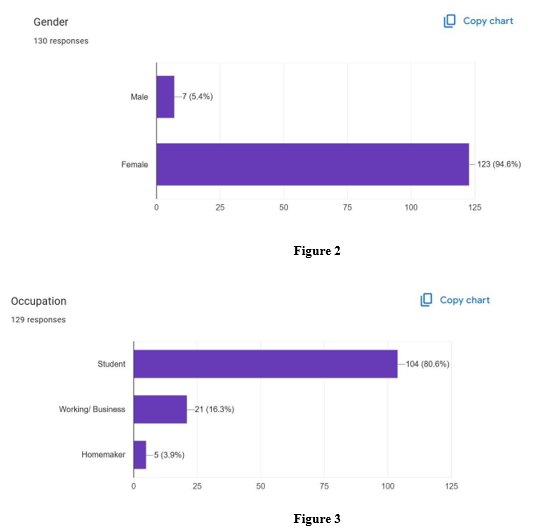

Figure 4
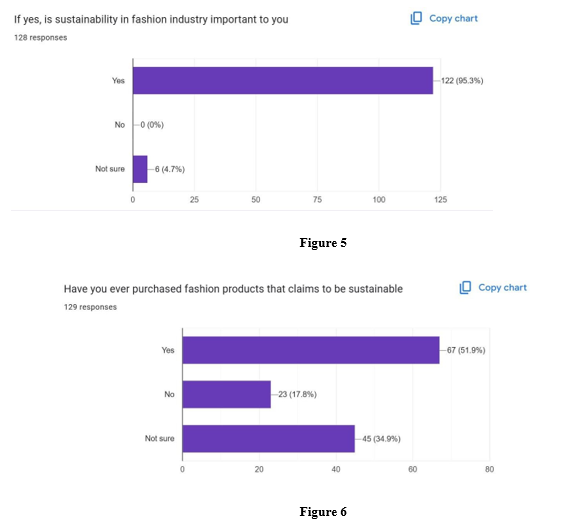

Figure 7
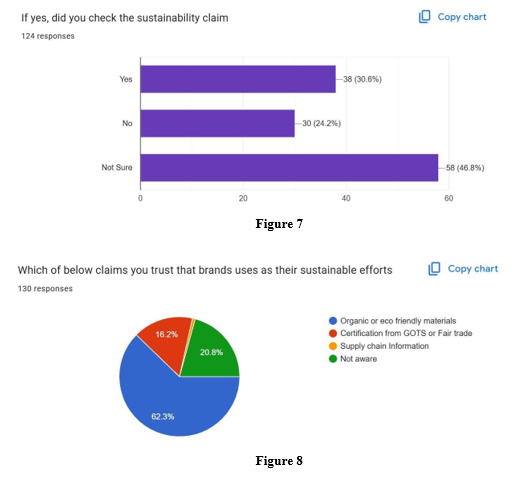
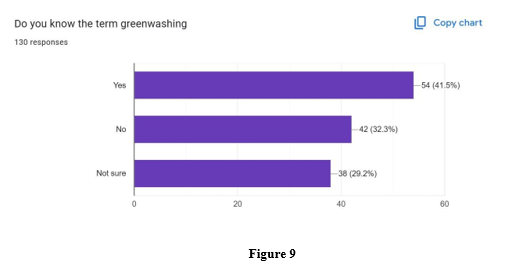

Figure 10
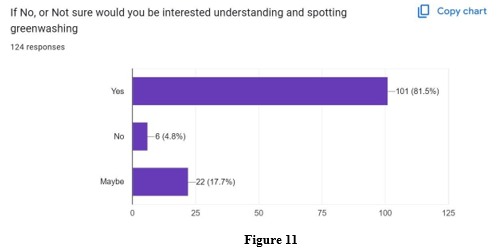
Although there are gaps in purchasing (55.7% non-buyers), claim verification (48.3% doubtful), and greenwashing knowledge (80.9% unaware/unsure), the study highlights a high level of awareness (96.2%) and importance (95.3%) of fashion sustainability. The levels of the suggested educational framework—awareness, analysis, and action—to empower consumers, especially urban young, against deceptive techniques are supported by the youth-heavy sample (79.4% 18– 25) and 92.5% interest in learning.
Focus Groups
Two focus groups, each with 3–5 experts from the institution, were conducted in Pune. prevalence of greenwashing, consumer knowledge gaps, educational barriers, curriculum-based interventions, and student-led practical advocacy with industry transparency. The prevalence of Greenwashing: According to experts, companies such as Westside deceive urban youngsters by using ambiguous terms like “earth-friendly” in their marketing without mentioning sustainable activities. They emphasized Baggit’s “vegan” bags, which students believe to be completely environmentally benign even though their source is unclear. Online retailers like as Suta were criticized for misleading young customers by marketing “handwoven” as sustainable without mentioning its negative effects on the environment.
• Consumer Knowledge Gaps: Participants noted that while students or young consumers are aware of words like “eco-conscious,” they are unable to recognize reliable certifications like GOTS. According to reports, urban millennials believe bold marketing claims and believe that trendy goods are sustainable. Educators observed youngsters did not comprehend production processes, such as the environmental impact of dyeing. Educational Barriers: Inconsistent industry standards have been recognized by experts as an obstacle to teaching greenwashing, which makes it challenging to clarify genuine claims. Effective education is limited by design schools’ short curriculum duration and lack of useful resources. Experts have noted that students become disengaged when faced with intricate supply chain specifics.
• Curriculum-Based Interventions: In order to teach claim evaluation consistently, participants recommended incorporating ideas of greenwashing into regular curricula rather than depending solely on two-day conferences. To assist students in differentiating between legitimate certificates and ambiguous claims, they proposed hands-on courses such as creating sustainable prototypes from farm to fashion. To develop analytical abilities, one teacher suggested assigning students to work on semester-long projects that examined brand marketing
• Industry Transparency and Student-Led Practical Advocacy: Experts highlighted that design students may create Instagram campaigns to inform fellow learners about greenwashing. They recommended that students use their experience with craft projects to develop useful resources, like certification manuals, to encourage openness. To foster confidence, experts advised companies such as Suta to post comprehensive material source information online. Teachers suggested that students move beyond seminar-based learning by organizing campus exhibitions to promote standardized labeling.
Content Analysis
To investigate trends of greenwashing in fashion retail, a qualitative content analysis was performed on sustainability-related communication regularly utilised by Indian mass-market and fast-fashion businesses. Public-facing resources such as company websites, product descriptions, and social media narratives were examined for repeated sustainability terminology, the type of supporting evidence presented, and the presence of verifiable certifications or quantified environmental impact statistics. Sustainability communication at several Indian fashion businesses commonly uses broad descriptions like “eco-friendly,” “conscious,” and “sustainable fabrics.” Existing transparency studies, however, show that many mass and mid-market brands provide insufficient information on supply chain traceability, lifecycle assessments, and measurable environmental indicators (What Fuels Fashion Index, 2023; DFU Publications, 2023). This pattern demonstrates an emphasis on sustainability message without a proportionate disclosure of validated environmental performance.
H&M and other fast-fashion businesses in India use specific collections to promote sustainability efforts including recycled materials and organic cotton. While corporate-level sustainability reports support these attempts, various studies show that such collections account for a small proportion of overall output and are not often backed by complete product-level transparency [11]. This selective disclosure can convey a sense of environmental responsibility while concealing the larger ecological burden of large-scale industry. Overall, the analysis suggests a prevailing communication pattern in which sustainability-related terminology is more common than factual evidence [12-14]. This disparity between sustainability claims and validated disclosure is consistent with recognised definitions of greenwashing in fashion literature, emphasising the importance of consumer education frameworks that enable critical evaluation of ethical and environmental claims [15]. The categorisation of the table below is based on observable patterns in sustainability communication as documented in sector-level transparency studies and literature, rather than an assessment of individual brand practices [16-18].
|
Retail Segment |
Common Sustainability Claims |
Typical Evidence Provided |
Transparency Pattern |
Greenwashing Risk |
|
Mass-market |
Eco-friendly, |
Minimal |
Low disclosure |
High |
|
Indian fashion |
conscious |
certification |
|
|
|
brands |
fashion, |
details; limited |
|
|
|
|
sustainable |
quantified |
|
|
|
|
fabrics |
impact data |
|
|
|
Fast-fashion |
Recycled |
Corporate-level |
Medium |
Medium |
|
brands operating |
materials, |
sustainability |
disclosure |
|
|
in India (e.g., |
organic cotton |
reports; limited |
|
|
|
H&M) |
collections |
product-level |
|
|
|
|
|
transparency |
|
|
|
Mid-premium / apparel brands |
Eco-dyeing, responsible tailoring |
Selective certification references |
Fragmented disclosure |
Medium |
Table 1
Discussion
The findings of this study reveal a critical disconnect between perceived awareness and actual comprehension of sustainability in fashion consumption [19]. While survey results indicate a high level of awareness regarding sustainable fashion (96.2%), a substantial proportion of respondents were unable to accurately identify greenwashing practices or verify ethical claims [20-23]. This paradox suggests that sustainability has become a familiar concept rather than an understood one, reinforcing concerns that frequent exposure to sustainability-related language can create a false sense of informed decision-making. The content analysis contributes to this gap by highlighting how sustainability communication across retail categories is mainly reliant on generic terms and selective disclosure. Terms like “ecofriendly,” “conscious,” and “sustainable fabrics” are commonly used, yet they are frequently unsupported by verifiable indications or product transparency. This is consistent with Delmas and Burbano’s definition of greenwashing as a strategy tactic including ambiguity and incomplete disclosure, in which communication emphasises good environmental traits while masking broader repercussions [2].
Focus group conversations provide further evidence to support these conclusions. Industry leaders and academics agreed that sustainability statements are typically developed for commercial purposes rather than consumer clarification. Participants emphasised that the absence of standardised criteria, uneven labelling, and accessible verification procedures make it difficult for even informed consumers to determine authenticity. The convergence of survey uncertainty, content ambiguity, and expert concern enhances the findings’ validity across several data sources. Collectively, these findings underscore the difficulties of using brand-led communication or regulatory frameworks to combat greenwashing. Instead, they highlight the importance of consumer education programs that foster critical literacy about sustainability promises. Integrating greenwashing awareness, certification literacy, and material transparency into design and fashion education can help customers move beyond shallow narratives and make more informed ethical decisions. The proposed awareness-analysis-action approach directly addresses this need, emphasising consumer education as a critical weapon for combating inaccurate sustainability communication in the fashion and textile industries [24].
Conclusion
This study adds to the expanding discussion on ethical communication in the fashion and textile industries by looking at how consumers perceive, interpret, and frequently misunderstand sustainability narratives. Rather than focussing on individual brand practices, the study identifies a broader systemic issue: the growing use of sustainability as a marketing language without corresponding clarity or standardisation, complicating consumers’ ability to make informed ethical decisions. By combining survey data, focus group insights, and a segment-level content analysis, the study shows that consumer knowledge of sustainable fashion does not always convert into critical understanding. According to the findings, greenwashing persists not only due to confusing brand communication, but also due to a lack of consumer understanding of sustainability claims, certifications, and material transparency. This supports the idea that ethical consumption cannot be based exclusively on brand declarations or regulatory systems.
The study emphasises the necessity of consumer education as a strategic response against greenwashing. Introducing sustainability literacy into fashion and design education can help customers critically evaluate environmental and ethical claims, supporting industry accountability. The proposed awareness-analysis-action framework provides a structured strategy to building this essential capacity and can be applied in a variety of contexts, including education, retail, and policy. Future research can build on this work by undertaking longitudinal studies to measure how consumer comprehension changes in response to specific educational interventions. Further research may look into the function of digital tools, labelling systems, and upcoming technologies like blockchain in increasing transparency and trust. Furthermore, comparative research across countries and retail formats could shed light on how cultural, economic, and regulatory issues influence the efficacy of sustainability communications.
References
- Fletcher, K., 2012. Sustainable Fashion and Textiles, 0 ed. Routledge.
- Delmas, M.A., Burbano, V.C., 2011. The Drivers of Greenwashing. California Management Review 54, 64–87.
- Siddhartha, S., 2024. Sustainable Fashion: Exploring the Concept of Greenwashing and New Trends in the Fashion Industry. International Journal of Innovative Science and Research Technology (IJISRT) 1264–1272.
- Hameed, I., Hyder, Z., Imran, M., Shafiq, K., 2021. Greenwash and Green Purchase Behavior: An Environmentally Sustainable Perspective. Environ Dev Sustain 23, 13113–13134.
- Adamkiewicz, J., KochaÃÂ??ska, E., Adamkiewicz, I., Lukasik, R.M., 2022. Greenwashing and sustainable fashion industry. Current Opinion in Green and Sustainable Chemistry 38, 100710.
- Urbanski, M., Ul Haque, A., 2020. Are You Environmentally Conscious Enough to Differentiate between Greenwashed and Sustainable Items? A Global Consumers Perspective. Sustainability 12, 1786.
- Rahman, S.U., Nguyen-Viet, B., 2023. Towards sustainable development: Coupling green marketing strategies and consumer perceptions in addressing greenwashing. Bus Strat Env 32, 2420–2433
- Lu, X., Sheng, T., Zhou, X., Shen, C., Fang, B., 2022. How Does Young Consumers’ Greenwashing Perception Impact Their Green Purchase Intention in the Fast Fashion Industry? An Analysis from the Perspective of Perceived Risk Theory. Sustainability 14, 13473.
- Fernandes, J., Segev, S., Leopold, J.K., 2020. When consumers learn to spot deception in advertising: testing a literacy intervention to combat greenwashing. International Journal of Advertising 39, 1115–1149.
- Brydges, T., Henninger, C.E., Hanlon, M., 2022. Selling sustainability: investigating how Swedish fashion brands communicate sustainability to consumers. Sustainability: a Science, Practice and Policy 18, 357–370.
- Mehar. (2021b, February 16). The deception of greenwashing in fast fashion. Down to Earth.
- Commodore v. H&M Hennes & Mauritz LP (2022). Class-action lawsuit on misleading “Conscious Collection” claims.U.S. District Court, Eastern District of Missouri.
- Quartz Report (2022). H&M’s Scorecards Greenwashing Exposed. Quartz Media.
- Changing Markets Foundation (2021). Synthetics Anonymous: Fashion Brands’ Reliance on Fossil Fuels.
- European Commission Green Claims Directive (2023). Sweep of 344 Sustainability Claims in Textiles. European Commission.
- Mongabay India (2022). The Deception of Greenwashing in Fast Fashion. Mongabay.
- Fibre2Fashion (2023). Sustainability vs Greenwashing: A Closer Look at India. Fibre2Fashion.
- IIAD Blog (2025). Decoding Green Marketing and Greenwashing in Fashion. Indian Institute of Art and Design.
- Mongabay India (2022). The Deception of Greenwashing in Fast Fashion.
- Is It Leather? Blog (2024). Exposing the Truth Behind Greenwashing in Vegan Leather.
- Immaculate Vegan (2025). Leather Industry’s Greenwashing Debunked.
- Harper’s Bazaar UK (2020). Is Vegan Leather Worse for the Environment?.
- How climate-friendly is your fashion? Report ranks world’s largest fashion brands on transparency. (2025b, September 30). The Week.
- Assoune, A. (2023, January 20). Reliance trends. Panaprium.