

World Journal of Forest Research(WJFR)
ISSN: 2994-5569 | DOI: 10.33140/WJFR


Research Article - (2024) Volume 3, Issue 1
Survey of Forest and Farming Adaptations to Climate Change in Ondo State, Southwestern, Nigeria
2Department of Forest Resources Management, Ladoke Akintola University of Technology, Ogbomoso, Nigeria
Received Date: Sep 12, 2024 / Accepted Date: Oct 09, 2024 / Published Date: Oct 24, 2024
Copyright: ©©2024 Omidiwura F T, et al. This is an open-access article distributed under the terms of the Creative Commons Attribution License, which permits unrestricted use, distribution, and reproduction in any medium, provided the original author and source are credited.
Citation: Omidiwura, F. T., Alabi, P. G., Babalola, G. F., Adeleke, A. H., Adelasoye, K. A. (2024). Survey of Forest and Farming Adaptations to Climate Change in Ondo State, Southwestern, Nigeria. World J Forest Res, 3(1), 01-08.
Abstract
Climate change and variability is one of the biggest global threats to agricultural production for the current and future generations. The study analysed the survey of farming adaptations to climate change in Ile Oluji/Okeigbo, Ondo East and Ondo West Local Government, Ondo State, Southwest, Nigeria to investigate whether the farmers perceive climate change, if farmers adapt at all in their agricultural activities and how farmers predict the weather per season. Multi- stage sampling techniques were used to select good numbers of farmers in the study area. Representative sample of 40 farmers from the three Local Government Area were selected. Data were collected using a well-structured questionnaire. Descriptive statistics were used in the study. The study revealed that there were 100% of the respondents in Ile Oluji/Oke- Igbo LGA and Ondo West LGA respectively and 97.5% of the respondents in Ondo East LGA who were aware of climate change through various means (experience, formal education etc.). The study also revealed that there is always shift in temperature and precipitation in the study area. The survey showed that 40.82%, 50% and 19.51 of the respondents in Ile Oluji/Oke-Igbo LGA, Ondo East LGA and Ondo West LGA respectively use information from expert opinion to predict weather. The survey concluded that improving and strengthening human capital through education, outreach programs, extension services at all levels will improve capacity to adapt to climate change impact. There is an urgent need for meteorological reports and alerts to be made accessible (when necessary) to farmers in an understandable forms.
Keywords
Climate Change, Farming Adaptations, Temperature, Precipitation, Meteorological Reports
Introduction
Throughout human history, the climate has been known to change; however, the change has been more evident in recent times. The Intergovernmental Panel on Climate Change (IPCC) defines climate change as any change in climate over time due to natural climate variability or due to human activity. Climate change refers to any change in climate over time, whether due to natural variability or as a result of human activity [1]. Farmers’ understanding of climate variability/ change is fundamental in Africa, since climate is the primary determinant of agricultural effectiveness, and changes in climate have pronounced impacts, not only on the agricultural sector but also on other sectors. Studies have shown that climate change and extreme climatic events pose great threats to agricultural production, food securi¬ty, community health, natural resources, biodiversity, and water availability [2]. Climatic variability impacts different crops in different ways, but most impacts have been shown to be nega¬tive [3-5]. Although adaptive agronomic decisions (e.g. chang¬ing crop management) can contribute towards lowering the yield gap, such practices must be adapted to diverse socioeconomic context of smallholder systems [6,7]. Zilberman et al. defined adaptation as a set of strategies for responding to major environ¬mental changes—current and future—that have the potential for significant and long-term consequences [8]. According to Inter¬governmental Panel on Climate Change (IPCC), about one-sixth of the total population of the world lives in the regions which shall be affected by a decrease in melting water. The warmer climate will likely cause more heat waves, more violent rainfall and also amplification in the severity of hailstorms and thun¬derstorms. Rising of sea levels is the deadliest effect of global warming, the rise in temperature is causing the ice and glaciers to melt rapidly. This will lead to rise of water levels in oceans, rivers and lakes that can pilot devastation in the form of floods [9]. Understanding farming adaptation on climate variability and change is essential for designing adaptation policies and strate¬gies to deal with the impacts of climate change on the agricul¬tural sector and overcoming the challenges embedded in farming adaptation on climate variability will in no doubt increase agri¬cultural production and boost food security [10]. Therefore, the objective of this study was to investigate whether farmers per¬ceive climate change in the study area, whether farmers adapt at all in their agricultural activities how farmers predict the weather per season and the factors influencing their choice of particular adaptation methods in the study area.
Materials and Methods
The study was conducted in three local governments in Ondo State. They are Ile Oluji/ Oke Igbo, Ondo East and Ondo West. Ile Oluji is a Local Government Area in Ondo State, Nigeria. Its headquarters are in the town of Ile Oluji. It has an area of 698 km². While the Ile-Oluji people are of the Ondo stock, the Oke-Igbo people speak the Yoruba language of the Ile-Ife people.Ondo East is a Local Government Area in Ondo State, Nigeria. Its headquarters are in the town of Bolorunduro. The Local Government occupies an area of approximately 896 sq kilometres. The Local Government is located in the equatorial region and shares boundaries on the North with Idanre Local Government, on the South with Ondo West Local Government. Ile-Oluji/Oke-Igbo Local Government on the East and Ataki-mosa West in Osun State on the North Eastern part.Ondo East Local Government lies between latitude 5o 501 and 5o 051 and longitude 7o 301 and 7o 001 and it is dominated by feeder roads which serve as links between different communities within the Local Government. Ondo West is a Local Government Area in Ondo State, Nigeria. Its headquarters are in the town of Ondo. It has an area of 970 km². Primary data were collected through the administration of a well-structured questionnaire targeting the socio-economic characteristics of the respondents, the vari¬ous farming adaptation strategies such as conservation of agri¬culture, enhancing agricultural extension services, adoption of drought tolerant and early maturing varieties of crops, provision of accurate and timely weather forecasting, etc. Some merits of questionnaires involve; it is easy and possible to interview many respondents within a short period of time, it is free of bias and respondent’s confidentiality is ensured. Multi-stage sampling techniques were used to select good numbers of farmers in the study area. Representative sample of 40 farmers from three Lo¬cal Government Area, namely, Ile Oluji/Oke Igbo, Ondo East and Ondo West were selected. In all, total lists of 120 respon¬dents/farmers were interviewed. Most of the data collected from the study area were subjected to descriptive statistics such as percentages, frequencies and bar charts.
Results
Table 1 showed that most of the respondents (37.5%) were above 50 years of age in Ile Oluji/Oke-Igbo LGA, 45.0% of the respondents in Ondo East LGA were above 50 years of age and 55.0% of the respondents in Ondo West LGA were above 50 years. Based on the result in Table 1, few of the respondents (7.5%) in Ile Oluji/Oke-Igbo LGA and Ondo East LGA (15.0%) did not attend formal school, tertiary education attained in Ile Oluji Oke-Igbo LGA, Ondo East LGA and Ondo West LGA were 55.0%, 40.0% and 47.5% respectively. Gender distribution of the head of household is also shown in Table 1, about 95.0%, 90.0% and 97.5% of the head of household in Ile Oluji/Oke-Igbo LGA, Ondo East LGA and Ondo West LGA respectively were male while few percentages of the head of household were fe¬male.
|
Ile Oluji/Oke Igbo Ondo East Ondo West |
||||||
|
Variable |
Frequency |
Percentage |
Frequency |
Percentage |
Frequency |
Percentage |
|
Age(years) |
|
|
|
|
|
|
|
25-30 |
2 |
5 |
4 |
10 |
1 |
2.5 |
|
31-35 |
1 |
2.5 |
3 |
7.5 |
2 |
5 |
|
36-40 |
8 |
20 |
5 |
12.5 |
4 |
10 |
|
41-45 |
5 |
12.5 |
0 |
0 |
1 |
2.5 |
|
46-50 |
9 |
22.5 |
10 |
25 |
10 |
25 |
|
>50 |
15 |
37.5 |
18 |
45 |
22 |
55 |
|
Level of farmer’s |
|
|
|
|
|
|
|
education |
3 |
7.5 |
6 |
15.5 |
8 |
20 |
|
No formal education |
0 |
0 |
0 |
0 |
0 |
0 |
|
Adult education classes |
3 |
7.5 |
3 |
7.5 |
1 |
2.5 |
|
Primary |
1 |
2.5 |
2 |
5 |
1 |
2.5 |
|
Modern III |
1 |
2.5 |
1 |
2.5 |
0 |
0 |
|
Did not complete secondary |
|
|
|
|
|
|
|
school |
10 |
25 |
12 |
30 |
11 |
27.5 |
|
Secondary |
22 |
55 |
16 |
40 |
19 |
47.5 |
|
Tertiary |
|
|
|
|
|
|
|
Gender of head of household Male Female |
38 2 |
95 5 |
36 4 |
90 10 |
39 1 |
97.5 2 |
|
Years of farming |
|
|
|
|
|
|
|
experience |
11 |
27.5 |
10 |
25 |
7 |
17.5 |
|
1-10 |
15 |
37.5 |
20 |
50 |
23 |
57.3 |
|
11-20 |
7 |
17.5 |
7 |
17.5 |
7 |
17.5 |
|
21-30 |
6 |
15 |
2 |
5 |
3 |
7.5 |
|
31-40 |
1 |
2.5 |
1 |
2.5 |
0 |
0 |
|
41-50 |
|
|
|
|
|
|
|
Farm size (ha) |
|
|
|
|
|
|
|
1-4 |
22 |
55 |
26 |
65 |
17 |
42.5 |
|
5-8 |
13 |
32.5 |
10 |
25 |
13 |
32.5 |
|
9-13 |
3 |
7.5 |
4 |
10 |
7 |
17.5 |
|
>13 |
2 |
5 |
0 |
0 |
3 |
7.5 |
|
Household size |
|
|
|
|
|
|
|
1-3 |
2 |
5 |
7 |
17.5 |
1 |
2.5 |
|
4-6 |
13 |
32.5 |
19 |
47.5 |
21 |
52.5 |
|
7-9 |
16 |
40 |
7 |
17.5 |
17 |
42.5 |
|
10-12 |
7 |
17.5 |
5 |
12.5 |
1 |
2.5 |
|
13-15 |
1 |
2.5 |
1 |
2.5 |
0 |
0 |
|
>15 |
1 |
2.5 |
1 |
2.5 |
0 |
0 |
|
Household primary |
|
|
|
|
|
|
|
Occupation |
|
|
|
|
|
|
|
Farming |
12.44 |
31.1 |
17.68 |
44.2 |
18.28 |
45.7 |
|
Agriculture |
9.84 |
24.6 |
16.64 |
41.6 |
17.76 |
44.4 |
|
Artisan |
3.28 |
8.2 |
1.56 |
3.9 |
0 |
0 |
|
Office worker |
1.32 |
3.3 |
0.52 |
1.3 |
0 |
0 |
|
Civil servant |
3.28 |
8.2 |
0 |
0 |
0.48 |
1.2 |
|
Teaching |
6.56 |
16.4 |
0.52 |
1.3 |
0.48 |
1.2 |
|
Health worker |
0 |
0 |
0 |
0 |
0 |
0 |
|
Trading |
2.64 |
6.6 |
3.12 |
7.8 |
3 |
7.5 |
|
Other non-agriculture works |
0.64 |
1.6 |
0 |
0 |
0 |
0 |
|
Each Variable Total |
40 |
100 |
40 |
100 |
40 |
100 |
Table 1: Socio-Economic Characteristics of The Respondents
All the respondents (100%) in Ile Oluji/Oke-Igbo LGA and Ondo West LGA were aware of climate change and 97.5% of the respondents were aware of climate change in Ondo East LGA (Figure 1). Table 2 revealed that 95.0%, 100% and 97.5% of the respondents in Ile Oluji/Oke-Igbo LGA, Ondo East LGA and Ondo West LGA respectively noticed long term shift in tempera¬ture and precipitation on their farm. Results in Table 3 showed the adaptive measures farmers use to mitigate climate change. It revealed that 90.00% of the respondents in Ile Oluji/Oke-Igbo LGA always use certified seeds, 80.00% of the respondents in Ondo East LGA always change planting time while 95.00% of the respondents in Ondo West LGA always use chemical fertiliz¬er. It was further revealed that 91.67% of the respondents in the three local government on average use different crop varieties to adapt to climate change while few percentage (0.83%) of the re¬spondents in the three local governments on average always use water pumps since most farmers can’t afford irrigation system. It also showed that 62.50% of the respondents in Ile Oluji/Oke-Ig-bo LGA occasionally fallow their field, 42.50% of the respon¬dents in Ondo East LGA occasionally plan water requirements while 40.00% of the respondents in Ondo West LGA occasion¬ally use compost. It also showed that 55.00% of the respondents in the three local governments on average occasionally fallow the field while 3.33% of the respondents in the three local gov¬ernments on average occasionally use certified seeds to mitigate climate change impact. Figure 2 revealed the different sources of information received by the respondents to predict weather fol¬lowing season. The respondents (40.82%) in Ile Oluji/Oke-Igbo LGA, 50% of the respondents in Ondo East LGA and 19.51% of the respondents in Ondo West LGA used expert opinion to predict weather following season. In Ile Oluji/Oke-Igbo LGA, 34.69% of the respondents predicted weather through the infor¬mation they received from Radio, 43.90% of the respondents in Ondo West LGA used past season weather. None used television in Ile Oluji/Oke-Igbo LGA because of lack of electricity supply, 2.04% of the respondents in Ile Oluji/Oke-Igbo LGA received information from social media and seminar, 2.44% of the re¬spondents in Ondo West LGA used information received from seminar to predict weather.
|
Long term shift |
Ileoluji/ Okeigbo |
Percent age (%) |
Ondo East |
Percentag e (%) |
Ondo West |
Percentag e (%) |
|
Temperature |
|
|
|
|
|
|
|
Yes |
38 |
95.0 |
40 |
100.0 |
39 |
97.5 |
|
No |
2 |
5.0 |
0 |
0 |
1 |
2.5 |
|
Total |
40 |
100 |
40 |
100 |
40 |
100 |
|
Precipitation |
|
|
|
|
|
|
|
Yes |
38 |
95.0 |
40 |
100.0 |
39 |
97.5 |
|
No |
2 |
5.0 |
0 |
0 |
1 |
2.5 |
|
Total |
40 |
100 |
40 |
100 |
40 |
100 |
Source: Field Survey, 2019
Table 2: Long Term Shift in Temperature and Precipitation in The Study Areas
|
ADAPTIVE MEASURES |
ALWAYS |
OCCASIONALLY |
NEVER |
|||||||||
|
|
Ile oluji |
Ondo East |
Ondo West |
Average |
Ile oluji |
Ondo East |
Ondo West |
Average |
Ile oluji |
Ondo East |
Ondo West |
Average |
|
A |
75.00 |
80.00 |
97.50 |
84.17 |
2.50 |
20.00 |
2.50 |
8.33 |
0.00 |
0.00 |
0.00 |
0.00 |
|
B |
90.00 |
97.50 |
10.00 |
65.83 |
7.50 |
2.50 |
0.00 |
3.33 |
2.50 |
0.00 |
0.00 |
0.83 |
|
C |
7.50 |
2.50 |
0.00 |
3.33 |
55.00 |
42.50 |
37.50 |
45.00 |
37.50 |
55.00 |
62.50 |
51.67 |
|
D |
10.0 |
2.50 |
0.00 |
4.17 |
20.00 |
20.00 |
7.50 |
15.83 |
17.00 |
77.50 |
92.50 |
80.00 |
|
E |
5.00 |
5.0 |
0.00 |
3.33 |
62.50 |
42.50 |
25.00 |
43.33 |
32.50 |
52.50 |
75.00 |
53.33 |
|
F |
0.00 |
2.50 |
0.00 |
0.83 |
22.50 |
7.50 |
2.50 |
10.83 |
77.50 |
90.00 |
97.00 |
88.33 |
|
G |
47.50 |
8.25 |
95.00 |
50.25 |
47.50 |
10.00 |
5.00 |
20.83 |
5.00 |
7.50 |
0.00 |
4.17 |
|
H |
65.00 |
47.50 |
60.00 |
57.50 |
27.50 |
50.00 |
40.00 |
39.17 |
7.50 |
2.50 |
0.00 |
3.33 |
|
I |
80.00 |
80.00 |
8.50 |
56.17 |
15.00 |
20.00 |
15.00 |
16.67 |
5.00 |
0.00 |
0.00 |
1.67 |
|
J |
62.50 |
80.00 |
95.00 |
79.16 |
35.00 |
20.00 |
5.00 |
20.00 |
2.50 |
0.00 |
0.00 |
0.83 |
|
K |
35.00 |
30.00 |
62.50 |
42.50 |
62.50 |
17.00 |
32.50 |
55.00 |
2.50 |
0.00 |
0.00 |
0.83 |
|
L |
87.50 |
90.00 |
97.50 |
91.67 |
10.00 |
10.00 |
2.50 |
7.50 |
2.50 |
0.00 |
0.00 |
0.83 |
|
Source: Field survey, 2019 |
||||||||||||
Table 3: Distribution (%) Of Respondents Based on Adaptive Measures Used to Mitigate Climate Change Impact in The Study Area

Figure 1: Distribution of The Respondents by Awareness of Climate Change in Ile Oluji/Okeigbo, Ondo East and Ondo West LGAs Key: A = Yes; B = No
Source: Field Survey, 2019
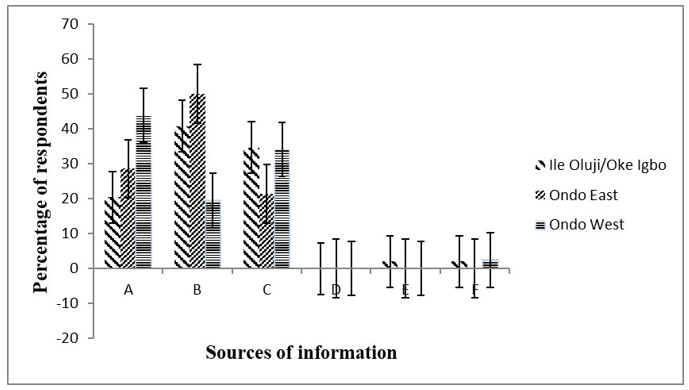
Figure 2: Distribution of The Respondent by Sources of Information in Ile Oluji/Oke Igbo, Ondo East and Ondo West LGAs Source: Field Survey, 2019
Key: A= Use past season weather; B = Expert Opinion; C = Radio; D =Television; E = Social media; F = Seminar.
In Table 4, 57.5%, 55.0% and 67.5% of the respondents in Ile Oluji/Oke Igbo LGA, Ondo East LGA and Ondo West respec-tively had access to extension services. The respondents (42.5%) in Ile Oluji/Oke Igbo LGA, 45.0% of the respondents in Ondo East LGA, 32.5% of the respondents in Ondo West LGA do not have access to extension services. Also, 40.0% of the respon- dents in Ondo West LGA pay for trainings and seminars orga¬nized by the extension agents. 100% of the respondents in Ile Oluji/Oke-Igbo LGA, 100% of respondents in Ondo East LGA and 24% of the respondents in Ondo West LGA do not pay for receiving extension advices as presented in Table 4.
|
Access to Extension Agent |
Ile oluji/Okeig bo |
Percenta ge (%) |
Ondo East |
Percent age (%) |
Ondo West |
Percenta ge (%) |
|
Yes |
23 |
57.5 |
22 |
55.0 |
27 |
67.5 |
|
No |
17 |
42.5 |
18 |
45.0 |
13 |
32.5 |
|
Total |
40 |
100 |
40 |
100 |
40 |
100 |
|
Payment for Extensions services |
|
|
|
|
|
|
|
Yes |
0 |
0 |
0 |
0 |
16 |
40.0 |
|
No |
40 |
100 |
40 |
100 |
24 |
60.0 |
|
Total |
40 |
100 |
40 |
100 |
40 |
100 |
Source: Field Survey, 2019
Table 4: Distribution of Respondents by Their Access to Extension Services and Possible Payment for Receiving Extension Services in Ile Oluji/Oke Igbo, Ondo East and Ondo West LGAs
Discussion
The study survey the awareness of farmers on climate change and the farming adaptation to climate change. Three local gov¬ernment areas were studied, the findings indicated that the lev¬el of illiteracy is low, most of the respondents from the study area had adequate education (formal) which helps them to know about climate change and different method to adapt to these changes hereby enhancing agricultural productivity and reducing hazards. The finding is consistent with previous lit¬erature which found that education and training may remove some adaptation barriers as farmers may be better able to ac¬cess information, services, and opportunities [11]. Majority of the respondents have better farming experience; several studies have shown that farmers with more years of farming experi¬ence perceive climate change adaptation strategies better than those with less experience in farming practices [12]. Most of the respondents in the three local governments were aware of cli¬mate change. In most studies, rural farmers’ level of awareness seems to be on increase regarding their experiences in change and length of seasons, incidence of environmental hazards such as flood, droughts, and crop failures, long term shift in wind speed, change in rainfall intensity and uncertainty of rain etc [13]. The findings also indicated that majority of the respondents in the study areas have access to information on climate change and adaptive measures to mitigate climate change through ex-tension agents. According to some researchers, reported that better accesses to extension and credit services seem to have a strong positive influence on adaptation [14]. Majority of the respondents in the selected LGAs (Ile Oluji/Oke-Igbo LGA, Ondo East LGA and Ondo West LGA) noticed long term shift in temperature on their farm. This implies that there is always shift in temperature, there is warmer and more frequent hot days and nights in the study areas. documents a gradual increasing air temperature between 1901 and 1970 and a higher increase between 1971 and 2005 [15]. Most of the respondents in the study areas use the adaptive measures they can afford and at the same time effective to mitigate climate change. Similarly, re¬ported that the use of drought-resistant crop varieties have been tried by smallholder farmers as adaptation methods to climate change in Nigeria, Senegal, Burkina Faso and Ghana [16]. Also, majority of the respondents have better farming experience in the study area. This showed that the respondents have improved climate change experience. The more experienced farmers are, the more likely to adapt [14].
Conclusion and Recommendation
Climate change is inevitable and crucial to farmers and agri-cultural production in all forms. This study concluded based on the research that farming experience and access to education were found to promote adaptation. It also showed that larger percentage of farmers use expert opinions, extension agents, ag¬ricultural leaders and radio to receive information on climate change. Thus, there is an urgent need for meteorological reports and alerts to be made accessible (when necessary) to farmers in an understandable forms. Access to extension services fre-quently ensures that farmers have the information for decision making and the means to take up relevant adaptation measures. In addition, empowerment (credit or grant facilities) is crucial in enhancing farmer’s awareness.
References
- Nnaji, C. E. (2012). Effects of climate change on household water sources in Benue State, Nigeria. An M. SC. Project thesis submitted in the Department of Agricultural Extension, University of Nigeria, Nsukka.
- Costello, A., Abbas, M., Allen, A., Ball, S., Bell, S., Bel-lamy, R., ... & Patterson, C. (2009). Managing the health effects of climate change: lancet and University College London Institute for Global Health Commission. The lancet, 373(9676), 1693-1733.
- Asseng, S., Foster, I. A. N., & Turner, N. C. (2011). The impact of temperature variability on wheat yields. Global change biology, 17(2), 997-1012.
- Krishnan, P., Ramakrishnan, B., Reddy, K. R., & Reddy, V.R. (2011). High-temperature effects on rice growth, yield, and grain quality. Advances in agronomy, 111, 87-206.
- Tiwari, Y. K., & Yadav, S. K. (2019). High temperature stress tolerance in maize (Zea mays L.): Physiological and molecular mechanisms. Journal of Plant Biology, 62, 93-102.
- Bryan, B. A., King, D., & Zhao, G. (2014). Influence of management and environment on Australian wheat: information for sustainable intensification and closing yield gaps. Environmental Research Letters, 9(4), 044005.
- Khanal, U., & Wilson, C. (2019). Derivation of a climate change adaptation index and assessing determinants and barriers to adaptation among farming households in Nepal. Environmental Science & Policy, 101, 156-165.
- Zilberman, D., Zhao, J., & Heiman, A. (2012). Adoption versus adaptation, with emphasis on climate change. Annu. Rev. Resour. Econ., 4(1), 27-53.
- Riphah, U. S. (2015). Global Warming: Causes, Effects and Solutions. Durreesamin J, 148(1).
- Deressa, T. T., Hassan, R. M., & Ringler, C. (2011). Perception of and adaptation to climate change by farmers in the Nile basin of Ethiopia. The Journal of Agricultural Science, 149(1), 23-31.
- Thinda, K. T., Ogundeji, A. A., Belle, J. A., & Ojo, T. O. (2020). Understanding the adoption of climate change adaptation strategies among smallholder farmers: Evidence from land reform beneficiaries in South Africa. Land Use Policy, 99, 104858.
- Takele, A., Abelieneh, A., & Wondimagegnhu, B. A. (2019). Factors affecting farm management adaptation strategies to climate change: The case of western Lake Tana and upper Beles watersheds, North West Ethiopia. Cogent Environmental Science, 5(1), 1708184.
- Moghariya, R., & Smardon, R. S. (2011). Farmer's Perception of Risk, Impacts and Adaptation to Climate Change. Perspectives from Western India.
- Apata, T. G., Samuel, K. D., & Adeola, A. O. (2009). Analysis of Climate Change Perception and Adaptation among Arable Food Crop Farmers in South Western Nigeria.
- Akpodiogaga-a, P., & Odjugo, O. (2010). General overview of climate change impacts in Nigeria. Journal of human ecology, 29(1), 47-55
- Ngigi, S. N. (2009). Climate change adaptation strategies: water resources management options for smallholder farming systems in sub-Saharan Africa. New York, NY: The Earth Institute at Columbia University.