

Advances in Theoretical & Computational Physics(ATCP)
ISSN: 2639-0108 | DOI: 10.33140/ATCP

Research Article - (2026) Volume 9, Issue 1
Supreme Theory of Everything: The Two Greatest Creations of God-Like Sine Waves
Received Date: Jan 15, 2026 / Accepted Date: Feb 25, 2026 / Published Date: Mar 26, 2026
Copyright: ©2026 Ulaanbaatar Tardad. This is an open-access article distributed under the terms of the Creative Commons Attribution License, which permits unrestricted use, distribution, and reproduction in any medium, provided the original author and source are credited.
Citation: Ulaanbaatar, T. (2026). Supreme Theory of Everything: The Two Greatest Creations of God-Like Sine Waves. Adv Theo Comp Phy, 9(1), 01-30.
Abstract
Electromagnetic waves affect everything all the time. Electric and magnetic fields are transverse waves that are mutually perpendicular. This is related to the ratio of the horizontal and vertical axes on a circle, which is a cross-section of a cylindrical coordinate system, or to the ratio of the sine and cosine functions. This property creates a natural prerequisite for the spontaneous occurrence of hysteresis.
In this article, we aim to prove that sine waves, when interacting with cosine waves, become omnipotent and creative, and can connect the abstract concepts of the mind and consciousness with reality. Sine waves within hysteresis are a miracle that is always with us, but we don't notice them. The second greatest of the sine wave creations is hysteresis, and the third greatest is wave-particle duality. Its scope suggests that it is a general phenomenon valid not only in quantum mechanics but also in cosmology. In this sense, we hope that sine waves can be compared to God. There are many reasons for this.
Introduction
It is almost superfluous to mention here the many amazing properties of sine waves. We have always understood the sine function as a simple trigonometrical function, just like any other wave function. On the contrary, waves, space, time, and everything in general, originate from sine waves and cannot exist without them. So, it is necessary to clarify the role of sine waves.
In the special theory of relativity, since both space and time are expressed in a Cartesian coordinate system in a single unit (the speed of light c), space and time are located at 90 degrees to each other, in vertical and horizontal axes, and at 45 degrees, both space and time have infinite values. Also, bodies at different speeds are represented by their own straight line, which is called "worldline". This is written as the following linear relationship:
t = ct*
Where c is the speed of light, t is the distance, and t* is the time.
Nature never allows for such a linear relationship, but rather follows a periodic pattern. Since such a linear relationship is almost non-existent in reality, the general theory of relativity was developed. The special theory of relativity describes uniform motion in a straight line, while the general theory of relativity describes the relative properties of a moving body that determine the velocity, acceleration, momentum, specific time, and specific space that occur when the velocity changes. In the theory of relativity, the two different concepts of space and time are measured in the same unit, so they have become indistinguishable. Consequently, they cannot be separated, and therefore a single term, spacetime, is used.
Space and time themselves are concepts that are defined directly or indirectly by the human mind and used in everyday life. Animals do not have a concept of time, only the biological time that feels the change of light and darkness, the difference between day and night, and space is considered to be determined by the comparison between objects and the magnetic field.
In the Supreme Theory of Everything, the descriptions of space and time are radically different from those of the special theory of relativity. We use the cylindrical coordinate system. The ratio of the sine and cosine functions of a circle, which is the cross-section of a cylinder in a cylindrical coordinate system, not only defines space and time, but also creates hysteresis. Meanwhile, the hysteresis can interpret a multitude of phenomena in physics, biology, economics, astronomy, and cosmology. In other words, everything is explained.
A sine wave lies on the vertical axis of a circle and represents the concept of space, while a cosine wave lies only on the circle and represents time in terms of angles. Also, sine waves can control everything by changing the angle and eccentricity of the ellipse. Therefore, a cosine wave can be considered absolute, and a sine wave can be considered relative. In other words, space is relative and time is absolute. There is no past or future time, only the present time, because it is only located on the circumference of a 3D cylindrical coordinate system, which makes it more understandable.
This article will discuss the greatest second and third artworks of the beautiful sine wave.
Some Trigonometric Functions
In physics, a wave is defined as a disturbance that transfers energy through a medium, moving from one area to another [1]. But some kinds of waves are destructive, while others are constructive. For instance, a sine wave is a creator.
The second great creation of the sine wave is hysteresis, and the third is wave-particle duality, the framework of which is not only the quantum world but the entire universe. The first and greatest creation of the sine wave will be published in the next paper.
For this exact reason, we call the wave-particle duality the Universal Duality of Everything.In physics, a wave is defined as a disturbance that transfers energy through a medium, moving from one area to another. A wave is a disturbance in a medium that carries energy without a net movement of particles. It may take the form of elastic deformation, a variation of pressure, electric or magnetic intensity, electric potential, or temperature. Quantum mechanics explains that all energy is transmitted in wave packets or quanta. At sufficiently high levels of attention energy, particles emerge from waves [1].
Two types of waves are most commonly studied in classical physics: mechanical waves and electromagnetic waves [2].
This paper considers electromagnetic waves.
There are two common ways to represent waves: using trigonometric functions (cosine and sine) and using complex exponential functions [3], which are written in trigonometry.
Amazingly, trigonometric functions can also be expressed back in terms of the complex exponential. Then everything involving trig functions can be transformed into something involving the exponential function. This is very surprising [4].
Trigonometric functions describe everything without any errors, but during our research, we noticed a few uncertainties, which we consider necessary to discuss at the beginning of the article.
Complex Exponential Functions
Complex wave functions are written using Euler’s formula:

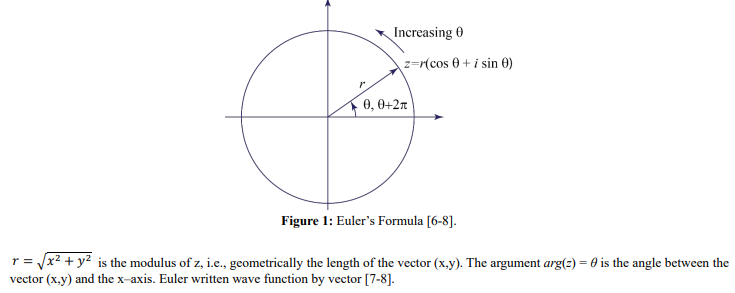
A simple wave has a fixed wavelength and is a disturbance in a field or matter. It's nothing more than an entity that describes the state of a quantum mechanical object [9].
Equation 2 becomes incorrect because the imaginary unit doesn’t exist [5].
Complex exponential functions have been used for many years, but applying them is not straightforward. On the other hand, there are no imaginary units [5].
The wavefunction is a complex quantity, so mathematically, the wavefunction gives no real meaning [10].
Fourier Series
Fourier analysis follows from Fourier’s theorem, which states that every function can be completely expressed as a sum of sines and cosines of various amplitudes and frequencies. This is a pretty impressive assertion – no matter what the shape of a function, and how little it looks like a sine wave, it can be rewritten as a sum of sines and cosines. The Fourier series tells you the amplitude and frequency of the sines and cosines that you should add up to recreate your original function [11].
Given a function f (x) we seek a representation in the form:

The series representation in Equation 2 is called a Fourier trigonometric series.
A Fourier series is a method of representing a periodic function as a sum of sine and cosine functions. A Fourier series could potentially possess an infinite number of harmonics. Not every harmonic in the Fourier series of a function generates an approximation to the given function.
Series are the basis of differential calculus and mathematical statistics. However, decomposing the sine and cosine functions into a series has many disadvantages.
Scattering in Sine Series
Instead of the sine function, the sine series is used (Equation 3). But approximation has many disadvantages

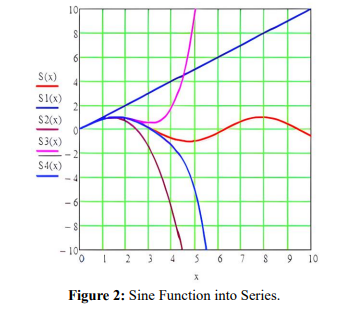
Sine is an initial impulse, with a restoring force, with a restoring force on the restoring force, and so on. [13].
Scattering in Cosine Series
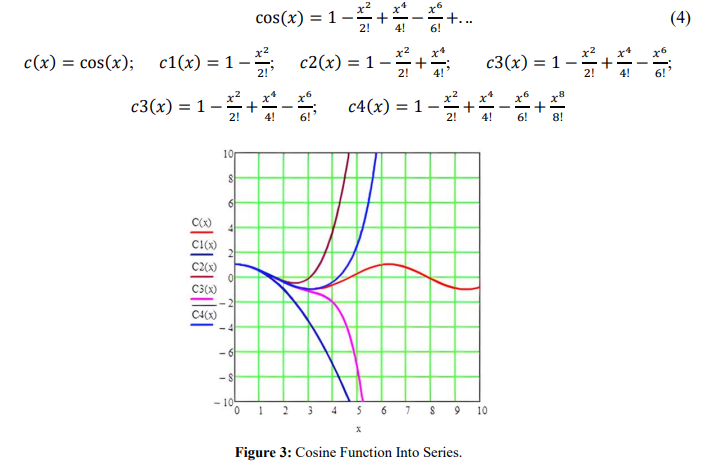
Cosine is an initial impulse, with a restoring force, with a restoring force on the restoring force, and so on (Equation 4) [13].
From these, we can draw the following conclusions. These are:
i) The upward and downward dispersion of the series shown in Figures 2 and 3 is a negative effect of decomposing the sine and cosine functions into series.
ii) If you cannot always use the restoring forces, the functions disperse everywhere.
iii) Since series are difficult to use in research and calculations, the first two or three terms of the series are used, and the others are discarded.
iv) The sine and cosine functions were separated into their negative and positive terms, called the imaginary part and the real part, and then, using de Moivre's theorem, it was even further removed from reality as an exponential complex number.
v) This is where erroneous expressions like Euler's formula and Euler's identity come from because there are no imaginary units [5]. Fourier wrote that any wave is a sum of other waves. According to the law of hysteresis, however, this can be expressed by a phase change of a single wave, which makes it easier to understand, analyze, and decompose.
The Fourier Transformation
The modern, complex-valued Fourier transform concisely contains both the sine and cosine transforms. Since the sine and cosine transforms use sine and cosine waves instead of complex exponentials and don't require complex numbers or negative frequency, they more closely correspond to Joseph Fourier's original transform equations and are still preferred in some signal processing and statistics applications, and may be better suited as an introduction to Fourier analysis.
Fourier's original formulation of the transform did not use complex numbers, but rather sines and cosines. Statisticians and others still use this form [14,15].
Finally, we see that Fourier's original transformation was correct without the complex exponential!
The Fourier transform is a type of mathematical function that splits a waveform, which is a time function, into the frequencies that it is made of. The result generated by the Fourier transform is always a complex-valued frequency function. The Fourier transform’s absolute value shows the frequency value existing in the original function. Its complicated argument denotes the phase offset of the fundamental sinusoidal at that particular frequency.

In this expression, i also represents the imaginary unit.
The Fourier transform enables the Fourier series to extend to non-periodic functions. This allows for taking any function as a total of simple sinusoids [16].
The most important thing about wave functions is that they are periodic. This periodic motion can be described by a wave function oscillating in time [17].
Trigonometric Functions
The doubts in Euler’s formula
Mathematically, the incident wave has been taken as

Is this correct?
Here's the problem.
In Figure 4, the Y-axis is amplitude. The X-axis, distance or time, or both? Is there a relationship between the two graphs? But how can you plot the displacement as a function of distance, because the displacement itself is distance [18]!

Figure 4: Difference of Distance and Time [18].
The main reason for my doubt is that two different quantities, distance and time, are combined into a single formula and plotted on the same axis. Let's take a closer look at Equation 1, which is used in Euler's formula, de Broglie's wavelength, and Schrödinger's formula.
Here
• A is the amplitude, representing the maximum displacement from the equilibrium position.
• k is the wave number: number of waves per unit length at one time.
• x denotes the place at which the wave function is being described.
• ω is the angular frequency, defining how rapidly the wave oscillates with time. Angular frequency: 2π times the frequency [4][19].
• φ0 is the phase constant: the wave’s phase at time zero, place zero.
Even weirder, three quantities with different units are included in one equation (Equation 1): wavelength, frequency, and finally, distance or time unit indicating the beginning of the wave function.
For example, the wave function shown above has the following form:
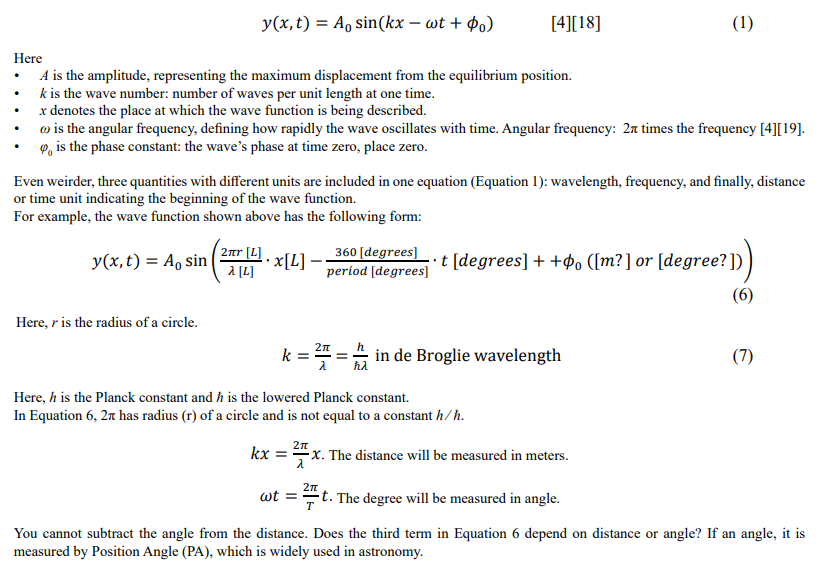
This shows that Equation 1 is incorrect. To clarify this, we need to decompose the wave function into two separate functions.
Distance-Dependent Wavefunction
Since the frequency is defined on the horizontal axis, it seems correct to express it in terms of angles. Therefore, the phase shift in terms of angles should also be written in terms of angles.

Time-Dependent Wavefunction
If we use the Position Angle for circumference, the phase of the wave function is as follows:

There are two examples of applications.
The Length of Daylight
For simplicity, let's say we're talking about time instead of angle. It takes theEarth 365 days to orbit the Sun once a year (360 degrees).

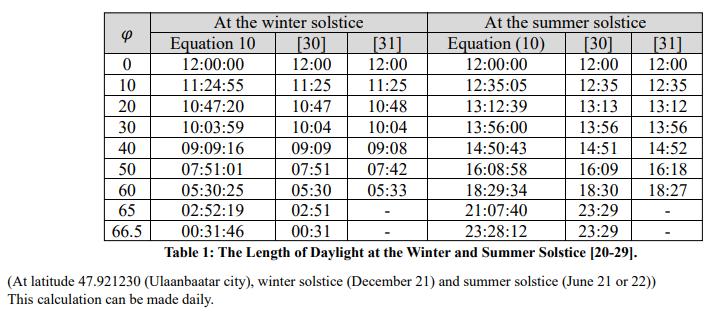
(At latitude 47.921230 (Ulaanbaatar city), winter solstice (December 21) and summer solstice (June 21 or 22)) This calculation can be made daily
The Yearly Altitude Variations of The Noon Sun (hφ n)
It is [25] as follows:


Figure 5: The Altitude of the Sun on 1 December at Geographical Latitude 47.921230.
This calculation can be made daily (Equation 11 and Figure 5). Summarizing, I can say that the sine wave formula is perfect in itself, so there is no need to put it into a mathematical form like Euler and Fourier series.
The Second Great Creation of The God-Like Sine Wave: Hysteresis
The conventional brief descriptions of refractive and reflective waves are as follows. Huygens’s principle states that every point on a wave front is a source of wavelets that spread out in the forward direction at the same speed as the wave itself [32].
Electromagnetic waves are transverse waves; we can consider them in 2D.
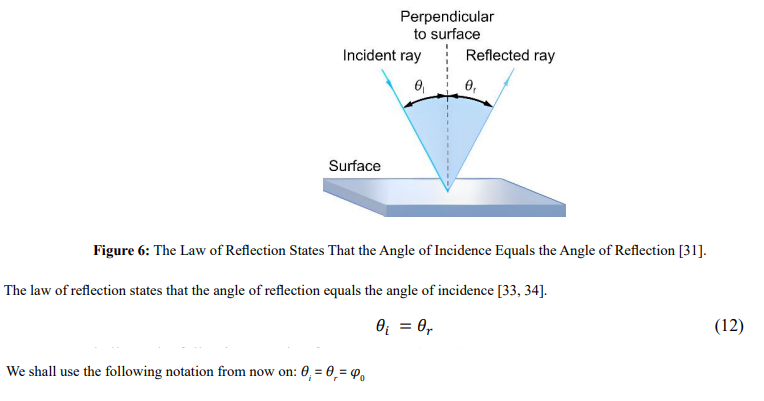

Figure 7: Wave Fronts in The Two Media
Initial Wavefront
At time t = 0, the wavefront separates the disturbed region from the undisturbed region.
Secondary Wavelets
Each point on the wavefront emits a spherical secondary wavelet. After time t, each wavelet has a radius of vt, where v is the speed of the wave.
New Wavefront
The surface that is tangent to all these wavelets is the new wavefront
This is referred to as the forward envelope of the wavelets [32].
Reflection can simply be defined as the bouncing back of light when it strikes the medium on a plane [33].
This concept is the traditional explanation of the reflected wave.
The law of the refraction wave shows that some pieces of the incoming sine wave are refracted into medium 2.
Some Beautiful Peculiarities of The Sine Function
The most familiar trigonometric function we know is the sine function. The root and very beginning of all trigonometry is the sine wave, and everything is perfectly expressed only through trigonometry. In other words, the sine wave creates the world. How can sinus do it?
1. A sine wave can remain a sine wave through any changes; only its phase changes paint the world. No other mathematical method can express everything as perfectly as the sine function. For example, we can write all trigonometric formulas using the sine function.
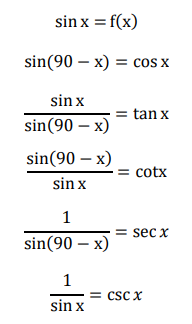
It is trigonometry. Trigonometric functions expressed as different phases of the sine are called differently for easy understanding: cosine, tangent, cotangent, secant, and cosecant. Another example, the Pythagorean identity can be written as follows:

Functions other than sine are merely auxiliary functions.
2. The wave starts at 0 in the coordinate system.
3. The sine function is independent of space and time, but changes only with the angle of the circle. Interestingly, instead of angles, we use the indirect but more sophisticated concepts called time and space.
4. Sine waves produce hysteresis, and the only wave that can approach its 270-degree vertical axis and affect the diamagnetic and paramagnetic properties of electromagnetic waves is the sine wave itself.

“A sine wave is the basic building block of all physical phenomena, including the life cycle of everything from tiny living things to the universe” [35].
Any arbitrary signal or physical phenomenon is actually a combination of a dc (constant) part, a sine wave with a fundamental time period, and its harmonics. The sine wave of the fundamental period possesses over 90% of the signal energy; thus, if we remove all harmonics, we actually do not lose much energy of the signal, but we will get the basic shape of the signal or physical phenomena – a sine wave. A sine wave is the ideal shape of any life cycle [36].
Along with the sine wave is its cousin, the cosine wave, which is the same except displaced to the right by half a cycle. A sine wave is the most basic form of periodic oscillation and is the ideal shape of any life cycle [37].
The beautiful sine wave is curious, as the function that defines the sine wave, sin(x), comes from comparing the lengths of sides in right-angled triangles – just about the least curvy things you could imagine. How does that concept result in the lovely curve of the sine wave [38]?
Indeed, as Sarah Hart points out, the ratio of the lengths of the sides of a right triangle is truly remarkable. This ratio defines hysteresis, which is not only strange but also admirable, as it forms the basis for the Supreme Theory of Everything.
A circle is only one of many things that a sine/cosine function can describe. A sine wave or sinusoid is a mathematical curve that describes a smooth periodic oscillation [39].
All living things, non-living things, countries, the world, astronomical bodies, the solar system, galaxies, the universe, everything has a life cycle. According to Fourier, any physical phenomenon can be explained by a sine wave.
Sinusoidal plane-wave solutions are particular solutions to the wave equation. The general solution of the electromagnetic wave equation in homogeneous, linear, time-independent media can be written as a linear superposition of plane waves of different frequencies and polarizations [39]. Mathematically, the simplest wave is a sinusoidal plane wave in which, at any point, the field experiences simple harmonic motion at one frequency [40].
The greatest creation of the wonderful sine wave is the hysteresis that defines everything.
Origins of the Hysteresis
A system with hysteresis has memory. Its output depends on where it came from [41]. For this reason, leading scientists worked hard to express the mathematical formulations of magnetic hysteresis, but it was generally experimental because the systematic understanding of everything is impossible without open hysteresis. How can we handle the hysteresis to open it?
Everything is in the interactions of waves. We live in a world of waves.
The published papers concerning hysteresis are summarized as [42-65].
Formula Extraction I Of the Hysteresis Emerging from The Refraction Wave
Snell's law is a formula used to describe the relationship between the angles of incidence and refraction when referring to light or other waves passing through a boundary between two different isotropic media, such as water, glass, or air [66].
Snell considered all media to be identical to medium 1; the difference between them was only the refractive index.

This is the correct model.
Let's see how hysteresis occurs through the interaction of sine waves.
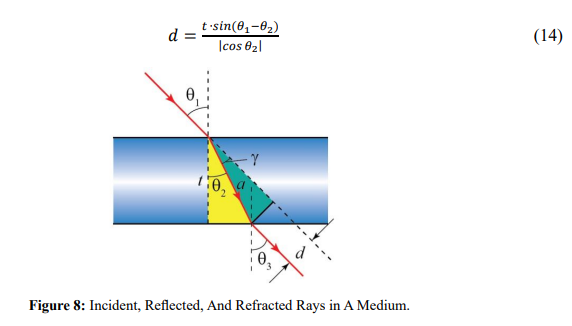
By refraction of a wave entering a second medium from the boundary of two media with different refractive indices, hysteresis exists.
The formula derivation of the hysteresis (Equation 14) has been described for the first time by the refraction wave in October 2019 [42-43].
Formula Extraction II of Hysteresis Based on Axes of The Unit Circle

Formula Extraction III of Hysteresis Emerging from Reflected Wave
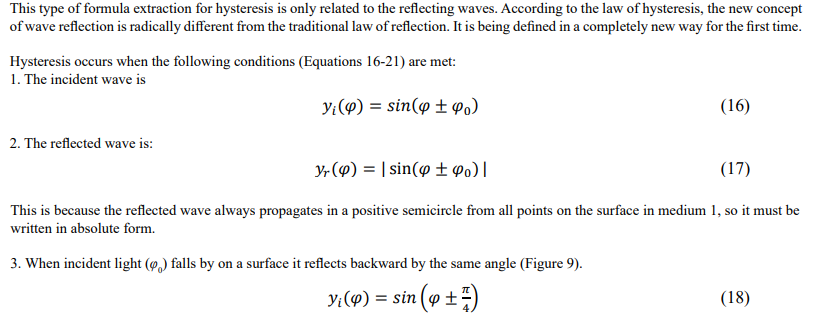
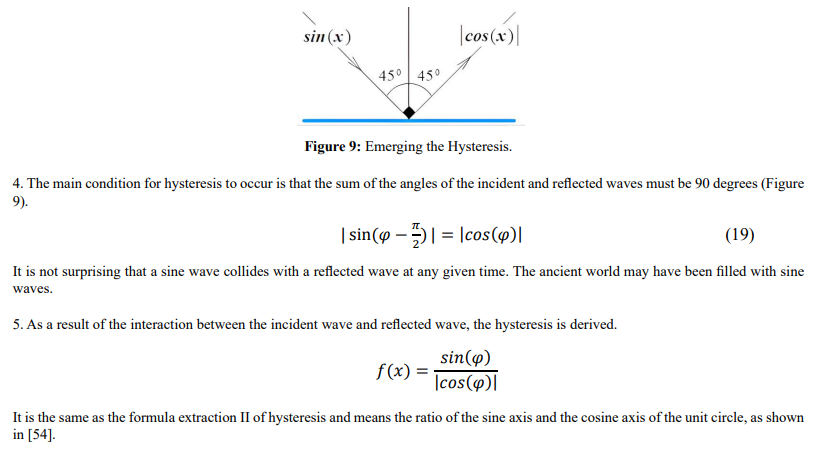
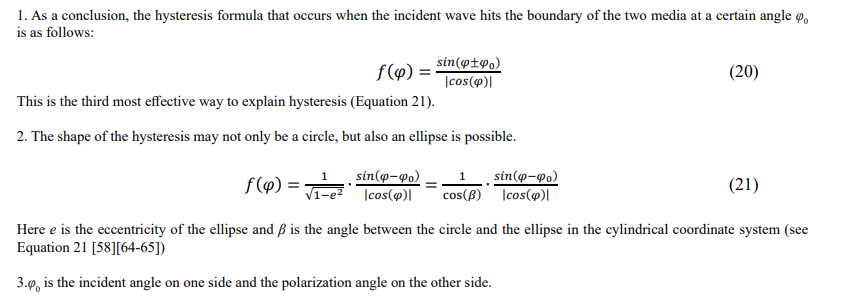

Figure 10: Polarization in Reflection and Refraction [67].
If the polarization angle φ0 is equal to 0, no hysteresis occurs, and only superparamagnetic properties are exhibited.
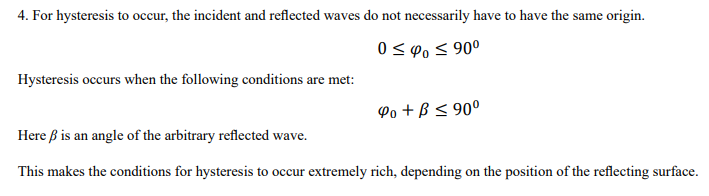
5. We must understand that the next parameters:
i) The amplitude (A) is the same as the eccentricity (e) of the ellipse.
ii) The incident angle is the same as the polarization angle. The hysteresis reflected wave formula expresses the nature of reflected waves in a completely new way, so I would like to call it the LAW II OF REFLECTION.
Is Quantum Hysteresis Possible to Emerge?
Photons are packets of energy, which have properties of both waves and particles [67].
In physics, a quantum is the minimum amount of any physical entity (physical property) involved in an interaction [68].
A photon is an elementary particle that is a quantum of the electromagnetic field, including electromagnetic radiation such as light and radio waves, and the force carrier for the electromagnetic force. Photons are massless particles that can only move at one speed, the speed of light measured in a vacuum. The photon belongs to the class of boson particles [69].
A photon is a single quantum of light of a specific frequency (or of any other form of electromagnetic radiation). Similarly, the energy of an electron bound within an atom is quantized and can exist only in certain discrete values [70].
E = hν is called the Planck-Einstein relation, which is a formula integral to quantum mechanics that says a quantum of energy (E), commonly thought of as a photon, is equal to the Planck constant (h) times a frequency of oscillation of an atomic oscillator (ν).
Quantum energy of a photon [71]:
E=hv (22)
It is the basis for Planck's law, which describes the spectral density of electromagnetic radiation emitted by a non-blackbody. However, this law (Equation 22) is not perfect [53].
In the attempt to bring theory into agreement with experiment, Max Planck postulated that electromagnetic energy is absorbed or emitted in discrete packets, or quanta [53].
Planck’s law states that electromagnetic radiation from heated bodies is not emitted as a continuous flow but is made up of discrete units or quanta of energy, the size of which involves a fundamental physical constant (Planck’s constant) [72].
If it is true that the energy of a photon is truly determined by the Planck-Einstein relation, then this is as flawed as Planck's law.
The reason why Planck's law is incorrect is, first, that the Hertzsprung-Russell diagram confirms it [53], second, that there is no derivation of a theoretical formula, and third, that an empirical theory was developed by combining several theories and formulas. We proposed using the hysteresis law instead of Planck's law of blackbody radiation [53]. In this case, a large part of the hysteresis law is the quantum hysteresis, is as follows:
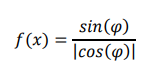
Hysteresis means that waves propagate in packets. That is, in quantum terms.
The sine wave contained in the hysteresis formula strongly reduces the radius of the circle, expressed as a cosine function, to almost zero at angles of 90 and 270 degrees (Formula 19). In other words, the only wave that can approach 270 degrees of the vertical axis, which can affect diamagnetic properties, paramagnetic properties, and is the sine wave. The real intuition begins when sine, together with its cousin cosine, enters the form of a formula. Cosine is always positive, horizontal, and base.
Thus, the quantum energy of a photon can be described by a hysteresis similar to non-Planck's law. This is quantum hysteresis.
Photons are packets of energy, which have properties of both waves and particles [53].
Finally, we can see that the photon is an object with very deep properties, expressed in all its properties of hysteresis, and that it is not as simple as depicted by the Planck-Einstein linear relationship.
Possibility for Sensing Dark Medium
The medium 1, for example, is air (atmosphere), since it is optically transparent, while medium 2 is a shallow layer of lithosphere, which is opaque. So, the light energy penetrates only in the form of heat into medium 2. In this case, medium 2 is really dark (Figure 11).
Another proof of darkness for medium 2: the leading sin θ is positive in medium 1 (0-180 degrees) and negative in medium 2 (180-360). For example, because the second environment is dark, underground information is obtained through several indirect geophysical methods, including electricity, magnetism, seismicity, and gravity. This is why the second environment is truly dark from an optical perspective and cognitively empty. Given our limited knowledge of the dark environment, it is not surprising that we cannot fully comprehend emptiness.

Figure 11: The Dark, Unknown, And Empty Medium 2.
The theory that can describe light and dark environments simultaneously is the law of hysteresis.
Sensitivity and Memory of the Hysteresis
I have a catalog displaying how the hysteresis spectrum changes during various phase transitions. It was found that the hysteresis sensitivity and memory are extremely high and have no limitations, even under any phase change. In other words, there are unlimited possibilities for defining anything in hysteresis.
For example, the infinitesimal changes of the phases in the formula of the hysteresis (Equation 21) can result in dramatically large fluctuations of the hysteresis with an uncountable long-term memory (Figures 13-15). For simplicity, we have selected the phase 
of the sine wave, and suppose the shape of the hysteresis is shown only by the changes of the phase of the sine wave.


Figure 12: The Hysteresis by Different Phases Of Cosine Function.
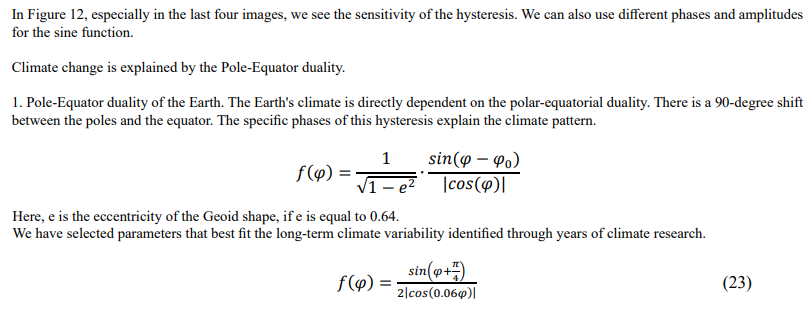

Figure 13: Climate Fluctuation of The Little Ice Age [73].
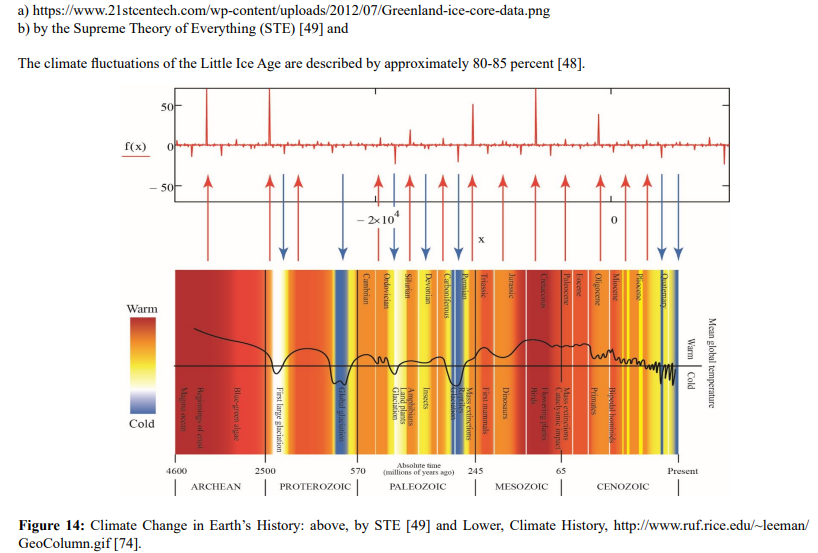
The accuracy of the relation between calculation by the Supreme Theory of Everything and climate fluctuation in Earth’s history is 60-65 percent [49].
It suggests the climate is not a random phenomenon.
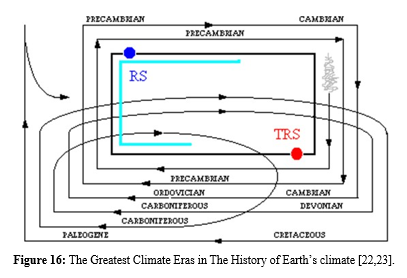
As can be seen from Figures 13-16, hysteresis has a huge memory that can store long-term information equivalent to the age of the Earth with an accuracy of 0.0001-0.00001 units.
Hysteresis is the dependence of the state of a system on its history. Hysteresis can be found in Wikipedia [41].
The entire spectrum of the Earth's climate is subject to hysteresis, or in common parlance, feedback mechanisms. These multiple feedback mechanisms create the Earth's climate history, or the hydrological Supercycle (Figures 15 and 16).
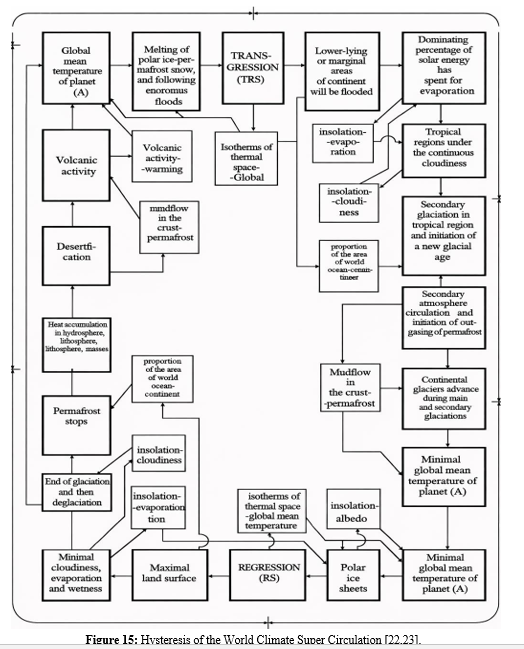
The diagram of the World Climate Supercirculation (WCS) [22] shows a hysteresis. The Earth's climate consists of a huge number of feedbacks.
The Third Great Creation of The God-Like Sine Wave: Wave-Particle Duality
The wave-particle duality is a most universal phenomenon in quantum and cosmological worlds. So, we call it the Universal Duality of Everything (UDE), which is described by the hysteresis and the sine function. It has one unique principle: The dualities cannot be separated from each other.
Wave Fundamentalism and The De Broglie-Bohm Theory
According to the law of hysteresis, the wave-particle duality is a common property that covers everything from quantum mechanics to cosmology.
The wave side of the wave-particle duality is empty, while the particle side is also empty when considered in detail (Figure 17). Because 99.9999999999996% of an atom is empty, and it is possible to shrink [75].
What is the remaining tiny part of the atom? It is either likely to decay again or it has no mass.
Everything in our universe is made up of atoms that are made up of electrons, neutrons, and protons, which are made up of quarks. And electrons are made up of leptons, but what are quarks and leptons made of? They’re made of nothing. Quarks and leptons are just pure energy. Quarks and leptons are fast-moving points of pure energy. They’re made up of literally nothing. They are nothing. So, that means that at the fundamental core of the atom, and therefore the fundamental core of everything in our universe. There is no material there. It’s just pure energy [76].
Protons are spin-1/2 fermions and are composed of three valence quarks, making them baryons (a sub-type of hadrons). The two up quarks and one down quark of a proton are held together by the strong force, mediated by gluons [70]. From these, it follows that everything is empty because the atoms that are believed to make up the real world have an empty nature. For this reason, one of the key insights from wave-particle duality is that waves are considered more fundamental than particles.
The emptiness is not only present in the hysteresis black singularity, but also firmly embedded in the atomic structure.
De Broglie-Bohm Theory, that is also called Bohmian Mechanics, considers that the wave nature predominates, and thus the particle-wave duality vanishes. Waves indeed dominate in Bohm mechanics, but according to the hysteresis law, the wave-particle duality does not disappear and continues in the black singularity of hysteresis. Therefore, there is no reason to believe that either side of the wave-particle duality will disappear. Because the particle nature is hidden in the black singularity of hysteresis. The wave-particle duality is symmetric about the horizontal and vertical axes of hysteresis (Figure 17).
The universe and everything are empty. This is manifested by the black and white singularities of hysteresis. [58, 62-65].
Let us see again which and where reality or emptiness predominates in the UDE (Figure 17).
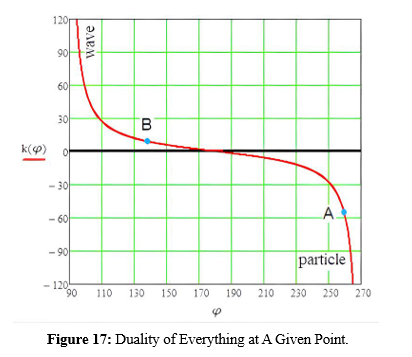
In the white singularity, emptiness prevails due to waves. In the black singularity, emptiness also exists. First, because of the flow of Cooper pairs, and second, because these particles are not physical points, but wave packets. At each point on the wave-particle curve (in red), both reality and emptiness coexist (Figure 17).
It means the two states coexist at the same location. If they were just one point, Figure 17 would only show one point with no curve. However, the relationship between them is a curve. The red curve tells us what percentage of reality and emptiness are present in a single point. The principle of uncertainty is becoming the principle of certainty.
The black singularity is almost empty because of the flow of electron pairs. A particle is not a point, but a wave packet distributed in space.
The quantum uncertainty principle, formulated by Werner Heisenberg, is a fundamental concept in quantum mechanics stating that there is a limit to the precision with which certain pairs of physical properties, like a particle's position and momentum, can be simultaneously known. The more accurately one property is measured, the less accurately the other can be known; you cannot simultaneously know both with perfect accuracy [77].
According to the law of hysteresis, the elementary particles can be in two states at once or since two quantities coexist at the same location, if the value of one is determined with high precision, the value of the other can also be determined by the location in Figure 17.
The double slit experiment confirms that reality and emptiness coexist at each point shown in Figure 17. And everyone knows from the photoelectric effect experiment that when a wave hits a surface, particles are separated and fly away. This proves that at every point on the surface, both wave-like and particle-like properties coexist.
The real and the empty cannot exist separately. The real is not absolutely real, and the empty is not absolutely empty.
According to the law of hysteresis, the elementary particles can be in two states at once, or since two quantities coexist at the same location, if the value of one is determined with high precision, the value of the other can also be determined by the location in Figure 17.
The double slit experiment confirms that reality and emptiness coexist at each point shown in Figure 17. And everyone knows from the photoelectric effect experiment that when a wave hits a surface, particles are separated and fly away. This proves that at every point on the surface, both wave-like and particle-like properties coexist.In other words, not only wave-particle duality, but the wave and particle have dualities separately. In this case, we can say that the real is not absolutely real, and the empty is not absolutely empty.
“Darkness” still has light in it, according to a new quantum theory. You’ve probably heard of the famous double-slit experiment, where light passes through two slits and forms a striped pattern of bright and dark bands on a screen. For over 200 years, scientists explained this using wave theory: where the waves from each slit overlap, they either boost each other (bright spots) or cancel out (dark spots). But what if those “dark” spots aren’t really empty at all?
A new theory from physicists in Brazil, Switzerland, and Germany says the old explanation misses something big. Even when two light waves cancel each other out, the light particles – called photons – are still present. They’re just in what the researchers call a “dark quantum state”: they exist, but they can’t trigger a detector like normal light does.
Their idea reframes the whole interference pattern not as a result of wave behavior, but as a mix of “bright” and “dark” quantum states of light. In bright states, photons interact with atoms or detectors. In dark states, they don’t – even though the photons are still there. This explains why we see the striped pattern without needing classical wave interference.
Even more mind-bending? The theory suggests that observing a particle’s path doesn’t physically push it or knock it off-course. It just changes its quantum state, turning what was a “dark” particle into a “bright” one, effectively making it visible and destroying the pattern. It’s like flipping a switch on visibility itself.
This research could help resolve decades-old paradoxes in physics, bridging the gap between classical and quantum views of light, and even hinting at new ways to control or detect hidden quantum states.[78]
The new theory of Brazilian, Swiss, and German physicists is absolutely correct in suggesting that the old explanation missed something big. Every given point contains duality (Figure 17).
Mathematics of Universal Duality of Everything
First, let's introduce the quantum mechanical explanation.
“Have any mathematical formulas of wave-particle duality theory?
“The mathematical foundation of wave-particle duality theory is primarily built on de Broglie's equation and Planck's equation, which relate a particle's wave-like properties (wavelength) to its particle-like properties (momentum) and energy, respectively [79].
• De Broglie's Equation
This equation, λ = h/p, links a particle's wavelength (λ) to its momentum (p), where h is Planck's constant. This equation suggests that all matter, not just light, exhibits wave-like behavior.
• Planck's Equation
E = hν (or E = hc/ λ) connects a particle's energy (E) to its wave frequency (ν) or wavelength (λ), where h is Planck's constant and c is the speed of light. This equation, originally describing light, is extended to matter, suggesting that particles also have energy associated with their wave nature.
Other Relevant Equations:
• E = mc²: Einstein's famous equation, which relates energy and mass, is also relevant when considering wave-particle duality, particularly for massless particles like photons.
• p = h/λ: This is another form of de Broglie's equation, expressing momentum (p) in terms of Planck's constant (h) and wavelength (λ).
These equations, along with the concept of wave functions and the Schrödinger equation in quantum mechanics, provide the mathematical framework for understanding how particles can exhibit both wave-like and particle-like behavior
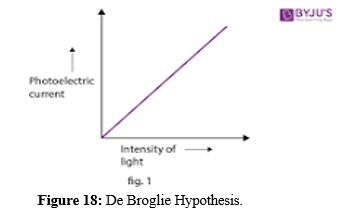
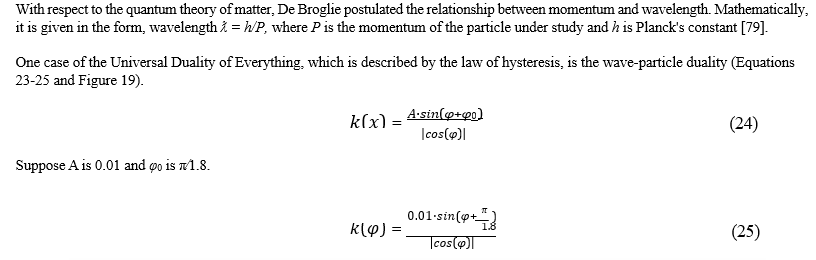


Figure 19 shows that the universal duality of everything is confined between two singularities: wave and particle saturation.
The most compelling evidence of universal duality in everything is Planck's law, which describes the spectral density of electromagnetic radiation emitted by a black body. However, it is too empirical, far from reality, and has numerous contradictions, such as the lack of an extraction formula [53].
Therefore, given the Universal Duality of Everything, reality and emptiness do not exist separately, independently of each other. This means that the real is not absolutely real, and the empty is not absolutely empty. Therefore, it can be seen that everything in this universe is a combination of reality and emptiness. In other words, Universal Duality of Everything is the most common law of existence in the universe, not only in the microscopic but also in the macroscopic world.
One of the most studied dualities is the wave-particle duality.
“MIT physicists’ findings demonstrate, with atomic-level precision, the dual yet evasive nature of light. Today, with the formulation of
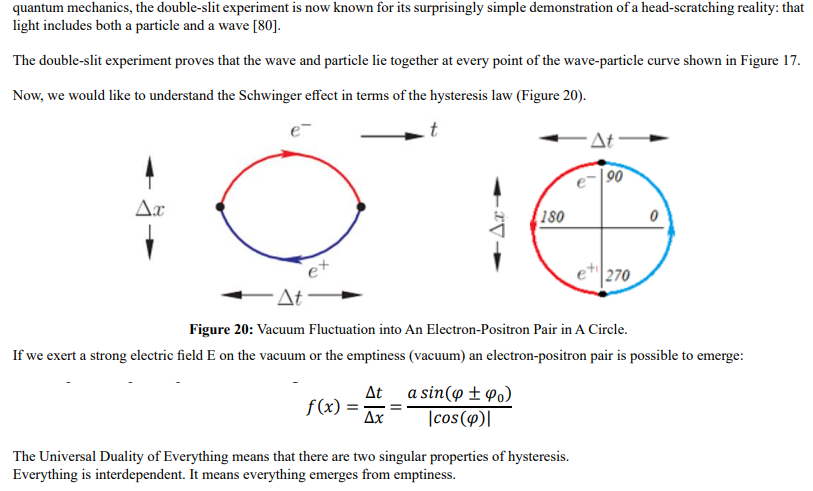
Justifications of The Universal Duality of Everything
There are many justifications for the Universal Duality of Everything. There is very, very solid evidence there was… We have a long list of dualities. However, for the sake of brevity, let's group the Subsection snippets and consider some key dualities.
Wave-Particle Duality of a Photon
Photons shape reality by acting as light particles and waves at once, driving everything from vision to stars. Light is not just brightness. It carries energy, information, and structure, making it one of the most important messengers in the universe.
A photon is the smallest packet of light possible. It has no weight, yet it carries momentum. It can act like a tiny bullet hitting a surface, or like a spreading wave passing through space. Quantum physics allows this dual behavior without contradiction. Light simply follows rules that differ from everyday experience.
Sometimes it formed patterns like waves. Other times it arrived in single hits like particles. Accepting both descriptions became necessary. The universe was not broken [81].
According to the hysteresis law, a photon has the duality of wave-particle, which can be considered as a point. The unit point shown in Figures 17 and 19 confirms that duality is present. Since the duality is determined by hysteresis, this not only indicates that the photon has hysteresis, but also that it has all the properties of hysteresis.
Pole-Equator Duality of the Earth
Sine-cosine duality (See Subsection 3.2.2)
The hysteresis law is described based on the sine-cosine wave duality [55,56].
Mass-Distance Duality in the Barycenter of Celestial Bodies
This duality is shown in [65].
Kinetic Energy and Potential Energy Duality
The shape of the Universe obeys its total energy, including Kinetic-Potential Energy Duality in Section 5.9.
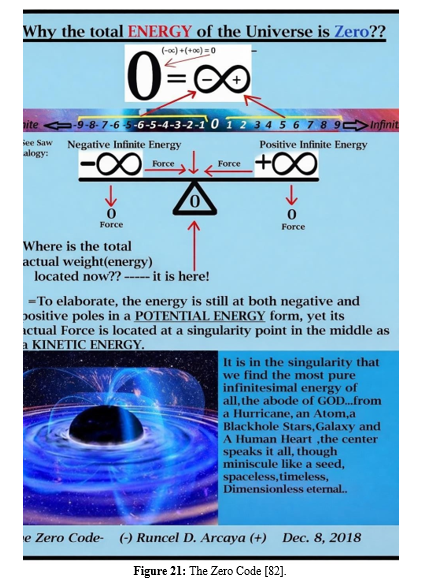
I found a picture in my email inbox that shows 0 is equal to infinity (Figure 21).
Orbital Motion: Perihelion-Aphelion Duality
We say that planets orbit stars, but that’s not the whole truth. Planets and stars actually orbit around their common center of mass. This common center of mass is called the barycenter. The barycenter also helps astronomers search for planets beyond our solar system [65]!
Electricity-Magnetism Duality [54,55]
“Electric fields should be generated by changing magnetic fields. For me Electric field is the derivative of the magnetic field.
I think the electric field must be shifted by 90 degrees relative to the magnetic field along the direction of radiation propagation.
The most important issue is raised here. Since the electric and magnetic fields are perpendicular to each other, the law of right angles in a circle can be used. Electric and magnetic waves are transverse waves and are shifted by 90 degrees in the direction of travel, which causes the sine to have a maximum value and the cosine to have a minimum value.
In the opposite case, as shown in the figure, the electric field has a minimum value and the magnetic field has a maximum value. Figure 22 confirms that the concept of the singularity in the hysteresis law is correct.
And this Figure shows the shape of the electric field landscape formed by a single positive charge and a single negative charge.
Since there is a positive and negative electric charges, but there is no magnetic charge. Therefore, the magnetic field oscillates in the cross-section (circle) of the cylindrical coordinate system, and the electric field oscillates in the vertical direction.”
 T
T
Figure 22: The Positive and Negative Singularities of The Hysteresis [83].
Attraction-Repulsion Duality [54] [61]
Positive-Negative Charge Duality [54] (Figure 22)
Duality of Information in a Binary System [64]
The cumulative distribution of information in a binary system is illustrated by the red curves, where 0 and 1 represent the two saturations of duality (Figure 19). [64]
Death-Life Duality
We like to explain the death-life duality based on the experiment “Schrodinger's Cat”.
Schrödinger asked the right questions here: You know, take my cat, it can be dead; it can be alive.
Schrödinger's Cat is a thought experiment that demonstrates the idea in quantum physics that tiny particles can be in two states at once until they're observed [84]. It asks you to imagine a cat in a box with a mechanism that might kill it. Until you look inside, the cat is both alive and dead at the same time.
We do not know what a cat is like between life and death. There are an infinite number of possibilities between being perfectly dead and healthy. This is possible to call the Death-Life Duality in the frame of Universal Duality of Everything in the hysteresis law (Figure 16). Not all animals are perfectly healthy or completely dead, but live somewhere between dead and alive. But some people live as if they were dead while they were alive, and there are some people dead but seem alive. How do you measure complete death?
We are not always perfectly healthy either. That's true, the cat is in a duality between life and death. Even if the cat comes out of the box, it is still in a duality of death and life. There are an infinite number of possibilities between being perfectly dead and being perfectly healthy.
Don't be happy that your cat is alive! It's better to go to the veterinary hospital. But if we find where the point on the curve in Figure 17 is, we can calculate the level of health.
Black Body-White Body Duality
The Black Body-White Body duality is written in Section 5.3.
Space-Time Duality
According to the hysteresis law, the present time exists on the cross-section or circle of the cylinder without past and future time (Figure 21). Both space and time are measured only by the angle of this circle. The difference between space and time is that space is located only on the circle, while time wanders due to the eccentricity of the ellipse. Space is absolute and time is relative. So, it seems that we humans produced the concept of time to simplify and understand it as much as possible by using the high-precision repeating motions of nature. This is not so early history. The animals sense time by biological time and space by magnetic direction.
Fortunately, I received just now mind-breaking news from Facebook entitled Scientists Observe Quantum 'Time Loops' – Future Events Seem to Return and Alter the Past by Omar Vueltas [85].
In an experiment that could rewrite our understanding of reality, quantum physicists have observed behavior suggesting that time itself may not flow in a straight line.
Instead of predictably moving from past to future, time appeared to bend, twist, and even loop backward, allowing events to influence each other across temporal boundaries.
Researchers achieved this using quantum entanglement—the strange connection where two particles remain linked no matter how far apart they are. But when scientists changed the measurement of one particle, its entangled partner seemed to respond retroactively, as if the future had come back to reshape the past.
In this view, the universe might not separate past, present, and future, but instead weave them together into a dynamic whole.
Time itself doesn't flow in a straight line, but in a circle.
Space-time duality is described as follows [64,65]:
We apply the polar coordinates, which are:
• Semi-major axis (a),
• Semi-minor axis (b) and
• Angle (φ) is the angle within the circle and
• β is the angle of the ellipse on the circle (00 to 3600).
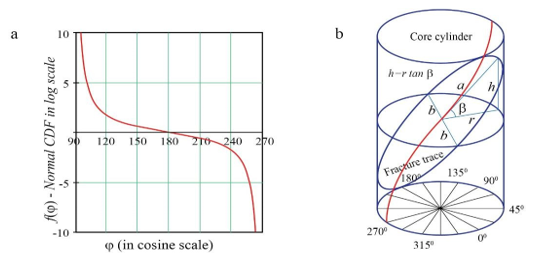
Figure 23: The Concept of Time in Cross-Section in The Cylindrical Coordinate System (Time is measured by degrees of a circle).
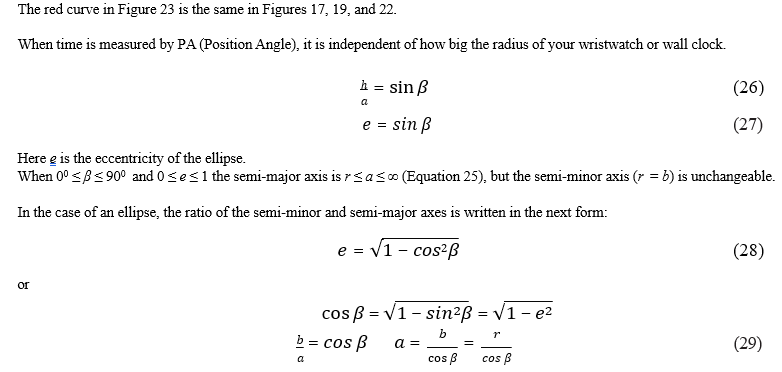
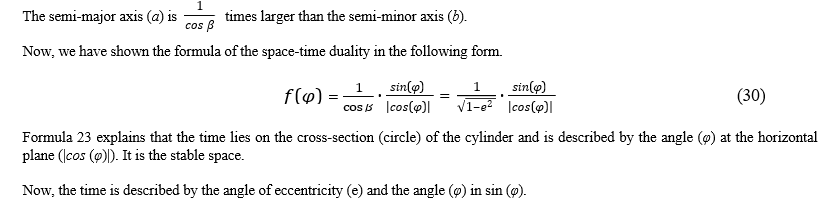
The duality of space-time presents time as an angle on a circle (Figure 23). This raises the question of whether time is primary or angle is. In fact, animals are guided by biological clocks and the instinct of the magnetic field. Angles are a gift of nature, but time is a human invention designed to make angles closer to life and understandable.
The above-listed justifications show that all laws and principles of physics are subject to the UDE and the law of hysteresis.
Based on Figures 17 and 19, we describe the law of UDE, which states that the ratio between the sine and cosine axes gives rise to the hysteresis written in Subsections 4.1-4.3.
Conclusion
The vertical axis of the circle formed by the cross-section of the cylindrical coordinate system is expressed as the sine function and represents space, while the horizontal axis is expressed as the cosine function and represents time.
Sine waves are the basic source and building block of all phenomena and processes in the universe, and when they interact with cosine waves, hysteresis occurs, which can exhibit many extraordinary properties in physics, nature, mind, and intuition. Hysteresis, with its extremely high memory, sensitivity, and intelligence. Hysteresis and its soul, the sine wave, have the unique ability to control, regulate, sense, and act on everything.
The second greatest and most wonderful creation of the sine wave is hysteresis, and the third is the wave-particle duality. Starting from quantum hysteresis, hysteresis is unique in that it can express the shape, size, and all parameters of the universe.
References
- Principles of quantum mechanics. (n.d.). Pinterest. https://www.pinterest.com/pin/24699497941409326/
- Wikipedia contributors. (n.d.). Wave. https://en.wikipedia.org/wiki/Wave
- Ayala Bertel, L. G. (2023). Mathematical introduction to wave-particle duality and the Schrödinger equation. IBM Community.https://community.ibm.com/community/user/blogs/luis-gerardo
- Stein, W. (n.d.). Trigonometry and complex exponentials. https://wstein.org/edu/winter06/20b/notes/html/node30.html
- Tardad, U. (2025a). Imaginary units: An absurd starting point or a mathematical necessity? London Journal of Research in Science: Natural & Formal, 25(1), 43–46.
- Encyclopaedia Britannica. (n.d.). Euler’s formula. https://www.britannica.com/science/Eulers-formula
- Physics OER. (n.d.). Euler’s formula. https://oer.physics.manchester.ac.uk/Math2/Notes/jsmath/Notesse4.html
- Djandali, M. (n.d.). What is the difference between a wave function and a wave equation? Quora. https://www.quora.com
- Hussain, S. (n.d.). What is a wave function? What is the difference between the wave function and probability density? Quora.https://www.quora.com
- Stanford University. (n.d.). Fourier analysis. https://web.stanford.edu/class/nbio228-01/handouts/Ch5_Fourier_Analysis.pdf
- Herman, R. (n.d.). Fourier trigonometric series. LibreTexts. https://math.libretexts.org
- Kalid Azad. (n.d.). Intuitive understanding of sine waves. BetterExplained. https://betterexplained.com/articles/intuitive-understanding-of-sine-waves/
- Wikipedia contributors. (n.d.). Fourier transform. https://en.wikipedia.org/wiki/Fourier_transform
- Chatfield, C. (2004). The analysis of time series: An introduction (6th ed.). Chapman & Hall/CRC.
- BYJU’S. (n.d.). Fourier transform. https://byjus.com/physics/fourier-transform/
- Merz, S. (n.d.). Why are so many things in physics connected to waves? Quora.
- Chatterjee, A. (n.d.). What is the most misunderstood thing in physics? Quora.
- Lane, W. C. (n.d.). The wave equation and its solutions.
- Ulaanbaatar, T. (1991). Length of daylight. Engineering, 1, 14.
- Ulaanbaatar, T. (1994). Mathematical modeling of the thermal regime on and near the Earth’s surface and cryosphere (PhD thesis). Mongolian University of Science and Technology.
- Ulaanbaatar, T. (1998a). Climate supercirculation of the Earth. Scientific Translation, 3(132), 246–264.
- Ulaanbaatar, T. (1998b). Feedbacks in the world climate supercirculation and their interactions. Scientific Translation, 6(147),124–139.
- Ulaanbaatar, T. (1999a). Hierarchy in complexity in the time of length of daylight. Proceedings of the Mongolian Academy of Sciences.
- Ulaanbaatar, T. (1999b). Length of daylight. IUGG General Assembly Proceedings, Birmingham, UK.
- Ulaanbaatar, T. (1999c). Insolation regime on and near the Earth’s surface. IUGG General Assembly Proceedings, Birmingham,UK.
- Ulaanbaatar, T. (1999d). United time system of Earth system model. IUGG General Assembly Proceedings, Birmingham, UK.
- Ulaanbaatar, T. (1999e). Mathematical regionalization of organic resources in the Earth’s crust. IUGG General AssemblyProceedings, Birmingham, UK.
- Ulaanbaatar, T. (1999f). High latitude thermal variability in relation to lower latitude. IUGG General Assembly Proceedings,Birmingham, UK.
- Shubaev, L. P. (1977). Earth sciences (pp. 80–81). Higher School.
- Tarbuck, E. J., & Lutgens, F. K. (n.d.). Earth science. McGraw-Hill.
- ALLEN. (n.d.). Huygens’ principle. https://allen.in/jee/physics/huygens-principle
- Ling, S. J., Sanny, J., & Moebs, W. (n.d.). The law of reflection. Pressbooks. https://pressbooks.bccampus.ca
- Testbook. (n.d.). Reflection of waves: Free end and fixed end reflection. https://testbook.com/physics/reflection-of-waves
- BYJU’S. (n.d.). Difference between reflection and refraction. https://byjus.com/physics/difference-between-reflection-and-refraction/
- Wikipedia contributors. (n.d.). Sine wave. https://en.wikipedia.org/wiki/Sine_wave
- Debnath, P. (2019). The complete life cycle of the universe. AIP Conference Proceedings, 2142, 110029. https://doi. org/10.1063/1.5122489
- Wikipedia contributors. (n.d.). Sine wave. https://en.wikipedia.org/wiki/Sine_wave
- Hart, S. (n.d.). The incredible sine wave and its uses. Gresham College. https://www.gresham.ac.uk/speakers/professor-sarah-hart
- Moorchung, N. (2019). Waves that bind body and planet. Deccan Herald. https://www.deccanherald.com/opinion/waves-that-bind-body-and-planet-724074.html
- Wikipedia contributors. (n.d.). Sinusoidal plane-wave solutions of the electromagnetic wave equation. https://en.wikipedia.org/ wiki/Sinusoidal_plane-wave_solutions_of_the_electromagnetic_wave_equation
- Wikipedia contributors. (n.d.). Hysteresis. https://en.wikipedia.org/wiki/Hysteresis
- Tarzad, U. (2019b). Formula extraction in supreme theory of everything. Advances in Theoretical & Computational Physics, 2(4). https://doi.org/10.33140/ATCP.02.04.01
- Tarzad, U. (2022b). Formula extraction of open hysteresis in supreme theory of everything. In New Trends in Physical Science Research (pp. 117–122).
- Tarzad, U. (2022c). Supreme theory of everything. In Research Highlights in Mathematics and Computer Science.
- Tarzad, U. (2018a). On the singularity striving to zero. Scientific Transactions, Mongolian University of Science and Technology,1(228), 50–58.
- Tarzad, U. (2018b). Supreme theory of everything. Journal of Astrophysics & Aerospace Technology, 6.
- Tarzad, U. (2018c). 4th International Conference on Astrophysics and Particle Physics. Chicago, USA.
- Tarzad, U. (2019a). Supreme theory of everything. Advances in Theoretical & Computational Physics, 2(2), 1–6. https://doi. org/10.33140/ATCP.02.02.05
- Tarzad, U. (2020). Supreme theory of everything: Whole universe in a simple formula. London Journal of Research in Science: Natural and Formal, 20(5), 73–90.
- Tarzad, U. (2021a). Supreme theory of everything: The open hysteresis in place of inverse-square law. London Journal of Research in Science: Natural and Formal, 21(2), 55–69.
- Tarzad, U., Jargalan, N., Batgerel, B., & Sangaa, D. (2021b). New possibility to open the hysteresis. Scientific Transactions, 47,116–125.
- Tarzad, U., Jargalan, N., Batgerel, B., & Sangaa, D. (2021c). Supreme theory of everything: A new possibility to open the hysteresis.London Journal of Research in Computer Science and Technology, 21(1).
- Tarzad, U. (2021d). Theoretical formulation of the spectral density of electromagnetic radiation emitted by a nonblack body. Advances in Theoretical & Computational Physics, 4(2), 191–196. https://doi.org/10.33140/ATCP.04.02.12
- Tarzad, U. (2021e). Geometric methods for complex analysis. Journal of Current Trends in Physics Research and Applications, 2(1), 1–7.
- Tardad, U. (2022a). Back to the fundamental principles of arithmetic. Advances in Theoretical & Computational Physics, 5(1).https://doi.org/10.33140/ATCP.05.01.06
- Tardad, U. (2022d). A new concept of the photoelectric effect. London Journal of Research in Science: Natural and Formal, 22(14),1–12.
- Tarzad, U. (2022e). Special theory of relativity was lost from the beginning. International Journal of Innovative Science and Research Technology, 7(5), 973–978.
- Tarzad, U. (2022f). Geometric methods for complex analysis. Journal of Current Trends in Physics Research and Applications, 2(1), 1–7.
- Tardad, U. (2023a). It is time to discuss Hubble’s law. London Journal of Research in Science: Natural and Formal, 23(1), 21–29.
- Tarzad, U. (2023b). A descriptive study of the supreme theory of everything. In New Frontiers in Physical Science Research (Vol. 6, pp. 53–69).
- Tardad, U., Sangaa, D., & Chuluunbaatar, A. (2023c). Superconductivity and non-ohmic resistivity in a negative singularity of the open hysteresis. Nano Technology & Nano Science Journal, 5, 341–352.
- Tardad, U. (2023d). The fundamental forces in quantum hysteresis. Journal of Applied Mathematics and Physics, 11, 3274–3285. https://doi.org/10.4236/jamp.2023.1110210
- Tardad, U. (2024). Deep mysteries of thermodynamics. Applied Physics Research, 16(1), 155–179. https://doi.org/10.5539/apr. v16n1p155
- Tardad, U. (2025b). The contribution of hysteresis in information theory. Advances in Theoretical & Computational Physics, 8(3), 1–21.
- Tardad, U. (2025c). A hysteretic description of non-Kepler’s orbit in two-body celestial mechanics. Journal of Applied Mathematics and Physics, 13(11).
- Wikipedia contributors. (n.d.). Snell’s law. https://en.wikipedia.org/wiki/Snell%27s_law
- Ling, S. J., Sanny, J., & Moebs, W. (n.d.). Polarization. https://pressbooks.online.ucf.edu/osuniversityphysics3/chapter/polarization/
- Open University. (n.d.). Quarks and photons. https://www.open.edu
- Wikipedia contributors. (n.d.). Quantum. https://en.wikipedia.org/wiki/Quantum
- Wikipedia contributors. (n.d.). Photon. https://en.wikipedia.org/wiki/Photon
- BYJU’S. (n.d.). Planck equation. https://byjus.com/physics/planck-equation/
- Wikipedia contributors. (n.d.). Planck constant. https://en.wikipedia.org/wiki/Planck_constant
- 21st Century Tech. (n.d.). Climate fluctuation of the Little Ice Age.
- Rice University. (n.d.). Climate history.
- Silvertant, E. (n.d.). If atoms are 99.9999999999996% empty, is it possible to shrink an atom? Quora.
- Scientific proof that humans are not physical beings. (n.d.). Pinterest.
- Wikipedia contributors. (n.d.). Uncertainty principle. https://en.wikipedia.org/wiki/Uncertainty_principle
- Villas-Boas, C. J., Máximo, C. E., Paulino, P. J., Bachelard, R. P., & Rempe, G. (2025). Bright and dark states of light: The quantumorigin of classical interference. Physical Review Letters, 134, 133603. https://doi.org/10.1103/PhysRevLett.134
- BYJU’S. (n.d.). Dual nature of matter and radiation. https://byjus.com/jee/dual-nature-of-matter/
- Chu, J. (2025). Famous double-slit experiment holds up when stripped to its quantum essentials. MIT News. https://news.mit. edu/2025/famous-double-slit-experiment-holds-when-stripped-to-quantum-essentials-0728
- Quantum physics post. (n.d.). Facebook.
- Runcel, A. (2018). Why the total energy of the universe is zero? The Zero Code. Pinterest.
- CyberPhysics. (n.d.). Electric intensity or electric field strength. https://www.cyberphysics.co.uk
- Wikipedia contributors. (n.d.). Schrödinger’s cat. https://en.wikipedia.org/wiki/Schr%C3%B6dinger%27s_cat
- Vueltas, O. (n.d.). Scientists observe quantum time loops – future events seem to return and alter the past. Facebook.