

Journal of Quantum Science & Emerging Technologies(JQSET)


Review Article - (2026) Volume 1, Issue 2
Supernumber Theory and Quantum Superposition Phenomena
 and Hua Li
 Received Date: Jun 02, 2026 / Accepted Date: Jul 09, 2026 / Published Date: Jul 15, 2026
Copyright: ©2026 Zhi Li., et al. This is an open-access article distributed under the terms of the Creative Commons Attribution License, which permits unrestricted use, distribution, and reproduction in any medium, provided the original author and source are credited.
Citation: Li, Z., Li, H. (2026). Supernumber Theory and Quantum Superposition Phenomena. J of Quantum Science & Emerging Techno, 1(2), 01-05.
Abstract
Hyperreal numbers are a field encompassing real numbers, infinitesimals, and infinities. In the hyperreal number system, infinitesimals are not equal to zero, and operations can be performed on infinitesimals and infinities. Based on hyperreal number theory, this paper discovers that multi-level radicals that cannot be simplified have no definite value, varying in size; these can be called quantum numbers or inaccurate numbers. A special type of multi-level radical can exhibit quantum superposition phenomena similar to those in the physical world. This allows the hyperreal number system to be extended to a supernumber system, a field encompassing real numbers, infinitesimals, infinities, and inaccurate numbers. Confirming the existence and properties of quantum numbers or inaccurate numbers and classifying them as supernumbers provides a new perspective. Within this framework, the negation proves the Riemann hypothesis.
Keywords
Supernumber Theory, Inaccurate Numbers, Quantum Numbers, Quantum Superposition Phenomenon, Riemann Hypothesis
Introduction
Hyperreal number theory is a modern mathematical theory system developed within the last hundred years. It was founded in 1960 by American mathematical logician A. Robinson. Hyperreal numbers are a field that includes real numbers, infinitesimals, and infinities [1]. In the hyperreal number system, infinitesimals are not equal to zero, and operations can be performed on infinitesimals and infinities. Based on hyperreal number theory, this paper finds that multi-level radical numbers that cannot be simplified do not have a definite value, and are sometimes large and sometimes small, and are quantum numbers or inaccurate numbers [2,3]. Among them, special kinds of multi-level radical numbers can exhibit quantum superposition phenomena similar to quantum in the physical world [3]. Thus, the hyperreal number system can be extended to a super-number system, which is a field that includes real numbers, infinitesimals, infinities, and inaccurate numbers.
Examples of Numerical Experiments
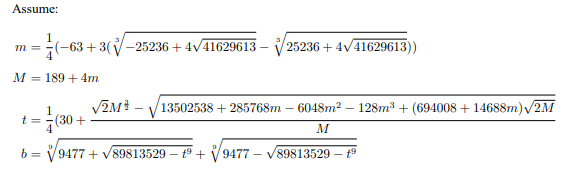
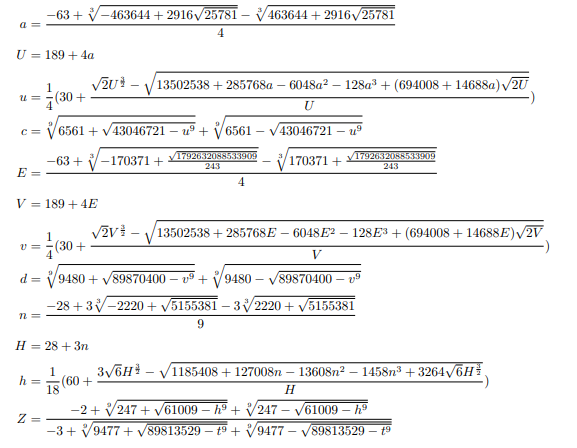
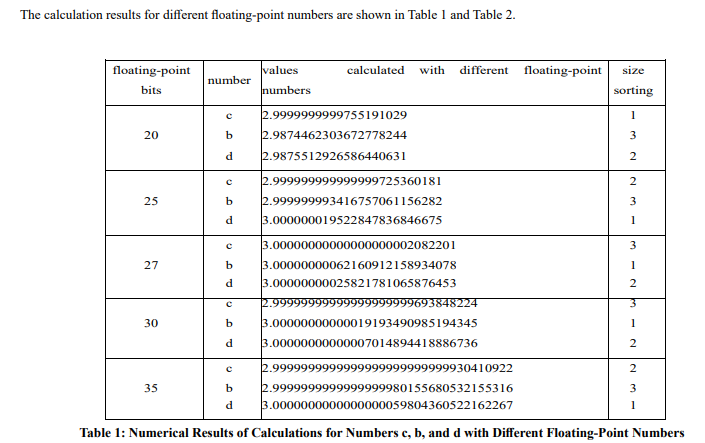
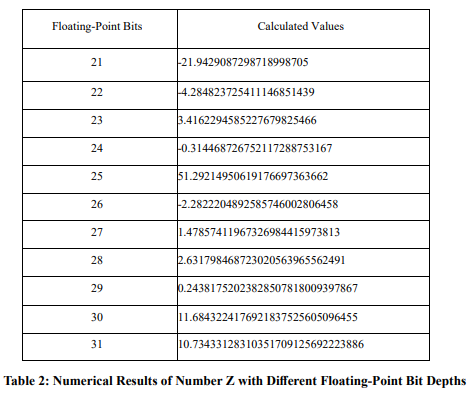
Discussion and Conclusion of Calculated Results
The numerical calculations above show that, within the framework of the hyperreal number system, numbers c, b, d, and z do not have definite values; they only exhibit fixed values when calculated using a selected number of floating-point bits. The calculated values of numbers c, b, and d are sometimes greater than the integer 3 and sometimes less than 3. The sorting results of the values of numbers c, b, and d calculated with different floating-point bits vary with the number of floating-point bits. Therefore, it is impossible to determine the relative sizes of numbers c, b, and d; that is, these numbers do not possess the ordered nature of the real number system and the hyperreal number system, and cannot be sorted.
The values of numbers c, b, d, and z depend on the precision chosen for their calculation, and these numbers cannot be represented by series. Because a convergent series approaches a certain limit value in a single direction, while the calculated values of the above numbers with different floating-point bits jump around a certain integer value, this indicates a need to further expand the number system.
Practical Applications
Proof of the negation of the Riemann Hypothesis.
Calculation Method for Nontrivial Zeros of Riemann Zeta Function ζ(s)
Proof of the Rejection of the Riemann Hypothesis
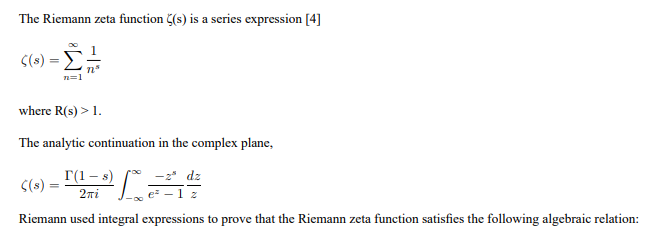
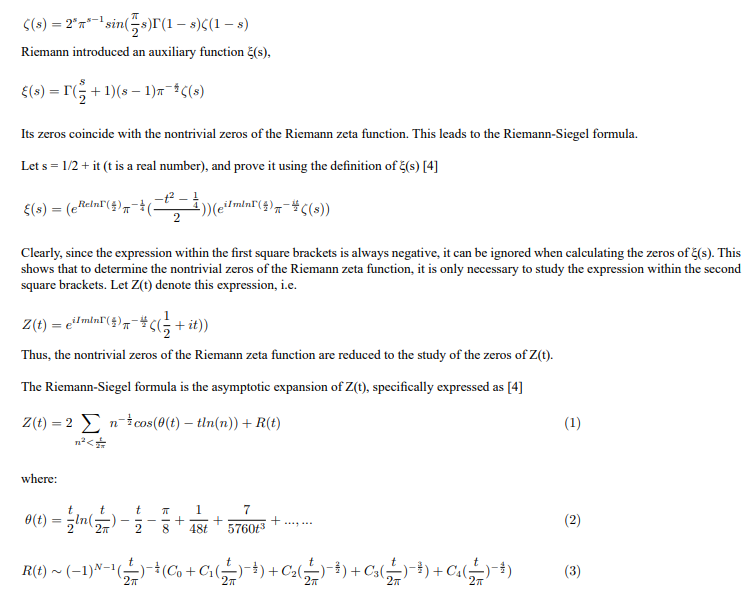
The Riemann Hypothesis states that when s = (1/2 + it), (t is a real number), the value calculated by function (1) is zero, and s = (1/2 +it) is a non-trivial zero.
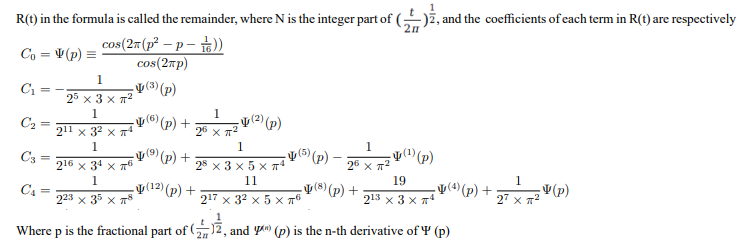
Because the formula (3) for calculating the remainder R(t) contains p and

etc., there are numerous roots of the transcendental number π, and function (1) contains a large number of trigonometric function operations involving irrational numbers, which are similar to multi-level radical numbers. The test results in this paper show that such numbers do not have definite values and are quantum numbers or inaccurate numbers. The result of calculations involving multiple such numbers that cannot cancel each other out is definitely not zero. As a result, the value calculated by function (1) cannot be zero regardless of the real number t. That is, for any real number t, s = (1/2 + it) is not a non-trivial zero.
In summary, it can be proven that there are no "nontrivial zeros" and that there are no roots of polynomials whose real part has a value of 1/2. This negates the Riemann hypothesis, or proves that the Riemann hypothesis does not hold within the framework of supernumber systems.
Discussions
The only correct way to prove whether two numbers are exactly the same is to simplify them to their simplest form and then compare them. If the simplest forms are exactly the same, then they are the same number. Real numbers under the classical definition have density, order and continuity, and there is a unique one-to-one correspondence with points on the number line.
It is generally believed that numbers on the number line are real numbers, while infinitesimals and infinity introduced in hyperreal numbers are not fixed "points" on the number line. The test results in this paper prove that it is impossible to determine whether numbers c, b and d are greater than or less than the integer 3, and they do not correspond to fixed "points" on the number line. Therefore, such numbers can be named quantum numbers [3]. We give the following definition of quantum numbers:
Quantum numbers: a class of multi-level radical numbers that do not have ordering.
Quantum numbers have the same phenomenon as quanta in the physical world, both of which have uncertainty. Quantum numbers do not have a definite value. Their value depends on the numerical precision used in the calculation, or in other words, it can only be determined when the calculation is instantiated. This new discovery enriches the types of numbers and breaks the traditional concept that "numbers all have accurate values". The new discovery proves that the phenomenon of quantum superposition exists not only in the objective physical world, but also in the abstract field of mathematics.