

Journal of Applied Material Science & Engineering Research(AMSE)
ISSN: 2689-1204 | DOI: 10.33140/AMSE
Impact Factor: 0.98

Research Article - (2025) Volume 9, Issue 3
Study of the Mechanical Behavior of Papyrus Fiber-Reinforced Composites
2IPC-Institute of Polymers and Composite, University of Minho, Portugal
Received Date: Nov 17, 2025 / Accepted Date: Dec 11, 2025 / Published Date: Dec 19, 2025
Copyright: ©2025 N C Loureiro, et al. This is an open-access article distributed under the terms of the Creative Commons Attribution License, which permits unrestricted use, distribution, and reproduction in any medium, provided the original author and source are credited.
Citation: Costa, G. S., Soares, T. C., Rocha, M. A., Loureiro, N. C. (2025). Study of The Mechanical Behavior of Papyrus Fiber-Reinforced Composites. J App Mat Sci & Engg Res, 9(3), 01-03.
Abstract
This work investigates the feasibility of papyrus fiber laminates as sustainable composite materials. Cyperus Papyrus stems were harvested, processed into longitudinal strips, hydrated, and cross woven to form laminated sheets. These were bonded with commercial polyvinyl acetate adhesive and subjected to tensile testing according to ISO 527 4. The composite exhibited average tensile strength of 3.32 MPa, elastic modulus of 149.3 MPa, and elongation of 3.58%. Although lower than conventional synthetic composites, the material demonstrated competitive performance compared to lightweight polymeric foams and certain natural fiber composites. The study highlights the potential of papyrus laminates for low load, biodegradable applications, bridging ancestral fabrication techniques with modern sustainable engineering.
Keywords
Papyrus, Natural Fibers, Biomaterials, Mechanical Characterization, Sustainability
Introduction
The extensive use of petroleum derived polymers has contributed to environmental degradation, particularly through persistent plastic waste in terrestrial and aquatic ecosystems. Global plastic production exceeds 400 million tons annually, with a significant fraction accumulating in landfills or natural environments [1].
Natural fiber reinforced composites (NFRCs) have emerged as viable alternatives, offering biodegradability, renewability, and acceptable mechanical performance for low to medium structural applications [2,3]. Their high strength to weight ratio, ease of processing, and compatibility with adhesives make them attractive for packaging, insulation, and non permanent structural elements [4].
Cyperus Papyrus, historically used as a writing substrate in Ancient Egypt, possesses a fibrous pith rich in cellulose and characterized by low density and flexibility. These attributes suggest potential for reinforcement in bio composites [5]. This study evaluates the mechanical behavior of papyrus laminates fabricated through artisanal weaving and bonding, aiming to assess their suitability for sustainable engineering applications.
Methodology
Papyrus stems were sourced from organic plantations to avoid chemical contamination.

Figure 1: Cyperus Papyrus Plantation
Deteriorated specimens were excluded.
The rigid outer bark was removed, and the pith was sliced into strips (~1 mm thick). Strips were hydrated for seven days, then manually cross woven to form sheets.
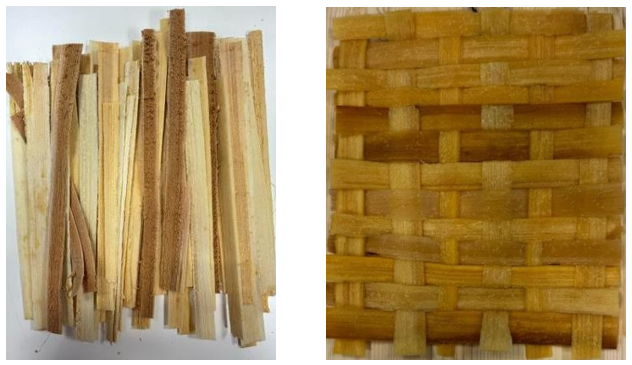
Figure 2: Papyrus Stripes After Treatment (Left); Papyrus Sheet (Right)
Sheets were pressed under 110 bar for seven days to promote adhesion and drying. Laminates were bonded with Ceys® white glue to a thickness of 5 mm and re pressed for 24 hours.
Specimens (120 × 25 × 5 mm³) were tested using a SHIMADZU AG X 100 kN universal machine at 2 mm/min displacement, following ISO 527 4 [6]. Stress strain curves were recorded, and tensile strength, elastic modulus, and elongation were calculated.
Results
Table 1 Summarizes Tensile Test Results.
Specimen Tensile Strength (MPa) Elastic Modulus (MPa) Elongation (%)
|
1 |
2.91 |
132.67 |
3.64 |
|
2 |
4.15 |
159.24 |
4.09 |
|
3 |
3.12 |
131.12 |
4.51 |
|
4 |
3.91 |
201.08 |
2.70 |
|
5 |
2.48 |
122.32 |
2.96 |
|
Mean |
3.32 |
149.29 |
3.58 |
|
Standard Deviation |
0.70 |
32.07 |
0.76 |
The composite exhibited consistent mechanical behavior, with tensile strength ranging between 2.48–4.15 MPa. Elastic modulus averaged 0.15 GPa, lower than synthetic composites (0.56–1.7 GPa) but superior to PVC cables (0.006 GPa) and styrene butadiene copolymers (0.0689 GPa) [7].
Discussion
The papyrus laminate demonstrated predictable mechanical performance, with relatively low dispersion compared to synthetic counterparts. While tensile strength is modest, the material’s stability and cohesion make it suitable for applications where reliability and biodegradability outweigh high strength requirements.
The methodology, inspired by ancestral papyrus fabrication, illustrates how traditional techniques can be adapted for modern composite processing. Optimization strategies such as fiber surface treatments, improved weaving patterns, or resin impregnation could enhance mechanical properties.
Conclusions
This study confirms the feasibility of papyrus fiber laminates for low load applications.
With tensile strength of 3.32 MPa and elastic modulus of 149.3 MPa, the material competes with lightweight foams and certain natural composites.
Potential applications include biodegradable packaging, decorative elements, and eco friendly reinforcement components.
Future work should focus on process optimization, hybridization with technical resins, and evaluation of durability under environmental exposure.
Acknowledgments
The authors acknowledge the Fundação Terras de Santa Maria da Feira for financial support of this work.
References
- Andrady, A. L. (2011). Microplastics in the marine environment. Marine pollution bulletin, 62(8), 1596-1605.
- Bledzki, A. K., & Gassan, J. (1999). Composites reinforced with cellulose based fibres. Progress in polymer science, 24(2), 221-274.
- Sanjay, M. R., Madhu, P., Jawaid, M., Senthamaraikannan, P., Senthil, S., & Pradeep, S. (2018). Characterization and properties of natural fiber polymer composites: A comprehensive review. Journal of Cleaner production, 172, 566-581.
- Pickering, K. L., Efendy, M. A., & Le, T. M. (2016). A review of recent developments in natural fibre composites and their mechanical performance. Composites Part A: Applied Science and Manufacturing, 83, 98-112.
- Faruk, O., Bledzki, A. K., Fink, H. P., & Sain, M. (2012). Biocomposites reinforced with natural fibers: 2000–2010. Progress in polymer science, 37(11), 1552-1596.
- ISO, E. (1997). 527-4 Plastics-Determination of tensile properties-Part 4: Test conditions for isotropic and orthotropic fibre-reinforced plastic composites. International Organization for Standardization (ISO), Geneva, Switzerland.
- Ku, H., Wang, H., Pattarachaiyakoop, N., & Trada, M. (2011). A review on the tensile properties of natural fiber reinforced polymer composites. Composites Part B: Engineering, 42(4), 856-873.