

International Journal of Diabetes & Metabolic Disorders(IJDMD)
ISSN: 2475-5451 | DOI: 10.33140/IJDMD
Impact Factor: 1.23


Research Article - (2024) Volume 9, Issue 1
State of E-Governance at Urban Local Government in Bangladesh: A Paradigm of Rajshahi City Corporation
2Dean, Faculty of Social Sciences, University of Rajshahi, Bangladesh
Received Date: Dec 22, 2023 / Accepted Date: Apr 03, 2024 / Published Date: Apr 24, 2024
Copyright: ©Â©2024 Md. Sabbir Hasan, et al. This is an open-access article distributed under the terms of the Creative Commons Attribution License, which permits unrestricted use, distribution, and reproduction in any medium, provided the original author and source are credited.
Citation: Hasan, S. Md, Ullah, S.M. A. (2024). State of E-Governance at Urban Local Government in Bangladesh: A Paradigm of Rajshahi City Corporation. Int J Diabetes Metab Disord, 9(1), 01-13.
Abstract
The purport of this study is to depict the present scenario of e-governance at urban local government in Bangladesh. Rajshahi City Corporation (RCC), as a leading municipality in initiating and applying e-governance, has introduced almost ten e-services. After a deep exploration on RCC, it reveals that EBRIS and SARMS both the e-governance projections of RCC are successfully implemented presently. E-tender, e-nothi, e-death registration and web portals are also fairly implemented. And e-revenue and e-application are on the way to implementation. Contrarily, e-waste management, sms-based information service and smart rajshahi app are not implemented yet. The most realistic findings of this research are the unimproved ICT infrastructure, lack of proper IT training of the e-service providers, lack of cooperativeness of e-service receivers, lack of e-literacy of e-service receivers, intervention of third party and demanding bribe for providing e-services, harassment by e-service providers, lack of efficiency of e-service providers and lack of awareness of e-service receivers about e-governance. As an empirical research, it uses both the qualitative and quantitative methods. This study is an endeavor to present an overall current status of e-governance in RCC.
Keywords
E-Governance, E-Services, Urban Local Government, Rajshahi City Corporation, Bangladesh
Introduction
E-Governance is a catalyst to make a smart city [1]. It plays very significant role in digitalizing and modernizing urban governance. E-Governance leads the governing process towards modernity. Smart urban governance can be described as the capability of using modern technological equipments in urban planning, decision making and service delivery to the citizens in urban areas [2]. In this digital era, good urban governance is relied on the extent to which the proper application of ICT-based governance system. The application of e-governance creates more widespread transparent opportunities and swift transection of services which in turn, enhance the quality of life and the enhanced facilities of e-governance make people’s life simple [3]. One study shows that up to 80% of citizen-government transactions take place at the local level [4]. Likewise, Urban Local government (ULG), a body of local government, directly interacts with the people who live in the urban areas. In the urban context of many developing countries, a number of innovative applications that harness ICT are improving the living standard of the citizenry by transforming the delivery of services [5]. According to the survey report of Local Online Service Index (LOSI), 2020 of UN, the municipalities which have obtain very high level of online service delivery are Madrid, New York, Tannin, Paris, Stockholm, Moscow, Bogota, Buenos Aires, Berlin, Seoul, Shanghai, Istanbul, London, Roma. Moreover, Sao Paulo, Brussels, Dubai, Toronto, Helsinki, Mexico city, Warsaw, Amsterdam, Prague, Tokyo, Sydney, Johannesburg, Lisbon, Athens, Almaty and Kuala Lumpur have got high level. Furthermore, the municipalities which have secured the middle level are Riyadh, Vienna, Budapest, Mumbai, Guayaquil, Nairobi, Santo Domingo, Kabul, Bangkok, Lima, Tunis, Belgrade, Colombo, Ho Chi Minh, Lagos, Santiago, Amman, Jakarta, La Paz, Cairo, Kiev, Guatemala City, Bucharest, Addis Ababa, Casablanca, Algiers, Luanda, Tashkent, Kathmandu, Kigali, Dushanbe, Harare, Lusaka. However, Abidjan, Baku, Dar es Salaam, Karachi, Minsk, Manila, Havana, Yangon, Baghdad, Kampala, Caracas, Dhaka, Tehran, Damascus, Phnom Penh, Tegucigalpa, Antananarivo, Ouagadougou, Porto Moresby, Kumasi, Porto Novo, Bujumbura, Lilongwe have under low level [27]. The state of e-governance at the urban local level in Bangladesh is not appreciable but perceivable [6]. A recent study on e-governance in top 100 municipalities worldwide clearly shows the position of Bangladesh in the global ranking. This survey analyzes the five aspects of e-governance of a municipality. These are: 1. Privacy and Security; 2. Usability; 3. Content; 4. Services; and 5. Citizen and Social Engagement. In privacy and security, Dhaka, the biggest municipality of Bangladesh, ranked 80 (from the last) out of 100, in usability, placed 65 out of 100, in content, ranked 69 out of 100, as well as in service category, 60 out of 100, and in citizen and social engagement, ranked 65 out of 100 [7]. As mentioned earlier, report of the UN shows the actual state of local government level of Bangladesh from a global perspective. According to the survey report of Local Online Service Index (LOSI), 2020 of UN, Dhaka, the biggest municipality of Bangladesh, has ranked 75 with a low level in global ranking [27]. Rajshahi City Corporation, an instance of urban local government, is trying to bring all its sectors under digitalization. The concept of e-governance has penetrated in RCC through the electronic birth registration information system (EBRIS) in 2001 [8]. EBRIS is still the most successful e-governance projection here. Another successful e-governance programme is smart auto-rickshaw management system (SARMS). E-tender, e-nothi and e-death registration, the e-governance projections of RCC, are fairly implemented. The current status of e-tender is very appreciative in RCC. Waste management is one of the vital departments of RCC. Currently, it is collecting and managing the solid waste from the city area. But it has not started its operation to collect e-waste yet. It was just initiated to collect e-waste from different areas. The service of informing city people by using SMS has still not been established here. Recently, it has installed ‘smart rajshahi app’ to provide twenty-four (24) online services within one (1) app. But this service has not been activated yet. Such e-governance projections like e-revenue and e-application are on the way of implementation. Thus, the objective of this study is to explore the present status of e-services in RCC.
Objectives
This paper is prepared for meeting up some objectives. The broad and general objective of the study is to have a look at the current status of e-governance at urban local government in Bangladesh. However, the specific objectives are:
 to profile the present scenario of e-governance in Rajshahi City Corporation;
to find the impediments of implementing e-governance in RCC;
to recommend some policy guidelines for successful implementation of e-governance in RCC.
Conceptual Framework
Now-a-days, e-governance is a futuristic concept in this globalized world. This term was developed in late 1990. Several world-famous organizations have defined the term ‘e-governance’. Likewise, some renowned scholars of this ground have conceptualized the term ‘e-governance’ from their own outlook. United Nations Educational, Scientific and Cultural Organization (UNESCO), a specialized agency of the United Nations, argues that “E-Governance is the use of information and communication technologies in public sectors with the aim of improving information and service delivery, encouraging citizen’s participation in the decision-making process and making government more accountable, transparent and effective. E-Governance involves new styles of leadership, new ways of debating and deciding policy and investment, new ways of accessing education, new ways of listening to citizens and new ways of organizing and delivering information and services. E-Governance is generally considered as a wider concept than e-government, since it can bring about a change in the way that citizens relate to governments and to each other. E-Governance can bring forth new concepts of citizenship, both in terms of citizen needs and responsibilities. Its objective is to engage, enable and empower the citizens” [9]. World Bank (WB), an international financial institution, defines the term e-governance as “It is not just the web site and e-mail about government, about service delivery over the internet or about digital access to government information or electronic payments. E-Governance is intended to change the way that citizens relate to governments, citizens relate to each other, and the governments relate to citizens” [10] . The Council of Europe, an organization of European countries, defines e-governance as “It means the use of electronic technologies in three areas of public action: relations between the public authorities and civil society, functioning of the public authorities at all stages of the democratic process (electronic democracy), the provision of public services (electronic public services)” [25]. In the words of Kate Oakley, “E-Governance is a set of technology-mediated processes that are changing both the delivery of public services and the broader interactions between citizens and government” [11] . According to the view of Sharon S. Dawes, “E-Governance comprises the use of information and communication technologies (ICTs) to support public services, government administration, democratic processes, and relationships among citizens, civil society, the private sector, and the state” [12]. C.S.R. Prabhu defines the term e-Governance as “It means the process of delivering SMART (Simple, Moral, Accountable, Responsible and Transparent) governmental services to the citizens” [13] . E-Governance means electronic governance, digital governance, modern governance, and smart governance. Basically, e-governance is a technological mode of governance which aims to change the way of delivering public services and to link between the government and citizens by using information and communication technology (ICT).
Methodology
Generally, research methodology is the means of achieving the objectives of the research. According to the objectives of this research, all of the service providers (functionaries) and service recipients (beneficiaries) of RCC, where e-governance policies are made and implemented as well as the majority of the e-governance services are provided, have been considered as the population of the study. Considering the frequency of the e-governance service recipients, 10 wards of Rajshahi City Corporation are randomly selected as the sample areas for collecting necessary data on electronic birth registration information system (EBRIS). And all auto-rickshaws (both red and green color) of the RCC area are selected randomly for collecting the necessary data on the smart auto-rickshaw management system (SARMS). Considering the frequency of the e-service providers, Rajshahi City Corporation office and 10 ward offices of RCC are selected as sample areas for collecting pertinent data. Some auto-rickshaw stations within the RCC area have been randomly selected as sample spot for collecting samples from the auto-rickshaw drivers. A total of 220 respondents are estimated as samples for this study. From the e-service receiver’s side, 100 EBRIS beneficiaries (10 from each word), and 100 auto-rickshaw drivers (50 from red color and 50 from green color) of RCC area considered as the SARMS beneficiaries, are selected as the samples for collecting data. And from the e-service provider’s side, 10 RCC functionaries and the 10 (1 from each ward) data entry operators form ward offices are considered as the samples for collecting data. Both probable and non-probable sampling methods are used to collect the sample from the field survey. This research randomly selected 10 wards out of 30 wards of Rajshahi City Corporation (RCC) to specify the sample area by using a simple random sampling technique (lottery method). This study also has followed the simple random sampling technique to gather the samples from EBRIS beneficiaries within this sample area. It further has followed the quota sampling technique to collect the samples from the SARMS beneficiaries. The total number of auto-rickshaws in RCC is 7580 (red 3790+ green 3790). In this study, 100 samples (red 50 + green 50) have been collected from them by maintaining the proportion. Purposive sampling technique is also used in this research for collecting the targeted samples from the specific respondents. This study has applied the purposive sampling technique to collect samples from RCC functionaries namely: Chief Executive Officer(CEO), Chief Health Officer(CHO), Chief Conservancy Officer(CCO), Chief Revenue Officer(CRO), Executive Engineer(EE), Assistant Programmer(AP), Birth & Death Registration officer(BDRO), e-GP Assistant(EGPA), Office Assistant (DoC), Personal Assistant of CRO and the data entry operators of RCC ward offices (ward no, 4, 8, 11, 13, 14, 20, 22, 23, 25, 27) within the delimited sample area. This research has applied both the primary data and secondary data for achieving the research objective. It has necessarily used the field oriented primary data. So, the primary data have been gathered from the 100 EBRIS and 100 SARMS beneficiaries, 10 RCC functionaries and 10 data entry operators of ward offices through two sets of structured questionnaires. On the other hand, this study has also collected primary data from 10 EBRIS and 10 SARMS beneficiaries, 5 RCC functionaries and 5 data entry operators by using key informant interview method. Secondary data have also been necessary for conducting this research. Basically, secondary data have been collected by reviewing and analyzing some relevant contents. However, the main sources of secondary data for this research were relevant books, journal articles, unpublished dissertations, The Constitution of People’s Republic of Bangladesh, proceedings of international conference, periodicals, newspaper articles, encyclopaedias, online libraries, tutorials videos, official documents of RCC and others. In this study, two types of procedure have been used for collecting the primary data. These are: Questionnaire Survey, and interview (Key Informant Interview (KII) & face to face interview with structured questionnaire). And the technique of collecting secondary data is only the analysis of relevant contents. Questionnaire survey is one of the common and easy methods of collecting the primary data. In this research, two separate structured questionnaires were prepared with both some open ended and close ended questions for collecting the authentic data from the respondents. One set questionnaire was prepared for e-service providers and another for e-service receivers. In this study, the interview method has also been used for collecting primary data. To e-service receiver’s extent, 10 EBRIS beneficiaries (1 from each ward) and 10 SARMS beneficiaries (5 red colors and 5 green colors) have been selected for collecting primary data through interview. On the e-service provider’s side, 5 data entry operators of RCC ward offices (ward no. 4, 11, 20, 22, 25) have been considered as key informants for the interview. And this study has interviewed 5 RCC functionaries (CEO, CRO, CCO, EE and AP) through separate structured questionnaires.
A Brief Introduction
Rajshahi is a tranquil city situated in the North Western side of Bangladesh beside the fringe of Padma River [14] . Rajshahi City Corporation (RCC) is located in between 24’20’ and 24’24’ North latitudes and in between 88’32’ and 88’40’ East longitudes with an area of 97.18 sq km. RCC was established as a municipality in 1876. That municipality was upgraded to Municipal Corporation in 1987. And finally, this Municipal Corporation was upgraded to City Corporation in 1991 [15] . According to the Population and Housing Census, 2011, RCC is divided into 30 wards and 283 mahallahs with 99245 households. At present, the total population of RCC is 449756 (male 232974+ female 216782). The literacy rate of RCC is 74 percent now (BBS, 2020, p. 37). Rajshahi city is by and large known as ‘Silk City’ , ‘Education City’ and ‘Clean City’ . RCC has been awarded as “Environment Friendly City of the Year 2020” for its fresh air and green environment in 2020 (Business Standard, 2020).
State of E-Governance in RCC
The current status of e-services of Rajshahi City Corporation (RCC) is so flourishing. Presently, it is providing almost five to seven e-services to the citizens. Among all of the e-services, electronic birth registration and smart auto-rickshaw management system is implemented. Rajshahi City Corporation as a body of urban local government, at first, introduced online birth registration or electronic birth registration information system (EBRIS) at urban local level. And RCC is the only one City Corporation among all the City Corporations in our country which has inaugurated smart auto-rickshaw management system (SARMS) aiming to reduce traffic jams in city roads. Some e-services are fairly implemented in RCC such as e-tender, e-nothi, e-death registration and web portals. On the other side, e-revenue, a crucial sector of e-services, is on the way to implementation. Online application or e-application is also on the way to implementation in RCC. E-Waste management, SMS-based information system and smart rajshahi app are not implemented yet. The present status of e-services is illustrated as under (Table 1):
Present Status of E-Governance in Rajshahi City Corporation
|
Implemented |
Fairly Implemented |
On the Way to Implementation |
Not Implemented Yet |
|
Electronic birth registration Information system (EBRIS) Smart auto-rickshaw management system (SARMS) |
E-tender E-nothi E-death registration Web portals |
E-revenue E-application |
E-waste management SMS-based information service Smart Rajshahi App |
Table 1: Present Status of E-Governance in RCC (Developed by authors, 2021)
Electronic Birth Registration Information System (EBRIS)
E-birth registration, online birth registration and digital birth registration are the name concept. E’ means electronic. And birth registration is a process by which the government authority records the birth related information (like date of birth, parents’ information, permanent address etc.) of a newborn infant in civil registry. The registration of birth can be done into two ways such as manually and electronically. When the whole birth registration process is accomplished online or electronically is called e-birth registration. Now-a-days, online birth registration is indispensable for every man’s life. Moreover, the online birth registration is required for getting a national identity card (NID), and e-passport. For children, it is necessary for school admission. At first, Rajshahi City Corporation (RCC) had introduced the EBRIS Programme in 2001 among all the city corporations in Bangladesh. About the necessity of e-birth registration, one of the respondents opined, “I was in a fix when I had gone to do my e-passport because I did not have up to date online birth registration certificate.” It is beyond doubt that EBRIS is a successful e-governance projection in RCC from the very beginning but now RCC is facing several problems to run this programme. The e-service providers of RCC who are directly involved in EBRIS and the EBRIS beneficiaries both are facing the following problems. The process of online birth registration for a 45 day’s child is very complicated. The birth registration of 45 day’s child who is born after January 1, 2001 will not be allowed to complete without its vaccine card and its parents up to date birth registration certificate (English and Bangla both). But it is not so easy to arrange an instant parent’s online birth certificate. On the other hand, the naming problem of parents creates a serious problem. For such complications, the percentage of online birth registration of 45 day’s children declined. The rate of online birth registration of 45 day’s children was monthly 90% in 2020 but this percentage got down by only 2% in 2021. A respondent said “My name is Shahanaz in my birth certificate but my name enlisted in NID (National Identity Card) as Mst. Sahanaj Parvin. For this problem I could not accomplish my child’s online birth registration within 45 days. All of the ward offices of RCC have introduced new software (https://bdris.gov.bd) to apply for online birth and death registration in early 2021. This software is not as simple as before. Majority Data Entry Operators (DEO) don’t know how to operate the software. Firstly, they cannot adapt with the new software. Most of the Data Entry Operators (DEO) have learned the operating system of this software by watching some tutorial videos on YouTube. Some DEOs are solving their software problems by discussing with other operators. The Data Entry Operators who are directly involved to provide the online birth and death registration related services have no formal training on ICT. Some respondents say that they have got a new software for online birth registration without any software training. For this reason, they cannot understand how they will operate it. A respondent said that “I cannot understand the printing system of this new software.” The online birth registration process is not as fast as before because of the strict supervision of the DC office. Now-a-days, the total online birth registration system is under the overall supervision of the DC office. At the beginning of the EBRIS programme , RCC authorized absolutely. No one could easily change or correct his/her information on their birth certificate easily. Now everyone has to go to the DC office for correcting his/her spelling of name or other information on their birth certificate. It is time consuming and costly. Most of the data entry operators (DEO) face server problems during application for online birth registration. And sometimes they cannot provide the online birth certificate to the applicants timely because of server problems. One of the respondents said that “this server runs swiftly from 9 am to 11 am. After 11 am it works very slowly.”
E-Death Registration
E-death registration is same as e-birth registration. Online death registration is a successful e-governance projection of RCC like the EBRIS programme. At present, the total number of online death registration is 28862 by June, 2021. But the process of death registration is as easy as EBRIS. Death registration will have to be there, where a person has done his/her birth registration. Therefore, the city people will get the death certificate from here only who have done their birth registration under RCC. (Table 2) shows the number of Online Death Registration in RCC.
|
Total Population in RCC (According to the Census of 2011) |
Total Number of Death by June, 2021 |
Total Online Death Registration by June, 2021 |
Percentage (%) of Online Death Registration |
|
467187 |
79050 |
28868 |
36.51% |
Source: Public Health Department, RCC
Table 2: Number of Online Death Registration in RCC
Smart Auto-Rickshaw Management System (SARMS)
Smart Auto-rickshaw Management System (SARMS) is one of the biggest e-governance projections in Rajshahi City Corporation (RCC). RCC authority has taken a new management system of auto-rickshaws to reduce the traffic jams in the city area. It initiates smart auto-rickshaw management system on July 1st, 2020. Presently, registered auto-rickshaws are 7580 (3790 green + 3790 red) and battery/charger rickshaws are 5000 in the RCC area. RCC has fixed the colors of auto-rickshaws. The auto-rickshaws of even numbers (Kha-05788) are of red color. On the other hand, the auto-rickshaws of odd numbers (Kha-06653) are of green color. Under this new system, RCC has divided a full day into two shifts such as morning shift and evening shift. And according to the decision of RCC, only one color auto-rickshaws can run in one shift. That means, if the red color auto-rickshaws run in the morning shift, then the evening shift is fixed only for green color auto-rickshaws. Every auto-rickshaw driver is bound to maintain discipline. If anyone breaks the rule, he must pay the penalty. It is noted that every registered auto-rickshaw has a smart card. RCC authority controls the new system centrally. If any driver makes a fake or duplicate smart card, the authority finds it out by using Near Field Communication (NFC) technology. Smart Auto-rickshaw Management System (SARMS) is an online based registration process of all auto-rickshaws in the RCC area. This process is almost the same as EBRIS. Firstly, drivers apply in online for the registration of their auto-rickshaws. In the next step, they have to submit all the necessary papers and information in online. And finally they get a smart card. Though the initiative of Smart Auto-rickshaw Management System (SARMS) is very effective to reduce traffic on city roads, it creates some problems for the auto-drivers. Under this new system, they can drive their auto-rickshaws only for one shift (morning shift or evening shift). So the daily income of the drivers has declined by half. Md. Faisal (Regi. no. Kha-2326) said “Prior to this new shifting system, I could drive my auto-rickshaw full day. But after starting this new system, I can drive only one shift in a day. So, now I can earn almost half than before.” An auto-driver named Md. Jalal (Regi. no. Kha-03182) said “I have sent 2550 tk. for the registration of my auto-rickshaw in online. But this money has erroneously gone in another number. I didn’t get back this money. So, I had to pay second time.” Some respondents have reproached the fee for renewing smart card. Jakir Hossain (Regi. no. Kha-05788) remonstrated that the smart card renewal fee is so high. The auto-rickshaw and charger rickshaw control committee has arranged a meeting on September 6, 2021. Shoriful Islam Babu, 1, no. panel mayor and councilor of 12 no. ward, was present there as chair. He spoke that, “Smart auto-rickshaw management system (SARMS), initiated by RCC, will be the model for the whole country. He also said that SARMS will reduce traffic jam in the city area.”
E-Waste Management
E-Waste means electronic waste. Basically, the discarded component of Electrical and Electronic Equipment is called the e-waste [17] . It includes all useless electronic goods, like; dilapidated computers or computer peripherals (For instance CPU, monitors, mouse, keyboard, speaker etc.) laptops, mobile phones, land phones, televisions, fax machines, tabs, CD and DVD players, LCD monitors, Radios, video cameras, note books, calculators, printers, air conditioners, refrigerators, lamps or light bulbs, washing machines, ATM machines, heat pumps, electronic thermometers, light switches and all electronic goods (New Age, 2020). The e-waste management programme under the Department of Conservancy (DoC) of RCC is subsisted at the very initial level. It inaugurated an awareness programme about the negative side of e-waste in February, 2021. This department is trying to make the city people aware through its publicity. RCC jointly with BRAC (The largest Non-governmental Organization (NGO) in the world) attached a banner in front of Rajshahi New Market (Huge electronic goods selling marketplace in Rajshahi city) area for raising the awareness of the city people. RCC associated with BRAC distributed some leaflets among the city people aiming to fulfill the 6.3, 11.6 and 12.5 goals of SDGs.
E-Revenue
When the revenue is collected by online is called e-revenue. E-Revenue is a broader sector of e-governance in Rajshahi City Corporation. It includes all billings and taxings of RCC. Unfortunately, this sector is not completely digitized yet. It does not introduce an e-trade license. The taxes from city markets are collected manually. Even the city people pay their holding taxes physically. After launching the SARMS (Smart Auto-rickshaw Management System) programme, RCC just started to collect the auto-rickshaw registration fees, smart card renewal fees, and late renewal fine in online as well as the battery rickshaws. (Table 3) shows the registration and renewal fees of drivers are also collected in online from this year. Revenue Collection (in online) by April 11, 2021 in RCC is shown below.
|
Serial No. |
Sector Name |
Each Fee |
Number |
Surcharge |
Total Number of Registration |
Total Collection (online) |
|
1 |
Auto-rickshaw (new) |
10000 |
45 |
|
45 |
450000 |
|
2 |
Auto-rickshaw (renew) |
2500 |
4932 |
|
|
12330000 |
|
3 |
Auto-rickshaw (renew with 10% fine) |
2500 |
612 |
153000 |
5544 |
1683000 |
|
4 |
Charger rickshaw (new) |
3000 |
18 |
|
|
54000 |
|
5 |
Charger rickshaw(renew) |
1000 |
4483 |
|
4598 |
4483000 |
|
6 |
Charger rickshaw (renew with 10% fine) |
1000 |
115 |
11500 |
|
126500 |
|
7 |
Driver registration(new) |
200 |
678 |
|
2190 |
135600 |
|
8 |
Driver registration(new) |
300 |
833 |
|
|
249900 |
|
9 |
Driver registration(new) |
500 |
679 |
|
|
339500 |
|
10 |
Driver registration renew |
100 |
5392 |
|
7949 |
539200 |
|
11 |
Driver registration renew |
200 |
1026 |
|
|
205200 |
|
12 |
Driver registration renew |
300 |
1531 |
|
|
459300 |
|
Total collection (in online) |
21,055,200 |
|||||
Source: Department of Revenue, RCC
Table 3: Revenue Collection (in online) by April 11, 2021 in RCC
E-Nothi
Nothi means official files and documents. It refers to all official papers of any institutions which are accumulated by relevant authorities. However, e-nothi means e-file. When the official documents and files are stored in electronic devices (like: computer, tab, smartphone etc.) and available in certain websites is called e-nothi. Rajshahi City Corporation (RCC) has opened an ICT department at the end of 2019. E-nothi management system was inaugurated in the same year under the control of the ICT department. The e-nothi app is categorized into thirty-one types of document. Only the relevant documents can be enrolled in this app. RCC arranged a workshop on July 20, 2019 for introducing the e-nothi system. RCC launched a two day-long training programme on e-nothi on January 4, 2020 to January 5, 2020. At present, all of the departments could not adapt with the e-nothi system yet because of the lack of sufficient computers, lack of ICT knowledge and proper training and lack of file management knowledge.
E-Tender
E-tender or electronic tender means a tendering process which is accomplished by electronical means. A national web portal named e-GP (Electronic Government Procurement) was opened by Prime Minister on July 2, 2011 as a part of Digital Bangladesh. E-GP was developed by the Central Procurement Technical Unit (CPTU) under the Division of Planning (Daily Star, 2011). The Public Procurement Act (PPA) was amended in 2008 and added e-tendering for protecting tender betting or and abolishing the unscrupulous cycle who are involved in tenderbaji [16] . Rajshahi City Corporation adapted the e-tendering system from 2017. RCC basically follows Open Tendering Method (OTM). At first RCC tenderers open an account in CPTU (Central Procurement Technical Unit) under e-GP. Contractors or tender seekers also open an account in CPTU. Only the e-GP registered contractors are allowed to participate in this process. Tenderers make APP (Annual Procurement Plan) and show their tender details in APP. RCC tenderers publish their tenders in e-GP from APP. E-tender is almost a successful e-governance projection of RCC. In RCC, four engineering departments are now working under the e-tendering system. Electrical department has issued 20, mechanical department has issued 23, civil department has issued 109 and chief engineering department has issued 21 e-tenders by July, 2021. (Table 4) shows the number of Issuing e-Tender by 2021 in RCC.
|
Serial No. |
Name of Department |
Number of Issued E-Tender by 2021 in RCC |
|
|
1 |
Electrical Department |
20 |
|
|
2 |
Mechanical Department |
23 |
|
|
3 |
Civil Department |
Planning section |
48 |
|
Superintendent section |
61 |
||
|
4 |
Chief Engineering Department |
21 |
|
|
|
Total |
173 |
|
Source: Engineering Department, RCC
Table 4: Number of Issuing e-Tender by 2021 in RCC
Smart Rajshahi App
Rajshahi City Corporation (RCC) has initiated a new website (https://smartrajshahi. gov.bd) named Smart Rajshahi App aiming to provide twenty-four online civic services to the city people (New Age, 2021). It is new and unique. It is noted that RCC has firstly started such online civic services for its citizens among all the city corporations. Present mayor of RCC, inaugurated this app in online on May 3, 2021. The State Minister of Information and Communication Technology Division, Ministry of Post, Telecommunication and Information Technology (MoPTIT), has joined virtually that inaugural ceremony (Daily Jugantor, 2021). The project of Smart Rajshahi App (SRA) has been implemented by Seltron with the collaboration of Department of Information and Communication Technology (DICT). The city people can get online services from this app by using three online platforms, such as websites, mobile apps, Android and iOS (Banglanews24.com., 2021).The city people can avail twenty-four (24) online civic services from Rajshahi City Corporation by using Smart Rajshahi App through the following steps in (Figure 1):

Figure 1: Process of Getting Services from Smart Rajshahi App
E-Application
The process of online application for getting services is not quite implemented in Rajshahi City Corporation (RCC) yet. Presently, most of the services have come under e-application or online application in RCC such as application for birth and death registration, application for birth and death certificate, application for auto-rickshaw registration, application for tender, application for vaccine registration, application for vaccine certificate, and application for job in RCC. The implementation of online application for trade licenses is on the way of implementation.
SMS-Based Information System
The system of informing people through short messages over mobile phones is still exempted in Rajshahi City Corporation. RCC authority informs people by SMS in a very few cases. For instance, vaccine related information, birth and death registration related information and auto-rickshaw related information etc.
Web Portals
A web portal is a website which is especially designed with information. Rajshahi City Corporation has developed some web portals for informing the city people. Such as:
https://erajshahi.portal.gov.bd/
https://erajshahi.portal.gov.bd/site/view/notices
https://bdjobresults.com/rajshahi-city-corporation-job-circular
https://en.wikipedia.org/wiki/Rajshahi_City_Corporation
https://smartrajshahi.gov.bd/
RCC Citizens Views about E-Governance
The views of the respondents (RCC citizens) with their personal details have presented below through the tables and figures.
Distribution of the Respondents
The following table exhibits the distribution of the respondents according to their gender, marital status, religion, age, education, occupation and monthly income.
|
Gender |
Male |
Female |
||||||||
|
69.5% |
30.5% |
|||||||||
|
Marital Status |
Married |
Unmarried |
||||||||
|
86% |
14% |
|||||||||
|
Religion |
Muslim |
Hindu |
||||||||
|
88.5% |
11.5% |
|||||||||
|
Age |
Less than 21 |
21-30 |
31-40 |
41-50 |
More than 50 |
|||||
|
|
3.5% |
57% |
27% |
8% |
4.5% |
|||||
|
Education |
Primary |
Secondary |
Higher- secondary |
Graduation |
Post- graduation |
|||||
|
46% |
29.5% |
16.5% |
6.5% |
1.5% |
||||||
|
Occupation |
Job |
Self- employment |
Business |
Auto-rickshaw driving |
No-job |
|||||
|
7.5% |
6.5% |
6% |
50% |
30% |
||||||
|
Monthly Income |
Less than 15000 |
15001-25000 |
25001- 35000 |
More than 35000 |
No income |
|||||
|
36.5% |
17.5% |
8.5% |
7.5% |
30% |
||||||
Table 5: Distribution of the Respondents
Table 5 shows that most of the respondents (69.5%) are male. And 30.5 percent (%) of respondents are female. However, the better numbers of the respondents are male. Most of the respondents (86%) are married. And only 14 percent (%) of the total respondents are unmarried. The majority of the respondents (88.5%) are Muslims. And only 11.5(%) of all the respondents are Hindus. 3.5 percent (%) of the respondents are less than 21 year old. Most of the respondents (57%) are in the age group 21-30. 27 percent (%) of respondents fall under the age group 31-40. 8 percent (%) of respondents are of the age group 41-50. And 4.5 percent (%) are more than 50 years old. The education levels of 46 percent (%) of the respondents are primary. Some of the respondents (29.5%) have secondary education. 16.5 percent (%) of respondents are of higher-secondary level and 6.5 percent (%) respondents achieve graduation level. Only 1.5 percent (%) of respondents has post-graduation. 7.5 percent (%) of the respondents are service holders. 6.5 percent (%) of the respondents are self-employed. 6 percent (%) of the respondents are businessmen. Almost half (50%) of the total respondents are auto-rickshaw drivers. And the percentage of jobless respondents is 30. The monthly income of 36.5 percent (%) respondents is less than 15000 Tk. 17.5 percent (%) of total respondents fall into 15001-25000 Tk. 8.5 percent (%) of them earned 25001-35000 Tk. The monthly income of 7.5 percent (%) respondents is more than 35000 Tk. And 30 percent (%) of the respondents have no income.
Listening about E-Governance
The respondent’s views on the listening about e-governance are shown through the following figure.
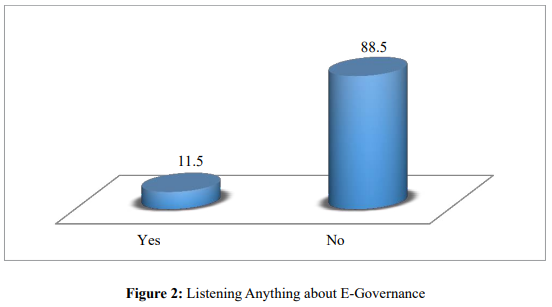
Figure 2: Listening Anything about E-Governance Figure 2 shows that a small portion of the total respondents (11.5%) has heard about e-governance. Surprisingly most of the respondents (88.5%) don’t hear about e-governance.
Knowledge about E-Governance
The opinions of the respondents about knowing anything about e-governance are shown below:
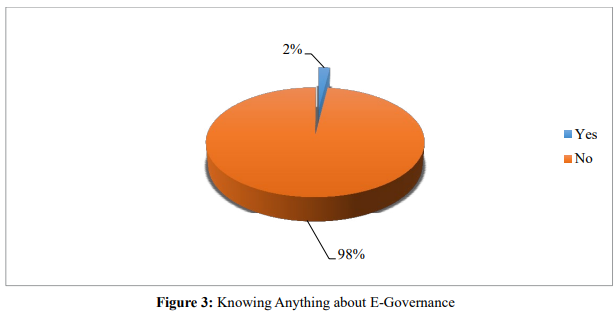
It is shown in the above figure 3 that only 2 percent (%) of the total respondents know about e-governance. But a large part of the total respondents (98%) don’t know anything about e-governance.
Is Online Service Delivery Process More Time Saving Than Manual Process?
The respondent’s views on online service delivery process more time saving than the manual process are shown below:
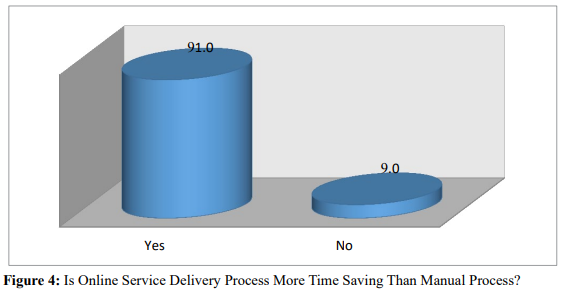
Figure 4 clearly indicates that the very large portion of the total respondents (91%) think the online service delivery process is more time saving than the manual process. Only 9 percent (%) of the respondents don’t think so.
Is E-Service Delivery A Costly Process?
The views of the respondents about service delivery cost are shown through the following figure.
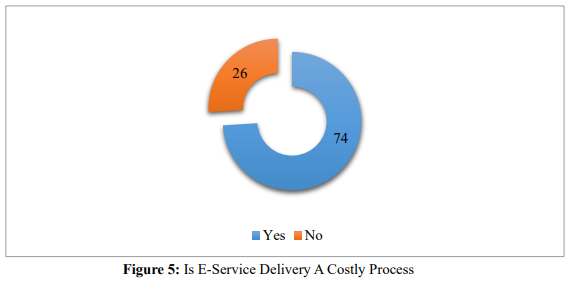
From the above figure 5, it is clearly shown that majority respondents (74%) think e-service delivery is a costly process. And 26 percent (%) of the respondents think so either.
Problems Feel in Understanding E-Governance
The opinions of the respondents about feeling problems in understanding e-governance are shown under the following figure.
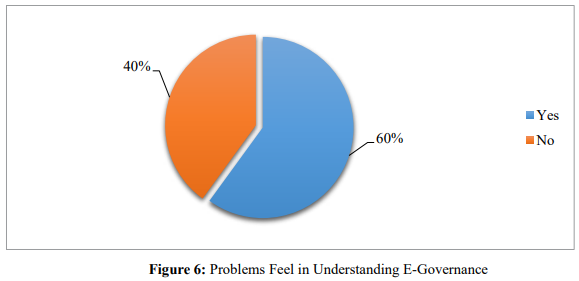
It is indicated in the above figure 6 that 60 percent (%) of the respondents feel problem understanding e-governance. On the other hand, 40 percent (%) of the respondents don’t feel any problem understanding e-governance.
Tools Used for Receiving E-Services
The following figure shows the tools used by the respondents for receiving e-services.
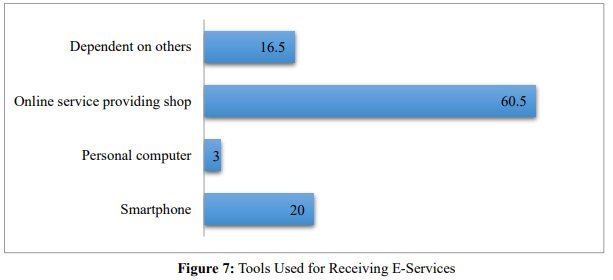
Figure 7 shows that 20 percent (%) of the respondents use smart phone, only 3 percent (%) use personal computer, and most of the respondents (60.5%) use online service providing shops to receive online services. On the other hand, 16.5 percent (%) of the respondents depended on others to receive e-services.
Findings
The ICT infrastructure of Rajshahi City Corporation (RCC) is not so developed as implementing e-governance projections. There are not enough computers for the functionaries. Internet connectivity is not available. RCC officials lack proper ICT training. Only a few of them have attended seminars or workshops on e-governance. This research has found that there is a lack of cooperativeness of e-service receivers during taking e-services from the e-service providers. Most of the e-service receivers have a huge lack of e-literacy. Sometimes, they face problems during receiving e-services because of their illiteracy. This research has also found that most of the time, third parties intervene in e-service delivery. However, they demand bribes from the e-service receivers. According to the e-service receivers’ view, they are harassed by the e-service providers. Unnecessarily, they delay to provide e-services. This research sought out that majority RCC functionaries related with e-services delivery are not efficient as well as most of them have no ICT knowledge. Unfortunately, the e-service receivers are not aware of e-governance.
Policy Recommendations and Conclusion
Based on research findings, researchers have made some recommendations specifically for e-service providers and e-service receivers of Rajshahi City Corporation. An enriched ICT infrastructure is the prerequisite for providing e-services to the receivers. The ICT infrastructure of Rajshahi City Corporation (RCC), a leading city corporation adopting e-governance, is not so developed. It should ensure available computers to provide for its all employees with available internet facilities. However, The RCC authority should develop its overall ICT infrastructure for providing better e-services to its citizens. Majority e-service providers of RCC are facing several problems in time of providing the e-services to its citizens for the lack of proper training. For ensuring better e-services, RCC authority should arrange proper ICT training for all employees specially who are directly involved in providing e-services. At present, the rate of online birth registration of 45 day’s children has declined to 2% from 100%. RCC authority should find the cause of decline and take strong steps to increase this rate into 100% very fast. Under the smart auto-rickshaw management system (SARMS), the daily income of the drivers has declined to half than before. RCC authorities should be aware of it and search out suitable solutions. It also should pay attention on the high renewal fee of auto-rickshaw registration. RCC authority collects the utility bills and taxes manually yet. It should incorporate e-revenue system and ensure online payment. According to the respondent’s view, offering bribes is still a common affair in online service delivery in RCC. So, the authority should have a look on it and take necessary steps to reduce the illegal activities. Sometimes, general people who want to get e-services are harassed by the e-service providers of RCC. The authority should aware of it and take proper steps against such harassment. RCC authority should take proper action to stop the intervention of third party in e-service delivery. Finally, RCC authority should try heart and soul to make Rajshahi a smart and digital city. Contrarily, every citizen must try to be engaged in e-participation. Everyone should attain the e-literacy for adapting with e-governance. Each e-service receiver should avoid offering bribes to the e-service providers for gaining special services from them. Every e-service receiver of RCC should co-operate with the e-service providers while taking the e-services from them. Everyone should inform the RCC authority about their harassment by the e-service providers. Every citizen of RCC should be aware of e-governance. From assessing all of the e-services of Rajshahi City Corporation (RCC), it is worth mentioning that the present situation of e-governance of RCC is very progressive. The e-governance projections in RCC are rapidly moving forward among all of the city corporations in Bangladesh. At present, most of the departments of RCC are under digitalization process. In spite of some limitations (Budgetary limitation, ICT infrastructure limitation and so on) it is trying to provide e-government services to its citizens. ‘Smart rajshahi app’ is an unparalleled initiative of RCC by which the city people can avail almost twenty-four (24) civic services. It will make the citizen’s life more alleviated. Another unique e-governance initiative of RCC is the smart auto-rickshaw management system (SARMS) which is very effective in reducing traffic on the city roads. Therefore, it can be predicted that this continuous effort of RCC authority will make Rajshahi a digital city very soon [18-27].
References
- Hasan, S., & Ullah, S. A. (2022). State of E-Governance at Urban Local Government in Bangladesh: A Paradigm of Rajshahi City Corporation..
- Pereira, G. V., Parycek, P., Falco, E., & Kleinhans, R. (2018). Smart governance in the context of smart cities: A literature review. Information Polity, 23(2), 143-162..
- Akther, M. S., Onishi, T., & Kidokoro, T. (2007). E-government in a developing country: citizen-centric approach for success. International Journal of Electronic Governance, 1(1), 38-51. (Accessed on June 25, 2021)
- Podder, B. (2013). Evaluating local e-Government in New Zealand: a socio-technical approach (Doctoral dissertation, Auckland University of Technology).
- Hasan Relhan, G., Ionkova, K., & Huque, R. (2012). Good Urban Governance through ICT..
- Hasan, S., & Ullah, S. A. (2022). State of E-Governance at Urban Local Government in Bangladesh: A Paradigm of Rajshahi City Corporation..
- Holzer, M., Manoharan, A. P., Melitsky, J., & Moon, M. J. (2020). Global E-Government Survey (2018-19): Eight Worlwide Survey; Longitudinal Assessment and Rankings of Municipal Websites. National Center for Public Performance., 2020, pp. 43-106. (Accessed on August 23, 2021)
- Alam, M. S., & Hassan, M. S. (2011). Problems when implementing e-governance systems in developing countries: A quantitative investigation of implementation problems in Bangladesh..16.
- Jafari, S. M., & Ali, N. A. (2011). Exploring the values of e-governance to citizens. In E-CASE & e-Tech Inter. Conference, Jan (Vol. 11, pp. 1312-1332).18-20.
- WB. (2002). New-Economy Sector Study Electronic Government and Governance: Lessons for Argentina.
- Nair, P. (2007, December). E-Governance: A step towards digital democracy. In 5th International Conference on E-Governance: Foundations of EGovernment (pp. 28-30).
- Dawes, S. S. (2008). The evolution and continuing challenges of e-governance. Public administration review, 68, S86-S102., S86.
- Prabhu, C. S. R. (2013). E-governance: concepts and case studies. PHI Learning Pvt. Ltd..,
- Halder, P. K., Paul, N., Hoque, M. E., Hoque, A. M., Parvez,M. S., Rahman, M. H., & Ali, M. (2014). Municipal solid waste and its management in Rajshahi City, Bangladesh: a source of energy. International Journal of Renewable Energy Research, 4(1), 168-175., 4 (1), 169.
- Banglanews24.com. (2021). Smart Rajshahi’ Apps Launched, 24 Services Available, May 3, 2021.
- Kaler Kantho. (2018). Named E-Tendering Manual in Practice, December 26, 2018.
- Rahman, M. A. (2017). E-waste management: A study on legal framework and institutional preparedness in Bangladesh. The Cost and Management, 45, 28-35. Islam, S. (2003). : national encyclopedia of Bangladesh.
- Statistics, B. B. O. (2011). STATISTICAL YEARBOOK OF BANGLADESH., GoB, 37.
- Business Standard. (2020). Rajshahi Awarded Eco-Friendly City of the Year. January 4, 2020.
- Daily Star. (2011). E-tendering: Right Step at Right Time, June 10, 2011.
- Ahmed, R. (2020). Swelling e-waste threatens health, environment in Bangladesh. New Age, 30.
- New Age Bangladesh. (2021). Smart Rajshahi Website, Mobile apps Launched, May 3, 2021.
- Rahman, M. A. (2017). E-waste management: A study on legal framework and institutional preparedness in Bangladesh. The Cost and Management, 45, 28-35.
- Hasan Relhan, G., Ionkova, K., & Huque, R. (2012). Good Urban Governance through ICT..
- Second Administrative Reforms Commission. (2008). Eleventh Report on Promoting E-Governance-The SMART Way Forward. Government of India. 9.
- Ullah, A., Pinglu, C., Ullah, S., Abbas, H. S. M., & Khan,S. (2021). The role of e-governance in combating COVID-19 and promoting sustainable development: a comparative study of China and Pakistan. Chinese Political Science Review, 6(1), 86-118.
- UN. (2020), E-Government Survey Report, 2020, p. 278.(Accessed on April 21, 2021) UN. (2020), E-Government Survey Report, 2020, 278.