

Journal of Traditional Medicine & Applications(JTMA)
ISSN: 2833-1389 | DOI: 10.33140/JTMA
Impact Factor: 1.02


Research Article - (2025) Volume 4, Issue 2
Standard Operating Procedure for Preparing Kadali Ksharasutra with A 100% Alcohol-Based Guggulu Resin Solution and Lakadong Turmeric, Including Its Phyto-Pharmacological Review
Received Date: Jun 01, 2025 / Accepted Date: Jul 10, 2025 / Published Date: Jul 18, 2025
Copyright: ©2025 Alok Kumar. This is an open-access article distributed under the terms of the Creative Commons Attribution License, which permits unrestricted use, distribution, and reproduction in any medium, provided the original author and source are credited.
Citation: Kumar, A. (2025). Standard Operating Procedure for Preparing Kadali Ksharasutra with A 100% Alcohol-Based Guggulu Resin Solution and Lakadong Turmeric, Including Its Phyto-Pharmacological Review. J Traditional Medicine & Applications, 4(2), 01-08.
Abstract
Ksharasutra therapy is a recognised treatment method for managing Fistula in-ano (Bhagandara). Ksharasutra is a medicated thread made by coating it multiple times with herbal drugs described in ancient Ayurvedic texts. Fistula in ano is a challenging condition due to its tendency to recur. Various treatment options exist, including Fistulotomy, Fistulectomy, advanced anal flap, fibrin glue, LIFT, and VAAFT. Among these, Ayurvedic Ksharasutra therapy is regarded as the Gold standard for managing fistula in ano. It stands out because it reduces recurrence rates and minimises complications such as sphincter damage. However, the main challenge with Ksharasutra is the lack of a modern, scientific standard operating procedure (SOP) for its preparation. Although some studies have been published on standardizing the process of making Apamarga Ksharasutra using snuhi ksheer, this study aims to develop a comprehensive SOP for preparing Ksharasutra using Kadali Kshara instead of Apamarga Kshara, employing an alcoholic Guggulu resin solution in place of snuhi ksheer (latex), and coating with Lakadong turmeric. The field of Shalya Tantra, which focuses on surgical techniques in Ayurveda, has advanced significantly over time. Notably, the development of the Ksharasutra method for fistula-in-ano treatment is a groundbreaking innovation. This approach involves using a medicated seton crafted from herbal materials and has demonstrated exceptional success in managing this difficult condition. Traditional Ksharasutra preparation, as described by ancient Ayurvedic scholars, requires careful processes and specific ingredients to ensure its therapeutic potency. The modern version, developed at Banaras Hindu University, adheres to a strict SOP to ensure consistency and quality. I hope this SOP will gain international acceptance, establishing Ksharasutra therapy as a preferred option for treating anorectal diseases. The present includes a detailed step-by-step guide for preparing Ksharasutra with alternative herbal drugs, as well as a phytopharmacological evaluation of Kadali Ksharasutra and the safety measures necessary during preparation.
Keywords
Standard Operating Procedure (SOP) of Ksharasutra Preparation, Fistula-In-Ano, Kadali, Bhagandara, Guggulu Resin
Introduction
Acharya (Scholar) Sushruta is one of the foremost surgeons from ancient times, often regarded as the father of ancient surgery [1]. He mentioned Astha-mahagada (a group of dreadful conditions with poor prognosis) in his classic work, the Sushruta Samhita [2]. Astha-mahagada refers to the eight notorious diseases, all of which are dangerous and have a poor outlook. Bhagandara is one of these diseases. It closely resembles the condition known as fistula in ano in modern medicine. Fistula in ano is characterised by a non-healing, chronic sinus that discharges pus and communicates between the anus or rectum and the perianal skin [3]. According to the St. James University classification, it is divided into five stages [4]. There are various surgical options available for treating anal fistula. Traditional techniques like fistulotomy and fistulectomy are still commonly performed for low anal fistula, but these are less effective for high or complicated fistulae due to poor patient compliance, high recurrence rates, and the risk of complications such as anal incontinence [5]. As reported by Lijiang Ji et al., many recent advancements have been made in the management of fistula in ano, including modified seton procedures, modified LIFT (ligation of the intersphincteric fistula tract), OTSC® (Over-the-Scope-Clip) proctology device, fistulectomy, primary sphincteroplasty (FIPS), filling therapy, photodynamic therapy (PDT), transanal opening of intersphincteric space (TROPIS), as well as other surgical procedures like PERFACT (Preventing Fistula with Tract Curettage), tunnel-like fistulectomy combinedwith draining seton, and procedures involving the incision of the internal opening of the fistula (TFSIA [6]. Non-surgical techniques include washing the fistula with 1% silver nitrate solution and ozone injections. Additional approaches include VAAFT (Video- Assisted Anal Fistula Treatment), ASCs (adipose-derived stem cells), interception of the fistulous track with Ksharasutra application (IFTAK), and multi-stage surgical approaches such as MSSAAK (Multiple Stage Surgical Approach with Ksharasutra) [7,8]. Despite these numerous modern advancements, fistula in ano remains a formidable challenge for proctologists. It is notoriously difficult to treat, with high recurrence rates and hazards such as anal incontinence.
The Ksharasutra (medicated seton) technique is the original seton method detailed in Ayurvedic classics, where Acharya described preparing a medicated seton through multiple coatings of various herbal preparations [9]. Acharya Sushruta specified 23 herbal drugs that can be used in the preparation of the Kshara (alkali) material, which is the primary component of Ksharasutra concerning its medicinal properties [10]. The other two substances in Ksharasutra preparations are a base coating material, Snuhi ksheer (latex of Euphorbia neriifolia), traditionally used, and Haridra powder (turmeric) for outer coating. Although the traditional Ksharasutra, prepared on a No. 20 linen thread with coatings of Snuhi ksheer, Apamarga Kshara, and Haridra powder, works effectively for treating Bhagandara (fistula in ano), availability of these drugs varies geographically, and there is no universally accepted standard operating procedure (SOP) for Ksharasutra preparation.n of the Ksharasutra. The current version of Ksharasutra was established in the Shalya Tantra department of Banaras Hindu University in Varanasi, India, by Dr. P. S. Shankaran. Prof. P. J. Deshpande meticulously created it after conducting various studies in this field. The Kshara sutra was developed in the department byprofessors K. R. Sharma, G. C. Prasad, and S. N. Pathak, among others [11]. In recent times, the Kshara sutra therapy is received internationally and has become a paradigm treatment for anorectal diseases [12]. The recurrence rate of anal fistula treated with Ksharasutra was found to be just 4% by the Indian Council of Medical Research (ICMR), compared to 11% in patients treated with traditional surgery for anal fistula [13]. Dr Versa Saxena et al. have developed an SOP for the preparation of the Udumbara Ksharasutra and published it in 2020 [14]. In the present study, a Standard Operating Procedure (SOP) for preparing Kadali Ksharasutra with a 100% alcohol-based Guggulu resin solution and Lakadong turmeric, including its phyto-pharmacological review, A noble effort has been made to develop the SOP for the preparation of the Ksharasutra and provide other options of herbal drugs used for the preparation of Ksharasutra
Aims and Objectives
• The aim of this is to develop a Standard Operating Procedure (SOP) for the preparation of Ksharasutra made from Kadali (Musa paradisiaca) Kshara, using a 100% alcoholic solution of Guggulu resin and Lakadong turmeric.
• The research aims to present the Phyto-pharmacological review of this Ksharasutra.
Materials & Methods
The same Kadali Ksharasutra is prepared multiple times, and the procedure is documented each time. Based on these observations, the author has prepared the SOPs. Information regarding the phytochemical and pharmacological actions of the utilised drugs is gathered from numerous sources, including classical Ayurvedic literature and various published works over many years in reputable journals. The collected information is recorded, examined, and systematically organised.
The following.
|
S.N. |
Material/equipment required for Ksharasutra preparation |
|
1 |
Kshara powder (Alkali powder) prepared from Kadali |
|
2 |
Linen thread 20 no. (Barbour’s |
|
3 |
100% alcohol |
|
4 |
Guggulu resin |
|
5 |
Lakadong turmeric powder |
|
6 |
Ksharasutra cabinet with hanger |
|
7 |
Utensil for Kshara preparation |
|
8 |
Measuring scale for measurement |
|
9 |
Safety material like sterilized gloves, masks, eyeglasses, etc. |
Table 1: Material Required for Kshara Sutra Formation
Standard Operating Procedure for Preparing Kadali Ksharasutra Using a 100 Per cent Alcoholic Solution of Guggulu Resin and Lakadong Turmeric
According to the United States Environmental Protection Agency Quality System Series documents, the Standard Operating Procedure (SOP) is a set of written instructions for a routine or recurring action within an establishment [15]. SOPs are vital to a successful quality system because they provide evidence that helps people perform tasks correctly and ensure consistency in the quality and integrity of the output. The term SOP may also be replaced with laboratory operating procedure, protocol, instructions, or worksheets. Here, the author has prepared the SOP for the preparation of Kshara powder first, followed by the preparation of Ksharasutra in brief. It is a step-by-step guide to every procedure required for Kadali Ksharasutra preparation.
Observation and Results
Collection of the Drug
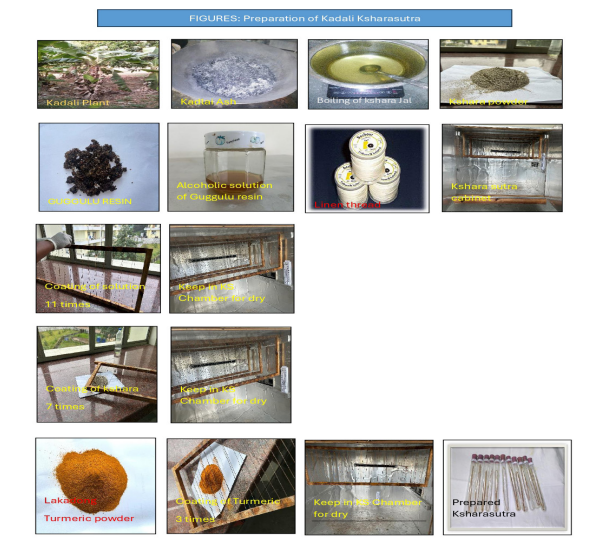
For the preparation of any Ksharasutra, Kshara is the fundamental ingredient, so the initial step was to gather the raw drug, i.e., Kadali. A fully healthy plant of Kadali (Musa paradisiaca), including Pachanga (stem, leaves, root, fruit, and flower) as per classical references, was collected and cut into small pieces. After cutting into small sections, it was kept in the shade to dry. Once dry, it was burned in a large, shallow metal vessel (kadhai). It was left to cool naturally, then the ash was cleaned, and any charcoal (partially burnt material) was removed. The ash was stored in an airtight container in a dry, cool place. Guggulu resin was also sourced from the market through registered raw drug distributors known for their quality. The turmeric powder was obtained from the original Lakadong village in the Jaintia Hills of Meghalaya to ensure authentic Lakadong turmeric. This variety is renowned for having the highest curcumin content. The turmeric was sieved through a linen cloth to produce a very fine powder and stored in a dry, cool place in an airtight container.
Kadai Kshara Powder Preparation
The 1.0 kg ash of Kadali was taken in a large saucepan and mixed with six litres of water, following the classical reference of Sushruta Samhita. It was evenly dissolved with the aid of a hand. The mixture was kept overnight, then filtered the next day through a linen cloth of 120gsm, discarding the supernatant charcoal. The filtrate was left overnight again, and this process was repeated 21 times until a light-yellow solution resembling cow urine colour was obtained. This solution was heated on an induction cooktop in a stainless-steel vessel until boiling, and after three hours, it transformed into a white, granulated material. The consistency of the mixture changed from liquid to semi-liquid paste and ultimately in to granulated form. Throughout the process, all safety precautions such as gloves, masks, and eyeglasses were utilised. The resulting granulated material was ground into a fine powder using a grinder and stored in a dry, airtight glass container. From the original one kilogram of ash, approximately 800 grams of Kshara powder was obtained.
Preparation of 100% Alcoholic Guggulu Resin Solution
The 100 g of good quality Guggulu resin was placed in a glass container, mixed with 100 ml of alcohol, and kept overnight. Since the Guggulu resin is soluble in alcohol, it dissolved well. The next day, the solution was filtered, and the supernatant was discarded. The filtrate, a 100% alcoholic solution, was stored in an airtight glass container for later use in coating the thread.
Preparation of Hanger for Coating
Barbour’s linen thread of 20 No. was taken and tied over the wooden hangers of the Ksharasutra chamber. The hangers measure 100x30 cm. The thread was secured over the hangers firmly, neither loose nor too tight. The Ksharasutra cabinet was equipped with a hot air blower, thermometer, and ultraviolet light.
Ksharasutra Cabinet
It was an airtight box measuring 125x100x100 cm (width x height x depth), made of aluminium-coated wooden planks or boards. It contained a source of ultraviolet light, a hot air blower, and a thermometer inside hangers, which were kept after tying linen thread. It was used to hold the hangers for drying and sterilisation after each coating. The hangers measured 120 cm in length and 30 cm in width.
Procedure for the Coating of the Thread
The Ksharasutra has been coated with all three drugs in a stepwise manner. The first step involves 11 coats of Guggulu resin to prepare a base, followed by 7 layers of Guggulu resin, then Kadali Kshara, and finally 3 coats of Guggulu resin followed by Haridra powder. A total of 21 layers of coating were applied. During the coating process, care was taken to ensure that before every layer, the thread was dried, and no coating was applied on wet thread. Guggulu resin was used as an alcoholic solution; a gauze piece was dipped into the solution, and the coating was applied to the thread using that gauze. This process was repeated for each thread 11 times. In the second step, a similar Guggulu coating was applied, and the wet thread was passed through a heap of Kshara powder so that the powder adhered to the thread. Once all the threads on the hanger had been passed through the powder, the hanger was shaken to remove excess powder, keeping the thread smooth and preventing excess Kshara. The same procedure was followed for the final three Guggulu resin and Haridra powder coatings. After each coating, the hanger was stored in the Ksharasutra cabinet.
Cutting and Packaging of Ksharasutra
The Ksharasutra were cut from hangers into 30 cm lengths, and each Ksharasutra was stored inside sterilised borosilicate glass test tubes, which were then sealed. These test tubes were placed inside the Ksharasutra cabinet for UV sterilisation until needed. All safety precautions, such as gloves, masks, and eyeglasses, were observed throughout the entire process of Ksharasutra preparation.
Phyto-Pharmacological Properties of Kadali (Musa Par- adisiaca)
Kadali, commonly known as Banana, is a tropical fruit with the scientific name Musa paradisiaca. Another species of Musa is Musa sapientum. It spread across the tropical regions after leaving its natural habitat in the Southwestern Pacific and reaching India by 600 BC. It is likely the earliest cultivated crop. By 200–300 BC, it also spread to West Africa and the Pacific Islands. Tradition holds that the fruits of Musa paradisiaca and Musa sapientum are used to treat various conditions such as unripe diarrhoea, dysentery, ulcerative colitis, unripe diabetes, sprue, uricemia, nephritis, gout, hypertension, and heart disease [16]. M. sapientum var. speciosa is used with Canna indica L. to treat heavy menstruation. Banana leaf ashes are applied as cool compresses for burns and blisters in eczema cases [17]. During menorrhoea and dysentery, the flowers are consumed. The stem juice of the plant is used to treat cholera, diarrhoea, haemoptysis, ear pain, and dysentery; the flower relieves menorrhagia, diabetes, and dysentery. The roots address blood disorders, venereal diseases, and act as anthelmintics [18]. Additionally, the plant helps treat snakebites, discomfort, and inflammation [19]. According to the Ayurvedic Pharmacopoeiaof India, Kadali possesses the pharmacological properties listed in Table No. 2. no.2 Musa paradisiaca, an ancient herbal remedy from Ayurveda, treats various ailments [20]. Its leaves are effective against bronchitis and cough, while the roots have potent astringent qualities used to control haemoptysis and have anti-helminthic effects. The fruits help enhances kidney function and lower the risk of kidney cancer. Antioxidants are used to counteract free radical damage. Additionally, Musa paradisiaca is traditionally used for snake bites, burns, asthma, diabetes, diarrhoea, heavy menstrual bleeding, and fever. The extensive pharmacological research on Musa paradisiaca and Musa sapientum confirms that their traditional uses for treating ulcers, diabetes, hypertension, diarrhoea, dysentery, and heart conditions are scientifically supported. These plants exhibit anti-ulcer, antimicrobial, antifungal, antioxidant, wound healing, and anti-allergic properties, among others [21-23]. Although the Kshara, after preparation, develops its own characteristics, it must retain some qualities of the original plant. All these activities contribute to healing the fistulous tract when applied via the Ksharasutra.
Phyto-Pharmacological Properties of Guggulu
Guggulu is an oleo-gum resin obtained from the bark of Commiphora wightii (Arnott) Bhandari (also known as Commiphora mukul (Hook. Ex Stocks) Engl; Balsamodendron mukul (Hook. Ex Stocks); belonging to the Burseraceae family) [24]. Traditionally, it has been used in Ayurveda for centuries to treat various conditions such as obesity, gout, rheumatism, inflammation, and lipid metabolism issues. It contains phytoconstituents, including volatile oils, lignans, sugars, amino acids, steroids, flavonoids, guggulsterols, monoterpenoids, sesquiterpenoids, and diterpenoids [25]. Guggulu formulations contain 30%–60% water-soluble gum, 20%–40% alcohol-soluble resins, and approximately 8% volatile oils with biological properties [26]. Guggulu extracts that are chemically soluble in water contain mucilage, sugars, and proteins, while extracts soluble in alcohol contain heerabomyrrhols, commiphoric acids, and commiphorinic acid [27]. According to the Ayurvedic Pharmacopoeia of India, Guggulu possesses various pharmacological properties listed in Table no 2. This adaptable medicine is highly effective in treating a wide range of ailments due to its unique qualities. Traditional uses of Guggulu include remedies for inflammation, rheumatism, obesity, microbiological infections, wounds, pain, fractures, tumors, and gastrointestinal disorders. It exhibits antimicrobial, anti-inflammatory, cytotoxic, and antioxidant activities, which enhance the effectiveness of the Ksharasutra in treating fistula-in-ano [28]. Guggulu is coated with its alcohol-soluble components, making the solution stickier over the thread, thereby aiding in the retention of Kshara and turmeric powder on the thread.
Phyto-Pharmacological Properties of Haridra
Haridra is a precious and important component of Ksharasutra preparation drugs [29]. The scientific name of the turmeric is Curcuma longa. The Curcuma genus has 80–130 species that are undergoing identification, of which 80 are certain. Curcuma phaeocaulis, C. zedoary, and C. kwangsiensis are other Curcuma species that have recently attracted medical attention. Turmeric is made up of short, thick, longitudinal, unevenly formed rhizomes, which are utilized to make powder. It creates the outer three layers of Ksharasutra. It is known as turmeric, Haldi, and Kumkum, etc. India produces 1074526 tons of turmeric in 2023-24 which is about 80% of world production [30]. Meghalaya also produces the indigenous variety of turmeric called Lakadong turmeric [31]. Lakadong is a locality in the Jaintia district of Meghalaya where it is grown and distributed everywhere. Out of many alkaloids present in turmeric, Curcumin is the most active part which is responsible for most of its pharmacological properties. Lakadong turmeric is the most curcumin-yielding turmeric in the world. The pharmacological properties of turmeric are in Table 2, as mentioned in the Ayurvedic Pharmacopoeia of India. The extract of Curcuma longa contains curcumin, dimethoxy curcumin, and bisdemethoxycurcumin [32]. It possesses anti-inflammatory, anti- platelet, and anti-cancer properties, and may inhibit something in the Cox-2 pathway, among other medicinal benefits. It also induces apoptosis in various cancer cell types and has antiviral, antibacterial, and antifungal properties. Additionally, it prevents Helicobacter pylori [33].
|
S.N. |
Name of drugs |
Rasa |
Guna |
Virya |
Vipaak |
Karma |
|
1. |
Kadali |
Madhura, Tikta & Kashaya |
Dipana, Mradu, Grahi |
Ushna |
Madhura |
Balya, Vrsya, Ruca, Pittashamak, Kaphagna & Stambhaka |
|
2. |
Guggulu |
Katu, Tikta, Kashaya |
Laghu Sara, Vishada |
Ushna |
Kate |
Balya, Ras¡Yana, Varnya, Vatabalsajit, Bhagnasandhankrt, Medohara. |
|
3. |
Haridra |
Tikta, Katu |
Ruksha, Laghu |
Usna |
Katu |
Varnya, Kusthaghnata, Raktaprasadana, Raktavardhaka, Raktasthambhana, Kandughna, Pandughna, Vranashodhana, Vranaropana, Vishaghna, Anulomana, , Krimighna, Sothaghna, Vedanasthapana, Jwaraghna, Etc. |
Table 2: Pharmacological Properties of the Drugs Used in the Preparation of the Kadali Ksharasutra as Per API
Discussion
In terms of recurrence, fistula in ano is a very notorious disease, and even after Ksharasutra, it remains a remarkably effective treatment modality for this condition [34]. Developing a standard Operating Procedure (SOP) for preparing Kadali Ksharasutra provides a step-by-step guide for practitioners to prepare and utilise a standard Ksharasutra, enhancing the quality of care for patients with fistula-in-ano. According to Ayurvedic principles, every drug possesses its own pharmacological action based on its phytochemical properties. Although Kshara has properties such as chedana (excision), bhedana (incision), lekhana (scraping), sodhana (debridement), and ropana (wound healing), the original properties of the plant before Kshara preparation also remain within it [35]. This enhances the final effect of the Kshara, because Kadali has Madhura Rasa and Madhura Vipaak. The side effects of Kshara, such as a burning sensation, are reduced when the Ksharasutra is prepared with Kadali Panchanga. In a study by Alok et al [36]. Kadali Ksharasutra exhibited less burning sensation compared to Apamarga Ksharasutra. Guggulu resin provides an effective and convenient alternative to snuhi ksheer, as collecting snuhi ksheer is tedious, and it precipitates and becomes useless within a short period. Guggulu solution can be stored for longer durations without losing quality. Containing 100% alcohol, it is sterilisedand dries more quickly than snuhi ksheer. The outer coating of this Ksharasutra is similar to that of Apamarga Ksharasutra, made with turmeric powder; however, Lakadong turmeric makes this Ksharasutra more effective, as it contains a higher percentage of curcumin than other varieties. This Ksharasutra will be as effective as Apamarga Ksharasutra, but is easier to prepare and offers a suitable alternative for anorectal surgeons.
Conclusion
According to Ayurvedic classical texts, Bhagandara is considered a krichasadhya (difficult to treat) condition. Despite progress in modern surgical methods, fistula in ano remains a difficult challenge for surgeons. The Ksharasutra is now seen as a highly effective treatment for managing anal fistula. The author has developed a Standard Operating Procedure that covers everything from drug collection to packaging the Ksharasutra, including safety measures, providing a step-by-step guide for those seeking alternatives to the Apamarga Ksharasutra. Since the standard Ksharasutra, traditionally made with Snuhi latex, is not always available, this study explores an alternative using a 100% w/v alcoholic Guggulu resin solution, and Kadali has been used as a substitute for Kshara preparation instead of Apamarga.

Flow chart: Steps of SOP for Guggulu-Coated Kadali Ksharasutra Preparation
References
- Singh, V. (2017). Sushruta: The father of surgery. National journal of maxillofacial surgery, 8(1), 1-3.
- Masram M, Tiwari SS, Singh Tiwari S, Singh R. A Unique Concept Of Ayurveda-Mahagada [Internet]. 2022.
- Kumar, A. (2018). Current trends in the usage of ksharakarma (alkaline therapy) and ksharasutra (alkaline seton) for managing bhagandhara (fistula-in–ano). J. res. tradit. med, 4(2), 70e7.
- Zhao, W. W., Yu, J., Shu, J., Sha, J. T., Li, C. Y., Zeng, J.,... & Yang, Y. (2023). Precise and comprehensive evaluation of perianal fistulas, classification and related complications using magnetic resonance imaging. American journal of translational research, 15(5), 3674.
- Fabbri, N., Ascanelli, S., D'urbano, F., Resta, G., Cavallesco, G., & Carcoforo, P. (2020). Treatment of fistula-in-ano: Outcome comparison between traditional surgery and novel approaches. A retrospective cohort study in a single center. Journal of Surgery and Medicine, 4(7), 582-586.
- Ji, L., Zhang, Y., Xu, L., Wei, J., Weng, L., & Jiang, J. (2021).Advances in the treatment of anal fistula: a mini-review of recent five-year clinical studies. Frontiers in surgery, 7, 586891.
- Sherkhane, R., Meena, P., Hanifa, N., Mahanta, V. D., & Gupta, S. K. (2020). IFTAK technique: An advanced Ksharsutra technique for management of fistula in ano. Journal of Ayurveda and integrative medicine, 12(1), 161.
- Kumar, A., Kumar, P. H., & Singh, N. (2019). Multiple Stage Surgical Approach along with Ksharasutra Therapy in the Management of High Anal Fistula (Bhagandara). JOURNAL OF RESEARCH IN TRADITIONAL MEDICINE, 2(2), 51-51.
- Sharma, S. K., Sharma, K. R., & Singh, K. (Eds.). (1995). Kshara Sutra Therapy in Fistula-in-ano And other Ano-Rectal Disorders. Rashtriya Ayurveda Vidyapeeth..
- Kumar, R. S., Nagar Lalit, N. L., Sinde Ashashri, S. A., Gahunge Pankaj, G. P., Lamo Ringzin, L. R., & Khemani Naresh, K. N. (2012). Review of source plants of kshara for kshara sutra preparation for the management of fistula-in-ano.
- Varsha S, Lakshman S. IJAMS I. A Comparative Study of Three Different Types of Kshara Sutra in the Management of Bhagandara (Fistula In Ano). International Journal of Ayurveda & Medical Sciences, 2(3). 1-58.
- Sahu M. A Mannual on Fistula in Ano and Kshara Sutra Therapy . 1st ed. Vol. 1. varanasi: National Resource: Centre on Kshara Sutra Therapy; 2015.
- Radhakrishna, S. (1991). Multicentric randomized controlled clinical trial of Kshaarasootra (Ayurvedic medicated thread) in the management of fistula-in-ano. Indian journal of medical research. Section B, biomedical research other than infectious diseases, 94(JUN), 177-185.
- Varsha, S., Niraj, S., & Lakshman, S. (2020). Standard Operative Procedure (SOP) for Udumber Stem Bark Kshara Sutra and its Phytopharmacological Appraisal. Biomedical and Pharmacology Journal, 13(1), 317-324.
- Epa U, Quality Management Division E. Guidance for Preparing Standard Operating Procedures (SOPs) [Internet].2007.
- Ghani A. (2003) Medicinal Plants of Bangladesh: Chemical Constituents and Uses. 2nd ed. Dhaka, Bangladesh: The Asiatic Society of Bangladesh; 315–315 p.
- Okoli, R. I., Aigbe, O., Ohaju-Obodo, J. O., & Mensah, J. K. (2007). Medicinal herbs used for managing some common ailments among Esan people of Edo State, Nigeria. Pakistan Journal of Nutrition, 6(5), 490-496.
- Khare CP. Indian Medicinal Plants. New Delhi, India:Springer ; 2007.
- Coe, F. G., & Anderson, G. J. (1999). Ethnobotany of the Sumu (Ulwa) of southeastern Nicaragua and comparisons with Miskitu plant lore. Economic Botany, 363-386.
- Sharma S. Comprehensive Review of Musa paradisiaca Kadali: Ethnobotanical, Phytochemical, and Pharmcological Insights into a Versatile Medicinal Plant. International Journal of Science and Research (IJSR). 2023 Aug 5;12(8):933–40.
- Owusu-Boadi, E., Akuoko Essuman, M., Mensah, G., Ayamba Ayimbissa, E., & Boye, A. (2021). Antimicrobial activity against oral pathogens confirms the use of Musa paradisiaca fruit stalk in ethnodentistry. Evidenceâ?Based Complementary and Alternative Medicine, 2021(1), 8663210.
- Loyaga-Castillo, M., Calla-Poma, R. D., Calla-Poma, R., Requena-Mendizabal, M. F., & Millones-Gómez, P. A. (2020). Antifungal activity of peruvian banana peel (Musa paradisiaca L.) on candida albicans: An in vitro study. J. Contemp. Dent. Pract, 21(5), 509-514.
- Adesola, R. (2021). The pharmacological potentials of Musa paradisiaca Linn. Plant Science Today, 8(4), 1091-1097.
- Sarup, P., Bala, S., & Kamboj, S. (2015). Pharmacology and phytochemistry of oleoâ?gum resin of Commiphora wightii (Guggulu). Scientifica, 2015(1), 138039.
- Sunita, Kalsi, V., Mukhtar, H. M., & Dubey, S. (2023, September). Medicinal properties and health benefits of guggul-Commiphora mukul. In AIP conference proceedings (Vol. 2800, No. 1, p. 020158). AIP Publishing LLC.
- Farooqui, A. A. (2019). Molecular mechanisms of dementia: Biomarkers, neurochemistry, and therapy. Academic Press.
- Pendyala, V., Janga, R. B., & Suryadevara, V. (2017). Phytochemical and pharmacological evaluation of Commiphora mukul for antidepressant activity in albino mice. Asian Journal of Pharmaceutical and Clinical Research, 360- 363.
- Ishnava, K. B., Mahida, Y. N., & Mohan, J. S. S. (2010). In vitro assessments of antibacterial potential of Commiphora wightii (Arn.) Bhandari. gum extract. Journal of Pharmacognosy and Phytotherapy, 2(7), 91-96.
- Prasad, S., & Aggarwal, B. B. (2011). Turmeric, the golden spice. Herbal Medicine: Biomolecular and Clinical Aspects. 2nd edition.
- Naveen. Turmeric Seasonal Report: 2024 [Internet]. [cited 2024 Sep 27].
- Beda J, Lyngdoh W, Iangjuh T, Laso A, Pyngrope RM, Rajee L, et al.(2023). A Study on The Efficacy of Lakadong Turmeric Collected from Selected Regions of Meghalaya [Internet].Vol. 5.
- Jyotirmayee, B., Nayak, S. S., Mohapatra, N., Sahoo, S., Mishra, M., & Mahalik, G. (2023). Bioactive compounds and biological activities of turmeric (Curcuma longa L.). In Bioactive Compounds in the Storage Organs of Plants (pp. 1-29). Cham: Springer Nature Switzerland.
- Lim, J., Nguyen, T. T. H., Pal, K., Kang, C. G., Park, C., Kim, S. W., & Kim, D. (2022). Phytochemical properties and functional characteristics of wild turmeric (Curcuma aromatica) fermented with Rhizopus oligosporus. Food Chemistry: X, 13, 100198.
- The Ayurvedic Pharmacopoeia of India [internet]. 1st ed. vol. New Delhi: Government of India, Ministry of Health and Family Welfare Department OF AYUSH; 1989 [cited 2024 Sep 27].
- Bang, M. S., Redkar, P. P., & Kangad, R. N. Ayurveda Importance Of Kshara Karma WSR To Properties And Indications Of Kshara.
- Kumar Alok, Kumar Hemantha P. (2020). A clinical study to evaluate the efficacy of kadali, aragvadh, and palashksharsutra in the management of vataj, pittaj, and kaphaj bhagandar. International Journal of Current Research. 12(10), 14264–70.